Showing posts with label Elisha. Show all posts

11 November 2024

Not Why, but What

Thirty-Second Sunday in Ordinary Time
    Sometimes the way that God answers prayers doesn’t appear obvious.  Some people pray for a miraculous cure for their family member or friend and they get a miracle.  Other people say the same prayers and yet their loved one dies.  A natural disaster like a tornado or a hurricane demolishes one church, but another which is in the direct path has only minor damage.  Why?
    Some would like to attribute it to personal holiness.  And certainly being a friend of God, not only in name but also in deed, doesn’t hurt when asking God for a favor.  But that’s not what happened in the first reading.  The prophet Elijah went to Zarephath, which was a pagan town.  The widow he helped during the famine was not Jewish, but worshipped false gods.  Yet God answered her prayer for sustenance through Elijah, though many Jewish widows had to see their children die of starvation.  Jesus also speaks about how “there were many lepers in Israel during the time of Elisha the prophet; yet not one of them was cleansed, but only Naaman the Syrian.”  

    So how does God answer prayers?  Why do the prayers of some get heard, while others seemed to be ignored?  God never ignores prayers, but He doesn’t always answer them as we want.  And, to be honest, we don’t often know why He answers some prayers as people want, but not others as they want.  Why God allows good things to happen to bad people, and bad things to happen to good people is a conundrum we won’t know on this side of eternity.  Sometimes we do see that an answered prayer helps a non-believe believe, or that even a seemingly-unanswered prayer doesn’t shake the faith of one who believes in God, who accepts even a negative outcome gracefully.  But often, we don’t have the answer to why.
    So what do we do?  We ask a different question.  And that question is not “why?”, but “what?”.  What do we know?  We know that God loves us, and that, as St. Paul says, “all things work for the good of those who love God.”  Whatever God wills for us, and even whatever He allows us to undergo, helps us to be the saints that He wants us to be.  Sometimes what God wills and what God allows seems beneficial to us, like an unexpected raise, or recovery from an illness.  Sometimes what God allows does not seem so beneficial.  But He desires that everything we might undergo, even the tragic death of a loved one, would increase or faith, hope, and love in Him.
    We also know, as we hear in the second reading, that Christ is forever interceding for us to our heavenly Father.  Though He is also God, Christ stands in the heavenly Jerusalem, the sanctuary not made with hands, bringing our prayers, made in the power of the Holy Spirit, to God the Father.  Christ offers Himself, not in a bloody way, but in an unbloody way, to the Father, bringing our humanity to God throughout all time.  He offers Himself always so that our sins might be taken away, just as He offered, once for all, the perfect sacrifice on the cross for the salvation of all the world.  And Christ, who shares our human nature, always asks the Father to give us what we need for our sanctification.  
    During this month of November, which we began with the celebration of All Saints, we also know that all the saints plead with God for us and our needs.  They do so, not to change the will of God, but to submit our desires and our prayers to the will of God which is always for our good.  I often ask St. Anthony to help me or others find things that they have lost.  Or maybe you pray to St. Monica to ask God to give your children who have left the faith the openness to the grace to return to His Holy Church.  Or maybe you ask St. Joseph to intercede for a loved one who is terminally ill for the grace of a happy death.  Or whatever other desire you might have.  The saints cannot do anything but that which is in accord with the will of God.  But they always ask God that our desires might be aligned with His so that our faith, hope, and love will find more strength and resiliency.  
    Lastly, we know that God desires that we trust Him.  The poor widow who gave all the money that she had trusted that God would provide.  God doesn’t always ask for money, though we should support the Church financially, but He does always ask for the gift of our entire selves.  He wants all of us, not just parts of us.  He even wants the sinful parts of us, so that He can transform them by the power of his grace and mercy.  Just as Christ offers all of who He is to the Father in the Holy Spirit, so the Father desires that we offer all of who we are, in the power of the Holy Spirit, to Him.  And when we offer all of who we are, God offers all of who He is, which is a treasure beyond imagining, not in the sense the world uses treasure, but in the sense of the deepest longing of our hearts.  
    We don’t always know God’s ways.  We may never fully understand why some prayers are answered the way we want, but others God does not answer the way we want.  But we know that God loves us, that He always acts for our good and salvation, and that the best gift we can give God is the gift of ourselves, trusting in His will and plan for our salvation.  

26 July 2021

What We Offer to God

 Seventeenth Sunday in Ordinary Time

    While the news has moved on to what it considers to be “juicier” stories, there was quite a bit of digital and literal ink spilled about the US bishops recently, who decided to write a document on our belief in the Eucharist.  Of course, the press focused on the political issues, especially with a baptized Catholic as president of the United States.  But the document that the bishops are drafting goes beyond Catholic politicians, and is meant to help teach us about the Eucharist.  Given that our next few weeks of readings will be focusing on the Eucharist anyway, I thought I would get a head start, and preach about the Eucharist.
    If you look at stats about how many Catholics actually believe what the Church teaches on the Eucharist, it’s pretty depressing (at least if you work for the Church).  From a survey taken in 2019 or so, I think it’s something like 33%.  That’s horribly low!  So the need is there.  I’ll try not to make this too academic, though.
    Before we get to the Eucharist in itself, we can look at what we’re giving God.  In today’s Gospel, the people are hungry, and Jesus wants to feed them.  But there’s only five loaves and two fish.  Still, God takes what the people has, miraculously multiplies it (this whole junk about sharing is trying to force a different message into this Gospel, rather than reading what the Gospel truly says), and then returns it to them.  And in our first reading, bread is brought to Elisha, who multiplies it for the people to eat.  So the people bring what they have and offer it to the Lord, who makes it enough for all who desire to eat.  
    At face value, what we offer for the Eucharist is bread and wine (aren’t you glad it’s not bread and fish??).  When we think of why we use bread and wine for the Eucharist, there is, of course, the reality that bread and wine were common items in Judea at the time of Jesus (and well before that, and well after that, as well).  Bread and wine were also already part of the sacrificial system of the Jews.  There was showbread, which was in the presence of the Lord in the inner temple.  And there were also libations, drink offerings, poured out to God.  So bread and wine were common, not only for food, but for sacrificing.
    But when we look at what we use for the Eucharist, there’s also the reality of how bread and wine are made, which also helps us understand something of why they are used for the celebration of the Mass.  Think of how bread is made.  For our Eucharistic bread, the hosts, it can only be made from flour and water.  Flour comes from wheat which is finely ground.  After baking the mixture of flour and water, we have unleavened bread.  
    Wine is made from grapes.  But you can’t just leave grapes on your counter and magically get wine (you’ll get raisins, I suppose).  You have to crush the grapes in a wine press, and let the juices ferment.  Then you get wine.
    In his 2006 homily on the Solemnity of Corpus Christi, Pope Benedict spoke about the cooperation between God and humanity that is required to get bread and wine that we use in the Eucharist.  God has to provide the fertile fields, and even the water itself in order for wheat to grow.  But then we need to grind the wheat to make the flour.  God has to provide rain and sun for the grapes to grow on the vine, but then we have to press the grapes.  So what we need for the Eucharist is a cooperation between us and God, which is the original intent of God in the Garden of Eden: God and humanity working together to sanctify the world.
    Another text called The Doctrine of the Twelve Apostles, which was written around the year 100, also says, “Even as this broken bread was scattered over the hills, and was gathered together and became one, so let Thy Church be gathered together from the ends of the earth into Thy Kingdom.”  The gathering of the different heads of grain is itself an image of the diversity of the human race coming together, and then being offered to God for Him to bless and transform it into something new.  
    But beyond the bread and wine that we offer, Jesus invites us to give all of who we are to Him, to allow Him to transform us into something new.  From the beginning, in the sacrificial system, humanity was invited to give God their all, represented by some earthly thing.  So we, as Catholics, are invited to give all of who we are, and unite it to the bread and wine offered by me on your behalf to God the Father through Christ the Son in the power of the Holy Spirit.  We are invited to give God the good and the bad.  Did you have a horrible week, where nothing went right, where you lost friends or family, where the car broke down, where it rained every day on your vacation?  Offer it to God!  Did you have a great week, where you hit every green light when you were late, when your kids and grandkids visited, where you received an unexpected compliment or word of praise?  Offer it to God.  
    God wants all of it, the good and the bad.  He wants to transform it from something simply earthly, to something heavenly, like the Eucharist.  But He will not transform what we do not give Him.  If we do not give Him our life, the daily ups and downs, then they remain simply ours; they remain earthly and limited.  But if we give him what has happened since the last time we came to Mass, He will bless it, transform it, and return it to us as something that helps us draw closer to Him and experience the heavenly life.  
    The invitation has been extended.  Today, and at every Mass you attend, offer to God whatever you have, no matter how little you think it may be.  Let God transform your daily life, as He will shortly, through my ministry, transform the bread and the wine we offer Him, into the Body and Blood, Soul and Divinity, of our Lord Jesus Christ.

14 October 2019

The Mass and Gratitude

Twenty-eighth Sunday in Ordinary Time
   One of the cartoons I would watch growing up was “Scooby Doo.”  For those who aren’t very familiar with the series, it follows a group of friends along with a dog, Scooby Doo, who solves mysteries, especially when aided by Scooby snacks.  While I haven’t watched the show in some time, I seem to remember that there was always some twist at the end, where one of the people they encountered earlier in the episode ended up being dressed up as a monster or a ghost, trying to scare and intimidate someone for some reason.
    Today’s first reading and Gospel accounts would have seemed like such a twist to those who heard the story.  For the Jews hearing about Elisha, they would have been shocked that Naaman, a pagan, would have been healed by God, and then really shocked that he wanted land so that he could worship the true God, rather than his pagan gods, on the soil of the Promised Land.  And for the Jewish Christians hearing about how the ten lepers were healed, but only the Samaritan, the non-Jew, returned to thank Jesus, the shock would have likely been similar.  In neither of those cases was the result expected: pagans were not often considered as likely for conversion, and Samaritans were supposed to be a heretical mix of Judaism and paganism, so they weren’t thought of highly, either.
    And yet, that’s what happened.  When Naaman encountered God through the prophet Elisha and the healing that Elisha performed, Naaman tried to reward Elisha, but then asked simply to be able to worship the true God.  And when the Samaritan, whom Jesus healed of leprosy, realized what had been done, he returned to thank God, while the others simply went about their business. 
    Gratitude happens most easily when we encounter someone who offers us something that we want or need, and we realize the value of that which we received.  When a friend calls or texts to help us out in difficult times, we are grateful.  When we receive a gift for which we asked, or maybe even we didn’t ask for it, but wanted it and received it, we are grateful.  When a neighbor, colleague, or even a stranger does something that makes our life a little easier, even if it’s something as simple as holding a door or raking the leaves up in our yard, we are grateful. 
    But gratitude is a virtue, which means it is a practiced piece of our character, a disposition to act in a particular way based upon many occasions of acting that way.  Virtues take practice for them to become second-nature; they don’t start off that way in most cases.  And so you display gratitude even when you get underwear for Christmas, or when your birthday gift isn’t exactly that item you wanted, or even when the execution of assistance ends up making life more difficult.  In order to be thankful people, to have that virtue of gratitude, we have to give thanks.
    Throughout the month of October, our diocese has each parish count the number of people who attend Mass.  Since 2012, our average attendance at Mass as dropped from 876 people, to 395 people in 2018.  That’s a decrease of 55%.  There are certainly a lot of factors that go into it, but part of that decrease goes to why people go to Mass.  I hear it from both youth and adults: Mass is boring; I don’t like the music; I don’t like the preaching; it’s too long.  The common thread in all of those answers, and even more that I’m not mentioning, is that the self is the center of importance.  There is something about the Mass that doesn’t appeal to me, whatever it is. 
    But the Mass is an act of gratitude.  In fact, the word Eucharist comes from two Greek words which mean to give thanks well.  The Mass is our sacrifice of praise, offered to God, for what He has done for us in the past week.  It is our sacrifice, and yet is acceptable because we unite it to Christ’s perfect and acceptable sacrifice of praise that He offered on the cross.  The Mass is our opportunity to practice the virtue of gratitude, even when it’s difficult, which means that we’re growing in virtue.
    And the key to gratitude is that it’s not about me.  Being grateful is precisely about the other and what he or she has done.  Maybe we did get underwear for Christmas that we didn’t really want or need.  But we say thank you because the other person wanted to express their affection for us, and we want to acknowledge that goodness in the other person.  Maybe someone helped us out when we were having a rough day, or week, or month, or year, and we want to acknowledge the time they took out of their own schedule to focus on us.  Gratitude, if true, does not care about what I get out of it.  Its only concern is that the other is affirmed in the gift they gave.
    Why do fewer people go to Mass?  Because we’re ungrateful.  When we don’t acknowledge the gifts that God gives us throughout every moment of our life, of course we don’t care to take time to say thank you to God at Mass.  When, instead, we live in an awareness of just how much God gives us, then we should desire to say thank you to God.  And even when maybe we feel that urge to stay home, or watch a game, and skip Mass because it takes effort, we realize that we want to express to God just how grateful we are for what He has given us.
    It was certainly a plot twist, a surprise, when the two pagans were the ones who gave thanks to God after encountering His gift.  What is more surprising is when those who claim to follow Jesus don’t return each week to thank Him for the many gifts He has given us.  Don’t be ungrateful to God.  Give thanks to the Lord for the gifts He has given us in this sacrifice of thanksgiving of the Mass.
 

19 April 2019

The Whole World Is Changed

Easter Sunday–At the Easter Vigil in the Holy Night of Easter
Tonight the whole world is changed.  Tonight we participate in the most wondrous, unexpected, joyful event ever: the Resurrection.  We keep watch, or vigil, with Jesus, knowing that at some point, during the night, the tomb which had sealed Jesus was broken, the guard scattered, and Jesus went forth from the tomb, not dead, but alive.  The holy women went to the tomb at daybreak on the first day of the week, on Sunday, and the stone had already been rolled away.  They see two men in dazzling garments, who tell them that Jesus has been raised.  And the whole world was changed.
The Aediculum, the place of the Resurrection of Jesus
in the Church of the Holy Sepulchre
Nothing like this had ever happened.  Sure, people had been raised from the dead before.  Elijah and Elisha both raised a boy from the dead; Jesus raised Lazarus from the dead.  But no one had ever risen from the dead on His own power.  And that is what Jesus did.  Jesus, who had no sin, took upon Himself the penalty for sin, and because He suffered willingly for a crime He didn’t commit, sin itself was defeated, and with it death.  And the world was created anew.
We heard about creation in the first reading tonight.  God ordered the chaos.  He separated light from darkness, day from night, earth from water, animals of different kinds, and crowned His creation with man and woman, made in His image and likeness.  But tonight, the night of the Resurrection, God created the world again, no longer under the burden placed upon it by Adam and Eve and their disobedience, but liberated by the Son of Adam and His obedience, even when this meant death, death on a cross.
Abraham showed us a prefigurement of the sacrifice of Jesus in his willingness to sacrifice Isaac, his beloved son.  Isaac carried the wood upon the mountain, Mount Moriah; he willingly let himself be bound to it when his father was about to sacrifice.  But at the last moment, God stayed Abraham’s hand.  Yesterday, Jesus carried the wood of the cross up Golgotha, the place of skull, so named because it was, by tradition, the place Adam died.  It was the place of his skull.  Mount Moriah is also, according to some, the place where King Solomon built the temple a thousand years later.  And so Jesus would have died somewhere around that mountain.  But no ram took the place of Jesus, as it did for Isaac.  Jesus suffered the fate that the angel of God stopped when it came to Isaac.  And because of that death, life, eternal life, became possible.

From the pierced side of Jesus, blood and water flowed.  The water flows from the side of Jesus, which quenches the thirst of all who approach it.  The Blood is the Eucharist; the water is Baptism; both are essential to the life of the Church.  The water renews the covenant God made with David, and makes the new creation fertile and fruitful.  It is the clean water that Ezekiel prophesied, which cleanses us of our impurities and false gods.  It is the water which gives us a new heart and a new spirit, so that we can live by the statutes of God, and become truly His people, His children by adoption.
Tonight the whole world was changed because of what one Person did.  And tonight, the whole world is changed because of what two people are doing.  Tonight, Bilal, with your new baptismal name, Maron, and Mikayla, you two are changing the world.  You are dying with Christ in the waters of baptism, and rising with Him to new life.  You are becoming a part of that new creation, no longer weighed down by the slavery to sin and death, but called to live in the freedom of the children of God.  And it is by people such as yourselves that the world is changed.  
Tonight you become children of God, whereas before you belonged only to your parents.  Tonight you become friends of God, though before you were at enmity with Him.  And that friendship and that identity as a son and a daughter of God in the Son of God will allow you to make the life of Jesus your own in your day-to-day lives.  You may not look different, but you will be different.  The Spirit of God will dwell in you, to help to you love God and love your neighbor; to help you to choose good and avoid evil; to be the light of Christ in a world surrounded by darkness.
People wrote off Jesus when He died on the cross.  Even the holy women, with the exception of Mary, the Mother of God, expected only to anoint Jesus’ body, which they were not able to do on the day before because of the solemn Sabbath of Passover.  They did not expect to see Jesus raised.  But Jesus outdid their expectations.  So you, too, may not seem like much.  You’re only two young people.  But if you stay faithful to Jesus, then you have the same power in you that Jesus had, to change the world, not by force or violence, but by grace and love.  Jesus now shares with you the power to help re-create the world according to the will of God, not the reign of Satan.  
Tonight, we, too, already baptized in Christ, stand with you, assuring you of our support, but also recommitting ourselves to be that new creation in Christ.  As we wait for Jesus to return to put an end to all sin and death and usher in the fulness of His Kingdom, we sometimes forget that we have the power to change the world for Christ by His grace.  We become complacent.  We write ourselves off.  Tonight, we are reminded, as we are every Sunday, that Jesus is alive, not dead; that life conquers death and holiness conquers sin; that God can change the world by His grace active in us.

Tonight, the whole world is changed through Christ.  Tonight, the whole world is changed through God’s grace in you, Maron and Mikayla.  Tonight, the whole world is changed through God’s grace in us.  Tonight, the whole world is changed.  

04 February 2019

Disciples are Made for Greatness, Not Comfort

Fourth Sunday in Ordinary Time
There’s a temptation that can creep into any believer’s life, that if we just do the right things, then everything in our life is going to go well.  Maybe it comes from a desire for justice, for everyone getting what is owed them, but we can easily think that if we follow God, if we live our life according to what the Church teaches, then life should be easy for us.  We should be rewarded for good behavior, just like bad behavior should be punished.  There are even those who claim to preach the Gospel (they are really just perverting it) who say that if we follow God’s laws and if we give 10% to the Church, then God is going to make us rich and give us every earthly pleasure that is holy that we could desire.  We call that the Gospel of Prosperity (note that it’s not the Gospel of Jesus Christ).  
This perhaps also betrays a certain tendency in our human nature to want comfort, which is especially prevalent today among the young.  We want the good life, where we don’t have to struggle, don’t have to put forth effort, but we still get the rewards that would come from struggle and effort.  In one sense, we might say that this is built in to us because we were created for prelapsarian life, the life before the Fall in the Garden of Eden.  But we are living in postlapsarian times, the time after the Fall, where we earn our living by the sweat of our brow.  Furthermore, as Pope Benedict XVI reminded us, “The world promises you comfort, but you were not made for comfort.  You were made for greatness.”  Greatness takes work.  Works means struggle.  Struggle means pain.  And it even applies for those who follow God.

Take Jeremiah in our first reading.  God appointed him a prophet.  In fact, God says that He appointed Jeremiah a prophet even while Jeremiah was in his mother’s womb.  And yet, Jeremiah has a tough life, so much so, that God says, “gird your loins; […] Be not crushed on their account.”  Jeremiah is the prophet who immediately prophesies the destruction of Jerusalem and the exile of God’s people to Babylon.  As you might imagine, no one liked hearing this dire message.  But even as God tells Jeremiah that he will undergo a lot, he also promises that he has “made you a fortified city, a pillar of iron, a wall of brass…They will fight against you but not prevail over you, for I am with you to deliver you, says the Lord.”  
But besides the fact that God does not promise that those who follow Him and speak for Him will have it easy, Jesus also reminds us that sometimes those who don’t follow God get blessings.  The widow in Zarephath to whom Elijah was sent was not a Jew, and yet God took care of her.  Naaman the Syrian was a foreign general, a general of an army that was constantly threatening to destroy the Jews, and yet God, through the Prophet Elisha, cured him of leprosy.  Those who don’t follow God can still receive His blessings and healing.
And, if we look at Jesus, the co-eternal Son of God, He was perfect.  He never sinned, never did anything wrong.  He followed God’s will perfectly, and extended healing to many, both Jew and Gentile alike.  And what did Jesus get for perfectly doing the will of God and healing those who were ill?  He was led to the cross do die for our sins.  He suffered the most painful and embarrassing way to die as nails pierced his hands and feet and he hung naked outside the walls of Jerusalem.
But just in case you thought that being a disciple of Jesus means that life is going to be quite painful and horrible, that’s not the truth either.  Yes, our life on earth, in the vale of tears, may have a lot of suffering, but faithfulness to God always leads to eternal life in heaven.  Jesus shows us that in the most perfect way in His Resurrection.  Yes, following God’s will led Jesus to the cross, but the cross led to the Resurrection.  Yes, Jeremiah was treated poorly for speaking a difficult word from God, but he was received into heaven when Christ opened the gates of Paradise.  We long for the ease of Eden, but God promises, after our trials and tribulations on earth, a paradise and a comfort that exceeds anything that earth can offer to an infinite degree.  To tweak Pope Benedict’s words slightly, we were not made for comfort on this earth, but we were made for eternal joy in heaven.  
And what guides us amid the joys and sorrows of life?  Love.  True love, which means the type of love that is patient, kind, not jealous, not pompous, not rude, not quick-tempered, not brooding, rejoicing in the truth.  Love guides us to our eternal joy because perfect love is eternal joy in heaven, where God, who is Love itself, shows us himself face to face.  

It would be nice if everything came to us without effort; if following Jesus did not require sacrifice and struggle.  But because we are fallen, following Jesus does not mean that we will get everything we want and life will not always be easy.  But, if we stay faithful to Christ, especially when it requires sacrifice and struggle, we know that we have a treasure, not made by hands, eternal in heaven, waiting for us, and fulfilling beyond measure the desire we have on earth for true joy.

30 July 2018

Like Fr. Mulcahy

Seventeenth Sunday in Ordinary Time
Whenever I ask my parents what they want for their birthday or Christmas, they usually say they don’t need anything.  There may be a few things that they might pick-up for themselves, but they’re usually not that communicative about what those things are.  And the things that I usually think of that they probably would enjoy, are a bit out of my price range for gifts. 
As we begin our five-week trek through John chapter 6 today, we start with Jesus feeding the 5,000 plus.  We heard a similar story in our first reading from the Second Book of Kings with the Prophet Elisha.  Elisha has twenty barley loaves for 100 people, and Jesus has five loaves and two fish for over 5,000 people.  When Philip says that they don’t have enough, Andrew replies that they only have a little, and certainly not enough for everyone.  But Jesus takes that little, and miraculously multiplies it so that everyone has enough, and, in fact, there are twelve wicker baskets left over.  God provides for His people, even when all they have is just a little gift.
I’m a pretty big fan of the TV show “M*A*S*H.”  And, as you might imagine, I identify a bit with Fr. Mulcahy.  But it goes beyond the fact that he’s a priest chaplain in the show, and I’m a priest and chaplain in real life.  Fr. Mulcahy is a little naïve, doesn’t get the big crowds for Sunday services, and doesn’t have much that is spectacular about him.  In one of the episodes, he has to compete against a great runner for a competition between two different units.  And even though the other runner is far superior, Fr. Mulcahy does not back down and runs his best race anyway.  I won’t spoil the episode for you by telling you what happens, in case you want to watch it.
I’m a bit like Fr. Mulcahy.  I’ve lived a fairly sheltered life.  People don’t generally look at me with the word “spectacular” on their mind (in fact, one of my great disappointments in life is how little time I have spent and spend on my own physical fitness).  I’ve got no great talents (one of my classmates has a special charism of healing).  I enjoy learning but I’m not a great student or teacher (one of my other classmates learns foreign languages with ease and has his doctorate).  I work hard at preaching, but I’m no Bishop Barron or Fulton Sheen, let alone St. John Chrysostom.  I’m just Fr. Anthony Strouse, with a few small talents from a small town, doing his best to lead people to God and run a parish.
But, like Fr. Mulcahy in “M*A*S*H,” I can honestly say that I try to give what little I have to God, and He uses them to bring about some good.  I know it’s God, because it’s far beyond what I could have ever done on my own.  God takes this pipsqueak of a man, with an average amount of small talents, and does great things, just like He did almost 2,000 years ago when He fed all those people.  There’s nothing spectacular about five loaves and two fish.  But God made it more than enough through Jesus.  
Maybe some of you are the brightest in your field, or the richest, or the strongest, or the most socially connected.  Praise God for those things and use them for His glory.  But if you’re like me, and don’t have much to offer the Lord, I would invite you today to give it to Him anyway.  How? you say.  Well, as you might have noticed in my three years here, I’m big on the liturgy, and celebrating it well.  And part of celebrating that well is for all the people at Mass to give Jesus everything, even the smallest thing, that has happened since you last came to Mass.  Just give it to Jesus.  Tell him about it in your prayer before Mass begins.  Visualize putting whatever it is you have with the bread and the wine that are brought forward.  And as you listen in silence to the Eucharistic Prayer I say, see the angels taking those small things and big things to God the Father in heaven, through Jesus Christ His Son, in the power of the Holy Spirit.  And then God will do something great with it.  I don’t know what it will be, but when we give our best gifts to God, no matter how small they are, He always receives them as the best gift from His children, and transforms us and the world by it.  
Maybe I’m wrong.  Maybe letting the liturgy transform us by offering ourselves to God the Father through Christ the Son in the power of the Holy Spirit won’t have a huge effect.  Maybe its just a cockamamie belief of mine that I picked up through years of study.  But I don’t think I am wrong on this.  And I think the Mass can transform us if we truly offer ourselves with the bread and the wine.  Now, it hasn’t made me a strong stud, I still don’t have the gifts that many of my brother priests do, and I’m certainly not a saint yet.  But I know it’s helping to change me, for the better, and helping me become the saint that God wants me to be.  

So maybe try it out yourselves, if you’re not already.  In these moments of silence after the homily, think of what you want to give God, no matter how insignificant you think it might be.  After all, if God can feed 5,000 plus with five loaves and two fish, imagine what He could do with you!

09 July 2018

Domesticated Prophets

Fourteenth Sunday in Ordinary Time
According to the most scholarly of sources, Wikipedia, dogs were domesticated sometime around 14,700 years ago, based on a dog being buried near a human grave.  Since then, we have many different varieties of domestic dogs that are called, because of their long association with humans, man’s best friend.
What our early ancestors did with dogs, we have done with Biblical prophets: we have domesticated them.  We have taken out, or chosen to ignore, many of the wild traits, in order to make it more comfortable to live with them.  But prophets have always been quite eccentric people that were not, at first blush, the best spokesmen for God.  Moses, the first great prophet, was slow of speech and tongue, according to his own words.  And he, by the power of God, changed a staff into a snake, caused the Nile to turn to blood, and brought a number of plagues upon Egypt.  Samuel, the great prophet who anointed the first kings of Israel, Saul and David, killed the Amalekite King Agag because Saul, was ordered by God to kill King Agag, but refused to do so.  Elisha was jeered at by some small
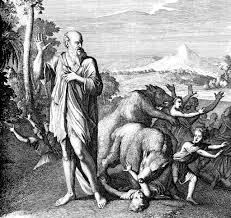
boys, who said, “‘Go up, baldhead!” and he cursed them, and two she-bears came out of the woods and tore them to pieces.  In chapter 20 of the Book of the Prophet Isaiah, God tells Isaiah, “Go and take off the sackcloth from your waist, and remove the sandals from your feet.  This he did, walking naked and barefoot.”  And it says in the next verse that this happened for 3 years.  Jeremiah told the king that Jerusalem, the place of the great Temple of the Lord, was going to be destroyed, and no one believed him.  And St. John the Baptist, the last and greatest of prophets, wore a camel-hair tunic and ate locusts and honey.  None of these seem to be people that civilized folk would want to be around.
And perhaps that is part of the reason they were never accepted in their home towns, as Jesus said in the Gospel today.  We tend to think of the prophets as nice guys who were able to tell the future.  We make them pretty well-dressed, white-bearded men.  But they railed against the injustices of their day and often became very unpopular in the process (walking around naked for 3 years can tend to make a person unpopular).  In many cases, they spoke out against the king, because he was the leader of the people.  But no matter whether they spoke out against a person or a situation, they always spoke the words that God gave them to say.
It’s cliché, but as prophets, God calls us to give comfort to the afflicted and affliction to the comfortable.  Jesus, as the source of prophecy and the Prophet about whom Moses spoke, to whom the Chosen People needed to listen, lived this out in a most perfect way.  To the Pharisees and scribes, those who were assured about their own righteousness, Jesus did not have great words to say, calling them “broods of vipers” and “white-washed sepulchers.”  But to the sinners, those who were often excluded from the daily life of Israel, Jesus preached love and acceptance, even while calling them, too, to conversion.  The woman caught in adultery is not stoned for her sin, but is told to go and sin no more.  The Samaritan woman at the well was convicted by Jesus about her many husbands, but she is also encouraged to drink the living water that comes from Jesus so that she can have eternal life.
There are parts of our life that God calls others to confront in us, and parts of our life that need the comfort of God.  When a person does not realize the conversion that needs to take place, God calls us to issue strong, dramatic words to help that person realize his or her need for God and a change in life.  When a person is beat up by the world, and despairing of any chance of redemption, God calls us to issue tender, loving words to help that person realize how much value he or she has.  We are not called to be nice, to say, “but that’s none of my business,” when we see sin and its effects in others.  But we are called to be prophets, by virtue of our baptism, who afflict the comfortable and comfort the afflicted.  
I’m not suggesting that we should walk around naked, not even for a day.  I’m not saying that we should curse people who make fun of us and send she-bears after them to tear them to pieces.  I’m not saying that we should threaten the destruction of a church.  But we also have to be careful about only saying things that people want to hear, things that do not make demands on life or call for conversion, things that do not challenge.  

God has called us to be prophets, and that in itself is a radical demand.  God calls us to speak His Word in our daily lives so that others can either turn from the evil they’re doing and live, and/or know just how much God loves them and wants the best for them.  Do not take the wild nature out of our prophetic call!  God save us from domesticated prophets!!

03 July 2017

"With What Shall I Come Before the Lord?"

Thirteenth Sunday in Ordinary Time
The study of Canon Law, the law of the Church, is one of the least popular disciplines for priests to study after they have been ordained.  Recently, Bishop Boyea appointed one of my good priest friends, Fr. David Fons, to study Canon Law in the University of St. Thomas in the City (more commonly referred to as the Angelicum) in Rome.  Bishop Boyea’s two other choices were either Fr. Gary or Fr. Todd Koenigsknecht, the twins from Fowler who were ordained a couple of years ago.  They were very happy when Bishop Boyea chose Fr. David.  I joked with Fr. David that he should tell Frs. Gary and Todd: “Someday, and that day may never come, I’ll call upon you to do a service for me,” quoting the famous line at the beginning of the movie “The Godfather.”

We don’t have to be in the mafia to want to do something kind for those who do something for us.  We hear about the Prophet Elisha who is taken care of by a woman of influence as she gives him room on the roof “with a bed, table, chair, and lamp.”  And without her asking, Elisha wants to do something for her to repay her generosity.  And he promises her that she will conceive a son with her husband, since she was childless and her husband was an older man.
Jesus Himself in our Gospel talks about how those who serve the servants of God will receive their reward: 

“Whoever receives a prophet because he is a prophet will receive a prophet’s reward, and whoever receives a righteous man because he is a righteous man will receive a righteous man’s reward.  And whoever gives only a cup of cold water to one of these little ones to drink because the little one is a disciple–amen, I say to you, he will surely not lose his reward.”

Now, this isn’t a homily about trying to butter Father Anthony up in order to get something in return.  I may call my bulletin article Don Antonio’s Dispatch, but I’m not Don Corleone.  You, my parishioners, my family, are very generous, but you’ll never hear me say, “Someday, and that day may never come, I’ll call upon you to do a service for me.”
If we really think about it, we have received everything from Jesus.  I dare you to think about one thing, other than your sins, that you have not received from God.  Your talents–from God; your family, spouse, and children–from God; your house–God gave you the talents that helped you find a job that paid you that helped you to get the house, so from God; this building–it was built by the generosity of our parishioners who went before us, and some still here, who paid for it with the money they made from the jobs they worked using the talents they received…you guess it, from God; your priest–some of you might be saying from the devil, but I was sent here by Bishop Boyea, who, when it comes to parish assignments, speaks for God.  Everything except our sin, which is when we try to do things on our own without God, is a gift to us from God.  We are in God’s debt.  There is no two ways about it.  We owe everything to God.  So how can we repay God?
One of the choral anthems played at my first Mass of Thanksgiving and at both my installations as pastor is based on Micah 6:6-8: 

With what shall I come before the Lord, and bow before God most high?  Shall I come before him with burnt offerings, with calves a year old?  Will the Lord be pleased with thousands of rams, with myriad streams of oil?  Shall I give my firstborn for my crime, the fruit of my body for the sin of my soul?  You have been told, O mortal, what is good, and what the Lord requires of you: Only to do justice and to love goodness, and to walk humbly with your God.

But Jesus, as He so often does, raises the stakes.  He says that we must give Him everything of who we are.  If we love even our family more than Jesus, then we are not worthy of the gifts He has given me.  Only if we give away our life to Him will we find it.
And in this Mass we have the opportunity to do exactly that, at least as a beginning to our week.  Every Mass we are invited to offer all of who we are–our joys, sorrows, excitements, fears, job, family, vacation, and all that has happened since the last time we went to Mass–and unite it with the bread and the wine that is offered to God and changed into the Body and Blood of Jesus.  I know I’ve said that before, but have we done that?  Have we really put ourselves into what is offered on the altar?  I can tell you that when I do that, especially if I have something heavy on my heart, then as I hold the host in my hands and say, “This is my Body,” and as I hold the chalice in my hands and say, “This is my Blood,” there is a great weight lifted from my shoulders and I almost want to cry because of the great gift of freedom that Jesus gives me as I give Him my all.  And then God transforms it and gives it back to me as something that no longer weighs me down, but that gives me life.  But it’s not just for the tough stuff; it also applies to our joys.  And then, having given God our all in the Mass, we are then much more likely to give Him our all during the week. 

You might think that this is just my shtick as a guy who studied the liturgy–the Mass and the Sacraments.  But I truly believe it.  Give your all to Jesus, because He has already given His all for you.  And He doesn’t want a favor or a service like a mafia don.  The only thing that Jesus wants the thing only you can provide: you.

27 June 2016

Trusting God with our Future

Thirteenth Sunday in Ordinary Time
These readings for the Thirteenth Sunday in Ordinary Time providentially connect well with my final Sunday as pastor of St. Joseph.  This is one of the amazing things about the Word of God.  It always has something to say to us to strengthen us, to comfort us, and to provide us with the way forward in our lives, no matter what is happening.
I do have to say, though, it is a bit funny that the first reading is about Elijah calling Elisha away from his home, and the Gospel includes a passage where Jesus affirms that He has no permanent home in His ministry, unlike the foxes and birds who have their dens and nests.  
When I was ordained a priest, six years ago, I put my hands in Bishop Boyea’s hands, and Bishop Boyea asked me, “Do you promise respect and obedience to me and my successors?”  I answered, “I do.”  Bishop Boyea then continued, “May God who has begun the good work in you bring it to fulfillment.”  Bishop Boyea didn’t tell me that moving to Flint was part of my promise of obedience to him.  But as he asked me to leave my home, Adrian, behind, I knew that God was asking me to let go of that which I treasured, and entrust myself to Him, just as Elisha had to entrust himself to God as he followed Elijah.
One of the things that may seem crazy is the life of a priest.  The decision to give up money, the ability to make the major decisions in our life, to be obedient to another, as well as to give up sex and a biological family, seems, in the view of our society to be crazy.  It might even sound boring or too much to give up.  But, even with the very real sacrifices that I do make, I am grateful to God that He called me to be a priest, and I would make the same decision again if I had to.  I also can think of at least 8 young men who are in the parish (in addition to Jake, the seminarian who is living with me) or are from the parish who would make a good priest (I won’t embarrass them by naming them).  If you are a young man, even if you think you know exactly what you want to do with your life, do not be afraid to be open to the will of God.  If you have heard that little voice in your heart suggesting a priestly vocation, at least look into it.  Keep praying about it.  And do not be afraid to see if that is where the Lord is calling you.
But that attitude of abandonment to God’s will is not just for priests.  As Christians, we are all called to a radical trust in God in every circumstance.  And sometimes God calls us to walk away from what we think is best in order that we can continue to grow in faith in Him.  Sometimes that means moving, like in my case.  Sometimes that means letting go of a favorite hobby, food, or especially a sin without which we are sure we cannot live.  Maybe it means being open to another child when we think we’ve had enough.  Of course, when it comes to a new life entering our lives, we want to pray about it, and use the gift of reason that God has given us as we discern God’s will.  But just because our will says one thing, does not mean that it is necessarily God’s will.
We are called to live by the Spirit, as St. Paul reminds us in the second reading.  And not just any spirit, but the Spirit of God.  Our fallen human nature sometimes says one thing while the Spirit of God says another.  We are always tempted to take our lives into our own hands and make all the decisions ourselves.  We still struggle with the same temptation that afflicted Adam and Eve: to put ourselves in the place of God and decide our future without any relation to God.  But by our baptism, we can know God’s will, and we can choose to make what may seem like an insane decision according to the wisdom of the world, but which is the best decision according to the wisdom of God.

The Lord calls us throughout our lives to put our trust in Him and to follow Him, even to places we didn’t expect to go.  Will we have the courage to be like Elisha and leave what we know behind in order to serve God where He leads us?

02 February 2016

But That's None of My Business

Fourth Sunday in Ordinary Time
Having spent four years working with high school students, I learned some interesting phrases and words, some that I can even say in church, but which will all sound rediculous, I’m sure, coming from my mouth: you don’t even know (sometimes abbreviated UOENO); but that’s none of my business (usually on a meme with Kermit the Frog sipping from a cup with Lipton tea); fo sho (which means for sure); bae (slang for a significant other; allegedly the abbreviation for before anyone else, as in, she comes before anyone else); and you don’t know me (which is usually used as a response when a person a being accused of something).  If Scripture was translated into slang of the new millennium (which I don’t advise), perhaps Jesus’ response to his neighbors asking, “‘Isn’t this the son of Joseph?’” would be “You don’t know me!”  Or maybe, after talking about how Elijah went to a foreigner, a Gentile, to provide bread during the famine, or how Elisha cured Naaman, who was not Jewish, of leprosy, Jesus would have said, “But that’s none of my business.”  Maybe He wouldn’t have.  
But the point is the same.  Last week we heard about how Jesus went back to His home town and read from the scroll of Isaiah about the Messiah, and said that the Scripture was fulfilled in the hearing of his neighbors.  This week, we hear their reaction, their disbelief.  And Jesus gets upset at their lack of faith, because they think they know who this guy is.  He’s just the neighbor boy from down the road, who was poor and seemed to be special in no way whatsoever.      So He needs to prove that He is special by doing some miracles, by putting on a show for His neighbors, so that they can believe.  But of course, we know human nature all too well, and Jesus knew it even better: even if he would have done a miracle, they would have found some excuse to not believe, because their minds were already made up that He was no one special.  And all of this, because He spoke God’s Word.
It can be tough to speak God’s Word, especially around the people we know.  That’s what it means to be a prophet, and we were all called to be prophets, to speak for God, when we were baptized.  But people know us.  They know our faults.  They know where we came from.  All too often they will not listen.  That is why God tells Jeremiah in the first reading, that he will have to gird his loins, a phrase which literally means, “make sure your underwear’s tight so you’re ready for combat or strenuous activity,” but which we could also say means “be prepared.”  God warns Jeremiah that the people to whom God is sending Jeremiah (the Chosen People) will try to crush him, and that Jeremiah will need to be “a fortified city, a pillar of iron, a wall of brass.”  He will have to be strong because his own people will reject what he says as he speaks on God’s behalf.
We have to be strong if we’re going to speak for God.  To speak out against the dirty joke or internet site that our friends are telling or viewing; to encourage a family member back into the Catholic faith who has been away for a while; to defend the Catholic faith when someone is mocking one of our beliefs; these are all difficult things to do, and we need to be strong like Jeremiah and especially like Jesus.  Neither of them backed off when others challenged them speaking for God.  In fact, they reiterated their message.
But, as St. Paul reminds us in the beautiful hymn of love in our second reading, we have to speak God’s Word with love.  “If I speak in human and angelic tongues, but do not have love, I am a resounding gong or a clashing cymbal.  And if I have the gift of prophecy, and comprehend all mysteries and knowledge; if I have all faith so as to move mountains, but do not have love, I am nothing.”  If one temptation is to shrink back from speaking God’s word, the other temptation is to speak God’s Word in a sanctimonious and overbearing way.  Neither of these are the right approaches.  The virtuous middle is to speak God’s Word, but to do so out of love for the other.  
How do you know if you’re speaking with love?  Are you impatient in your speech?  Are you rude?  Are you seeking your own interests, quick-tempered, or brooding over an injury?  If so, St. Paul tells us that we’re not speaking with love.  Love, rather, “does not rejoice over wrongdoing, but rejoices with the truth.  It bears all things, believes all things, hopes all things, endures all things.”  

It is challenging to be a prophet, to speak God’s message.  If it were easy, everyone would do it.  But the Lord calls us to be strong and speak His message, His Word, to those we know and those we meet.  He calls us to spread His word, even when it calls for conversion and change of life, with love.  We don’t have to be perfect to speak for God.  Jeremiah wasn’t.  But if we are followers of Jesus, then we, too, are called “‘to bring glad tidings to the poor…to proclaim liberty to captives and recovery of sight to the blind, to let the oppressed go free, and to proclaim a year acceptable to the Lord.’”  That is fo sho what we are called to do.

14 October 2013

Ty! Yw!!


Twenty-eighth Sunday in Ordinary Time
            There is a new language developing right in our very midst.  I’m not a philologist, but I’m sure those who study languages are having a field day with this new language.  I wouldn’t say that I speak this language fluently, but I am conversational in it, though, to be honest, it’s not a spoken language, but only a written one.  I don’t know if there’s a name for it, but I’m going to call it English Text Language.
           
It’s a very efficient language, because it seeks to eliminate the excess characters you have to put into a text, or even in a tweet, where you are limited to 140 characters to express a thought.  Some of the words and phrases in English Text Language are easy.  The word “be” is simply the letter b, just like the word “are” is just the letter r.  You get rid of the English rules about your (y-o-u-r) and you’re (y-o-u-‘-r-e) by just writing u-r, unless you want to say you are, in which case you can separate the letters u and r.  But it does get a bit more complicated.  Common phrases are often abbreviated: s-m-h is shaking my head; w-d-y-m is what do you mean; I-d-k is I don’t know, and I-d-c is I don’t care.  Another ubiquitous abbreviation is n-p: no problem, which is often the response when someone texts “thank you,” which would of course be written, t-y.
            There are obviously some benefits to this system if you’re texting or tweeting.  But it strikes me that the response n-p can have s a negative effect on our appreciation for a person or an act for which we should be grateful.  Rather than acknowledging the person or the thing that was done, it’s written off, minimized, because it was no problem.  The person who is being thanked is basically saying, though perhaps not with this intention, there’s no reason to thank me, because what I did wasn’t that much or wasn’t that important.  And this message, over time, can erode a culture of gratitude that is so important, and about which our first reading and Gospel speak today.
            In the first reading, Naaman wants to thank Elisha because Naaman had been a leper, but had followed the advice of Elisha and washed in the Jordan, and was cured.  Now, at first, maybe it seems like Elisha just tells Naaman, n-p, because he will not accept Naaman’s gift.  But what is really happening is that Elisha is refusing to take credit, because it was God who healed Naaman, not Elisha.  And Naaman, after some arguing back and forth, gets the point, because he ends up taking dirt so he can worship the true God, rather than his pagan gods.  Naaman wants to give thanks to God by offering a sacrifice.
            In the Gospel, it can be very easy to moralize this story of the ten lepers.  How many times have parents used it to teach children to say thank you?  And that certainly is part of the message.  But we shouldn’t want to say thank you simply because there’s a rule.  Whenever we receive a gift, thanksgiving should exude from us quite naturally.  Yes, Jesus wondered why the other nine lepers did not return to give thanks (though it should be noted that He never told them to return).  But he does wonder, that is, He is impressed, that thanksgiving is the natural response of the leper, a Samaritan, back to Jesus.  And this Samaritan has some faith that Jesus is God, as Jesus says, “‘your faith has saved you.’”  Jesus accepts what Elisha cannot, because Jesus is the same God who healed Naaman centuries before.
            How often are we thankful, and how often do we give God thanks for the many blessings He has given us?  We are meant to give thanks each time we come to Mass, because even the work Eucharist comes from Greek which mean “to give thanks well.”  We offer thanks to God the Father through Jesus the Son in the power of the Holy Spirit first and foremost for the gift of new life that was made possible by the death and resurrection of Jesus.  But we should also give thanks to God for all the other great gifts He has given us: life; our talents; love; perhaps financial stability; perhaps a good education; friends; faith; the list can go on and on.  I want to challenge you to spend 3 minutes before each Mass thanking God.  I know that a lot of us talk to our friends when we’re here in the nave of the church.  Catching up with friends is a great thing, but spend 3 minutes before Mass here in the pews thanking your best friend, God, who has given you the other friends to whom you can speak.  Talk with your other friends earlier before Mass or after Mass in the vestibule, so that everyone can take time in silence to thank God for the many blessings.
            And, the next time you do something kind for someone, and they say “thank you” (because they were taught good manners), don’t say, “no problem,” or text n-p, but say you’re welcome, and accept the gratitude that the other person is sharing with you, no matter how big or how small you think the gift or favor was.  In this way we’ll build up a culture of gratitude, which will certainly make the world a better and holier place.  T-t-y-l.