Showing posts with label Bishop Boyea. Show all posts

27 April 2026

Praying for a Good Shepherd

Fourth Sunday of Easter
    On 10 April, Bishop Boyea, as required by canon law, submitted his letter of resignation to Pope Leo XIV.  As of my composing of this homily, it has not been accepted, and my guess is that it will be at least eight months until we get a new bishop, maybe even twelve or more months.  Bishop Boyea has noted that there are something like twenty-two dioceses who do not have a bishop ahead of him.

    In my own humble estimation, Bishop Boyea has been a good bishop.  He has been a good shepherd after the Most Sacred Heart of the one Good Shepherd, Jesus Christ, who refers to Himself as the Good Shepherd, a title that was also referenced in the second reading by St. Peter, our first pope.  In this time where we wait for a new bishop, I would encourage us all to pray to God for another good bishop, and pray to the Holy Spirit to guide all involved in the process, all the way up to Pope Leo, to choose for us the bishop who will help us continue to grow in our relationship with Jesus Christ.
    But what makes a good bishop?  What makes a good shepherd?  We each might have our own ideas, and not only would there be differences between your ideas and mine in some cases (as I relate to our diocesan bishop a bit differently than the lay faithful), but there are probably even some differences if I asked each of you, though there would also be some similarities.
    In some ways, our own desires for a good bishop would likely follow our own wisdom, which may or may not be connected to the wisdom of the Holy Spirit.  In humility, we all need to acknowledge that just because we see some charism or trait as important, does not mean that God considers it equally important.  We are sheep, and sheep are not the wisest of animals.  For example, sheep, if not moved around, will pull up the roots of the plants on which they graze, eliminating future food sources in their short-sightedness.  They also so rely on the herd, that they have been known to put themselves into danger, simply because a few other sheep are leading them that way.  So when our Lord calls us sheep, He’s not exactly giving us a compliment.  Sometimes we can take things to far like sheep pulling up roots.  Or sometimes we can go along with an idea because one or a few people that we like or we respect lead us that way.
    But Christ tells us that a good shepherd is one who lays down his life for his sheep.  A good shepherd, from today’s passage, also looks for other sheep that would benefit from being part of the fold, even if they are not part of the fold yet.  So as we pray for a good new bishop, we should pray for a holy man who is willing to die for us to protect us from spiritual dangers, as well as a man who seeks out lost sheep, or sheep that belong to another fold, and one who will welcome them in to the pastures of the Catholic Church.
    As I think of Bishop Boyea, and why I think he has been a good shepherd, he truly has a love for the Lord and seeks to have others follow the Lord.  Liturgically he has been very faithful to the way the Church wants to see the Mass and the sacraments celebrated: in a beautiful, transcendent way.  He tries to reach people where they’re at, including by his weekly videos that teach us about different aspects of the faith.  He has done his best to strengthen the weak, but to fight the arrogance of the proud.  And, he has challenged me to go beyond my own first opinions and ideas, to make sure that what I suggest to him makes sense.  And he has told me that I was wrong, when I needed to hear it, even if I didn’t always want to hear it.  
    We probably consider correction more when it comes to others that we see are wrong, rather than ourselves.  But a good shepherd doesn’t let his sheep wander away, but calls them back.  In the Letter to the Hebrews, we read: “all discipline seems a cause not for joy but for pain, yet later it brings the peaceful fruit of righteousness to those who are trained by it.”  And we hear in different Gospel passages how the Lord has to correct the Apostles, including even St. Peter right after our Lord made Peter the Chief Shepherd of His Church, and Peter told the Lord that He should not have to suffer.  So, when praying for a new good bishop, we should also pray for one that will hold our feet to the fire when we do not live up to our call to follow the Lord, but are following our own designs.
    Trevor, today you will become the newest sheep in the Lord’s flock.  Through prayer and study you have come to the point where you want to enter into full communion with the one Church Jesus Christ founded.  The Lord, the Good Shepherd, has been with you all throughout your life, calling you to this moment, to enter these pastures.  And with great love He will seal your entrance into the Catholic Church with a fresh outpouring of the Holy Spirit through the Sacrament of Confirmation, and the gift of Jesus’ own Body and Blood through the Eucharist.  We, your fellow sheep, promise to help you continue to grow in your faith in and love of Christ, until hopefully we are all ready to enter the eternal pastures of heaven.
    I know a lot of people have expressed anxiety about who our new bishop will be.  Perhaps other recent episcopal appointments have added to that concern, though I would caution that just because we read something in a particular blog or periodical, even Catholic, does not mean that we have the whole story.  But if we make our desires for a good bishop known to the one Good Shepherd and Bishop of our souls (as St. Peter said at the end of today’s second reading, though our translation uses the word guardian), I have no doubt that God will give us the bishop that we need, who will help us to grow as disciples of our Lord Jesus Christ.

21 April 2026

What Makes a Good Shepherd?

Second Sunday after Easter
    In the name of the Father, and of the Son, and of the Holy Spirit.  Amen.  Nine days ago Bishop Boyea, as required by canon law, submitted his letter of resignation to Pope Leo XIV.  As of my composing of this homily, it has not been accepted, and my guess is that it will be at least eight months until we get a new bishop, maybe even twelve or more months.  Bishop Boyea has noted that there are something like twenty-two dioceses who do not have a bishop ahead of him.

    In my own humble estimation, Bishop Boyea has been a good bishop.  He has been a good shepherd after the Most Sacred Heart of the one Good Shepherd, Jesus Christ, who today in our Gospel referred to Himself as the Good Shepherd, a title that was also referenced in the epistle by St. Peter, our first pope.  In this time where we wait for a new bishop, I would encourage us all to pray to God for another good bishop, and pray to the Holy Spirit to guide all involved in the process, all the way up to Pope Leo, to choose for us the bishop who will help us continue to grow in our relationship with Jesus Christ.
    But what makes a good bishop?  What makes a good shepherd?  We each might have our own ideas, and not only would there be differences between your ideas and mine in some cases (as I relate to our diocesan bishop a bit differently than the lay faithful), but there are probably even some differences if I asked each of you, though there would also be some similarities.
    In some ways, our own desires for a good bishop would likely follow our own wisdom, which may or may not be connected to the wisdom of the Holy Spirit.  In humility, we all need to acknowledge that just because we see some charism or trait as important, does not mean that God considers it equally important.  We are sheep, and sheep are not the wisest of animals.  For example, sheep, if not moved around, will pull up the roots of the plants on which they graze, eliminating future food sources in their short-sightedness.  They also so rely on the herd, that they have been known to put themselves into danger, simply because a few other sheep are leading them that way.  So when our Lord calls us sheep, He’s not exactly giving us a compliment.  Sometimes we can take things to far like sheep pulling up roots.  Or sometimes we can go along with an idea because one or a few people that we like or we respect lead us that way.
    But Christ tells us that a good shepherd is one who lays down his life for his sheep.  A good shepherd, from today’s passage, also looks for other sheep that would benefit from being part of the fold, even if they are not part of the fold yet.  So as we pray for a good new bishop, we should pray for a holy man who is willing to die for us to protect us from spiritual dangers, as well as a man who seeks out lost sheep, or sheep that belong to another fold, and one who will welcome them in to the pastures of the Catholic Church.
    As I think of Bishop Boyea, and why I think he has been a good shepherd, he truly has a love for the Lord and seeks to have others follow the Lord.  Liturgically he has been very faithful to the way the Church wants to see the Mass and the sacraments celebrated: in a beautiful, transcendent way.  He tries to reach people where they’re at, including by his weekly videos that teach us about different aspects of the faith.  He has done his best to strengthen the weak, but to fight the arrogance of the proud.  And he has challenged me to go beyond my own first opinions and ideas, to make sure that what I suggest to him makes sense.  And he has told me that I was wrong when I needed to hear it, even if I didn’t always want to hear it.  
    We probably consider correction more when it comes to others that we see are wrong, rather than ourselves.  But a good shepherd doesn’t let his sheep wander away, but calls them back.  In the epistle the Hebrews, we read: “all discipline seems a cause not for joy but for pain, yet later it brings the peaceful fruit of righteousness to those who are trained by it.”  And we hear in different Gospel passages how the Lord has to correct the Apostles, including even St. Peter right after our Lord made Peter the Chief Shepherd of His Church, and Peter told the Lord that He should not have to suffer.  So, when praying for a new good bishop, we should also pray for one that will hold our feet to the fire when we do not live up to our call to follow the Lord, but are following our own designs.
    I know a lot of people have expressed anxiety about who our new bishop will be.  Perhaps other recent episcopal appointments have added to that concern, though I would caution that just because we read something in a particular blog or periodical, even Catholic, does not mean that we have the whole story.  But if we make our desires for a good bishop known to the one Good Shepherd and Bishop of our souls (as St. Peter said at the end of today’s epistle), I have no doubt that God will give us the bishop that we need, who will help us to grow as disciples of our Lord Jesus Christ, who with the Father and the Holy Spirit is God, for ever and ever.  Amen.   

27 January 2025

Our Mission Statement

Third Sunday in Ordinary Time
    We are all used to mission statements in work.  Many business have some written mission statement.  As a parish, we have a purpose statement that is on the front of our bulletin each week: “Our parish purpose is to use beauty and truth to inspire and develop disciples to transform the secular order by the grace of God, for His glorification and the edification of man.”    We’re also used to it on certain TV shows.  For example Star Trek: “Space: the final frontier.  These are the voyages of the starship Enterprise.  Its continuing mission: to explore strange new worlds, to seek out new life and new civilizations, to boldly go where no man has gone before.”  

    In the Gospel today we hear both the purpose statement of St. Luke and the mission statement of Jesus.  St. Luke tells us that his purpose is “to write [a narrative of events] in an orderly sequence for you…so that you may realize the certainty of the teachings you have received.”  He writes his Gospel account in order to help us believe in what we have heard about Jesus, because he collected the information from those who knew the Lord.  He took his part in the Mystical Body of Christ, the Church, by sharing in written form the good news, the Gospel, of Jesus.  
    Jesus, for His part, quotes the prophet Isaiah, as St. Luke tells us, as He explains in Nazareth, His home town, that He is the long-awaited Messiah.  He tells the people: “‘The Spirit of the Lord is upon me, because he has anointed me to bring glad tidings to the poor.  He has sent me to proclaim liberty to captives and recovery of sight to the blind, to let the oppressed go free, and to proclaim a year acceptable to the Lord.’”  And, in case there was any doubt about what He was saying, He tells the people there, “‘Today this Scripture passage is fulfilled in your hearing.’”  
    Perhaps this is from where the practice of bishops choosing a motto stems, though those are usually much shorter.  For example, Pope Francis chose Miserando atque eligendo, or “by having mercy and also by choosing.”  Or Pope Benedict XVI chose Cooperatores veritatis–cooperators of the truth.  Or Pope St. John Paul II’s famous motto, Totus tuus–Totally yours (referring to the Blessed Mother).  Bishop Boyea has In manus tuas–Into your hands, taken from Luke’s Gospel, as the final words of Jesus on the cross, which He quotes Psalm 31.  Even I have one for my coat-of-arms: In spiritu et veritate–In spirit and truth, which comes from Jesus’ interaction with the Samaritan woman in St. John’s Gospel, and references how we are to worship.  In seminary as jokes, we would sometimes suggest mottos for our brothers when they were ordained, taking out of context other Scripture passages like, “Surely, Lord, there be a stench” and “And Jesus wept,” both from the account of the raising of Lazarus.  
    But it’s not a bad idea for us to have some Scripture that guides our spiritual life, even if it changes from year to year.  Because, like the Blues Brothers, we are all on a mission from God.  Our mission is generally the same, to bring others to believe in Jesus as well as to go to heaven ourselves.  But, as St. Paul reminds us in the second reading, we each have different parts to play in the Church, which does not diminish each person and their role, but helps each of us to shine in what God has called us to do.  Some are apostles; others, prophets; others, teachers; others do mighty deeds; others have gifts of healing or assistance or administration; others, speak in tongues; and other gifts, as well.  But God desires each of us to use the gifts that we have, which He has freely given us, to help us go to heaven and to help build up the Church.  
    Again, that role that we have may change over time.  Maybe at one point of our life we are really strong in apologetics; maybe at another time our role in building up the Church is raising a family as disciples of Christ; maybe at another time it’s helping with different groups in the parish; maybe at another time it’s bearing witness to the faith at work.  The list goes on and on.  But God desires that we, throughout our life and especially after we are confirmed, do what we can to share the Gospel and help the Church grow.
    So what would your motto or mission statement be?  What Scripture passage guides you at this time in your life?  You may not have thought of this before, so I encourage you this week to open up the family Bible (hopefully it’s not hard to find and isn’t simply collecting dust), and read through the Psalms or Gospel passages or the epistles of St. Paul to choose a Scripture passage that will guide you this year.  Maybe it will be part of what we heard in the Gospel today: “to bring glad tidings to the poor.”  Maybe it will be from our first reading: “rejoicing in the Lord must be your strength.”  Hopefully it’s not a joke, like the taken-out-of-context phrase from the second reading, “‘I do not need you.’”  Whatever Scripture passage you discern the Lord wants to guide you with this year, may it shape your activities in work and rest, and home and abroad, to help spread the Gospel and build up the Church, which continues the mission of the Lord by the power of the Holy Spirit. 

27 March 2024

Obedience

Good Friday of the Lord’s Passion

    On Sunday, 17 March, before celebrating Mass on St. Patrick’s Day here at St. Matthew, while in the sacristy, Bishop Boyea had me make a Profession of Faith and take the Oath of Fidelity, which are required for me based upon my recent appointment as the Dean of the Flint Deanery.  He had not prepared me that this was going to happen, and perhaps that made the moment even weightier. 
    The Profession of Faith has me begin by professing the words of the Nicene-Constantinopolitan Creed, and then stating that I believe everything contained in God’s Word, written or handed down, in the ordinary and universal Magisterium, firmly accept all that the Church definitively teaches for faith and morals, and will submit my will and intellect to the teachings of the Roman Pontiff or the college of bishops when they exercise the authentic Magisterium. 
    The Oath of Fidelity has me promise that I will preserve communion with the Catholic Church, hold fast to and hand on the deposit of faith, and avoid anything contrary to it.  I also promise to observe all ecclesiastical laws.  Lastly, I said, “In Christian obedience I shall unite myself with what is declared by the bishops as authentic doctors and teachers of the faith or established by them as those responsible for the governance of the Church;” and assist the diocesan bishops in carrying out the apostolic activity in communion with the Church.  The Oath of Fidelity closes with, “So help me God, and God’s holy Gospels, on which I place my hand.”  Those last words, in particular, really weighed upon me, not so much as a burden, as a recognition of just how serious the office is to which I was appointed.
Calvary in Jerusalem
    I thought of that obedience for today when meditating upon what our Savior did for us.  The obedience I promised imitates the obedience that Christ demonstrated usque ad mortem, even unto death.  But that obedience was not just God the Father imposing His will against the will of God the Son.  That obedience was an act of love, willingly endured for the sake of Christ’s beloved–the human race–from the creation of man until the return of Christ in glory at the end of time.  Yes, Christ’s human nature, as seen in the Garden of Gethsemane, desired not to drink from the chalice that the Father presented to our Lord, but He drank from it out of love, and knowing that whatever the Father wills is for good. 
    Our society struggles (to put it lightly) with obedience.  And while recognizing the legitimate times that one should refuse the will of others when asked to do something against Divine Law or Natural Law, we find all sorts of reasons to disobey even without those legitimate times.  And perhaps this is because we do not trust enough and we do not love enough.  Our fallen wills balk when someone asks us to do something that does not delight us, unless we can see a higher good.
    For this year, it would be good to think about how obedient we are: first to God, then to the Church, then to others who exercise legitimate authority.  The model of Christ reminds us that love submits to the will of the Father because of the trust that the Father will not abandon us, no matter how bad things get.
    And things may get bad.  The agony of the cross was no small thing.  Besides the physical pain, there was the spiritual pain of the eclipse of God’s love and favor that are the consequences of all sins from all time.  But Christ could still follow through and not call upon His army of angels to make it all stop because He trusted the Father; He loved the Father.
    How much do we love the Father?  How much do we trust the Father?  The more we love God and trust God, the more we will submit our wills to His and allow His plan to work itself out, no matter how painful and dark it may seem.  But remember, the pain and the darkness, both of today and of our individual acts of obedience, are not the end.  Yes, today we mourn in sorrow,  but obedience bears fruit that not even death can hold back.  But to bear that fruit, we have to plant the seeds of obedience.  “So help me God, and God’s holy Gospels.”

15 January 2024

Come, and You Will See

Second Sunday in Ordinary Time-St. Pius X

    Once the Bishop Boyea decreed that St. Pius X parish would be closed and which date the closing Mass would be, I was curious about what the reading would be for the week before (today), the last time I would preach as pastor of St. Pius X parish.  The last homily of a pastor at a parish is always a big homily, but especially when the parish is closing.
    So as I looked for the Gospel today, I was grateful that this Gospel passage would close out my preaching at St. Pius X.  This Gospel of the call of St. Andrew, St. John, and St. Peter (formerly named Simon) may not seem perfect, but it truly is.
    Today, and even more so next week, you may have this sense of, “What am I going to do?  Where am I going to go?”  In this way, you are like St. Andrew and St. John, whom St. John the Baptist directs to Jesus.  Today, as then, Jesus asks you, “‘What are you looking for?’”  Your answers certainly have a common thread, but also are as diverse as each person is.  Each of you seeks something the same and something different from the Lord.  Perhaps your question is like St. Andrew and St. John’s: “‘Where are you staying?’”  Or maybe better for today and next week, “Where are you?”  There is nothing wrong with that question.  All honest questions are welcome to the Messiah.
    Today, Jesus says to you, as He did to Andrew and John, “‘Come, and you will see.’”  Jesus didn’t tell them all that would happen to them over the next three years.  He didn’t immediately give them the term “Apostle.”  He simply invited them to stay with Him, and they did, starting with that day.  
    On 29 June 1955, Bishop Joseph H. Albers, first bishop of Lansing, erected St. Pius X parish.  And on 7 August of the same year, Fr. John A Blasko, the founding pastor, celebrated the first Mass in the Flint CIO Labor Temple at the corner of Corunna and Downey.  On those days, and all the days that followed, the invitation was the same: Come, and you will see.  Jesus didn’t show us then the ups and downs of the parish; the different locations where Mass would be said; the different priests who would serve as pastor or parochial vicar; or even how long the parish would last.  He simply said, “‘Come, and you will see.’”  And we have seen God working.  For 68 years and 7 months God has revealed Himself.  He has done so through the Mass, through the sisters and lay people who taught in the school, through the CCD classes, through the faith-sharing groups, through the food pantry, through the priests, through the buildings, and through the parishioners who became more like family.  
    And next week, as Bishop Boyea closes the doors to this church and declares it de-consecrated, the message will not change.  Jesus will still invite you: Come, and you will see.  And whether you stay with Jesus by joining St. Matthew or by joining another parish, Jesus wants you to stay with Him.  Today: stay with Him.  Tomorrow: stay with Him.  The rest will work itself out.  As long as you stay with Him.
    It wouldn’t always be easy.  Simon, after meeting the Lord, got a new name.  This group of three would grow to a group of twelve, which would shrink by one when Judas betrayed the Lord, and then would add Matthias and later on Paul.  Christ would demonstrate great miracles like the feeding of 5,000 with fives loaves and two fish.  Pharisees and scribes would seemingly constantly harass this wandering Rabbi and His disciples.  Most would abandon the Lord after He said that they had to eat His flesh and drink His blood to have life within them.  All of Jerusalem would welcome Him right before Passover, and then they would all yell out, “Crucify him!” five days later.  All but John and Peter would abandon the Lord after He was arrested, and even then Peter would deny he even knew Jesus.  Talk about your ups and downs.  But, even after abandoning Him, they would gather to stay in the place He celebrated the First Mass with them, and see Him risen from the dead and receive both His peace and His commission to spread the Gospel.  
    It has been and always will be the same: someone points out Jesus to us, and Jesus invites us to stay with Him.  It’s that simple and that complicated.  Stay with Jesus; stay with the Church.  I don’t know what that will entail for you, but the Lord of History, Jesus Christ, does.  What will happen if you stay with Jesus?  “‘Come, and you will see.’”

20 November 2023

Thanksgiving for Faith, Hope, and Charity

Resumed Sixth Sunday after Epiphany
    In the name of the Father, and of the Son, and of the Holy Spirit.  Amen.  This week our nation takes a break to celebrate Thanksgiving: a day of food, family, and football (and the Lions might even win this year!).  So how fitting is it that St. Paul, in the epistle today, begins with thanksgiving for the people of Thessaloniki.  According to one Scripture scholar, St. Paul gives thanks in all but four of his epistles: his second epistle to the Corinthians; his first epistle to St. Timothy; his epistle to St. Titus; and his epistle to the Galatians.  In particular, in this first epistle to the Thessalonians, St. Paul gives thanks for their “work of faith and labor of love and endurance in hope.”  In other words, St. Paul expresses gratitude for the three theological virtues active in their lives: faith, hope, and charity. 

    If Bishop Boyea, a successor of the Apostles himself, were to write a letter about us, what would that letter say?  What virtues would he praise in us that he has seen at work?  What would he have to say about our faith, our hope, and our charity?
    When it comes to faith, we can use the word ambivalently.  We sometimes mean the articles in which we should believe and we sometimes mean our trust in God.  In today’s epistle, St. Paul seems to highlight the former, as he talks about the people’s conversion away “from idols to serve the living and true God.”  And that aspect of faith is important.  Do we believe what God has revealed as true?  Not too long ago we took the Disciple Maker Index, and I have to say that our answers from the questions on beliefs of the Church were quite high.  So that’s good.  But one of the areas that we discovered we need to work at is sharing that faith that we hold so strongly with others. 
    Because our beliefs, the revelation of truth and happiness from the God who made us, is not only for our own benefit, and then we hide it under a bushel basket (to use a Gospel metaphor).  If we truly have charity, the love of God for others, then we want others to know the truth and happiness that we have found in following Christ and making His life our own.  The Gospel is not our possession to be buried in a field until the master’s return (to use another Gospel metaphor).  We are called to invest it and help it to multiply so that the Master receives a return on what He gave to us.
    The other aspect of faith is harder to quantify, but is no less important.  Do we trust in God?  And do we trust, not only when things are going well, but when they do not go the way we want them to?  Bl. Solanus Casey comes to mind in this regard.  He would say, “Thank God ahead of time.”  We can only do that if we trust in what God will give us to or allow us to experience. 
Bl. Solanus Casey
    I have been working on this with the replacement of our boiler.  We ordered our new boiler towards the end of May, and were told it could take 26 weeks of lead time, due to supply chain and employee issues.  I had hoped back then that we would get it before it got cold.  That, obviously, did not happen.  But, as the cold weather started to approach in October, I asked our Blessed Mother to watch over us and intercede for us to get our boiler sooner, or at least to keep our church at a temperature that we could still occupy it.  I tried to thank God ahead of time for taking care of us.  And I have not been disappointed; well, not totally.  I certainly wish we had our new boiler already.  But, as cold as it has gotten at night, our building has not dropped thus far below 57 degrees.  And we have had some nice, sunny 60 degree days interspersed which have also helped.  I choose to believe that our Blessed Mother has been keeping the church warm, despite cold outside temperatures.  I choose to have faith, even faith as small as a mustard seed, that everything will be alright, and our church, while not a toasty temperature, will stay warm enough where we can stay here until we get our new boiler.
    Very much connected to that trust is hope.  St. Paul describes hope as the confidence in receiving that which is, as yet, not seen.  Hope helps us to persevere towards the fulfillment of Christ’s promises to us, though we do not experience them in their fullness right now.  Heaven and the fullness of new life in Christ is our ultimate hope.  Hope helps us to keep going, even though it seems like heaven and the life Christ desires for us is so far away, or even when what Christ promises seems impossible.  Living the virtue of hope especially helps us when somethings or everything seems to be working against what we desire.
    Many bemoan the state of the Church these days.  Many have wandered away from the Church to do what they consider worship on their couches in front of a screen; or to attend ecclesial communities whose music is more adapted to their secular tastes; or simply to stop living according to the teachings of Christ altogether because they seem so antiquated.  We have had our own struggles with the Extraordinary Form restrictions, though, for the most part, we have not had to endure many restrictions outside of the sacrament of Confirmation.  Even within those who profess to be Catholic, many are confused or sow confusion and try to change teachings that cannot be changed.  So the Church seems attacked from without and even from within.  But in the midst of all of this, we keep our eyes on Christ and his promises that the gates of hell will not prevail against the Church, nor will death and sin have the final say, because Christ has already conquered sin and death.  Hope gives us the ability to cling to Christ throughout whatever storms arise, knowing that if we stay with Him and His Church, we will arrive in safe harbors at the appointed time.
    Lastly, charity.  When many hear the word charity, they think of going beyond the norm to give to someone in need.  But the theological virtue of charity animates us to love with the love of God, at least as close as we can on this side of heaven.  Charity, a specific form of love, helps us to give God our best out of devotion to Him, and to care for those for whom God cares, especially the poor, widows, and orphans.  The love which is charity draws us out from ourselves and wills the good of the other.  We love because God first loved us.  And God’s love for us didn’t come because we deserved it, but as a generous gift to those who were totally unworthy of love. 
    And that love was sealed with the sacrifice of Christ, which is re-presented for us today in an unbloody manner in the Most Holy Sacrifice of the Mass.  Charity, the love of God, means sacrificing ourselves for the other, just as Christ sacrificed Himself for us.  And the more we share in the fruit of that sacrificial love, the more we share in the result of that sacrificial love, which is the resurrection and pure joy with God in heaven.  Love, especially sacrificial love, doesn’t always feel good, but it always brings about good, because when we love others we are sharing God, and God is Goodness itself, just as He is Love itself. 
    There are many ways that we can sacrifice for the other.  This can be in our own families, and letting them get their way rather than our own (as long as it is not harmful for them).  It can be in the work we do for the poor and the needy, especially as holidays approach.  I think we’re all paying more for just about everything.  For those who don’t have more to spend because of unemployment or underemployment, can we help them to still have a good Thanksgiving or a good Christmas by our generosity?  I say generosity, but it’s really just good stewardship, because every good thing is a gift from God, and we’re merely passing on those gifts that God has shared with us.
    Today I give thanks for you, my beloved children in Christ.  I am truly blessed and humbled to be your pastor.  Throughout my time here I have been inspired by your faith, by your hope, and by your love.  We are not done in growing in these virtues, but we have a good foundation in Christ for our future.  May God continue to inspire your “work of faith and labor of love and endurance in hope of our Lord Jesus Christ,” who with the Father and the Holy Spirit live and reign for ever and ever.  Amen.  

23 September 2019

Where Everybody Knows Your Name

Solemnity of the Anniversary of the Dedication of St. Pius X Church
    Most of you are old enough (even I’m old enough!) to know the TV show that goes with these lyrics: “Making your way in the world today / Takes everything you got. / Taking a break from all your worries / It sure would help a lot. / Wouldn’t you like to get away? // Sometimes you want to go / Where everybody knows your name / And they’re always glad you came. / You want to be where you can see / The troubles are all the same. / You want to be where everybody knows your name.”  Of course, that TV show was “Cheers” (and now you’ll probably have that theme song stuck in your head).     
     But as we celebrate the Anniversary of the Dedication of this church, we celebrate not only the building, but what the building signifies, what it stands for, what it represents.  So many people find St. Pius X to be a kind, welcoming community, small enough where, at least at the Mass you go to, everybody does know your name, and generally they’re glad you came (we all have off days, right?).  St. Pius X is a smaller community, but it does encourage that sense of belonging and knowing the people at least who come to the same Mass, or join Bible studies, or volunteer together.
    And this building is celebrated because it is a foretaste of heaven.  In heaven, we are known better than we could ever be known here on earth.  Heaven is the place where God wants us to be, where He rejoices in our presence because He made us for heaven.  Heaven is that place where we take a perpetual break from our worries and troubles, basking in the love of the Trinity that brought all things into being, and sustains all things in being.  And this church is meant to remind us of that reality, and also to prepare us for that reality. 
    But sometimes we can get complacent about who is here.  We get so used to having the same people every week, that we can forget that, as people who are configured to Jesus in baptism, our mission is the same as Jesus’: to bring as many people as we can into the joy of heaven, the place where we are known and loved beyond all measure.  And before we know it, because we content with the people we have here, those people start to leave, as generations do, through changing jobs, or moving to be closer to family, or even death, until we’re a shell of the community we used to be.
    The way we used to keep parishes, the communities that gave us a foretaste of heaven, going was simply through baptism.  We conceived and birthed new members of our biological family that we also introduced into the family of God through baptism.  We lived the faith ourselves and shared it with our children, and that faith was also supported by the community.  But we no longer live in a world that supports faith, and we cannot rely on the osmosis of grace simply to do the work for us when we have children. 
    What Pope St. John Paul II, and Pope Benedict XVI, and Pope Francis have all encouraged us to do in the past forty years; what Bishop Boyea and our Diocesan Assemblies have encouraged us to do for the past ten years is not only to keep passing on the faith through baptism of our children, but also to bring in new people to the faith through our words and deeds.  Not pulling other Catholics into our parish from another Catholic parish, but reaching out to fallen-away Catholics, and reaching out to those who have no faith, and inviting them into this relationship with Jesus Christ where their name is known and people are glad they came. 
    Brothers and sisters, this doesn’t happen on accident.  This doesn’t happen by osmosis.  Sharing our faith only happens when we are purposefully doing it.  And if we’re not, we have to ask ourselves, why don’t I want someone to be in this community?  Why don’t I want to share with others a relationship with Jesus?  Are we afraid that it will make this place less of a home?  Are we afraid that Jesus cannot love other people without lessening His love for us?  If this is such a great community, which I know it to be, then why not invite others into that greatness? 
    St. Pius X church was consecrated on 23 September 1956, 63 years ago.  Priests, religious, and parishioners have worked hard to have this place be like “Cheers,” a place where you are known and loved, a place where you can offer your worries to God and be transformed by His grace, a place that anticipates that joy and peace and love of heaven.  Are we willing to invite others into this community?  Are we willing to invite others to the goodness that we have found here?  Do we really want others to have this foretaste of heaven?  Only you can answer that question, and the answer will be manifest in what you do.


05 October 2018

Would that All God's People Were Prophets!

Twenty-sixth Sunday in Ordinary Time
Sometimes reading the Bible is difficult.  Sometimes it’s difficult because of unique names.  The two we had in the first reading, Eldad and Medad, aren’t too bad, but when you get to names like Melchisedech, Rehoboam, Abinadab, etc., it’s easy to see why some people get a little nervous.  It’s also tough because some parts of the Bible are read differently than others.  In some cases, we can follow the literal meaning that is easily recognizable at face value.  Other times, God speaks more figuratively.  And, if you’re just reading the text, you can’t always tell the difference.  It’s not like there are brackets around the literal phrases and italics for the more figurative statements.  But that’s why we have a Magisterium, an official teaching office entrusted to the Pope and the Bishops to help us understand how the Word of God is to be interpreted.  And that’s why we offer Bible studies at our parish: to help you understand what the Word of God means. 
Back in the late-second to the mid-third century, there was a guy from Alexandria, Egypt, and his name was Origen.  Origen was a firebrand of a guy.  He really wanted to be a martyr to witness to how much he loved Jesus.  But his mother wasn’t so keen on the idea.  Origen was bound and determined to die for Jesus, and was ready to run off to die for Jesus.  So his mother hid all his clothes, guessing (correctly, as it turned out) that he would not run out of the house naked.  Origen was known for his interpretation of Scripture, and he is one of the most prolific theological writers of the third century.  But, he could not always tell the difference between literal and the figurative senses of Scripture.  In one big mix-up, Origen took the passage we heard today much too literally: “‘If your hand causes you to sin, but it off.  It is better for you to enter into life maimed than with two hands to go into Gehenna, into the unquenchable fire.’”  But Origen’s issue was sexual sins, so it wasn’t his hands he cut off, and I’ll leave it at that.
While that part of our Gospel is not literal, our first reading can be taken literally.  God sent His spirit, that He had previously bestowed on Moses, and gave it to seventy elders.  God told the seventy to be in a certain spot to receive His spirit.  Of course, two of the seventy didn’t make it, or didn’t get the message.  So they were in the general camp, when they started prophesying.  Joshua, Moses’ assistant, complains because they didn’t follow directions.  But Moses said, “‘Would that all the people of the Lord were prophets!  Would that the Lord might bestow his spirit on them all!’”  Moses wanted, and God wants, all His people to be filled with the Holy Spirit so that we might all be prophets, so that we might all speak God’s message.  But perhaps we take this passage a bit too figuratively.  
After all, we might say, the priests are the ones who are supposed to be prophets and speak God’s word.  Or religious sisters; they’re supposed to be prophets and speak God’s word.  Or missionaries in Africa and tropical islands: they’re supposed to be prophets and speak God’s word.  That’s not us!  But, that’s not what God is saying here.  God is saying He wants us all to speak His message for Him.  We can’t pawn it off on priests or deacons or sisters or missionaries.  We are all called to be prophets, as I preached last Sunday.
But what, then, are we meant to say?  I think all of us can start with the basics of Catholicism.  And in case you’re rusty, here it is: we’re sinners; we cannot save ourselves; God sent His Son Jesus to save us from sin and death; Jesus did this by His Death and Resurrection; we can be saved by believing in Jesus and following Him; if we believe in Jesus and follow Him, we’ll be ready for heaven, which is perfect happiness and the goal of our life.  That’s it.  
And you know what?  People need to hear it.  People are generally miserable.  Sometimes they hide it.  Sometimes they try to distract themselves with temptations or shortcuts to happiness: sensual pleasure, power, and glory.  All of them, but especially the first one, is the Johnny Lee song: “Looking for Love in All the Wrong Places.”  The second one is when we strive to be in control–of the world, of people, of work, of ourselves–when in fact we have control over almost nothing.  The third one is about being known, being famous, being popular.  And while all of them will give us pleasure, and may even distract us for a while, they will never give us true happiness.  

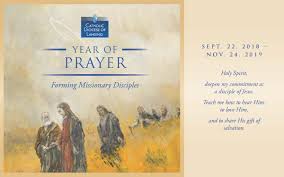
And since this is what everybody needs, Bishop Boyea has proclaimed another Year of Prayer.  This time the Year of Prayer is focused on helping us become a community of Missionary Disciples.  Not just that we believe in Jesus (which is a necessary first step), but that we share that news for others.  So, to be clear, when the Bible says would that all of God’s people were prophets, it’s not symbolic language, it’s not figurative language.  God wants all of us to hear His message of salvation and truth; and then proclaim it to others.  So go and announce the Gospel of the Lord!

23 April 2018

Unexpected Pastures

Fourth Sunday of Easter
This Sunday of Easter is called Good Shepherd Sunday, and it’s not hard to understand why: our Gospel today comes from the Gospel according to John where Jesus refers to Himself as the Good Shepherd.  I think that we all see the necessity of Jesus leading us, like a shepherd, and, in fact, probably the most popular Psalm in the Bible is Psalm 23, which usually is remembered for it’s first line, “The Lord is my shepherd.”  
A shepherd is someone who leads us, and sometimes we don’t want to be led.  Often we want to lead ourselves, to determine our own direction and our own destinies.  But we proclaim this weekend that God is the one who is supposed to lead us.  Without God we would be lost and in danger, like sheep without a shepherd.  There are many other hirelings who tell us that they will lead us to good places, but Jesus reminds us today that they run away when danger comes, and they often do not lead us where we truly want to go.

I know in my own life Jesus, the Good Shepherd, has led me places I never imagined I would go.  If I simply think about my assignments as a priest, when I was meeting with Bishop Boyea to be approved for ordination to be a priest, I was wondering where he would send me.  The parishes I thought would be open for a newly-ordained priest would be Queen of the Miraculous Medal in Jackson (where I had interned as a seminarian), St. Gerard in Lansing (where I had lived for a summer in college), St. Thomas Aquinas/St. John Church & Student Center in East Lansing (where I went to middle school and where I had spent a couple of summers in college), and St. John the Evangelist in Fenton, where I was then serving as a deacon.  In my heart, I wanted to stay at St. John the Evangelist in Fenton, as I had grown to love that community, and knew how things operated with Fr. Harvey.  But Jesus, the Good Shepherd, through Bishop Boyea, sent me to St. Thomas Aquinas in East Lansing.  Even though it wasn’t my first choice, I had a great four years in East Lansing, made some lifelong friends, and learned a lot about parish ministry.
Then, when my first four years were coming to a close, I thought I might become an administrator in a new parish.  There were a number of parishes that were open, but none of them really jumped out at me as a place for which I should apply.  Jesus, the Good Shepherd, through Bishop Boyea, sent me to St. Joseph in Adrian, on the outskirts of the Diocese of Lansing.  I had never even really visited Adrian before.  And yet, the people of St. Joseph became near and dear to my heart and it was a good, two-year assignment which helped me learn how to be a pastor.
In my second year in Adrian, Jesus, the Good Shepherd, through Bishop Boyea, again led me somewhere I never imagined to go: Flint.  I was very happy in Adrian, but Bishop Boyea said that, because of other moves, he needed me to go to St. Pius X.  I told him that if that’s where God wanted me, then that’s where I would go.  We have certainly had our struggles here at St. Pius X since I arrived, but I love it here, and I love you, my parish family.
In each of my moves, the Good Shepherd has taken me to pastures I never expected.  And in each move, I have found blessings more than I ever would have expected at places that maybe I thought I would do well.  And that extends even beyond my parish assignments: Jesus, the Good Shepherd, continues to guide my formation as a priest.  That is greatly impacted by Bishop Boyea, my immediate shepherd, who, I know, loves me (as he does all his priests), but also challenges me (as he does with all his priests) to grow.
The People of God, the laity, are also called to grow in ways, sometimes that they never expected, and Jesus, the Good Shepherd, exercises his role as Shepherd through His priests.  This is also World Day of Prayer for Vocations.  Each vocation is a gift from God, and whether a person receives the Sacrament of Matrimony, makes vows in consecrated life, or receives the Sacrament of Holy Order, each is called to build up the Church, along with those perhaps not in one of those vocations temporarily or permanently.  But priests in a special way help make the Church.  Without priests, we do not have the ordinary way that God forgives our sins in the Sacrament of Penance, and without priests, we are not strengthened to live our universal vocation to be saints through the Most Blessed Sacrament of the Eucharist.  
And yet, some parents, or other family members, discourage their sons, grandsons, nephews, etc., to answer God’s call to become a priest.  As far as I know, no son of St. Pius X has ever been ordained a priest, or has even entered the seminary.  That is a very sad statistic.  Priesthood is not always easy; it is a sacrifice; and it requires a real man to step up and give his life away for the good of the People of God.  But it is also rewarding beyond any measure that I ever expected.  And I cannot imagine my life doing anything else (yes, that even includes being a police officer).  
So what can we do?  If you have a son or multiple sons, encourage them to think and pray about becoming a priest.  Always include it as an option for a future.  The same goes for if you have grandsons or nephews.  If you don’t, or can’t think of anyone who would be a good priest, then pray for the Holy Spirit to call one of the sons of St. Pius X to consider this vocation, maybe even if it’s simply trying out the seminary.  And pray for that man to be open to the Holy Spirit’s voice.  Another great way to promote the priesthood is to live married life faithful to the call in Holy Matrimony: a life of prayer, sacrifice for the other, and holiness.  Good priests come from good families.  

Jesus is our Good Shepherd, who sends us places sometimes we never expect.  He also sends us shepherds who care for us and help us to follow Him.  Pray for more men to respond to the call of priesthood: to a life of sacrifice, yes,  but also a life of great joy spent in imitation of the Good Shepherd, who calls us all to be saints, and leads us to green pastures.

05 September 2017

You're Killing Me, Smalls!

Twenty-second Sunday in Ordinary Time
Sometimes there are quotes from different things that we have read or seen that stick with us and come to mind.  In the move “The Sandlot,” there’s a line that often gets used among people of my age: “You’re killing me, Smalls!”  Or a series of books that I read called the Wheel of Time series by Robert Jordan includes a line from the protagonist that has stuck with me: “duty is heavier than a mountain; death lighter than a feather.”  When Alan Rickman, who played Severus Snape in the “Harry Potter” series died, his one word response to Dumbledore, “Always,” becomes an oft-mentioned word.  And, on a lighter note, anyone who has seen “The Lion King,” is sure to say, at least once in a while, “Hakuna Matata.”
Scripture is also a great place to find quotes that can and should stick with us.  Bishops, and popes often have mottos for their ministry.  Bishop Mengeling’s phrase was “He Must Increase,” which is from St. John the Baptist in the Gospel according to John, when John says, “He must increase; I must decrease” in reference to Jesus.  Bishop Boyea’s motto is “In manus tuas,” which is Latin for “Into your hands.”  This comes from Psalm 31, and says, “Into you hands, Lord, I commend my spirit.”  It was also the words that Jesus said as He was dying on the cross, and is part of a response that consecrated men and women, and those in holy orders say before they go to bed each night.  In seminary, we had a classmate who was joking about becoming a bishop.  We said that his motto should be, “And Jesus wept.”

Today in our readings, we have four Scripture passages that might stick with us.  From our first reading: “You duped me, O Lord, and I let myself be duped”; from the responsorial psalm: “My soul is thirsting for you, O Lord my God”; from our second reading we have two options: “offer your bodies as a living sacrifice, holy and pleasing to God, your spiritual worship” and “Do not conform yourselves to this age, but be transformed by the renewal of your mind”; and from our Gospel: “Get behind me, Satan!”
Each of these has its own context.  In the first reading, Jeremiah is fed up with God, because all Jeremiah has done is tell the people what God told him, and yet everyone hates him.  Jeremiah suffered greatly, because the people didn’t want to hear that they needed to change, or else they would be exiled by the Babylonians.  Jeremiah feels compelled to say what God wants him to say, because Jeremiah loves God, but that love of God leads to suffering, and Jeremiah feels like he was tricked, but he can’t stop speaking for God.
In our Psalm, the author talks about how he wants God, desires God, like parched earth for water, so he looks toward the sanctuary to see the power and glory of God.  This is a psalm that is said on every special celebration in the Church’s life by those in religious communities and holy orders, so it’s one that comes to my mind often.
Our second reading with its two passages are from St. Paul, who is urging the early Roman Christians to be faithful to Jesus Christ.  St. Paul encourages the Romans to not simply let Catholicism be a religion of the mind, where we think about holy things and quietly commune with God in our souls, but even to offer our bodies to God, as a form of worship, as a way of giving God praise, so that what we do with our bodies and our souls may both be acceptable to God, whom we worship.  The second phrase, though, guards the Romans against becoming to comfortable in a pagan society, and being modeled on the outside world.  Instead, St. Paul says that they should be transformed by the conversion of what they think is good, so that they might do what is good and pleasing and perfect to God.
Lastly, our Gospel, which sounds like a good admonition to get rid of temptations, is spoken to St. Peter.  This passage follows after the one we heard last week, where Jesus calls Peter blessed and the rock upon which Jesus will build His Church.  This week, after Peter says that Jesus should not suffer, die, and be raised, Jesus says to Peter, “‘Get behind me, Satan!  You are an obstacle to me.  You are thinking not as God does, but as human beings do.’”  Jesus insists to Peter and the other apostles that suffering is part of the plan of God for the redemption of humanity, because suffering is part of the human condition, and Jesus must take it all upon Himself in order to redeem the entire human condition.

There are other passages in Scripture that we can use.  Memorizing little bits of Scripture can help us as we go throughout our day, in good times and bad, to praise the Lord or ask for His help.  When we feel like nothing’s going right even though we try to do God’s will, we might say, “You duped me, O Lord, and I let myself be duped.”  When we feel like we need God to be present to us, we might say, “My soul is thirsting for you, O Lord my God.”  When we need to remember that being Catholic is not simply about the prayers we say in quiet, or the thoughts in our head, or that we should not let ourselves become like our fallen, hedonist culture, we might say, “offer your bodies as a living sacrifice, holy and pleasing to God, your spiritual worship” or “Do not conform yourselves to this age, but be transformed by the renewal of your mind.”  When we are tempted by Satan in any way, or when we are afraid to follow God’s plan because it’s not the one that we want, we should say, “Get behind me, Satan!”  The Word of God can help us in any situation.  Let’s be familiar with it so that we can turn to Jesus, the Word of God, when we want to thank God and ask for His help, in times of sorrow and times of joy.

14 August 2017

"Do You Trust Me?"

Nineteenth Sunday in Ordinary Time
It doesn’t seem like that long ago, but the Disney version of “Aladdin” came out 25 years ago!  Robin Williams is the voice of the Genie, and it has the famous song, “A Whole New World.”  That song takes place on Aladdin’s magic carpet, and it begins right after Aladdin, pretending to be Prince Ali Abawa, asks Princess Jasmine, whom he likes, “Do you trust me?”  Those are the exact same words that Aladdin asks Princess Jasmine when she is pretending to be a commoner and she is running away from trouble in the marketplace: “Do you trust me?”
“Trust,” we so often say, “is earned, not given.”  Or we might say, “Trust, but verify.”  But in our Gospel, St. Peter takes neither of those approaches.  Jesus has done some amazing things for Peter (helps him catch fish even though they had been fishing all night; changes water into wine), but it’s not clear that Peter knows exactly who Jesus is.  It’s not for another chapter in Matthew’s Gospel that we hear Peter confess that Jesus is the Christ, the Messiah, the Son of God.  And it’s clear that most of the apostles think that the vision of Jesus is a ghost, not the real thing.  Peter had no way to verify if it truly was Jesus.  In fact, in Peter’s act of faith (which, admittedly, falters), Peter walking on water was the way he was going to verify it was Jesus.
But Peter must have trusted that it was truly Jesus, and that if Jesus told him to walk on water, then walk on water was what Peter would do.  Think of all the temptations that Peter had before he even got out of the boat: they were being tossed about by waves, it was the middle of the night, and the apostles were all terrified.  And yet Peter stepped out onto the water because Jesus, or something that Peter thinks might be Jesus, tells him to do so.  
But as soon as Peter stops trusting Jesus, as soon as the realities around Peter become the focus and not Jesus, Peter starts to sink.  But even then, Jesus verifies and earns Peter’s trust, by reaching out to save Peter when he cries out in fear.

Do we trust Jesus?  Or do we feel Jesus hasn’t earned our trust, or we need to verify before we can trust Jesus?  Would we be willing to step out on water (and not the frozen kind) to walk to Jesus, or would the fear of drowning keep us from even putting one foot over the side of the boat?
Trusting God can seem hard.  It doesn’t mean life always goes well.  Jesus had to entrust Himself to God the Father even on the cross.  Temptation eats at Jesus, as we hear Him say, “My God, my God, why have you abandoned me?”  But even though tempted, Jesus doesn’t give in to His fears, and will also say, “Into your hands I commend [or entrust] my spirit.”  Even as He is dying, Jesus shows us how to trust God in horrible circumstances.  
What makes it especially difficult to trust is when we feel that we have been let down.  We all have that one person, maybe a former friend, who has let us down, betrayed us, and not been there when we needed him or her.  Maybe that friend was even a spouse.  And now we find it hard to trust again.  That fear of betrayal, of abandonment, can easily bleed into our relationship with God.  We show up, but it’s on our terms, not God’s.  We have expectations about how things should be, and if they’re not fulfilled, then we’ll cut bait and run.  
For many of us, we trust God with certain things: secrets, hopes, fears, etc.  But maybe there’s an area of our life where we don’t trust God.  Maybe we don’t trust God when it comes to money.  Maybe we don’t trust God to guide our relationship.  Maybe we don’t trust God when it comes to conceiving a child or how many kids we should have.  Maybe we don’t trust God to truly forgive us.  All of those are very common ways that we think we know better than God, or we don’t want to involve God in those parts of our lives.  But to that fear, Jesus invites us to trust in Him and walk on water.
Maybe we don’t trust that God will be enough for us, or we don’t trust that we can be alone with God.  In our first reading, Elijah heard God not in the dramatic aspects of life–the strong and heavy wind, the crushing of rocks, the earthquake, the fire–but in a tiny whispering sound.  The only way to hear that tiny whisper is to keep silence.  If we really want to know if we trust God, try being silent with Him.  Silence can be the scariest thing in the world, because we might actually hear God, and maybe we don’t trust that what He says to us will be for our good.  It’s so much easier to play with our phones, to listen to music, to distract ourselves, than to be silent with God.  
After the music stops and while I’m still purifying the sacred vessels (or as some say, cleaning the dishes), can you simply kneel or sit in silence and wait to hear God, whom you have just received in the Eucharist?  It would be comical if it weren’t so sad, how many times someone feels like they have to break the silence by a “cough” or another noise (and I’m talking about adults, not kids).  But it is in the silence where we can so often hear God speaking to us, inviting us to trust Him in every aspect of our lives, not just the ones we want.
Take time in your life for silent prayer with God, a time, maybe just 5 minutes, to entrust yourself to God.  For some of us it may be as scary as stepping out onto the water like St. Peter did.  But remember that God will not let us drown.

Today at the end of Mass, we will also, along with every other parish in the Diocese of Lansing, entrust our parish and all who belong to it, to the Immaculate Heart of Mary in an act of consecration.  In a formal way we give ourselves over to God for His glory, rather than our own plans.  We do so on the 100th Anniversary of the apparition of our Blessed Mother to the shepherd children at Fatima.  We entrust our lives to her and ask her to help us to say yes to God, just as she did at every moment of her life.  There is more information in the narthex if you are interested.  May we truly trust in the love of our Lord Jesus Christ, and His Immaculate Mother, the Blessed Virgin Mary.

23 January 2017

Jesus in Hicksville

Third Sunday in Ordinary Time
Sometimes the name of a place is used, but then no one really knows where it is.  For example, people will still sometimes say, “She lives to Timbuktu,” to express that the woman lives very far away.  But if you ask people where Timbuktu is, most people don’t know, other than the fact that it’s far away.  Other people might think it’s a made-up city.  In fact, Timbuktu is a real city in the West African country of Mali.  Now, as Americans aren’t always the best at geography, even saying it’s in Mali in West Africa might not help.  So, hopefully to make it clearer, Mali is north of the countries of Ivory Coast and Ghana.  If you’re still not clear where Timbuktu is, you can google it when you get home.

For Jews hearing about the lands of Zebulun and Naphtali, they would have understood where that was.  We, as 21st century Americans, probably just glossed over those names, and figured that they are some weird names from a time long past.  Zebulun and Naphtali were two of the 12 sons of Jacob, also known as Israel.  Long after they died, the tribes that bore their names received land in the Promised Land.  They were not the strongest tribes or the most distinguished for anything, and they became the part of Israel that broke away after King Solomon died.  They were later conquered by the Assyrians, and mixed Judaism with the pagan religions.  For observant Jews, those lands were backward, not faithful, and not a destination.  We might use the term “Hicksville” to describe it.
But the Prophet Isaiah promised that God, after degrading those lands, would give it a great light, to bring it out of darkness.  God would give them great joy, as at a harvest festival, and would end their slavery.  God promises good things for those who, for centuries, were not seen as entitled to good things.
That promise was fulfilled in Jesus.  Jesus goes to Capernaum, “in the region of Zebulun and Naphtali,” to preach the Gospel, saying, “‘Repent, for the kingdom of heaven is at hand.’”  Jesus is the one who is the Light of the World, and gives them light by revealing the good news of salvation in Him.  Jesus cures the sick and expels demons, something that would cause anyone to rejoice.  And Jesus would eventually destroy the slavery of sin by His death on the cross.  Jesus was the perfect fulfillment of Isaiah’s prophecy to “Hicksville.”  While Jerusalem was the place to be because of the temple, and was the center of religious life for any Jew, God, in the Person of Jesus, goes to places that other religious leaders had long since abandoned.  
And while in “Hicksville,” Jesus begins to form His new Church.  He choses Twelve Apostles, some of whose names we begin to hear at the end of today’s Gospel: Simon, later called Peter, and his brother, Andrew, as well as James and John, the sons of Zebedee.  These four are fisherman.  They are not well educated, and while they practiced Judaism, they were not scholars of it.  None of them were rabbis or scribes.  
In one sense, as people who live in the greater-Flint area, we should be able to relate to the land of Zebulun and Naphtali.  Flint may not be “Hicksville,” but it’s not exactly the top destination of Michigan.  Generally, people are not climbing over each other to move into Flint, as we all well know.  But that does not mean that God has abandoned us.  To the contrary, God still brings light to people who walk in darkness, and still wants to crush the slavery of sin in our lives.  
We see that through the care of Bishop Boyea, a successor to the apostles, for Flint.  Besides the entire Faith in Flint initiative, which seeks to gather the resources of the Diocese of Lansing to assist the Catholic and even non-Catholic population of Flint, no other region in the Diocese has so many young, dynamic priests like Fr. Zach Mabee, Fr. Paul Donnelly, Fr. James Mangan, and Fr. Dan Kogut.  Just as God has a special love for what Biblical scholars refer to as the anawim, the poor and outcast, so Bishop Boyea has shown his special love for Flint by sending all-star priests to build-up the faithful and spread the Gospel.
But God is also calling you to build up the Church.  While we priests do our best to support the faithful with the graces which flow from the sacramental life of the Church, it is the faithful who are called in particular to spread the Gospel and build up the Church.  It is by encountering Christ, even here in Flint, which strengthens us to live our faith, not just for an hour on Sundays, but seven days a week in our homes and workplaces.  Faith sharing groups like ARISE are meant to strengthen our faith and give us the courage to be sent out, which in Greek comes from the word 𝛂𝛑𝛐𝛔𝛕𝛐𝛌𝛐𝛊, which means those who are sent out.

The strength of this parish comes from your response to God’s grace.  If you engage your faith, and make it something that is not only about Sundays, we will be a strong parish.  If we are willing to be challenged to conform our lives more closely to Jesus, and then to be sent out to show and tell others about that transformation in our lives, then Flint will become a place of blessing, a place Jesus is at work.  God calls us to repent and spread the good news of the kingdom of heaven.  Will we respond to God’s call?