Showing posts with label prophets. Show all posts

05 October 2018

Would that All God's People Were Prophets!

Twenty-sixth Sunday in Ordinary Time
Sometimes reading the Bible is difficult.  Sometimes it’s difficult because of unique names.  The two we had in the first reading, Eldad and Medad, aren’t too bad, but when you get to names like Melchisedech, Rehoboam, Abinadab, etc., it’s easy to see why some people get a little nervous.  It’s also tough because some parts of the Bible are read differently than others.  In some cases, we can follow the literal meaning that is easily recognizable at face value.  Other times, God speaks more figuratively.  And, if you’re just reading the text, you can’t always tell the difference.  It’s not like there are brackets around the literal phrases and italics for the more figurative statements.  But that’s why we have a Magisterium, an official teaching office entrusted to the Pope and the Bishops to help us understand how the Word of God is to be interpreted.  And that’s why we offer Bible studies at our parish: to help you understand what the Word of God means. 
Back in the late-second to the mid-third century, there was a guy from Alexandria, Egypt, and his name was Origen.  Origen was a firebrand of a guy.  He really wanted to be a martyr to witness to how much he loved Jesus.  But his mother wasn’t so keen on the idea.  Origen was bound and determined to die for Jesus, and was ready to run off to die for Jesus.  So his mother hid all his clothes, guessing (correctly, as it turned out) that he would not run out of the house naked.  Origen was known for his interpretation of Scripture, and he is one of the most prolific theological writers of the third century.  But, he could not always tell the difference between literal and the figurative senses of Scripture.  In one big mix-up, Origen took the passage we heard today much too literally: “‘If your hand causes you to sin, but it off.  It is better for you to enter into life maimed than with two hands to go into Gehenna, into the unquenchable fire.’”  But Origen’s issue was sexual sins, so it wasn’t his hands he cut off, and I’ll leave it at that.
While that part of our Gospel is not literal, our first reading can be taken literally.  God sent His spirit, that He had previously bestowed on Moses, and gave it to seventy elders.  God told the seventy to be in a certain spot to receive His spirit.  Of course, two of the seventy didn’t make it, or didn’t get the message.  So they were in the general camp, when they started prophesying.  Joshua, Moses’ assistant, complains because they didn’t follow directions.  But Moses said, “‘Would that all the people of the Lord were prophets!  Would that the Lord might bestow his spirit on them all!’”  Moses wanted, and God wants, all His people to be filled with the Holy Spirit so that we might all be prophets, so that we might all speak God’s message.  But perhaps we take this passage a bit too figuratively.  
After all, we might say, the priests are the ones who are supposed to be prophets and speak God’s word.  Or religious sisters; they’re supposed to be prophets and speak God’s word.  Or missionaries in Africa and tropical islands: they’re supposed to be prophets and speak God’s word.  That’s not us!  But, that’s not what God is saying here.  God is saying He wants us all to speak His message for Him.  We can’t pawn it off on priests or deacons or sisters or missionaries.  We are all called to be prophets, as I preached last Sunday.
But what, then, are we meant to say?  I think all of us can start with the basics of Catholicism.  And in case you’re rusty, here it is: we’re sinners; we cannot save ourselves; God sent His Son Jesus to save us from sin and death; Jesus did this by His Death and Resurrection; we can be saved by believing in Jesus and following Him; if we believe in Jesus and follow Him, we’ll be ready for heaven, which is perfect happiness and the goal of our life.  That’s it.  
And you know what?  People need to hear it.  People are generally miserable.  Sometimes they hide it.  Sometimes they try to distract themselves with temptations or shortcuts to happiness: sensual pleasure, power, and glory.  All of them, but especially the first one, is the Johnny Lee song: “Looking for Love in All the Wrong Places.”  The second one is when we strive to be in control–of the world, of people, of work, of ourselves–when in fact we have control over almost nothing.  The third one is about being known, being famous, being popular.  And while all of them will give us pleasure, and may even distract us for a while, they will never give us true happiness.  

And since this is what everybody needs, Bishop Boyea has proclaimed another Year of Prayer.  This time the Year of Prayer is focused on helping us become a community of Missionary Disciples.  Not just that we believe in Jesus (which is a necessary first step), but that we share that news for others.  So, to be clear, when the Bible says would that all of God’s people were prophets, it’s not symbolic language, it’s not figurative language.  God wants all of us to hear His message of salvation and truth; and then proclaim it to others.  So go and announce the Gospel of the Lord!
09 July 2018

Domesticated Prophets

Fourteenth Sunday in Ordinary Time
According to the most scholarly of sources, Wikipedia, dogs were domesticated sometime around 14,700 years ago, based on a dog being buried near a human grave.  Since then, we have many different varieties of domestic dogs that are called, because of their long association with humans, man’s best friend.
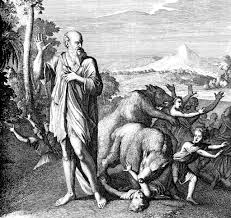
What our early ancestors did with dogs, we have done with Biblical prophets: we have domesticated them.  We have taken out, or chosen to ignore, many of the wild traits, in order to make it more comfortable to live with them.  But prophets have always been quite eccentric people that were not, at first blush, the best spokesmen for God.  Moses, the first great prophet, was slow of speech and tongue, according to his own words.  And he, by the power of God, changed a staff into a snake, caused the Nile to turn to blood, and brought a number of plagues upon Egypt.  Samuel, the great prophet who anointed the first kings of Israel, Saul and David, killed the Amalekite King Agag because Saul, was ordered by God to kill King Agag, but refused to do so.  Elisha was jeered at by some small
boys, who said, “‘Go up, baldhead!” and he cursed them, and two she-bears came out of the woods and tore them to pieces.  In chapter 20 of the Book of the Prophet Isaiah, God tells Isaiah, “Go and take off the sackcloth from your waist, and remove the sandals from your feet.  This he did, walking naked and barefoot.”  And it says in the next verse that this happened for 3 years.  Jeremiah told the king that Jerusalem, the place of the great Temple of the Lord, was going to be destroyed, and no one believed him.  And St. John the Baptist, the last and greatest of prophets, wore a camel-hair tunic and ate locusts and honey.  None of these seem to be people that civilized folk would want to be around.
And perhaps that is part of the reason they were never accepted in their home towns, as Jesus said in the Gospel today.  We tend to think of the prophets as nice guys who were able to tell the future.  We make them pretty well-dressed, white-bearded men.  But they railed against the injustices of their day and often became very unpopular in the process (walking around naked for 3 years can tend to make a person unpopular).  In many cases, they spoke out against the king, because he was the leader of the people.  But no matter whether they spoke out against a person or a situation, they always spoke the words that God gave them to say.
It’s cliché, but as prophets, God calls us to give comfort to the afflicted and affliction to the comfortable.  Jesus, as the source of prophecy and the Prophet about whom Moses spoke, to whom the Chosen People needed to listen, lived this out in a most perfect way.  To the Pharisees and scribes, those who were assured about their own righteousness, Jesus did not have great words to say, calling them “broods of vipers” and “white-washed sepulchers.”  But to the sinners, those who were often excluded from the daily life of Israel, Jesus preached love and acceptance, even while calling them, too, to conversion.  The woman caught in adultery is not stoned for her sin, but is told to go and sin no more.  The Samaritan woman at the well was convicted by Jesus about her many husbands, but she is also encouraged to drink the living water that comes from Jesus so that she can have eternal life.
There are parts of our life that God calls others to confront in us, and parts of our life that need the comfort of God.  When a person does not realize the conversion that needs to take place, God calls us to issue strong, dramatic words to help that person realize his or her need for God and a change in life.  When a person is beat up by the world, and despairing of any chance of redemption, God calls us to issue tender, loving words to help that person realize how much value he or she has.  We are not called to be nice, to say, “but that’s none of my business,” when we see sin and its effects in others.  But we are called to be prophets, by virtue of our baptism, who afflict the comfortable and comfort the afflicted.  
I’m not suggesting that we should walk around naked, not even for a day.  I’m not saying that we should curse people who make fun of us and send she-bears after them to tear them to pieces.  I’m not saying that we should threaten the destruction of a church.  But we also have to be careful about only saying things that people want to hear, things that do not make demands on life or call for conversion, things that do not challenge.  

God has called us to be prophets, and that in itself is a radical demand.  God calls us to speak His Word in our daily lives so that others can either turn from the evil they’re doing and live, and/or know just how much God loves them and wants the best for them.  Do not take the wild nature out of our prophetic call!  God save us from domesticated prophets!!

17 May 2016

A Tour of Salvation History with the Holy Spirit

Solemnity of Pentecost–At the Vigil
Why?  That is the question in some of your minds right now.  Why so many readings?  This may remind some of you of the Easter Vigil.  But this is the Pentecost Vigil, and it is one of two Masses in the year that the Church gives us the option of an extended Liturgy of the Word, to hear the Word of God and meditate on it to a greater extent than usual.  Just as we prepared for and began our celebration of one of the great mysteries of our faith, the Resurrection of Jesus, with an extended time of prayer, so as we prepare for and begin our celebration of the descent of the Holy Spirit upon the disciples, we have an extended time of prayer.
The introduction that I said at the beginning of Mass, also reminds us that tonight, as we gather, we are following the example of the Blessed Virgin Mary and the Apostles and disciples, who were waiting for Jesus’ promised gift of the Spirit, who would be their Advocate, and help them to proclaim Jesus to the world.  We are invited to relive all of salvation history in a quick glance, and see how God’s promise of the Holy Spirit was from the beginning and continued through the Old Testament, as was the Resurrection of Jesus.
The readings that we heard tonight tell us something about how the Holy Spirit acts in us, as He acted in the Apostles.  The Holy Spirit unifies what sin divided.  In Genesis, sinful humanity tried to get to God on their own terms by building a tower to the heavens.  But it didn’t work.  We cannot get to God on our own terms.  And where our sinful pride led to the multiplication of languages, the Holy Spirit, given at Pentecost, allowed the Gospel, the new of way life and the way to eternal life with the Father, to be proclaimed so that all could understand.  
The Holy Spirit is the source of power, and consecrates the People of God.  In Exodus, we are told of how God’s people are called to be a “‘kingdom of priests, a holy nation.’”  And Mount Sinai gets wrapped in smoke and thunder and fire, with trumpet blasts, so much that the people are afraid to approach God.  Through Baptism, we are made priests, so that we can offer our spiritual sacrifices in union with the perfect sacrifice of Jesus on the cross, and we are given power from on high.
The Holy Spirit is the giver of life.  If we are just flesh and bone, then we do not have life.  But if the Spirit of God fills us, then we are no longer zombies, no longer the walking dead, but are filled with life.  When God first made us, He breathed His life into us.  We lost that divine life when Adam and Eve disobeyed God.  But through the Holy Spirit, new life is given to us.  Finnian will receive that new life today as he is baptized, so that he is not dead in his sin, but alive in Christ.
The Holy Spirit helps us to understand the things of God.  In the Old Testament, only certain people were able to speak for God, and they were called the prophets.  God would speak to individuals like Samuel, Isaiah, Jeremiah, and Joel, and they would pass on what God had said.  But in this new age after the Resurrection, all of God’s people have access to His voice, and have the possibility of seeing with the eyes of God.  All flesh has the possibility to receive the Holy Spirit.
The Holy Spirit is a well-spring of life.  We cannot live without water.  But Jesus promises the Holy Spirit will be a river of living water flowing from within us.  It will give us new life so that we can truly live, not for ourselves, but for God.  The Holy Spirit helps us to believe in God the Father and His Son, Jesus, and to quench our thirst for the infinite and the eternal, that can only be satisfied in God.

All of what I mentioned happens today as Finnian is baptized.  Finnian is united to God, receives power and consecration to be a member of God’s priestly people, receives new life, is able to understand the things of God, and is given the ability to live for God.  All of that happened to us when we were baptized.  And it was given to us in a new way in the Sacrament of Confirmation.  Union with God, power and consecration, new life, seeing things through God’s eyes, and living for God are all possible because of the great gift of the Holy Spirit, who continues the work of Jesus.  That work is continued in us.  Will you cooperate with the Holy Spirit in proclaiming the Gospel and living as a disciples of Jesus, as the disciples did after they received the Holy Spirit?  Will you put into action in your life what was foreshadowed in the Old Testament?  Will you receive the Holy Spirit?

26 December 2011

God Sees His Son


Nativity of the Lord, Mass during the Day
            Have you ever noticed how everyone seems to soften in the presence of a baby?  It makes sense that mothers are very soft and tender in the presence of a child because of their motherly instincts.  But it even happens with the gruffest, toughest men.  In the presence of a baby even the sternest face can be softened by a smile, and the epitome of a man’s man starts talking gibberish, trying to communicate with the child and get it to smile back.
            Today we rejoice in the fact that, in the fullness of time, right when God wanted it, when all the conditions were as God knew in His Divine Wisdom they needed to be, the invisible God who could not be seen, the Word through whom all things were made, and without whom nothing came to be, became visible in the flesh.  God was made known to the world as a baby.  While we have grown used to this fact over 2,000 years of Christian activity, this was unthinkable, truly awesome, and even somewhat scandalous to Jews and Gentiles alike.
            In the past, as we heard in the second reading, “God spoke in partial and various ways to our ancestors through the prophets.”  From the very beginning, when God created Adam and Eve in His own likeness and walked among them in the Garden of Eden, God had wanted to be close to the crown of His creation.  He wanted to be with us in all things.  And even when, through Adam, sin entered the world, He continued to reveal Himself partially to the Chosen People: to Abram, telling him to leave Ur of Chaldea and go to the land of Canaan, where he would become Abraham, the father of many nations, and in the form of three visitors to announce the conception of Isaac, the son of the promise; to Moses in the Burning Bush and on Mount Sinai; to all the Chosen People in the form of a pillar of cloud and fire, leading them through the desert; through the prophets, those chosen by God to speak for Him to a people who constantly preferred to wander away from God, rather than be close, especially Isaiah, Jeremiah, Elijah, Ezekiel, and others. 
But this was always a partial revelation of God.  In Bethlehem, when Jesus was born, we had the chance to see that God had fulfilled the prophecies that a Virgin would bear a Son and would name Him Emmanuel, God-with-us.  In the Nativity of Jesus according to the flesh a marvelous exchange took place, what the Church Fathers called admirabile commercium.  In this great exchange, God took our sinful nature to Himself, though He was free from sin, and united it fully to His divinity, so that we could live forever in heaven united to the Son.  In the words of St. Athanasius: God became man so that man could become God.
This is what St. John is speaking of when, in the Gospel passage we heard today, he writes, “But to those who did accept him he gave power to become children of God, to those who believe in his name, who were born not by natural generation nor by human choice nor by a man’s decision by of God.”  In Baptism we were made members of the Mystical Body of Christ, and our nature was joined to Christ, just as Christ joined His nature to ours at the Annunciation, which we celebrated 9 months ago. 
The Gospel, the Good News that this truly is should astound us!  Because if we have been baptized and united to the Mystical Body of Christ, then when God looks down on us, he no longer sees a child born of natural generation, but His only-begotten, beloved Son, just as when Mary and Joseph looked down at the Christ child, they did not just see a baby, but the eternal God in flesh.  In baptism, where we are born again by water and the Spirit, we become a son or a daughter in Christ the Son. 
This participation in the Sonship of Christ is no small thing!  “To which of the angels did God ever say: You are my son; this day I have begotten you?  Or again: I will be a father to him, and he shall be a son to me?”  Because Jesus joined our nature to His, humbling Himself to take on all that it means to be human: hunger, thirst, pain, temptation, we have a higher dignity than the angels of God.  You are a higher creation than an angel, because Christ was not an angel, nor did He become one of them.  He chose to join our nature to His, and so we join in the dignity of Christ who is “as far superior to the angels as the name he has inherited is more excellent than theirs.”
Do not cheapen, then, the great gift you have been given this Christmas, the gift of knowing that we can be united to Christ.  Do not count as worthless the great gift of being a part of His Body, the Church, with all the great gifts and duties that come along with membership in the People God has claimed for His own.  As Pope St. Leo the Great wrote in his Christmas sermon:

Acknowledge, O Christian, the dignity that is yours!  Being made a partaker in the divine nature, do not by an unworthy manner of living fall back into your former abjectness of life.  Be mindful of Whose Head, and of Whose Body, you are a member.  Remember, that wrested from the powers of darkness, you are now translated into the Light and the Kingdom of God.  By the sacrament of baptism you have become the temple of the Holy Spirit.  Do not, by evil deeds, drive out from you such a One dwelling with you, and submit yourself again to the bondage of the devil.  Because your price was the Blood of Christ; because in strictness He shall judge you Who in mercy has redeemed you, Who with the Father and the Holy Spirit, lives and reigns, world without end.  Amen.