Showing posts with label Garden of Eden. Show all posts

09 February 2026

Eden, Heaven, and Sacrifice

Anniversary of the Dedication of St. Matthew Church
    [In the name of the Father, and of the Son, and of the Holy Spirit.  Amen].  “I can worship God anywhere, I don’t need to go to church.”  We hear this phrase, sometimes from teens who don’t want to go to Mass, sometimes from adults who feel the same way.  And I think most, if not all, of us have had experiences of God outside the walls of this building, be it a beautiful sunset or a powerful storm, or maybe the calm and peace that come from time spent with a loved one.  

    And while when people enter this building for the first time, most tend to lose their breath for a bit, or look all around and say or whisper, “wow!”, why bother assembling in a place to worship God?  Why do we spend large amounts of money to build and maintain churches like this?  Why does the Catholic Church assign one of the greatest importances to celebrating the day a building was dedicated?
    It all has to do with what churches should do, and there are, I would argue, three primary goals for a church: remind us of Eden, point towards heaven, and celebrate a sacrifice.  The more a church does all three, the more we can truly call it a beautiful church.
    First, churches should point us to Eden.  In the Garden of Eden, God and man walked together as friends.  God was still God, and we were not, but there was a strong and close relationship between humanity and God.  The strain that came from work and the pain that came from childbirth didn’t exist, because they only came to be through sin.  The harmony that existed between God, humanity, and the rest of the created world was the only reality.  Man and woman didn’t lust after each other, even though they appreciated each other.  The break of that trifold relationship of God-man-nature only broke down when Adam and Eve tried to usurp the place of God and committed the original sin, a sin which they passed down to their descendants, even to us in the present day.  
    The ordering of the Church should remind us of the original order and harmony of the Garden of Eden.  We see hints of vegetation in our capitals on the columns, there are ordered other plants in the wallpaper in the sanctuary, like heads of grain and bunches of grapes, there are animals that are staying calm like the pelican image on the front of the high altar and fish in the wallpaper.  There is also a harmony that exists among the created items that make up this building, working together to provide a solid, intelligent structure.  In the church, we also have a harmony with each other and with God, which is why, at the beginning of Mass, we ask pardon from each other for any faults we have committed in the Confiteor.  When a church lacks any sense of the harmony of nature and the harmony that exists between God and humanity, it lacks a certain beauty.  Also, we don’t find this ordering anywhere else, because outside of this building, the effects of sin still run rampant between us and God, each other, and us and nature.  The order that exists here simply doesn’t exist outside in the same way.
St. Pier Giorgio Frassati
    Secondly, a church should point us towards heaven.  Why do we have so many images of the saints?  Why aren’t Catholic Churches just whitewashed walls?  Because heaven has numerous occupants.  It’s never been “me and Jesus” alone.  To be in union with the Lord means that we are also in union with those who are already united to Him in heaven.  That cloud of witnesses, from Abel to the Sts. Pier Giorgio Frassati and Carlo Acutis (to name two of our newest canonized saints), join with us in the in-breaking of heaven on earth.  Churches use precious materials because St. John describes heaven, in the Book of Revelation, as filled with precious materials.  Churches do not only look to the past and the Garden of Eden, but also look to the future and the place we want to end up, in heaven with God.  When we worship God at Mass, all the angels and saints join with us, and we with them, in a liturgy that echoes how heaven is described in the Bible.  As much as Shoeless Joe Jackson can ask Ray Kineslla in the classic movie “Field of Dreams” as he walks into the corn field from the baseball diamond Ray built, “Is this heaven?”, we know that heaven is not a place on earth.  But in the church, we get a glimpse of heaven breaking into earth in a way that happens no where else other than in churches.  
    Lastly, we celebrate a sacrifice.  Churches are not simply lecture halls where one can hear a rousing sermon (though I’m sure you’re moved by the current homily).  Churches are not concert halls where one simply hears music, being Gregorian chant or Christian rock.  Churches are places of sacrifice.  And how do we know this?  From the earliest days of the Church, church buildings contained an altar.  St. Ignatius of Antioch, who died around the year AD 107, who learned the faith from St. John the Apostle and whom St. Peter ordained a bishop, referred to a feature in the Christian celebration with the word thusiasterion, a Greek word that means altar, when talking about the Eucharist that the bishop celebrated.  Tertullian (who died in AD 240) and St. Cyprian (who died in AD 258) also speak about altars when describing the Eucharistic table.  
    But altars only exist for one reason: for sacrifice.  The first Christians understood the Eucharist as a sacrifice, but not as a new sacrifice, but the joining to the once-for-all sacrifice of Christ on the cross.  And Christ allowed us to join in that sacrifice through the ritual He Himself gave us at the Last Supper.  In the church building we fulfill the Lord’s command to do this ritual in memory of Him that unites us mystically to the offering of the Lord on the cross on Calvary.  No where else in nature does God randomly change bread and wine into the Body and Blood of His Beloved Son in an unbloody manner.  Only when we come to a church building do we have this opportunity to join ourselves to the sacrifice that saved us from sin and death and opened heaven for believers.  
    So no; you can’t worship God in the same way anywhere else other than a church building.  And that’s why, 107 years ago, our predecessors put aside large amounts of money to begin the building of this church building.  That’s why, through the decades that followed 1919, priests and people worked to beautify this sacred temple to help it reflect Eden, heaven, and the sacrifice of the Lamb.  May we continue the good work they began in Christ, and may this holy building continue to give us rest from our earthly labors and communion with God and each other as we seek to see the Lord Jesus Christ [who, with the Father and the Holy Spirit, live and reign for ever and ever.  Amen].

06 February 2023

Helping Hearts Rest in the Lord

 Anniversary of the Dedication of St. Matthew Church

    [In the name of the Father, and of the Son, and of the Holy Spirit.  Amen].  Today we assemble to celebrate and to mourn, to rejoice and to honor.  We celebrate this beautiful edifice, this temple of God which draws us closer to Him through the intercession of St. Matthew.  We rejoice that this church is a visible reminder that God dwells among us, and that we are called to participate in His Church, as living stones of the heavenly Jerusalem, the temple not made with hands.  At the same time we mourn the passing of Fr. Frederick Harold Taggart, OSA, our beloved former pastor, and Augustinian priest who was professed for 65 years.  We honor his service to his parish, and all the souls whom he helped to grow closer to God.
    But while celebrating and mourning, rejoicing and honoring may not seem to go together well, as the author of Ecclesiastes says, there is a time for everything, and a season for everything under heaven.  And, in a way, celebrating this church is a great way to honor the pastor who helped beautify it, and kept this treasure going in downtown Flint.
    A favorite phrase of St. Augustine for many is from his Confessions: “You have made us for yourself, O Lord, and our hearts are restless until they rest in you.”  This church is a place of rest, a true rest area off the highway of life.  Architecturally and aesthetically, a church is meant to bring one back to the Temple of Solomon, which itself pointed back to the Garden of Eden.  In Eden, humanity did not labor, but rested in the presence of God.  The dissonance of sin had not yet entered the world, so only harmony resonated between God and Adam and Eve, and between Adam and Eve themselves, and between Adam and Eve and the created world.  As we enter this sacred building, the design of the arches is not meant to confound the eye (making, as it were, the parishioner wonder, ‘How does this stay up?’), but to let it rest in the solidity of the building.  The precious materials used for the sacred liturgy, whether the altar, the ambo (where the Word of God is proclaimed), or the sacred vessels, remind us of the heavenly Jerusalem, which is decorated with all kinds of precious stones and metals.  The stained-glass windows remind us that the saints worship with us, and call us to be the best version of ourselves that we can be.  Though we labor through pain and temptation during our daily lives, inside this building, our hearts are meant to be at rest.
    Fr. Taggart also did his best to let the hearts of all who came here to rest in Christ.  In his 57 years as a priest, only God now knows how many Masses he said for the living and the dead; how many confessions he heard so that hearts weighted down by sin could be relieved through the mercy of God; how many baptisms he celebrated, making children of God out of the children of men; how many weddings he witnessed as two hearts became one; how many families he comforted as they mourned the loss of their own loved ones and friends; how many hearts were poured out in spiritual counseling and guidance.  In the Order of St. Augustine, Fr. Fred had found a place where his heart could rest in the Lord, and his pastoral ministry was a response to that love, and a desire to help others find that same rest in Christ.  He strove to be a just man, and a light in darkness to the upright, as Psalm 112 (111) states.
    [In particular for the Traditional Latin Mass community, Fr. Fred was instrumental in helping to have a fitting place to celebrate the more ancient Roman Rite.  We celebrated the first Sunday Mass here at St. Matthew on 5 July 2015, and haven’t looked back.  While he did not, to my knowledge, celebrate the Extraordinary Form Mass after the newer Mass came long, he did, I believe, use the older forms for baptism when requested, and always sought to celebrate the Mass reverently.  And he certainly provided a church that would serve the needs of this important and necessary part of St. Matthew parish.]
    Did he do this perfectly?  Does this church always grant rest to our hearts and minds?  No.  Like any person, Fr. Fred has his own human weaknesses and failings.  As a pastor, a father of the family, Fr. Fred sometimes had to make decisions that were not popular among all his spiritual children.  One of the stories I heard about Fr. Taggart when I arrived was about his interaction with Ardith Goodroe and the choir here at St. Matthew.  What strikes me as most important about that story is that he and Ardith, after a period of tension, could still be good friends.  And that says something: when a difficult decision needs to be made, and feelings are hurt, that two people can reconcile and renew their friendship with each other.  None of us are perfect, but with grace and understanding we can overcome hurt that we cause each other.
    This church, too, is a work in progress.  We’re still working on stopping leaks in the downspouts, which cause the plaster to break-up and crumble.  There are always repairs and improvements that can be made to any church, like the beautiful floor that was installed some years ago, and the renovation of the bride’s room.  So for us: we’re never done in our relationship with Christ.  There are always ways that we can grow, emotional and spiritual wounds that need to be healed, virtues that need to be strengthened.  Just as we cannot simply let this building sit, so we cannot rest on the laurels of previous periods of growth and holiness in our relationship with Christ.  Christ calls us to deeper and deeper trust in Him, to find new ways that He wants our hearts to rest in Him, since He made us for union with Himself.  
    It is my hope, as your current pastor, and successor of Fr. Taggart, that I can continue help you find your rest in Christ.  Through my ministry, I hope that you can experience the peace and love of God for which He created humanity.  We are not the largest parish in Genesee County, but, as a family, we can help each other rest in God, and encourage others to find that same rest in God through participation in the Sacred Liturgy, service to the poor, and growth in our understanding of God’s never-changing truth.  Like Fr. Fred, I am committed to preserving this temple so that God may be glorified and the intercession of the saints may be sought.  Like Fr. Fred I will sometimes err, but I hope that, with grace and understanding, we can continue to be a family of faith the encourages each other to be the best we can be in Christ.  Every human being is made for God.  Every human’s heart desires to rest in God.  May we, the people of St. Matthew parish, the sons and daughters of our spiritual father, Fr. Fred Taggart, engage in the mission of helping every heart rest in God and find the love and peace that each desires.  Eternal rest grant unto Fr. Taggart, O Lord, and let perpetual light shine upon him.  May he rest in peace.  Amen.  May Fr. Fred’s soul and all the souls of the faithful departed through the mercy of God [the Father, and the Son, and of the Holy Spirit] rest in peace.  Amen. 

19 April 2019

115 Days Since Christmas

Good Friday of the Lord’s Passion
It has been 115 days since Christmas.  115 days since we celebrated the birth of Jesus Christ from the Blessed Virgin Mary, God-with-us, Emmanuel.  115 days since that joy of knowing that God loved us so much that He sent His only Son to become like us in all things but sin.  And every day, since Christmas, has been pointing to this day.
Recall that there was a tree in the Garden of Eden besides the Tree of the Knowledge of Good and Evil, from which God had forbidden Adam and Eve to eat.  That other tree was the Tree of Life.  And when Adam and Eve had been expelled from the garden, God stationed a cherubim with a “fiery revolving sword…to guard the way to the tree of life.”  Humanity was created for life, but because of sin, they chose to seek after death.
Jesus, on the other hand, was, in a sense, born for death.  Now, to be clear, Jesus’ death should have never happened.  When God became flesh, we should have accepted Him and followed Him, and then God would have brought about salvation in some other way.  But, as we know that God knows the course of history, because all time belongs to Him as is as the present to Him, we also know that God the Father knew that Jesus, His Beloved Son, would be rejected.  God the Father knew that His Son would be “marred…beyond human semblance.”  He knew that Jesus would be “spurned and avoided by people, a man of suffering…pierced for our offenses, [and] crushed for our sins.”  And yet, God chose His Beloved Son to be born so that He could die.
Why?  Why would a loving Father–and we know God the Father is loving because Jesus revealed to us so many times how loving God is–send His Son to die?  God sent His Son to die that we could, once more, have access to the Tree of Life, closed off to us by sin.  And let’s be clear, it is not as if this was foisted upon Jesus.  Jesus willingly, lovingly, accepted His death out of that same love for us that God the Father has.  In the supernatural order, sin brought death, but, ironically, it was death that brought life.  And just as sin entered by a tree, so by a tree, the cross, sin and death were defeated by life itself.
We deserved death because of sin.  We had abandoned God, though He never abandoned us.  Jesus, on the other hand, did not deserve death, because He had no sin.  He was tested, as our second reading says, but He did not sin.  But He still took upon Himself our offenses, our sins, so that, by His chastisements, we might be made whole; by His stripes we might be healed; by His offering of His life, we no longer had to lose ours.  
The place of the Crucifixion in the
Church of the Holy Sepulchre
John’s Gospel makes very clear that, through it all, Jesus remained God and in control.  If He wanted to, Jesus could have called upon an army of cherubim with their fiery swords, and brought about divine vengeance upon all who wished to harm the Son of God.  But He didn’t.  He was killed in the most shameful way, the most painful way, and the Lamb of God who takes away the sins of the world, was “like a lamb led to the slaughter…he was silent and opened not his mouth.”  
In one sense it was our sin that led Jesus here today.  Even the smallest venial sin, the tiniest act of disobedience to God cries out for justice, and, as St. Paul says, the wages of sin is death.  We cannot simply blame the Jews of Jesus’ time for calling for His death; we cannot simply blame Pontius Pilate and his moral weakness for capitulating to the Chief Priests' and Pharisees’ demand for blood.  We also must blame ourselves because our sins, our personal sins, no matter how big or how small, closed off the tree of life from us.
But, in another sense, it was the love of God that led Jesus here today.  The love of God that is so strong that it leaves the 99 safe sheep behind for the 1 lost lamb; the love of God that is so strong that it runs out to meet the Prodigal Son even as he is far off; the love of God that is so strong that He would rather sacrifice Himself to death than see any of His ungrateful children suffer.  It was love that led Jesus here, to die for us on a tree, the tree to which He was nailed to become the Tree of Life for all who believe.  

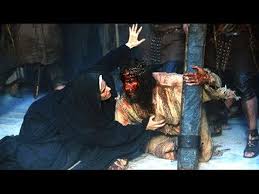
In one of the most powerful scenes, I think, from the movie “The Passion of the Christ,” we see Jesus on the Via Dolorosa, the Sorrowful Way, the Way of the Cross.  Mary, the Blessed Mother, is off in the distance with St. John, the Beloved Apostle, shocked at what they are doing to her Son.  Jesus falls, and says, “Mother,” and Mary thinks back to little Jesus falling on a road on Nazareth.  She notices, and, as any loving mother does, she rushes to comfort the little Child who has fallen.  As she runs to the Child Jesus, she cries out, “Jeshua, Jeshua,” “Jesus, Jesus,” and it then shows Mary, now as Jesus walks to His death, and she runs to him again, saying, as she did when He was a child, “I’m here.  I’m here.”  She embraces the suffering Jesus, just as she embraced the Child Jesus.  And Jesus, clinging to His Cross, says, “See, Mother, I make all things new.”  Jesus was born to make all things new.  He died to make all things new; to have the cherubim sheath his fiery sword, and give all access to the Tree of Life which gives immortality, the wood of the Cross.  Come, let us worship!

11 March 2019

Into the Desert

First Sunday of Lent
“Filled with the Holy Spirit, Jesus…was led by the Spirit into the desert for forty days.”  Did you hear that first line of the Gospel, or did it go by unnoticed?  Listen to it again: “Filled withe the Holy Spirit, Jesus…was led by the Spirit into the desert for forty days.”  If we’re listening to it, it should jostle us a little.  It should lead us to ask, ‘Why would the Holy Spirit lead Jesus into the desert?’  
The desert, after all, is a place of trial and death.  It’s the opposite of the place God first intended for humanity, which was a garden, the Garden of Eden.  God also led the Chosen People through the desert, but the desert wasn’t a happy place for them.  The goal was the Promised Land, the “land flowing with milk and honey.”  The desert was where they had to wander due to their lack of faith in God, and it is the place where they grumbled against God, even though He was providing for all their needs.  So why would God the Holy Spirit lead Jesus (God the Son) there?
Jesus goes into the desert to show us how to fight against temptation.  Jesus was like us in all ways except sin.  He shows us that, when we unite our humanity, our nature, to the divinity of God, God’s nature, we can resist in the desert what Adam and Eve did not resist in the garden.  While not for Jesus, for us, the desert is a time of purification, helping us to grow in our relationship with God and to trust in Him to provide all that we need.
Lent for us is that time of purification, of growing in our relationship with God, of trusting in God to provide for all our needs.  It is the desert.  It is not the destination, not the goal, but the way by which we reach our destination and goal.  It is the place where God puts to death temptation and sin, and prepares us for the life of paradise.  It is what makes us ready for the life of paradise, the life of the Promised Land.  And the Holy Spirit leads us there, not to stay there, but to get to the Promised Land.
Right now we are in the desert as a Church.  We are in a time of purification, where temptation and sin are being put to death.  We could talk about the different issues that are plaguing the Church right now.  But those are simply symptoms of the problem.  The heart of the problem is that we, as a society, have given in to the second temptation of Satan from today’s Gospel.  
The enemy tempted Jesus, “‘I shall give to you all this power and glory; for it has been handed over to me, and I may give it to whomever I wish.  All this will be yours if you worship me.’”  We, as a society, and therefore as individuals, have decided to worship false gods, mostly the self and pleasure, for the sake of power and glory.  We abandoned the worship of the true God who leads us to paradise, and we have reveled in the worship of false gods who lead us to death and destruction.
We see it in politics, where money and power have become ultimate goods, and people are told what they want to hear, not what is right.  The personal pleasure of each individual has become the supreme good to which everything–the child in the womb, the elderly who are sick or dying, the natural law written into our very human nature–has to be subjected.  So many politicians, across party lines, do whatever will get them money from donors and reelected, not what is best for the country and its citizens.
We see it also in our sacred liturgy.  My formative years were where most of the songs and most of the focus at Mass was on me: what makes me feel good; how can I be affirmed as a person; and how much God loved me as I am.  Now, feeling good can be good; personal affirmation can be good; and God does love me unconditionally.  But feeling good is only good when it comes from doing good and avoiding evil.  Affirmation of what is noble is good, but we should feel shame for doing what is base.  God loves me as I am, but He loves me too much to leave me there; He calls me each day to conversion.  We are tempted to narcissism, exercises on focusing on the self, rather than God.  But, as Jesus reminds us, “‘You shall worship the Lord, your God, and him alone shall you serve.’”
How often do we hear: I don’t like the music, so I’m leaving the church.  I don’t like the preaching, so I’m leaving the church.  I don’t like the priest, so I’m leaving the church.  The common denominator is that the person is not going to church for God, but for what he likes.  But we don’t come to Mass because of what we like.  We come to give thanks to God for what He did by giving us Jesus so that we could go to heaven.

The Holy Spirit has led the Church into the desert because we have given in to temptation to worship false gods, often the self.  We need to be purified from societal narcissism and be drawn back to the transcendent God, who draws us from ourselves to Him who satisfies all our needs.  Following God doesn’t always feel good; the desert is dry and hot.  Following God doesn’t always affirm our actions; the desert requires us to put away what is ancillary.  Following God means that we say no to the temptations that arise in our daily life which look enticing, but which really keep us out of the garden and paradise.  But, if we follow God through the desert, if we say no to the temptations, especially the false gods we make in our life, then it leads to the Promised Land, to the garden, to place that God has prepared for those who follow His Son.  So during this Lent, follow the Holy Spirit into the desert and fight temptation, empowered by that same Spirit, who with the Father and the Son is one God, for ever and ever.

04 February 2019

Disciples are Made for Greatness, Not Comfort

Fourth Sunday in Ordinary Time
There’s a temptation that can creep into any believer’s life, that if we just do the right things, then everything in our life is going to go well.  Maybe it comes from a desire for justice, for everyone getting what is owed them, but we can easily think that if we follow God, if we live our life according to what the Church teaches, then life should be easy for us.  We should be rewarded for good behavior, just like bad behavior should be punished.  There are even those who claim to preach the Gospel (they are really just perverting it) who say that if we follow God’s laws and if we give 10% to the Church, then God is going to make us rich and give us every earthly pleasure that is holy that we could desire.  We call that the Gospel of Prosperity (note that it’s not the Gospel of Jesus Christ).  
This perhaps also betrays a certain tendency in our human nature to want comfort, which is especially prevalent today among the young.  We want the good life, where we don’t have to struggle, don’t have to put forth effort, but we still get the rewards that would come from struggle and effort.  In one sense, we might say that this is built in to us because we were created for prelapsarian life, the life before the Fall in the Garden of Eden.  But we are living in postlapsarian times, the time after the Fall, where we earn our living by the sweat of our brow.  Furthermore, as Pope Benedict XVI reminded us, “The world promises you comfort, but you were not made for comfort.  You were made for greatness.”  Greatness takes work.  Works means struggle.  Struggle means pain.  And it even applies for those who follow God.

Take Jeremiah in our first reading.  God appointed him a prophet.  In fact, God says that He appointed Jeremiah a prophet even while Jeremiah was in his mother’s womb.  And yet, Jeremiah has a tough life, so much so, that God says, “gird your loins; […] Be not crushed on their account.”  Jeremiah is the prophet who immediately prophesies the destruction of Jerusalem and the exile of God’s people to Babylon.  As you might imagine, no one liked hearing this dire message.  But even as God tells Jeremiah that he will undergo a lot, he also promises that he has “made you a fortified city, a pillar of iron, a wall of brass…They will fight against you but not prevail over you, for I am with you to deliver you, says the Lord.”  
But besides the fact that God does not promise that those who follow Him and speak for Him will have it easy, Jesus also reminds us that sometimes those who don’t follow God get blessings.  The widow in Zarephath to whom Elijah was sent was not a Jew, and yet God took care of her.  Naaman the Syrian was a foreign general, a general of an army that was constantly threatening to destroy the Jews, and yet God, through the Prophet Elisha, cured him of leprosy.  Those who don’t follow God can still receive His blessings and healing.
And, if we look at Jesus, the co-eternal Son of God, He was perfect.  He never sinned, never did anything wrong.  He followed God’s will perfectly, and extended healing to many, both Jew and Gentile alike.  And what did Jesus get for perfectly doing the will of God and healing those who were ill?  He was led to the cross do die for our sins.  He suffered the most painful and embarrassing way to die as nails pierced his hands and feet and he hung naked outside the walls of Jerusalem.
But just in case you thought that being a disciple of Jesus means that life is going to be quite painful and horrible, that’s not the truth either.  Yes, our life on earth, in the vale of tears, may have a lot of suffering, but faithfulness to God always leads to eternal life in heaven.  Jesus shows us that in the most perfect way in His Resurrection.  Yes, following God’s will led Jesus to the cross, but the cross led to the Resurrection.  Yes, Jeremiah was treated poorly for speaking a difficult word from God, but he was received into heaven when Christ opened the gates of Paradise.  We long for the ease of Eden, but God promises, after our trials and tribulations on earth, a paradise and a comfort that exceeds anything that earth can offer to an infinite degree.  To tweak Pope Benedict’s words slightly, we were not made for comfort on this earth, but we were made for eternal joy in heaven.  
And what guides us amid the joys and sorrows of life?  Love.  True love, which means the type of love that is patient, kind, not jealous, not pompous, not rude, not quick-tempered, not brooding, rejoicing in the truth.  Love guides us to our eternal joy because perfect love is eternal joy in heaven, where God, who is Love itself, shows us himself face to face.  

It would be nice if everything came to us without effort; if following Jesus did not require sacrifice and struggle.  But because we are fallen, following Jesus does not mean that we will get everything we want and life will not always be easy.  But, if we stay faithful to Christ, especially when it requires sacrifice and struggle, we know that we have a treasure, not made by hands, eternal in heaven, waiting for us, and fulfilling beyond measure the desire we have on earth for true joy.

27 September 2017

Backwards and Forwards

Anniversary of the Dedication of St. Pius X Church
Today we have the great joy of celebrating the Anniversary of the Dedication of St. Pius X Catholic Church.  We have the chance to exclaim with the psalmist, “How lovely is your dwelling place, Lord God of Hosts.”  This may seem odd that we would take a day to celebrate a building.  But as Catholics, we know that the material world has been redeemed in Christ and sanctified, and what is visible has become a way for the invisible to be communicated.  Bricks and mortar are no longer bricks and mortar, but are elements that remind us that each of us plays a role in building up the kingdom of God.

But how do Catholics view a church building?  While this sense has been lost by many, a church building is not about functionality.  Church buildings do not exist simply so that people can stay protected from the rain and snow, the heat and the cold.  Our church building is a temple for the True God, which points us back to the Temple that King Solomon built (we heard about that in our first reading today, and it was alluded to in the Gospel).  And that temple points us back to the Garden of Eden, the place of paradise where humanity and God could dwell in peace and harmony.  But it also looks forward to the heavenly Jerusalem, the temple not built by hands, eternal with God.
The temple was divided into different parts.  There were different courts, or areas where people could gather to pray.  Then there was the sanctuary, where the priests could go and offer sacrifices, some of which went to God, some of which went to the priest, and some of which were given back to the people.  Then there was the Holy of Holies, the inner sanctuary, where the High Priest could go, once a year on the Jewish Day of Atonement, Yom Kippur, and ask forgiveness for all the sins of the previous year.  
In our own church building, we have different areas.  We have the narthex, sometimes called the gathering space, where people are welcomed to the church each time they come to Mass.  This is the place where we can speak to each other and find out how each other has been since the last time we saw them.  Then we have the nave, the place where the pews and the choir are, the place where we have devotional candles set up.  This is the place of prayer, where our focus changes from talking to our neighbor to talking to God, the best friend of our soul, who rejoices with us in our joys, and comforts us in our sorrows.  Then there is our sanctuary, the raised area where the Word of God is proclaimed and the sacrifice of Christ on the Cross at Calvary is re-presented for us.  This is a place that is proper to the priest, but into which other commissioned extraordinary ministers of the Word and of Holy Communion, and servers are invited in during particular parts of the Mass to assist the priest.  And at the head of our sanctuary is the Tabernacle, the Seat of Mercy of God, which holds our reserve Blessed Sacrament.  Christ remains here with us, always interceding for forgiveness for our sins before God the Father.  
But our church also points back to the Garden of Eden.  No, this doesn’t mean we get to be naked in church; no one wants that!  But it is meant to be a place of peace and harmony with God.  In this building God speaks to us directly, as He spoke to Adam and Eve, helping us to know what His will is for us, both as a Church and as individuals.  God also feeds us, as He gave Adam and Eve every good food for their sustenance.  God gives us the Body and Blood of His Son, the bread of eternal life, which sustains our souls as we try to follow Jesus.  And in the center of this Garden of Eden is the tree of life, the Crucifix, from which we are able to receive eternal life because of the sacrifice of Jesus, the unblemished Lamb, whose Blood speaks more eloquently than that of Abel, the son of our first parents.  That is why the Crucifix plays such an important role in our faith and in our church: because it is the source of immortality for all who believe and unite their lives to it.
But our church also looks forward to heaven.  In fact, in the Mass, the veil that separates heaven and earth is pulled back, and we are able to anticipate here on earth the glory and peace of heaven.  As the Book of Revelation says, those who have been redeemed sing, “Holy, Holy, Holy, Lord God of Hosts” to God the Father and to the Lamb who was slain but lives.  We worship with all the angels and saints, of which our few statues, and in the future our icons, will remind us.  We see those here on earth who worship God, but we probably do not see the myriad, the thousands upon thousands of angels and saints who join with us in worshipping God.  In this church we also anticipate heaven we are also called to leave the fallen world behind, and so we are invited to “lift up our hearts” from the fallenness of our world to the perfection of heaven.  
That all sounds nice, but how does it affect us?  How does our understanding of the church building help us follow Jesus?  It changes the way we behave, the reason why we try to keep quiet in the nave, so that everyone can pray to God in the silence of our hearts; the reason why we don’t chew gum or drink coffee as if this were simply an auditorium.  But it also gives us a reason to return each week.  Who here doesn’t need a break from our fallen world?  Who here doesn’t want to have communion with God?  Who here doesn’t need time away from technology and the cacophony of sounds to have time with God in the silence?  I know I do!  And, as we have a chance to be refreshed by God, we can then better respond to our fallen world, and share the love and the truth that Jesus calls us to spread as He calls us His disciples.  

So while we celebrate a building today, we celebrate a place that prepares us for heaven, and allows us in our own time to taste a little of eternity.  And that is certainly good news for us, who need to hear God and be fed by Him.  And for that reason, we can all say, “How lovely is your dwelling place, Lord God of Hosts.”