Showing posts with label gift of self. Show all posts

09 March 2026

A Fragrant Aroma

Third Sunday of Lent
    In the name of the Father, and of the Son, and of the Holy Spirit.  Amen.  When we think about powerful senses in humans, the sense of smell may not immediately come to mind.  Sure, for dogs like bloodhounds we might think about the sense of smell as powerful, but human noses aren’t always the most sensitive, especially if you had COVID.  But, in reality, the sense of smell, while not as strong as in other animals, has a certain power to it in humans.  Even though my grandparents have been dead for almost six years now, I can still imagine the smell of their houses, and sometimes if I smell the perfume my grandmothers wore, it brings them immediately to mind.  Or have you ever noticed that schools tend to have the same smell, even after decades have passed since you attended classes there?  Or there’s something about the smell of a roast in a crockpot that just makes you feel at ease.  
    St. Paul, in the epistle today, tells us to be imitators of God and live in love, “as Christ loved us and handed himself over for us as a sacrificial offering to God for a fragrant aroma.”  We probably don’t think about this, but when Jews offered sacrifices in the temple, there was probably a nice smell in the air: the smell of roast lamb, or beef, or even grains and wine cooking.  I’m sure among pagans, people imagined that the gods enjoyed the smell of roasting meat just as much as they did, and that the smell would appease their gods.  Even Genesis 8:20-21 says: “Then Noah built an altar to the Lord, and choosing from every clean animal and every clean bird, he offered burnt offerings on the altar.  When the Lord smelled the sweet odor, the Lord said to himself: Never again will I curse the ground because of human beings.”
    So what is this odor or aroma that pleases God?  Sometimes in the church we talk about the odor of sanctity, though in other speech we tend to use the word odor for a negative smell, which is probably why we use the word aroma when we mean a positive smell.  To me, the smell of holiness would probably smell like Sacred Chrism, which is olive oil with a balsam perfume added to it, or the smell of nice incense.  
    But, of course, St. Paul is not talking about an aroma that our noses can pick up, but rather that we offer ourselves as a sacrifice to God, and that our sacrifice pleases God, like the smell of roast lamb pleases many people.  And the thing that dies in our sacrifice to God consists of our sinful self, while our holy self rises to God like a pleasing aroma.  No longer are we roasting lamb or oxen or birds, nor do we burn up grain, wine, or oil, but we offer ourselves to God the Father, united to the cross of Christ, in the power of the Holy Spirit.  We don’t destroy stuff in order to appease God, but we ask God’s grace to destroy in us all that God does not find worthy.  
    In Isaiah 1:11, God says, “What do I care for the multitude of your sacrifices?…I have had enough of whole-burn rams and fat of failings; In the blood of calves, lambs, and goats I find no pleasure….To bring offerings is useless; incense is an abomination to me.”  But in the same chapter in verses 16-17 God says, “Put away your misdeeds from before my eyes; cease doing evil; learn to do good.  Make justice your aim: redress the wronged, hear the orphan’s plea, defend the widow.”  The point of sacrifice was not simply to cook something for God.  God intended the sacrifice to remind the people that they had to destroy that which was evil in them, and live for what was good, especially caring for those who could not care for themselves: the unjustly condemned, the orphan, and the widow.  

    All the sacrifices of the Old Testament pointed to the one efficacious sacrifice of Christ on the cross, the truly unblemished Lamb of God.  But what pleased God with the sacrifice of Christ?  That He willingly gave up His entire self to God, trustingly putting Himself in the providential arms of the Father.  Psalm 50, the Miserere, anticipates this when it says, “For you do not desire sacrifice or I would give it; a burnt offering you would not accept.  My sacrifice, O God, is a contrite spirit; a contrite, humbled heart, O God, you will not scorn.”  Or Psalm 39: “Sacrifice and offering you do not want; you opened my ears.  Holocaust and sin-offering you do not request; so I said, ‘See; I come with an inscribed scroll written upon me.  I delight to do you will, my God.’”
    God does not want sheep or goats or oxen, or even bread, wine, or oil.  What He wants is us: all of us.  But unlike animal or food offerings, when we give them to God, we lose nothing.  In fact, when we offer ourselves to God, we gain everything.  It’s like the exchange in the Eucharist: we give God bread and wine (which is truly meant to represent ourselves), and He transforms it by the power of His grace into the Body and Blood of Christ, a gift we could never achieve on our own, and which strengthens us to give ourselves to the Father by joining us to the one perfect sacrifice of Christ on the cross, though we celebrate it in an unbloody manner.  
    This Lent, we should recommit ourselves to smelling good.  Not because we have showered and washed off the grime of the day; not because we have put on deodorant to mask our body odor; not because we use cologne or perfume to make ourselves smell manly or womanly.  But we should seek to have the odor of holiness, a virtuous life of grace, the fragrant aroma of a life offered entirely to the providential love of the Father, who with the Son and the Holy Spirit is God, for ever and ever.  Amen.  

08 January 2024

Prayer over the Offerings

Solemnity of the Epiphany of the Lord
    When people talk about preparing for Mass, they often speak of getting dressed with better clothes than usual, brushing teeth, combing or brushing hair, maybe the ladies putting on make-up, maybe guys using that button-up shirt and maybe even a tie.  Or sometimes they mean looking at the readings ahead of time, which can be found at the Daily Readings tab of the usccb.org website.  Rarely do people look over the prayers that are said at Mass before they attend the Mass, but this is also a good way to prepare, as the prayers are usually based on saying from the Church Fathers, and often are poetic and filled with rich imagery.
    I want to focus today on the Prayer over the Offerings for the Solemnity of the Epiphany, which we celebrate tonight/today.  For this ancient feast, there are different prayers for the day before than for the day itself, and I want to focus on the Prayer over the Offerings for the actual day of Epiphany.  The prayer reads: “Look with favor, Lord, we pray, / on these gifts of your Church, / in which are offered now not gold or frankincense or myrrh, / but he who by them is proclaimed, / sacrificed and received, Jesus Christ. / Who lives and reigns for ever and ever.”  You will hear me chant that prayer after the altar is prepared for the celebration of the Eucharist.  It is the same prayer from the pre-Conciliar Mass, and I would guess the prayer likely is quite old, much older than even the 1570 Missal that Pope St. Pius V promulgated as a result of the Council of Trent.
    But what does the prayer say?  It is poetic, but what about the meaning?  It starts by talking about the gifts of God’s church, and asks God to receive them favorably.  Those gifts are the same gifts the Church has used since the Lord instituted the Eucharist on Holy Thursday at the Last Supper: bread and wine.  And it compares those gifts to the gifts we heard about in the Gospel: gold, frankincense, and myrrh.  But it talks about how these gifts are not the same gifts of the Magi, but rather, Jesus Christ Himself, who “is proclaimed, sacrificed and received.”  It looks forward to the purpose of the presentation of these gifts of bread and wine, their transformation or transubstantiation into the Body and Blood of Jesus Christ.  It reminds us that what we offer here is not only our gifts, like the gifts of the Magi, but the gift of Christ Himself to the Father, the very offering of His life on the Cross, which is made present for us in an unbloody manner through the Most Holy Sacrament of the Eucharist.  It’s as if we being catapulted through different scenes from the Gospel: first the adoration of the Magi when Jesus was little, to the Last Supper, to the Crucifixion. 
    But it goes even deeper than that.  Because our gifts of bread and wine are meant to represent something much more precious: the gift of our very selves.  Christ is our model, and He offered His entire self to the Father, even to the shedding of His Precious Blood.  He did not hold anything back.  So we, who claim to follow Him, are meant to offer all of who we are, not so much right now in the shedding of our blood, but if the pouring out of all that has happened in our life since the last time we went to Mass like a libation, a liquid offering.  We put on that bread the credit card bill that’s due with all the charges for a Christmas dinner with the family and Christmas presents; we place the joy of conceiving a new child; the concern for an infirm family member; the sorrow of a death at what is usually such a joyous time of year; the excitement of a new job or new opportunities; the extended time spent while on vacation with the kids; the relief of sending the kids back to school.  All of that and more, really our very selves, are supposed to be united to the bread and the wine spiritually.

    And this is the gift that Jesus wants.  Sure, the gold represents Christ’s kingly identity; the frankincense His divinity; the myrrh His Death.  But Christ still wants to receive gifts from us even if we don’t have those items to offer up.  He wants us to offer ourselves, united with Him, to the Father, and to receive, like Him, new life back from the Father who never lets us remain empty-handed.  The Father transforms whatever we give Him, and returns it back to us as a vehicle of grace, a chance to grow closer to Him, which is our ultimate happiness.
    All of that, and more, from a prayer that is six lines and forty-three words long.  How often do we miss those words, not just on the Epiphany, but each Sunday, because we haven’t truly prepared ourselves for Mass?  We miss the poetry, the connections, the deeper meaning of these very deep prayers that the Church has perfected over two millennia of encounters with God. 
    Perhaps this week you can give God a little more of your time and attention.  Perhaps this week, maybe on Saturday morning or even before that, you can look ahead and try to see what the prayers for the Mass are.  Or even if you can’t do it ahead of time, to accustom yourself to paying close attention to the prayers that are said during the Mass.  Offer to God that aspect of yourself, that time of preparation, and be prepared for God to enrich your life even more than you thought, because God will not be outdone in generosity.

06 January 2018

A Gift for Jesus

Solemnity of the Epiphany of the Lord
I am not the greatest gift giver.  I try; I really do.  I try to think what my parents, sisters, nieces, and friends would like to get, especially for Christmas.  But I never seem to have the knack of getting something that they really want, unless, of course, I’ve already asked them what they want.  I don’t beat myself up too much for needing to ask what my nieces want; I don’t see them too often, and I’m not quite in touch with what 2 and 5 year girls like.  
On Christmas, we celebrated the greatest gift ever: Jesus Christ, God-made-man, God-with-us.  At Christmas we usually give gifts, and it’s fitting that we try to imitate God’s generosity, though His generosity can never be outdone.  God gave us the possibility of eternal salvation when heaven and earth were joined in Jesus, the Word made flesh.  And throughout the Christmas season we have probably treasured our gifts, maybe used them, and maybe we think of the person who gave us those gifts when we do use them.
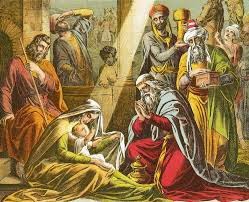
Today, as we celebrate the Epiphany, we celebrate God manifesting Himself (Epiphany means to show forth or manifest) to all the world, represented by the magi.  At Christmas God revealed Himself to the Chosen People, to Israel, represented by Mary, Joseph, and the shepherds.  Now at the Epiphany, God reveals Himself to those were not part of God’s people, the pagans, the Gentiles, the non-Jews.  God allowed the natural world (the star) to guide those who followed the movement of the stars, to lead them to Jesus, Mary, and Joseph.  And there they laid down their gifts at the feet of the newborn King.  Each gift has a meaning.
And that’s part of the beauty of the many verses of the hymn “We Three Kings”: the gifts are explained.  Gold is for a king (“Born a King on Bethlehem’s plain / Gold we bring to crown Him again;”); frankincense is for a God (“Frankincense to offer have I; / Incense owns a Deity nigh;”); myrrh is for burial (“Myrrh is mine; its bitter perfume / Breathes a life of gathering gloom;”).  Even though the magi were not part of the Chosen People, and did not have the revelation of God’s will through the Old Testament, they brought gifts for a King who was God, but who was also going to die.  They recognized Jesus as a King, as God, and as born to die, even when others later on would struggle with one or another of those identities.
But the gifts that we give Jesus tend to reveal more about ourselves than it does about Jesus.  We know who Jesus is.  We know that He was born a king, that He is truly God, and that He was born to die so that we can live.  But in the gifts that we give Jesus, we show Him what we really think about Him, and how much importance we give Him.
Time is definitely a gift that we can give Jesus, and to the extent that we give it to Him, it shows the extent to which we value His friendship.  Some have a habit of walking out after receiving Holy Communion.  While there can be legitimate reasons for this, for most people, waiting an extra 5 or 10 minutes won’t endanger anyone’s life or job.  And yet how many people leave early?  Or how many families, including sometime our Catholic school families, don’t even bother coming?  Yes, giving up an hour does mean that we are giving up doing something else that we might want to do.  But when we choose not to go to Mass (obviously not counting when we are sick, or more than 30 minutes away from a church, or when the weather makes it dangerous to drive), we withhold the gift of our time and attention from Jesus, and tell him that He is not as important as our plans and our will.
Love is also a gift that we can give Jesus.  I think sometimes we feel like an act of love of Jesus has to be profound and wordy.  But we can say it the same way we say it to others: “I love you, Jesus.”  What a beautiful prayer that is!  How many times have you said “I love you” to Jesus?  If you said it as infrequently to your spouse as you do to Jesus, would you still be married?  Even teenagers will throw that word around…a lot!  The girlfriend or boyfriend is loved, even if they have only been dating for a week.  But do we say it to Jesus?  
In a weird way, sin is also a gift that we can give Jesus.  No, this doesn’t mean that Jesus wants you to sin.  But if we do sin, He wants to take that from us, because He wants to take our death that comes from sin, and to give us life that comes from Him.  And the ordinary way of giving Jesus our sins is by going to confession.  Maybe it’s just a few small sins.  Maybe it’s a few big sins.  In either case, Jesus doesn’t want us to carry that burden.  And the ordinary way that He takes away that burden is by going to confession.  That’s the way Jesus established in the Scriptures; that’s the way a Catholic has his or her sins forgiven.  And by giving Jesus even our failings, we show Him that we want Him to have everything from us.  It’s not like Jesus doesn’t know the bad stuff we do, but we can sometimes pretend like all He needs to know about is the good stuff.  We cannot hide from God; we cannot pretend that we have not failed Him, that we have not fallen short of the glory of God.  Give even your sins to Jesus and let Him heal you.  He wants to.  He doesn’t just want your good; He also wants the bad and the ugly.  We shouldn’t try to sin, but when we do sin, give it to Jesus.

Because at the end of the day, Jesus wants all of us.  The gift He wants is of a heart given to Him.  That doesn’t mean we have to become a monk or a nun.  In every form of life, we can give Jesus our all.  And that is the perfect gift for Jesus, the gift that will give joy to His heart, the gift that He’s been waiting to receive.

03 July 2017

"With What Shall I Come Before the Lord?"

Thirteenth Sunday in Ordinary Time
The study of Canon Law, the law of the Church, is one of the least popular disciplines for priests to study after they have been ordained.  Recently, Bishop Boyea appointed one of my good priest friends, Fr. David Fons, to study Canon Law in the University of St. Thomas in the City (more commonly referred to as the Angelicum) in Rome.  Bishop Boyea’s two other choices were either Fr. Gary or Fr. Todd Koenigsknecht, the twins from Fowler who were ordained a couple of years ago.  They were very happy when Bishop Boyea chose Fr. David.  I joked with Fr. David that he should tell Frs. Gary and Todd: “Someday, and that day may never come, I’ll call upon you to do a service for me,” quoting the famous line at the beginning of the movie “The Godfather.”

We don’t have to be in the mafia to want to do something kind for those who do something for us.  We hear about the Prophet Elisha who is taken care of by a woman of influence as she gives him room on the roof “with a bed, table, chair, and lamp.”  And without her asking, Elisha wants to do something for her to repay her generosity.  And he promises her that she will conceive a son with her husband, since she was childless and her husband was an older man.
Jesus Himself in our Gospel talks about how those who serve the servants of God will receive their reward: 

“Whoever receives a prophet because he is a prophet will receive a prophet’s reward, and whoever receives a righteous man because he is a righteous man will receive a righteous man’s reward.  And whoever gives only a cup of cold water to one of these little ones to drink because the little one is a disciple–amen, I say to you, he will surely not lose his reward.”

Now, this isn’t a homily about trying to butter Father Anthony up in order to get something in return.  I may call my bulletin article Don Antonio’s Dispatch, but I’m not Don Corleone.  You, my parishioners, my family, are very generous, but you’ll never hear me say, “Someday, and that day may never come, I’ll call upon you to do a service for me.”
If we really think about it, we have received everything from Jesus.  I dare you to think about one thing, other than your sins, that you have not received from God.  Your talents–from God; your family, spouse, and children–from God; your house–God gave you the talents that helped you find a job that paid you that helped you to get the house, so from God; this building–it was built by the generosity of our parishioners who went before us, and some still here, who paid for it with the money they made from the jobs they worked using the talents they received…you guess it, from God; your priest–some of you might be saying from the devil, but I was sent here by Bishop Boyea, who, when it comes to parish assignments, speaks for God.  Everything except our sin, which is when we try to do things on our own without God, is a gift to us from God.  We are in God’s debt.  There is no two ways about it.  We owe everything to God.  So how can we repay God?
One of the choral anthems played at my first Mass of Thanksgiving and at both my installations as pastor is based on Micah 6:6-8: 

With what shall I come before the Lord, and bow before God most high?  Shall I come before him with burnt offerings, with calves a year old?  Will the Lord be pleased with thousands of rams, with myriad streams of oil?  Shall I give my firstborn for my crime, the fruit of my body for the sin of my soul?  You have been told, O mortal, what is good, and what the Lord requires of you: Only to do justice and to love goodness, and to walk humbly with your God.

But Jesus, as He so often does, raises the stakes.  He says that we must give Him everything of who we are.  If we love even our family more than Jesus, then we are not worthy of the gifts He has given me.  Only if we give away our life to Him will we find it.
And in this Mass we have the opportunity to do exactly that, at least as a beginning to our week.  Every Mass we are invited to offer all of who we are–our joys, sorrows, excitements, fears, job, family, vacation, and all that has happened since the last time we went to Mass–and unite it with the bread and the wine that is offered to God and changed into the Body and Blood of Jesus.  I know I’ve said that before, but have we done that?  Have we really put ourselves into what is offered on the altar?  I can tell you that when I do that, especially if I have something heavy on my heart, then as I hold the host in my hands and say, “This is my Body,” and as I hold the chalice in my hands and say, “This is my Blood,” there is a great weight lifted from my shoulders and I almost want to cry because of the great gift of freedom that Jesus gives me as I give Him my all.  And then God transforms it and gives it back to me as something that no longer weighs me down, but that gives me life.  But it’s not just for the tough stuff; it also applies to our joys.  And then, having given God our all in the Mass, we are then much more likely to give Him our all during the week. 

You might think that this is just my shtick as a guy who studied the liturgy–the Mass and the Sacraments.  But I truly believe it.  Give your all to Jesus, because He has already given His all for you.  And He doesn’t want a favor or a service like a mafia don.  The only thing that Jesus wants the thing only you can provide: you.

30 December 2014

The Gift Jesus Wants to Give Us

The Nativity of the Lord
Many people have favorite Christmas movies.  There are the old classics: “White Christmas,” “It’s a Wonderful Life,” and “Miracle on 34th Street.”  There are new favorites, like the Jim Carrey version of “How the Grinch Stole Christmas,” “The Santa Clause,” and “Elf.”  There are also the usual line up of songs made into short movies: “Rudolph the Red-Nosed Reindeer,” “Santa Claus is Comin to Town,” and a lesser-known, but also very good movie, “The Little Drummer Boy.”  
In this movie, there is a little boy, Aaron, who has a drum, and a pet lamb.  They end up finding the three Magi, and going with them to Bethlehem (something we will celebrate in about two weeks at the Solemnity of the Epiphany).  But along the way, the lamb that belongs to Aaron, is injured mortally.  He asks the Magi to heal it, thinking that because they are Wise Men they can heal it, but they admit they cannot.  So they encourage Aaron to go to the newest king, the baby, and ask the baby to heal the little lamb.  Aaron, not knowing what to offer the king, offers what he has: the gift of playing his drum.  At this point, the narrator says, “And as Aaron looked at the babe, he thought it was the most beautiful sight he had ever seen.”
Tonight/Today, we come to celebrate the birth of that littlest of kings, Jesus.  We come because while tomorrow (and maybe tonight) we will give gifts to each other, there is a gift that we need from Jesus.  There is some need that tugs on our heart and draws us, not to the star of Bethlehem, a city whose name means “House of Bread,” but to this church, this House of God.  There is something that we want to ask of Jesus.  But maybe we are afraid.
Isn’t it funny that we could be afraid of so little a child, so peaceful a king, so gentle a ruler?  We are afraid to ask for something, even though this infant king would grow to say, “Come to me, all you who labor and are burdened, and I will give you rest.  Take my yoke upon your shoulder and learn from me, for I am meek and humble of heart.  And you will find rest for yourself, for my yoke is easy and my burden light.”  We are afraid to ask for something, even though this merciful king would later say, “Has no one condemned you? Then neither do I condemn you.  Go, and from now on, sin no more.”  We are afraid to ask for something, even though this suffering king would later say, “Whatever you ask the Father in my name he will give you.”  What are we afraid to ask for?
What weighs on our heart tonight/this morning?  It’s likely not that we get this or that toy.  The desire of our hearts is for something greater: healing; forgiveness; love.  And Jesus wants to give us these gifts.  He wants to heal us, forgive us, and shower His love upon us.  But in order to receive that gift, we have to open our hands to Him.  And in order to open our hands to Him, we have to give something away.  Hands that are already holding on to something cannot be filled with God’s good gifts.  In order to receive the good gifts of God, what will we give away?
The Little Drummer Boy gives what he has: not silver, not power, not wisdom, not fancy clothes, not jewels, not even gold, frankincense, and myrrh like the three kings.  The Little Drummer Boy gives himself.  And he demonstrates this gift of self by playing his drum.  Have you ever heard a single drum play by itself?  It’s not very impressive.  The simple rat-a-tat-tat, or, as the song goes, ra-pa-pum-pum, has no grandeur to it, but only simplicity.  And yet, as simple as it is, it is a full gift, because it is all the boy has.  It is like the widow’s mite, her lowly coin, that is all she has.  After the boy plays the drum, and the song plays in the background, one of the three kings says, “Your gift, little drummer boy, given out of the simple desperation of a pure love is the one favored above all.”  The gift of love, given when we have nothing else to give, is the gift God favors above all.  He wants the gift of our heart, given to Him because we know we have nothing else but love.  And when we give that gift of love, the love we receive in return is overwhelming.
Tonights readings all focus us the gift of Jesus that God gave to us, to those who could receive Him.  In times past, God had sent other gifts through the judges and prophets and kings.  But this gift is the greatest of all, because it was the gift of the Love of God, His Only-Begotten Son.  As I sit down, I want you all to close your eyes, take a deep breath in, breathe it out, and then say in the silence of your heart: God, I offer you my heart.  God, I offer you my heart.  God, I offer you my heart.

That is the best gift we can give at Christmas.  That is the gift God wants.  May that be our prayer every day: God, I offer you my heart.