Showing posts with label gift. Show all posts

20 January 2025

Stewardship

Second Sunday after Epiphany
    In the name of the Father, and of the Son, and of the Holy Spirit.  Amen.  I either recently received a book on stewardship, or I recently rediscovered that I received a book on stewardship.  In any case, I’ve been reading a little each day (it’s a very thin book to begin with), but it struck me as I read the epistle today that a theme in this part of St. Paul’s epistle the Romans deals with stewardship.
    Now, I know that some use stewardship as a code word for giving money.  And, as we just finished our part of the Diocesan Capital Campaign, you might think that talking about stewardship is killing a dead horse.  But this is not such much about giving money, as you have all been very generous with the parish, as a reminder about important points that lead to fruitful stewardship of time, talent, and, yes, treasure.
    Because one of the first points this book makes is that stewardship comes naturally when we consider that everything that we have is a gift from God.  And that view does not come naturally to us because of our fallen reality.  We tend to grasp at most things like they’re ours, like we are responsible for them, and like we don’t want anyone else to have them.  We live with a scarcity mentality, as if when we don’t hold on to things, others may take them, and we might miss out on something we need.  Just think back to the beginning of COVID: we had plenty of toilet paper.  But someone got it in his head that we might run out, and no one wants to rely on leaves, so they started buying up all they could, such that there was a scarcity because people took what they didn’t need.  
    But when we recognize that everything is a gift from God, then we want to give back to God what He desires, which is everything.  Everything may not be much, but the Lord praises the widow, not for the amount of coins she gave (others gave more coins than she), but for the value of what she gave, which was her everything.  

    What does God do when we give Him everything?  Many times He gives it all back, or even makes it better.  Now, I’m not preaching the so-called “prosperity Gospel.”  I’m not preaching that if you just give 10% of your annual salary, God will give you 20% more money.  That’s not the Gospel.  But the Gospel from today does teach us the lesson that God is not outdone in His generosity, to paraphrase St. Paul.  The servants give our Lord water.  And they put them, not in the finest containers, but in the containers with which the guests would wash their hands.  But when the servants take the containers to the chief steward of the feast, he doesn’t taste water, but wine, which came about through the first miracle our Lord worked.  The Father does the same thing with what we offer Him in this Mass.  We offer the Father bread and wine, and not the best bread or wine, either.  It’s not like we’re getting the bread from crust or from Zingermans.  It’s not like the wine is a fine 2020 cab from Napa.  But we offer Him the bread and wine that He desires, and, by the power of the Holy Spirit and through the ministry of the priest, bread and wine offered to God become the Body and Blood of our Savior.  We can’t taste or see any different, but we know that it’s no longer bread and wine, but the Bread of Life and the antidote of immortality (as St. Ignatius of Antioch called the Eucharist).  We offer God what we have, even if it doesn’t seem like much, and God transforms it by His grace into something better.
    And when we receive that something better, and we recognize just how much God has given us, we want to share that gift with others.  And my gift is different than your gift.  But when we all make a return on our gifts, the whole Mystical Body of Christ works well and changes lives.  St. Paul write about that in our epistle, how some were given the gift of prophecy, or administration, or in ministry, or in teaching, or exhortation, or cheerfulness.  St. Paul doesn’t tell those who are good in cheerfulness that they need to start prophesying.  Or those who teach well need to start working on administration.  He asks everyone to use the gifts they have to the best of their ability so that the Gospel can be preached and the Church can be built up.  
    So, for example, I’m pretty bad a brainstorming.  This doesn’t mean that I’ve never had an original idea, but that’s not where I thrive.  I thrive in evaluating ideas and seeing what it would take to execute, or if execution is even a possibility or probability.  But I try to use that build up the Body of Christ.  Now, as a priest, I am called to do certain things, like preach.  I am not Venerable Fulton Sheen, but I offer God my meditation on the Scripture passage or the season, and the work that I put in, and the Holy Spirit does the rest.  Sometimes I think a homily is horrible, and then lots of people tell me how it touched them.  Sometimes I think a homily is great, but then no one says anything.  But no matter what, I am called to give my all to God, trusting that God will perfect my gift, and help it to multiply for the building up of His Church.
    So many of you are committed to this parish and to spreading the Gospel.  You give of your time, talent, and treasure to support the work, not just of St. Matthew, but of the Church in this Diocese, and the Church present throughout the world.  But the Lord reminds us today to continue to work at giving all of who we are to Him.  He never leaves us empty handed, even if we don’t necessarily increase in material wealth, but will always give us back better than received.  As the Blessed Mother encouraged the servants to do at the wedding at Cana, give what you have to Christ, who will never let you want for any good thing, and who, with the Father and the Holy Spirit is God for ever and ever.  Amen. 

06 January 2018

A Gift for Jesus

Solemnity of the Epiphany of the Lord
I am not the greatest gift giver.  I try; I really do.  I try to think what my parents, sisters, nieces, and friends would like to get, especially for Christmas.  But I never seem to have the knack of getting something that they really want, unless, of course, I’ve already asked them what they want.  I don’t beat myself up too much for needing to ask what my nieces want; I don’t see them too often, and I’m not quite in touch with what 2 and 5 year girls like.  
On Christmas, we celebrated the greatest gift ever: Jesus Christ, God-made-man, God-with-us.  At Christmas we usually give gifts, and it’s fitting that we try to imitate God’s generosity, though His generosity can never be outdone.  God gave us the possibility of eternal salvation when heaven and earth were joined in Jesus, the Word made flesh.  And throughout the Christmas season we have probably treasured our gifts, maybe used them, and maybe we think of the person who gave us those gifts when we do use them.
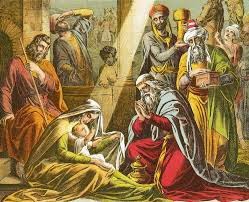
Today, as we celebrate the Epiphany, we celebrate God manifesting Himself (Epiphany means to show forth or manifest) to all the world, represented by the magi.  At Christmas God revealed Himself to the Chosen People, to Israel, represented by Mary, Joseph, and the shepherds.  Now at the Epiphany, God reveals Himself to those were not part of God’s people, the pagans, the Gentiles, the non-Jews.  God allowed the natural world (the star) to guide those who followed the movement of the stars, to lead them to Jesus, Mary, and Joseph.  And there they laid down their gifts at the feet of the newborn King.  Each gift has a meaning.
And that’s part of the beauty of the many verses of the hymn “We Three Kings”: the gifts are explained.  Gold is for a king (“Born a King on Bethlehem’s plain / Gold we bring to crown Him again;”); frankincense is for a God (“Frankincense to offer have I; / Incense owns a Deity nigh;”); myrrh is for burial (“Myrrh is mine; its bitter perfume / Breathes a life of gathering gloom;”).  Even though the magi were not part of the Chosen People, and did not have the revelation of God’s will through the Old Testament, they brought gifts for a King who was God, but who was also going to die.  They recognized Jesus as a King, as God, and as born to die, even when others later on would struggle with one or another of those identities.
But the gifts that we give Jesus tend to reveal more about ourselves than it does about Jesus.  We know who Jesus is.  We know that He was born a king, that He is truly God, and that He was born to die so that we can live.  But in the gifts that we give Jesus, we show Him what we really think about Him, and how much importance we give Him.
Time is definitely a gift that we can give Jesus, and to the extent that we give it to Him, it shows the extent to which we value His friendship.  Some have a habit of walking out after receiving Holy Communion.  While there can be legitimate reasons for this, for most people, waiting an extra 5 or 10 minutes won’t endanger anyone’s life or job.  And yet how many people leave early?  Or how many families, including sometime our Catholic school families, don’t even bother coming?  Yes, giving up an hour does mean that we are giving up doing something else that we might want to do.  But when we choose not to go to Mass (obviously not counting when we are sick, or more than 30 minutes away from a church, or when the weather makes it dangerous to drive), we withhold the gift of our time and attention from Jesus, and tell him that He is not as important as our plans and our will.
Love is also a gift that we can give Jesus.  I think sometimes we feel like an act of love of Jesus has to be profound and wordy.  But we can say it the same way we say it to others: “I love you, Jesus.”  What a beautiful prayer that is!  How many times have you said “I love you” to Jesus?  If you said it as infrequently to your spouse as you do to Jesus, would you still be married?  Even teenagers will throw that word around…a lot!  The girlfriend or boyfriend is loved, even if they have only been dating for a week.  But do we say it to Jesus?  
In a weird way, sin is also a gift that we can give Jesus.  No, this doesn’t mean that Jesus wants you to sin.  But if we do sin, He wants to take that from us, because He wants to take our death that comes from sin, and to give us life that comes from Him.  And the ordinary way of giving Jesus our sins is by going to confession.  Maybe it’s just a few small sins.  Maybe it’s a few big sins.  In either case, Jesus doesn’t want us to carry that burden.  And the ordinary way that He takes away that burden is by going to confession.  That’s the way Jesus established in the Scriptures; that’s the way a Catholic has his or her sins forgiven.  And by giving Jesus even our failings, we show Him that we want Him to have everything from us.  It’s not like Jesus doesn’t know the bad stuff we do, but we can sometimes pretend like all He needs to know about is the good stuff.  We cannot hide from God; we cannot pretend that we have not failed Him, that we have not fallen short of the glory of God.  Give even your sins to Jesus and let Him heal you.  He wants to.  He doesn’t just want your good; He also wants the bad and the ugly.  We shouldn’t try to sin, but when we do sin, give it to Jesus.

Because at the end of the day, Jesus wants all of us.  The gift He wants is of a heart given to Him.  That doesn’t mean we have to become a monk or a nun.  In every form of life, we can give Jesus our all.  And that is the perfect gift for Jesus, the gift that will give joy to His heart, the gift that He’s been waiting to receive.

03 July 2017

"With What Shall I Come Before the Lord?"

Thirteenth Sunday in Ordinary Time
The study of Canon Law, the law of the Church, is one of the least popular disciplines for priests to study after they have been ordained.  Recently, Bishop Boyea appointed one of my good priest friends, Fr. David Fons, to study Canon Law in the University of St. Thomas in the City (more commonly referred to as the Angelicum) in Rome.  Bishop Boyea’s two other choices were either Fr. Gary or Fr. Todd Koenigsknecht, the twins from Fowler who were ordained a couple of years ago.  They were very happy when Bishop Boyea chose Fr. David.  I joked with Fr. David that he should tell Frs. Gary and Todd: “Someday, and that day may never come, I’ll call upon you to do a service for me,” quoting the famous line at the beginning of the movie “The Godfather.”

We don’t have to be in the mafia to want to do something kind for those who do something for us.  We hear about the Prophet Elisha who is taken care of by a woman of influence as she gives him room on the roof “with a bed, table, chair, and lamp.”  And without her asking, Elisha wants to do something for her to repay her generosity.  And he promises her that she will conceive a son with her husband, since she was childless and her husband was an older man.
Jesus Himself in our Gospel talks about how those who serve the servants of God will receive their reward: 

“Whoever receives a prophet because he is a prophet will receive a prophet’s reward, and whoever receives a righteous man because he is a righteous man will receive a righteous man’s reward.  And whoever gives only a cup of cold water to one of these little ones to drink because the little one is a disciple–amen, I say to you, he will surely not lose his reward.”

Now, this isn’t a homily about trying to butter Father Anthony up in order to get something in return.  I may call my bulletin article Don Antonio’s Dispatch, but I’m not Don Corleone.  You, my parishioners, my family, are very generous, but you’ll never hear me say, “Someday, and that day may never come, I’ll call upon you to do a service for me.”
If we really think about it, we have received everything from Jesus.  I dare you to think about one thing, other than your sins, that you have not received from God.  Your talents–from God; your family, spouse, and children–from God; your house–God gave you the talents that helped you find a job that paid you that helped you to get the house, so from God; this building–it was built by the generosity of our parishioners who went before us, and some still here, who paid for it with the money they made from the jobs they worked using the talents they received…you guess it, from God; your priest–some of you might be saying from the devil, but I was sent here by Bishop Boyea, who, when it comes to parish assignments, speaks for God.  Everything except our sin, which is when we try to do things on our own without God, is a gift to us from God.  We are in God’s debt.  There is no two ways about it.  We owe everything to God.  So how can we repay God?
One of the choral anthems played at my first Mass of Thanksgiving and at both my installations as pastor is based on Micah 6:6-8: 

With what shall I come before the Lord, and bow before God most high?  Shall I come before him with burnt offerings, with calves a year old?  Will the Lord be pleased with thousands of rams, with myriad streams of oil?  Shall I give my firstborn for my crime, the fruit of my body for the sin of my soul?  You have been told, O mortal, what is good, and what the Lord requires of you: Only to do justice and to love goodness, and to walk humbly with your God.

But Jesus, as He so often does, raises the stakes.  He says that we must give Him everything of who we are.  If we love even our family more than Jesus, then we are not worthy of the gifts He has given me.  Only if we give away our life to Him will we find it.
And in this Mass we have the opportunity to do exactly that, at least as a beginning to our week.  Every Mass we are invited to offer all of who we are–our joys, sorrows, excitements, fears, job, family, vacation, and all that has happened since the last time we went to Mass–and unite it with the bread and the wine that is offered to God and changed into the Body and Blood of Jesus.  I know I’ve said that before, but have we done that?  Have we really put ourselves into what is offered on the altar?  I can tell you that when I do that, especially if I have something heavy on my heart, then as I hold the host in my hands and say, “This is my Body,” and as I hold the chalice in my hands and say, “This is my Blood,” there is a great weight lifted from my shoulders and I almost want to cry because of the great gift of freedom that Jesus gives me as I give Him my all.  And then God transforms it and gives it back to me as something that no longer weighs me down, but that gives me life.  But it’s not just for the tough stuff; it also applies to our joys.  And then, having given God our all in the Mass, we are then much more likely to give Him our all during the week. 

You might think that this is just my shtick as a guy who studied the liturgy–the Mass and the Sacraments.  But I truly believe it.  Give your all to Jesus, because He has already given His all for you.  And He doesn’t want a favor or a service like a mafia don.  The only thing that Jesus wants the thing only you can provide: you.

30 December 2013

Why are you here?


Solemnity of the Nativity of Our Lord
            Why did you come here this morning?  Why interrupt the family celebrations, the excitement of opening presents?  Why brave the elements?  Maybe you don't have power.  There are many other answers, too, perhaps as many as there are people in this church.  And there is only one answer: because God wants you here.
            God wants you here like He wanted the shepherds to visit that cave where Jesus was born.  Somewhere in your hearts He sent His angel to proclaim to you the “good news of great joy”, that, “today in the city of David a savior has been born for you who is Christ and Lord.”   And we ourselves joined in the angelic song, “Glory to God in the highest and on earth peace to people of good will.” 
            God wants you to be here because He has a gift for you, and a gift He wants from you.  The gift He gives to you is Himself.  The gift He wants from you is yourself.  His gift can only be received if your gift is given.  God’s very life, which we call grace, is offered to you this night.  It is like a bottle of wine waiting to be poured into the glass of your soul.  But in order for the wine to be poured, you first has to offer Him your glass, because God will not force His gift upon you. 
            It’s strange, isn’t it?  That our God, who created all the exists: the heavens, the earth, and all that dwells in them—the  angels, the animals, the waters, the mountains, the stars, the galaxies—God who created all this and who has unlimited power, will not overwhelm us with this power, but waits for our yes to His invitation.  It’s strange that, when our God decided to take on human flesh, He did not come as a Roman Emperor from the West, or as a Persian priest from the East, but as a baby.  But that is exactly what happened.
            We probably all want God’s gift.  Who would not want to receive the very life of God?  Who would not want to love of God, the peace of God, the joy of God to flow through our very souls?  We all want God’s gift.  But we are more hesitant to give God His gift from us.  We all want God’s life, but we shrink back at giving God our life.  We hesitate at the idea that we would turn over to God our time, even our focused time of around an hour each Sunday.  We falter at the idea that God would be in control of our life and direct our actions and words.  We pause when we consider that God might take us somewhere we don’t want to go.
            Fear.  It can be paralyzing.  Fear can stop us from doing what we truly want to do.  We all have fear at giving our gift to God, the gift of our entire life.  I still have areas of my heart that do no belong to Jesus fully.  Why?  Because I am afraid that I will miss that part of my life if I give it away.  I do not trust that God will truly be enough for me.  Yes, much of my life belongs to the Lord, but there are still parts that I hold back.  Maybe you haven’t visited your Catholic home, the church, for a while.  Maybe it took all your courage just to come here today.  First and foremost: welcome home!  We love you and we have missed you.  Maybe you come every week, but the practice of your faith ends as you walk out these doors.  We love you, too, and encourage you to share your faith with others.  We all have parts of our lives that are not fully given over to Jesus.  Some of us have held back more than others.  But no matter how much we have reserved from God, we are all called to band together, to be courageous together, and to support each other in giving our entire lives to God.  We lose nothing when we give ourselves away.  In fact, in Divine Irony, we only lose our life when we fail to give it away.
           
What we celebrate today is the scandalous fact that God, whom the heavens and earth cannot contain, took flesh and was born of the Virgin Mary.  Why?  So that our fear could be melted by one who was like us in all things but sin; so that we could have the audacity to give ourselves entirely over to the Lord; so that the yoke of sin that burdens us, the pole of guilt on our shoulders, the rod of slavery to sin of our taskmaster could be smashed and we could be set free; so that the grace of God, the life of God, could train us “to reject godless ways and worldly desires and to live temperately, justly, and devoutly in this age, as we await the blessed hope, the appearance of the glory of our great God and savior Jesus Christ,” as St. Paul says in his letter to St. Titus; so that we could live in the light of Christ, which shines in the darkness of ignorance, falsehood, and lies, and the darkness does not overcome it, as St. John says in the Prologue of his Gospel; so that we could receive from the fullness of God, “grace in place of grace,” again as St. John says in his Gospel. 
            Today God wants you here.  He wants to give you the gift of Himself.  But He will not force His gift on you.  You and I must be open to that gift by giving God our entire life: nothing more, nothing less.  If we are open to it, God will change us to be more like Him, which will give us true happiness.  And if we are like God, then this world, wrapped in the double darkness of sin and ignorance, will also be changed into a light of holiness and truth, the world in which we all want to live.