11 February 2019

Duc In Altum

Fifth Sunday in Ordinary Time
One of my favorite saints has always been St. Peter.  No, I don’t want to be pope (being a pastor is enough responsibility for me!), but I like St. Peter.  He’s one of the great apostles of Jesus, who always has great things to say, unless he’s putting his foot in his mouth (as he also often does).  He is, we might say, very relatable.  I’d like to believe that I have had great moments of faith and trust in God (even if great is a sliding scale), but I also know that I have had my own outbreaks of foot-in-mouth disease.
And since I like St. Peter so much, today’s Gospel is one of my favorites.  It’s St. Luke talking about how St. Peter was called by Jesus.  St. Peter (still going by Simon at this point) is fishing all night and catching nothing (side note: have you ever noticed that St. Peter is never able to catch fish on his own?!?).  Then Jesus, who, from all outside views, knows nothing about fishing, tells him to go out again, and put into deep waters.  St. Peter begrudgingly does this, and then catches so many fish that he has to call his partners, James and John (who also became apostles), to help him drag it in.  St. Peter realizes that he is in the presence of someone special, someone great, and makes a confession of his own sinfulness.  Jesus tells him not to be afraid, because he will be catching men from now on.
When others hear this story, they sometimes ask me how I came to follow Jesus as a priest.  And certainly, all of our readings focus on calls: on the call of Isaiah to be a prophet; the call of St. Paul to preach the Gospel as the last apostle; and, as I mentioned, the call of St. Peter to follow Jesus as one, and the chief, of His apostles.  
Some priests I know have amazing stories like St. Peter of Jesus doing something great and spectacular in their lives.  But for me, that’s not the case.  As an eighth grader, I started thinking about what I wanted to do as an adult (so that I could concentrate on the right classes in high school, get into a good college in a field in which I wanted, and then get a good job).  If it were up to me, I wanted to be a lawyer, and then maybe go into politics.  I wanted to be married, have a few kids, a couple of dogs, and have lots of money.  But I knew that if I were going to be happy, I had to do what God wanted me to do.  So I started praying to God each night, asking Him to let me know.  And I heard nothing.  
So I started to go to daily Mass a few times at Lansing Catholic High School, and it was there that a stranger asked me if I were going to be a priest.  And other classmates and teachers started to do the same thing.  And before long, I started to realize that maybe God was asking me to consider a vocation to the priesthood.  I started to learn more about Catholicism, and fell in love with the Church, as one falls in love with his girlfriend.  And I decided that I wanted to give my life to serve her, just as a man decides (and hopefully the woman agrees) that he wants to give his life to serve the woman he wants to be his wife.  I applied to the seminary in my senior year through the Diocese of Lansing, and was accepted for my freshman year of college.  Each year I asked God to make it painfully clear if He didn’t want me to continue on.  And each year, I was asked to come back and continue studying to become a priest.  It wasn’t always easy; there were times where I thought (with the assistance of a rather attractive female lab partner) that maybe the priesthood wasn’t for me; but God did and has sustained me in my vocation.  God’s providential care for me has been more in the day-to-day events of life, not so much in the spectacular, like St. Peter.
But God knows what we need in responding to His call.  Some people don’t need the dramatic moments.  Some people do.  The key is that we are listening for the call of Jesus, and we respond with courage to the call of Jesus.  Because Jesus says to anyone who wants to follow Him, “Put out into deep water.”  In Latin that phrase is Duc in altum, and it was used by Pope St. John Paul II as he began his Apostolic Letter on the new millennium in 2001.  It was also a favorite of Bishop Mengeling, who told us seminarians not to dangle our toes in the water, but to put out into deep water.
Any vocational call–ordained ministry, marriage, consecrated life–and even while discerning God’s call, takes courage.  It takes faith in God, and confidence that He will show you the way.  As a priest it takes courage to serve when a very small percentage have tainted the good name of the priesthood, and it takes courage to say yes to never having a wife and a biological family of your own.  As a consecrated man or woman it takes courage to promise to not have any personal bank accounts and to be obedient to the religious congregation’s superiors.  As a married man or woman, it takes courage to commit to only being with one person in the special friendship of marriage for your entire life, to only be physically intimate with that person as long as that person lives.  Any vocation, and, again, even when trying to find out what God wants us to do, takes the courage to put out into deep waters and trust that God will not abandon us in those waters.

Many of you already have discerned your vocation here.  But some of you have not.  Be courageous in answering the Lord’s call, whatever it is, in your life.  Some of you may have spectacular calls like St. Peter.  Some of you will have more quotidian or ordinary calls like me.  But don’t be afraid to answer it.  Duc in altum!

04 February 2019

Disciples are Made for Greatness, Not Comfort

Fourth Sunday in Ordinary Time
There’s a temptation that can creep into any believer’s life, that if we just do the right things, then everything in our life is going to go well.  Maybe it comes from a desire for justice, for everyone getting what is owed them, but we can easily think that if we follow God, if we live our life according to what the Church teaches, then life should be easy for us.  We should be rewarded for good behavior, just like bad behavior should be punished.  There are even those who claim to preach the Gospel (they are really just perverting it) who say that if we follow God’s laws and if we give 10% to the Church, then God is going to make us rich and give us every earthly pleasure that is holy that we could desire.  We call that the Gospel of Prosperity (note that it’s not the Gospel of Jesus Christ).  
This perhaps also betrays a certain tendency in our human nature to want comfort, which is especially prevalent today among the young.  We want the good life, where we don’t have to struggle, don’t have to put forth effort, but we still get the rewards that would come from struggle and effort.  In one sense, we might say that this is built in to us because we were created for prelapsarian life, the life before the Fall in the Garden of Eden.  But we are living in postlapsarian times, the time after the Fall, where we earn our living by the sweat of our brow.  Furthermore, as Pope Benedict XVI reminded us, “The world promises you comfort, but you were not made for comfort.  You were made for greatness.”  Greatness takes work.  Works means struggle.  Struggle means pain.  And it even applies for those who follow God.

Take Jeremiah in our first reading.  God appointed him a prophet.  In fact, God says that He appointed Jeremiah a prophet even while Jeremiah was in his mother’s womb.  And yet, Jeremiah has a tough life, so much so, that God says, “gird your loins; […] Be not crushed on their account.”  Jeremiah is the prophet who immediately prophesies the destruction of Jerusalem and the exile of God’s people to Babylon.  As you might imagine, no one liked hearing this dire message.  But even as God tells Jeremiah that he will undergo a lot, he also promises that he has “made you a fortified city, a pillar of iron, a wall of brass…They will fight against you but not prevail over you, for I am with you to deliver you, says the Lord.”  
But besides the fact that God does not promise that those who follow Him and speak for Him will have it easy, Jesus also reminds us that sometimes those who don’t follow God get blessings.  The widow in Zarephath to whom Elijah was sent was not a Jew, and yet God took care of her.  Naaman the Syrian was a foreign general, a general of an army that was constantly threatening to destroy the Jews, and yet God, through the Prophet Elisha, cured him of leprosy.  Those who don’t follow God can still receive His blessings and healing.
And, if we look at Jesus, the co-eternal Son of God, He was perfect.  He never sinned, never did anything wrong.  He followed God’s will perfectly, and extended healing to many, both Jew and Gentile alike.  And what did Jesus get for perfectly doing the will of God and healing those who were ill?  He was led to the cross do die for our sins.  He suffered the most painful and embarrassing way to die as nails pierced his hands and feet and he hung naked outside the walls of Jerusalem.
But just in case you thought that being a disciple of Jesus means that life is going to be quite painful and horrible, that’s not the truth either.  Yes, our life on earth, in the vale of tears, may have a lot of suffering, but faithfulness to God always leads to eternal life in heaven.  Jesus shows us that in the most perfect way in His Resurrection.  Yes, following God’s will led Jesus to the cross, but the cross led to the Resurrection.  Yes, Jeremiah was treated poorly for speaking a difficult word from God, but he was received into heaven when Christ opened the gates of Paradise.  We long for the ease of Eden, but God promises, after our trials and tribulations on earth, a paradise and a comfort that exceeds anything that earth can offer to an infinite degree.  To tweak Pope Benedict’s words slightly, we were not made for comfort on this earth, but we were made for eternal joy in heaven.  
And what guides us amid the joys and sorrows of life?  Love.  True love, which means the type of love that is patient, kind, not jealous, not pompous, not rude, not quick-tempered, not brooding, rejoicing in the truth.  Love guides us to our eternal joy because perfect love is eternal joy in heaven, where God, who is Love itself, shows us himself face to face.  

It would be nice if everything came to us without effort; if following Jesus did not require sacrifice and struggle.  But because we are fallen, following Jesus does not mean that we will get everything we want and life will not always be easy.  But, if we stay faithful to Christ, especially when it requires sacrifice and struggle, we know that we have a treasure, not made by hands, eternal in heaven, waiting for us, and fulfilling beyond measure the desire we have on earth for true joy.

28 January 2019

Not Them vs. Us

Third Sunday in Ordinary Time
If you’ve been watching the news recently (a depressing venture, to be sure), you’ve heard about students from Convington Catholic High School at the March for Life.  A first video was shared which seemed to show an elder Native American activist being shouted at by the students, some with “Make America Great Again” hats, with one student in particular with a smug, very condescending smile on his face.  Some also claimed that the students were chanting “Build the Wall.”  The students were excoriated in the media as being the problem with America, and by some, the problem with the pro-life movement.  The Diocese of Convington apologized for the students’ behavior and judged them as guilty based upon the popular narrative at the time.
Shortly after the first video was released, a second video was released with more context, showing that the students were being yelled at by an African-American group that was protesting.  That group of people were yelling hateful things towards the students, so, to drown out the hate, they started doing school chants.  At that point, the elder Native American and his group walked towards the students, and the Native American elder stood very close to the smiling student.  That student explained that he was smiling to try to diffuse a very tense situation, and did what he thought was best to keep other students from the school from becoming verbally or physically abusive in retaliation.  Some apologies and retractions were issued about those who pounced on the first video, and these students were put forward as good examples of our youth not being baited into a fight, while others were excoriated for jumping to conclusions and reporting those conclusions before all the facts were available.
I’m not here to dissect all the blame in this situation, and who is right and who is wrong.  I’m here to preach the Gospel, and our Gospel today bears upon this situation.  Jesus in the Gospel says, quoting the Prophet Isaiah, that he has come “‘to proclaim liberty to captives…[and] to let the oppressed go free.’”  When we hear those words, we probably associate them with those who are incarcerated or held by strong forces (captives) and those who are downtrodden (the oppressed).  Maybe we think about it in social terms or government terms, or maybe even military or law enforcement terms (probably, some of those hearing it understood Jesus to mean that He was going to free them from Roman rule).  
But we are today captivated, that is to say, held by, and oppressed by more things than just foreign powers or strong worldly forces.  We are, I would suggested, held captive and oppressed by a mentality, from which Jesus came to free us.  That mentality, which captivates and oppresses us is a mentality which divides the world into “them” and “us.”  Jesus does not see people as “others,” but rather, as “His,” because all things have been handed over to Him by His Father, by our heavenly Father.  
This is not to say that Jesus naïvely thought that everyone was working for him.  How many times did Jesus condemn the scribes and Pharisees for their wrong interpretation of the law, their oppression of people, and they hypocrisy.  And yet, when a Pharisee came asking Jesus about the greatest commandment, and when Jesus responded, that Pharisee gave his assent to the teaching of Jesus, then Jesus told the Pharisee that he was not far from salvation.  Jesus condemned the misreading and skepticism about the resurrection of the dead by the Sadducees, and yet Nicodemus, one of the Sadducees, engaged in dialogue with Jesus about baptism and being born again, and there was no condemnation from Jesus.  Jesus told the adulterous woman to go and sin no more, and called tax collectors to stop cheating others, and called everyone to stop hating their enemies, or looking lustfully at people, or swearing oaths blithely.  But Jesus also welcomed sinners into His company and invited them to a relationship with Him so that they could find the conversion to which Jesus called them.
We have become captives and oppressed by a worldview that divides the world.  We are all too happy to condemn them when they don’t agree with us.  This is hard to do as humans, because we’re social and want to belong.  So we demonize others, put them down, so that we can write them off.  Look at Congress and the President over the past month.  Nothing was getting done because each side had demonized the other.  There’s plenty of blame to go around for both sides; no one side is perfectly innocent.  The same goes for the coverage of the Convington Catholic students.  And yet, we willingly let ourselves be led like lemmings to a pre-determined conclusion because of a political or social affiliation that we value more than our affiliation with Jesus.  St. Paul says in his letter to the Ephesians: 
remember that at one time you, Gentiles in the flesh…were at that time without Christ, alienated from the community of Israel and strangers to the covenants of promise, without hope and without God in the world.  But now in Christ Jesus you who once were far off have become nearly by the blood of Christ.  For he is our peace, he who made both one and broke down the dividing wall of enmity, through his flesh…[creating] in himself one new person in place of the two, thus establishing peace.

St. Paul puts it in terms of Gentile and Jew, the Jewish division of the world.  But it applies to any division we make in our world.

There are people who do evil in the world.  There is legitimate blame for things that people do wrong, for which we can hold them accountable.  But if we see the world through the lens of “them” vs. “us,” then we are ignoring the Good News that Jesus came to bring, that He came to bring us freedom from being held captive and oppressed by division, and that God’s freedom, prophesied by Isaiah, has been fulfilled by Christ.

12 January 2019

Our True Identity

Feast of the Baptism of the Lord
One of the most popular Disney movies is “The Lion King.”  I think we’ve all seen it; I know as a kid I watched it too many times to count.  Powers did a great stage production of it last year.  Towards the end of the movie, there is a powerful scene, and I won’t be able to do justice to it here, but it’s the scene where Rafiki, the wise baboon, tells Simba, now grown and hanging out in the jungle with Timon and Pumba, that his father, Mufasa, is still alive (remember that Scar had killed Mufasa when Mufasa saved Simba).  Rafiki takes Simba to a pool, where Simba looks into the pool and sees his reflection.  Disappionted, Simba says that it’s just his reflection.  “Look harder,” Rafiki says.  And Simba looks again.  Rafiki continues, “You see, he lives in you.”
Today we celebrate the Baptism of the Lord.  Even though Jesus was already God the Father’s co-eternal Son, still, the voice of the Father is heard from the heavens, “‘You are my beloved Son; with you I am well pleased.’”  Jesus had no need to be baptized, but he still allowed St. John the Baptist to baptize him as a model for what we are to do, and to show us the reality of what happens.
When we are baptized, original sin is washed away from us, like dirt being washed away by the water.  When we are baptized, we become a member of the Church, the mystical Body of Christ, the group of those who follow Jesus’ teachings.  When we are baptized, even if we cannot hear it, the voice of the Father comes from heaven and says, “You are my beloved Son; with you I am well pleased.”  In baptism, we become sons and daughters in the Son of God.  God gives us His life, and imprints in us the identity of His Son, Jesus Christ.  That becomes who we are, and who we are meant to be.
Too often, we identify ourselves by something other than our baptism.  Maybe we identify ourselves by our work, by what we do.  Maybe we identify ourselves by our worldly successes, by how much money we make, or the home we own, or the car we drive.  Maybe we identify ourselves by our failures, by the mistakes we make, the sins we commit, the standards, realistic or unrealistic, that are set for us or that we set for ourselves.  I know that’s my Achille’s heal: to identify myself by my failures, and Lord knows there’s enough of them to think about!  But, however we think we should identify ourselves, God invites us today to identify ourselves the way He does: by our baptism. 
In Baptism we are given a dignity that infinitely surpasses anything we could hope to achieve on earth.  Even if we were the most powerful, the richest, the most famous person on earth, that is nothing compared to how God sees us.  Even the weakest, poorest, most insignificant person, if baptized, is a son or daughter of God in the Son of God, and has worth beyond measure in the eyes of God.  Think about how much love God has for Jesus.  Try to imagine it!  You can’t imagine it, because God’s love for Jesus is infinite, and our finite minds could never even come close to processing how much God loves Jesus.  Now, because of baptism, that love that God the Father has for Jesus is given, freely and generously, to us.  In baptism, we are joined to Christ so that the Father sees Jesus whenever He sees us.
It is that identity that then becomes the way we should live our lives.  We don’t live a certain way to earn God’s love.  That’s foolish and a heresy (Pelagianism).  We can never earn God’s love.  If we were to live the best and holist life ever, we could still never earn God’s love.  But the identity that we receive in baptism, the identity of Christ, that calls us to live in a certain way, to live as Jesus would live, to the best of our ability.  It is supposed to be, as St. Paul says, no longer I who lives but Christ who lives in me.  
Think back to the Lion King.  Simba had grown used to living as a wart hog and a meer cat.  It was fun, it was carefree (hakuna matata!), but it wasn’t who Simba was.  Sin is often fun, it’s almost always carefree.  But it’s not who we are.  We are not our jobs.  We are not our successes.  Most importantly, we are not our failures.  Satan tries to convince us that our identity is in something other than our baptism.  Simba, though, was a lion and a king.  And it was living according to that identity that gave him true joy.  We are, in Christ, little anointed ones, little christs.  In Jesus, we are sons and daughters of God.  That identity gives us true joy, and helps us know how we are to live our life.

When we were baptized, we went from merely being our parents’ child, to being a child of God in the Son of God.  God made our identity that of His beloved Son.  That is how we should see ourselves.  That shows us how to act in life.  That is the most important thing to know about who we are.  Today the voice of the Father speaks: “‘You are my beloved Son.’”

07 January 2019

Giving Jesus our Time, Talent, and Treasure

Solemnity of the Epiphany
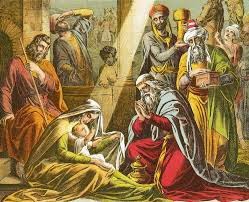
When we think about the gifts that the magi bring to the Christ Child, we might think that they’re a little odd.  Gold, yes, everyone can use some gold.  Frankincense, we might not think as so helpful.  And myrrh, well, let’s be honest, many people probably don’t even know what myrrh is.  We may think that the magi should have brought more practical gifts, like diapers, or blankets, or almost anything else.  
But while our minds are geared towards practicality, the gifts that the magi, or wise men, brought is not concerned with the practical, but rather, the symbolic.  The magi, by their gifts, mean to communicate a message about who they understand Jesus to be.  Gold is a gift that you would give a king.  The magi understood, however faintly, that Jesus is the King of kings and Lord of lords, and their gift acknowledged that reality.  Frankincense, like the incense we use today, is what is offered to God.  The smoke of the incense rises, reminding us of our prayers rising to the heavens as we adore God.  It also gives a sense of transcendence, since the cloudy can seem otherworldly.  Think about Mt. Sinai in the Book of Exodus: the mountain is wrapped in smoke when God is present.  The magi recognized that, in addition to being a king, Jesus was also a deity, and deserved worship and the things that belong with it.  Myrrh is an oil, or a balm, and it was used to anoint the bodies of the dead.  While the Egyptians embalmed their dead, such a practice was not as common in the rest of the world.  So the bodies were anointed with a perfumed oil as a sign of respect and preparation for whatever came after death.  Besides recognizing that Jesus was a King and God, they also recognized that He was going to die (especially an odd thought if you believed that Jesus was a God).  Yet, we all look to Good Friday when God died on the Cross in the Person of Jesus.
As we celebrate this Epiphany, and the gifts that the magi presented to Jesus, we, too, have a chance to bring our gifts to Jesus.  Maybe we wonder what gifts Jesus really needs, since He’s God and owns the whole world.  But what Jesus desires from us is all of who we are.  Jesus desires us to share with Him our very life, each day, in all that we do.  This is what St. Paul means when he exhorts us to pray constantly.  When we offer our lives, and everything that is a part of it, each day to God, we are praying throughout the day as we work, as we learn, as we relax.  
The Church sometimes expresses how we can give Jesus a gift through the word stewardship.  Stewardship means that we have received gifts which do not, in fact, belong to us, but are given to us to use wisely.  A steward had the full authority of the master, and could act in his name.  But the steward was supposed to act according to the mind of the master, too, not simply using the master’s possessions without reference to the will of the master.  When we talk about stewardship, we talk about the three Ts: time, talent, and treasure.
Treasure is the easy one to think about.  We earn money by working, using what we have received from God to provide for ourselves and our families.  But that money is entrusted to us to use for our good, the good of the poor, and the good of the Church.  I honestly hate talking about money, and our generosity with money is often the fruit of a deep relationship with Jesus.  When we love Jesus we give what we can to serve Him through the poor and the Church.  When we are selfish with money it usually betrays a lack of a love for the poor and Jesus, as we put other priorities, sometimes simply our own will, ahead of the good of others.
Talents, though, are easy to talk about.  Each of us have gifts that God has given to us.  God expects us to use those gifts for helping us to be saints, and helping others to be saints.  Those gifts are not meant to be kept to ourselves (like in the parable of the talents), but are meant to be “invested,” shared, for the building up of the kingdom of God.  A talent doesn’t have to be extraordinary, but it is meant to be shared.  And at this time I invite our ushers to pass out our stewardship surveys.  This survey is meant to help you determine how best you can share your talents with our parish family.  You can mark down how you currently participating, or how you wish to participate.  If it’s something new, someone will contact you (give us a few weeks) about how to get involved.  But I encourage you to get involved.  This parish cannot operate without volunteers, and one of our parish challenges is that our volunteers are getting voluntired and we need people to fill the roles that many of our older parishioners used to fill.  Usually, about 20% of the people do 80% of the work.  It would be great if we could even get that number up to 30 or 40%!
Time is also easier to talk about, though perhaps this is a commodity that we value at least as much as our money.  How much time do we give to God?  If we are in a good relationship with another, we want to spend time with them whenever we can.  Facebook is always showing me ways that friends are spending time with each other.  But when it comes to our relationship with God, are we willing to spend time with God?  We have a great number of retirees in our parish, and our Mass times during the week are geared towards them.  But it seems like the same people each week (and, to be clear, I’m happy to have them!), which is simply a small selection of the parish.  I’m not saying you have to go to Mass every day (there are worse things to do with your time), but maybe, if you have a weekday open at 8:15 a.m., you could join us for Mass.  Or make sure you’re taking time out to pray.  If you’re not at all, start with 5 minutes, and then increase from there.  Or maybe, if your schedule allows, spend 30 minutes with Jesus in adoration on 3rd Fridays, or almost every Friday between 7 and 8 a.m.  

God desires gifts from us, not out of necessity, but as a sign of our love.  Is there anything that we’re holding back from God?  Will we give Him the gift of our time, talent, and treasure?

31 December 2018

Challenges for the Holy Family

Feast of the Holy Family of Jesus, Mary, and Joseph
This Christmas was different than in years past.  In the past the tradition was always to visit my mom’s parents on Christmas Eve, celebrate Christmas as an immediate family Christmas Day morning, and then go to my dad’s parents for Christmas Day dinner.  Then, when I became a priest, we tweaked things a little to adjust to my new responsibilities.  This year, with both my mom’s mom and my dad’s mom deceased (and I think many of us know how mom’s are often the glue that holds the family together), we celebrated our immediate family Christmas on Christmas Eve morning, and invited both grandfathers over later in the morning so that we could see them.
Those changes weren’t easy.  And this year especially it felt like Christmas celebrations were truncated, even though I got to see my immediate family and both grandfathers.  I am certainly the kind of person who likes to leave traditions the way that they have been.  But, with both grandmothers now gone from this earth, it was inevitable that things would change.  And, we’ll see what happens for Christmas 2019.
In our parish family over this past year I’ve buried my fair share of grandparents, and some younger people, too.  We’ve had 19 funerals of active, sometimes very active, parishioners since 2018 began.  The trend, going back at least to 2014, but likely before, of losing 80-90 parishioners per year according to our October counts, has continued to the present, where we’re down to just under 400 people who attend Mass at St. Pius X each weekend.  These changes to our parish family precipitate adjustments, just like changes in our biological family yield new realities.  Adjustments are difficult.  Changes can be hard, especially when they are not always communicated well or received well.  Each member of the family takes changes differently, and that’s no different with our parish family.  Over my past three years here, there have been some who have been very welcoming to changes of different kinds that were made, about 25% of the people.  There have been some who have been very vocal about not liking the changes, about 25% of the people.  There have been some who have not communicated delight or disgust, about 50% of the people.  Some have joined our parish family because of changes; some have left our parish family because of changes.  
As we celebrate the Holy Family, I think we forget that their life was not easy, not really in any way.  Before Joseph and Mary were married, Mary comes to Joseph and says that she’s pregnant, and that the child is not his.  But don’t worry, it’s the Son of God, conceived by the Holy Spirit!  Talk about changes!!  Then, as Mary’s ready to give birth, Joseph and Mary, pregnant with Jesus, have to travel from Nazareth to Bethlehem for a census put on by the Roman government, which was none too kind to Jews.  Then, they finally make it to Bethlehem, only to be told that there’s no room (because of the census), they should have left earlier if they needed a place to stay, so they go to a nearby cave, which I’m sure is the exact place any mother would want to give birth, especially when you’re child is the Son of God!
After settling in Bethlehem for around 2 years, the Magi visit, and bring unique gifts.  But then, Joseph is warned in a dream that he has to take Mary to Egypt, because King Herod wants to kill Jesus.  Egypt was not a place a Jew went willingly.  When Joseph, the son of Jacob, from the Old Testament, went down to Egypt, it eventually led to 400 years of slavery.  Deciding to settle in Egypt is like asking a Spartan to settle down in Ann Arbor, or a Wolverine to settle down in Columbus.  And yet, on the road again, Joseph, Mary, and the Christ Child are obedient to God.  After King Herod dies, the Holy Family travels back to Judea, but because of another not-so-hot king, they again settle in Nazareth, a very backwoods part of the area called Galilee.  And we all heard the story about losing Jesus in the temple.  And then Joseph dies sometime before Jesus turns 30, and Mary follows Jesus, because she has no one to take care of her.  
The Holy Family was a family that was, more often than not, going through changes and challenges.  And yet, they are our example of how to respond: by trusting in God.  They didn’t complain; they didn’t tell God that if there was one more change they were going to stop believing in Him.  Theirs was a true example of patient perseverance in following God.
St. Paul also reminds us how we can all navigate changes that happen in our lives, both those in our biological family and those in our parish family: “heartfelt compassion, kindness, humility, gentleness, and patience, bearing with one another and forgiving one another.  […] And over these put on love.”  That’s how we can imitate the Holy Family every day.  It’s certainly a tall order, but it’s also a recipe for how to be saints.

Just like the Holy Family, our life will probably include changes, some of which will be difficult.  But we all can look to the Holy Family to see how to trust in God, to remain faithful, even in the midst of difficult changes.  

21 December 2018

Belonging to Jesus

Solemnity of the Nativity of the Lord
One of the great feelings that we get to experience as humans is the feeling that we belong.  There are so many groups to which we can belong.  First and foremost is family, and as we celebrate Christmas, we have a strong sense of belonging to that group.  We might also belong to a school, and we especially gravitate towards high school and belonging to a particular class (e.g., I’m a member of the Lansing Catholic High School class of 2002).  Maybe work gives us a sense of belonging.  I know that one of the greatest blessings in my life is belonging to the fraternity of the Catholic priesthood, a band of brothers who are in the field, fighting spiritual combat day in and day out.  Or perhaps our volunteer work gives us that sense of belonging.  I would say that being a chaplain for the Michigan State Police is also a great blessing for me and is a group I treasure.  Or maybe it’s something altogether different than any of the categories that I have mentioned.  Still, as humans, we seek to belong.
As Catholics, there is a group to which we belong which should be a defining aspect of our life: our faith.  In baptism, we became part of the family of God.  We also became members of the Mystical Body of Christ, the Church, through baptism, a group that offers us belonging.  We often break down this sense of belonging into a more manageable size, we might say bite-size pieces, as we look to our parish.  Parish identity is often how people identify how they belong to the Catholic Church, and how they define their membership as a Catholic.  I know that, as a priest, while I have been in three parishes in my eight and a half years as a Catholic priest, each time I go to a place, I dive in, and make that new place my home, my family, and how identify myself (at least partially).  
I think of all the people who are back here tonight because of a connection, present or past, to St. Pius X parish.  In my three years here I have seen people come to Christmas Mass here (regardless of where they live now) because they went to school here, because they were baptized here, or because their family still goes here.  And it’s beautiful to welcome them back.  People always talk about how St. Pius X always feels like home.  And I think we can say that part of that is that they belong.
But what we celebrate tonight is one of the primary mysteries, or realities, of our faith: that God became man.  God did not lack anything.  He was a perfect communion of Divine Persons–Father, Son, and Holy Spirit–existing from all eternity in perfect love, in perfect belonging.  But, in the fullness of time, in order to save His highest creation, humanity, who had wandered away starting in the Garden of Eden and through the subsequent centuries.  God joined Himself to us in Christ, uniting the Divine to the Human in the Person of Jesus.  We might say, in a sense, that God wanted to belong with us in a way that He never had before.  God knew us better than we knew ourselves, but He wanted to share all of our human experiences, except without sin.  And that’s what we celebrate tonight/today: the Word became flesh and dwelt among us.  Jesus, who is consubstantial with the Father, God from God, Light from Light, True God from True God, was conceived in the womb of the Blessed Mother by the power of the Holy Spirit, and was born in Bethlehem.
Few things are more hurtful than when the desire to belong is not reciprocated.  Mary and Joseph, looking for a place to give birth, did not belong and were not welcomed in Bethlehem.  How many times would Jesus be rejected throughout His public ministry, especially by the Pharisees and scribes, but eventually by almost all people, including most of His closest friends who were not with Him at the foot of the cross.  When Jesus taught about Himself as the Bread of Life, the Eucharist, in John 6, at the end, it says that many of His disciples left Him because His teaching was too difficult for them.  And on the cross, Jesus even experiences the full weight of sin, of feeling separated from God the Father, as He cries out, “‘My God, my God, why have you abandoned me?’”
But have we changed?  Are we so different from those who rejected Jesus?  Being a follower of Jesus means more than just showing up tonight/today.  Yes, this is one of the important high points of following Jesus, celebrating His Nativity, but if we wish to truly belong with Jesus, then it can’t be the only point.  If we think of our relationship with God like a marriage, it becomes obvious that this is true.  If I imagined myself married for a second (every woman’s nightmare, I’m sure!), and then, after the wedding, told my bride that I’d see her once a year, or even once a month, I’m sure our marriage wouldn’t be exactly a model union.  If, in our home, we agreed to treat each other with a certain level of respect, and follow certain practices for the betterment of our union, like putting the toilet seat down after I’m done, but then I never followed through, I’m sure our marriage wouldn’t be one for the ages.  I’m sure if we had kids, and I let the kids do whatever they wanted, while I relied on my wife to do all the disciplining, our marriage would be more written in the sand than in the stars.  

Belonging to someone means that we change our life for that person.  Belonging to Jesus means that we give our whole life–not just one day a year, or one day a month, or even just one day a week–to Him.  If we haven’t before, today is the perfect day to start.  The Lord always is waiting for us with open arms.  Jesus gave us everything: His conception, His birth, His life, His Death, and His Resurrection.  He left nothing out when He chose to belong to us.  Will we, to the best of our ability, leave nothing out when we have chosen to belong to Him?

Humble Moses

Fourth Sunday of Advent
There is a meme that I recently saw on Facebook.  It is a picture of a person writing at a desk (probably supposed to be Moses), and it says, “‘Moses was more humble than any other person on earth’, by Moses.”  What it references is Numbers 12:3, which reads, “Now the man Moses was very humble, more than anyone else on earth,” along with the tradition that Moses himself composed the first five books of the Bible…including the Book of Numbers. 
Our first reading an our Gospel focus specifically on humility.  In the first reading we heard about Bethlehem, who is so small, and yet will be the place from which comes the ruler in Israel, the ruler “whose origin is from of old, from ancient times.”  Bethlehem was the City of King David, which is why Joseph and Mary had to travel back there during the census, since both Joseph and Mary were of the house of David.  But it had long since lost its notoriety, and was a place of no importance.  Still, God chose that place for His co-eternal Son to be born, from two parents who were very poor, who had next to nothing.
Our Gospel, too, talks about the Blessed Mother’s visit to Elizabeth.  Now, I’ve never been pregnant, but I’m not sure, if I were pregnant, that I would walk from Nazareth to Ein Kerem, a distance of 80 miles, to see my cousin, who was also pregnant.  However, Elizabeth was old, and it was out of love and concern that Mary did not think about her own needs, but went to take care of her family member.  Mary does not bask in the fact that she is the Mother of God (remember that life starts at conception, not birth!).  She does not let this great honor go to her head.  She focuses on the needs of others, and does as a pregnant woman what others may not have done without a child in the womb.
I’m sure we’ve all heard lots about humility.  Often times it gets confused with abasement, with lowering oneself.  And maybe that’s because our general trend is puffing ourselves up.  But humility is primarily concerned with the truth about ourselves, not with making ourselves less than we are.  Humility is thinking neither less nor more than we truly are.  And in not thinking more of ourselves than we are, in not holding on to what we want to believe we are, we open our hands to receive who we are from God.  Humility allows us to not try to take our identity, certainly not from what others say, but from the one who created us, from God, who knows who we are better than we do ourselves.
Bethlehem didn’t try to put on heirs.  It didn’t advertise itself as a center of power (that would have been Jerusalem).  But God chose it to be the place where the Messiah would be born.  Mary, though she was of the house of David, did not act as if she was supposed to be a queen.  And yet, because she became the Mother of God, truly became the Queen Mother of Heaven and Earth.  Humility allowed more honors than either of them could have achieved if they would have sought after honors and privilege themselves.
That approach to life is hard for us.  And it certainly doesn’t mean that we don’t use our gifts and talents to better the areas in which we live, work, etc.  That’s false humility, not recognizing the gifts that we have, burying our talents.  But it also doesn’t mean that we seek after power and notoriety.  We strive to be the best mother, father, daughter, or son that we can be, but when we do something well, we don’t have to proclaim it to the world.  We strive to be the best boss or best employee that we can be, but we don’t do it so that we are noticed by corporate or by our boss, we do it because it helps the company and the people that the company serves.  We strive to be the best student we can be, but we don’t have to brag to our friends that we got an A.  It’s not bad to be happy about those things, and maybe even to share then with close friends and family.  But it’s not about what others think of us.  It’s about how God thinks of us. 

Pride so often closes our hands to what God wants to give us.  God wants to give us every good gift that we need for our salvation.  God never holds something back from us that we need, because He is our loving Father.  And yet, in our pride, we close our hands to hold on to the lesser gifts that we think we need, that gives us passing pleasure.  And because of that, we might miss out on opportunities that God desires for us.  In these last couple of days of Advent, may we rediscover the gift of humility, which opens our lives us to the great things that God wants for us.  May we have the trust in God to let Him exalt us, rather than trying to exalt ourselves.

10 December 2018

A Level Path to Heaven

Second Sunday of Advent
One of the great memories in my life is my pilgrimage in northern Spain to the tomb of St. James the Greater, Apostle in 2004. 
One of the mornings as we started to walk
Eight of my fellow seminarians who were studying in Rome and I walked 110 km. in five days from a little town of Sarria to the city of Santiago de Compostela, the resting place of the remains of St. James.  Generally we would wake up around 5:30 a.m., get walking at about 6 a.m., and finish walking around 1 p.m., before it got too hot.  We averaged a little over 20 km, or 12.5 miles per day.  It was an amazing trip, with beautiful landscapes.  But I have to admit, rolling landscapes are much easier to look at than walk.  I was in much better shape in 2004, but even then I needed ace wraps for both my knees, which were ready to give out after only two days of walking.  Honestly, walking up the hills was easier than walking down them, and a make-shift walking stick was a great aide to the pilgrimage.  
So for me, the first reading and Gospel, which talk about mountains being made low, and valleys being filled in, makes perfect sense to me.  A flat land is much easier to traverse.  And let’s remember, whether it was during the time of the Prophet Baruch in the sixth century BC, or around the year AD 30 when Jesus was doing His public ministry, there weren’t cars to drive you, trains to take you, or Ubers to call, so hills and valleys were tough, whether it was on the knees of a donkey or the knees of a human.
Jesus makes things easier.  He levels out the road to salvation.  It may not always seem that way, but it’s true.  In order to find salvation, we need to follow Jesus.  It’s that simple, and that difficult.  No longer do we have to try to figure out if this or that prophet was really sent by God.  No longer do we have to make yearly pilgrimages to Jerusalem for the great Jewish feasts.  All we need to do is follow Jesus.  Even Jesus Himself tells us to take His yoke upon our shoulders, for His yoke is easy, and His burden light, and we will find rest for ourselves.  
Our Catholic faith is simply following Jesus as the full and final manifestation of who God is.  Our understanding of the Trinity comes from Jesus, who revealed the Communion of Three Divine Persons.  All the letters of St. Paul, the letters of St. Peter, the letter of St. Jude, the Letter to the Hebrews, the Letters of St. John, and the Book of Revelation are simply Jesus continuing to teach through those He appointed to act in His Name, so that, as He said, “Whoever listens to you, listens to me.”  All that the Church has taught as necessary for salvation throughout these nearly two millennia is Jesus teaching us what we are to believe and how we are to live.  This is done through the pope and the bishops in union with him, in a variety of different settings and different ways.  But at the end of the day, it’s simply following Jesus.  
I’ve been, for some time, very impressed with Bishop Robert Barron, who is an auxiliary bishop of Los Angeles.  Before that he was a priest of the Archdiocese of Chicago, and founded Word on Fire, an evangelistic Catholic ministry whose work is to spread the Gospel.  In particular, Bishop Barron focuses on beauty as a way to evangelize, rather than outlining the “rules” of Catholicism and defending them.  There is something to this, as the leveling out of the hills and valleys.  Rules can seem like efforts to climb and descend.  But beauty is something for which we were made.  St. Augustine says it this way in his work, The Confessions:

Late have I loved you, O Beauty ever ancient, ever new, late have I loved you!  You were within me, but I was outside, and it was there that I searched for you.  In my unloveliness I plunged into the lovely things which you created.  You were with me, but I was not with you.  Created things kept me from you; yet if they had not been in you they would have not been at all.  You called, you shouted, and you broke through my deafness.  You flashed, you shone, and you dispelled my blindness.  You breathed your fragrance on me; I drew in breath and now I pant for you.  I have tasted you, now I hunger and thirst for more.  You touched me, and I burned for your peace.”


God is Beauty itself, just as He is also Truth itself and Goodness itself.  But Beauty is often more accessible than truth.  Bishop Barron talks about baseball, one of his great loves, and says that no one really gets into baseball by simply studying the rules.  There is a beauty to the game which attracts the person to it.  But, he also states that, in order to play the game well, you need to know the rules, and the rules actually make you a freer baseball player.  Still, no one learns about the infield fly rule, and then says, “I really want to play baseball!”  They play because of the beauty of the game.  

In regards to our faith, Jesus is the one who attracts us, or should attract us, because, as Pope Benedict XVI said in Deus caritas est, his Encyclical Letter of 2005, “Being Christian is not the result of an ethical choice or a lofty idea, but the encounter with…a person,” and that person is Jesus Christ.  If we have encountered that Person, if we love that Person, then all the other rules fall into place, make sense, and help us to encounter Jesus and love Jesus more.  That is the easy way, the level path, the road to salvation: falling in love with Jesus and following all that He teaches us because of our love.  No hills, no valleys, just a level pilgrimage to the goal of every human life: eternal happiness with God in heaven. 

03 December 2018

History is Going Somewhere

First Sunday of Advent
If you asked a seminarian for a description of Hell, he would likely say that Hell would be remaining in seminary forever.  Don’t get me wrong, seminary is a great place, and were some of the best eight years of my life (four in college, four in theology), but it had a goal: ordination to the priesthood.  Of course, there’s no way to teach us all the things we’ll need to know in seminary, but if they kept us until we knew everything we needed, we’d never become priests; we’d be seminarians forever; which would be Hell.
It think sometimes we forget that history has a goal.  History is not aimlessly meandering throughout the centuries and millennia.  History is proceeding to the final judgement.  History is going towards Jesus.  And our goal, as Catholics, is to make sure that we’re on the right side of history.  
History for the Jews was going towards Jesus, their long-awaited Messiah.  Jeremiah speaks the Lord’s message that God was going to “raise up for David a just shoot.”  God was going to fulfill His promise that a son of David would sit on the throne of Israel forever, and that promise was fulfilled in Jesus.  Of course, the Jews do not recognize Jesus as the Messiah, but He is the Messiah, and proved it throughout the Gospels .  
For us as Catholics, as the fulfillment of Judaism and  even the Gentiles (those who were joined to Judaism who were not originally part of the Chosen People), our goal is to remain faithful to Jesus the Messiah until He returns to judge the living and the dead.  St. Paul reminds us that we know how to conduct ourselves as pleasing to God, through the instructions that St. Paul gave us.  And not just St. Paul, but the apostles, joined in union with St. Peter and his successors, the popes, who are called to authentically teach us how to live out our faith, and how to follow Jesus in new times and places.  
Jesus Himself reminds us in the Gospel not to become drowsy from immoral behavior and the daily grind of life.  Instead, we are to be vigilant, waiting for that culmination of human history in the return of the Messiah who, at the end of time, will bring to fulfillment the victory He won on the cross.
And this season of Advent is our reminder to be ready, and to keep ourselves on the right side of history.  Advent is the time when, as the days grow darker, we focus more intently on the Light of the World that is Jesus.  Nations will be in dismay because they are not faithful to the teachings of Jesus.  The ending of the world will cause non-believers to fear because they will be on the wrong side of history and their days of power and control will come to an end.  Those who follow Jesus will “‘stand erect and raise [their] heads because [their] redemption is at hand.’”
What will remain?  Jesus and all that is in Him and His Mystical Body, the Church.  What will pass away?  Everything that is contrary to Jesus and His Mystical Body, the Church.  Sadly, we tend to see things more in a political view than in a Gospel view.  We give allegiance to this or that political group, but not as much to Jesus and His Church.  The Gospel and the unbroken teaching of the Church tell us that we cannot support abortion, artificial contraception, homosexual activity, and the philosophy that we can determine our gender independent of the way God has created our bodies.  Of course, to our American ears that sounds like I’m attacking women and diversity and the Democratic party.  And certainly, we are called to love those who try to promote or get an abortion, those who engage in homosexual acts, and those who are confused about their gender.  But at the same time that we love them we cannot endorse their actions.  The Gospel and the unbroken teaching of the Church also tell us that we have an obligation to assist the poor, especially those who cannot care for themselves, and to care for the stranger, the alien, and those in prison, to strive for just working conditions and a fare wage.  Of course, to our American ears that sounds like I’m supporting laziness, like I don’t care about national security, and am in the pockets of the unions, and attacking the Republican party.  But God the Father doesn’t call us to be part of a political party.  He calls us to follow Jesus with all that it entails, which cannot be entirely encompassed by one political party (at least not one that I’ve seen).  We can have strong borders, encourage others to work, and make sure that employees are not taken advantage of for profit.  But we also have to make sure that we are treating all people with human dignity, no matter what their circumstance in life.

Our goal is to advance our life and the lives of those around us, towards Christ, following what He teaches in its fulness, not picking and choosing the parts we like.  Our goal is to be part of the trajectory of history that is going towards Jesus, committed to Him entirely, not committed to other groups or ideologies before Jesus.  During this Advent, let’s recommit ourselves to moving towards the goal of history, towards Jesus, and avoiding being on the wrong side of the judgement of Christ.