Showing posts with label Messiah. Show all posts

29 July 2024

Truly a Miracle

Seventeenth Sunday in Ordinary Time
    Last Sunday concluded the National Eucharistic Congress, a great gathering from Catholics from all across the United States, some 50,000 people who assembled to witness to their faith in our Eucharistic Lord, and be strengthened by confession, Mass, and talks by world-renown speakers.  How fortuitous and providential it is that, coming off the this great witness of the Church in the United States of our belief that the Eucharist is truly the Body and Blood, Soul and Divinity of our Lord, Jesus Christ, we now, this weekend, begin a few weeks away from our usual Marcan Gospel accounts, and look towards John and His Eucharistic writings in the sixth chapter of his Gospel account.

From the Church of the Multiplication of the Loaves
    It’s funny (perhaps funny is not the right word) that a drop in faith in the Eucharist has happened as priests wrongly interpreted this passage of the multiplication of the loaves and fish as a story about the “miracle” of sharing.  Perhaps you have heard it preached that the boy gives what little amount he has to Jesus, but then the people feel bad because they, too, have food, and so there is enough food because Jesus gets everybody to share.  It’s an interesting hypothesis, but one that is totally implausible if you actually read the Gospel passage.  You basically have to start with the premise that miracles don’t happen, and then read that thesis into this Gospel to create the rather unintelligent explanation that what we heard today was the miracle of sharing.
    How can I say this?  Well, Jesus clearly prays over the bread and the fish, which were not enough for everybody, but then John says that they distributed as much as they wanted, enough for 5,000 men, not counting women and children.  Secondly, after this, the response of the crowd is twofold: they think He is the Prophet (with a capital P), and they want to make Him king.
    The term “The Prophet” refers back to Deuteronomy, chapter 18, where Moses says, “A prophet like me will the Lord, your God, raise up for you from among your own kindred; that is the one to whom you shall listen.”  What did Moses do that a prophet like him would do?  Moses asked God for miraculous bread, and God gave them manna, a bread that they did not anticipate, and which they could only collect the amount they needed; any extra would waste away.  So the people recognize that Jesus is giving them miraculous bread (and we’ll hear more about this in the coming weeks), but not just enough for what they needed; there was some left over.  Jesus went beyond what Moses could do.  
    In seeking to make him king, they recognized some greatness in Him.  Sharing, while we might think it is tough at times, and something which people do not do of their own accord, is not something which would make people want to make Jesus a king.  If anything, it simply shows that they have the power.  They wanted to make Jesus king because they realized that if He could multiple bread and fish, He could be the Messiah, the Davidic ruler of Israel.  So they knew this was not mere sharing.  

    So, too, more Catholics, though not at this parish as much, have started to think of the Eucharist as simply a reminder of Jesus’ presence, or a sign of His presence.  They have abandoned the faith of the Apostles, the Church Fathers (those who came immediately after the Apostles), and the unbroken faith throughout the two millennia of the Church, that the bread and wine become the Body and Blood of Christ.  St. Ignatius of Antioch, who died around the year AD 112 talks about the Eucharist truly being the flesh of Christ.  St. Justin Martyr, who died around the year AD 165 said that while it looks like bread and wine, it “is the flesh and blood of that Jesus who was made flesh.”  Indeed, the first Christians were accused of cannibalism because of these rumors that they were eating the flesh of Jesus.
    There were arguments around the year 1000 about the Eucharist, but it was around how we could understand that we truly received the flesh of Jesus.  In the year 1215, during the Fourth Ecumenical Lateran Council, Pope Innocent decreed that, “[Jesus Christ’s] body and blood are truly contained in the sacrament of the altar under the forms of bread and wine, the bread and wine having been changed in substance [transsubstantiatis], by God’s power, into his body and blood.”  This word, transubstantiation, is adopted by the Church and echoes throughout the rest of the centuries as our understanding of how what looks like bread and wine actually are, in substance, the Body and Blood of Christ.
    This is no less a miracle than the multiplication of the loaves and fish.  If God can make something out of nothing, whether at the beginning of creation or when Jesus creates bread and fish from fives loaves and two fish, He can certainly change bread into the flesh of Jesus and wine into His blood.  We see this miracle take place each time we come to Mass.
    So how do we respond?  Do we, like the people, acknowledge Jesus as someone special because we encounter this miracle?  Do we want to make Him king of our hearts and lives because He gives us His flesh?  There are more and more stories coming out of the National Eucharistic Congress of the way that the encounter with the Eucharistic Lord changes lives, whether of devout Catholics, lukewarm Catholics, Catholics who had suffered sexual abuse at the hands of priests, or even non-Catholics who met people alive in their faith and wanted to know how to have that joy in their life.  But even though we’re not 50,000 strong here at St. Matthew, it’s the same Lord who makes Himself present on the altar that made Himself present in Indianapolis last weekend, and that multiplied loaves and fish some 2,000 years ago.
    Allow this weekly miracle to change your lives, as God wants it to.  We don’t have to wait for a Eucharistic Congress to know that God is real, and He gives Himself for us in the Sacrament of the Altar.  Have faith in the miracle of the multiplication; have faith in the miracle of transubstantiation.  And let that faith open you up to the graces that God wants to send to change your life!

22 July 2024

Cars and Jerusalem

Ninth Sunday after Pentecost
    In the name of the Father, and of the Son, and of the Holy Spirit.  Amen.  While this is my eighth year living in Vehicle City, I will admit that I’m not a car guy.  That is to say, I don’t get cars and how they work.  I know how to use them, but if I were to pop the hood, I wouldn’t know how everything is supposed to work together.  I know there are things like spark plugs, carburetors, belts, fans, etc., but how they are all supposed work together is beyond me.  My grandfather, who worked tool and die at Fisher Body in Lansing for most of his adult life, probably would just shake his head at my ignorance, if he were alive today.
    But when we don’t understand how something is supposed to go together or function properly, we can easily miss when something is amiss.  We might have a sense that something is wrong (is my car supposed to sound like that?), but we couldn’t really tell you if something was really wrong, or what it might be.  

Church of Dominus Flevit
   That’s sort of what Christ bemoans in the Gospel today.  This is the time when the Lord weeps over Jerusalem because she does not realize the time of His visitation, the presence of the long-awaited Messiah, the Prince of Peace.  There is a beautiful church just outside the old city of Jerusalem called Dominus Flevit, Latin for the Lord Wept, that recalls this Gospel passage and could have been the place where the Lord wept over Jerusalem, because you can see much of the old city from this elevated point outside.  There is a chapel that has an iron grate, which stands between the viewer and the old city, and the grate has both a chalice with a host, as well as a cross seemingly overlaid over the landscape of modern Jerusalem.  
    Jerusalem had a particular destiny, as the king’s city, to welcome the Messiah when he came.  But because of the hardness of their hearts, most did not recognize the Lord as their long-awaited Messiah, and they missed the opportunity to welcome the Prince of Peace into His city.  So, because Jerusalem rejected peace, the Redeemer prophesied that war would come the city and stone would not be left upon stone, a prophecy that was fulfilled some forty years later when the Romans sacked Jerusalem and destroyed the ancient city, and took away many of the treasures that were there.
    We, too, are meant to recognize the Messiah when He comes.  Of course, we recognize that Jesus is the Messiah, the Christ, as far as the macro scale goes.  We know we’re not waiting for His first advent, but His second advent, His return in glory.  But do we recognize His third advent, how he comes to us each day, month, and year?  Do we recognize what God is trying to do in our life?
    If we don’t, we might still arrive at the destination the Lord desires for us: heaven.  But it will be much harder than it has to be.  A blind man may reach his destination by wandering around and bumping into obstacles.  But it helps if he has a guide to make sure he doesn’t fall into holes, or lose his sense of direction and start walking towards a destination he doesn’t desire.  So, too, for our salvation: if we are not attentive to God, we might still make our way to Him.  But it will be much easier and less dangerous if we attend to how God communicates.  How does God communicate?
    First, we can look to the Scriptures.  St. Jerome famously said, “Ignorance of Scripture is ignorance of Christ.”  By reading the Bible, whether as a whole or in a guided Bible study or at least the more prosaic parts (I know the genealogies of the Old Testament can be tough to get through), we come to see how God works.  We see His special love for the poor, the widow, and the orphan.  We see how He often chooses those whom the world considers losers or worthless to accomplish His mighty deeds.  We see how He calls people to follow His will, and gently (and sometimes not-so-gently) reminds them to come back if they have wandered away.  
    Secondly, we can look to the Church.  The Church takes all the Scriptures and reads it in the light of Christ and salvation.  Our Holy Mother Church teaches us what we need to know about how to be saved, which is really just teaching us how to follow Christ.  She helps us to recognize, through saints and reflection on God’s revelation, how God is working, and how His voice sounds, as opposed to the voice of the world, which can often sound more enticing.
    Thirdly, we can look to prayer.  A daily habit of prayer doesn’t meant that life will go smoothly for us.  But it does mean that through the ups and downs of life, we can better see what God is doing because we’re asking Him on a regular basis, “What are you doing, Lord?”  In prayer we should take time to bring our joys and sorrows, our understanding and our questions to God.  But we should also make time to listen, silencing our minds as best we can to allow God to speak to us and enlighten us with His plan, which, as God said to the prophet Samuel, is not always what we would do.  
    When we come to know God’s will, we can have peace.  Not simply a peace that means we are not struggling, but a peace knowing how the struggle will work out, or at least that it will in some way work out in a way that God has directed for our salvation and the salvation of the world.  The saints show us this peace time and time again, even in the midst of violent persecutions, because they know that whatever God allows will somehow give us the opportunity to grow closer to Him, even to the point of shedding our blood, if necessary.
    Throughout life, we might not understand how everything fits together and works out.  It might seem as foreign to you as the inner workings of a car seems to me.  But if we are attentive to Christ’s presence in our life and in the world, we are more likely to understand, and cooperate with God’s will, rather than working to frustrate it or simply wandering around in the dark.  Lord, through your word in the Scriptures, through your Bride, the Church, and through our daily commitment to prayer, help us to know your will, to love your will, and to embrace your will.  In the name of the Father, and of the Son, and of the Holy Spirit.  Amen.

03 April 2023

The Fickle Nature of Humanity

Palm Sunday of the Lord’s Passion
    [In the name of the Father, and of the Son, and of the Holy Spirit.  Amen].  Today’s Mass is an exhibit on the fickle nature of humanity.  It is an emotional roller coaster if ever there was one.  Even the usually pristine nature of the Mass takes on notes of higher and lower pitch. 

    We started today echoing the words of the people as Christ entered His city, Jerusalem, fulfilling the prophecy of Zechariah.  We, like the Jews at the time of Christ, waved our palm branches, signs of victory and jubilation.  Not long after, however, our cries of “Hosanna” changed to “Crucify him!”  We started with, “‘Blessed is he who comes in the name of the Lord.’” and we ended with, “‘His blood be upon us and upon our children.’”
    How did this happen?  Our Lord was cheered as a hero, as the fulfillment of the messianic prophecies that filled the minds of the pilgrims in Jerusalem.  He was welcomed and embraced as an honored guest in the Holy City.  But in those few short days between Palm Sunday and Good Friday, the mood changed.  The Messiah was not the type of Messiah the people wanted.  They grew tired of His preaching.  The newness wore off.  Until, whipped into a frenzy by agitators, this honored guest was not only brushed away and forgotten, but snuffed out, even while the crowds called for the release of a notorious prisoner, Barabbas, whose name, ironically, means “son of the father.” 
    It would be easy to think of this simply as a past event.  It would certainly ease our conscience if we didn’t have to take any part in the great drama of salvation, and could stand as critics who know how the scene should play out, because we observe like omniscient spectators, convinced of our own wisdom.  But to do so is to miss the point.  We did not live 2,000 years ago, but we still cry out “Hosanna” and “Crucify him” because we are the crowd.  We are the mob.  We are fickle.
    We see Christ do amazing things for us.  Perhaps we ourselves witness miracles that Christ does to ease our suffering or heal our illness.  Something goes right and we say, “Thank you, Jesus!”  We embrace Him with love because of the mercy He shows us.  But then, as times get tough; as we do not receive all that we desire; as we have to say no to our fallen sinful selves; as our love is tested by sacrifice, we embrace Him again, but this time we say, “‘Hail, Rabbi,’” and kiss Him with the kiss of the betrayer.  We make the words of Psalm 41 (40) about us, as the Lord says, “Thus even my friend, in whom I trusted, / who ate my bread, has turned against me.”  We, who have eaten the bread of angels, the Eucharist, betray Christ and cast Him out of our midst. 
    To be welcomed and celebrated and then cast off so quickly.  How would we respond?  How does Christ?  He feels the agony of rejection, of betrayal, by those whom He loved so dearly: “‘My God, my God, why have you forsaken me?’” he cries out, quoting Psalm 22 (21).  And yet, He also says, “Father, forgive them.  They know not what they do.”  As Isaiah prophesied, “The Lord God is [His] help, therefore [he is] not disgraced.”  He is not ashamed to be called our Brother, even though we are ashamed, at times, to be called His. 
    We are fickle.  Our love fades so quickly.  Perhaps, though, today we silent our tongues, not cheering out in joy, nor howling in impious mockery.  But we simply watch, silently, as our Lord does what must be done for the salvation of the world [In the name of the Father, and of the Son, and of the Holy Spirit.  Amen].

06 December 2021

Maybe I Got it Wrong?

 Second Sunday of Advent

St. John the Baptist
     

    In the name of the Father, and of the Son, and of the Holy Spirit.  Amen.  It is generally a bad idea to try to get into the head of a saint and analyze his intentions, unless one is a saint oneself.  The saints operate with the will of God at the first and foremost of their minds, and for those who don’t operate that way, what they do can seem crazy or other worldly.  
    Having said that, and with the very real knowledge that I am not a saint, I was wondering what St. John the Baptist was thinking in the Gospel passage we heard today.  You have John, the cousin of our Lord, who pointed Him out as the Lamb of God, and who saw the dove descend upon Him at His Baptism, as the voice of the Father was heard, “This is my beloved Son.”  John says that he has found the bridegroom, and so rejoices.  It seems like John knows exactly who our Lord is.
    And yet, today’s Gospel, some time after the baptism having passed, it seems like John starts to question what had happened earlier.  “‘Are you the one who is to come, or should we look for another?’” John says.  And, at least from an earthly point of view, John’s confusion seems very rational.  After all, John is in prison, and little does he know, he’s about to lose his head.  This is probably not what John had in mind when he thought of the Messiah coming.  
    What did John think would happen?  Biblical scholars say that there were four expectations that Jews had about the Messiah: he would gather the tribes of Israel; he would cleanse the temple; he would destroy Israel’s enemies; and he would reign as king of the Gentiles.  So far, none of that seems to have happened from what John knows.  So John questions (we can say that because the evangelist says it) if maybe Jesus was a special person, but not the Messiah.  
    Of course, we know that our Lord is the Messiah.  We hear in the Gospels how Jesus not only cleanses the temple, but raises up a new temple, His Sacred Body, in the Resurrection.  In His Death, He destroys sin and death, the great enemy of God’s people, forever.  He gathers the Twelve as the new patriarchs of the tribes of the new Israel, the Church; and, as St. Paul talks about in our epistle, the Gentiles are gathered together under the reign of Christ the King.  
    But I’m willing to bet that we have had times where we can sympathize with John the Baptist.  We have recognized Christ as the Lord; we have felt His presence in our life; perhaps we have even seen miracles that He has worked for us or for friends and family.  But then something goes wrong; and then another something; and then life doesn’t happen exactly the way that we expect it to go.  And all the sudden, those experiences we have with the Lord get questioned, perhaps even doubted, and we’re wondering if we bet on the wrong horse.  
    To these questions, we can look to our Lord for the answer.  How does our Lord respond to John’s disciples?  Look to what He has done.  The blind see, the lame walk, lepers are cleansed, the dead are raised, and the poor have the Good News proclaimed to them.  God gives us clues that He is who He says He is, and it’s in what He accomplishes day by day.  We have only to be attentive to what is happening.
    God is not detached from our life.  It is very easy to fall into the deist view of God, that God is like a grand watch-maker, who put everything together and wound everything up, but then just lets it all go.  But God still interacts in the life of His People.  He does not simply watch from afar, but changes individuals lives.  In the house explosion that happened just six houses down from St. Pius X on the Monday before Thanksgiving, there is a story about a woman and her boyfriend who lived next-door to the house that exploded.  The boyfriend wanted to go out and do something fun, but the woman didn’t want to go out.  After her boyfriend kept asking her, she relented and they went out and about, only to find out minutes later, that the house next to theirs had exploded, and their home was destroyed.  The woman noted in her recounting that she just had this little voice telling her to go out, so she did.  And it changed her life.
    Sometimes we get so busy that we fail to hear that voice, or we hear it and act on it, but then forget that our conscience is the voice of God in our hearts.  We fail to recognize the works of God that are happening everyday.  Sometimes they get mentioned on the news, like with the woman who left her home shortly before it burned up, but more often than not they are not famous stories or publicized, but are in the daily moments of our life.  Advent is a perfect time for quiet reflection on those ways that God intervenes in our life in ways that can only be seen and heard for those who have eyes to see and ears to hear.
    During this Advent season, we should be making time for God in silence.  It could be in our Monday times of Adoration, or simply in a prayer corner in your home.  But wherever it is, we need silence, even just a couple of minutes, to be able to hear the voice of God and see how He operates in our life.  That may seem especially difficult with kids, but even kids need to nap, and that can be a perfect time to catch some quick time with God.  God knows you’re busy; He knows that you have family and work responsibilities.  But He asks for even just a few moments so that He can share His love with you, and help you to see what He is doing in your life.
    We all can have moments where we wonder what God is doing.  We don’t understand why something is happening in our life.  Do we pay attention to what God has done for us in the past, and what He promises for us in our future, beyond the present struggles?  Do we still trust in what has been revealed by God the Father, and the Son, and the Holy Spirit?

23 December 2020

The Hard Way

 Solemnity of the Nativity of the Lord–At the Vigil Mass

When I was a freshman in high school I had a science class.  I like science, in general, but I’m not good at science.  One of our final projects in the class was to make a car from a mousetrap and have it travel 3 feet or so.  We could use anything we wanted to, as long it didn’t include a motor.  All we were given were the mousetrap and four plastic wheels.  I had seen someone else use CDs for wheels, and though that was a good idea.  Besides, what else would I do with all those AOL CDs that we got in the mail each month?  Try as I might, I could not get it to go forward.  I was left with simply pulling the arm of the trap back, and quickly releasing, trying to get enough forward momentum from my arm releasing it quickly.  It didn’t work.  When it came time for us to demonstrate what we had done, I watched my classmates and saw their cars.  They used strings or rubber bands attached to the arm of the trap, which were connected to the axels of the wheels, which, when the arm was released, propelled the mousetrap car forward.  It seemed so obvious, and yet it hadn’t occurred to me at all.  I certainly hadn’t found the easiest way to do things.  In fact, I have a special gift for often missing the easiest way, and finding the hardest way to do something.
    It may seem like God also chooses to do things the most difficult way.  St. Paul gives the basics of the Gospel as he is preaching in the synagogue in Antioch in Pisidia, which we heard in our second readings.  God chose a people, is where St. Paul starts.  The story would have been familiar to the Jews.  But in case it’s not as familiar to us, let’s make sure we know that the people God chose were not a strong nation, or the best warriors, or the smartest.  No, God chose a family, Abram and Sarai, who were very old, had no children, and lived in modern-day Iraq, and told them to go to the land of Canaan.  That family, starting with the miracle child, Isaac, slowly grows into a small household, who sell one of the brothers into slavery, and then they have to beg from that brother for food during a famine.  
    The family makes its way to Egypt, lives comfortably there for a while, before Pharaoh gets nervous about their fecundity, and enslaves them.  God sends them Moses to free them from slavery, but this people, this nation now, always seems to think life was better in Egypt as slaves as God tries to give them Canaan and freedom.  God promises them the land and peace as long as they follow Him, but they can’t do it for even one generation.  So they struggle with the surrounding nations, until they beg God for a king, even though God tells them they have a king: Him; they don’t need another.  But they whine some more, and God gives them what they want.  First comes Saul, who is pretty bad at following God, and then David, who is much better at following God, except when he’s murdering to cover-up his adulterous relationship.  Still, David is mostly for God, which is good, because he’s the last king like that.  
    The people, throughout the centuries, wander away from God, get in trouble, cry out to God, and then God saves them, only for the people to get comfortable again, and turn away from God.  Then God sends John the Baptist to prepare the way for the Messiah, Jesus.
    One would think that the Messiah, God’s own co-eternal Son, would have things easier.  Instead, His mother is almost divorced by His foster-father; He has to make numerous trips, first in the womb, then as an infant, then as a young boy.  Jesus’ foster-father, Joseph, dies before Jesus reaches the age of thirty, and then Jesus preaches God’s message, first welcomed with open arms, but eventually rejected by his followers, betrayed by one of his closest friends, and then dies on the cross, abandoned by almost everyone except His mother and few others.
    That’s not the easiest way.  As we celebrate Christmas, we celebrate that God took flesh, and so could feel the jostling in the womb on the road to Bethlehem; was cold as he was delivered in a cave, because no inns had room.  Jesus, the eternal God, could be hungry and thirsty, could stink from soiling his diapers, and could feel the emotional struggle of rejection as He grew up, similar to everyone else in appearance, but clearly very different from his neighborhood friends.  
    God didn’t choose the easiest way to save us; but He chose the best way.  He entered into our forsakenness, our desolation, so that He could change us into His Delight and His Espoused.  It was not clean and easy, but neither was humanity.  Whether it’s building mousetraps or trying to live as disciples of Jesus, we seem to choose the harder, not smarter, way.  But God loves us enough to enter into that messiness so that, by His grace, we can clean up.  
    What we celebrate at Christmas is that God didn’t take the easy way out.  He could have simply willed to save us, but instead He sent His only-begotten Son to become like us in all ways but sin.  He took on our messy history, the saints and the sinners, and made it His own history.  God became man, so that man could become God, to paraphrase St. Athanasius.  
    This Christmas is hard, no doubt about it.  But the Good News is that God is here, and He understands our challenges, our difficulties, probably better than we do ourselves.  But God is still working to save us, no matter how hard, how difficult.  And that love, that dedication to us and to our eternal happiness that humbled itself to become like us in all things but sin, is definitely worth celebrating, and is something that not even COVID-19 can take away.  O come let us adore Him, Christ the Lord!

03 December 2018

History is Going Somewhere

First Sunday of Advent
If you asked a seminarian for a description of Hell, he would likely say that Hell would be remaining in seminary forever.  Don’t get me wrong, seminary is a great place, and were some of the best eight years of my life (four in college, four in theology), but it had a goal: ordination to the priesthood.  Of course, there’s no way to teach us all the things we’ll need to know in seminary, but if they kept us until we knew everything we needed, we’d never become priests; we’d be seminarians forever; which would be Hell.
It think sometimes we forget that history has a goal.  History is not aimlessly meandering throughout the centuries and millennia.  History is proceeding to the final judgement.  History is going towards Jesus.  And our goal, as Catholics, is to make sure that we’re on the right side of history.  
History for the Jews was going towards Jesus, their long-awaited Messiah.  Jeremiah speaks the Lord’s message that God was going to “raise up for David a just shoot.”  God was going to fulfill His promise that a son of David would sit on the throne of Israel forever, and that promise was fulfilled in Jesus.  Of course, the Jews do not recognize Jesus as the Messiah, but He is the Messiah, and proved it throughout the Gospels .  
For us as Catholics, as the fulfillment of Judaism and  even the Gentiles (those who were joined to Judaism who were not originally part of the Chosen People), our goal is to remain faithful to Jesus the Messiah until He returns to judge the living and the dead.  St. Paul reminds us that we know how to conduct ourselves as pleasing to God, through the instructions that St. Paul gave us.  And not just St. Paul, but the apostles, joined in union with St. Peter and his successors, the popes, who are called to authentically teach us how to live out our faith, and how to follow Jesus in new times and places.  
Jesus Himself reminds us in the Gospel not to become drowsy from immoral behavior and the daily grind of life.  Instead, we are to be vigilant, waiting for that culmination of human history in the return of the Messiah who, at the end of time, will bring to fulfillment the victory He won on the cross.
And this season of Advent is our reminder to be ready, and to keep ourselves on the right side of history.  Advent is the time when, as the days grow darker, we focus more intently on the Light of the World that is Jesus.  Nations will be in dismay because they are not faithful to the teachings of Jesus.  The ending of the world will cause non-believers to fear because they will be on the wrong side of history and their days of power and control will come to an end.  Those who follow Jesus will “‘stand erect and raise [their] heads because [their] redemption is at hand.’”
What will remain?  Jesus and all that is in Him and His Mystical Body, the Church.  What will pass away?  Everything that is contrary to Jesus and His Mystical Body, the Church.  Sadly, we tend to see things more in a political view than in a Gospel view.  We give allegiance to this or that political group, but not as much to Jesus and His Church.  The Gospel and the unbroken teaching of the Church tell us that we cannot support abortion, artificial contraception, homosexual activity, and the philosophy that we can determine our gender independent of the way God has created our bodies.  Of course, to our American ears that sounds like I’m attacking women and diversity and the Democratic party.  And certainly, we are called to love those who try to promote or get an abortion, those who engage in homosexual acts, and those who are confused about their gender.  But at the same time that we love them we cannot endorse their actions.  The Gospel and the unbroken teaching of the Church also tell us that we have an obligation to assist the poor, especially those who cannot care for themselves, and to care for the stranger, the alien, and those in prison, to strive for just working conditions and a fare wage.  Of course, to our American ears that sounds like I’m supporting laziness, like I don’t care about national security, and am in the pockets of the unions, and attacking the Republican party.  But God the Father doesn’t call us to be part of a political party.  He calls us to follow Jesus with all that it entails, which cannot be entirely encompassed by one political party (at least not one that I’ve seen).  We can have strong borders, encourage others to work, and make sure that employees are not taken advantage of for profit.  But we also have to make sure that we are treating all people with human dignity, no matter what their circumstance in life.

Our goal is to advance our life and the lives of those around us, towards Christ, following what He teaches in its fulness, not picking and choosing the parts we like.  Our goal is to be part of the trajectory of history that is going towards Jesus, committed to Him entirely, not committed to other groups or ideologies before Jesus.  During this Advent, let’s recommit ourselves to moving towards the goal of history, towards Jesus, and avoiding being on the wrong side of the judgement of Christ.

26 December 2017

Not Yet

Fourth Sunday of Advent
I’m not quite ready.  This is the shortest Advent possible, and this year, it feels like it.  I don’t know about you, but it feels like we just started Advent, and tomorrow night/tonight we are at Christmas.  That’s not to say that the time has had good things.  On the contrary, I have had some great celebrations over the past week.  But I just feel like I’m not ready yet.  Now does not seem like the right time for Christmas.
God in our first reading tells King David through the prophet Nathan that it wasn’t, in fact, quite time yet for the temple.  David wanted to build a temple out of his love for God.  David lived in a pretty plush house for the times, and wanted God’s house to be even greater.  And at first, Nathan agrees.  But then, after God speaks to Nathan at night, Nathan tells David that it’s not time yet.  God has blessed David in many ways, and God will even make a dynasty for David that will last forever.  But God will have David’s son, Solomon, build the temple, not David.
A model of Solomon's Temple
in Jerusalem
We can’t really say that God wasn’t ready for David to build a temple.  But the promise God made to David, and even the building of the temple, was not just in the short term, with David’s immediate descendants and a temple building, but looked forward to the Gospel passage we heard today.
God fulfilled His promise to David through Jesus, who has a kingdom that will never end.  Whereas David died and rested with his ancestors, Jesus was raised from the dead after three days, and lives forever.  And since Mary is of the house of David, Jesus is the fulfillment of that Davidic prophecy.  Jesus rules over the house of Jacob for ever from His throne in heaven.  Perhaps that is why Handel’s Messiah is so popular even at Christmas.  The words from the Hallelujah chorus, at which people traditionally stand, is from the Book of Revelation, and says, “For the Lord God omnipotent reigneth” and “The Kingdom of this world/ Is become the kingdom of our Lord/ And of His Christ, and He shall reign for ever and ever” and “King of Kings, and Lord of Lords.”  That promise that we associate with Jesus being born, is still fulfilled as Christ reigns in heaven for ever and ever as King of Kings and Lord of Lords.  
But God also fulfills in our Gospel the promise to have a temple.  No, there is no building really spoken of in our Gospel.  It speaks about the Annunciation, when Jesus becomes flesh in the womb of the Virgin Mary.  But the temple is the house of God, the place where God dwells, and the womb of the Blessed Virgin Mary becomes the new temple, not made with hands, that houses God, the second Person of the Blessed Trinity.  And because the temple was the house of God, it had to be pure, immaculate, so God preserved, from the moment of her conception, the Blessed Virgin Mary from the stain of original sin, which we celebrate each year on 8 December.  When King Solomon built the temple and consecrated it, God overshadowed it and dwelt in it.  So, when Mary said “yes” to becoming the Mother of Jesus, and therefore the Mother of God, the Theotokos, God overshadowed her and Jesus began to dwell in her.  

But besides Mary being the temple, because she was the house of God, Jesus is also the eternal temple, which was destroyed in His crucifixion, but rebuilt in three days.  Jesus’ Body is the physical house of His Divinity, and so is the new temple forever, because Jesus’ humanity is never divorced from His Divinity; they are forever one flesh, the marriage of God and man.  
But we, too, are called to be the temple of God.  God consecrates us and begins to dwell within us in baptism.  Our bodies become the temple of the Holy Spirit, which the Church holds to even in our death, which is why the Church recommends a funeral and burial with a body whenever possible (even if the Church does allow cremation as long as one does not act in a way that rejects the resurrection of the body).  All throughout our lives we strive to make sure that the temple is clean, and a place where God feels at home.  We don’t do as well as the Blessed Virgin Mary, who was the perfect disciple, but when our temple needs cleaning and purifying, we ask God’s mercy in confession, so that it can be a place where the Holy Spirit feels at home again.  God always gives us the necessary grace to live as His temple, but we have to respond to that grace.

As we prepare tonight to celebrate the Nativity of our Lord, when the temple of the Lord in Jesus became visible in Bethlehem, may we also prepare our temples, even in this last day, to be the pure and holy temple of God.

20 March 2017

Drawing Closer to Jesus

Third Sunday of Lent
We are a month away from Easter Sunday.  Those words might sound exciting and comforting to you, as your Lenten penances only have 4 more weeks, but as a priest, four weeks to Easter is the busiest time of the year.  In addition to the usual busyness, I am one of the assistant Masters of Ceremonies for the Chrism Mass on Holy Thursday morning, so I’m assisting with a lot of the behind the scenes work.  And, this is my first Easter here, so I’m learning how things have been done here before, and feeling my way through the liturgical celebrations as we enter into them.  This is my favorite time of year in the Church calendar, but it’s also the most intense, and, if we let it be, the most powerful.
Today we hear our first long Gospel, prepping us for Holy Week.  That’s not really why we have these long Gospels over the next three weeks, but it seems to work out that we have three long Gospels to prepare us for the Passion Narrative (a super long Gospel) that we will hear on Palm Sunday and Good Friday.  Today’s Gospel and the next two weeks’ Gospels are passages which deal with conversion, our major theme during Lent.  
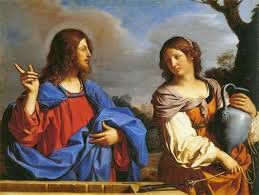
Today’s conversion story is about a woman of Samaria.  And in her conversion, she comes to know Jesus more and more as the story continues.  She starts out by referring to Jesus simply as “a Jew.”  There’s no personal interaction, only referencing his religion.  But Jesus draws her in more closely, as he offers her living water.
That encounter with Jesus leads to a change in tone.  No longer is Jesus simply “you, a Jew,” but is now “Sir.”  Jesus offers her something, and she’s interested in this “living water” she is speaking about.  She likes the idea of never having to draw water again, because she is drawing water, alone, at the hottest part of the day.  We’ll learn why later in this story.

Then Jesus changes the subject.  And it is probably not the subject that modern, polite people would talk about.  Jesus says, “‘Go call your husband,’” knowing full well what her situation is.  This woman at the well is an adulteress, which is why she’s drawing water alone at the hottest part of the day.  She has been married five times before, and the man she is living with currently is not her husband.  She, of course, doesn’t want to admit this (who would?), and coyly says, “‘I do not have a husband.’”  But Jesus reveals to her a part of her life that is not in order.  This leads her to acknowledge Jesus in a different way; she comes to know Him more.  He is not, “you, a Jew,” and he is no longer just “Sir.”  He is, she says, a prophet.  
But feeling a little uneasy about the trajectory of this conversation about her love life, she changes it to something she knows will divert attention away from her personal life: how to worship.  Not much has changed today: if you want to get someone in a heated conversation, talk about how you think Mass should be celebrated.  But Jesus doesn’t rebuff her question.  He answers by stating that true worshippers will worship God the Father in Spirit and truth. 
After talking to her about worshipping well, she is drawn to talk about the Messiah.  And Jesus says to her, “‘I am he, the one speaking with you.’”  Jesus reveals Himself and His mission.  When she first started, she did not recognize Him as anything but a foreigner.  Now she is led to think of Him as the Messiah, which in Greek, is translated 𝛸𝜌𝜄𝜎𝜏𝜊𝜍, which we translate as Christ.  From there she tells everybody about Jesus, and they come to believe as well.
This process of conversion is present in our own lives, as well.  It is present in the life of our Elect, Alexis, who is preparing for the Sacraments of Initiation.  It is present in Chris, our Candidate, preparing to be received into the Church and receive the Sacraments of Confirmation and the Eucharist.  But it is, or should be, present in each one of us.  All of us have opportunities to grow closer to Jesus.
Some of us, honestly, don’t know Jesus that well.  He is, we might say, only “you, a Jew.”  He is a stranger to us.  Some of us know about Jesus.  Maybe we come to Mass every week, we do our duty, or we come because that’s what we’ve always done on Sundays.  But Jesus still isn’t known well to us.  He is simply a respected person.  But we keep him at arm’s length, because we like the way we live, and we don’t want to have to change.
Some of us recognize Jesus as a good guy, a religious leader, someone who speaks for God (in other words, a prophet).  We feel that tug at our soul for God, and maybe we’ve even had some religious experiences in our lives when we felt really close to God.  But we still don’t recognize who Jesus fully is.  Some of us recognize Jesus as the Messiah.  We’re very active in our faith, but there are still some areas of our life that we don’t want Jesus to see, and we’re not sure we want to tell others about Jesus.  That seems a bit pushy to tell others about Jesus.  

No matter where we are in our faith, Jesus calls us to a deeper relationship with Him.  Sometimes, as we grow closer to Him, He reveals our need for Him, a need that only He can satisfy, no matter how much we try to fill that need with other, passing things.  Sometimes Jesus even points out our sins to us, in order to reject our sins and choose Him.  But Jesus always wants us to grow close to Him, especially through our worship of the Trinity in Mass.  And then He wants us to tell others about Him.  Where are we in our conversion?  We are never done; we can always grow closer to God.  Are we open to letting God change our lives?

15 December 2015

Getting Lost

Third Sunday of Advent
When I was younger, I would go camping with my family during the summer.  One weekend during the summer was our family camping weekend, which included my grandparents and uncles and aunts and cousins.  One such family camping weekend, when I was in 5th or 6th grade, I decided to go exploring with one of my sisters and two of my cousins.  We were having a grand old time, wandering around, until we realized we were lost.  After the original panic of not knowing what to do, one of my cousins and my sister decided that they were going to try and find their way back by retracing their steps.  I was pretty sure I had no idea how we had arrived at our location, so I decided to try to find another section of the State Campground, and then walk back to our site, following the numbers.  We both eventually made it back, each with our own stories of how we made it.
Today the Church invites us to rejoice.  She does so because we are more than halfway to our celebration of Christmas.  But we also rejoice because of the Good News of the Incarnation.  We rejoice because God was made flesh in order to save us from our sins.  But, in order to rejoice, we have to recognize that we are sinners.  We all get lost.
A savior is only helpful when someone needs saving.  You don’t rejoice at a lifeguard swimming out to get you when you just taking it easy, floating in your inner tube on the lazy river.  You rejoice at a lifeguard when you’re drowning.  Many soldiers celebrated General Patton pushing through in the forest of Bastogne during the Battle of the Bulge, but not Easy Company of the 101st Airborne, because, while they were surrounded by Nazi troops and running out of supplies, they claimed they didn’t need Patton to save them.  We only rejoice at Jesus’ coming, at the true meaning of Christmas, when we recognize that we need to be saved.  Otherwise it’s just another day off from work.
To sin is to be lost.  The Greek word for sin, 𝛼𝜇𝛼𝜌𝜏𝜄𝛼, means to miss the mark.  It has the connotation of an arrow being off-course from hitting the bulls-eye.  Whenever we sin, we go off target.  We get lost, and we need to find our way back to the right path.  The problem is, only Jesus gets us truly back to the right path to God.  We can never do it by ourselves.  
The worst thing, when you’re lost, is not recognizing that you’re lost.  How many times have wives asked their husbands to stop and ask for directions, while the husband assured the wife he knew where he was going, only to end up farther away than ever 30 minutes later when he finally recognized he was lost and needed to ask for help.  We can tend not to take sin so seriously, perhaps an over reaction to decades long gone where we gave sin more power and influence than it truly had.  So many people figure that if they’re not Hitler or Stalin, then they’re doing ok.  They’re just skipping Mass; they’re just lying occasionally; they’re just taking small supplies from the company; they’re just looking at porn by themselves; it’s not like they’re murdering anyone.  Murder is certainly missing the mark.  But so are all those other things.  
The Jews knew they were in need of a savior.  That’s why the crowds asked St. John the Baptist in today’s Gospel passage, “‘What should we do?’”  St. John the Baptist didn’t say, “You’re not that bad, so don’t worry about it.”  He gave them all practical things that they could do to repent, to turn away from their sins, and prepare for the Messiah to reveal Himself.  St. John the Baptist told the people they were lost, so that they could rejoice when the one who was going to lead them back to the right path would appear.
Zephaniah also connects rejoicing and being saved in our first reading.  Zion is encouraged to shout for joy, and Israel exhorted to sing joyfully, and Jerusalem told to be glad and exult because “The Lord has removed the judgment against you.”  The joy that God is granting is one based upon being freed from sin.  Instead of judgment and the penalty falling upon the guilty, God takes it upon Himself, and restores us to right relationship with Him.  God does what we could not do, and that is certainly a reason to rejoice.
In this Jubilee Year of Mercy, Jesus invites us to receive the greatest gift He gave us: the gift of chesed, the Hebrew word which means steadfast love and mercy.  But we can only receive it if we are aware that we need it.  We are dirty; we are in need of the shower of God’s mercy.  But until we recognize that we have sinned and are in need of God’s mercy, it’s like we take an umbrella into the shower with us, to prevent us from getting wet.  Pretty rediculous, right?  

Brothers and sisters, we all have sinned and fallen short of the glory of God.  But the Good News is that God has come to save us, and in less than two weeks, we will celebrate when that Good News of the Incarnation became known to the world through the birth of Jesus.  That is truly a reason to rejoice.

09 December 2015

Planning for Christmas

Second Sunday of Advent
I am a planner.  Some of you may know that already.  My close friends certainly know that.  I have been known to call friends and see if they want to go on vacation…ten to eleven months before I am planning to leave.  There are a few of my friends who are not planners at all.  And it drives them up a wall to no end when I try to arrange times to get together with them.  They would much rather see if something will work a week out.  Of course, my calendar has a tendency to fill up, so planning something a week out usually means it won’t happen because I’ve already committed to something else…because I’m a planner.
St. John the Baptist may or may not have been a planner.  But we heard today about how he was trying to prepare Israel for the Messiah by preaching in the desert and saying, “‘Prepare the way of the Lord, make straight his paths.’”  He was getting them ready for the day when Israel could take off its robe “of mourning and misery” and “put on the splendor of glory from God” as we heard in our first reading.  St. John the Baptist was trying to help them plan for the day when God would clothe them in the righteousness of God, a royal priesthood.  This was not something which the Chosen People could simply fall into or start working on a week ahead of time.  St. John the Baptist was helping the Chosen People prepare to meet their new king.  
How have we been preparing for the celebration when we will meet Jesus Christ the King?  For four weeks the Church gives us the chance to plan for Christmas: not for the parties; not for the decorations; not for the presents; but for the celebration of the birth of Jesus Christ.  She does not simply tell us one week ahead of time, “Hey, you doing anything 25 December?  We should hang out at Church; I hear it’s going to be a big celebration.”  Instead, she asks us to watch in joyful hope for the coming of our savior, Jesus Christ.  One week out would not give us enough time to prepare.  We need four weeks (and even that doesn’t quite seem long enough) to be ready to celebrate.
And what are we celebrating?  We are celebrating a paradox.  We celebrate that the God who created Time and who guides it according to His will, became subject to Time in the Person of Jesus.  We celebrate that God, Whom the heavens and the earth cannot contain, suddenly was seen as a little infant who took up space and could be located in one place and not another.  But this story, though 2,000 years removed from us today, happened in a particular time.  And that is hat St. Luke also tries to convey to us.  The Birth of Jesus did not happen long, long ago in a galaxy far, far away.  It happened sometime before the “fifteenth year of the reign of Tiberius Caesar, when Pontius Pilate was governor of Judea, and Herod was tetrarch of Galilee…during the high priesthood of Annas and Caiaphas.”  God, the Lord of History, in the Person of Jesus became a subject of History as well.  Jesus is not a made-up story, like the Greek or other Middle-Eastern stories about the gods.  Jesus was seen, heard, touched by many people, who spread that Good News to others.

Have we planned enough for Christmas?  Not for the parties, the decorations, or the presents, but to celebrate what Christmas is truly about: God loved us so much that in the Person of Jesus He became man and dwelt among us.  Has the message of St. John the Baptist taken root in our hearts?  Have we prepared the way of the Lord?

21 April 2015

The Puzzle of Salvation

Third Sunday of Easter
When I was in middle school, my best friend at the time, Jeff, had a puzzle for me to figure out.  It was a kind of a guessing game.  He said I had to guess the secret of the green glass door, by asking me if certain things were behind the green glass door.  He started off by giving me a few examples: Jeff was behind the green glass door; Anthony was not.  Neither cats nor dogs were behind the green glass door, but both trees and grass were.  I asked him all sorts of questions about whether certain persons, animals, and things were behind the green glass door, and it took me weeks to figure out the secret of the green glass door.  I won’t tell it to you, but don’t zone out of my homily to think about the green glass door!
St. Peter preaching
Peter in our first reading and Jesus in the Gospel are trying to give people the key to the puzzle of salvation.  Peter in the first reading is addressing the people who are listening to him after he and John had cured a crippled man at the temple.  They are all amazed and puzzled how these two fishermen could do such an amazing thing.  Peter points out that the man is healed by Jesus, who is the fulfillment of “‘what [God] had announced beforehand through the mouth of all the prophets.’”  Peter was explaining that Jesus is the fulfillment of God’s plan throughout the entire Old Testament, and that Jesus is the long-awaited Messiah, even though Jesus suffered and was put to death.  This idea that the Messiah was a suffering servant was in the Scriptures, especially the prophets Isaiah and Jeremiah, but the Messiah was expected to bring suffering to those who oppressed the Jews, not suffer himself!  So Peter has to tell the Jews that following Jesus is the culmination of what it means to be a Jew, and that the healing of the crippled man bears witness to the power of the Risen Lord.
Peter knew this all too well at this point, because he had no idea throughout the life of Jesus before His crucifixion.  Right after Peter makes his affirmation that Jesus is the Christ (the Greek translation of the Hebrew word Messiah), and right after Jesus tells Peter that the Church will be built upon Peter, the Rock, Jesus announces His passion for the first time, and Peter says, “God forbid!”  Peter doesn’t understand.  And as Jesus prepares His disciples before the crucifixion, they have no idea.  Even after Jesus has been raised, he has to explain to the apostles that this was part of the plan of God.  Jesus says, “‘Thus it is written that the Christ would suffer and rise from the dead on the third day and that repentance, for the forgiveness of sins, would be preached in his name to all the nations, beginning from Jerusalem.’”  It takes a lot to help the apostles understand that the crucifixion was part of the plan just as the Resurrection was.  
We can often be in the same place as the apostles: confused.  How many times when suffering comes do we immediately go to: why me?  Or: what did I do wrong?  Or: why is God punishing me?  Our vision of what it means to follow Jesus is similar to the apostles and to the early Jews: if we follow God, everything is going to be hunky-dory (that’s a profound theological term, of course).  Sometimes we even hear it from religious leaders (hopefully not Catholic): if you follow Jesus, your life will be easy; if you give 10% of your income to the church, then you will never suffer from hard financial times; if you’re suffering then you must be doing something wrong.  That is, to quote Bishop Mengeling, puke!  
We often need to be reminded that suffering is part of individuals and groups that work against God, just as individuals worked to put Jesus to death.  Jesus Himself warned us that if they treat the Master that way, how else do we think they will treat the servants?  Suffering–and not just the natural suffering of bad weather and calamities–exists because the world is fallen and people can say no to God in radical ways that hurt us.  Suffering is not what God wants for us, but it is often part of His plan for us, not as a punishment or because God enjoys seeing us suffer, but because the cross and all the suffering in our life is the way to the Resurrection.  St. Rose of Lima said it this way: 

Our Lord and Savior lifted up his voice and said with incomparable majesty: “Let all men know that grace comes after tribulation.  Let them know that without the burden of afflictions it is impossible to reach the height of grace.  Let them know that the gifts of grace increase as the struggles increase.  Let men take care not to stray and be deceived.  This is the only true stairway to paradise, and without the cross they can find no road to climb to heaven.”

What beautiful and profound words from one of the first saints from the Americas!

Suffering is not good.  It is not good that Jesus died on the cross for us.  It would have been better if we would have just accepted Him.  But God knew from all eternity that we would reject Him, and so the cross became the means for our salvation, and the way that the new life of the Resurrection was made possible.  Easter doesn’t mean that Good Friday was just a bad dream.  But Easter makes Good Friday bearable because we know that suffering and death are not the end, but that Christ has won for us new life where once there was only death.  Sometimes we need to be reminded of the puzzle of salvation.  But in the times of suffering, let us cling to the faith and hope of the Resurrection, as the fulfillment of God’s plan for His suffering people.  

23 December 2013

How Blest We Are!!


Fourth Sunday of Advent
            When I was young (maybe younger is the better word here), I know that I did not understand how blessed I was.  I grew up in a middle class home with a loving family.  We never wanted for anything that we needed.  And yet, as I saw my friends in middle school and high school, all I could focus on was what I didn’t have, which made me blind to what I did have.  We never had video games.  The best we got was Oregon Trail (the old one, mind you) and Sim City.  My dad didn’t like to buy fruit snacks, both because they were not very healthy (that was probably more of my mom’s influence), and because they were expensive (that was certainly my dad’s doing).  We never went on a Spring Break trip to tropical locales like many of my friends did.  In fact, my first Spring Break trip was from St. Paul to Chicago as a freshman in college (not quite the exotic vacation you dream of in cold weather).  But, as I grew older, I have come to realize how blessed I truly was.
            As Catholics we can sometimes forget how blessed we with our faith.  When we grow up in a Catholic culture in our homes, it can be easy to take for granted the great gift we have in the opportunities to grow in our knowledge and love of Jesus.  It can be easy to forget that for two millennia or so, God’s chosen People were waiting for someone to undo the ancient curse that our first parents, Adam and Eve, brought upon the entire human race through original sin.
            God had promised to send a redeemer, but there was a lot of waiting involved.  Right after the Fall, God promised one who would strike at the head of the serpent.  Moses promised a great prophet, to whom the Jews must listen.  Our first reading, which is quoted by St. Matthew in our Gospel passage, gives us one of the Messianic promises of Isaiah, that “the virgin shall conceive and bear a son, and shall name him Emmanuel,” which means God-with-us.  St. Paul reminds the Romans and us in the second reading, that the Good News that God has saved His people from their sins was “promised previously through his prophets in the holy Scriptures.”  Even our preface, the prayer I chant before the Holy, Holy, Holy reminds us of this fact, as it says, “For all the oracles of the prophets foretold him.” 
And at the time of Jesus, there was great longing for the Messiah: partly because the Jews wanted to be freed from their Roman oppressors, but also because it had been hundreds of years since the last prophet.  Can you imagine the anticipation of the Blessed Mother, knowing that the unseen child in her womb was truly the Son of God?  Every mother is excited to see her baby for the first time at its birth, but Mary’s excitement must have been even greater since this baby was not just her baby, but was also God-with-us.  Or think of John the Baptist.  In the womb he leapt for joy in the presence of Jesus at the Visitation of the Blessed Mother to her cousin Elizabeth.  But imagine his waiting, too, at the Jordan River, knowing that his whole mission was to point out the Messiah.  Our preface takes up their excitement, too, as it says, “the Virgin Mother longed for him with love beyond all telling, John the Baptist sang of his coming and proclaimed him when he came.”  Jesus Himself will say to his disciples: “Blessed are your eyes for what they see.  For many kings and prophets longed to see what you see and did not see it, and to hear what you hear and did not hear it.”  And again He says, “Abraham longed to see my day.” 
And we get to see and receive that Jesus.  We have been blessed in receiving that gift of faith in Jesus, knowing that He is the long-awaited Messiah!  We don’t have to wonder if God will ever make good on the promises He made from Adam and Eve, to Moses, and to the prophets.  We know that God has fulfilled His word in the Word-made-flesh, Jesus.  Do we realize how blessed we are?  Do we think about this in these last three days before Christmas?  Or are our hearts focused on what we don’t have: on the gifts we hope to get, the material things that we cannot afford?  Yes, we have been waiting for almost two millennia for Jesus to return as He promised, but we don’t have to wonder if there ever will be a Messiah or not.  God has given us the Messiah, and since those first apostles, we have passed on that the God who created heaven and earth and all that is in them deigned, lowered Himself, to be seen, heard, and touched.  As the preface will say again, “already we rejoice at the mystery of the Nativity.”  We wait to celebrate what has already happened and so we can be joyful.
We can also be joyful because the same Jesus comes to us in this Mass, as He does at every Mass, in His Word spoken to us through the Scriptures; and in the Eucharist, the Body and Blood, Soul and Divinity of the same Jesus who was conceived by the Holy Spirit in the womb of the Blessed Mother, and who first showed us the Face of God as He was born in Bethlehem.  How blest are our eyes that see God and our ears that hear His Word!  In these last days of Advent, don’t get caught up in the rush to finish all the preparations, but take time in prayer to thank God for the many blessings that we have in our faith, especially for the gift of Jesus, the prophesied and long-awaited Messiah who makes Himself present for us each day, and especially each time we get to come to Mass.

16 December 2010

The Urgency of Advent


Second Sunday of Advent
            Have you ever noticed how the urgency, or even the lack thereof, can change the way we communicate?  Say you have tons of time, but you still want someone to get something done.  What do we usually say?  “If you wouldn’t mind, could you…” or “When you get a chance might you…”.  On the flip side, if we’re rushed, if we feel that something has to happen quickly, then we tend to forego the formalities, and just get to the point: “I need to you to do…” or even “Do…”. 
            In our first reading from Isaiah, we might think that he’s taking a more laid back approach.  After all, compared to the way John the Baptist was preaching in our Gospel, anything would seem laid back.  But listen again to the images Isaiah uses. 
            First we have a shoot sprouting from a stump.  That’s pretty drastic.  And this shoot is really a man, who will be filled with the Spirit of the Lord.  But not just the general Spirit of the Lord, but a spirit of wisdom, understanding, counsel, strength, knowledge, fear of the Lord.  This is part of the common list of the gifts of the Holy Spirit.  This shoot is not going to judge by hearsay or appearance (sort of an allusion to the way the judges in the time of Isaiah were judging), but “shall judge the poor with justice.”  Then we get really drastic.
            This just judge “shall strike the ruthless with the rod of his mouth, and with the breath of his lips he shall slay the wicked.”  That’s pretty intense!  And then, we get what we think of as a very bucolic scene: “the wolf shall be a guest of the lamb; and the leopard shall lie down with the kid; the calf and the young lion shall browse together, with a little child to guide them” but which in reality means that a major change is going to take place.  No longer will predator/prey be the main relationship, as it is now, but all will be at peace.  But of course, you need someone to instill that peace: the just judge, the shoot from Jesse’s stump.  Even this is a pretty extreme scenario.
            This makes John the Baptist not seem so different from the line of the prophets.  His words, as harsh as they sound in today’s Gospel, are just as intense as Isaiah’s were.  But, for John, there is even more urgency, because he knows that he is on “a mission from God” to quote a famous movie, “‘A voice of one crying out in the desert, Prepare the way of the Lord, make straight his paths.’”
A statue of St. John the Baptist from his
home town of Ein Keren in Israel
            John the Baptist knows that his mission is to bring the people to repentance, because it is by repentance that they will recognize the Messiah.  And when he doesn’t see that repentance, the urgency of the message leads him to say some pretty amazing things: “‘Your brood of vipers!” he says to the Pharisees and Sadducees.  And John continues: “Even now the ax lies at the root of the trees.  Therefore, every tree that does not bear good fruit will be cut down and thrown into the fire…His winnowing fan is in his hand.  He will clear his threshing floor and gather his wheat into his barn, but the chaff he will burn with unquenchable fire.”  In other words, repent, or it’s going to be really bad for you.
            Brothers and sisters, we should have the same urgency about us.  Jesus is coming back.  For all we know, He could return tomorrow.  And yet what is the tone in our hearts and in our voice when it comes to repentance to prepare for Jesus’ return?  Is it, “It would be nice if I were a better disciple” or “If I get around to it I’ll change my life to more conform with the Gospel”?  That’s probably true for each of us, some of us at times, others of us for much of our lives.  We need John the Baptist to communicate to us the urgency of turning back to Christ.  We need him yelling in the wilderness, “‘Repent, for the kingdom of heaven is at hand!”
            And this time, Jesus will not come as a tiny baby, seemingly powerless.  When He comes again He will come to judge the living and the dead, as we profess each solemnity in the creed, to separate the sheep from the goats.  And if we’re goats, there’s nothing but eternal torment in the fires of hell to look forward to.  He will come as a conquering King to bring a final end to Satan, and all his demons, and all those who by their actions tell God that they would rather “reign in hell than serve in heaven.”
            The time is near.  It is urgent that we convert.  So how do we repent?  How do we more configure our lives to Christ?  We begin and end with God’s grace, with our cooperation in the middle.  We first ask God for forgiveness for those times that we have sinned, especially through sacramental confession and absolution.  We take time to be honest with God and tell Him the areas of our life that still need conversion.  And God never rejects those who honestly come to Him asking for His help.  And then we use that grace that we receive from sacramental reconciliation to change real actions in our life, to truly stop sinful actions, and replace them with acts of charity, acts of benevolence, acts of faith and trust in God.  And then God crowns those gifts with more grace, so that we can continue in our response to the love which God first showered upon us.
            We should not put off our conversion.  We should not delay in conforming our lives more to Christ.  The time is now.  It is urgent.  “Repent, for the kingdom of heaven is at hand!”