Showing posts with label talent. Show all posts

01 August 2022

Being A Good Steward (Precept #5)

 Eighth Sunday after Pentecost
    In the name of the Father, and of the Son, and of the Holy Spirit.  Amen.  As we pass through these Sundays after Pentecost, I thought it would be good to focus on some thematic preaching.  I still want to tie it to the readings, in some way, maybe only loosely, but still seeing how our faith and the Word of God are intertwined.  So, I’ve decided, for the next weeks, to concentrate on the Precepts of the Church.
    There are five precepts, which are described as “positive laws decreed by the pastoral authorities…meant to guarantee to the faithful the very necessary minimum in the spirit of prayer and moral effort, int he growth in love of God and neighbor.”  So these are not all there is to being Catholic, but we could call them the basic rules and expectations of membership in the institutional Church.  The five (as found in the Catechism, paragraphs 2041-2043) are:


You shall attend Mass on Sundays and on holy days of obligation and rest from servile labor;
You shall confess your sins at least once a year
You shall receive the sacrament of the Eucharist at least during the Easter season;
You shall observe the days of fasting and abstinence established by the Church
You shall help to provide for the needs of the Church
 

Again, there are other necessary aspects of being Catholic (belief in the revealed dogmas of faith and living revealed moral teachings, respect and obedience to legitimate ecclesiastical authority, daily prayer, etc.), but these give us a base line.  Today, based upon our Gospel, I would like to focus on the last precept: you shall help to provide for the needs of the Church.

    Today's Gospel focuses on stewardship.  Our Lord tells a parable about a dishonest steward, who then makes side deals with the debtors, hoping that one of them will take him in after he’s fired, since he’s not able to do hard labor, and too ashamed to beg.  The fifth precept tells us that we are to provide for the needs of the Church, including, it goes on to say, the material needs of the Church, “each according to his abilities.”  
    We probably naturally go to money when we think of the needs of the Church and possibly even the word stewardship.  Priests are either very hesitant or very quick to talk about money.  One layman joked that when a priest talks about money it can be called the Sermon on the Amount.  Personally, I try to avoid talking about money unless I need to.  But this one time probably won’t hurt too much (for you or for me).
    Because, honestly, the people of St. Matthew are very generous.  And I greatly appreciate your generosity.  I believe that people give what they can, according to their financial realities.  As St. Paul says, he does not want us to make ourselves poor in assisting others, but that each could have enough, based on their own situations.  Some give weekly, others give monthly; some give cash or checks, others donate online with a credit card.  We recently have been the beneficiary or a large bequest, which is helping to make our office renovation a reality, so some even remember St. Matthew after death.  But, I’ll admit, it took me a while as a young man to consider giving to the church.  In high school, even though I was working a summer maintenance job for my parish, I’m pretty sure I didn’t give anything.  I didn’t make much, and that continued as a seminarian, and so I didn’t give much or anything.  But, after I was ordained, I made a commitment to give at least 5% of my income to the Church (whether the parish or the Diocese or even the universal Church), which would then leave me to donate up to 5% to other organizations.  And I think I’ve been pretty faithful to that.  But I don’t remember being approached by anyone as a young man, to remember to give.  So, for all you young adults, whether living with your parents or living on your own, here’s my plug: consider giving to the parish.  Maybe it’s only a buck or two every week, but you’ll be part of supporting our great parish.  
    Why give?  Because a steward is one who recognizes that what he has is not his.  A steward uses the goods of the master, with the master’s authority.  But they don’t, strictly speaking, belong to the steward.  When it comes to us, everything we have, whether directly or indirectly, comes from God.  The talents we use to get a good job come from God.  The talents of entrepreneurs who form companies that then hire us come from God.  Everything eventually gets traced back to God.  And so, as part of the virtue of justice, we give back to God some of what He has given to us.
    But I know that many of you are blessed with large families, and so don’t have a lot of money, even to give to the church.  And that is why it’s important to note that stewardship is not only about money.  It’s also about time and talent.  
    I have been so impressed by the donation of time and talent of parishioners here!  We have groups that help clean the church, ushers who collect our paper hand missals, gardeners who help care for the flowers, catechists who help form children (sometimes their own) and adults in the faith, those who donate food for our potlucks, members of our Finance Council and Pastoral Council who help guide the future of the parish, sacristans, servers, cantors, and the list goes on and on (I do not mean to leave you out, so please don’t take offense if I did not explicitly mention your group or activity).  People giving their time and talent to the parish are also a great sign of health and vitality.  And it gives a way for all people, those with large incomes and those who struggle to make ends meet each week, a way to build up the Mystical Body of Christ.
    And that is the real point of stewardship: that we do what we can to serve Christ.  I’m not the judge of your stewardship: that belongs to the Lord, who sees not only the external gifts, but also the internal gifts, and judges justly.  But we can never rest on our laurels when it comes to being good stewards.  Each June I re-evaluate how I am being a good steward of what God gave me, just as each Lent I re-evaluate my beneficiaries for what I will leave behind.  It’s a good thing not to view our stewardship with the perspective of fear, but in the freedom of being poor in spirit, relying on God for what we need and doing what we can to help others who are in need, to be, as St. Theresa of Avila says, the hands of God.  
    Thank you for your generosity of time, talent, and treasure, which helps St. Matthew continue to be a lamp in the city of Flint, radiating the truth and love of Christ to a city which desperately needs it.  Let’s re-evaluate what we can do, so that we can be even better stewards of all that our generous God has entrusted to us, Father, Son, and Holy Spirit.  Amen. 

07 January 2019

Giving Jesus our Time, Talent, and Treasure

Solemnity of the Epiphany
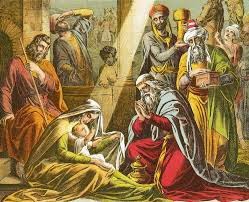
When we think about the gifts that the magi bring to the Christ Child, we might think that they’re a little odd.  Gold, yes, everyone can use some gold.  Frankincense, we might not think as so helpful.  And myrrh, well, let’s be honest, many people probably don’t even know what myrrh is.  We may think that the magi should have brought more practical gifts, like diapers, or blankets, or almost anything else.  
But while our minds are geared towards practicality, the gifts that the magi, or wise men, brought is not concerned with the practical, but rather, the symbolic.  The magi, by their gifts, mean to communicate a message about who they understand Jesus to be.  Gold is a gift that you would give a king.  The magi understood, however faintly, that Jesus is the King of kings and Lord of lords, and their gift acknowledged that reality.  Frankincense, like the incense we use today, is what is offered to God.  The smoke of the incense rises, reminding us of our prayers rising to the heavens as we adore God.  It also gives a sense of transcendence, since the cloudy can seem otherworldly.  Think about Mt. Sinai in the Book of Exodus: the mountain is wrapped in smoke when God is present.  The magi recognized that, in addition to being a king, Jesus was also a deity, and deserved worship and the things that belong with it.  Myrrh is an oil, or a balm, and it was used to anoint the bodies of the dead.  While the Egyptians embalmed their dead, such a practice was not as common in the rest of the world.  So the bodies were anointed with a perfumed oil as a sign of respect and preparation for whatever came after death.  Besides recognizing that Jesus was a King and God, they also recognized that He was going to die (especially an odd thought if you believed that Jesus was a God).  Yet, we all look to Good Friday when God died on the Cross in the Person of Jesus.
As we celebrate this Epiphany, and the gifts that the magi presented to Jesus, we, too, have a chance to bring our gifts to Jesus.  Maybe we wonder what gifts Jesus really needs, since He’s God and owns the whole world.  But what Jesus desires from us is all of who we are.  Jesus desires us to share with Him our very life, each day, in all that we do.  This is what St. Paul means when he exhorts us to pray constantly.  When we offer our lives, and everything that is a part of it, each day to God, we are praying throughout the day as we work, as we learn, as we relax.  
The Church sometimes expresses how we can give Jesus a gift through the word stewardship.  Stewardship means that we have received gifts which do not, in fact, belong to us, but are given to us to use wisely.  A steward had the full authority of the master, and could act in his name.  But the steward was supposed to act according to the mind of the master, too, not simply using the master’s possessions without reference to the will of the master.  When we talk about stewardship, we talk about the three Ts: time, talent, and treasure.
Treasure is the easy one to think about.  We earn money by working, using what we have received from God to provide for ourselves and our families.  But that money is entrusted to us to use for our good, the good of the poor, and the good of the Church.  I honestly hate talking about money, and our generosity with money is often the fruit of a deep relationship with Jesus.  When we love Jesus we give what we can to serve Him through the poor and the Church.  When we are selfish with money it usually betrays a lack of a love for the poor and Jesus, as we put other priorities, sometimes simply our own will, ahead of the good of others.
Talents, though, are easy to talk about.  Each of us have gifts that God has given to us.  God expects us to use those gifts for helping us to be saints, and helping others to be saints.  Those gifts are not meant to be kept to ourselves (like in the parable of the talents), but are meant to be “invested,” shared, for the building up of the kingdom of God.  A talent doesn’t have to be extraordinary, but it is meant to be shared.  And at this time I invite our ushers to pass out our stewardship surveys.  This survey is meant to help you determine how best you can share your talents with our parish family.  You can mark down how you currently participating, or how you wish to participate.  If it’s something new, someone will contact you (give us a few weeks) about how to get involved.  But I encourage you to get involved.  This parish cannot operate without volunteers, and one of our parish challenges is that our volunteers are getting voluntired and we need people to fill the roles that many of our older parishioners used to fill.  Usually, about 20% of the people do 80% of the work.  It would be great if we could even get that number up to 30 or 40%!
Time is also easier to talk about, though perhaps this is a commodity that we value at least as much as our money.  How much time do we give to God?  If we are in a good relationship with another, we want to spend time with them whenever we can.  Facebook is always showing me ways that friends are spending time with each other.  But when it comes to our relationship with God, are we willing to spend time with God?  We have a great number of retirees in our parish, and our Mass times during the week are geared towards them.  But it seems like the same people each week (and, to be clear, I’m happy to have them!), which is simply a small selection of the parish.  I’m not saying you have to go to Mass every day (there are worse things to do with your time), but maybe, if you have a weekday open at 8:15 a.m., you could join us for Mass.  Or make sure you’re taking time out to pray.  If you’re not at all, start with 5 minutes, and then increase from there.  Or maybe, if your schedule allows, spend 30 minutes with Jesus in adoration on 3rd Fridays, or almost every Friday between 7 and 8 a.m.  

God desires gifts from us, not out of necessity, but as a sign of our love.  Is there anything that we’re holding back from God?  Will we give Him the gift of our time, talent, and treasure?