Showing posts with label Stewardship. Show all posts

16 November 2026

Stewardship: But Not Another Money Talk

Thirty-Third Sunday in Ordinary Time
    When speaking generally about stewardship in the Church, usually the person references the three Ts: time; talent; and treasure.  When a priest talks about stewardship in a homily, most often he really wants to talk about money (which can, actually, work against the full idea of stewardship, as people then only associate stewardship with money, rather than a broader way of looking at stewardship).  
    Today, I’d like to talk to you about stewardship.  And while, yes, stewardship does include how you carefully consider to give to the parish and diocese a share of what God has allowed you to reap financially, I actually don’t want to focus on money.  I want to focus on everything else.
    Because as we heard this familiar parable about the talents (a talent being worth approximately twenty years’ worth of annual wages), God invites us to look at what He has entrusted to us.  I’ve mentioned this before, but after the Second Vatican Council, when changing the Lectionary, or the readings that the Church uses for Mass, those who drafted it always tried to connect the first reading and the Gospel.  But notice what our first reading talks about: a worthy wife; not money.  So clearly, the Church definitely wants us to look at stewardship beyond simply money.
    But before we dive into the particulars, we have to understand stewardship in general.  To act as a steward was to have full control of property (be it money, land, crops, etc.) that wasn’t yours.  A steward acted with his master’s power and authority, but nothing belonged to the steward.  It all belonged to the master.  The first thing God invites us to reflect on today is whether we think we’re the steward or the master.  As Jesus taught in Matthew 23:10: “Do not be called ‘Master’; you have but one master, the Christ.”  Strictly speaking, nothing we have belongs to us.  Every good thing that we have comes from God.  But so often we forget that important fact.  We can act like children who think that everything in the house belongs to us to use or abuse as we want, but who don’t pay the mortgage, or pay for groceries, or the car insurance, or the utilities bill, etc., etc.  The beginning of what the Lord invites us to consider today is that we are stewards, not masters.  We use things, but we didn’t create them, and they’re not fully ours.

Strouse Family 2024
    With the principle of stewardship established let’s start with the first reading and the psalm, which focus on the family.  First, do I view my family as a talent, as a treasure?  And secondly, do I exercise good stewardship with my family?  God has entrusted your spouse to you.  God has entrusted your children to you.  Now, though the good stewards in the Gospel make money off their talents by trading and investing them, you cannot trade your family to make more money.  That’s not what I’m saying.  But God entrusts your family to you, whatever that family may look like, so that you can help return them in better condition than you received them.  Do you help your family grow in holiness?  I’ve quoted this phrase that I stole from a Dominican friar before, but it’s been a while, so it’s worth repeating: in marriage, your goal is not to be happy.  Your goal is to make your spouse happy and to help them get to heaven.  The same could be said for your kids.  By your words; by your actions; by what you give them; by what you deny them; are you helping them get closer to God and heaven?  At some point, you will need to return your spouse or your children to God the Father.  We see this when a husband buries his wife, or a wife buries her husband.  Sadly, we even see this when a parent has to bury a child.  But even if you predecease your spouse or your children, will you be able to say that you were a good steward of the family God entrusted to you?
    God also entrusts time to us.  Starting in the teenage years, we tend to consider ourselves masters of our time.  And even into adulthood we presume that we will always have tomorrow.  But what happens if, as Garth Brooks sings, tomorrow never comes?  In the epistle of St. James, chapter 4, the Apostle James writes, “you have no idea what your life will be like tomorrow.  You are a puff of smoke that appears briefly and then disappears.”  As I mentioned last week, Fr. Mike Williams died unexpectedly at the age of 60.  He had retirement plans, but still had five years before he could retire.  Some of us here, due to medical issues or traumatic incidents, have stared our mortality in the face, and come to realize that God never promised us tomorrow.  We shouldn’t be scrupulous or paranoid about dying, but have we exercised good stewardship of the time God has given to us?  This doesn’t mean that we’re praying 24/7, or that we quit jobs to go to daily Mass.  But it does mean that we give God the first fruits of our time, and include Him throughout the day, even in small ways, with little prayers or pious phrases that keep our mind on God.
    See, a priest can talk about stewardship without talking about money!  God invites us to consider whether we think of ourselves as a steward, or, falsely, as the master.  And if we recognize that we are stewards, how are we managing the talents, the very valuable treasures, that God has entrusted to us?  If we pretend that we’re the Master, then we can look forward to darkness and to wailing and grinding of teeth. If, instead, we seek to be good stewards of what God entrusts to us, then we can hope to hear, “‘Well done, my good and faithful servant….Come, share your master’s joy.’”

20 January 2025

Stewardship

Second Sunday after Epiphany
    In the name of the Father, and of the Son, and of the Holy Spirit.  Amen.  I either recently received a book on stewardship, or I recently rediscovered that I received a book on stewardship.  In any case, I’ve been reading a little each day (it’s a very thin book to begin with), but it struck me as I read the epistle today that a theme in this part of St. Paul’s epistle the Romans deals with stewardship.
    Now, I know that some use stewardship as a code word for giving money.  And, as we just finished our part of the Diocesan Capital Campaign, you might think that talking about stewardship is killing a dead horse.  But this is not such much about giving money, as you have all been very generous with the parish, as a reminder about important points that lead to fruitful stewardship of time, talent, and, yes, treasure.
    Because one of the first points this book makes is that stewardship comes naturally when we consider that everything that we have is a gift from God.  And that view does not come naturally to us because of our fallen reality.  We tend to grasp at most things like they’re ours, like we are responsible for them, and like we don’t want anyone else to have them.  We live with a scarcity mentality, as if when we don’t hold on to things, others may take them, and we might miss out on something we need.  Just think back to the beginning of COVID: we had plenty of toilet paper.  But someone got it in his head that we might run out, and no one wants to rely on leaves, so they started buying up all they could, such that there was a scarcity because people took what they didn’t need.  
    But when we recognize that everything is a gift from God, then we want to give back to God what He desires, which is everything.  Everything may not be much, but the Lord praises the widow, not for the amount of coins she gave (others gave more coins than she), but for the value of what she gave, which was her everything.  

    What does God do when we give Him everything?  Many times He gives it all back, or even makes it better.  Now, I’m not preaching the so-called “prosperity Gospel.”  I’m not preaching that if you just give 10% of your annual salary, God will give you 20% more money.  That’s not the Gospel.  But the Gospel from today does teach us the lesson that God is not outdone in His generosity, to paraphrase St. Paul.  The servants give our Lord water.  And they put them, not in the finest containers, but in the containers with which the guests would wash their hands.  But when the servants take the containers to the chief steward of the feast, he doesn’t taste water, but wine, which came about through the first miracle our Lord worked.  The Father does the same thing with what we offer Him in this Mass.  We offer the Father bread and wine, and not the best bread or wine, either.  It’s not like we’re getting the bread from crust or from Zingermans.  It’s not like the wine is a fine 2020 cab from Napa.  But we offer Him the bread and wine that He desires, and, by the power of the Holy Spirit and through the ministry of the priest, bread and wine offered to God become the Body and Blood of our Savior.  We can’t taste or see any different, but we know that it’s no longer bread and wine, but the Bread of Life and the antidote of immortality (as St. Ignatius of Antioch called the Eucharist).  We offer God what we have, even if it doesn’t seem like much, and God transforms it by His grace into something better.
    And when we receive that something better, and we recognize just how much God has given us, we want to share that gift with others.  And my gift is different than your gift.  But when we all make a return on our gifts, the whole Mystical Body of Christ works well and changes lives.  St. Paul write about that in our epistle, how some were given the gift of prophecy, or administration, or in ministry, or in teaching, or exhortation, or cheerfulness.  St. Paul doesn’t tell those who are good in cheerfulness that they need to start prophesying.  Or those who teach well need to start working on administration.  He asks everyone to use the gifts they have to the best of their ability so that the Gospel can be preached and the Church can be built up.  
    So, for example, I’m pretty bad a brainstorming.  This doesn’t mean that I’ve never had an original idea, but that’s not where I thrive.  I thrive in evaluating ideas and seeing what it would take to execute, or if execution is even a possibility or probability.  But I try to use that build up the Body of Christ.  Now, as a priest, I am called to do certain things, like preach.  I am not Venerable Fulton Sheen, but I offer God my meditation on the Scripture passage or the season, and the work that I put in, and the Holy Spirit does the rest.  Sometimes I think a homily is horrible, and then lots of people tell me how it touched them.  Sometimes I think a homily is great, but then no one says anything.  But no matter what, I am called to give my all to God, trusting that God will perfect my gift, and help it to multiply for the building up of His Church.
    So many of you are committed to this parish and to spreading the Gospel.  You give of your time, talent, and treasure to support the work, not just of St. Matthew, but of the Church in this Diocese, and the Church present throughout the world.  But the Lord reminds us today to continue to work at giving all of who we are to Him.  He never leaves us empty handed, even if we don’t necessarily increase in material wealth, but will always give us back better than received.  As the Blessed Mother encouraged the servants to do at the wedding at Cana, give what you have to Christ, who will never let you want for any good thing, and who, with the Father and the Holy Spirit is God for ever and ever.  Amen. 

01 August 2022

Being A Good Steward (Precept #5)

 Eighth Sunday after Pentecost
    In the name of the Father, and of the Son, and of the Holy Spirit.  Amen.  As we pass through these Sundays after Pentecost, I thought it would be good to focus on some thematic preaching.  I still want to tie it to the readings, in some way, maybe only loosely, but still seeing how our faith and the Word of God are intertwined.  So, I’ve decided, for the next weeks, to concentrate on the Precepts of the Church.
    There are five precepts, which are described as “positive laws decreed by the pastoral authorities…meant to guarantee to the faithful the very necessary minimum in the spirit of prayer and moral effort, int he growth in love of God and neighbor.”  So these are not all there is to being Catholic, but we could call them the basic rules and expectations of membership in the institutional Church.  The five (as found in the Catechism, paragraphs 2041-2043) are:


You shall attend Mass on Sundays and on holy days of obligation and rest from servile labor;
You shall confess your sins at least once a year
You shall receive the sacrament of the Eucharist at least during the Easter season;
You shall observe the days of fasting and abstinence established by the Church
You shall help to provide for the needs of the Church
 

Again, there are other necessary aspects of being Catholic (belief in the revealed dogmas of faith and living revealed moral teachings, respect and obedience to legitimate ecclesiastical authority, daily prayer, etc.), but these give us a base line.  Today, based upon our Gospel, I would like to focus on the last precept: you shall help to provide for the needs of the Church.

    Today's Gospel focuses on stewardship.  Our Lord tells a parable about a dishonest steward, who then makes side deals with the debtors, hoping that one of them will take him in after he’s fired, since he’s not able to do hard labor, and too ashamed to beg.  The fifth precept tells us that we are to provide for the needs of the Church, including, it goes on to say, the material needs of the Church, “each according to his abilities.”  
    We probably naturally go to money when we think of the needs of the Church and possibly even the word stewardship.  Priests are either very hesitant or very quick to talk about money.  One layman joked that when a priest talks about money it can be called the Sermon on the Amount.  Personally, I try to avoid talking about money unless I need to.  But this one time probably won’t hurt too much (for you or for me).
    Because, honestly, the people of St. Matthew are very generous.  And I greatly appreciate your generosity.  I believe that people give what they can, according to their financial realities.  As St. Paul says, he does not want us to make ourselves poor in assisting others, but that each could have enough, based on their own situations.  Some give weekly, others give monthly; some give cash or checks, others donate online with a credit card.  We recently have been the beneficiary or a large bequest, which is helping to make our office renovation a reality, so some even remember St. Matthew after death.  But, I’ll admit, it took me a while as a young man to consider giving to the church.  In high school, even though I was working a summer maintenance job for my parish, I’m pretty sure I didn’t give anything.  I didn’t make much, and that continued as a seminarian, and so I didn’t give much or anything.  But, after I was ordained, I made a commitment to give at least 5% of my income to the Church (whether the parish or the Diocese or even the universal Church), which would then leave me to donate up to 5% to other organizations.  And I think I’ve been pretty faithful to that.  But I don’t remember being approached by anyone as a young man, to remember to give.  So, for all you young adults, whether living with your parents or living on your own, here’s my plug: consider giving to the parish.  Maybe it’s only a buck or two every week, but you’ll be part of supporting our great parish.  
    Why give?  Because a steward is one who recognizes that what he has is not his.  A steward uses the goods of the master, with the master’s authority.  But they don’t, strictly speaking, belong to the steward.  When it comes to us, everything we have, whether directly or indirectly, comes from God.  The talents we use to get a good job come from God.  The talents of entrepreneurs who form companies that then hire us come from God.  Everything eventually gets traced back to God.  And so, as part of the virtue of justice, we give back to God some of what He has given to us.
    But I know that many of you are blessed with large families, and so don’t have a lot of money, even to give to the church.  And that is why it’s important to note that stewardship is not only about money.  It’s also about time and talent.  
    I have been so impressed by the donation of time and talent of parishioners here!  We have groups that help clean the church, ushers who collect our paper hand missals, gardeners who help care for the flowers, catechists who help form children (sometimes their own) and adults in the faith, those who donate food for our potlucks, members of our Finance Council and Pastoral Council who help guide the future of the parish, sacristans, servers, cantors, and the list goes on and on (I do not mean to leave you out, so please don’t take offense if I did not explicitly mention your group or activity).  People giving their time and talent to the parish are also a great sign of health and vitality.  And it gives a way for all people, those with large incomes and those who struggle to make ends meet each week, a way to build up the Mystical Body of Christ.
    And that is the real point of stewardship: that we do what we can to serve Christ.  I’m not the judge of your stewardship: that belongs to the Lord, who sees not only the external gifts, but also the internal gifts, and judges justly.  But we can never rest on our laurels when it comes to being good stewards.  Each June I re-evaluate how I am being a good steward of what God gave me, just as each Lent I re-evaluate my beneficiaries for what I will leave behind.  It’s a good thing not to view our stewardship with the perspective of fear, but in the freedom of being poor in spirit, relying on God for what we need and doing what we can to help others who are in need, to be, as St. Theresa of Avila says, the hands of God.  
    Thank you for your generosity of time, talent, and treasure, which helps St. Matthew continue to be a lamp in the city of Flint, radiating the truth and love of Christ to a city which desperately needs it.  Let’s re-evaluate what we can do, so that we can be even better stewards of all that our generous God has entrusted to us, Father, Son, and Holy Spirit.  Amen. 

25 October 2021

What Belongs to God

 Twenty-Second Sunday after Pentecost
    In the name of the Father, and of the Son, and of the Holy Spirit.  Amen.  So, this is the Gospel passage where we start talking about politics and religion, church and state, and how the two intersect, how they should or shouldn’t intersect, what’s right in politics, what’s wrong in politics, etc.  Politics, though now considered a dirty word in some arenas, is a good thing, as it is the science of running the polis, the city (in Greek).  But I don’t know about you, but it seems like politics is all we talk about any more, even as a church.
    Don’t get me wrong: the Gospel has political implications.  If we truly believe in Jesus and follow Him, there are some things we cannot support, and some things that we must support.  But our Lord’s point is much greater than what we owe to government, and what we owe to God.
    Let’s start with the fact that, although the Herodians had tried to trap our Lord in a trap, He set one of His own.  And though Christ didn’t fall into the trap, the Herodians were quite easily ensnared.  What was that trap?  Well, to begin with, you have to go back one chapter to realize where our Lord is.  He was in the Temple.  He had entered into Jerusalem, had left for Bethany, and then had returned.  And the traps that the Pharisees are laying for Him are everywhere!  But the Savior ducks and weaves, and lands a few punches (metaphorically speaking) of His own.  

Denarius with the image of Marcus Aurelius

    So, in the temple, the Herodians are asked to pull out a Roman coin.  We don’t think much of it, because we carry money around with us everywhere.  But, because there was a commandment about not having a graven images, a good Jew would have never brought a Roman coin into the Temple, because that was bringing the image of a pagan god (the emperor) into the house of the true God.  That’s why there were money changers in the Temple: you had to exchange your pagan coins–that, outside the Temple were necessary for daily business–for Jewish coins that did not break the Law.  So the Herodians are actually shown to be breaking the law by having those Roman coins with them.  
    But further, there’s this point about giving God what belongs to God.  A good Jew, going back to Genesis 1 and 2, would ascribe everything as a good creation of God.  Certainly, we wouldn’t talk this way about artifacts (like coins) that were man-made.  But break the coin down to its constitutive parts, and you get metals, which are fancy rocks, which are part of the earth, which God created.  And the skill of mining those fancy rocks was given by God by the creation of a rational brain in humans.  And the strength needed to flatten out the fancy rocks and shape them in such a way was also given, at least indirectly, by God.  Everything came from God.  God loaned, as it were, everything to mankind, making man and woman the stewards of creation.  So everything really belongs to God.
    So are we to give God everything?  In a word, yes!  When God asks for something, He’s not asking for a gift from us, or asking us to be benevolent and generous.  He is asking for what is rightfully His.  A steward was never the owner of the property of the household, though he could buy and sell.  A steward always did business realizing that the goods which he bought and sold truly belonged to the Master, for which he would have to account.  So nothing is, strictly speaking, ours.  This is where St. Thomas Aquinas gets the idea, repeated throughout the ages and dating back to the church fathers, that while we can own private property–we can possess things for ourselves–there is a universal destination of goods.  As St. Basil the Great says, “The bread in your cupboard belongs to the hungry; the coat unused in your closet belongs to the one who needs it; the shoes rotting your closet belong to the one who has no shoes; the money which you hoard up belongs to the poor.”  He can only say that if everything, ultimately, belongs to God.  
    Consecrated men and women live this out radically (at the root) by not owning private property.  I was recently at dinner with a family whose son is a religious brother.  This topic came up about owning all things in common, and, as happens, the question of common underwear came up.  Of course, people use their own underwear (at least in most congregations).  But, this brother was quick to point out that the underwear was not, technically, his; it belongs to the community.  For we seculars, whether priests or married, we can’t simply say that the universal destination of goods are only for consecrated men and women.  According to our vocation, we also are called to make sure that others, especially in the household of faith, are not in need while we are in excess.
    But offering God everything does not stop at what is tangible.  God desires and deserves everything, and that means everything.  The joy that we have when we are praised for a job well done should be given back to God.  The sorrow we have when we don’t do as well as a job as we wanted should also be given back to God.  And everything in-between.  
    God desires our all.  Lumen gentium, the Dogmatic Constitution on the Church of the Second Vatican Ecumenical Council, states: 


For all [the laity’s] works, prayers and apostolic endeavors, their ordinary married and family life, their daily occupations, their physical and mental relaxation, if carried out in the Spirit, and even the hardships of life, if patiently borne–all these become "spiritual sacrifices acceptable to God through Jesus Christ.”  Together with the offering of the Lord’s body, they are most fittingly offered in the celebration of the Eucharist.

Everything you do as laity, and everything I do as a priest, is meant to be offered to God, because, in the end, everything comes from God; it is His.  The only thing we do on our own is sin, and even that God wants, so that He can, by His grace, heal us and transform us.  
    As with any Scripture, there are many ways to apply today’s Gospel.  But today the Lord invites us to truly give Him our all, united with the bread and wine which I offer on your behalf to the Eternal Father, through Christ the Son, in the power of the Holy Spirit.  Offer to God your everything, and you will find that you have lost nothing, but gained everything, because God, as our loving Father, withholds nothing of what we need.  So give to God what belongs to God: the Father, and the Son, and the Holy Spirit.  Amen. 

07 January 2019

Giving Jesus our Time, Talent, and Treasure

Solemnity of the Epiphany
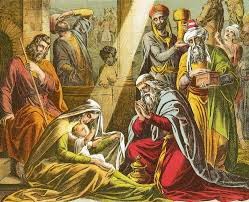
When we think about the gifts that the magi bring to the Christ Child, we might think that they’re a little odd.  Gold, yes, everyone can use some gold.  Frankincense, we might not think as so helpful.  And myrrh, well, let’s be honest, many people probably don’t even know what myrrh is.  We may think that the magi should have brought more practical gifts, like diapers, or blankets, or almost anything else.  
But while our minds are geared towards practicality, the gifts that the magi, or wise men, brought is not concerned with the practical, but rather, the symbolic.  The magi, by their gifts, mean to communicate a message about who they understand Jesus to be.  Gold is a gift that you would give a king.  The magi understood, however faintly, that Jesus is the King of kings and Lord of lords, and their gift acknowledged that reality.  Frankincense, like the incense we use today, is what is offered to God.  The smoke of the incense rises, reminding us of our prayers rising to the heavens as we adore God.  It also gives a sense of transcendence, since the cloudy can seem otherworldly.  Think about Mt. Sinai in the Book of Exodus: the mountain is wrapped in smoke when God is present.  The magi recognized that, in addition to being a king, Jesus was also a deity, and deserved worship and the things that belong with it.  Myrrh is an oil, or a balm, and it was used to anoint the bodies of the dead.  While the Egyptians embalmed their dead, such a practice was not as common in the rest of the world.  So the bodies were anointed with a perfumed oil as a sign of respect and preparation for whatever came after death.  Besides recognizing that Jesus was a King and God, they also recognized that He was going to die (especially an odd thought if you believed that Jesus was a God).  Yet, we all look to Good Friday when God died on the Cross in the Person of Jesus.
As we celebrate this Epiphany, and the gifts that the magi presented to Jesus, we, too, have a chance to bring our gifts to Jesus.  Maybe we wonder what gifts Jesus really needs, since He’s God and owns the whole world.  But what Jesus desires from us is all of who we are.  Jesus desires us to share with Him our very life, each day, in all that we do.  This is what St. Paul means when he exhorts us to pray constantly.  When we offer our lives, and everything that is a part of it, each day to God, we are praying throughout the day as we work, as we learn, as we relax.  
The Church sometimes expresses how we can give Jesus a gift through the word stewardship.  Stewardship means that we have received gifts which do not, in fact, belong to us, but are given to us to use wisely.  A steward had the full authority of the master, and could act in his name.  But the steward was supposed to act according to the mind of the master, too, not simply using the master’s possessions without reference to the will of the master.  When we talk about stewardship, we talk about the three Ts: time, talent, and treasure.
Treasure is the easy one to think about.  We earn money by working, using what we have received from God to provide for ourselves and our families.  But that money is entrusted to us to use for our good, the good of the poor, and the good of the Church.  I honestly hate talking about money, and our generosity with money is often the fruit of a deep relationship with Jesus.  When we love Jesus we give what we can to serve Him through the poor and the Church.  When we are selfish with money it usually betrays a lack of a love for the poor and Jesus, as we put other priorities, sometimes simply our own will, ahead of the good of others.
Talents, though, are easy to talk about.  Each of us have gifts that God has given to us.  God expects us to use those gifts for helping us to be saints, and helping others to be saints.  Those gifts are not meant to be kept to ourselves (like in the parable of the talents), but are meant to be “invested,” shared, for the building up of the kingdom of God.  A talent doesn’t have to be extraordinary, but it is meant to be shared.  And at this time I invite our ushers to pass out our stewardship surveys.  This survey is meant to help you determine how best you can share your talents with our parish family.  You can mark down how you currently participating, or how you wish to participate.  If it’s something new, someone will contact you (give us a few weeks) about how to get involved.  But I encourage you to get involved.  This parish cannot operate without volunteers, and one of our parish challenges is that our volunteers are getting voluntired and we need people to fill the roles that many of our older parishioners used to fill.  Usually, about 20% of the people do 80% of the work.  It would be great if we could even get that number up to 30 or 40%!
Time is also easier to talk about, though perhaps this is a commodity that we value at least as much as our money.  How much time do we give to God?  If we are in a good relationship with another, we want to spend time with them whenever we can.  Facebook is always showing me ways that friends are spending time with each other.  But when it comes to our relationship with God, are we willing to spend time with God?  We have a great number of retirees in our parish, and our Mass times during the week are geared towards them.  But it seems like the same people each week (and, to be clear, I’m happy to have them!), which is simply a small selection of the parish.  I’m not saying you have to go to Mass every day (there are worse things to do with your time), but maybe, if you have a weekday open at 8:15 a.m., you could join us for Mass.  Or make sure you’re taking time out to pray.  If you’re not at all, start with 5 minutes, and then increase from there.  Or maybe, if your schedule allows, spend 30 minutes with Jesus in adoration on 3rd Fridays, or almost every Friday between 7 and 8 a.m.  

God desires gifts from us, not out of necessity, but as a sign of our love.  Is there anything that we’re holding back from God?  Will we give Him the gift of our time, talent, and treasure?

12 August 2013

Trying to See the Tracks


Nineteenth Sunday in Ordinary Time
           
I remember when I was finally tall enough to ride Space Mountain at Disney World.  I was excited, because everyone kept talking about how much fun the ride was, but I was still nervous because it was my first real roller coaster.  And it was in the dark.  So, as I bravely sat in the little car, my only real concern was trying to see the track ahead of me, so I would know when there was a dip or a sharp turn. 
            “Faith,” says our first reading today, “is the … evidence of things not seen.”  Faith is precisely not being able to see the track ahead of you, no matter how hard you peer into the darkness.  Some people find this exhilarating.  Some people find it scarier than anything else in the world.  But growing in faith means that we are growing in our comfort in the dark: not that our eyes adjust, but that we are less concerned with seeing.
            Faith, then, is all about trust.  Even though the tracks are not seen, the faith-filled person does not worry about seeing because he or she trusts in the one who brought them there.  We can trust that beliefs are true, and that is one aspect of faith.  But even then, our faith that this teaching is true is based upon trust in the One who said it.  Our faith in what God has taught us, through His Word in Scriptures and His Word in the teachings of the Church is based upon the fact that we trust that God is trustworthy.  We only doubt one whom we feel cannot be trusted.
            When we doubt something the Church teaches as part of God’s plan for humanity, we fail to trust Jesus’ promise in Matthew 16 that the gates of the netherworld will not prevail against it, and that despite their own individual sinfulness, the apostles and successors can teach without error what must be authentically believed and how one should live.  Surrounded by the darkness, we choose to trust in ourselves rather than in Jesus and the one Church He founded.  We figure we can do it better our way.  Maybe we trust ourselves more about our responsibilities in the Church: to attend Mass each Sunday and Holyday; to support the parish with our time, talent, and treasure; to go to confession at least once a year when we’re aware of a mortal sin.  Maybe we trust ourselves and our own opinions when it comes to human sexuality, marriage, contraception.  Whatever the issue, the temptation is always there to respond to the darkness, not with faith, but with self-sufficiency and over-confidence in our own opinions rather than by what God has communicated through His Word.
But, faith is not just the evidence of things unseen.  It is also, “the realization of what is hoped for.”  Faith does involve darkness.  But it is also a light, hence the title of Pope Francis’ first Encyclical, Lumen fidei, the Light of Faith.  Faith allows us to realize, even now, what will only be fulfilled in the future.  Abraham had faith in God, he trusted God, that everything would be ok if he left the only land he knew, Ur of the Chaldeans, and went to Canaan.  He trusted that God would give him a son, and that, even though God asked him to sacrifice his own son, that God could raise up another son who would fulfill the promise that Abraham would have “descendants as numerous as the stars in the sky, and as countless as the sands on the seashore.”
The Jews, as we heard in our first reading, had faith that God, who had promised the land of Canaan to Abraham, would fulfill His word, and so even in slavery in Egypt, they foresaw the Passover, the saving of God’s Chosen People from oppression. 
We are called to be a people of faith, to trust in Jesus to light the right path before us through His Body, the Church.  We are called to be the faithful servants who have faith that the Master will return, and so are ready to open the door for Him when He knocks.  When we trust Jesus, we find that we who are His servants are served by Him, as He prepares a meal for us, the Eucharist, and waits on us so that we are spiritually nourished.  And when we have faith in the Eucharist, we see already in these sacramental signs of bread and wine, made into the Body and Blood, Soul and Divinity of Jesus Christ, the eternal wedding feast of the Lamb in heaven.  We participate in a foretaste of it.  Faith in God allows us to see the good things that are in store for us if we are faithful servants, waiting for our Master’s return.  It enlightens us so that what we choose prepares us for the end God desires for us: heaven.  Faith enlightens our work, our recreation, the way we spend our time, the way we use our gift of sexuality, how we use our money, etc.  There is no aspect of our lives that faith does not alter if it’s being lived out. 
Faith is trust in the midst of darkness, the darkness that comes not because God is absent, but because He is so close that our eyes cannot take the brilliance.  Faith illumines every aspect of our lives to receive the good things God has promised to us, even if we do not possess them in their fullness yet.  In these last months of the Year of Faith, trust God: He will not disappoint.  Trust the Church He has founded to authentically communicate what we are to believe and how we are to live: it only leads to perfect happiness.  Do not be afraid!!  Have faith!!  

03 June 2013

Putting Yourself in the Mass


Solemnity of Corpus Christi
            It was not uncommon, in medieval art, for the painter to put himself into his work of art.  From what I have heard, one of the faces on the back wall of the Sistine Chapel, in the great mural The Final Judgment is the face of Michelangelo.  Caravaggio put himself into most of his famous paintings.  And even if they don’t put their image into their paintings, a painter pours his or her heart and soul into creating a work of beauty, a work which shows forth the splendor of the truth.

            Today’s readings focus us in on offering what we have, of putting ourselves into what we are doing, no matter how little or how big.  The first reading from Genesis is the story where Melchizedek blesses bread and wine and offers them to God Most High, and then Abram offers him a tenth (or tithe) of everything.  The Letter to the Hebrews makes a big deal out of this event, because one greater blesses one who is lesser, and you only offer a tithe if there is a debt to be paid to another.  Now, Melchizedek must have been pretty important to make Abram, the Father of the Chosen People, the lesser of the two, and for Abram to offer Melchizedek a tithe.  The author of the Letter to the Hebrews focuses in on Melchizedek’s name, which means king of righteousness, and his country, King of Salem, from the root word, shalom, which makes him the King of Peace, and that, unlike almost everyone else in Scripture, there is no lineage.  Melchizedek just shows up without father or mother or ancestors.  For this reason, the Letter to the Hebrews states that Melchizedek was a foreshadowing of Christ, the true King of Righteousness and King of Peace, who is the co-eternal Son of the Father, without beginning.  When you throw in offering bread and wine, too, it is not hard to see why the author equated the two. 
            And in the Gospel, there are only five loaves and two fish to feed five thousand men, not to mention women and children.  But they are offered to Jesus who miraculously multiplies them so that it is enough, and not just enough, but enough to satisfy everyone. 
            And so we often talk about stewardship: sharing the time, talent, and treasure we have with the Church to continue the work of Christ.  Think of anything you like here at St. John or St. Thomas.  We can’t do it without people generously donating their time.  Think of anything you like here at St. John or St. Thomas.  We can’t do it without people coming together to use a diversity of gifts towards a common goal.  No one person has a monopoly on all the gifts necessary to preach Jesus Christ and His salvation.  Think of anything you like here at St. John or St. Thomas.  We can’t do it without people giving of their treasure to fund the staff salaries, the opportunities for retreats and programs, etc.  And the burden is not the laity’s alone to bear.  I also feel compelled to give to our parish each week, to the scholarship fund for St. Thomas Aquinas parish school, to the Capital Campaign we are in for the school, to DSA, and my list, probably like yours, goes on and on, even beyond this parish.
            But, as we celebrate Corpus Christi today, I want to ask you: do you put yourself in the celebration of the Mass?  Do you invest your energy when you come here each Sunday, or is it something to pass an hour on a Sunday morning?  I can tell you that, for me, celebrating Mass is exhausting.  Our sacristans and Mass coordinators and servers and tell you that it’s not uncommon for me to yawn out of fatigue after the first Mass and before the second.  Why?  Because each time I celebrate Mass, I try to pour myself in what I am saying or chanting and doing.  I try to bring all of who I am, and when I offer all of me, it can be exhausting.
            Because we are all members of the priesthood of the faithful, we have a priestly office, even if it isn’t the same as the ministerial priesthood.  All of us baptized are invited by Holy Mother Church to offer who we are to the Father with the Son in the power of the Holy Spirit.  Yes, we pass the basket to collect our treasure.  Yes, we bring up bread and wine.  But united with that bread and wine is supposed to be all of who we are.  Did you have a crummy week where nothing seemed to go right?  Offer it to God, united with the bread and wine as you silently listen to the words of Jesus offering His Body and Blood to the Father.  Did you have a great week where everything was just how you wanted it?  Rejoice and thank God by offering it united to the bread and the wine.  This morning, eight of our parish children have the opportunity to offer their excitement, and maybe a little nervousness, with that bread and wine, as they prepare to receive the Body and Blood, Soul and Divinity of Jesus Christ, the eternal High Priest and Victim for the first time.  All of us, no matter what our age, vocation, occupation, or race, can put ourselves into the Paschal Mystery and offer ourselves to God.    As Lumen gentium, 34 from the Second Vatican Council stated:

all their works, prayers and apostolic endeavors, their ordinary married and family life, their daily occupations, their physical and mental relaxation, if carried out in the Spirit, and even the hardships of life, if patiently borne—all these become “spiritual sacrifices acceptable to God through Jesus Christ.”  Together with the offering of the Lord’s body, they are most fittingly offered in the celebration of the Eucharist.

Pour yourself into this, and every Mass.  Make it not just a routine, but a purposeful time to unite yourself to the Lord by offering your lives with the bread and wine, which will be given back to you as the Body and Blood, Soul and Divinity, of our Lord Jesus Christ.  Put yourself into the beautiful work of art that the Mass is.

03 October 2011

You're Sick


Twenty-seventh Sunday in Ordinary Time
            Context helps us to understand the meaning of a situation that could be interpreted in a number of ways.  For example: if I were to say, “You’re sick” to a person who has a runny nose, cough, and looks exhausted, I mean that the person should get some rest because he or she has an illness.  If I were to say those same two words, “You’re sick” to a person who eats rotten cheese, I mean that the person has some disgusting habits.  If I say, “You’re sick” to a football player who just returned a punt for a touchdown, I mean that the person is amazing.  Without the context, “You’re sick” can mean a number of different things. 
            We need some context to understand today’s Gospel passage better.  The parable is not too mysterious.  And yet, as we know the context, we understand it better.  A first bit of context comes from when this parable is told.  Earlier in this same chapter 21, Jesus arrived triumphantly into Jerusalem, receiving the messianic shouts of “‘Hosanna to the Son of David; blessed is he who comes in the name of the Lord; hosanna in the highest’”, similar words to those we sing to usher in the Eucharistic prayer.  Earlier in this same chapter, Jesus cleanses the temple by throwing out those who were selling animals and exchanging money and says that those who are engaging in such things are making the house of God a “‘den of thieves’”, quoting both Isaiah and Jeremiah.  The Pharisees have questioned Jesus’ authority to do all of this, and Jesus asks them about John the Baptist’s authority, which silences the chief priests and the elders.  And now we come to this parable. 
            Another important part of the context is actually supplied by our first reading.  Jesus’ parable of the vineyard mirrors the same parable that Isaiah gave to the people of Jerusalem and Judah.  In that parable, God accuses the people of not taking care of the vineyard He has entrusted to their care.  This vineyard is the faith God had given to Judah.  God cleared the vineyard (the land flowing with milk and honey) of the stones (the foreign nations), planted the choicest vines (the good seed of the Word of God), built watchtowers (the judges and prophets) so that he could harvest good grapes (the results of the faith of the people).  But instead he received wild grapes (infidelity, idolatry, injustice), or, as the Hebrew word might more closely be translated, rotten grapes.
            Jesus takes the parable, familiar to the crowd, and twists the message a little.  He still talks about how God has been so good to Israel by giving it a land flowing with milk and honey, clearing out the foreign nations, and giving them the Word of God, especially through the prophets.  But God also sends servants (prophets) like John the Baptist who are to make sure that only the good grapes grow.  These servants are beaten and killed by the tenants of the vineyard.  So the landowner sends his son to them, thinking, “‘They will respect my son’”, but even the son is killed by the tenants.  When Jesus asks the chief priests and the elders (the tenants) what should be done, they advocate putting those “‘wretched men to a wretched death’” and giving the vineyard to new tenants.  While Jesus does not put those chief priests and elders to death, because His mercy is much more expansive than human mercy, he prophesies giving the vineyard into the hands of the Gentiles, who will produce good grapes at the proper time.
            The question for us is whether or not we are good tenants, good stewards of what God has given to us.  Have we produced good grapes which yield good wine, or have we produced wild, rotten grapes which are good for nothing?  The question of our stewardship is an important one. 
            At this point, maybe you’re thinking to yourself, “Stewardship.  Great!  Father’s going to ask us to give more money.”  And certainly, I would not refuse your generosity to the parish.  Catholics, on average, give only about 1-2% of their yearly income to the Church.  But stewardship is not just about money.  We usually use three Ts to talk about stewardship: time, talent, and treasure.  Notice that treasure is at the end.
            God gives us so many gifts, more than we deserve.  He gives our faith and salvation through Jesus.  He gives us talents that help us to praise His glory, find employment, and assist others.  He gives many of us good salaries, even in these difficult economic times.  We deserve none of it.  And yet God gives us His good gifts anyway.  If we are grateful for those gifts, then we should thank Him, not only by our words, but also by our actions.  Otherwise we are ungrateful for the gifts, and produce rotten grapes. 
            Stewardship is a way of life.  It is a response to the generosity of God.  If we are generous with our time then we’re not simply punching the clock at Sunday Mass, hoping for a short homily so we don’t have to spend more than 60 minutes in the Church, but try to focus time each day on our relationship with God, the most important relationship we have.  If we are generous with our talents then we take stock of the many ways in which we can build up our community for good by using those skills that God has blessed us with to preach the Good News, to help others in need, to spend time volunteering for the Church.  And yes, if we are generous with our treasures, then we do take stock of how much we’re donating to the Church.  I am overwhelmed by the generosity of some of our members who contribute large percentages of their income for the good of this Catholic community.  For you students, that may mean putting in a dollar or two or five each week.  For others it means giving more.  But the point is good stewardship, not a dollar amount.
            The Diocese of Wichita in Kansas is usually held up as a model for stewardship.  Their local church is invested in using well the time, talents, and treasure that God has given to them.  Because of this, their participation is up in parishes, and Catholic schools are free to any registered Catholic in the diocese.  When we are good stewards, the impossible becomes reality.  Let’s rise to the challenge to produce good grapes and be good stewards of the many gifts God has given to us.  Let’s be the good tenants to whom God can entrust his vineyard.