Showing posts with label Origen. Show all posts

07 September 2026

Senses of Scripture

Fifteenth Sunday after Pentecost
    In the name of the Father, and of the Son, and of the Holy Spirit.  Amen.  An early Church Father from the end of the second and beginning of the third century is Origen.  When he was not yet seventeen, his father was arrested for being Catholic, and was sentenced to death.  Origen wanted to accompany his father, but his mother would not let him, and hid his clothes, so he couldn’t leave his house because of his nudity.  This is the first oddity about Origen.
    He studied the Scriptures deeply, and wrote commentaries on the Gospel of John, the Books of Genesis and Exodus, Psalms 1-25, the Book of Lamentations, Ezekiel and the Song of Songs, as well as other works on prayer.  He wrote the Hexapla, which was the first critical edition of the Old Testament, with the original Hebrew, four different Greek translations, and a Greek transliteration in different columns.  It was quite the monumental work.  While disputed by some, there is a common story that Origen read Matthew 19:12 a bit too literally.  In case that verse doesn’t immediately come to your mind, it’s where Christ says that if your eyes cause you to sin, pluck them out, for it is better to enter heaven without eyes than enter Gehenna with two eyes.  Origen’s eyes weren’t his problem, his libido was.  So he castrated himself.  He also “bishop-shopped” in order to get ordained.  So there were some issues with Origen.
    While some of his teachings (or teachings ascribed to him) were condemned after his death, he gave us the understanding of three different aspects of Biblical interpretation, a schema we still can use today: the literal sense (what does the Biblical account actually say and what happened?); the moral sense (how does this apply to my daily life?); and the spiritual sense (how does this point to Christ?).  And that is what I want to focus on in our Gospel.

    What literally happened (and yes, I’m using that word correctly), was that our Lord encountered a funeral procession in the city of Nain, saw that a boy, the only son of a widowed-mother, had died, and raised him from the dead.  I’ve been to Nain in the Holy Land and there’s a little chapel to commemorate the miracle.  I do find it interesting that we tend to forget that Christ raised other people from the dead other than Lazarus: the daughter of Jairus and the son of the widow of Nain.  
    As we look to the spiritual sense, we see especially in this miracle a foreshadowing of Christ’s own Resurrection.  He was the Blessed Mother’s only son.  By tradition, Mary was a widow when Christ died for our salvation (otherwise Joseph would have also been with Christ during His ministry and especially at the foot of the cross).  The raising of this boy anticipates the Resurrection of Christ in a very direct way.
    But does this story have anything to do with us?  Can we understand this story from a moral point of view and how it affects our daily lives?  I think Origen would say that any Scripture can have a moral sense, if we reflect enough.  And in thinking about this passage, the following occurred to me.
    Sometimes we have spiritually died.  Maybe that’s from mortal sin, which takes away from us sanctifying grace, or the grace that allows us to go to heaven.  We cut ourselves off from our relationship with God.  Our Mother, who gave us spiritual birth, Holy Mother Church, mourns us with all those who are close to her.  At that point, we can do nothing else for ourselves.
    But never fear: Christ is near.  Even while we cannot do anything for ourselves, Christ comes to us to call us from death to life.  He tells Holy Mother Church that she need not weep, because He has risen from the dead and destroyed death and sin.  He has the power to raise us to life again, and tells us to get up from our sin and walk away from them.  And, because of Christ’s power, we can rise up and once more praise God.  We are given new life.
    We probably more often think of the Sacrament of Penance–Confession–as a car wash.  But properly speaking, it’s more like a resurrection, a restoring to new life of someone who was dead, specially if we have committed any mortal, or deadly, sins.  We cannot take away sin ourselves.  Even the desire to ask for forgiveness is itself a gift from God and a way that He already is raising us to new life.  Our sin saddens the family of the Church, and causes them to weep for our loss.  But in Christ, all is not lost, and we can rise again.  That is why we might think of the Sacrament of Penance like a second baptism, a new rising to life for those who are dead, not because of original sin, but because of personal sins.  St. Jerome calls it is a second plank to which we grasp on, after the shipwreck of the loss of the state of grace.  
    So see in the desire for confession Christ coming near to you and starting to raise you to new life.  Holy Mother Church desires you to be fully alive, which, as St. Irenaeus says, is also the glory of God.  Christ comes to you and calls you to stand up and walk away from sin.  May the grace and mercy of God call you to new life and the wholeness that are the gifts of the Resurrection of Christ: who with the Father and the Holy Spirit lives and reigns for ever and ever.  Amen.  

05 October 2018

Would that All God's People Were Prophets!

Twenty-sixth Sunday in Ordinary Time
Sometimes reading the Bible is difficult.  Sometimes it’s difficult because of unique names.  The two we had in the first reading, Eldad and Medad, aren’t too bad, but when you get to names like Melchisedech, Rehoboam, Abinadab, etc., it’s easy to see why some people get a little nervous.  It’s also tough because some parts of the Bible are read differently than others.  In some cases, we can follow the literal meaning that is easily recognizable at face value.  Other times, God speaks more figuratively.  And, if you’re just reading the text, you can’t always tell the difference.  It’s not like there are brackets around the literal phrases and italics for the more figurative statements.  But that’s why we have a Magisterium, an official teaching office entrusted to the Pope and the Bishops to help us understand how the Word of God is to be interpreted.  And that’s why we offer Bible studies at our parish: to help you understand what the Word of God means. 
Back in the late-second to the mid-third century, there was a guy from Alexandria, Egypt, and his name was Origen.  Origen was a firebrand of a guy.  He really wanted to be a martyr to witness to how much he loved Jesus.  But his mother wasn’t so keen on the idea.  Origen was bound and determined to die for Jesus, and was ready to run off to die for Jesus.  So his mother hid all his clothes, guessing (correctly, as it turned out) that he would not run out of the house naked.  Origen was known for his interpretation of Scripture, and he is one of the most prolific theological writers of the third century.  But, he could not always tell the difference between literal and the figurative senses of Scripture.  In one big mix-up, Origen took the passage we heard today much too literally: “‘If your hand causes you to sin, but it off.  It is better for you to enter into life maimed than with two hands to go into Gehenna, into the unquenchable fire.’”  But Origen’s issue was sexual sins, so it wasn’t his hands he cut off, and I’ll leave it at that.
While that part of our Gospel is not literal, our first reading can be taken literally.  God sent His spirit, that He had previously bestowed on Moses, and gave it to seventy elders.  God told the seventy to be in a certain spot to receive His spirit.  Of course, two of the seventy didn’t make it, or didn’t get the message.  So they were in the general camp, when they started prophesying.  Joshua, Moses’ assistant, complains because they didn’t follow directions.  But Moses said, “‘Would that all the people of the Lord were prophets!  Would that the Lord might bestow his spirit on them all!’”  Moses wanted, and God wants, all His people to be filled with the Holy Spirit so that we might all be prophets, so that we might all speak God’s message.  But perhaps we take this passage a bit too figuratively.  
After all, we might say, the priests are the ones who are supposed to be prophets and speak God’s word.  Or religious sisters; they’re supposed to be prophets and speak God’s word.  Or missionaries in Africa and tropical islands: they’re supposed to be prophets and speak God’s word.  That’s not us!  But, that’s not what God is saying here.  God is saying He wants us all to speak His message for Him.  We can’t pawn it off on priests or deacons or sisters or missionaries.  We are all called to be prophets, as I preached last Sunday.
But what, then, are we meant to say?  I think all of us can start with the basics of Catholicism.  And in case you’re rusty, here it is: we’re sinners; we cannot save ourselves; God sent His Son Jesus to save us from sin and death; Jesus did this by His Death and Resurrection; we can be saved by believing in Jesus and following Him; if we believe in Jesus and follow Him, we’ll be ready for heaven, which is perfect happiness and the goal of our life.  That’s it.  
And you know what?  People need to hear it.  People are generally miserable.  Sometimes they hide it.  Sometimes they try to distract themselves with temptations or shortcuts to happiness: sensual pleasure, power, and glory.  All of them, but especially the first one, is the Johnny Lee song: “Looking for Love in All the Wrong Places.”  The second one is when we strive to be in control–of the world, of people, of work, of ourselves–when in fact we have control over almost nothing.  The third one is about being known, being famous, being popular.  And while all of them will give us pleasure, and may even distract us for a while, they will never give us true happiness.  

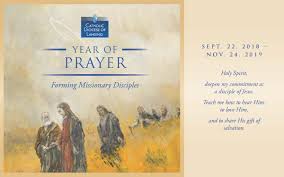
And since this is what everybody needs, Bishop Boyea has proclaimed another Year of Prayer.  This time the Year of Prayer is focused on helping us become a community of Missionary Disciples.  Not just that we believe in Jesus (which is a necessary first step), but that we share that news for others.  So, to be clear, when the Bible says would that all of God’s people were prophets, it’s not symbolic language, it’s not figurative language.  God wants all of us to hear His message of salvation and truth; and then proclaim it to others.  So go and announce the Gospel of the Lord!