Showing posts with label Faith. Show all posts

23 March 2026

Proving His Identity

Fifth Sunday of Lent–Third Scrutiny
    With the increase of AI and internet bots, it’s not uncommon for webpages that require a log-in to also require you to verify you’re human.  Apparently, all it takes to be human is the ability to select pictures with bridges, traffic lights, or motorcycles.  It strikes me as funny the different times and situations when we have to prove our identity.  In an ever-more-automated world, I suppose we pray the price for security with electronic hoops through which to jump.
    In the totally un-automated time of Christ, He still had to prove who He was.  If we go through the Gospels we see Jesus proving His divine identity to the people.  Sometimes it’s a whole crowd, other times it’s just the disciples or very few apostles.  We have the miraculous catch of fish when Jesus calls Peter to follow the Lord.  We have the healing of Peter’s mother-in-law (which maybe led Peter away from believing in the Lord’s goodness).  Jesus turns water into wine at a wedding when it ran out.  Then there’s the healing of the paralytic, lowered through the roof, where Jesus forgives the man’s sins and then heals the man of his paralysis.  There’s the multiplication of the loaves and fish for thousands at different times.  Jesus heals the blind and the deaf and mute.  He calms the storm when the Apostles are in the boat and afraid they are about to drown.  He walks on water, and even invites Peter to do the same.  He expels demons, including once into a herd of swine.  He heals the centurion’s servant from afar, and raises to life the daughter of Jairus and the son of the widow of Nain.  Lepers approach Jesus, and not only does Jesus not catch leprosy, He heals them of it.  Two weeks ago we heard Jesus reveal private details of her life to a Samaritan woman.  Last week we heard of the healing of the man who was blind from birth, something that was unheard of, as the man testifies.  
    But apparently, even with all these miracles, people still wondered who Jesus was.  Even with all these miracles, Jesus often bemoans the people’s lack of faith, and their ever-continuing doubt about His identity.  They even accuse Jesus of being in cahoots with the devil when Jesus casts out demons from people, and accuse Christ of breaking the Law of Moses.  In His own home town and in Capernaum, Jesus cannot do many miracles because of their lack of faith.

    Today’s Gospel shows the culmination of all of Jesus’ signs or miracles.  After four days of being in the tomb, Jesus raises His friend, Lazarus from the dead.  There was no way to claim this was a parlor trick or a sleight of hand.  Lazarus was clearly dead.  And not just mostly dead (as Miracle Max declares in “The Princess Bride”), but dead as a doornail.  In fact, as the Jews knew, based upon their concern at rolling back the stone that there would be a stench, putrefaction, where bacteria starts to break down tissues, would have started in 2-3 days after death, or 1-2 days before Jesus arrived in Bethany.  Still, Jesus prays, and raises Lazarus from the dead, and restores bodily wholeness to Lazarus.
    Certainly this would prove Jesus’ identity, even more than clicking boxes with bridges, traffic lights, and motorcycles.  And yet, as we will hear next week on Palm Sunday, while many people believed–the crowd that would welcome Jesus in as the Son of David–there will still many who did not believe: certainly the Pharisees, scribes, and Sadducees, and maybe even Judas Iscariot, who betrayed Jesus.  
    Do we believe that Jesus is who He says He is?  Do we take His miracles as proof of His divinity?  Or do we doubt?  Certainly, belief requires faith, which makes the leap from what is known to what is unknown or cannot be proven scientifically.  But faith is also a form of knowledge.  And when that faith has reason to assist it, even if we are not 100% sure, we can have a certitude in our faith.  For example, I’m relatively sure that my car is in my garage right now.  I can’t see it right now, so I don’t have scientific proof that it’s there, but I remember parking it there yesterday, and the garage door, last time I checked, was still closed and intact, so that I don’t have any suggestion that someone else has taken it without my permission.  But, strictly speaking, I only know it’s there by faith.
    When bad things happen to us, we can doubt in the presence of God, or that God truly loves us.  We wonder why God would let us suffer so much?  How could a good God let evil happen?  The devil tempts us to abandon these true stories we have heard from the Gospels where God proves His love for us, because what we want didn’t happen, or because we had to undergo something bad.  
    In the midst of these temptations to doubt, our Lord invites us to look at the evidence: His teachings that help us live a happier life; His miracles which prove that He is God.  Look especially to this miracle, the culmination of His previous miracles, as the nail in the coffin (pun intended) that God can do anything.  But even greater than that, is the miracle that we will hear about over the next two Sundays: how God, in the Person of Jesus, died for us so that the reign of sin and death could be ended, and the punishment due to sin, which first entered the world through Adam and Eve, could be remitted.  And then, to prove that nothing has power over God, God will raise Jesus from the dead to show us that we, too, can have new life if we are joined to Him through Holy Baptism and through following His way of life.
    My dear elect, you are also signs to us of God’s love and the veracity of what Jesus said.  You have come to believe in Him, through your own pilgrimage of faith, and your choice strengthens our faith.  In these last few weeks, doubts may enter your mind.  But have confidence in the choice you have made, and do not listen to the temptations of the evil one.  God does not only tell us to believe in Him, He gives us miracles and signs which attest to His Divine identity and His power and grace.  God desires to give you new life through His Death and Resurrection.  Yes, faith is required, but it is not a blind-faith, but rather a reasonable belief that God can do all things, because we have heard and experienced through the millennia how He has done all things, even beyond the laws of nature.
    All of us may have doubts from time to time.  We may wonder if our faith will be rewarded, or if it’s just a desire.  Look to the miracles in the Gospels and through the Church for 2,000 years.  Look to the witness of the martyrs who died rather than give up their faith.  Soon we will celebrate, once more, how Christ once-and-for-all proved His love and His power: through His Death and Resurrection which gave us freedom from sin and death, and opened the kingdom of heaven for us.

05 July 2024

Pray, Hope, and Don't Worry

Seventh Sunday after Pentecost
    In the name of the Father, and of the Son, and of the Holy Spirit.  Amen.  Recently more and more journalists are reporting that sometime around the middle of this month, Pope Francis will further restrict celebrations of the Mass using the Missal of Pope St. John XXIII.  And while I’m loathe to accept rumors and gossip as fact, two previous similar situations have proven that, at times, rumors and gossip do have a ring of truth.
    I cannot and will not go into detail now about speculating on what will happen after Rome releases this document, if there will be, in fact, a document as feared, because we don’t know what it will say.  I have, through the Diocese of Lansing’s Office of Worship, asked Bishop Boyea to release a pastoral letter to the communities that celebrate using the Usus antiquior if further restrictions are levied against us.  Certainly, in times of upheaval and strife, the words of the spiritual father of our Diocese are most important.
    But what do we do until then?  One temptation is to worry.  But our Lord told us quite directly not to do that.  “Do not worry about your life…” he said in Matthew, chapter 6.  “Can any of you by worrying add a single moment to your life-span?”  Worry is what the enemy seeks to have us do, because when we worry we try to take the place of God where everything has to be in our own hands for an appropriate answer and resolution.  No amount of worrying will change anything, but it will exhaust us and cause us to lack trust in God, who can do all things.

    St. Pio of Pietrelcina, more commonly known as Padre Pio, would say it this way: “Pray, hope, and don’t worry.”  Prayer is something we can do.  When we pray we take our concerns to God, for whom all things are possible.  Whether we pray Rosaries, or litanies, or novenas, or simple Paters and Aves, prayer draws us closer to the Sacred Heart, which always benefits us.  In prayer we become like the beloved disciple, St. John, who leaned his head against the breast of our Savior at the Last Supper.  And that is not a bad place to be.
    Obedience is also key.  St. Augustine of Hippo once wrote, “If you believe what you like in the Gospel, and reject what you don’t like, it is not the Gospel you believe, but yourself.”  Analogously, we could say that if we only obey what we like, and disobey when we don’t like something, then we are not truly obedient.  Pope Francis, whatever we may think about the reasons for any upcoming decision, is the Pope.  He was validly elected.  If he weren’t, I’m sure Cardinal Burke, who was present for the election, would have said something by now.  I don’t have to agree with all of Pope Francis’s decisions.  I don’t have to find that his words or actions always to help foster faith.  But I do owe him, as Supreme Pontiff, religious submission of will and intellect.  And Popes have always retained the authority to adjust the form of the sacraments and the way the Mass is celebrated.  Pope St. Pius V did so in eliminating rites that were less than 100 years old.  Pope St. John XXIII did it when he added St. Joseph’s name to the Canon.  Pope Benedict XVI (who should be canonized) did it when he gave all individual priests that authority to celebrate using the pre-Conciliar liturgy. 
    In my time here, I have observed almost none of the criticisms which Pope Francis has leveled against those who prefer the Traditional Latin Mass.  Very few deny the dogmatic and doctrinal authority of the Second Vatican Ecumenical Council, even while some (quite rightly) do point out issues in its implementation.  Very few do what Cardinal Burke has condemned: lacking respect and obedience to the Holy Father by simply referring to him as Bergoglio or using other words to describe him which are not fitting for Catholics when referring to the pontiff.  Most, if not all, even while struggling with some of the things Pope Francis says (as do I, at times) pray for him and seek only to be good Catholics who appreciate the entire 2,000 year history of the Church, and prefer to worship using the older Mass.  We have united well in our parish with those who worship using the Missal of Pope St. Paul VI, and I truly believe we are united as one parish, not a divisive group within a parish.  So the attacks that some level against us are not true, and we suffer quietly those detractions, as St. Peter, our first pontiff, encouraged us to do.
    We also remain true to our conscience.  Conscience is a word that has been warped in the past decades.  Right now, most consider conscience as simply what they want to do or what they feel in their gut is right.  But conscience is the voice of God, and so God cannot contradict Himself, nor what He has revealed as true for the past 2,000 years.  Conscience has to be aided by the study of Church teaching, both in the Scriptures and in the Magisterial pronouncements.  Conscience is our practical application of those teachings in individual circumstances, not the changing of teachings to fit individual circumstances.  And the Church is very clear: whoever knows the Catholic Church to be necessary for salvation, but purposely chooses to leave her, cannot be saved.  We must follow our conscience, even if it errs.  But we have the responsibility to make sure our conscience is formed so that we can hear God’s voice and not rely only on our gut or instinct.
    When a recent parishioner who attends this Mass brought up to me the now-more-pervasive stories about further restrictions, his approach was an inspiring act of faith.  He simply said that he would trust God and not worry about what was ahead, because God is in control.  He said he chose not to worry because worrying wouldn’t accomplish anything productive, and could prove quite destructive.  I applaud that man’s faith, and hope that we can all emulate it. 
    Be assured of this: as your local shepherd, your pastor, and your spiritual father, I will never lead you away from what I believe to be the truth and the best course of action.  I will ardently yet gently encourage you to stay with the Church, even as waves sometimes seem to pummel the barque of Peter.  I will never encourage anything which I believe will endanger your eternal salvation, and I will do whatever I can to make sure that the Mass is still celebrated reverently according to whatever legitimate laws we need to follow.  I pray that you will not worry, but you will pray and entrust this present trial to God.  I pray that we will all have the wisdom to know when to be obedient and how best to do that.  And in this way, we can be assured that we are not simply those who say, “Lord, Lord,” but are truly those who do the will of our heavenly Father, and so prepare ourselves for heaven, where He lives and reigns with the Son in the unity of the Holy Spirit, God for ever and ever.  Amen.  

20 November 2023

Thanksgiving for Faith, Hope, and Charity

Resumed Sixth Sunday after Epiphany
    In the name of the Father, and of the Son, and of the Holy Spirit.  Amen.  This week our nation takes a break to celebrate Thanksgiving: a day of food, family, and football (and the Lions might even win this year!).  So how fitting is it that St. Paul, in the epistle today, begins with thanksgiving for the people of Thessaloniki.  According to one Scripture scholar, St. Paul gives thanks in all but four of his epistles: his second epistle to the Corinthians; his first epistle to St. Timothy; his epistle to St. Titus; and his epistle to the Galatians.  In particular, in this first epistle to the Thessalonians, St. Paul gives thanks for their “work of faith and labor of love and endurance in hope.”  In other words, St. Paul expresses gratitude for the three theological virtues active in their lives: faith, hope, and charity. 

    If Bishop Boyea, a successor of the Apostles himself, were to write a letter about us, what would that letter say?  What virtues would he praise in us that he has seen at work?  What would he have to say about our faith, our hope, and our charity?
    When it comes to faith, we can use the word ambivalently.  We sometimes mean the articles in which we should believe and we sometimes mean our trust in God.  In today’s epistle, St. Paul seems to highlight the former, as he talks about the people’s conversion away “from idols to serve the living and true God.”  And that aspect of faith is important.  Do we believe what God has revealed as true?  Not too long ago we took the Disciple Maker Index, and I have to say that our answers from the questions on beliefs of the Church were quite high.  So that’s good.  But one of the areas that we discovered we need to work at is sharing that faith that we hold so strongly with others. 
    Because our beliefs, the revelation of truth and happiness from the God who made us, is not only for our own benefit, and then we hide it under a bushel basket (to use a Gospel metaphor).  If we truly have charity, the love of God for others, then we want others to know the truth and happiness that we have found in following Christ and making His life our own.  The Gospel is not our possession to be buried in a field until the master’s return (to use another Gospel metaphor).  We are called to invest it and help it to multiply so that the Master receives a return on what He gave to us.
    The other aspect of faith is harder to quantify, but is no less important.  Do we trust in God?  And do we trust, not only when things are going well, but when they do not go the way we want them to?  Bl. Solanus Casey comes to mind in this regard.  He would say, “Thank God ahead of time.”  We can only do that if we trust in what God will give us to or allow us to experience. 
Bl. Solanus Casey
    I have been working on this with the replacement of our boiler.  We ordered our new boiler towards the end of May, and were told it could take 26 weeks of lead time, due to supply chain and employee issues.  I had hoped back then that we would get it before it got cold.  That, obviously, did not happen.  But, as the cold weather started to approach in October, I asked our Blessed Mother to watch over us and intercede for us to get our boiler sooner, or at least to keep our church at a temperature that we could still occupy it.  I tried to thank God ahead of time for taking care of us.  And I have not been disappointed; well, not totally.  I certainly wish we had our new boiler already.  But, as cold as it has gotten at night, our building has not dropped thus far below 57 degrees.  And we have had some nice, sunny 60 degree days interspersed which have also helped.  I choose to believe that our Blessed Mother has been keeping the church warm, despite cold outside temperatures.  I choose to have faith, even faith as small as a mustard seed, that everything will be alright, and our church, while not a toasty temperature, will stay warm enough where we can stay here until we get our new boiler.
    Very much connected to that trust is hope.  St. Paul describes hope as the confidence in receiving that which is, as yet, not seen.  Hope helps us to persevere towards the fulfillment of Christ’s promises to us, though we do not experience them in their fullness right now.  Heaven and the fullness of new life in Christ is our ultimate hope.  Hope helps us to keep going, even though it seems like heaven and the life Christ desires for us is so far away, or even when what Christ promises seems impossible.  Living the virtue of hope especially helps us when somethings or everything seems to be working against what we desire.
    Many bemoan the state of the Church these days.  Many have wandered away from the Church to do what they consider worship on their couches in front of a screen; or to attend ecclesial communities whose music is more adapted to their secular tastes; or simply to stop living according to the teachings of Christ altogether because they seem so antiquated.  We have had our own struggles with the Extraordinary Form restrictions, though, for the most part, we have not had to endure many restrictions outside of the sacrament of Confirmation.  Even within those who profess to be Catholic, many are confused or sow confusion and try to change teachings that cannot be changed.  So the Church seems attacked from without and even from within.  But in the midst of all of this, we keep our eyes on Christ and his promises that the gates of hell will not prevail against the Church, nor will death and sin have the final say, because Christ has already conquered sin and death.  Hope gives us the ability to cling to Christ throughout whatever storms arise, knowing that if we stay with Him and His Church, we will arrive in safe harbors at the appointed time.
    Lastly, charity.  When many hear the word charity, they think of going beyond the norm to give to someone in need.  But the theological virtue of charity animates us to love with the love of God, at least as close as we can on this side of heaven.  Charity, a specific form of love, helps us to give God our best out of devotion to Him, and to care for those for whom God cares, especially the poor, widows, and orphans.  The love which is charity draws us out from ourselves and wills the good of the other.  We love because God first loved us.  And God’s love for us didn’t come because we deserved it, but as a generous gift to those who were totally unworthy of love. 
    And that love was sealed with the sacrifice of Christ, which is re-presented for us today in an unbloody manner in the Most Holy Sacrifice of the Mass.  Charity, the love of God, means sacrificing ourselves for the other, just as Christ sacrificed Himself for us.  And the more we share in the fruit of that sacrificial love, the more we share in the result of that sacrificial love, which is the resurrection and pure joy with God in heaven.  Love, especially sacrificial love, doesn’t always feel good, but it always brings about good, because when we love others we are sharing God, and God is Goodness itself, just as He is Love itself. 
    There are many ways that we can sacrifice for the other.  This can be in our own families, and letting them get their way rather than our own (as long as it is not harmful for them).  It can be in the work we do for the poor and the needy, especially as holidays approach.  I think we’re all paying more for just about everything.  For those who don’t have more to spend because of unemployment or underemployment, can we help them to still have a good Thanksgiving or a good Christmas by our generosity?  I say generosity, but it’s really just good stewardship, because every good thing is a gift from God, and we’re merely passing on those gifts that God has shared with us.
    Today I give thanks for you, my beloved children in Christ.  I am truly blessed and humbled to be your pastor.  Throughout my time here I have been inspired by your faith, by your hope, and by your love.  We are not done in growing in these virtues, but we have a good foundation in Christ for our future.  May God continue to inspire your “work of faith and labor of love and endurance in hope of our Lord Jesus Christ,” who with the Father and the Holy Spirit live and reign for ever and ever.  Amen.  

23 January 2023

Reaching Out to Untouchables

Third Sunday after Epiphany

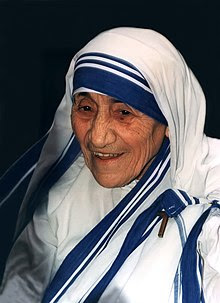
    In the name of the Father, and of the Son, and of the Holy Spirit.  Amen.  St. Theresa of Calcutta (aka Mother Theresa) was known for her work among the poorest of the poor in India.  Through reading her biography, and hearing the testimony of priests who worked with her, I learned of so many stories of Mother (as they simply called her) seeing people in the streets and loving and caring for them.  There were stories of how she would find a dying person who had been placed literally in the gutters, just left alone to die.  Sometimes there would already be maggots eating away at sores on the bodies, but Mother would pick them up, carry them to her priory, and clean them up and care for them. 
    I had a chance to work with the Missionaries of Charity when I was studying abroad in Rome.  They had a house at San Gregorio not far from the Circus Maximus and the Colosseum.  We didn’t provide medical care, but we helped prep the food that they would be served, and mopped the floors and cleaned up.  Whenever I smell overly ripe fruit or vegetables (which we had to clean before we served it), my mind often goes back to those days.  I am ashamed to say that my charity, my love of Christ for others, was not often present, and I did the work only because I was required to do so.  That is a part of my soul that still deeply needs conversion.
    As we hear about our Lord healing the leper and the centurion’s slave in today’s Gospel, we probably sanitize this story in our mind.  We know leprosy was bad, and very contagious.  And we know that the Romans were hated by most Jews, not only because of their political oppression, but because they had symbols of their pagan religion everywhere.  But do we appreciate how outcast those two groups were at the time of Christ?
    Perhaps our country came somewhat closer to understanding the shame and the isolation of a leper as we muddled our way (often in a less than virtuous manner) through the early days of the COVID pandemic.  So many, myself included at times, especially at the beginning, would be so nervous about a person coughing.  There were still other viruses present, and yet how quickly we could assume that the other person had COVID, and if (especially in the beginning) we even looked at them we might get it too, and be under house arrest for 14 days!  But even that doesn’t really get to an understanding of leprosy.  A leper’s flesh was literally rotting away.  He or she was likely covered with cloths to hide some of those sores, but those cloths were probably not cleaned that often.  Though no one had deodorant in those days (though the rich had perfumes), leper colonies were often in horrible, inhospitable places, where personal hygiene was even lower than the average standard of that time.  Perhaps maggots also were in the flesh of those who had leprosy, just like some of the untouchables for whom Mother Theresa cared.
    But the Savior didn’t shrink back.  I doubt He covered His nose, or turned away.  No, from what we hear and from my own estimation, our Lord stretched out His hand, touched the man, and healed Him.  Christ saw, not a leper, but a child of God who needed to be made whole and healed from a disease that cut one off from practically every good and wholesome part of human existence. 
    When it comes to the Romans, we do have some people that we tend to ostracize.  These days it tends to be the Russians and Chinese.  Around September 11th it was Arabs.  But to get a closer sense of the animosity, we’d probably want to think back to the way we treated Russians in the 1950s.  While I was not alive, certainly the stories about how we, as Americans, were afraid of Russian spies infiltrating our government (which perhaps they did, in some ways).  So we ostracized and persecuted anyone we thought might be connected to the Russian communists.  Better dead than Red, we would say.
    And yet, as this Roman, this hated figure came to our Lord seeking a healing for the centurion’s slave, again, Christ didn’t pull back, or say that He had no times for Romans.  The request was made for healing, our Lord offered to go, but then the Roman demonstrated faith that no such visit was necessary; as long as our Lord said it would happen, it would happen.  I’m not sure we can fully appreciate just how revolutionary and rebellious that action was, not to mention when the Savior said that many foreigners would recline with Abraham and Isaac and Jacob, but many children of the kingdom would be outside, wailing and grinding their teeth. 
    The basic requirement for healing was faith, and as long as one had faith, our Lord was not ashamed to help that person.  It didn’t matter whether your were ritually unclean, or diseased, or even a soldier of an oppressing pagan regime.  God would act if the faith was present.
    From whom do we still make sure we keep six feet away (or farther)?  Whom do we ostracize?  How many opportunities for conversion do we miss out on because we treat the other as someone not worthy of our time or attention?  In what ways are deep conversions lost because we’re not willing to approach the other?  Our Lord didn’t say that leprosy was no big deal, but He restored that leper to wholeness, not just physically, but in terms of community and right worship.  Our Lord didn’t say that Roman oppression and the treatment of the Jews was just, but He healed the slave of the centurion.  There was a centurion at the foot of the cross, who exclaimed, “Truly, this was the Son of God!”  Perhaps it was the same centurion, whom we now refer to as St. Longinus.  Perhaps that healing was the first step in that soldier rejecting pagan gods and believing in the true Son of God, Jesus Christ.
    I won’t stand before you today and say that I’ve got it all together, and willingly reach out to our modern “untouchables.”  I would be a hypocrite to say that there are not people whom I keep at a distance, of whose conversion I could be an instrument if I would put aside my own fears and stereotypes.  But I’m working at it, and I hope you will, too.  Because no matter who the person is, or what the person has done, that person, without a doubt, needs the Father, and the Son, and the Holy Spirit.  Amen.  

24 October 2022

Measuring Faith and Virtue

 Twentieth Sunday after Pentecost

    In the name of the Father, and of the Son, and of the Holy Spirit.  Amen.  At the house of former parishioners in East Lansing who have become like an extended family to me, there are marks at one of the closet doors with names and dates.  Maybe your family has a similar tradition, where the grandchildren’s heights are measured from time to time, and noted on the frame of a door.  It’s been fun to see the grandkids come back and see their heights at different stages of their life.
    Of course, as a kid, you’re always making sure you’re standing up nice and strait, trying to get every extra centimeter that you can.  And, if you measure yourself too closely in time, you’re not going to see much, if any difference in your height. It may appear that you’re not growing at all!
    In our Gospel today we hear about a man who didn’t have to see to believe.  He first approaches the Lord for the healing of his son, and our Lord somewhat rebuffs his request: unless you see signs, you will not believe.  Already, the Savior is noting that the people won’t believe unless He does something spectacular.  Still, the man has faith, and begs our Lord to do something, otherwise his son will die.  Christ assures him that his son will live, though the man cannot see the proof of his faith until he returns home, and his son is fine.  In fact, the son is healed at the moment that our Lord had said to the man that his son would be healed.  That sign (the term the Evangelist John uses for miracles) then leads others to believe.
    Still, think about the man walking back to his home.  We don’t know how far it was, but the walk must have taken at least a day, as the man inquires when the healing happened, and at which hour it took place.  The answer was that it took place a day earlier.  From what we can tell in the Gospel, the man never doubted that what our Lord said would happen would, in fact, happen.  Walking home, perhaps we would wonder if our faith would really be rewarded, if this Jesus was truly able to do something, especially so far away.  Would we doubt?  Would we lower our expectations so that we wouldn’t be disappointed?  None of these things the man seems to do.
    When it comes to our faith and our trust in the Lord, are we like the man who has faith?  Or are we like the crowds that need to see signs before we believe?  Do we have confidence when God says something will happen, even if we do not immediately see the results?  
    In some ways, we can be like kids who want to measure faith every day like we measure our height.  And, like our height, we may not see very noticeable results.  We pray for trust in God, we pray to be open to His will, but each day we don’t seem to make much progress.  Or maybe it’s working on a particular virtue, or eliminating a particular vice.  We ask God to strengthen us to choose the good, or support us in times of temptation so that we don’t fall, but we see no real movement.  Are we willing to be patient, not only with God, but also with ourselves, in growth in holiness?
    I do not consider myself a millennial; nor do I see myself as part of generation X.  I’m the micro-, in-between generation that some call xenials (with an x).  I know life before everyone had a cell-phone; I’m comfortable with cassette tapes and VHS.  We couldn’t simply pause TV if we had to go the bathroom; you had to rush to the bathroom and hope you finished your business by the time the commercials were ending.  But I have, like many millennials and later generations, gotten used to getting what I want immediately, thanks to the Internet and having a phone with me almost all the time.  And so patience is not always my strong suit.  I do work at patience, and I ask God to help me, but day-by-day, I didn’t seem to make any progress.  
    One day, a few years ago, I flew to Australia, to visit a priest friend of mine in Sydney.  My flight left in early November.  The day my flight left was the day in 2019 when we got pounded with 8 or so inches of snow.  I arrived at Bishop airport in Flint, and my flight was delayed.  I waited all day in the airport, only to find out that the flight was cancelled, and I would lose a day of my vacation, as United tried to rebook a whole plane of customers who had to go to Chicago, and then continue their travels.  Normally I would have been upset and frustrated.  I would not have normally been calm and collected when talking to the gate agents.  But, for whatever reason, I was patient.  And that virtue that I had been working on, I noticed that I was better, after all those years of praying for more patience.  God had answered my prayers, but I had to trust in His timing, and the work that had to be done in my soul before I would be open to that virtue.  
    Can we trust God, even when we don’t see miracles, even when we don’t see the work that He is doing?  God’s work is so often invisible, and so our cooperation in that work is also an act of faith.  We do have to go out on a limb to have confidence that God will change us, He will perfect us, as and if we allow Him to do so.  We may not see much progress day-by-day, but after a year or more, I’m willing to bet that we will notice that we are different, that we have grown in virtue.  Be like the man in today’s Gospel: no matter how long the walk takes to see the fruit of your faith, do not doubt God, but have confidence that, if we but trust in God to transform our lives, He will not disappoint us.  He will, in fact, outdo our expectations: the Father, and the Son, and the Holy Spirit.  Amen. 

03 October 2022

Praying Like Veruka Salt

 Twenty-Seventh Sunday in Ordinary Time
    It seems to me that recently, Hollywood in general does not know how to make good movies anymore.  They simply rehash old ones that were popular.  A case in point in the newer version of “Willy Wonka” released in 2005, called “Charlie and the Chocolate Factory,” which re-told the story of the movie released in 1971.  For me, Willy Wonka is always Gene Wilder, not Johnny Depp, even though the 1971 has some pretty scary scenes in it.

    In both movies, though, we see all sorts of bad character in children.  One in particular, Veruka Salt, is very demanding and self-centered.  She wants what she wants and she wants it now.  She often wants it without any personal labor.  Indeed, to find the golden ticket, her dad forces his workers to open thousands of bars of candy, until it’s found.  And then, when she’s on the tour with Willy Wonka, she wants a goose that lays a golden egg (in the 1971 version), demonstrated by her song, “I Want It Now," which ends with her standing on a scale, that determines that she’s a bad egg, and sends her to garbage chute.  
    While we don’t prefer to think of ourselves this way, this approach, that we want what we want and we want it now, can creep into our faith life.  We heard in the first reading from the Prophet Habakkuk, who probably wrote this book in the 7th century (600s) BC.  Perhaps, in our prayers, we have even used words like his: “How long, O Lord?  I cry for help but you do not listen!”  God, I’m praying to you!  You’re supposed to give me what I want as soon as I ask for it!!  Habakkuk, expressing that cry of his people, was not asking for anything bad.  The Babylonians are about to capture Jerusalem, God’s Holy Dwelling.  So they’re asking for His protection.  This is not a bad thing.  But remember, God had previously sent prophets to instruct the people to turn away from their evil, and they had not listened.  The consequences of their rebellion against God are about to fall on their own heads.
    Sometimes, we, too, ask for things that are not bad.  We seek some good that God can give us.  We feel that something should be in accord with God’s will.  And so we want it now.  Of course, we know that God allowed the Babylonians to sack Jerusalem, and the Jews went into exile from 587-539 BC.  But, God conveys through Habakkuk, that “the vision still has its time, pressed on to fulfillment, and will not disappoint; if it delays, wait for it, it will surely come.”  God will answer the cries of the people, but it will be on His schedule, not on theirs.  
    God invites us to be patient, and to trust that He will give us what we need, even if it’s after when we think we need it.  That takes faith, which Jesus encourages in the Gospel.  But there’s the curious follow-up to Jesus’ invitation to us to have faith, where He talks about us as servants, who need to wait for the Master’s schedule of dining.  Still, with ears to hear, we can see how often our prayers requests can come from an attitude where we are in charge, and we are the ones around whom God should make His plans.  But we are not the Master, but the unprofitable servants, whose job it is to serve the Master.  God’s will doesn’t have to conform to ours; quite the opposite: our will needs to conform to God’s.  
    I admit, I do not always exemplify that trust in God’s timing and the priority of God’s will over mine.  Because of my strong will (which can help me cling to God even in difficult times), I struggle saying “Thy will be done” and acknowledging that if it didn’t happen, then it’s not for the best.  When I want something, I automatically presume it’s for the best.  But, compared to God’s omniscience, we are like children who want dessert all the time, rather than eating our peas and carrots first.
    I think this struggle to accept God’s will and timing is most evident when someone we love is struggling with poor health and is approaching death.  There’s nothing wrong with seeking alternative treatments and second opinions, to make sure that we have explored every option.  But sometimes there is no other outcome than death.  Still I have seen adult children struggle greatly with accepting that reality, and wanting to keep trying every new medicine and prolong life, even when doctors are clear that there is no cure, beyond a miracle, and death is the only end to a disease or condition.  It’s not wrong to pray for miracles and have faith that God can accomplish mighty deeds, but are we willing to accept when God’s plan is different than ours, no matter how hard that is to accept?  
    And it is hard, especially when the answer we want in prayer deals with someone we love.  Love, we so often think, is doing everything we possibly can for the beloved.  But sometimes love is also accepting that God’s will is not ours, that what we love will not continue in the same way as before, and that love will simply treasure the days, weeks, or maybe months that we have left.  
    Faith is hard; faith requires us to battle our own desires and wills.  If it were easy, everyone would have faith, and it wouldn’t be so important for us in our relationship with God.  But today God invites us to make that move from “I want it now!” to “the just one, because of his faith, shall live.” 

08 August 2022

A New Perspective

 Nineteenth Sunday in Ordinary Time
    When I come to a problem, or something that needs fixing, I have a way of seeing one solution to that problem, and proceeding accordingly.  However, sometimes my approach is not the best, or won’t work at all.  It’s not until the problem is looked at from another angle and another approach is taken that the problem can easily be solved or addressed.
    We have lots of issues in society today.  And there are twice as many solutions proposed as there are problems.  But the solutions all tend to focus on an earthly solution; most look to solve the issue.  While laws are important, and policies can help direct funding to needed programs, so many of the issues we deal with cannot be truly solved with earthly solutions.  We need to look to heaven.
    Christians have sometimes been accused of not caring about the world.  They are said to only care about heaven, and so don’t care about the things here on earth.  But more often than not, it is only by concentrating on heaven that we come to see the ways that we can treat, not only the symptoms of what ills our world, but the disease, because the way we deal with our world has an impact on whether or not we go to heaven.  
    Living for heaven takes faith, looking beyond what is seen to what is unseen.  Our long reading from the Letter to the Hebrews talks about Abraham as the model of faith.  He left his homeland in modern-day Iraq to travel to the Promised Land, not knowing what he would find when he got there, or if this God who had revealed Himself to Abraham and called him to sojourn to a new land would care for him.  And then, Abraham trusted that God would give him descendants, though he and Sarah, his wife, were past the childbearing age.  And then, when God asked Abraham to sacrifice that son that they had conceived, Abraham trusted that God would raise him up, so that God’s promise that Abraham’s descendants would be as numerous as the stars in the sky would come true.

     All of this, from an earthly point of view, seemed foolish.  Iraq has been called the cradle of civilization, and society there was likely more advanced than the scattered and small Canaanite nations to which Abraham ventured.  Abraham was one hundred years old when Isaac was born, and no one would have expected that Abraham and Sarah could even conceive, let along bring a healthy boy into the world.  In fact, Sarah saw things from an earthly point of view, and so, before God promised that she would conceive, Sarah told Abraham to have relations with her slave, Haggar, in order to “help” God fulfill His promises.  But Haggar’s son, Ishamel, was not to be the son of the promise, because God had a different solution.  And lastly, even Isaac was probably concerned when Abraham led them both up the mountain, as they had the wood and the fire for the sacrifice, and they had a knife, but no animal to slaughter.  From an earthly point of view, it would have been better to not even climb the mountain and simply run away from God’s mysterious command.
    But Abraham had faith in God, and trusted that, if God promised, He would deliver.  So Jesus told His disciples and tells us, that we are to take a different view as we go about this world.  We are to act as those awaiting for the Master to return.  If we do, then the Master will serve us.  But if we don’t, if we don’t act in accordance with the Master’s will, and do whatever we want, then we will be punished for our disobedience to the Master.
    What does this practically mean?  It means that the choices we make should coincide with God’s will, as much as we are able.  It means that we don’t look necessarily to earthly fixes to our problems, as to heavenly guidance and solutions. When it comes to our environment, we have a responsibility to care for the earth.  Some would say that we can no longer drive gas cars, or travel in planes, or even eat meat because cows fart too much.  That certainly is an earthly point of view (often enough, sadly, wrought with exceptions for the rich and the powerful).  From a faith point of view, we look first at ourselves, and examine our stewardship of created goods.  Do I waste a lot?  Do I use resources unnecessarily?  How do I treat the environment in which I live?  Laws can help us be good stewards of creation.  But when we have that conversion to live as good stewards of creation, as God called us to be in Genesis, then we find even better solutions than mandating rules that apply to “thee but not me.”
    When it comes to the violence that plagues our nation, from an earthly point of view, it would seem the easiest to simply outlaw all guns, or types of guns, for most people.  I can tell you from my work with the State Police, that there are a large amount of people who don’t care what the laws state; they will do whatever they want, for good or for ill.  So simply passing this law, or outlawing that gun, is not going to stop the violence (though perhaps there are certain laws that would help).  When we look to a heavenly point of view, we see how broken families are these days, and how that affects the development of children into adolescence and adulthood.  We see how much disturbing violence children are exposed to on screens from an early age.  We see that people are not taught constructive ways to work out differences, but those who call themselves leaders tend to yell, scream, and destroy whenever they don’t get their way.  Do I do all I can to be a loving mother or father (or grandfather or grandmother)?  Do I make time for my children (or grandchildren), limit and monitor their screen time and what they are viewing?  Do I belittle others and treat them as less than human when they don’t agree with me, or show that each human being has dignity and value, even when we don’t see eye-to-eye?
    With these, and countless other issues, we can get stuck in a hamster-wheel of trying to find solutions that don’t solve the bigger problems.  We forget God, and forget that God has given us long and lasting ways to solve, not only the symptoms of our human failings, but the deeper disease.  Those who keep their eyes on heaven, and on the fact that they will be called to account for their actions to our heavenly Masters, are precisely the ones who are more likely to be good stewards here on earth.  Don’t just seek earthly solutions.  Seek the answers that come from heaven.

09 May 2022

The Necessity of Faith

Third Sunday after Easter
    In the name of the Father, and of the Son, and of the Holy Spirit.  Amen.  I think we often presume that it would have been better to be alive when our Lord was walking the earth.  We hear this stories from the Gospels and presume that if we would have been there, we certainly would have followed Christ and been one of His most faithful disciples.  We would have recognized that He is who He says He is, not only from His teachings, but especially from His miracles.  And that’s a pleasant thought.  But the Gospels also paint a very different picture of everyone else, including the Apostles.  No one seems to understand who Christ is, not even the Apostles, until after He has been raised from the dead.  Our Lord does draw big crowds at times (the Sermon on the Mount and the feeding of the five thousand come to mind), but a lot of people didn’t take well to either of those situations after a little while, and we know that most of the disciples stopped following Christ after the bread of life discourse.
    Interacting with the Lord always requires faith.  When He walked on the earth it required faith to know that this itinerant rabbi from Nazareth was the co-eternal Son of the Father.  It required faith to know that, when the Savior said our sins are forgiven and that we should pick up our mat and walk, that they really were and we really should. 

   The Gospel we hear today is from the Last Supper discourses, and the Lord says that we will not see Him, but that we will see Him again.  We might have some sense of what He meant, but the apostles did not.  And the explanation that the Lord gives, that we will be sad and mourn, but that we will later rejoice, didn’t really seem to answer the question.  It was confusing, especially in the light of the Master washing His servants’ feet, and then changing the Passover ritual to say that the bread was really His Body, and the wine was really His Blood. 
    But we are in the time of labor right now, the time when the Lord is away, knowing that He will return in a short time.  The labor is not joyful, but the fruit of this labor will be exceedingly joyful.  And when the fruit of the labor comes, we won’t even think about the pain we went through to get to it. 
    The labor is faith.  The labor is striving after God, doing our best to love and serve Him with our whole mind, heart, and strength, when may things around us and many things inside of us tell us to love and serve only ourselves.  It is painful to die to oneself, as Christ instructed us to do, to take up our cross daily and follow Him.  It is an act of faith to say that it will all be worth it, because we don’t see many results, and certainly not the eternally lasting ones, until after we are dead.  It’s Indiana Jones walking out onto a ledge he cannot see in “The Last Crusade.” 
    It takes faith to not live according to the desires of our flesh, as St. Peter instructs us.  It takes faith to be subject to governmental leaders, especially when they’re working against you.  That’s the context in which St. Peter wrote this passage.  He wasn’t talking about a good emperor or governor.  He was talking about an emperor and governors who were seeking the extinction of Christianity.  He was talking about those who were finding new and cruel ways to torture those who followed Christ. 
    He’s not saying that we should obey our civil leaders when they tell us to do something against divine or natural law, the laws of God or the laws that God set up for nature, that any person can know by the gift of reason.  But He does tell us to be good citizens and be subject to them in promoting the good of the city, State, and country.  But that takes faith.  It seems to especially take faith these days, that being good citizens when so many are confused about so much is somehow part of God’s plan, and that God will make everything right and will correct the errors of our day and that justice and truth will win out.  But they will.
    And we see a clearer distinction between good and evil these days.  The choice between following Christ is becoming a starker choice.  Catholics who wish to be faithful to the Gospel and the Church can no longer simply “go along” with society, as society now posits as good that which is evil, and, as much as science is touted as the ultimate truth, science is ignored if it doesn’t support particular viewpoints (like gender dysphoria and the unique personhood of an infant in the womb).  It takes faith to trust that God will right all these, but He will.  And we don’t want to be on the losing side when He does right these wrongs.
    Today the Lord invites us to have faith; to trust that He is who He says He is; that He can do mighty things, not only while He was on earth, but even now when His glorified Body is at the right hand of God in heaven.  The Lord invites us to be good citizens, and to be subject to our government leaders as long as they don’t work against our practice of the faith.  Christ invites us to trust Him, to trust the Father, and the Holy Spirit, God for ever and ever.  Amen.  

02 July 2018

Death and Resurrection

Thirteenth Sunday in Ordinary Time
Death.  It’s scary.  It seems so final.  What is beyond death is, generally, unknown.  It is the biggest change a person goes through in life, after being conceived and born.  We do everything we can to avoid death: we create new medicines; we buy creams to try to keep us looking young; we spend lots of money to fight death.  And yet, death comes to us all, some as young people, some as old.
Fighting death is, in one sense, natural for us because we were not made for death.  In the Garden of Eden, Adam and Eve cared for the Tree of Life, which would have allowed them to live forever.  But they were cast out of the garden, and banned from that tree.  And, as our first reading stated, “God did not make death.”  Death entered the world because when our first parents rejected God, they rejected life.  St. Paul says it this way in the Letter to the Romans: “Therefore, just as through one person sin entered the world, and through sin, death, and thus death came to all, inasmuch as all sinned…”  Everything in our being knows that we are made for eternal life, and yet we all have to experience death, and so we fight against it.
But, we need no longer fear death, because Jesus has conquered it by His Death and Resurrection.  Jesus gave a foretaste of that in today’s Gospel.  The woman with hemorrhages was getting worse; perhaps she was close to death.  But she went to Jesus because she had faith that He could make things better.  The little girl, the synagogue official’s daughter, was already dead by the time that Jesus got to her.  But her parents had faith, and she was returned to them.  Jesus unbound the power of death and gave new life.  Now, in both cases, the woman and the girl, they would later die.  But their faith changed the approach to death.  They followed Jesus’ command that we heard, “‘Do not be afraid; just have faith.’”
Death, for those who have faith in and follow Jesus should not be something that we fear so much.  Yes, we still may be anxious about the unknown, and we should not do anything to speed up our own death, but we need not be afraid if we have faith.  
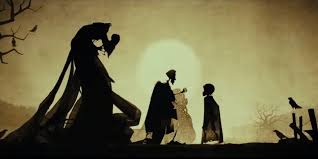
In “Harry Potter and the Deathly Hallows,” a story is told about the Deathly Hallows and three brothers.  Two of the three brothers try to cheat death.  But the third brother gained Death’s cloak of invisibility, and hid from death for many years.  After a long life, the third brother gave his cloak of invisibility to his son, and, as the story goes, “greeted death as an old friend.”  That’s not quite our view of death as Christians, but there is something that rings true in that story.  As believers in Jesus, death is not something we fear, but something that we can greet as a friend, because it is the necessary transition from this life to the life to come.  St. Augustine says that the only Christian who should fear death, is the one who has not truly followed Jesus, because eternal life will not be a life of joy, but a life of eternal torment.
If we are not afraid, if we have faith in Jesus, death is that which is the conclusion of our trials and testing on earth, and the beginning of our reward.  The student who has studied is not afraid of the final exam, but sees it as the necessary way to move towards graduation.  Our final judgment is not based on what we know, but, as St. John of the Cross states, whom we loved and how we loved.  But it still can allow us to graduate, to move on, to pass over, from this Valley of Tears to the eternal banquet of the Lamb of God in heaven.  
But death need not only be thought of in terms of our final breath.  We experience little deaths throughout our life, and our approach to those little deaths should be no less occasions of faith in what Jesus can do.  There’s the little deaths that happen in our family life: when we realize that our little baby is no longer a baby and is becoming more independent; when we lose a job; when, despite years of Catholic education and formation in the home, a child breaks our heart and stops practicing the faith.  There’s also little deaths that happen in our faith life: when we lose a pastor that we love; up 75 a bit and then down 475, St. Mary in Mt. Morris announced last Tuesday that, effective immediately, the school is closed; in our own parish as we make the transition to two weekend Masses from three.  All of those and more are little deaths in our lives.  We can fear it, we can fight it, we can kick and scream about it, or we can be not afraid and have faith in Jesus, trusting that He who brought us to all those situations and more will carry us through it.

Because our faith and our hope is in what is beyond the death, and that’s new life.  When Jesus rose from the dead He blazed a trail for us so that where He has gone, we hope to follow.  And although we have never seen what is on the other side of our own death, we have seen what is on the other side of Jesus’ death, and that is new life, transfigured life, glorified life.  To gain that new, transfigured, and glorified life, we need only follow Jesus and His way.  As we face death, in its many forms, Jesus invites us today: “‘Do not be afraid; just have faith.’”

01 October 2016

Signs of Fall

Twenty-seventh Sunday in Ordinary Time
There are some tell-tale signs that we are in the Fall: Friday night high school football, college football Saturdays, less daylight each day, cooler evenings and mornings, young ladies are starting to break out their uggs and ordering pumpkin spice everything.  Fall is upon us!  And it can be tough with less darker mornings and evenings.  Even during the days, it seems like there is more and more dreariness.

It can also feel darker and darker sometimes in terms of our city.  As you might have guessed, when I told people I was going to Flint, most people quickly responded with, “Don’t drink the water.”  Our water crisis, though we have started to address it, rages on.  As of April 2015, the unemployment rate in Flint was still 9.7%; city-data.com still lists Flint as a high crime area.  It seems like there is little good news for us!
In spite of this, the Word of God gives us some encouragement.  The Book of the Prophet Habakkuk, written likely in the 7th century BC, is written shortly before the Babylonians sack Jerusalem and exile the Chosen People to modern-day Iraq.  There was not very much good news for them, either.  In fact, the prophet says, “How long, O Lord?  I cry for help but you do not listen!  […] Why do you let me see ruin; why must I look at misery?”  Perhaps this is our prayer as well.  But the Lord does not remain silent.  He responds, “the vision still has its time, presses on to fulfillment, and will not disappoint; if it delays, wait for it, it will surely come, it will not be late.”  God promises not to abandon his people, even if things look very dark.  What are the people to do in the meantime?  “The just one,” Habakkuk writes, “because of his faith, shall live.”  
Faith is hard, because, as the Letter to the Hebrews states, it is the “evidence of things not seen.”  We see darkness around us.  The light is not visible to our eyes.  It takes faith to trust that the dawn will break forth and scatter the darkness.  When our experience is negative, it’s hard to know there is any positive at all.  And we can sometimes rationalize not having faith by saying that we’re realists.  
But if we wish to see better times, then faith is necessary.  And we don’t need a large amount of faith, but only the size of a mustard seed, one of the smallest seeds around.  If we have faith that small, then we can command trees to move to their death, and they will do it.  Now, I’m pretty sure the Lord is not telling us to have faith that so we can landscape differently.  But he is saying that if we have a little bit of faith, anything can happen.
Having faith has made a difference in my life.  When I was a parochial vicar in East Lansing, there was a young man I knew who was attending Michigan State.  I had taught him a little at Lansing Catholic High School.  One day he contacted me and asked for prayers because his bike, which was locked on a bike rack, was stolen, and the police had very little hope of getting it back.  He relied on the bike to make it to class and to football practice.  I prayed, through the intercession of St. Anthony and St. Dominic, and had faith that God would answer my prayers according to His will.  I pleaded with God that this young man needed his bike to be a good student, and that getting his bike back would strengthen his faith.  A day after I prayed, the bike was found and returned to its owner.   This definitely did help to increase that young man’s faith.  This young man had been sure that he would never see his bike again.  The police were sure he was right.  Faith made the impossible happen.  

If we have faith, what we see is not what will always be.  That’s true for our spiritual lives: the struggles we have, if united to Jesus, can one day lead to glory in heaven.  It’s true for our city: I see signs of hope that Flint is coming back, and if we follow God’s will we can once more have a thriving city.  And I am excited to be a part of that renewal right here in our parish.  If we have faith in God’s will, and trust in God, we can be major contributors to the flourishing of Flint.  Things may still look bleak, but the Lord invites us to follow Him and trust in Him.  “For the vision still has its time, presses on to fulfillment, and will not disappoint; if it delays, wait for it, it will surely come, it will not be late.”  Trust that being obedient to God’s will will give us things that we never thought could be.  Have faith!

08 August 2016

Patience

19th Sunday of Year C–Installation of Fr. Anthony Strouse as Pastor of St. Pius X, Flint
by Most Rev. Earl Boyea, Bishop of Lansing

        What if you pulled into a McDonalds or Wendys drive through and ordered your burgers and fries and were told, “OK, if you will pull over there, we promise you we will get your food to you at some point”?  What if you turned on your computer to play a game or to retrieve your e-mail and a message came up saying, “Go out for a walk; your computer will be ready eventually”?  What if it was approaching December 25th and you were told by your teacher or your employer, “I promise you a vacation for the holidays but you will have to wait to find out when it will be”?  Most of us, in any of these circumstances, would easily lose our patience.  I know that when my phone takes longer to process something than I think it should, I get very impatient and start waving my hands, “come on, come on”!  We do not know how to wait; we are not very good at delayed gratification.  Yet everything that is really good in our lives is something that we must wait for, we must prepare for. This is especially true of God’s promises to us.
Abraham, our Father in faith, is the one who best shows us how we are to wait for God’s promises.  His story is related in our second reading today from the Letter to the Hebrews.  Abraham was told by God to leave his own country, where he had grown up, where his family lived, and go to a strange country which God said he would give him.  Abraham had to wait a long time for that country to be his—in fact, it did not happen until his descendants, the Israelites, took the land hundreds of years after his death.  We are told in the Letter to the Hebrews today that in the meantime, Abraham lived “in tents with Isaac and Jacob, heirs of the same promise” as they waited for God to fulfill that promise. 
Abraham was also promised many descendants and yet for most of his life he did not even have a son.  It was only late in life that he and his wife had a son, whom they named Isaac.  Yet through all this time Abraham trusted that God would be faithful to his promises—that is what we call faith.
Jesus promises us in the Gospel today that if we keep our eyes open and keep watching for his return in glory, then he, Jesus, will save us when he comes back.  Well, we have been waiting for 2000 years for Christ’s return.  But have we waited as Abraham waited?  My guess is that most of us need a quick answer from God.  We really are unable to keep going for the long haul on just a promise.
Two things are needed by us if we are to live a life of a Christian in our world today.  First of all, we need patience—we need to be able to wait for what is truly good without needing an answer right now.  Secondly, we need faith.  Only faith that God will be true to his promises will allow us to be patient and wait.
Patience means that when we are on the football team, we work hard day in and day out knowing that in the end all the work will pay off—maybe it will pay off in victories on the field, or maybe it will pay off later in our life.  Maybe we won’t win that many games, but maybe the friendships we developed, our discipline and stick-to-it-ness will help us be better adults and more responsible parents.  We may not even realize the pay off until we look back on our lives.  
Patience means that when our marriage seems to be falling apart, we make a new investment in it, taking the time to try to renew our relationship, realizing how much work went into it the first time, but believing and hoping that something positive and good can result.  
Very few of us, unfortunately, are willing to make this long-term effort.  We want to see results now.  Patience means that we raise our children and given them our time and attention, knowing full well, that we ourselves may not be the beneficiaries of all that effort.  
During my time of doing seminary work, I put a lot of time and energy into preparing young men for the priesthood—yet I didn’t expect them to bring about some great reform in the Church.  Rather, I hoped that they would train the next generation of priests who would begin to bring about that reform.  I am willing to play my little part in that long-range process.  Parents do the same thing with their kinds—for they are preparing parents for the next generation.
Why would any of us be patient?  We would any of us be willing to put off our satisfaction until sometime later?  It is only because we believe that in the end God will balance all this out—that we shall be rewarded in the end—and that reward, life with God, is worth waiting for, worth all our efforts.  Of course, we hold to this only due to the gift of faith.
My sisters and brothers, I promise you heaven—I promise you a life you cannot imagine—I promise you a love deeper and richer than anything you could dream about—but this will remain a promise until it is fulfilled—in the meantime, keep the faith, be patient, and keep your eyes on the look-out for Jesus.


God bless you all.

Seeing with the Eyes of our Souls

Nineteenth Sunday in Ordinary Time
The home that I grew up in was in the country, north of Williamston.  We had a two-story log cabin that my parents had someone build, with 5 acres of land.  Some of the land was developed, some was undeveloped and allowed to go wild.  My parents didn’t like the idea of video games, and, believe it or not, very few people had cell phones at that time (right now some of you who are kids are wondering how that is even possible and how we survived).  So my sisters and I were forced to use our imaginations, and we often played outside (I think that was partially because mom wanted time to herself in the house).  We imagined being super heroes, riding our bikes in our driveway as our super hero cars, or sometimes pretended that we were living in the wild, making forts and shelters from some of the trees that naturally grew in the undeveloped parts of the property.  Our imagination allowed us to see things that were not there.
Faith is not imagination.  Faith is not making something up that will never happen.  I am not Captain America (well, maybe I’m Captain America before he was strong).  I don’t have a super hero car (though I do love my Chevy Malibu).  But faith does allow us to see things that are not there.  
We hear about faith in all three readings, but especially in our first and second readings.  The sacred author of the Book of Wisdom talks about how the Jews had faith that God would deliver them from their bondage in Egypt, and would even the score against Israel’s oppressors.  And the sacred author of the Letter to the Hebrews speaks especially about the faith that Abraham, our father in faith, had when he left Ur for Palestine, when he trusted that Sarah would conceive Isaac, and when God asked Abraham to offer up that same son, Isaac, though God had promised descendants through Isaac.  Abraham had faith and saw a future for himself with God, though it was not the one he originally had planned for, or even seemed contrary to the future that God had promised.
Faith allows us to see, not only with the eyes in our head, but also with the eyes of our soul.  Faith invites us to change a part of our life that we think we need, trusting that God will supply for whatever we think we will lack.  Faith allows us to know things that are not apparent to our senses.  In some older holy cards that depict the Mass, it shows the priest, elevating the host and the chalice, with the angels and saints coming down from heaven in adoration.  That is not simply a pious image; that happens at every Mass, as we participate in a halfway point between heaven and earth.  Faith in God led the Sisters of Loretto in Santa Fe, New Mexico, to ask God to send the someone to complete their chapel, which lacked a staircase to the choir loft.  Sadly, there was little room for a regular staircase, and they had very little money.  After praying a novena to St. Joseph for nine days, a man came who promised to build the staircase for the sisters, but they had to give him total privacy.  He locked himself inside for three months, and only had primitive tools.  He disappeared as soon as the staircase was finished, without accolades or payment.  Experts still don’t know how it was done.  The sisters knew it was St. Joseph himself who had built it for them.
Faith leads us to do what we think is impossible, because we are not the main agents of the impossible, but God is.  We are so often limited by our vision, that we fail to see things with the vision of God.  After all, the Jews were looking for an earthly king like King David to be their Messiah.  God sent them Jesus, who was not whom the Jews expected, but freed them in a more powerful way than an earthly ruler ever could have–He saved them from sin and death.
What do we think is impossible?  What are those things that our eyes in our head tell us can never happen?  Jesus tells us in the Gospel not to grow complacent.  He reminds us that He will return, but it will be on His time.  If we lose our vision with the eyes of our souls, and only live with the eyes in our head, then we will forget about the Master who will return and will reward or punish us according to our service.  But, if we keep watch with the eyes of our souls, trusting that God can accomplish what is impossible–even the salvation and restoration of this fallen world–then God will reward us, making Himself our servant.  

We don’t simply have to imagine a world that is better than the one we have now: a world without violence, without hatred, without racism, without drugs, without war, without greed, without the fallen realities that continue to plague us.  God can make that world a reality.  Do we have faith to see how God wants to use us to help make the world that the eyes of the soul see the world that the eyes in our head see?

10 November 2015

A Leap from the Lion's Head

Thirty-second Sunday in Ordinary Time
Early in our pilgrimage to the Holy Land in 2017 we are traveling to Petra in Jordan (sign-up on our webpage if you’re interested!).  Petra is the place where the final scenes in “Indiana Jones and the Last Crusade” were filmed, that building that seemed to be carved into rocks.  Yes, it’s real (at least the outside is).  If you remember, in the movie, Indiana, has to face three trials before he can reach the chamber with the Holy Grail, and to do so he uses three clues.  In the first trial, he kneels, as “only the penitent man will pass.”  The second trial deals with the Name of God, which is very inaccurate because the Name Jehovah was not used until much later and is a German invention based upon the Tetragrammaton, the sacred Name of God in the Old Testament.  In the third and final trial to get to the grail chamber, Indiana is faced with a deep chasm, too wide to jump across, but which must be crossed.  His clue is: “only by a leap from the lion’s head will he prove his worth.”  As Indiana says, “It’s a leap of faith.”  I won’t spoil the rest of the movie for you.
Our readings present us with a challenge of faith, not to seek the Holy Grail, but to grow in our relationship with Jesus and be prepared for heaven.  Our first reading and Gospel in particular give us examples of faith to encourage us to have faith.
In the first reading, the widow of Zarephath and her son are about to run out of food because of the famine that God has sent upon the Land.  God sends Elijah to the widow for water and bread.  We hear this story, and we know the end, so of course we know it’s going to work out.  But for the widow, who had no idea, and who was not even a Jew, Elijah’s request must have been horribly painful: “‘Please bring along a bit of bread.’”  She has only a little bit of oil and flour, and after she makes a cake, she and her son will have nothing left, and they will die from starvation.  But Elijah promises her that she and her son will have food enough until the rains return and she is able to get more food.  She complies, and they have flour and oil enough for a year.  Again, we know the ending, so we easily gloss over it.  But imagine that you had only one pack of ramen noodles left for you and your child, and someone who claimed to speak for God, but belonged to a different religion, asked to share that one pack with you, all the while promising that you would have enough.  Would you have shared?  I know we all want to think that we would, but would we truly have faith to share?
Or the poor widow who gave her two small coins to the temple treasury to pay for the upkeep of the temple.  She gave all that she had, even though it was a little bit of money.  As a widow, she had no one to plead her cause, no one to provide her with food, and no one to protect her.  But she had faith that God would provide, and so she offered God what little she had.  Jesus commends that faith in the Gospel passage we heard from today, and makes her the example, though we don’t even know if she knew Jesus, had faith in Him, or ever encountered Him.
Faith is easy when our bellies are full.  Faith is easy when we feel like we have enough to make ends meet.  Faith is much harder when we have nothing and no one to rely on but God.  That happens with all too many people who lack food and drink.  That happens to all too many people who have no money even though they have tried to work and save.  But it is not limited to our bellies and our pocketbooks.  Whenever we feel like the rug has been pulled out from under us, it is hard to have faith.  But that’s when we find out how strong our faith is.  That’s when we find out in what or in whom we really do put our trust.
Some priests on this weekend will preach about money, and donating to the Church, just like the widows did with Elijah and in the Temple.  This is not that homily.  I’m not asking you to give more money, because, as you seen from our bulletin updates, you are already being generous, and I thank you for that generosity.  But I will ask you to give something much more precious than your money to God.  The gift of money sometimes is the sign of the gift that God truly wants, but not always.  God wants your heart, and he’s asking you to make a leap of faith, to trust in Him, and to give Him your love.
When we truly love someone, they become the focus of our attention, and we rearrange our lives around that person.  Parents take off work, and maybe even lose their jobs because they love their children who are sick or in danger.  Do we love God more than that?  Do we love God enough to make our relationship with Him the number one priority in our life?  Not: I’ve got a million things to do this weekend, so hopefully I make it to Mass; not: my bed’s so warm, I’ll sleep a little longer and skip my daily prayers; not: I know our St. Vincent de Paul Society or Knights of Columbus or CCW could use some help, but I’ll do that next month when I have more time.  Instead: Mass is the first thing I plan on the weekend, and everything else fits around that; or: I’m tired, but God loves to hear even my tired prayers; or: how can I serve others with my time?

It takes a leap of faith to make God the number one priority in our lives.  It can be scary.  God can sometimes take us places we never expected to go.  But a relationship with Jesus requires faith: faith like the widow from Zarephath had; faith like the poor widow in the Temple had.  Lord, we want to have faith in you; help us have faith in you more.