19 April 2019

The Whole World Is Changed

Easter Sunday–At the Easter Vigil in the Holy Night of Easter
Tonight the whole world is changed.  Tonight we participate in the most wondrous, unexpected, joyful event ever: the Resurrection.  We keep watch, or vigil, with Jesus, knowing that at some point, during the night, the tomb which had sealed Jesus was broken, the guard scattered, and Jesus went forth from the tomb, not dead, but alive.  The holy women went to the tomb at daybreak on the first day of the week, on Sunday, and the stone had already been rolled away.  They see two men in dazzling garments, who tell them that Jesus has been raised.  And the whole world was changed.
The Aediculum, the place of the Resurrection of Jesus
in the Church of the Holy Sepulchre
Nothing like this had ever happened.  Sure, people had been raised from the dead before.  Elijah and Elisha both raised a boy from the dead; Jesus raised Lazarus from the dead.  But no one had ever risen from the dead on His own power.  And that is what Jesus did.  Jesus, who had no sin, took upon Himself the penalty for sin, and because He suffered willingly for a crime He didn’t commit, sin itself was defeated, and with it death.  And the world was created anew.
We heard about creation in the first reading tonight.  God ordered the chaos.  He separated light from darkness, day from night, earth from water, animals of different kinds, and crowned His creation with man and woman, made in His image and likeness.  But tonight, the night of the Resurrection, God created the world again, no longer under the burden placed upon it by Adam and Eve and their disobedience, but liberated by the Son of Adam and His obedience, even when this meant death, death on a cross.
Abraham showed us a prefigurement of the sacrifice of Jesus in his willingness to sacrifice Isaac, his beloved son.  Isaac carried the wood upon the mountain, Mount Moriah; he willingly let himself be bound to it when his father was about to sacrifice.  But at the last moment, God stayed Abraham’s hand.  Yesterday, Jesus carried the wood of the cross up Golgotha, the place of skull, so named because it was, by tradition, the place Adam died.  It was the place of his skull.  Mount Moriah is also, according to some, the place where King Solomon built the temple a thousand years later.  And so Jesus would have died somewhere around that mountain.  But no ram took the place of Jesus, as it did for Isaac.  Jesus suffered the fate that the angel of God stopped when it came to Isaac.  And because of that death, life, eternal life, became possible.

From the pierced side of Jesus, blood and water flowed.  The water flows from the side of Jesus, which quenches the thirst of all who approach it.  The Blood is the Eucharist; the water is Baptism; both are essential to the life of the Church.  The water renews the covenant God made with David, and makes the new creation fertile and fruitful.  It is the clean water that Ezekiel prophesied, which cleanses us of our impurities and false gods.  It is the water which gives us a new heart and a new spirit, so that we can live by the statutes of God, and become truly His people, His children by adoption.
Tonight the whole world was changed because of what one Person did.  And tonight, the whole world is changed because of what two people are doing.  Tonight, Bilal, with your new baptismal name, Maron, and Mikayla, you two are changing the world.  You are dying with Christ in the waters of baptism, and rising with Him to new life.  You are becoming a part of that new creation, no longer weighed down by the slavery to sin and death, but called to live in the freedom of the children of God.  And it is by people such as yourselves that the world is changed.  
Tonight you become children of God, whereas before you belonged only to your parents.  Tonight you become friends of God, though before you were at enmity with Him.  And that friendship and that identity as a son and a daughter of God in the Son of God will allow you to make the life of Jesus your own in your day-to-day lives.  You may not look different, but you will be different.  The Spirit of God will dwell in you, to help to you love God and love your neighbor; to help you to choose good and avoid evil; to be the light of Christ in a world surrounded by darkness.
People wrote off Jesus when He died on the cross.  Even the holy women, with the exception of Mary, the Mother of God, expected only to anoint Jesus’ body, which they were not able to do on the day before because of the solemn Sabbath of Passover.  They did not expect to see Jesus raised.  But Jesus outdid their expectations.  So you, too, may not seem like much.  You’re only two young people.  But if you stay faithful to Jesus, then you have the same power in you that Jesus had, to change the world, not by force or violence, but by grace and love.  Jesus now shares with you the power to help re-create the world according to the will of God, not the reign of Satan.  
Tonight, we, too, already baptized in Christ, stand with you, assuring you of our support, but also recommitting ourselves to be that new creation in Christ.  As we wait for Jesus to return to put an end to all sin and death and usher in the fulness of His Kingdom, we sometimes forget that we have the power to change the world for Christ by His grace.  We become complacent.  We write ourselves off.  Tonight, we are reminded, as we are every Sunday, that Jesus is alive, not dead; that life conquers death and holiness conquers sin; that God can change the world by His grace active in us.

Tonight, the whole world is changed through Christ.  Tonight, the whole world is changed through God’s grace in you, Maron and Mikayla.  Tonight, the whole world is changed through God’s grace in us.  Tonight, the whole world is changed.  

115 Days Since Christmas

Good Friday of the Lord’s Passion
It has been 115 days since Christmas.  115 days since we celebrated the birth of Jesus Christ from the Blessed Virgin Mary, God-with-us, Emmanuel.  115 days since that joy of knowing that God loved us so much that He sent His only Son to become like us in all things but sin.  And every day, since Christmas, has been pointing to this day.
Recall that there was a tree in the Garden of Eden besides the Tree of the Knowledge of Good and Evil, from which God had forbidden Adam and Eve to eat.  That other tree was the Tree of Life.  And when Adam and Eve had been expelled from the garden, God stationed a cherubim with a “fiery revolving sword…to guard the way to the tree of life.”  Humanity was created for life, but because of sin, they chose to seek after death.
Jesus, on the other hand, was, in a sense, born for death.  Now, to be clear, Jesus’ death should have never happened.  When God became flesh, we should have accepted Him and followed Him, and then God would have brought about salvation in some other way.  But, as we know that God knows the course of history, because all time belongs to Him as is as the present to Him, we also know that God the Father knew that Jesus, His Beloved Son, would be rejected.  God the Father knew that His Son would be “marred…beyond human semblance.”  He knew that Jesus would be “spurned and avoided by people, a man of suffering…pierced for our offenses, [and] crushed for our sins.”  And yet, God chose His Beloved Son to be born so that He could die.
Why?  Why would a loving Father–and we know God the Father is loving because Jesus revealed to us so many times how loving God is–send His Son to die?  God sent His Son to die that we could, once more, have access to the Tree of Life, closed off to us by sin.  And let’s be clear, it is not as if this was foisted upon Jesus.  Jesus willingly, lovingly, accepted His death out of that same love for us that God the Father has.  In the supernatural order, sin brought death, but, ironically, it was death that brought life.  And just as sin entered by a tree, so by a tree, the cross, sin and death were defeated by life itself.
We deserved death because of sin.  We had abandoned God, though He never abandoned us.  Jesus, on the other hand, did not deserve death, because He had no sin.  He was tested, as our second reading says, but He did not sin.  But He still took upon Himself our offenses, our sins, so that, by His chastisements, we might be made whole; by His stripes we might be healed; by His offering of His life, we no longer had to lose ours.  
The place of the Crucifixion in the
Church of the Holy Sepulchre
John’s Gospel makes very clear that, through it all, Jesus remained God and in control.  If He wanted to, Jesus could have called upon an army of cherubim with their fiery swords, and brought about divine vengeance upon all who wished to harm the Son of God.  But He didn’t.  He was killed in the most shameful way, the most painful way, and the Lamb of God who takes away the sins of the world, was “like a lamb led to the slaughter…he was silent and opened not his mouth.”  
In one sense it was our sin that led Jesus here today.  Even the smallest venial sin, the tiniest act of disobedience to God cries out for justice, and, as St. Paul says, the wages of sin is death.  We cannot simply blame the Jews of Jesus’ time for calling for His death; we cannot simply blame Pontius Pilate and his moral weakness for capitulating to the Chief Priests' and Pharisees’ demand for blood.  We also must blame ourselves because our sins, our personal sins, no matter how big or how small, closed off the tree of life from us.
But, in another sense, it was the love of God that led Jesus here today.  The love of God that is so strong that it leaves the 99 safe sheep behind for the 1 lost lamb; the love of God that is so strong that it runs out to meet the Prodigal Son even as he is far off; the love of God that is so strong that He would rather sacrifice Himself to death than see any of His ungrateful children suffer.  It was love that led Jesus here, to die for us on a tree, the tree to which He was nailed to become the Tree of Life for all who believe.  

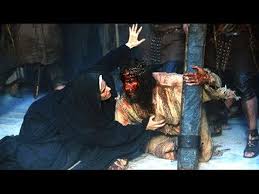
In one of the most powerful scenes, I think, from the movie “The Passion of the Christ,” we see Jesus on the Via Dolorosa, the Sorrowful Way, the Way of the Cross.  Mary, the Blessed Mother, is off in the distance with St. John, the Beloved Apostle, shocked at what they are doing to her Son.  Jesus falls, and says, “Mother,” and Mary thinks back to little Jesus falling on a road on Nazareth.  She notices, and, as any loving mother does, she rushes to comfort the little Child who has fallen.  As she runs to the Child Jesus, she cries out, “Jeshua, Jeshua,” “Jesus, Jesus,” and it then shows Mary, now as Jesus walks to His death, and she runs to him again, saying, as she did when He was a child, “I’m here.  I’m here.”  She embraces the suffering Jesus, just as she embraced the Child Jesus.  And Jesus, clinging to His Cross, says, “See, Mother, I make all things new.”  Jesus was born to make all things new.  He died to make all things new; to have the cherubim sheath his fiery sword, and give all access to the Tree of Life which gives immortality, the wood of the Cross.  Come, let us worship!

Participation in the Mystery

Mass of the Lord’s Supper
Sometimes you just need to mix things up a bit.  Usually, I preach on the readings, because the Word of God should be preached; St. Paul says, “Woe to me if I do not preach the Gospel.”  However, tonight, to mix things up, I thought I’d preach on one of the prayers that will be said soon, what we call the Prayer over the Offerings.  This is the prayer that is said after I have prepared the bread and the wine on the altar, and have washed my hands in preparation.  
The prayer says, “Grant us, O Lord, we pray, that we may participate worthily in these mysteries, for whenever the memorial of this sacrifice is celebrated the work of our redemption is accomplished.  Through Christ our Lord.”  Maybe it sounds to you like any other prayer in the Mass, a little wordy, some unique words.  But this one in particular is very full of meaning that, if we are not paying attention, can gloss over us.  
We start out by asking God the Father to help us “participate worthily in these mysteries…”  Right now, we are participants in something.  We are not spectators (at least we are not supposed to be).  We are engaged in something.  So often the Church uses the phrase “active participation” when it comes to what we should be doing in the Mass, and because we are an active society, we tend to take it as doing something, like being a lector or an extraordinary minister or a choir member.  But active participation is always united to us giving ourselves, first and foremost interiorly, to the Father through the Son in the power of the Holy Spirit, in what is being celebrated.  Tonight, on Holy Thursday, we participate in the Lord’s Supper in a mystical way.  We do not simply remember it.  A lot of Protestant music will talk about remembering what our Lord did at the Last Supper, remembering His saving life, Death, and Resurrection.  But we don’t only remember.  We participate.  Simply remembering is for museums, which is what some churches have become.  If people understood that they participate in what we celebrate, churches would not be so empty.  
But it is not any participation.  It is a worthy participation.  And how do we worthily participate?  We respond to the prayers with the voice, we listen to the prayers with our ears, we focus our attention on what is being done, on the smoke of the incense, on the precious nature of the vessels.  And hopefully, we also come with pure souls, free from any grave sins that hinder us from being present with Jesus, just as Judas left the Upper Room.  He could not worthily participate because his heart did not belong to God.  Shortly after this prayer we are invited to lift up our hearts, to leave behind the worries and anxieties of the day, and to focus on what God is doing for us.  We say, “We lift them up to the Lord,” but do we?
The Upper Room, where Jesus celebrated the
Last Supper
In what do we participate?  Yes, I have said the Last Supper, but we participate in the mystery of the Last Supper.  This is not a Sherlock Holmes mystery.  This mystery is something which is infinite, but which breaks into our finite time and minds.  We often will mentally chide St. Peter for not understanding what was going on when Jesus tried to wash St. Peter’s feet, or the apostles who fell asleep in the Garden of Gethsemane.  But do we understand what is going on?  Do we understand that the mystery of Jesus’ Body and Blood in the Eucharist is a gift beyond description, beyond riches, beyond understanding.  St. John Vianney said that if we truly understood what happened in the Mass, then they would die of joy.  
This mystery is so great that angels themselves bow down in worship, and shield their faces from the miracle that takes place when ordinary bread and wine become the Body of Blood of Jesus.  The God whom the universe cannot contain humbles Himself and makes Himself present in the ciborium and in the chalice.  The saints, who worship with us tonight and at every Mass, join their prayers to the perfect prayer of the Mass, the perfect prayer of Jesus offering Himself to the Father.  
The place in Jerusalem where Jesus was
nailed to the cross
And the Eucharist, every Eucharist, is not simply the Last Supper, but is what the Last Supper points to, what only one of the Apostles would actually experience, the sacrifice of Jesus on the cross.  Tonight only makes sense–and every Mass only makes sense–in the light of the crucifixion of Jesus on Calvary.  Jesus gave His Church, His bride, a way that His once for all sacrifice on the cross could be accessible, not only in memory, but in reality, to every member of the Church throughout the ages.  And that is why the prayer continues, “for whenever the memorial of this sacrifice is celebrated the work of our redemption is accomplished.”  Every time Mass is celebrated, Christ’s saving work continues.  That’s why we offer Masses for people, that Christ’s saving work can be applied for this person or that person, living or deceased.  Each and every day that the Mass is celebrated, salvation is achieved by Christ.  And it’s achieved here, where we get to participate in it, not watch it as spectators.  

Of course tonight we use many of our signs and symbols to impress what the prayers say.  But it’s the same at a Papal Mass, and at Mass in the gym at Powers, and at Mass here at St. Pius X Church.  Tonight, as we enter into the three intense days of our Lord’s saving action of Holy Thursday, Good Friday, and Easter, let us set aside all earthly cares, lift up our hearts to the heavenly things, and focus our spirit, mind, and body on the great mystery of our salvation, accomplished by Christ, and made present for us in the Mass.  “Grant us, O Lord, we pray, that we may participate worthily in these mysteries, for whenever the memorial of this sacrifice is celebrated the work of our redemption is accomplished.  Through Christ our Lord.”

16 April 2019

The Mob

Palm Sunday of the Passion of the Lord
The mob.  No, not the mafia or organized crime.  The mob, as in a group of people with a unified mentality.  Our readings today start and end with the mob.
As we gathered at the beginning of Mass, blessing the palms, we heard St. Luke’s account of the triumphant entry into Jerusalem.  The crowds are there for the Passover, and Jesus enters the Golden Gate, the only eastern gate leading into the Old City of Jerusalem.  It was also called Sha’ar HaRachamim, the Gate of Mercy.  According to Ezekiel, it was through this gate that the Messiah would come, and in fact, as those who went on the pilgrimage to the Holy Land with me heard, it is currently closed up by bricks, because there is a prophecy that the Messiah will go through that gate again at the end of time.
The Golden Gate in Jerusalem
 
The crowds, probably thinking about the prophecies of Ezekiel (that the Messiah would enter through this gate), and the prophecy of Zechariah (“Exult greatly, O daughter Zion!  Shout for joy, O daughter Jerusalem!  Behold: your king is coming to you, a just savior is he, humble and riding on a donkey, on a colt, the foal of a donkey”), acclaim Jesus as the Messiah, and recite Psalm 118: “Blessed is he who comes in the name of the Lord.”  They are excited, as a whole, about Jesus entering the Holy City for the Passover feasts.  They no longer really operate as individuals, but are now a mob, joyfully celebrating the entry of Jesus into Jerusalem.
But in our Passion Narrative, the same people are clamoring, now not for Jesus as a Messiah, but for the death of Jesus.  They no longer shout with the words of Scripture, but rather, “‘Crucify him!  Crucify him!’” to fulfill another prophecy of Zechariah which states: “they [shall] look upon him whom they have thrust through, they will mourn for him as one mourns for an only child, and they will grieve for him as one grieves over a firstborn.”
Mobs are, by their nature, fickle.  It doesn’t take much for people to set aside their rationality and give in to their emotions.  They do not consider so much what they do or what they say, but simply do what feels good.  And notice that Jesus does not placate the mob in either case.  He neither basks in their adulation, nor shrinks from their murderous howls.  Jesus is intent on doing the will of God, in good times and bad, no matter what people think of Him.
As those who have been configured to Christ in baptism, that is our task as well: not to give into mobs in our life, but to set our face like flint to do the will of God the Father.  It’s easier to disregard when we disagree with the negative shouts that they hurl at us.  Our natural instinct for self-defense usually tries to justify us and rationalize our behavior.  It’s much harder to avoid the mob and cave to them when they are pumping us up and saying things that we want to hear.  Especially in these days, we tend to surround ourselves with those who agree with us, and they become nothing else than an echo chamber for our mind and ego.  When people disagree with us,  rather than engaging in calm dialogue and rational debate, we cut them out of our lives, we unfriend them on Facebook or unfollow them on Twitter, and so the chances that those to whom we do listen encourage us becomes pretty likely.  But in the face of that, Jesus reminds us both not to give in to the negative or positive shouts of the mob, but to calmly and confidently do the will of God.
Another example of the mob mentality comes from our enemy, the devil.  He’s the one who does his best to entice us into doing evil, telling us that it will feel good, that it won’t hurt anyone, that it’s just a small sin that no one will know about.  But then, if we fall, he is also the first to condemn us, to tell us how evil we are, and undeserving of God’s love.  Again, Jesus tells us not to listen to the cacophony of voices from the devil: don’t give in to the temptation, but if we do, don’t despair of God’s mercy.  Rather, try our best to do God’s will in every circumstance in life, as best as we know it, but if we find ourselves having caved to sinful activity, then to run to the Gate of Mercy, the confessional, to be granted absolution from our merciful Father.  

While today’s readings began and ended with the mob, they also began and ended with Jesus, two stark examples of how to live our life.  May we not be part of the mindless mob, being blown on a whim from emotion to emotion, but be like Jesus, heart, mind, and body set on doing the will of God the Father.

08 April 2019

The Conversion Process

Fifth Sunday of Lent-3rd Scrutiny
For the past two weeks at this Mass, we have had the readings from Year A.  We do this because of the scrutinies, the rites by which we ask God to cast out from our Elect any evil which is in them, and to prepare them for the Easter Sacraments–Baptism, Confirmation, and the Eucharist.  In one sense, Bilal, our Elect, these readings have been specifically for you.  
Each Gospel passage (and the other readings as well that point to it) has hit home a theme of conversion, which is the process which has led you here.  On the third Sunday of Lent, we heard about the woman at the well, the woman who came to know Jesus more deeply as Jesus conversed with her.  He went from “a Jew,” to “Sir,” to “the Prophet,” to “the Messiah.”  And all of that happened because of a conversation with Jesus at a well.  Jesus was thirsting, not so much for the water, but for her.
On the fourth Sunday of Lent, we heard about the man born blind.  The man cannot see, and yet recognizes that Jesus is not an ordinary person.  Never before, he tells the Pharisees, has a man cured a man who was blind from birth.  And yet that is what Jesus did.  Because Jesus opens the eyes of the man, the man believes in Jesus, while the Pharisees, whose eyes were opened but hearts were closed, remain blind in their unbelief.

Today, the fifth Sunday of Lent, we hear about Jesus raising Lazarus from the dead.  Martha, the woman who was so concerned with serving Jesus that she forget to actually spend time with him, now is the sister who has faith that Jesus can do anything, that Jesus is Himself the Resurrection and the life.  And, sure enough, even though Lazarus was in the tomb for four days, deader than dead, Jesus brought Lazarus back to life.  
These readings were not chosen on accident.  Holy Mother Church, reflecting on her newborn children, sprung to life from the waters of baptism, saw in these three Gospel passages a message so important for you, our Elect, that she bid them to be read every year, even when it would interrupt the usual cycle of readings.
And She did this because in these three Gospel passages is the format for conversion: conversation with Jesus; Jesus opening our eyes; Jesus raising us to new life.  In your own life, Bilal, Jesus has spoken to you, to you heart.  And you sought to know more about him.  I can remember the day when you asked me about the Catholic Church, and what we believe, and we sat and talked on the pew in the narthex.  Jesus Himself spoke with you, maybe not about your past, but about your future, and about who He is.  
Through the Rites of Christian Initiation of Adults, which we have been celebrating with you for months, Jesus has also opened your eyes to see how He is who He says He is: God.  In fact, ever since Bishop Boyea chose you for the Easter Sacraments at the Rite of Election which you celebrated the Saturday after Ash Wednesday, you have been in the period that the Church calls “Purification and Enlightenment.”  In these last weeks of your preparation, Jesus has been opening your eyes to believe in Him more deeply, so that you are ready to follow Him always.
And today, as we hear about Jesus raising Lazarus to new life, you are being prepared to die with Christ and be buried with Him in the waters of baptism, so that you can rise with Him to new life.  You are almost at that point where Christ calls you out of the tomb into the radiance of new life with Him.
But these are also for us, because conversion is a process that is never done.  Each one of us, though we come as Christ’s faithful, have not always been so faithful.  There are parts of each of our lives that do not belong to Christ fully, and need conversion.  And so, Jesus continues to talk with us about those parts of our life.  He talks with us about our sinfulness, like the Samaritan woman, and the ways that our life is not configured to Him, not to condemn us, but to draw us to the freedom that only Jesus can give.
We, though we have been enlightened by Christ, still have some areas of blindness in our lives.  Each person here has things that we do not see, for a variety of reason, which we will not see unless we ask Jesus to open our eyes.  Some of these are failings that we have had since birth; others are failings that we have developed along the way.  But Christ wants to illuminate our vision so that we can see our failings, turn away from them, and turn back to Jesus.  
Though many of us have been through the waters of new birth in baptism, we all make deals with death.  We blockade ourselves into the tomb by our sins, which cause spiritual death.  We often want new life, but we sometimes don’t want it enough to accept it from Jesus.  The tomb may be musty, it may be dark, it may be a place of death, but sometimes we are comfortable with it, because death has become second nature to us, and we are surrounded by a culture of death.  But, Jesus wants to raise us to new life, and sometimes it’s someone else who begs the Lord to give us that new life.  

Yes, Bilal, these readings are for you, as our Elect, but they’re for all of us here.  Conversion does not end with baptism, or confirmation, or the Eucharist.  Conversion is a life-long process, of dying to sin and rising with Christ to new life.  Your first period of conversion is almost complete.  Your baptism is less than two weeks away.  Then you will join with us in continuing the conversion to which Jesus invites us each and every day, week, month, and year.

A Lenten Re-Prioritization

Fifth Sunday of Lent
What could we do without in our life?  I always joke that there is never a time that I want a nice, juicy steak more than on a Friday, especially a Friday of Lent.  And why is that the case?  Because I can’t have it.  It’s forbidden fruit syndrome: wanting something that we can’t have, simply because we can’t have it.  And yet, if abstaining from meat on Fridays has taught me anything, it is that I don’t have to eat meat on Fridays.  I can give up something which isn’t bad for the good of knowing what is truly important.  And getting what I want whenever I want it is not always good.
There is a trend right now called minimalism.  It’s a way of living where you get rid of all the things that you don’t need (and maybe even some things you think you need!).  I know that charitable organizations have been the happy recipients of an increase in donations of clothes and objects since this trend took off.  But it helps a person realize what is most important in his or her life.
St. Paul today in our second reading talks about considering everything else as a loss and as rubbish, compared to the good of knowing Jesus Christ.  St. Paul had a pretty good life.  He was a Jew, and yet a Roman citizen because he was born in Tarsus.  He was a Pharisee, and was very convinced in his faith.  He was also a tent-maker, so he could make money on the side if he needed.  But yet, after that fateful day on the road to Damascus, when the Lord revealed Himself to Paul and called him to be an apostle, his life was turned upside-down.  He was rejected by the Pharisees, attacked by many people for preaching about Jesus, expelled from synagogues, and it eventually led to him being taken to Rome as a prisoner, and being beheaded for being Christian.  But, in spite of all that, Paul considered everything that came before as trash in comparison to knowing Jesus and being in a relationship with Him.  
I can imagine that the woman caught in adultery that we heard about in today’s Gospel also valued her relationship with Jesus.  In fact, Jesus saved her life.  We know the story: she was caught in adultery, dragged in the middle of a crowd, and people were preparing to stone her.  Jesus was tested by the scribes and the Pharisees, the friends of St. Paul, to see if He would uphold the law of Moses.  Instead, Jesus forgave her, and told her to go and sin no more.  And, though we know nothing else of that woman, I am going to bet that she did just that, did not return to adultery, because she believed in Jesus and experienced His love.  

When we are loved by Jesus, when we encounter Him, if we truly encounter Him, then it has the power to change our life.  We re-evaluate everything in light of the love of God.  That’s not easy.  The love of God is never satisfied with the mediocrity for which we so often settle in our faith life.  The love of God always desires us to be more like God, because that’s how He created us.  Sometimes becoming more like God, what we mean when we say conversion, is painful, because we have to put certain aspects of our life behind us.  There were actually professions that people had to leave in the early church if they wanted to become baptized, which included acting and being a soldier (because those both required worshipping false gods).  I’m sure there were other professions, too, not so normalized today, that people gave up in order to follow Jesus.  Could we do it?
St. Paul and the woman caught in adultery were transformed by the power of Jesus’ love.  Every time we go to confession, we have the same opportunity to be forgiven by Jesus for every sin that we have committed.  Every time we come to Mass, we have the opportunity to encounter that same Jesus and eat His flesh and drink His blood.  If we are open to God’s grace, those encounters can change our life.  They can cause us to re-evaluate our priorities, and get rid or minimalize the things that don’t matter as much.
There are two things that I think are valued right now by many people, and may be valued too much.  One of those things is sports.  I love sports; I love watching sports; I used to love playing sports.  Sports teaches great lessons that are helpful in life, and can even be helpful in our faith life.  But it has become a number one priority for many people.  Sports for some is more important than encountering Jesus on the day He rose from the dead: Sunday.  Sports is valued more than Jesus; that’s what skipping Mass on Sunday means.  
The other value that is more important to God for many people is personal preference or the personal will.  We want God to be God on our terms; we want to encounter God on our terms; we want the world to revolve around us.  It is no longer revolutionary to say that the sun is the center of our solar system.  It is revolutionary to say that each person is not the center of the universe.  When we decide what parts of God’s teaching that we want to follow, and what parts we want to ignore because it interferes with our lifestyle and our conveniences, then we value our own will, our own desires, ahead of God.  

Lent is our perfect time to re-prioritize our life.  Lent is the time to put God back as the most important part of our life.  Can we say with St. Paul that our relationship with Jesus Christ our Lord is the supreme good in our life?

18 March 2019

Our Time to Shine

Second Sunday of Lent
The most recent Marvel movie that debuted is “Captain Marvel.”  The previews didn’t really excite me, but on a Sunday afternoon I had some free time and decided to catch the movie.  I have to say, I was really impressed with the movie, both as something enjoyable, and as a good part of the Marvel universe, especially with the upcoming late-April release of the latest Avengers film.
I don’t want to give away the movie, but like many of the first movies of a superhero (or in this case, superheroine) it explains Carol Danvers’ history and identity, as well as her becoming who she truly is meant to be.
In today’s Gospel, Jesus shows us a glimpse of what we’re supposed to be.  In the midst of the impending Passion of our Lord (in the Gospel according to Luke, the Transfiguration happens after the first prediction of Jesus’ Passion, and right before Jesus sets out for Jerusalem to undergo His Passion), Jesus gives Peter, James, and John a glimpse of what will happen after Jesus’ Passion and Death.  The Gospel describes Jesus as with “dazzling white” clothing and His face changed in appearance.  We often depict Jesus as glowing in His Transfiguration.  But what it comes down to is that Jesus shows His special apostles a prefigurement of His glorified body, and Jesus speaks with Moses and Elijah about “his exodus,” Jesus leading His people from slavery to freedom.

We were created for that glory that Jesus shows us in the Transfiguration.  We were created to communion with the saints in heaven as we make our way on our pilgrimage on earth.  We were made for heaven; that is the goal of every human life.
When we depict saints artistically or for sacred worship, we do so with a glorified body, and with a halo.  Good liturgical depictions of the saints may include the instruments of their life or even their death, but it does so in a way that shows that they are at peace.  We also try to make it look like the eternal light of heaven, that place where there is no night because the Lamb is the light and He is never hidden.  If you look at our icons, we have gold leaf for their halos as a way of reflecting and showing off the light.  And their faces are definitely peaceful, not affected by the passions or by even the external events of the world, but simply living the peace of Christ.
But that reality is not only for those in heaven.  If we are living the life of Christ, if we are putting on Christ and living as He desires, then we, too, can shine here on earth.  About certain holy men and women on earth, some have even mentioned that they seemed to shine.  Moses’ face shone after every encounter with God, as we read in the Old Testament.  
And if we shine more and more as we live the heavenly life, then we become more dull the more we immerse ourselves in our earthly life.  St. Paul speaks about that in our second reading.  He talks about those whose “end is destruction.  Their god is their stomach; their glory is in their ‘shame.’  Their minds are occupied with earthly things.”  The more that we focus, instead, on the heavenly life, the more Jesus “will change our lowly body to conform with his glorified body.”  The more that we focus on our earthly life, the more we resist that transformation that Jesus shows us in the Transfiguration.
Now, you might be thinking that you have to focus on our earthly life because you live an earthly life.  You, like I, have to pay bills, buy food, travel back and forth, pay mortgages or rent, etc.  But that’s not what I mean by the earthly life.  Earthly life is when we focus on our fallen and base desires.  When we are lustful; when we are greedy; when we make money or power or fame a god; when we lie; when we gossip.  When we do those things, we say no to the divine light that wants to change us, wants to transfigure us.  When we focus on prayer, on generosity, on helping our neighbors, on the common good, even while we are working or vacationing, then we allow that light to penetrate into the very fabric of our life and make us shine with the light of the eternal sun that never sets in heaven.  When we live the heavenly life, we can truly say that the “Lord is my light.”  
I don’t know about you, but I feel like our world is darker now than it was even not that long ago when I was growing up.  And I don’t think it’s a coincidence that since that time, people’s participation in the faith has decreased greatly.  Our world is darker because it is not illuminated by as many men and women striving for holiness, striving to let the light of the Lord shine through them.  And even some of those who do attend Mass do not have their hearts set on the Lord, but are living a double life where greed and power and lust are the happy focus of their life for six and a half days of the week, and the Lord is the focus for one hour on Sunday.  The light will not shine through those people, either.   Instead, by the grace of God, we need to allow God to change us, to forgive us through the Sacrament of Penance when we fall, and to transfigure us with His light.  

Our identity is not in our base desires.  Perhaps you’re still discovering the “superhero” that God is calling you to be.  Be that superhero of the faith.  Be that saint, even in your daily life.  Let God transfigure you to let His light shine through you.

11 March 2019

Into the Desert

First Sunday of Lent
“Filled with the Holy Spirit, Jesus…was led by the Spirit into the desert for forty days.”  Did you hear that first line of the Gospel, or did it go by unnoticed?  Listen to it again: “Filled withe the Holy Spirit, Jesus…was led by the Spirit into the desert for forty days.”  If we’re listening to it, it should jostle us a little.  It should lead us to ask, ‘Why would the Holy Spirit lead Jesus into the desert?’  
The desert, after all, is a place of trial and death.  It’s the opposite of the place God first intended for humanity, which was a garden, the Garden of Eden.  God also led the Chosen People through the desert, but the desert wasn’t a happy place for them.  The goal was the Promised Land, the “land flowing with milk and honey.”  The desert was where they had to wander due to their lack of faith in God, and it is the place where they grumbled against God, even though He was providing for all their needs.  So why would God the Holy Spirit lead Jesus (God the Son) there?
Jesus goes into the desert to show us how to fight against temptation.  Jesus was like us in all ways except sin.  He shows us that, when we unite our humanity, our nature, to the divinity of God, God’s nature, we can resist in the desert what Adam and Eve did not resist in the garden.  While not for Jesus, for us, the desert is a time of purification, helping us to grow in our relationship with God and to trust in Him to provide all that we need.
Lent for us is that time of purification, of growing in our relationship with God, of trusting in God to provide for all our needs.  It is the desert.  It is not the destination, not the goal, but the way by which we reach our destination and goal.  It is the place where God puts to death temptation and sin, and prepares us for the life of paradise.  It is what makes us ready for the life of paradise, the life of the Promised Land.  And the Holy Spirit leads us there, not to stay there, but to get to the Promised Land.
Right now we are in the desert as a Church.  We are in a time of purification, where temptation and sin are being put to death.  We could talk about the different issues that are plaguing the Church right now.  But those are simply symptoms of the problem.  The heart of the problem is that we, as a society, have given in to the second temptation of Satan from today’s Gospel.  
The enemy tempted Jesus, “‘I shall give to you all this power and glory; for it has been handed over to me, and I may give it to whomever I wish.  All this will be yours if you worship me.’”  We, as a society, and therefore as individuals, have decided to worship false gods, mostly the self and pleasure, for the sake of power and glory.  We abandoned the worship of the true God who leads us to paradise, and we have reveled in the worship of false gods who lead us to death and destruction.
We see it in politics, where money and power have become ultimate goods, and people are told what they want to hear, not what is right.  The personal pleasure of each individual has become the supreme good to which everything–the child in the womb, the elderly who are sick or dying, the natural law written into our very human nature–has to be subjected.  So many politicians, across party lines, do whatever will get them money from donors and reelected, not what is best for the country and its citizens.
We see it also in our sacred liturgy.  My formative years were where most of the songs and most of the focus at Mass was on me: what makes me feel good; how can I be affirmed as a person; and how much God loved me as I am.  Now, feeling good can be good; personal affirmation can be good; and God does love me unconditionally.  But feeling good is only good when it comes from doing good and avoiding evil.  Affirmation of what is noble is good, but we should feel shame for doing what is base.  God loves me as I am, but He loves me too much to leave me there; He calls me each day to conversion.  We are tempted to narcissism, exercises on focusing on the self, rather than God.  But, as Jesus reminds us, “‘You shall worship the Lord, your God, and him alone shall you serve.’”
How often do we hear: I don’t like the music, so I’m leaving the church.  I don’t like the preaching, so I’m leaving the church.  I don’t like the priest, so I’m leaving the church.  The common denominator is that the person is not going to church for God, but for what he likes.  But we don’t come to Mass because of what we like.  We come to give thanks to God for what He did by giving us Jesus so that we could go to heaven.

The Holy Spirit has led the Church into the desert because we have given in to temptation to worship false gods, often the self.  We need to be purified from societal narcissism and be drawn back to the transcendent God, who draws us from ourselves to Him who satisfies all our needs.  Following God doesn’t always feel good; the desert is dry and hot.  Following God doesn’t always affirm our actions; the desert requires us to put away what is ancillary.  Following God means that we say no to the temptations that arise in our daily life which look enticing, but which really keep us out of the garden and paradise.  But, if we follow God through the desert, if we say no to the temptations, especially the false gods we make in our life, then it leads to the Promised Land, to the garden, to place that God has prepared for those who follow His Son.  So during this Lent, follow the Holy Spirit into the desert and fight temptation, empowered by that same Spirit, who with the Father and the Son is one God, for ever and ever.

25 February 2019

Catholic Identity

Seventh Sunday in Ordinary Time
A parishioner was recently asking me about my work with the Michigan State Police.  In the midst of the conversation, I started to talk about how, for law enforcement officers in general, their work is their life.  That’s not to say they don’t have hobbies outside of work, but simply that their work changes who they are, how they see people, and how they act.  One example: if a cop goes out to eat, even off duty, he or she almost always will sit facing the entrance, if at all possible, to see what’s going on, who’s coming in, etc.  The same could be said for being a mother: it changes how you see things, and you’re always a mom, even if the child doesn’t necessarily belong to you.  And I’m sure there are others whose identity changes how they relate to the world they encounter each day.
I bring this up because the same should be able to be said about us as Catholics, as followers of Jesus.  Being Catholic is not a matter of belonging to an ancient club, with dues, with old rituals, with hierarchy, that provides certain privileges.  Being Catholic is not only about coming to Mass one day each week.  Being Catholic is, as St. Paul says in his letter to the Philippians, having the same attitude as Christ.  And when we have that same attitude, it changes everything we do.
A statue of King David
from Jerusalem
Even before Jesus, we can see what that looks like in our first reading.  David had been anointed by the Prophet Samuel to take over for King Saul after Saul was dead.  David’s fame and power kept growing, while King Saul’s fame and power was waning (remember that he had disobeyed the Lord, which is why the Lord’s favor left him).  Because of this, King Saul wanted to kill David, to get rid of his rival.  So David had to flee.  But King Saul pursued David.  And that’s where our first reading comes in today.  David is hiding from King Saul, but finds him asleep, along with all of his men.  David could have killed King Saul (Saul’s spear was in the ground next to King Saul’s head), but didn’t.  David’s advisor, Abishai, told David to kill King Saul, so that he could be king instead.  But David rejected that advice, and did no harm to the king that the Lord had anointed.  
That course of action makes no sense outside of faith in God.  If you come upon a man who is hunting you, who is bent on your destruction, and you have the chance to take him out, that is the best thing to do.  David could have become king and ruled over all Israel.  But it was not God’s will, so David did not do it, even though, from the wisdom of the world, it would have ensured success.
Jesus, the Son of David, tells us in the Gospel: 

“love your enemies, do good to those who hate you, bless those who curse you, pray for those who mistreat you.  […] Give to everyone who asks of you….Do to others as you would have them do to you….Be merciful, just as your Father is merciful….Stop judging…[s]top condemning…[f]orgive.”

That’s not the way to make it in a cutthroat world, the world in which Jesus lived, the world in which we live.  That’s not the smartest plan for someone who wants to be powerful, in control, determining his own destiny.  But that’s the attitude of Christ.
Being Catholic is about living in our daily circumstances like Jesus would live.  It means loving enemies, praying for those who hurt us, being generous with our material goods, being merciful.  Those actions, and everything that Jesus teaches us, is meant to become a part of us, so that, again paraphrasing St. Paul, it is not longer we who live, but Christ who lives in us.  Being Catholic is about becoming like Jesus, not so that we can earn God’s love, but as a result of God’s love.  Being Catholic should be in us as a part of who we are, which changes who we are, how we see people, how we act.   
When we approach people, we should try to see a person created in the image and likeness of God, and love them.  When we are struggling with a co-worker or a family member, our first instinct should be to pray for that person.  When we’re at the grocery or department store, or dealing with customer service, we should treat them as we would want to be treated.  When someone wrongs us, we should try to extend mercy to them, just as our heavenly Father extends mercy to us.  All of those things should flow from us because we are followers of Jesus, because we are Catholic.  Even more to the core of who we are than a job; even more to the core of who we are as a mother or father, we are followers of Jesus, and that should impact the way we live.  

Imagine for a second that our actions flowed from our identity as sons and daughters in the Son of God.  Imagine how different our world would be if we stopped acting out of a worldly mindset where we are in competition with each other for every last scrap, and where if we don’t take someone else down, that they could take us down.  Imagine if we had the same attitude as Christ.

11 February 2019

Duc In Altum

Fifth Sunday in Ordinary Time
One of my favorite saints has always been St. Peter.  No, I don’t want to be pope (being a pastor is enough responsibility for me!), but I like St. Peter.  He’s one of the great apostles of Jesus, who always has great things to say, unless he’s putting his foot in his mouth (as he also often does).  He is, we might say, very relatable.  I’d like to believe that I have had great moments of faith and trust in God (even if great is a sliding scale), but I also know that I have had my own outbreaks of foot-in-mouth disease.
And since I like St. Peter so much, today’s Gospel is one of my favorites.  It’s St. Luke talking about how St. Peter was called by Jesus.  St. Peter (still going by Simon at this point) is fishing all night and catching nothing (side note: have you ever noticed that St. Peter is never able to catch fish on his own?!?).  Then Jesus, who, from all outside views, knows nothing about fishing, tells him to go out again, and put into deep waters.  St. Peter begrudgingly does this, and then catches so many fish that he has to call his partners, James and John (who also became apostles), to help him drag it in.  St. Peter realizes that he is in the presence of someone special, someone great, and makes a confession of his own sinfulness.  Jesus tells him not to be afraid, because he will be catching men from now on.
When others hear this story, they sometimes ask me how I came to follow Jesus as a priest.  And certainly, all of our readings focus on calls: on the call of Isaiah to be a prophet; the call of St. Paul to preach the Gospel as the last apostle; and, as I mentioned, the call of St. Peter to follow Jesus as one, and the chief, of His apostles.  
Some priests I know have amazing stories like St. Peter of Jesus doing something great and spectacular in their lives.  But for me, that’s not the case.  As an eighth grader, I started thinking about what I wanted to do as an adult (so that I could concentrate on the right classes in high school, get into a good college in a field in which I wanted, and then get a good job).  If it were up to me, I wanted to be a lawyer, and then maybe go into politics.  I wanted to be married, have a few kids, a couple of dogs, and have lots of money.  But I knew that if I were going to be happy, I had to do what God wanted me to do.  So I started praying to God each night, asking Him to let me know.  And I heard nothing.  
So I started to go to daily Mass a few times at Lansing Catholic High School, and it was there that a stranger asked me if I were going to be a priest.  And other classmates and teachers started to do the same thing.  And before long, I started to realize that maybe God was asking me to consider a vocation to the priesthood.  I started to learn more about Catholicism, and fell in love with the Church, as one falls in love with his girlfriend.  And I decided that I wanted to give my life to serve her, just as a man decides (and hopefully the woman agrees) that he wants to give his life to serve the woman he wants to be his wife.  I applied to the seminary in my senior year through the Diocese of Lansing, and was accepted for my freshman year of college.  Each year I asked God to make it painfully clear if He didn’t want me to continue on.  And each year, I was asked to come back and continue studying to become a priest.  It wasn’t always easy; there were times where I thought (with the assistance of a rather attractive female lab partner) that maybe the priesthood wasn’t for me; but God did and has sustained me in my vocation.  God’s providential care for me has been more in the day-to-day events of life, not so much in the spectacular, like St. Peter.
But God knows what we need in responding to His call.  Some people don’t need the dramatic moments.  Some people do.  The key is that we are listening for the call of Jesus, and we respond with courage to the call of Jesus.  Because Jesus says to anyone who wants to follow Him, “Put out into deep water.”  In Latin that phrase is Duc in altum, and it was used by Pope St. John Paul II as he began his Apostolic Letter on the new millennium in 2001.  It was also a favorite of Bishop Mengeling, who told us seminarians not to dangle our toes in the water, but to put out into deep water.
Any vocational call–ordained ministry, marriage, consecrated life–and even while discerning God’s call, takes courage.  It takes faith in God, and confidence that He will show you the way.  As a priest it takes courage to serve when a very small percentage have tainted the good name of the priesthood, and it takes courage to say yes to never having a wife and a biological family of your own.  As a consecrated man or woman it takes courage to promise to not have any personal bank accounts and to be obedient to the religious congregation’s superiors.  As a married man or woman, it takes courage to commit to only being with one person in the special friendship of marriage for your entire life, to only be physically intimate with that person as long as that person lives.  Any vocation, and, again, even when trying to find out what God wants us to do, takes the courage to put out into deep waters and trust that God will not abandon us in those waters.

Many of you already have discerned your vocation here.  But some of you have not.  Be courageous in answering the Lord’s call, whatever it is, in your life.  Some of you may have spectacular calls like St. Peter.  Some of you will have more quotidian or ordinary calls like me.  But don’t be afraid to answer it.  Duc in altum!