Good Friday of the Lord’s Passion
It has been 115 days since Christmas. 115 days since we celebrated the birth of Jesus Christ from the Blessed Virgin Mary, God-with-us, Emmanuel. 115 days since that joy of knowing that God loved us so much that He sent His only Son to become like us in all things but sin. And every day, since Christmas, has been pointing to this day.

Jesus, on the other hand, was, in a sense, born for death. Now, to be clear, Jesus’ death should have never happened. When God became flesh, we should have accepted Him and followed Him, and then God would have brought about salvation in some other way. But, as we know that God knows the course of history, because all time belongs to Him as is as the present to Him, we also know that God the Father knew that Jesus, His Beloved Son, would be rejected. God the Father knew that His Son would be “marred…beyond human semblance.” He knew that Jesus would be “spurned and avoided by people, a man of suffering…pierced for our offenses, [and] crushed for our sins.” And yet, God chose His Beloved Son to be born so that He could die.
Why? Why would a loving Father–and we know God the Father is loving because Jesus revealed to us so many times how loving God is–send His Son to die? God sent His Son to die that we could, once more, have access to the Tree of Life, closed off to us by sin. And let’s be clear, it is not as if this was foisted upon Jesus. Jesus willingly, lovingly, accepted His death out of that same love for us that God the Father has. In the supernatural order, sin brought death, but, ironically, it was death that brought life. And just as sin entered by a tree, so by a tree, the cross, sin and death were defeated by life itself.
We deserved death because of sin. We had abandoned God, though He never abandoned us. Jesus, on the other hand, did not deserve death, because He had no sin. He was tested, as our second reading says, but He did not sin. But He still took upon Himself our offenses, our sins, so that, by His chastisements, we might be made whole; by His stripes we might be healed; by His offering of His life, we no longer had to lose ours.
 |
| The place of the Crucifixion in the Church of the Holy Sepulchre |
John’s Gospel makes very clear that, through it all, Jesus remained God and in control. If He wanted to, Jesus could have called upon an army of cherubim with their fiery swords, and brought about divine vengeance upon all who wished to harm the Son of God. But He didn’t. He was killed in the most shameful way, the most painful way, and the Lamb of God who takes away the sins of the world, was “like a lamb led to the slaughter…he was silent and opened not his mouth.”
In one sense it was our sin that led Jesus here today. Even the smallest venial sin, the tiniest act of disobedience to God cries out for justice, and, as St. Paul says, the wages of sin is death. We cannot simply blame the Jews of Jesus’ time for calling for His death; we cannot simply blame Pontius Pilate and his moral weakness for capitulating to the Chief Priests' and Pharisees’ demand for blood. We also must blame ourselves because our sins, our personal sins, no matter how big or how small, closed off the tree of life from us.
But, in another sense, it was the love of God that led Jesus here today. The love of God that is so strong that it leaves the 99 safe sheep behind for the 1 lost lamb; the love of God that is so strong that it runs out to meet the Prodigal Son even as he is far off; the love of God that is so strong that He would rather sacrifice Himself to death than see any of His ungrateful children suffer. It was love that led Jesus here, to die for us on a tree, the tree to which He was nailed to become the Tree of Life for all who believe.
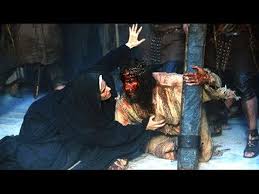
In one of the most powerful scenes, I think, from the movie “The Passion of the Christ,” we see Jesus on the Via Dolorosa, the Sorrowful Way, the Way of the Cross. Mary, the Blessed Mother, is off in the distance with St. John, the Beloved Apostle, shocked at what they are doing to her Son. Jesus falls, and says, “Mother,” and Mary thinks back to little Jesus falling on a road on Nazareth. She notices, and, as any loving mother does, she rushes to comfort the little Child who has fallen. As she runs to the Child Jesus, she cries out, “Jeshua, Jeshua,” “Jesus, Jesus,” and it then shows Mary, now as Jesus walks to His death, and she runs to him again, saying, as she did when He was a child, “I’m here. I’m here.” She embraces the suffering Jesus, just as she embraced the Child Jesus. And Jesus, clinging to His Cross, says, “See, Mother, I make all things new.” Jesus was born to make all things new. He died to make all things new; to have the cherubim sheath his fiery sword, and give all access to the Tree of Life which gives immortality, the wood of the Cross. Come, let us worship!