Showing posts with label Elect. Show all posts

09 March 2026

Hope that Doesn't Disappoint

Third Sunday of Lent–First Scrutiny
    St. Paul says today in the second reading: “we boast in hope of the glory of God.  And hope does not disappoint, because the love of God has been poured out into our hearts through the Holy Spirit who has been given to us.”  We probably associate hope more with Advent.  Or maybe when we think of hope we think of campaign slogans.  But Lent helps us to focus on hope, the theological virtue that draws us to have confidence in our salvation.
    Most of the time we use hope merely to denote a wish: I hope I win the lottery; I hope that cop didn’t see me speeding; I hope the Lions win a Super Bowl before I die.  None of those will likely happen.  But hope is more than just wishful (or maybe even delusional) thinking.  Hope draws us to God and enables us to trust that what He said would happen will happen.
    The Chosen People in the first reading today demonstrated the opposite of hope: despair.  God had promised the Chosen People that they would gain their freedom from slavery in Egypt, and that He would return them to the land He promised Abraham.  To put today’s reading in context, it comes after the Ten Plagues, including the death of the firstborn Egyptians; after the Jews had left Egypt; after they had gone through the Red Sea and the Egyptian army had been drowned.  And still, because they are thirsty, they cry out, “‘Why did you ever make us leave Egypt?’”  Even though God had proved He was trustworthy, they doubted God to do what He said He would do.  But even then, God further proved that they could trust Him, and provided them with water in a miraculous way.

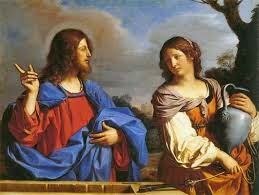
    The Samaritan woman, too, was a woman bereft of hope.  We probably missed the short sentence that St. John gave as a clue of her hopelessness: “It was about noon.”  We’re used to driving to Meijer’s or Costco to pick up whatever we need at almost any time of the day or night.  But in the time of Christ, to draw water during the hottest part of the day meant that you did not want to be around others, or maybe that they didn’t want you to be around them.  She’s living with a man who is not her husband, and her five previous husbands have left her.  She likely relied on the generosity of others to survive, or possibly worked in an unsavory occupation just to feed herself.  To the Samaritan woman, God seemed far away, and probably not worthy of trust.  But God comes to her, in the Person of Jesus, to give her hope, living water that gives eternal life.  
    As we sit here on this third Sunday of Lent, do we hope in God?  Do we trust that He will fulfill His promise?  God has promised that if we follow Him daily, eternal life is the consequence.  We cannot see eternal life right now, beyond slight glimpses.  But as we choose what God has revealed is good for us, do we do so with the confidence that as our actions show that we want God more, He will not leave us hanging and dash our hopes against a rock, like the Lions always seem to do?  
    Especially during Lent, when we focus on the price of our salvation–the death of Christ, we might struggle with despair a bit.  We might wonder if the abstaining from meat on Fridays, the fasting on Ash Wednesday and Good Friday, and our daily Lenten penances make any difference.  Or we might think about just what pain Christ suffered for us, and think that we are not worth it.  But God comes to us, like He came to the Samaritan woman, to tell us we are worth the price He paid, and that the little ways that we turn aside from our own will in order to focus on doing God’s will can prepare us for heaven, even if it’s happening a little at a time or even if we struggle to do our penitential practices.  Through our penitential practices, we are meant to allow the grace of God to open up our hearts even more so that they can receive more of the love of God the Father through the Holy Spirit whom God gave us at Holy Baptism.
    And you, our elect, chosen for the Easter sacraments: as we celebrate this first scrutiny, God comes to you to strengthen your hope and help you to persevere.  Christ came to you when you needed Him, and gave you the desire for the living waters which give eternal life, the saving waters of baptism.  He didn’t avoid you because of your past sins, whatever they may have been.  He came to you who did not have the hope of eternal life, which God ordinarily grants through baptism, and gave you hope to live forever with Him if you follow Him for the rest of your life and grow in love of Him.  Maybe you, like the Chosen People, have doubted if God will really do what He has promised.  At Easter, as you pass through your own Red Sea as the water is poured on your head, and as the paschal candle, the pillar of fire, leads you from darkness into light, you will see that God does fulfill His promises, and will give you new life.  You need only hold on to that hope that He inspired in you.
    Hope does not consist in mere wishing.  Theological hope holds on to the promise that God will give us eternal life if we are baptized and follow Him to the best of our ability after baptism.  That hope does not disappoint, because it is grounded in the one who loved us so much that He gave us His only Son, who suffered and died for us because He did not want us to live in despair, but wanted us to have eternal life with Him in heaven.  Allow the Holy Spirit to continue to pour hope into your hearts so that you can reach the true Promised Land, eternal happiness with God in heaven.  

22 April 2025

Getting the Bigger Picture

Easter Vigil
    I know someone well who is very smart.  His mind is a well-oiled machine.  When faced with different data points, he can put it together to make sense, and anticipate challenges and/or opportunities, and adjust expectations or actions as necessary.  Because of this, he is very gifted at administration.  When it comes to friendships: he struggles a bit more.  Because his mind tries to get to why a friend didn’t tell him something, or why did a friend use the words he did, and is that friend trying to communicate something subtly that he doesn’t want to say directly.  And then anxiety kicks in and his brain goes into overdrive trying to make sense of it all, and often reading into things that are much more innocent.
    I try to help him by reminding him to consider other facts that he knows to be true that will put his mind at ease.  I encourage him to expand the amount of data that his mind is analyzing to include more positive facts and input, and not just the negative ones to which his brain so easily goes.  While it takes work, seeing the bigger picture can help calm his fears of rejection and realize that he really does have good friends who aren’t looking to get rid of him.
    Maybe you don’t have an analytical mind, but with what has happened over the past few days, starting on Holy Thursday, there’s a lot to process.  In this one grand liturgy that began with the Mass of the Lord’s Supper, we entered into the model of service in the washing of feet; the institution of the priesthood and the Eucharist at the Last Supper; and the agony in the garden at the altar of repose.  On Good Friday we joined with Christ in the fruits of the betrayal by Judas and our God, Savior, and hope dying in the most horrible way possible.  Earlier today we just waited, joining with the apostles who had all likely lost hope and were wondering what they should do now that their Master was in a tomb.  And now, tonight, we celebrate that hope did not die, but that God raised His Son from the dead and conquered sin and death forever.  If we take these events seriously, they should make us wonder what God did and what it all means.  We may not get anxiety, but it calls for a deeper reflection on more facts, more data to understand God’s plan.
    And that’s why we had all these readings tonight.  We heard about how God created life to be good and an expression of His love.  We heard about Abraham almost sacrificing his beloved son, but God providing a ram to take Isaac’s place.  We heard about the Egyptians being put to death in water, which was also the way that God’s chosen people were saved: through water.  We heard the Prophet Isaiah talk about how God would take us back, though we had abandoned Him, and how God would give us the good things of life and renew His covenant with us.  The Prophet Baruch encouraged us to follow the ways of the Lord and so receive light and favor.  And we heard God tell the Prophet Ezekiel that God would give new life to His people, cleanse them from their sins, and lead them back to their promised inheritance.  
    These are all realities we all need to hear tonight, to better understand God’s plan.  But especially you, Dylan and Isaiah, need to hear these as you prepare to become Catholic through your baptism, confirmation, and reception of the Holy Eucharist.  You will go through water which will destroy all that is fallen in you, but will give you new life in Christ.  God will send His Spirit upon you to help you live the new law of grace.  And God will prepare for you the “rich fare” of the Eucharist, the food which is truly the Body and Blood of Christ, which will help join you to Christ in the closest union you can have with anyone while on earth.  Your stories–what brought you to this holy night, your path of conversion–now becomes a small part of the larger story of salvation, by which God gives us a greater gift even than the Garden of Eden, which He created for us, the people He has made in His image.  God made Eden for Adam and Eve, who lost it by their disobedience.  God opens heaven to you, greater than any earthly paradise, and you can receive it by your life of obedience to God.  

    The price of this great gift of heaven was costly indeed: the death of the Son of God.  But Christ accepted it lovingly as the will of the Father and because it meant you could go to heaven and be united with Him for all eternity, which is exactly why God created humanity in the first place: for union with Him.
    So do not only consider the drama of the past few days.  Do not fix your minds on what causes anxiety.  Consider all of salvation history, and how God, who created you in love, has redeemed you in love, and now welcomes you into His family of love, the Catholic Church, and now shows you the straight and narrow way to enter into eternal love in heaven.  

24 March 2025

A Relationship with the Truth

Third Sunday of Lent-First Scrutiny

    In high school I was on our own Quiz Bowl team (yes, I was a nerd).  And Lansing Catholic High School participated in the PBS TV station televised games called “Quiz Busters.”  I remember being in the championship game one year, with a one-year tuition scholarship to MSU on the line.  We were in the final Lightning Round, with either team in a position to win, and the question was asked, “In the Sistine Chapel, what color smoke…” to which I buzzed in and yelled “White!”, anticipating the rest of the question, which answer was right, and helped us win the “Quiz Busters” Championship against another school which was much larger than Lansing Catholic.
    I like to have the right answers, and there is something good about knowing the truth.  But having the right answers isn’t all there is, as we see in the Gospel today, this long Gospel that we use each year that we have an elect, a catechumen chosen by the Bishop for baptism at Easter.  The Samaritan woman has the right answers, at least most of them.  She knows that Jews do not drink from the same containers as Samaritan women, because the samaritans were pagans and it could render the Jew unclean.  She knows that to have water, you have to have a bucket to draw it out.  She gives a technically right answer when she says that she doesn’t have a husband.  And she says that Jews and Samaritans don’t agree on how and where to worship.
    But the Lord isn’t only looking for right answers.  He is looking for a relationship with her.  Now, Jesus also identifies Himself as the Truth.  So I’m not trying to say that the truth doesn’t matter.  It does.  But the truth comes in the context of a relationship with Truth Incarnate.  Jesus is trying to give the Samaritan woman eternal life, and all she can focus on is trying to give correct answers and trip Jesus up in theological debates.
    The Samaritan woman, upon entering into relationship with Jesus, recognizes that He knows her.  She says, “‘Come see a man who told me everything I have done.’”  Jesus knows her, more deeply than anyone else, though He just met her at the well.  The Samaritan woman heard Him say that He is the Christ, the Messiah, who will let everyone know what they are to believe and how they are to worship.  
    Dylan, as an elect, God already knows you.  But over these past months He has drawn you in to know Him better.  He knows everything you have done: the good, the bad, and the ugly.    But He wants to be in a relationship with you.  You have learned many important things over the past months about what it means to be Catholic and how we Catholics are called to follow Christ in our daily lives.  Being a friend of Jesus, and even more than a friend, a sibling with Jesus, means doing things that will strengthen your relationship with Him and avoiding anything that would harm that relationship with Him.  
    Through Holy Baptism, Confirmation, and reception of the Eucharist, the love of God will be poured into your heart, as St. Paul said in our second reading, “through the Holy Spirit who has been given to us.”  You will become an adopted son of God the Father, and God will dwell within you as in a temple.  
    As God prepares you for this, He draws you closer and closer to Himself.  The Samaritan woman changes the way she addresses Jesus as the conversation develops: she starts by calling Him “a Jew”; then, “Sir”; then “the Messiah.”  You, too, have come to know Jesus more deeply in the passing weeks and months, to be at a place where you are almost ready to profess Him as God and Savior.  
    And sometimes, like with the Samaritan woman, some of what Jesus the Savior has revealed has been painful.  I’m sure the Samaritan woman wasn’t too pleased when Christ said, “‘You are right in saying, “I do not have a husband.”  For you have had five husbands, and the one you have now is not your husband.’”  But Christ reveals our brokenness because He can heal us, and wants to heal us.  
    But this process of growing in relationship with Christ won’t end with your reception of the Sacraments of Initiation.  All of us here hopefully try to grow in our relationship with Christ each day.  Yes, we try to know the right answers, but we also try to be a good brother or sister of Christ and son or daughter of the Father.  Sometimes we miss the point, like the Samaritan woman.  Sometimes the Lord needs to convict us of sin, or sinful habits.  But everything the Lord does gives us the opportunity to grow closer to Him.  May we not squander the opportunities the Lord gives us to deepen our relationship with Him, especially this Lent, but drink from the living water which flows from the wounded side of Christ. 

03 April 2023

"Tonight is the Night of Nights"

Easter Vigil in the Holy Night of Easter

    On 5 June, 1944, as the 101st Airborne Division waited anxiously in England, Paratrooper George Luz of Easy Company read aloud a letter from the Col. Robert Sink, at first even imitating his voice: “Tonight is the night of nights.  As you read this, you are en route to the great adventure for which you trained for over two years.”  The next day, 6 June 1944, D-Day, they would jump into Nazi-occupied Normandy, and begin to change the tide of World War II, which, up to that point, had favored the Nazis.
    As we listened to the Old Testament readings, all seven of them, God took us back to all the ways that He had trained us for this night, the true night of nights, “when Christ broke the prison-bars of death and rose victorious from the underworld,” as the Exsultet proclaimed.  Even from the very dawn of creation, God was pointing us to the moment when His Incarnate Son would redeem the world that would fall at our hands, and forever destroy death and sin.
    We heard about Abraham and Isaac: how Isaac, the beloved Son, willingly walked up the mountain to be sacrificed, though God stayed the hand of Abraham and gave him a ram instead to sacrifice.  We heard how God led His Chosen People from slavery in Egypt, and how the Chosen People passed through the Red Sea safely with God’s help, while the forces of evil who pursued them were destroyed by the waters.  We heard from Isaiah how God would marry us to Himself, and how He would give us water to drink and food to eat that would truly satisfy us.  We heard Baruch prophesy how we had walked away from the Lord, but God brought us back, and has made known to us how we truly may be happy.  And lastly, we heard Ezekiel tell us that, though we had profaned God’s holy Name, He would display His power and holiness among us, and give us a new spirit so that we could be faithful to our covenant with Him, and be His holy people.  Not for two years, but for two thousand years, God was training us for the Resurrection.
    We have also been training over these past 40 days through our Lenten observances.  We took upon ourselves little “deaths” so that we could be prepared for the new life of the resurrection.  We recalled that even the enjoyable things of life are dust, and that we are called to turn away from sin and be faithful to the Gospel.  We fasted and abstained; we engaged in prayer, fasting, and almsgiving.  
    And you, my dear Elect and Candidate, and those who will receive sacraments tonight: you, too, have been training for weeks and months, preparing to open yourself up to become children of God, to become members of the Church, and to grow in your own initiation in the Catholic Church in which some of your were baptized.  You prayed over how God had led you out of the darkness of sin into the light of this night, and how He will walk with you, helping you to be His faithful follower, not only united to Him but also bearing witness to Him by word and deed.  
    You, like Easy Company, are being dropped behind enemy lines.  The fallen world, though Christ has conquered sin and death, still fights against Him.  But, like the Israelites and the Egyptians, with God on your side, you cannot be conquered.  God will crush your true enemy, Satan and all his fallen angels, and protect you through the waters of Baptism, which some of you are receiving tonight.  Through Confirmation, you will receive the Holy Spirit, who will go before you like a pillar of fire to light your way, and will give you the strength to witness to Christ by what you say and what you do.  And through the Most Holy Eucharist, the blood of the truly unblemished Lamb of God will be painted over the lintels of your lips, so that the angel of death will not smite you, but you will pass-over, unharmed by eternal death because you have received eternal life within you.  
    You, too, as with every person here, each have your own part to play in winning other souls for Christ and conquering the enemy.  Not everyone is expected to be a general, or a medic, or a radio tech.  But God has equipped each of you with certain gifts which will help His victory be spread and eternal life be shared with others.  From this point on, you cannot sit on the sidelines as a spectator.  You are an integral part of God’s mission to conform the entire world to Himself, which really means helping each person find true happiness by living like Christ in total obedience to the Father.  You have found the pearl of great price in Christ.  Do not hide that same treasure from others who desire it.  
    I close my homily with excerpts of the words of Col. Sink, which though written about the impending invasion of Normandy, are also aptly written about the victory Christ won tonight by His Resurrection: “Tomorrow throughout the whole of our homeland…the bells will ring out the tidings that…liberation has begun.  […] Imbued with faith…let us annihilate the enemy where found.  May God be with each of you….  By your actions let us justify His faith in us.”  Christ has liberated us from sin and death.  Filled with faith in him, let us put down the works of sin and death.  May our response to God’s grace be for the glory of His Name, and confirm the name that tonight we all will share: Catholic Christian.

08 April 2019

The Conversion Process

Fifth Sunday of Lent-3rd Scrutiny
For the past two weeks at this Mass, we have had the readings from Year A.  We do this because of the scrutinies, the rites by which we ask God to cast out from our Elect any evil which is in them, and to prepare them for the Easter Sacraments–Baptism, Confirmation, and the Eucharist.  In one sense, Bilal, our Elect, these readings have been specifically for you.  
Each Gospel passage (and the other readings as well that point to it) has hit home a theme of conversion, which is the process which has led you here.  On the third Sunday of Lent, we heard about the woman at the well, the woman who came to know Jesus more deeply as Jesus conversed with her.  He went from “a Jew,” to “Sir,” to “the Prophet,” to “the Messiah.”  And all of that happened because of a conversation with Jesus at a well.  Jesus was thirsting, not so much for the water, but for her.
On the fourth Sunday of Lent, we heard about the man born blind.  The man cannot see, and yet recognizes that Jesus is not an ordinary person.  Never before, he tells the Pharisees, has a man cured a man who was blind from birth.  And yet that is what Jesus did.  Because Jesus opens the eyes of the man, the man believes in Jesus, while the Pharisees, whose eyes were opened but hearts were closed, remain blind in their unbelief.

Today, the fifth Sunday of Lent, we hear about Jesus raising Lazarus from the dead.  Martha, the woman who was so concerned with serving Jesus that she forget to actually spend time with him, now is the sister who has faith that Jesus can do anything, that Jesus is Himself the Resurrection and the life.  And, sure enough, even though Lazarus was in the tomb for four days, deader than dead, Jesus brought Lazarus back to life.  
These readings were not chosen on accident.  Holy Mother Church, reflecting on her newborn children, sprung to life from the waters of baptism, saw in these three Gospel passages a message so important for you, our Elect, that she bid them to be read every year, even when it would interrupt the usual cycle of readings.
And She did this because in these three Gospel passages is the format for conversion: conversation with Jesus; Jesus opening our eyes; Jesus raising us to new life.  In your own life, Bilal, Jesus has spoken to you, to you heart.  And you sought to know more about him.  I can remember the day when you asked me about the Catholic Church, and what we believe, and we sat and talked on the pew in the narthex.  Jesus Himself spoke with you, maybe not about your past, but about your future, and about who He is.  
Through the Rites of Christian Initiation of Adults, which we have been celebrating with you for months, Jesus has also opened your eyes to see how He is who He says He is: God.  In fact, ever since Bishop Boyea chose you for the Easter Sacraments at the Rite of Election which you celebrated the Saturday after Ash Wednesday, you have been in the period that the Church calls “Purification and Enlightenment.”  In these last weeks of your preparation, Jesus has been opening your eyes to believe in Him more deeply, so that you are ready to follow Him always.
And today, as we hear about Jesus raising Lazarus to new life, you are being prepared to die with Christ and be buried with Him in the waters of baptism, so that you can rise with Him to new life.  You are almost at that point where Christ calls you out of the tomb into the radiance of new life with Him.
But these are also for us, because conversion is a process that is never done.  Each one of us, though we come as Christ’s faithful, have not always been so faithful.  There are parts of each of our lives that do not belong to Christ fully, and need conversion.  And so, Jesus continues to talk with us about those parts of our life.  He talks with us about our sinfulness, like the Samaritan woman, and the ways that our life is not configured to Him, not to condemn us, but to draw us to the freedom that only Jesus can give.
We, though we have been enlightened by Christ, still have some areas of blindness in our lives.  Each person here has things that we do not see, for a variety of reason, which we will not see unless we ask Jesus to open our eyes.  Some of these are failings that we have had since birth; others are failings that we have developed along the way.  But Christ wants to illuminate our vision so that we can see our failings, turn away from them, and turn back to Jesus.  
Though many of us have been through the waters of new birth in baptism, we all make deals with death.  We blockade ourselves into the tomb by our sins, which cause spiritual death.  We often want new life, but we sometimes don’t want it enough to accept it from Jesus.  The tomb may be musty, it may be dark, it may be a place of death, but sometimes we are comfortable with it, because death has become second nature to us, and we are surrounded by a culture of death.  But, Jesus wants to raise us to new life, and sometimes it’s someone else who begs the Lord to give us that new life.  

Yes, Bilal, these readings are for you, as our Elect, but they’re for all of us here.  Conversion does not end with baptism, or confirmation, or the Eucharist.  Conversion is a life-long process, of dying to sin and rising with Christ to new life.  Your first period of conversion is almost complete.  Your baptism is less than two weeks away.  Then you will join with us in continuing the conversion to which Jesus invites us each and every day, week, month, and year.

20 March 2017

Drawing Closer to Jesus

Third Sunday of Lent
We are a month away from Easter Sunday.  Those words might sound exciting and comforting to you, as your Lenten penances only have 4 more weeks, but as a priest, four weeks to Easter is the busiest time of the year.  In addition to the usual busyness, I am one of the assistant Masters of Ceremonies for the Chrism Mass on Holy Thursday morning, so I’m assisting with a lot of the behind the scenes work.  And, this is my first Easter here, so I’m learning how things have been done here before, and feeling my way through the liturgical celebrations as we enter into them.  This is my favorite time of year in the Church calendar, but it’s also the most intense, and, if we let it be, the most powerful.
Today we hear our first long Gospel, prepping us for Holy Week.  That’s not really why we have these long Gospels over the next three weeks, but it seems to work out that we have three long Gospels to prepare us for the Passion Narrative (a super long Gospel) that we will hear on Palm Sunday and Good Friday.  Today’s Gospel and the next two weeks’ Gospels are passages which deal with conversion, our major theme during Lent.  
Today’s conversion story is about a woman of Samaria.  And in her conversion, she comes to know Jesus more and more as the story continues.  She starts out by referring to Jesus simply as “a Jew.”  There’s no personal interaction, only referencing his religion.  But Jesus draws her in more closely, as he offers her living water.
That encounter with Jesus leads to a change in tone.  No longer is Jesus simply “you, a Jew,” but is now “Sir.”  Jesus offers her something, and she’s interested in this “living water” she is speaking about.  She likes the idea of never having to draw water again, because she is drawing water, alone, at the hottest part of the day.  We’ll learn why later in this story.

Then Jesus changes the subject.  And it is probably not the subject that modern, polite people would talk about.  Jesus says, “‘Go call your husband,’” knowing full well what her situation is.  This woman at the well is an adulteress, which is why she’s drawing water alone at the hottest part of the day.  She has been married five times before, and the man she is living with currently is not her husband.  She, of course, doesn’t want to admit this (who would?), and coyly says, “‘I do not have a husband.’”  But Jesus reveals to her a part of her life that is not in order.  This leads her to acknowledge Jesus in a different way; she comes to know Him more.  He is not, “you, a Jew,” and he is no longer just “Sir.”  He is, she says, a prophet.  
But feeling a little uneasy about the trajectory of this conversation about her love life, she changes it to something she knows will divert attention away from her personal life: how to worship.  Not much has changed today: if you want to get someone in a heated conversation, talk about how you think Mass should be celebrated.  But Jesus doesn’t rebuff her question.  He answers by stating that true worshippers will worship God the Father in Spirit and truth. 
After talking to her about worshipping well, she is drawn to talk about the Messiah.  And Jesus says to her, “‘I am he, the one speaking with you.’”  Jesus reveals Himself and His mission.  When she first started, she did not recognize Him as anything but a foreigner.  Now she is led to think of Him as the Messiah, which in Greek, is translated 𝛸𝜌𝜄𝜎𝜏𝜊𝜍, which we translate as Christ.  From there she tells everybody about Jesus, and they come to believe as well.
This process of conversion is present in our own lives, as well.  It is present in the life of our Elect, Alexis, who is preparing for the Sacraments of Initiation.  It is present in Chris, our Candidate, preparing to be received into the Church and receive the Sacraments of Confirmation and the Eucharist.  But it is, or should be, present in each one of us.  All of us have opportunities to grow closer to Jesus.
Some of us, honestly, don’t know Jesus that well.  He is, we might say, only “you, a Jew.”  He is a stranger to us.  Some of us know about Jesus.  Maybe we come to Mass every week, we do our duty, or we come because that’s what we’ve always done on Sundays.  But Jesus still isn’t known well to us.  He is simply a respected person.  But we keep him at arm’s length, because we like the way we live, and we don’t want to have to change.
Some of us recognize Jesus as a good guy, a religious leader, someone who speaks for God (in other words, a prophet).  We feel that tug at our soul for God, and maybe we’ve even had some religious experiences in our lives when we felt really close to God.  But we still don’t recognize who Jesus fully is.  Some of us recognize Jesus as the Messiah.  We’re very active in our faith, but there are still some areas of our life that we don’t want Jesus to see, and we’re not sure we want to tell others about Jesus.  That seems a bit pushy to tell others about Jesus.  

No matter where we are in our faith, Jesus calls us to a deeper relationship with Him.  Sometimes, as we grow closer to Him, He reveals our need for Him, a need that only He can satisfy, no matter how much we try to fill that need with other, passing things.  Sometimes Jesus even points out our sins to us, in order to reject our sins and choose Him.  But Jesus always wants us to grow close to Him, especially through our worship of the Trinity in Mass.  And then He wants us to tell others about Him.  Where are we in our conversion?  We are never done; we can always grow closer to God.  Are we open to letting God change our lives?

29 March 2016

Everything is Different

Easter Vigil
What happened was better than anyone could have expected.  Perhaps Mary, our Blessed Mother, alone had some idea of what would happen.  No one expected Jesus to rise from the dead, even though he had foretold it, along with the prophets of the Old Testament.  No one expected life to conquer death.  What happened was inconceivable.
Easter is not about little bunnies, candies, or pastel colors.  Easter is about Jesus rising from the dead.  We all know that, otherwise we’d be either getting ready to go to bed or sleeping right now.  The Resurrection of Jesus changes everything.  We are no longer trapped in a cycle of being born, doing our best to stay alive and not mess things up too much, and then dying.  We are no longer subject to the rich ruling the poor, the powerful controlling and abusing the weak, the educated domineering the uneducated.  Life is totally different.
“But Fr. Anthony,” you might say, “the rich still rule, the powerful still control and abuse, and the educated domineer.  You are living in a different world if you don’t think that happens.”  Certainly, our world is not perfect.  Just four short days ago, another terrorist attack happened in Europe.  No matter which party you belong to, the candidates all have to have sizable bank accounts and donors to become the President, legislators, and judges.  Each month seems to bring with it a new study of how we should change things because we know better now.
All of that doesn’t matter, because Christ has won.  There is still a battle going on, without a doubt, and it seems like the rich, the powerful, and the educated will always win.  But they have lost already.  They simply have not conceded.  To be fair, being rich, powerful, or educated does not make one bad.  Saints have come from the rich, the powerful, and the educated.  But those saints would be the first to say that they would give up everything if Jesus asked them to.  They live in the new life of the Resurrection where what is most important is Jesus, and the rest is all rubbish.
My dear Elect, in just a few moments, you will become part of that new life.  In the waters of baptism Jesus will give you His new life, which can save you from eternal death.  He will give you grace to reject Satan and all those who ally with him, who will lose.  He will give you His life so that you can re-evaluate everything you have in your life, and weigh it against Jesus Christ.  He will help you to know that the life you lead is no longer about you, but about Him, and loving Him by what you say and what you do to others.  Your life, after Baptism, will be different.
And in the Sacrament of Confirmation, you will receive strength to spread that good news of new life to those you meet.  Why do things in the world seem so dark right now?  Because we have forgotten what it means to be Christian.  We have forgotten to spread the new life and the new way of life to which Jesus invites us.  Even those who have been baptized have decided that they would rather do things their own way than follow Jesus.  And when we wander away from Jesus, we wander from new life and to death.
And in the Eucharist, your initiation into the Catholic Church will be complete.  You will have union with Jesus.  He will be with you, closer than you can be to any other person.  And in that heavenly food, you will find strength to live in the new life of Jesus.  
We, for our part, as your parish family, promise to help you live in that new life.  But we also ask you to help us.  It is too easy, and we see it all too often, for those who were baptized as infants to lose our love for Jesus, and to become complacent.  Your new energy from becoming Catholic reminds us of what we are called to do and be in Christ Jesus.

What happened on that first Easter night, so many years and decades and centuries ago, was better than we could have ever expected.  We received new life in Jesus, who invited us to be His followers and live in relationship with Him according to His new way.  It will not always be easy.  The powers of darkness will seek to have you forget.  But new life has won, and you have us, as well as almost 2,000 years of saints to help you and show you what it means to live this new life.  Christ has risen from the dead, alleluia!

15 April 2015

Why is This Night Different from All Other Nights?

Easter Vigil 
 
At the first question at the Seder, the meal that celebrates the Passover, the youngest child asks: Ma nishtana ha-laila ha-zeh mi-kol ha-leylot?  The English translation is: Why is this night different from all other nights?  On this night, the Passover in the Book of Exodus, when the angel of death passed over the house of the Chosen People, is fulfilled.  And so it is right for us to ask this same question: why is this night different from all other nights?
Why do we read these four readings from the Old Testament rather than one like we usually do at Mass?  We read these readings that point to the Resurrection all throughout Salvation History.  We begin with the creation of the world, and how God created all things beginning on the first day.  So on this, the eve of the first day of the week, the day after the Sabbath, we remember that Jesus Christ began a new creation in Himself, as He conquered sin and death.  We then hear about how Moses and the Chosen People were saved through water as God had them pass through the waters to safety, while He destroyed the evil Egyptians, the symbol of oppression of God’s People, in those same waters.  So, too, our Elect will pass through the water and be saved by it, while Satan’s kingdom will be further destroyed.  We hear from the Prophet Isaiah about being satisfied by the Lord, whose Word will have its effect to make the earth fertile and fruitful.  So God will feed us in the Eucharist and His Eternal Word, Jesus Christ, will continue the work of our baptism to change us to be more like Him.  We hear from the Prophet Ezekiel next as the last Old Testament reading how God, who had allowed His People to undergo the punishment of their infidelity will now save them because of the holiness of His Name, so that all may know that God is truly God and there is no other.  God will sprinkle clean water upon His People and pour out His Spirit upon them.  So we recall that God has now saved us through Christ and sent His Holy Spirit upon us, and especially upon those who will receive the Sacrament of Confirmation tonight.  
Next we sing the Gloria for the first time since Thursday night at the Mass of the Lord’s Supper.  This recalls for us the moment of the birth of Jesus Christ when the angels sang the glorious hymn: Glory to God in the Highest and on earth peace to people of good will.  We light the altar candles as the visible reminder that when Christ was born, a new light shone upon the world, and the light is Christ Himself.  So the candles around the altar, the altar which symbolizes Christ, are lit.  Then we turned to the New Testament, to the Apostle Paul, who reminded us that in baptism we died with Christ so that we could rise with Him to new life.  And that death that we experienced was meant to be a death from all that separated us from God, and all our sinful ways, into the new life in union with (we can also say communion with) God.  
And, in the high point of the Proclamation of God’s Word, we heard the Gospel of the Resurrection proclaimed.  We listened to the account of the holy women who went to the tomb, early on Sunday morning, only to find that the large stone had been rolled back, and Jesus was not there, but an angel, announcing that Jesus has been raised from the dead.  While we will likely not be here until after midnight, very early in the morning, we wait with watchful eyes and ears, in vigil, to solemnly celebrate the Resurrection of Jesus Christ from the dead.  
Tonight we gather because all of time, and especially all of how God revealed Himself through the Old Testament pointed to this moment.  Tonight we gather because from all people, katholicos in Greek, God has desired His children to share in the Paschal Mystery: the suffering, death, Resurrection, and ascension of Jesus Christ.  And tonight that same Paschal Mystery will be entered into by those receiving the Sacraments: the Elect who will receive Baptism, Confirmation, and the Eucharist; the Candidates who will profess their faith in all the Catholic Church teaches, and then be confirmed and receive the Eucharist as well.  They will begin to make the fullness of that Paschal Mystery theirs through life in the Catholic Church.  
Very shortly we will celebrate that Paschal Mystery in sacramental form.  I won’t explain that yet.  As in the early centuries of the Church, I want our Elect and Candidates to experience it for themselves first, and then to understand the mysteries that they celebrated afterwards.  I will let the symbols speak with their own power to communicate, and then, having joined the Church of Christ, they will have a chance to be guided in their understanding of what happened.  

But, whether you will become Catholic tonight or are already Catholic, tonight is different from all other nights because on this night the doors of our hearts were marked with the Blood of the Unblemished Lamb of God who by His death destroyed death and took away the sins of the world.  On this night life was changed forever because death no longer held sway over us.  This is the day the Lord has made, let us rejoice and be glad in it, alleluia!!

17 March 2015

Getting an Eye Transplant

Fourth Sunday of Lent–Second Scrutiny
I give real credit to those who use contacts.  I don’t think I’ll ever be a contacts guy because I hate the idea of touching my eyes.  I don’t know why I have this phobia, but one of the most sickening things for me in movies is when someone gets their eye poked or damaged or even removed!  I see pictures of people having eye surgery and it just makes me sick to my stomach!!
But, if we are honest, we need eye transplants.  Our eyes do not work as they are supposed to work.  They receive the light of the sun, but do they receive the light of God?  Just as our eyes need the light of the sun (s-u-n) to see our world, we need the light of the Son (S-o-n) to see as God sees.  Even Samuel, one of God’s greatest prophets, didn’t fully see by the light of God because he couldn’t see God’s choice for the new king of Israel.  Only after God enlightened Samuel did Samuel understand that David was to be the new king, even though David was not considered to be much by his family.  
So, too, the man born blind was able to tell who Jesus was, even without following Him, because Jesus cured Him.  The Pharisees were closed off to the Light of Christ and so they could not see, even when it was right in front of their faces, that Jesus is the Messiah, the Son of God.  Of course, even the blind man needs some help in recognizing just who Jesus is, because Jesus has to reveal Himself as the Messiah.  But as soon as that comes to light, the man born blind believes.
Today we’ll pray again for our Elect, that they might see with the light of the Son of God.  We will pray that they will be freed from being blind to truth, and seeing false values and lies.  And this freedom from lies will happen through the Holy Spirit, the Spirit of Truth.  But we also need to pray for ourselves.  We also need the Spirit of Truth to give us new eyes to see as God sees.  What a great gift to be able to see that way.  How differently would we treat each other if, when we saw a person in our work, on the street, and even in our homes, with the eyes of God!  What a difference that would make in our life and in theirs!!  

As much as it makes me a little queasy just to think about it, we need to pop out our eyes that see from a worldly point of view, and pop in eyes that only are work with the Light of Christ.  At the Easter Vigil I will sing “The Light of Christ” as that one Paschal Candle illumines the darkness of the night, showing us in visible form how Christ is the Light of the World who dispels the darkness.  In these next few weeks as we prepare for the Easter Vigil, that Vigil of Vigils, may our eyes be more attuned to the only light that we truly need: the Light of Christ.

10 March 2015

Blessed with a Long Gospel

Third Sunday of Lent–Scrutinies
As you stood and heard this long Gospel passage today, the Gospel of the Samaritan woman at the well, I am sure that certain words were going through your mind: words like “blest,” “privileged,” and “fortunate.”  Those were the words that were going through your mind, right?
Those should be the words that came to your mind as you heard this Gospel, because this Gospel is only read during this year when the Church is celebrating the Scrutinies.  And we only celebrate the Scrutinies when we have the Elect of God, those who are to be baptized, confirmed, and receive the Eucharist for the first time at the Easter Vigil.  The Elect are the children in the womb of this parish, who are about to be born to new life in the Sacraments.  The Scrutinies, the ritual book tells us, 

are reinforced by an exorcism, are rites for self-searching and repentance and have above all a spiritual purpose.  [They] are meant to uncover, then heal all that is weak, defective, or sinful in the hearts of the elect; to bring out, then strengthen all that is upright, strong, and good.  [They] are celebrated in order to deliver the elect from the power of sin and Satan, to protect them against temptation, and to give them strength in Christ, who is the way, the truth, and the life.

Now, this isn’t the kind of exorcism where heads spin and pea soup gets spit out.  This is a minor exorcism, meant to establish in the Elect the Lordship of Jesus Christ.  
This long Gospel is read because it is an example of conversion, to which the Elect have been called, and by which they can be strengthened.  And this is a perfect example of what happens when we encounter Christ.  At first the woman fights the conversion, speaking about how Jews and Samaritans are not supposed to mix.  But Jesus doesn’t give up.  He offers the woman living water, not just the water that she came to draw to quench her physical thirst.  And the woman wants it, but doesn’t quite understand just what Jesus is saying.  When we encounter Jesus, He offers a gift to us, and we may fight it, or may not fully understand what He wants to give us.
But then, as the encounter continues, Jesus identifies the ways in which there is separation between God and her.  She tries to avoid the situation by saying the truth, just not all the truth.  When confronted with the truth by Truth Himself, she tries to avoid again, and tries to start a fight about how worship should go.  But she is still drawn in.  At the beginning of the encounter, Jesus was just, “a Jew.”  After He promises her living water, He is “Sir.”  When He reveals her past, He is “a prophet.”  
When we are in the presence of holiness, our sinfulness has to be confronted in order to be cast out.  This is not always fun, and it’s not something we always want to do.  So we, too, often try to change the subject, rationalize away our sins, or even try to complain about the Mass being too long or celebrated in a way that we don’t like.  But when we truly encounter Christ, we, too, move from just Jesus the morally good guy, to Jesus the teacher, to Jesus the prophet who speaks for God.
Jesus sidesteps her argument about the Mass, and speaks about who God desires her to follow Him and worship God in spirit and truth.  He then reveals Himself as the Messiah, the anointed one of God, the desire of her heart.  And the woman cannot hold in her joy at becoming a follower of Jesus, but tell others.  
Jesus doesn’t stop with our sinfulness.  He tells us how much He loves us and wants us to follow Him and worship God in spirit and truth and reveals Himself to us as the desire of our hearts.  And if we truly have come into contact with Jesus, then we should want to tell others.  We see Jesus as the Son of God, who reveals us to ourselves so that we can truly be happy.  

Our Elect of God started by inquiring about who this Jesus guy is.  They were drawn to Him.  Then they drew closer in starting the process of learning what it means to be Catholic.  And recently, they were chosen by God through the ministry of the bishop to become Catholic at the Easter Vigil.  Let us pray for them that they will continue to know Jesus more fully until they are configured to Him in baptism.  Let us pray for ourselves, that we will also be converted more like the Samaritan woman, and tell those we know about Jesus the Messiah.

20 March 2013

From Death to Life


Fifth Sunday of Lent-Third Scrutiny
            For the past two weeks we have heard from the Gospel according to John at this Mass.  We step aside from the usual hearing from the Gospel according to Luke to meditate and reflect upon what St. John calls the main signs of Jesus’ ministry.  We do this to assist our Elect to prepare for baptism, confirmation, and the reception of Holy Communion for the first time, as we accompany them through the Scrutinies.
            These three signs that we hear about all have to do with life, and are fitting for the Elect who are preparing for new life in baptism.  Two weeks ago we heard about the Samaritan woman at the well, and how Jesus was going to give her living water.  As we all know, we can’t live without water.  Last week we heard of the man born blind and how Jesus is the light of the world.  Light is an important part of life.  Without sunlight, the plants don’t produce, which means we, and the animals we eat, don’t survive.  Today, we don’t deal with an image or a metaphor for life, but with life itself in the raising of Lazarus from the dead.
            The first important aspect is that faith is involved.  The Samaritan woman comes to believe in Jesus, and so she is given the life-giving water in her soul which will never run dry.  The man born blind has faith, and Jesus opens His eyes.  Martha has faith that Jesus will raise Lazarus.  In none of these cases is the faith complete, as if one knows it all.  In fact, if one truly knows it all, faith, the knowledge of things unseen, is not necessary.  But faith makes new life possible.
            It is faith, at least in its seminal form, which led you, Elect of God, to ask questions about the Catholic Church.  It is faith which led you to continue searching and opening the Word of God to see if this Jesus should be followed.  It is faith which you will profess before you are baptized.  This will not be the end of the journey, but only the beginning of new life in Christ, just as for those of us who were baptized as infants, when our parents and godparents professed faith for us so that we could receive the precious gift of new life in Christ, that moment of baptism was not the end of our pilgrimage, but the beginning.  And likewise confirmation is not the end of our development of faith, but another important step in the pilgrimage, not the destination.
            God’s love is shown for us in giving us new life.  God promises through the prophet Ezekiel that the way we know that God is God is by receiving new life from Him.  Jesus fulfills that prophecy in our Gospel passage from today.
            But new life is meant to be new, not old.  You don’t pour new wine into old wineskins.  Lazarus had been dead for four days.  His decomposing body was rank with the odor of death.  It looked like a body, in some regards, but was not (we use the word corpse for a body that is no longer animated by a soul).  That is how it is with us before we come to Christ.  Yes, we are made in the image and likeness of God, we have human dignity because we are rational and have an immortal soul, but we do not have new life in us.  That comes through baptism, at least ordinarily.  Before baptism, we are plagued by original sin which puts us at enmity with God.  That is why we pray for you, dear Elect, that, because you have already been chosen—elected—for baptism, the power of Satan may have no sway over you.  After baptism, original sin is washed away—death is washed away—and you are filled with new life.
            But our outsides need to match our insides.  There needs to be a certain consonance, a certainly harmony between the new life we have in our souls, and the way we act with our bodies.  Beauty comes from when the image matches the idea, and if we truly want to be beautiful, then we should try with all our might to make sure that the way we live matches what we believe.  That goes for all of us, not just you Elect.  How many times did Jesus decry the lack of consonance in the Pharisees: “‘You are like whitewashed tombs, which appear beautiful on the outside, but inside are full of dead men’s bones and every kind of filth.’”  The same could be said when what we have inside does not match what we do on the outside.  The temptations are great to keep our faith to ourselves and not let it impact the way we live our lives.  That is where scandal arises, when what we profess with our lips does not match the other actions of our life; when we have new life in us, but we still act like a rotting corpse; when we are members of the Body of Christ, but we act no differently than those who do not know Jesus.
            Dear Elect of God, we pray for you, that as you draw nearer to the life-giving waters of baptism, to the Light of Christ, to new life in Jesus, that you will grow in faith and be kept safe from the Evil One so that you are prepared to put to death the old man, and put on Christ, the new Man.  And we thank you, because your consonance of life between what you believe and how you live reminds us who were baptized before to live up to that call ourselves, so that more and more will be drawn to new life in Christ that not only changes our souls, but changes how we live each day.

23 March 2012

How's Your Sight?


Fourth Sunday of Lent—Second Scrutiny
            I remember the night pretty clearly: I was driving back to Sacred Heart Major Seminary from St. John the Evangelist parish in Fenton, where I was assigned as a transitional deacon.  It was dark out, and a steady rain began as I merged onto MI-10, the Lodge.  I suddenly noticed that, even just driving 57 miles per hour (with everyone flying by me, I might add) I couldn’t see the lines that separated each lane.  I didn’t want to slow down and get run over, but I certainly wanted to stay in my own lane so I didn’t cause or get in an accident. 
            At that time of my life, I was the only one of my parents and my two sisters who didn’t have corrective lenses.  But, when I finally made it safely home, I knew that I needed to at least get my eyes checked.  When I went to the optometrist, and she started to put those different lenses over my eyes for the reading chart, I suddenly realized how fuzzy the world had been, and how I hadn’t really been able to see.
            Our first reading and Gospel today give us an insight as to how God sees.  When Samuel goes to anoint a new king, after Saul had disobeyed the Lord, Samuel is directed to Jesse’s sons.  Samuel sees Eliab, the one he is sure is supposed to be king.  But the Spirit of God tells him that Eliab is not God’s choice.  And then Samuel goes through seven sons, but God does not choose any of them.  Finally, the youngest, David, is called in from the fields and is anointed as the new king of Israel (though he doesn’t formally become king for quite a while).  When Samuel wants to know why it was not Eliab, and likely why it was not the other sons, God tells Samuel, “‘Not as man sees does God see, because man sees the appearance, but the LORD looks into the heart.’”
            In our Gospel today, there’s a lot of seeing going on, but not all of it is true sight.  We begin with the disciples who see a man blind from birth.  When they look at him, they see a sinner, or at least the son of sinners.  But then Jesus looks at the man, and sees, not sinfulness, but a man whose cure of blindness at the hands of Jesus will make manifest the work of God.  Then the Pharisees see the man born blind, and they ask him about Jesus, whom they had also seen before.  The Pharisees see the man, now cured, and still see a sinner.  They look at Jesus as a horrible sinner who does work on the Sabbath.  And the man himself, though his sight is given to him at once, gradually sees who Jesus is, as he first calls Jesus a man, and then a prophet, and then the Son of Man and Lord.
            How easy it is to look upon failure or a lack of something as a curse.  As Catholics we’re particularly proficient at seeing something bad happen and figure that God is somehow punishing us.  Whether its an illness like cancer, or the loss of a job, or a troubled marriage, or whatever curse we feel we’re under, it’s easier to assume that God is, for one reason or another, punishing us for something we did, even if it was a long time ago. 
            And while there are sometimes bad consequences that follow from our bad choices, Jesus reminds us that what seems like a curse can truly be a way for the glory of God to shine forth.  For years the man born blind and maybe his parents assumed they had done something wrong; many people saw it that way, including the Pharisees.  But Jesus says that the man’s blindness was there so that he could be healed by Jesus and give glory to God.  Sometimes, our maladies or negative circumstances are ways that we can draw closer to God and reorder our lives properly.  Ironically, sometimes the bad stuff that happens can actually be a great blessing.
            These elect that we have with us today: those who will be baptized, confirmed, and make their first Holy Communion, have been on a path from spiritual blindness to sight, a pilgrimage we’re all on in different ways, but a path for them which is leading to be able to see with the eyes of God.  They began by inquiring about the faith, learning more about this man Jesus and His Body the Church, and why so many have joy who know Him.  Then they were accepted as catechumens, those who are seeking to be joined to Jesus in a certain way, and to know and love Him better as they open the Word and see it active in their lives as Jesus who is The Prophet speaks for God as His Word.  Then Bishop Boyea, in the name of Christ, chose them for the Easter Sacraments.  As they  continue today through the scrutinies where they are prayed for in a special way in these last weeks before Easter, they come to the sacraments so that they can profess Jesus as Lord, as God.  They are like the man born blind who, after he was healed, spoke about Jesus as a man; who when questioned by the Pharisees called Jesus a prophet; and when asked by Jesus, professed Him as Lord, which is the title used for God. 
            These Elect challenge us to see with the eyes of God, as they are growing to do.  They challenge us to approach the world with the sight of God, rather than putting people in the boxes that make us most comfortable and either accepting or rejecting them based on our criteria.  What a tragedy and a true scandal it would be for those who have been baptized, who have been enlightened by Christ, to not see with the eyes of faith that we received in baptism.  Look at other people, work, relaxation, and world situations with the eyes of God, so that we can look at what the world considers darkness, and bring the light of Christ.