Showing posts with label Palm Sunday. Show all posts

14 April 2025

Entering into the Events which Saved Us

Palm Sunday of the Lord’s Passion

    [In the name of the Father, and of the Son, and of the Holy Spirit.  Amen.]  A beautiful spiritual practice is to put ourselves in the Gospel accounts.  One can imagine him or herself as a particular person, like Peter or Mary or one of the other disciples, or one can put oneself into the story as a new bystander, observing what happens and noting one’s own physical and emotional response.
    I think that anyone who takes the Bible seriously would eventually ask, “What would I do if I were there?”  Especially given the Gospel before the Mass about the entrance into Jerusalem, as well as the long Passion narrative, it shouldn’t take much more to insert oneself into the profound stories we know so well of our Lord’s last week in His earthly ministry.  Would I have welcomed Christ like the crowd?  Or would I have been like a Pharisee, criticizing this display?  Would I have scattered in the Garden of Gethsemane, or what I would have remained with our Lord just a few steps behind the soldiers?  Would I have clamored for Barabbas, or would my cries to release the true Son of the Father have been drowned out by the mob asking for crucifixion of the Lord of Glory?
    But we don’t only have to imagine ourselves in the major events of our salvation.  This week, especially during the Sacred Triduum of Holy Thursday, Good Friday, and Holy Saturday, we participate in our salvation, in the events that gained for us eteral life.  In the Mass, we enter into those events, not just remember them.  While they are present sacramentally, they are also present truly, such that the fabric of time gets folded into itself, and we enter into the eternal present of God, in our own limited way.  
    So, the question is not, ‘what do I imagine myself doing at the Last Supper, the Garden of Gethsemane, Calvary, or the tomb?’, but will I be present at those events that saved me?  Will I come to the liturgies that make present what happened some 2,000 years ago?  Or do I have more important things to do than spend time with our Lord?
    This is not to make light of those who have no choice but to work on those days.  And none of the Sacred Triduum is a holyday of obligation.  But will we make ourselves present to our Lord if we can?  Will we put our life on hold for the one who gave up His life for us?  Yes, they are long liturgies.  Yes, they happen at irregular times from what we’re used to with Masses.  But if we were willing to take off work to see a presidential candidate, are we not willing to take off work to see the King of Kings and be with Him in His agony?
    The choice is yours.  And I will not be your judge as to whether you could or could not have gone for legitimate reasons, or whether you absented yourself due to sloth.  That is for God to judge.  But if we can, the Savior deserves extra time spent with Him this week.  He gave His all for us?  Can we give a little more than usual for Him?  [Who with the Father and the Holy Spirit live and reign for ever and ever.  Amen.]

25 March 2024

"Eloi, Eloi, lema sabachthani?"

Palm Sunday of the Lord’s Passion
    [In the name of the Father, and of the Son, and of the Holy Spirit.  Amen.].  In today’s Responsorial Psalm/Tract, we hear the words of Psalm 22 (21), which are also echoed in Matthew and Mark’s account of the Passion.  Today I wanted to reflect on these words, words which sounded forth from the lips of Christ as He hung on the cross for our salvation.

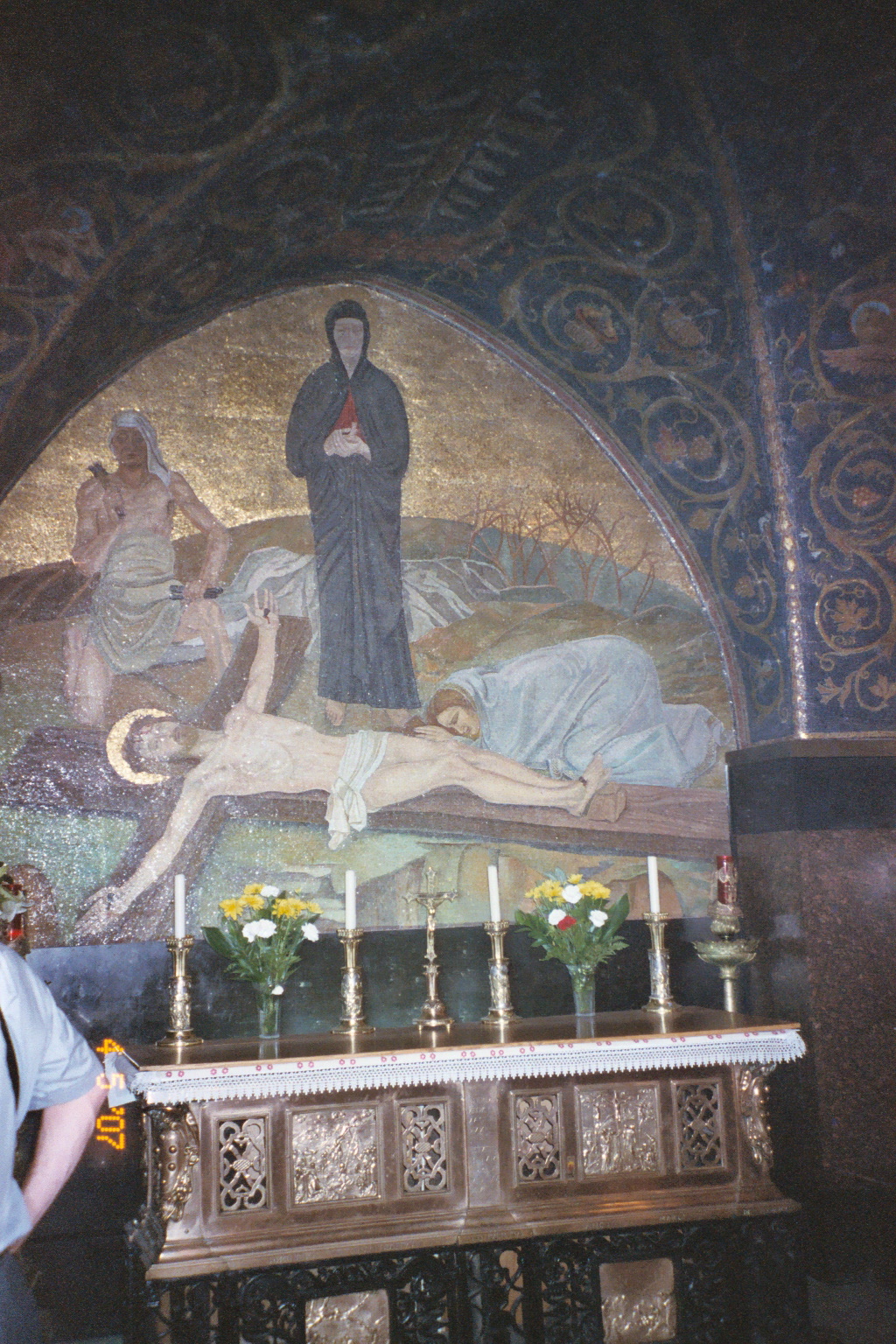
The place of the Crucifixion
    The first words do not sound appropriate for our Lord to say.  How could the consubstantial, co-eternal Son of the Father say, “My God, my God, why have you abandoned me?”  How could God abandon Himself?  Christ, as He hung on the cross, felt the full weight of sin in His human nature.  Sin does not simply reflect a choice we make contrary to what God wills.  Sin is, in some sense, a separation from God.  Even venial sins make a momentary choice where we do not choose God, who is holiness Himself, as we hear from the Books of Isaiah and Revelation: “Holy, holy, holy is the Lord God of Hosts!”  So when we choose that which is contrary to holiness, even if it is but for a second, we choose against God and we alienate ourselves from Him.  Our Lord, though He had no sin Himself, took upon Himself the consequences for sin of all time and space, and so felt, in His human nature, the horrible absence of God, though, of course, He remained God through all of His Passion.
    But to put these words of the psalmist on his lips also demonstrated His total union with us in all things but sin.  He experienced what we experience when we know we have wandered away from God: that lack of true happiness, that darkness, that void in our hearts that come from choosing lesser goods over our ultimate good. 
    And there is a beauty and a strength for us that come from the knowledge that our God loved us so much that He would humble Himself to experience the pain of sin, though He knew not sin Himself.  We can never truly understand the depths of another’s pain, since each person’s pain is unique, just like each person is.  Yet, it does help when someone we know has been through a similar circumstance, and knows what it is to lose as we have lost.  God can give us that comfort because He has been there, and suffered what we suffer when we do not live up to our supernatural purpose. 
    In saying this one line, Christ included the entire psalm, just as we sometimes will include in our conversation entire lyrics with simply one line.  So Christ also includes the later words within this psalm, “I will proclaim your name to my brethren; / in the midst of the assembly I will praise you: / “You who fear the Lord, praise him; / all you descendants of Jacob, give glory to him; / revere him, all you descendants of Israel!”  In the midst of this pain and sense of abandonment, our Lord also directs His suffering as an offering of praise to God among His brothers and sisters.  Indeed, we use the word assembly, but the Hebrew word is qahal, which is translated into Greek as 𝜀𝜅𝜅𝜆𝜂𝜎𝜄𝛼, whence we get the English word “ecclesial,” meaning belonging to the church.  In the midst of the pain and suffering, Christ praises God the Father in the Church, and invites God’s People to worship Him.
    Pain and suffering do not end in themselves.  Even these are gifts that can be offered to God and lead to praise and worship.  How?  As verse 20 states, “But you, O Lord, be not far from me; / O my help, hasten to aid me.”  God, even in the darkest times of our life, even in the darkest times of human history, past, present, or future, does not abandon us, even when it feels like it.  God the Father was ever present with his Son, Jesus Christ; the Father was not far from the Son, nor is He far from us.  And God sends us help to persevere through our suffering.  When we suffer, united to Christ, our suffering becomes redemptive, whether for ourselves or for others.  Pain gives way to healing; death gives way to life.  And isn’t that precisely what this week is all about?
    So, in the midst of our suffering, may this psalm be on our lips, just as it was on our Lord’s.  May we not stop at the first verse, the feeling of abandonment by God, but continue throughout the entire psalm, proclaiming in the midst of the Church God’s goodness and His proximity to us even when things look darkest, and giving glory to God: the Father, and the Son, and the Holy Spirit.  Amen.

03 April 2023

The Fickle Nature of Humanity

Palm Sunday of the Lord’s Passion
    [In the name of the Father, and of the Son, and of the Holy Spirit.  Amen].  Today’s Mass is an exhibit on the fickle nature of humanity.  It is an emotional roller coaster if ever there was one.  Even the usually pristine nature of the Mass takes on notes of higher and lower pitch. 

    We started today echoing the words of the people as Christ entered His city, Jerusalem, fulfilling the prophecy of Zechariah.  We, like the Jews at the time of Christ, waved our palm branches, signs of victory and jubilation.  Not long after, however, our cries of “Hosanna” changed to “Crucify him!”  We started with, “‘Blessed is he who comes in the name of the Lord.’” and we ended with, “‘His blood be upon us and upon our children.’”
    How did this happen?  Our Lord was cheered as a hero, as the fulfillment of the messianic prophecies that filled the minds of the pilgrims in Jerusalem.  He was welcomed and embraced as an honored guest in the Holy City.  But in those few short days between Palm Sunday and Good Friday, the mood changed.  The Messiah was not the type of Messiah the people wanted.  They grew tired of His preaching.  The newness wore off.  Until, whipped into a frenzy by agitators, this honored guest was not only brushed away and forgotten, but snuffed out, even while the crowds called for the release of a notorious prisoner, Barabbas, whose name, ironically, means “son of the father.” 
    It would be easy to think of this simply as a past event.  It would certainly ease our conscience if we didn’t have to take any part in the great drama of salvation, and could stand as critics who know how the scene should play out, because we observe like omniscient spectators, convinced of our own wisdom.  But to do so is to miss the point.  We did not live 2,000 years ago, but we still cry out “Hosanna” and “Crucify him” because we are the crowd.  We are the mob.  We are fickle.
    We see Christ do amazing things for us.  Perhaps we ourselves witness miracles that Christ does to ease our suffering or heal our illness.  Something goes right and we say, “Thank you, Jesus!”  We embrace Him with love because of the mercy He shows us.  But then, as times get tough; as we do not receive all that we desire; as we have to say no to our fallen sinful selves; as our love is tested by sacrifice, we embrace Him again, but this time we say, “‘Hail, Rabbi,’” and kiss Him with the kiss of the betrayer.  We make the words of Psalm 41 (40) about us, as the Lord says, “Thus even my friend, in whom I trusted, / who ate my bread, has turned against me.”  We, who have eaten the bread of angels, the Eucharist, betray Christ and cast Him out of our midst. 
    To be welcomed and celebrated and then cast off so quickly.  How would we respond?  How does Christ?  He feels the agony of rejection, of betrayal, by those whom He loved so dearly: “‘My God, my God, why have you forsaken me?’” he cries out, quoting Psalm 22 (21).  And yet, He also says, “Father, forgive them.  They know not what they do.”  As Isaiah prophesied, “The Lord God is [His] help, therefore [he is] not disgraced.”  He is not ashamed to be called our Brother, even though we are ashamed, at times, to be called His. 
    We are fickle.  Our love fades so quickly.  Perhaps, though, today we silent our tongues, not cheering out in joy, nor howling in impious mockery.  But we simply watch, silently, as our Lord does what must be done for the salvation of the world [In the name of the Father, and of the Son, and of the Holy Spirit.  Amen].

05 October 2020

Our Approach to Others

 Twenty-seventh Sunday in Ordinary Time
    Parents here will recognize the time-honored teaching technique of repeating something in a variety of different ways with the same message.  If repeated enough, it can finally be understood.  And that is what we have heard from Jesus over the past few weeks.  Two weeks ago we heard the parable of the vineyard.  Those who came first were upset at those who came later, and yet were given the same payment.  Last weekend we heard the parable about the two sons.  The first was disobedient in words but obedient in actions.  The second was obedient in words but disobedient in actions.  This week we hear another vineyard parable, except this time, we hear about tenants who are supposed to care for the vineyard, but when the landowner sends servants to obtain the produce, they harass and kill them.  Finally, the landowner sends his son, but the tenants kill him, thinking that they will get his inheritance.

    These parables are probably being told towards the end of Jesus’ ministry before the crucifixion.  Two weeks ago the Gospel was from the beginning of Matthew, chapter 20.  Last week’s Gospel was Matthew, chapter 21, verses 28-32.  This week’s Gospel is Matthew, chapter 21, verses 33-43.  I say this because the beginning of Matthew, chapter 21 is the entry into Jerusalem that we celebrate each Palm Sunday. 

    And the point Jesus is making in all three of these Gospels has to do with the attitude of the Chosen People, and specifically the religious leaders like the Pharisees, scribes, chief priests, and Sadducees, to the proclamation of the Gospel, the Good News, by Jesus.  In the first parable, Jesus compares the attitude of the members of the Chosen People who are not rejoicing that sinners and Gentiles (non-Jews) are hearing God’s word and changing their lives to those who went to work early in the day, but then were upset when those who came later and especially those who came at the last minute got paid the same.  In the second parable, Jesus compares the sinners and Gentiles who, at first, reject God’s command, but eventually do it, and compares certain members of the Chosen People to the second son who says he’ll follow God’s command, but then doesn’t follow through and actually do it.  And in this parable that we heard today, certain members of the Chosen People are the tenants.  The servants are the prophets whom God sent to teach the Chosen People how to live.  The son is Jesus.  And the religious leaders do the same thing as the tenants: they kill both the servants and the son.  In all of these parables, Jesus is telling some of those who were listening that they were on the wrong path, and needed to convert and accept the Gospel.  And especially the religious leaders who heard this got angrier and angrier because they knew Jesus was talking about them (which is why the continued to conspire to put Jesus to death).
    So what does this have to do with us?  I would say that Catholics, in particular, can struggle in the same ways as those to whom Jesus was addressing His parables.  So often, especially in these days, Catholics have the mentality that, as long as we’re baptized and we’re not Hitler or Stalin, then we’re good; we’re on the right path.  But Jesus is telling us that, while baptism is important as the ordinary means of salvation and the way Jesus taught us to come into communion with God, it’s not like if we have our baptism card then we’re all set.  We are constantly called to deeper and deeper conversion, to deepen our love for and our understanding of God.  Each day there are parts of our lives that need to change to be more like Jesus; we’re never done.  Baptism can easily become for us like circumcision was for some of the the Jews at that time: as long as I’ve gone through it then I don’t need to worry about anything.  And that’s simply not how a relationship with God works.  If we truly love God, we try each day to be a better friend of God, not resting on our laurels of previously having a good day or week with God, or even simply on the fact that we’ve had our Catholic card punched.
    The other struggle we can have is based upon how we view welcoming others into the Catholic faith.  Sometimes we can feel like a person needs to have it all together before they can be invited to church.  Certainly, entrance into the Catholic Church requires that daily conversion about which I just spoke.  But Jesus didn’t tells sinners that they needed to be a saint before they could start following Him.  He called them to follow so that they could become a saint.  Now, to be sure, becoming a saint means configuring our life to Christ and starting certain actions and leaving other actions behind.  Jesus never pretended that a person’s sins didn’t matter.  But he didn’t let their sins stop the conversation about moving in the right direction.  The woman caught in adultery in John’s Gospel is a perfect example: Jesus doesn’t condemn the woman for her adultery.  But after not condemning her, He tells her to go and sin no more.  
    This is not to say that we can approach everything that Jesus offers no matter what.  If our lives are not right in major ways, we should not approach the Eucharist.  If we are in an irregular marriage; if we support (by words or deeds) abortion and/or euthanasia; if we have stolen something of significant value, then approaching Jesus in the Eucharist as if none of that makes a difference is not the way Jesus wants us to do things.  But, on the other hand, it also doesn’t mean that Jesus doesn’t want us to see us again our interact with us again until we get our lives right by our own strength.  We can’t do it on our own strength.  We need Jesus to convert our hearts, and therefore our lives, so that we can, once more, have communion with Jesus in the Eucharist.  
    Today Jesus invites us not to set up more barriers to interacting with Jesus than He does.  He calls us each not to treat baptism as a “get out of hell free” card.  He calls each of us–me and you–to deeper conversion each day, to pattern our life more on Jesus each day, so that we can turn away from sin, and be faithful to the Gospel.

06 April 2020

Kenosis

Palm Sunday of the Lord’s Passion

    Usually for Palm Sunday, I contrast the beginning of Mass when we entered, waving palms, singing “Hosanna,” joyful in acclamation, and me wearing my very festive red cope, to the somberness that we get to by the Gospel, hearing the Passion narrative, and no longer singing “Hosanna,” but shouting, “Let him be crucified!”  But this year, there’s no waving palms, no singing “Hosanna” by the parish assembled here, no red cope.  #ThanksCOVID19.
    But it has pushed me to focus more on our second reading, from St. Paul’s letter to the Philippians.  Bishop Barron notes that scholars hypothesize that this was an adaptation of ancient hymn or prayer that St. Paul was repeating to the people of Philippi, perhaps from only a decade or so after Jesus died and rose from the dead, as this letter was written by St. Paul sometime in the 50s.  And this part talks about Jesus emptying Himself, which is the crux (if you’ll pardon the pun) of this passage.  The beginning (“Christ Jesus, though he was in the form of God, did not regard equality with God something to be grasped.”) leads up to Jesus emptying Himself, and the next verses describe the example (the how) and the consequences (the so what?) of Jesus emptying Himself (“taking the form of a slave…becoming obedient to the point of death, even death on a cross…God greatly exalted him…every knee should bend…and every tongue confess that Jesus Christ is Lord, to the glory of God the Father.”).  We talk about this emptying in theology by using the Greek word 𝜅𝜀𝜈𝜊𝜎𝜄𝜍. 
    Isn’t that what we heard about in the Gospel today?  Jesus emptied Himself through His Passion and Death on the Cross.  In modern phrases, we might say, Jesus “gave His all” or “gave 100%.”  But this was precisely a part of who Jesus is.  As the second Divine Person of the Blessed Trinity, Jesus, from all eternity, poured Himself out to God the Father, who, likewise, from all eternity, poured Himself out to God the Son, in a bond of love so strong that it eternally breathed forth the Holy Spirit.  And it’s who Jesus still is today; His emptying didn’t stop at the cross.  Jesus continues, for all eternity, to pour Himself out to the Father in that communion of love that I just mentioned.  
    We joke about people hoarding toilet paper, or panic buying in general, but hasn’t COVID-19 demonstrated the radical opposite focus of our lives?  Hasn’t it revealed a deep darkness in our world?  We, as members of the mystical Body of Christ, are not made for selfishness, for taking as much as we can, but for emptying ourselves for the other, for selflessness.  And yet, the selfishness of many parts of our culture are on display now more than ever.  When times get tough, the tough tend to only think of themselves.  It’s one thing to prepare in case a family is stuck at home for weeks on end.  It’s altogether different when those same supplies will be available week after week at the grocery store, to which we all can have access. 
    We are made for giving, even to the end.  And yet how many times are we afraid of giving ourselves?  Like any other virtue, selflessness has two extremes: too little, and too much.  We do have to take care of ourselves.  But more often than not, we’re not selfless enough, because we’re afraid that if we give ourselves away, we will lose something.  Maybe that goes for our marriage or family life.  Maybe that goes for work.  Maybe that goes for our relationship with Jesus.  We are afraid that if we give Jesus everything, then He might take something away that we like.  If we empty ourselves for Him, will He really empty Himself for us?
    Pope Emeritus Benedict XVI spoke about this to the youth in particular, but it applies to us all.  He said:

Are we not perhaps all afraid in some way? If we let Christ enter fully into our lives, if we open ourselves totally to him, are we not afraid that He might take something away from us? Are we not perhaps afraid to give up something significant, something unique, something that makes life so beautiful? Do we not then risk ending up diminished and deprived of our freedom? . . . No! If we let Christ into our lives, we lose nothing, nothing, absolutely nothing of what makes life free, beautiful and great. No! Only in this friendship are the doors of life opened wide. Only in this friendship is the great potential of human existence truly revealed. Only in this friendship do we experience beauty and liberation. And so, today, with great strength and great conviction, on the basis of long personal experience of life, I say to you, dear young people: Do not be afraid of Christ! He takes nothing away, and he gives you everything. When we give ourselves to him, we receive a hundredfold in return.
       
        During this Holy Week, following the example of Jesus, who emptied Himself for our salvation, who gave all of who He was, not only to God the Father, but “for us men and for our salvation” (as we say in the Nicene Creed), let’s also empty ourselves for God and for our fellow human beings.  What’s the result for us?  The same as it is for Jesus: when we empty ourselves, God greatly exalts us in Christ, and makes us sharers in the glory that is to come.  While we usually have on our lips “Hosanna” today, may this year’s struggles remind us today, this week, and every day, to also have another word in our minds and hearts, and on our lips: kenosis; emptying. 

16 April 2019

The Mob

Palm Sunday of the Passion of the Lord
The mob.  No, not the mafia or organized crime.  The mob, as in a group of people with a unified mentality.  Our readings today start and end with the mob.
As we gathered at the beginning of Mass, blessing the palms, we heard St. Luke’s account of the triumphant entry into Jerusalem.  The crowds are there for the Passover, and Jesus enters the Golden Gate, the only eastern gate leading into the Old City of Jerusalem.  It was also called Sha’ar HaRachamim, the Gate of Mercy.  According to Ezekiel, it was through this gate that the Messiah would come, and in fact, as those who went on the pilgrimage to the Holy Land with me heard, it is currently closed up by bricks, because there is a prophecy that the Messiah will go through that gate again at the end of time.
The Golden Gate in Jerusalem
 
The crowds, probably thinking about the prophecies of Ezekiel (that the Messiah would enter through this gate), and the prophecy of Zechariah (“Exult greatly, O daughter Zion!  Shout for joy, O daughter Jerusalem!  Behold: your king is coming to you, a just savior is he, humble and riding on a donkey, on a colt, the foal of a donkey”), acclaim Jesus as the Messiah, and recite Psalm 118: “Blessed is he who comes in the name of the Lord.”  They are excited, as a whole, about Jesus entering the Holy City for the Passover feasts.  They no longer really operate as individuals, but are now a mob, joyfully celebrating the entry of Jesus into Jerusalem.
But in our Passion Narrative, the same people are clamoring, now not for Jesus as a Messiah, but for the death of Jesus.  They no longer shout with the words of Scripture, but rather, “‘Crucify him!  Crucify him!’” to fulfill another prophecy of Zechariah which states: “they [shall] look upon him whom they have thrust through, they will mourn for him as one mourns for an only child, and they will grieve for him as one grieves over a firstborn.”
Mobs are, by their nature, fickle.  It doesn’t take much for people to set aside their rationality and give in to their emotions.  They do not consider so much what they do or what they say, but simply do what feels good.  And notice that Jesus does not placate the mob in either case.  He neither basks in their adulation, nor shrinks from their murderous howls.  Jesus is intent on doing the will of God, in good times and bad, no matter what people think of Him.
As those who have been configured to Christ in baptism, that is our task as well: not to give into mobs in our life, but to set our face like flint to do the will of God the Father.  It’s easier to disregard when we disagree with the negative shouts that they hurl at us.  Our natural instinct for self-defense usually tries to justify us and rationalize our behavior.  It’s much harder to avoid the mob and cave to them when they are pumping us up and saying things that we want to hear.  Especially in these days, we tend to surround ourselves with those who agree with us, and they become nothing else than an echo chamber for our mind and ego.  When people disagree with us,  rather than engaging in calm dialogue and rational debate, we cut them out of our lives, we unfriend them on Facebook or unfollow them on Twitter, and so the chances that those to whom we do listen encourage us becomes pretty likely.  But in the face of that, Jesus reminds us both not to give in to the negative or positive shouts of the mob, but to calmly and confidently do the will of God.
Another example of the mob mentality comes from our enemy, the devil.  He’s the one who does his best to entice us into doing evil, telling us that it will feel good, that it won’t hurt anyone, that it’s just a small sin that no one will know about.  But then, if we fall, he is also the first to condemn us, to tell us how evil we are, and undeserving of God’s love.  Again, Jesus tells us not to listen to the cacophony of voices from the devil: don’t give in to the temptation, but if we do, don’t despair of God’s mercy.  Rather, try our best to do God’s will in every circumstance in life, as best as we know it, but if we find ourselves having caved to sinful activity, then to run to the Gate of Mercy, the confessional, to be granted absolution from our merciful Father.  

While today’s readings began and ended with the mob, they also began and ended with Jesus, two stark examples of how to live our life.  May we not be part of the mindless mob, being blown on a whim from emotion to emotion, but be like Jesus, heart, mind, and body set on doing the will of God the Father.

26 March 2018

Alone

Palm Sunday of the Lord’s Passion
Our Gospels today relate a circumstance we know all too well: when things are going well and you’re on top of the world, your friends are happy to be with you.  But as soon as things go south, you are all alone.  It’s like when you’re young and you have friends over to your house: they’re happy to be with you to have a good time, but as soon as you hear your parents say your first name followed by your middle name, all the sudden your friends scatter and it’s just you having to face what you know will be at least a stern talking to by your parent.
Jesus enters Jerusalem, as we heard in the Gospel proclaimed at the blessing of palms, with lots of people, cheering Him on.  But when Jesus is arrested, and eventually led away to be crucified, it is only a few friends (by varying accounts the Blessed Mother, St. John the Apostle, St. Mary Magdalen, and a few others) who stand by Jesus.
Death is something that is a part of life which makes us feel alone.  Generally, no one else experiences it with us, even if there are people standing around us at the time of death.  We can never experience death for another person.  As much as we might sympathize, and as much as there are common factors, death will be a unique experience for each one of us.
So it makes sense, as Jesus dies on the cross, that He says, as we heard in today’s psalm, “My God, my God, why have you abandoned me?” Jesus, in His human nature, feels alone, abandoned by God, as He dies.  He experiences everything we do, except without sin, including the individuality of dying.  Of course, for Jesus, death is not part and parcel of His existence.  Jesus is God, the source of life, Life Incarnate, so death is not merely something which makes so little sense, it is the antithesis of who Jesus is.  Of course, God the Father does not truly abandon Jesus at the hour of His death, as Jesus truly takes up His cross, any more than God abandons us when we are faced with the cross.  But Jesus feels like He is alone, as He empties Himself and dies on the cross.
The cross is the other place where we feel alone.  When I say cross here, I’m talking about our suffering, our challenges, especially the ones that touch us at the deepest levels of our human nature.  Whether it’s a big cross or a small cross to outsiders, each cross is heavy to the person carrying it, to the person dying on it.  Carrying the cross, on the cross, is where the person feels alone, abandoned, perhaps even by God.  The cross is the way that we, too, like Jesus, are invited to empty ourselves.  Our pride tells us to hold on to ourselves, to puff up ourselves, but the cross is the great deflator.  
Of course, we don’t have to carry or die on our crosses.  We always have the choice to say no to the cross.  But in saying no to the cross, we say no to the Resurrection.  The cross empties us, as St. Paul talks about in the second reading.  The cross humbles us.  But in emptying us and humbling us, we finally have room for God, who will not leave us empty and debased, but will raise us up, just as He did for Jesus.
Because we are human, our tendency is to run away from the cross.  We are afraid of its weight, and that God will abandon us as we carry it and die on it.  The cross, which is also to say dying to ourselves, is painful.  But it is the only way that we can allow God to raise us up, to conquer our sin and death and give us holiness and life.  And God will not abandon us, even if it feels that way, when we suffer.  

So I invite you not to abandon Jesus, just as He didn’t abandon you.  All this week we have an opportunity to be with Jesus as He suffers, to tell Jesus with our actions that He is not alone.  Come to the Mass of the Lord’s Supper on Thursday night at 7 p.m. as Jesus institutes the Eucharist and the ministerial priesthood, and is arrested in the Garden of Gethsemane.  Come to our Good Friday Liturgy at 2 p.m., as Jesus dies on the cross, and to Tenebrae at 8 p.m., as He is laid in the tomb.  Embrace Jesus’ Passion, Cross, and Death, so that you can share in His Resurrection.

25 March 2016

Participating in the Events of our Redemption

Palm Sunday of the Lord’s Passion
We are blest in our parish with a number of talented actors and actresses who perform in their school plays and musicals, and even in the productions at the Croswell.  Their talent to bring to life a character from a certain time period in the past, or even in an imaginary world, helps tell a story, and remind us of those past events, or help us to dream of fantastic stories.
In many ways we can see these liturgies that we celebrate during Holy Week like the performances on the stage.  Today and on Good Friday the Gospel of the Passion of the Lord will be read by many readers, not just the priest or deacon.  We began today by, in a sense, re-enacting Jesus’ triumphant entry into Jerusalem.  Thursday I will wash the feet of six people as a reminder that we are to serve.
But if we think that we are simply remembering a past event, from which we are removed by almost 2,000 years, then we do not understand the Church’s liturgy.  Because we are not actors in a performance in the Mass.  We are participants in the actual events of our redemption.  We do not put on a show that remind us of what Jesus did for us.  We are invited to engage in the very events and experience them in sacramental signs.  Pope St. Leo the Great said, “What was visible in our Savior has passed over into his mysteries.”  Another word for mysteries in the sense that Pope Leo used it was Sacraments, rites that connect us to Jesus’ life, death, and resurrection.  
As we gathered before Mass, we joined the crowd at Bethphage and waved our palms, welcoming our Messiah into Jerusalem as we walked into an icon of the heavenly Jerusalem, this church building.  As we see others’ feet being washed, Jesus our Lord and Master humbles Himself for us and reminds us that to follow Him means to serve others.  As we enter into the Eucharistic Prayer, we go to Calvary, at the foot of the cross, and see the sacrifice of the spotless Lamb of God, who shed His Precious Blood out of love for us.  And as we receive the Eucharist worthily, we participate in that very sacrifice by which we are saved.  These events are not something that are far removed, but, by the power of the Holy Spirit, enter into our time and are supposed to have a real effect on our lives.

Many of us struggle with our Lenten promises.  Some of us have fallen, or never really began as we wanted.  In this last week of Lent, let us walk with Jesus on his pilgrimage to the crucifixion.  Let us not simply remember what Jesus did for us, but partake in the mysteries, the rites, which bring His life, death, and resurrection to us.  Because the beauty of our Catholic faith is that we not only remember what Jesus did for us, but we have the opportunity to be joined to our salvation and experience first-hand to what extent God would go to prove His love for us.

02 April 2012

Hammering in the Nails

Palm Sunday of Passion of the Lord
            We began Holy Week by hearing how Jesus entered triumphantly into His city, Jerusalem.  Shortly afterwards, we recalled in the Gospel how Jesus was then mocked, stripped, and crucified for our salvation.  What a stark contrast in a short amount of time.  What a short time it must have seemed for Jesus between the original Palm Sunday and Good Friday.
            How fickle the crown of God’s creation can be.  How easily swayed we are by excitement…and fear.  With the celebration of the Passover in the background, with tens of thousands of pilgrims coming to Jerusalem, the Jews welcomed Jesus.  With the pressure of the Chief Priests, the Scribes, and the Sadducees, the Jews condemned Jesus for blasphemy.  The King of Glory who entered His capital with shouts of “Hosanna” was made to reign upon the Cross with shouts of “Hail the King of the Jews” in mockery. 
            Because we have become so used to seeing Jesus on the cross in artistic renditions of the crucifix, we can easily become numb to its reality.  Death by crucifixion was a death of suffocation, the lungs filling with fluid, making it harder and harder to breathe.  The only way to get a breath was to use the hands and feet to push oneself up, which only increased the pain where the nails were.  It was a horrible, painful death, filled with shame and derision.
            In the face of such suffering, we can all too easily think that we would never have been part of the crowd crucifying Jesus.  We would not be so easily swayed.  We might even say with St. Peter, “‘Even though all should have their faith shaken, mine will not be.’”  But we would be wrong.  All of us—from Pope Benedict XVI to me and you—have all helped to hammer in those nails into Jesus’ hands and feet.  All of us stand guilty.
            If we lie to another, the hammer falls.  If we swear and curse and take the Lord’s name in vain, the hammer falls.  If we totally ignore the poor standing on the corner; if we make decisions based on prejudice and racism; if we fail to see Christ in those around us, the hammer falls.  If we think first of ourselves and never of others; if we skip Mass because we don’t make time for the Lord; if we react to our parents, children, or family members with anger rather than responding with love, the hammer falls.  If we ignore the Church’s teaching on human sexuality, marriage, and contraception because we feel we’re more enlightened; if we support organizations or ideologies that allow for an innocent child in the womb or an elderly or ill person to be put to death because they are inconvenient to our way of life; if we support the objectification of men and women through pornography, the hammer falls.
            All of us who can make a moral choice have been in that fickle mob that first hailed Jesus on His entry into Jerusalem, and then mocked him by hailing Him on the cross.  All of us have helped hammer in the nails into Jesus’ hands and feet.  All of us have sinned, and fallen short of the glory of God.  We made Jesus cry out from that cross “My God, my God, why have you forsaken me?” as Jesus felt the weight of our sins. 
            Since we have forced Jesus to walk that dark pilgrimage to the crucifixion, let us not abandon Him this week.  Though we ran away with the apostles in the garden 2,000 years ago, let us accompany Jesus this year, this week, these days as the Church celebrates our salvation in Christ: to the upper room on Holy Thursday to celebrate the Last Supper; from the upper room to the Garden of Gethsemane to keep watch in prayer; from Gethsemane to Golgotha on Good Friday; and because death and sin do not have the final word, from Golgotha to the empty tomb for the Easter Vigil or the Easter Sunday Mass.  We began Holy Week today in joy.  Let us also end it in the joy of those who, having repented of their sins and confessed them to the Lord, have been washed clean in the blood of the Lamb.  “Come now, let us set things right, says the Lord: Though your sins be like scarlet, they may become white as snow; Though they be red like crimson, they may become white as wool.”