26 March 2018

Alone

Palm Sunday of the Lord’s Passion
Our Gospels today relate a circumstance we know all too well: when things are going well and you’re on top of the world, your friends are happy to be with you.  But as soon as things go south, you are all alone.  It’s like when you’re young and you have friends over to your house: they’re happy to be with you to have a good time, but as soon as you hear your parents say your first name followed by your middle name, all the sudden your friends scatter and it’s just you having to face what you know will be at least a stern talking to by your parent.
Jesus enters Jerusalem, as we heard in the Gospel proclaimed at the blessing of palms, with lots of people, cheering Him on.  But when Jesus is arrested, and eventually led away to be crucified, it is only a few friends (by varying accounts the Blessed Mother, St. John the Apostle, St. Mary Magdalen, and a few others) who stand by Jesus.
Death is something that is a part of life which makes us feel alone.  Generally, no one else experiences it with us, even if there are people standing around us at the time of death.  We can never experience death for another person.  As much as we might sympathize, and as much as there are common factors, death will be a unique experience for each one of us.
So it makes sense, as Jesus dies on the cross, that He says, as we heard in today’s psalm, “My God, my God, why have you abandoned me?” Jesus, in His human nature, feels alone, abandoned by God, as He dies.  He experiences everything we do, except without sin, including the individuality of dying.  Of course, for Jesus, death is not part and parcel of His existence.  Jesus is God, the source of life, Life Incarnate, so death is not merely something which makes so little sense, it is the antithesis of who Jesus is.  Of course, God the Father does not truly abandon Jesus at the hour of His death, as Jesus truly takes up His cross, any more than God abandons us when we are faced with the cross.  But Jesus feels like He is alone, as He empties Himself and dies on the cross.
The cross is the other place where we feel alone.  When I say cross here, I’m talking about our suffering, our challenges, especially the ones that touch us at the deepest levels of our human nature.  Whether it’s a big cross or a small cross to outsiders, each cross is heavy to the person carrying it, to the person dying on it.  Carrying the cross, on the cross, is where the person feels alone, abandoned, perhaps even by God.  The cross is the way that we, too, like Jesus, are invited to empty ourselves.  Our pride tells us to hold on to ourselves, to puff up ourselves, but the cross is the great deflator.  
Of course, we don’t have to carry or die on our crosses.  We always have the choice to say no to the cross.  But in saying no to the cross, we say no to the Resurrection.  The cross empties us, as St. Paul talks about in the second reading.  The cross humbles us.  But in emptying us and humbling us, we finally have room for God, who will not leave us empty and debased, but will raise us up, just as He did for Jesus.
Because we are human, our tendency is to run away from the cross.  We are afraid of its weight, and that God will abandon us as we carry it and die on it.  The cross, which is also to say dying to ourselves, is painful.  But it is the only way that we can allow God to raise us up, to conquer our sin and death and give us holiness and life.  And God will not abandon us, even if it feels that way, when we suffer.  

So I invite you not to abandon Jesus, just as He didn’t abandon you.  All this week we have an opportunity to be with Jesus as He suffers, to tell Jesus with our actions that He is not alone.  Come to the Mass of the Lord’s Supper on Thursday night at 7 p.m. as Jesus institutes the Eucharist and the ministerial priesthood, and is arrested in the Garden of Gethsemane.  Come to our Good Friday Liturgy at 2 p.m., as Jesus dies on the cross, and to Tenebrae at 8 p.m., as He is laid in the tomb.  Embrace Jesus’ Passion, Cross, and Death, so that you can share in His Resurrection.

12 March 2018

For Whom would we Give Up our Life?

Fourth Sunday of Lent
There are a few people, but probably only a few, for whom the average person would give up his or her life.  I think any parent (any good parent, anyway) would give up his or her life for the child.  Siblings sometimes would give up their life for each other.  But generally the list of people for whom another person would give up his or her life is pretty small.
That is what is so impressive about those who serve in the military, law enforcement, or fire departments: they have made a commitment to give up their lives for total strangers.  It is quite humbling for me riding along with our MSP Troopers and seeing them walk up to cars, many with guns in them, and even while they practice safe approaches to the vehicle to limit their chance of being attacked, it still has happened all too frequently that they are in a situation where they may have to lay down their life, not only for a family member or friend, but for the citizens who may not even know they exist.  
If we think about it, giving up our life for a stranger is maybe a little easier if that person is good, maybe what we consider a productive member of society.  But what our first and second reading remind us this weekend is that we weren’t good.  This is an important aspect of salvation history: God loved us and entered into covenants with us to give us life and happiness, but we never lived up to our end of the bargain.  In the Garden of Eden, before we even had sin, we disobeyed God.  God saved Noah and his family because they followed God, but not long after that, Noah’s sons messed things up again.  Abraham did pretty well, but he still had inherited the sin of Adam and Eve that we call original sin.  Moses received the Law, the Ten Commandments from God, and no sooner had God given the Law, then the people broke it.  Even Moses himself couldn’t enter the Promised Land because he had disobeyed God on their journey through the desert.  King Saul disobeyed God, so David was chosen, but even David committed murder to cover up his adulterous relationship with Bathsheba.  Solomon started worshipping foreign gods, even though he had built the temple in Jerusalem, because of the influence of his foreign wives, and most of the kings who followed him were just as evil.  And so on and so on.  No one, not even the prophets, were good enough to earn heaven.  We all were, as St. Paul said in the second reading, “dead in our transgressions.”
And that’s what makes the familiar line we hear in the Gospel so powerful.  It’s not simply a sign that people hold up at football games behind the goal posts.  “God so loved the world that he gave his only Son, so that everyone who believes in him might not perish but might have eternal life.”  ‘Of course he did!’ we might say to ourselves.  We are so used to God dying for us, to save us from everlasting death and Hell, that we might be a little numb to the power that is in those words.  We might die for family or friends.  We may even die for a good person.  But Jesus died for those who were His enemies: those who worked against Him starting with Adam and Eve, those who clamored for His death in Jerusalem, and for us who have nailed Jesus to the cross each time we sin.  The power of what Jesus did comes from the fact that we were, before baptism, the enemies of God, working against God, happy to do our own thing, rather than follow God.  Even the most just man, because of original sin, was still an enemy of God who could not earn salvation.
How comfortable have so many of us become with the killing of God.  We take it as a matter of fact, and it is in the sense that it has happened.  But it should not have happened.  Jesus is the light of the world, and came not to condemn us but to save us, but we preferred darkness; and so we tried to snuff out the light.  But the light conquered our darkness, as light always does.  
Think of the person who troubles you the most; maybe you even hate that person.  That person has harmed you in a way you find unforgivable.  And now you have to die for that person tomorrow so that he or she can live.  Really think about it; what would be your reaction?  What would be your honest reaction?  Jesus’ reaction was love; not begrudgingly, not with caveats and conditions, not as one forced to do what is for the best, but not the best for Him.  Jesus died for us because He loved us.  He let us kill Him with our sins because He loved us.  We did not earn salvation, nor can we; “this is not from you; it is the gift of God.”  

The question is whether or not we will respond to God’s gift of salvation.  Will we choose the light, or do we prefer darkness?  Do we believe in Jesus, follow Him, and so find eternal life, or will we be condemned because we do not believe?  We are not worth dying for.  But Jesus died for us anyway.  Accept that love of God that died for you so that you may live.  

05 March 2018

Worldly vs. Catholic Wisdom

Third Sunday of Lent
Have you ever noticed that there is never a shortage of people who are willing to give you advice?  I suppose I might be cutting out my legs from under me, as most homilies are supposed to help people find practical way to apply the Gospel to their daily lives.  But, just think about it: how many TV shows or commercials are basically trying to give you advice on how to diet, how to learn, how to understand what’s happening in the world, in politics, in sports?  Maybe it’s “Dr. Oz,” maybe it’s “The View,” maybe it’s a commercial with your favorite celebrity on a political or social issue, maybe it’s a talk show on your preferred cable news station, or maybe it’s even the way the news is presented by individual networks.  But advice seems to be everywhere from people who want to tell you how to live your life.
This is, of course, nothing new.  Different groups have always been trying to influence the way people think, trying to get people to live their life based on a particular view of reality.  And with the advent of social media, that has only increased.  You can’t scroll Facebook or Twitter without seeing pithy quotes that are supposed to help you be a better person.  Sometimes the phrase sounds good, but in fact, isn’t really Catholic or Christian.  For example, I saw a post on Facebook the other day that said, “There is no turning your back on God.  There is only turning your back on yourself.”  Sounds profound, deep, insightful, right?  It’s rubbish!  Of course you can turn your back on God!  There are so many quotes like this that are from non-Christian or secular websites or pages that may sound amazing, but, in fact, are contrary to Scripture.  And we should be wary about giving our minds and our will to any wisdom that doesn’t come from God through the Scriptures or the Church’s teaching.  I’m not saying it’s all bad, but much of it is, and we don’t want to be poisoned by something that we think might be good.  Imagine picking mushrooms, not knowing which ones are good and which ones will kill you, and leaving behind the guidebook to which ones to consume.  That’s what it is to take wisdom from a non-Christian or secular source without running it past what God has revealed to us.
And what is the wisdom that God gives to us?  The wisdom of God is Christ crucified.  It seems like foolishness and maybe makes people stumble, but our crucified Christ is “wiser than human wisdom,” as St. Paul said in our second reading.  The life of Christ is not only a story, it is a pattern, a guide for all those who want to find happiness.  I know, it may not look like Jesus’ life had a lot of happiness: He was poor, wandered around, most of His best friends abandoned Him when He needed them the most, and He died mostly surrounded by His enemies in a most shameful way of dying.  Sign me up for that, right?
But God raised Jesus up, and, in fact, we have no evidence that Jesus ever seemed to want for anything, or lack any happiness.  He felt sorrow for those who couldn’t or wouldn’t follow Him, but I think it’s pretty safe to say that the Gospels paint Jesus as a happy Person.  He didn’t have money; He didn’t have power (in the way the world sees power); He didn’t have sex (do people really do that?!?).  But Jesus was happy; truly happy.  And He was happy because He lived by God’s Word, the words of everlasting life, as our Psalm response said this morning.  
The Ten Commandments that we heard in our first reading seem like a long list of nos that cramp our style: no idols, no taking God’s Name in vain; no work on the Sabbath; no murder, no adultery, not stealing, no lying, no coveting; the only really positive commandment is “Honor your father and your mother.”  And yet, that wisdom from God which seems so negative, opens us up to a larger ability to say yes.  By not doing menial work on Sunday, the Christian Sabbath, the day of the Resurrection, we are saying yes to enjoying time with our family, maybe even with a family dinner; to serving the poor; to worshipping God and being fed by God’s word and the Body and Blood of Jesus.  And all that because we take a break from work that will always be there.  Think about the people who say yes to taking whatever they want, even if they don’t have the money to pay for it: they may get away with stealing a candy bar or maybe something more, but eventually it catches up with them, and they end up being prosecuted, maybe even going to jail.  And I don’t know many, if any people, who are happy and in jail.  So by saying no to stealing, they are saying yes to freedom, to more opportunities, and to a happier life.

Sometimes living by the wisdom of the Word of God may seem like simply a lot of nos.  But in fact, the ways that God asks us to say no actually allows us to say yes: yes to God, yes to love, yes to peace, yes to happiness.  May our Lenten observances also encourage us to say no to all the things that bring us death and slavery, to our sins, and say yes to all the things that bring us life and freedom, to God’s grace.

23 February 2018

Transfiguring Society

Second Sunday of Lent
In the afternoon of Ash Wednesday the nation was alerted to what became the most-deadly school shooting in US history in Parkland, Florida.  There were so many tragic pictures and videos, many of them the result of almost everyone these days having a phone or tablet that can take pictures.  Last weekend we prayed for both the survivors and those who were murdered at our weekend Masses, and we certainly need to keep that entire community in our thoughts and prayers.
In the hours and the days after the shooting, there were many suggestions on how to stop such a tragedy from happening in the future.  Different suggestions included more gun control legislation and more help for the mentally ill, among others.  I’m not here to endorse or reject any suggestion that was offered on news sites and television programs.  But as we celebrate today the second Sunday of Lent, we are given a few reminders from God that are very poignant given what has happened in our country in the past couple of weeks.
In our first reading, we heard from Genesis about the well-known almost-sacrifice of Isaac.  While child sacrifice sounds so foreign to us, it was not so foreign to Abraham, as it was practiced in many of the local, near-Eastern religions that surrounded Abraham in the land of Canaan.  Abraham’s faith is tested by God, to see if Abraham is willing to give his most precious treasure up for God.  But before the sacrifice, God stays Abraham’s hand, and provides a sacrifice in Isaac’s place.  In God’s stopping Abraham, we see that God never wants any of His children to sacrifice their own children.  Child sacrifice is condemned (as God will condemn it again and again when the Israelites re-settle in the land of Canaan, the Promised Land), but it also looks forward to when God will allow what He would not require of Abraham, the death of His Son, His “only one,” whom God loved above all.  St. Paul reminds us in the second reading that God did not spare His own Son so that we could be raised from the dead and have our sins forgiven.
From the Church of the Transfiguration on Mt. Tabor
In our Gospel, though, Jesus is not dying, but being transfigured, being transformed so that His body takes on the quality of a resurrected, not a crucified, body.  “His clothes became dazzling white,” and the prophets Elijah and Moses stood next to Jesus.  And the voice of the Father instructed Peter, James, and John, “‘This is my beloved Son.  Listen to him.’”  And in the transfiguration, we find the key to putting an end to the horrible destruction of life that so plagues our society.
So many of the suggestions to put an end to school shootings, no matter how good they are, treat only the symptoms, and not the disease that has infected the body of society.  The key to ending such horrors is to be transfigured by Christ.  We, individually, and, as more and more individuals are, collectively, have to be transformed by Christ.  Without this transformation, we will sadly see our past national carnage repeated again and again.
How can we be transfigured?  By being open to the work of the Holy Spirit to become more like Jesus.  That’s what the Sacraments are meant to do.  That’s what going to Mass is meant to do.  God wants to change us to be more like Jesus, and we need to be changed by God in order to find happiness and peace and wholeness, and therefore holiness.  Being transfigured by God is the medicine that wipes out the virus, rather than simply treating the symptoms.  
But to be transfigured a certain openness is required on our part.  God will not transform us without our permission.  St. Augustine of Hippo, one of the saints on our icons, said exactly that in Sermon 169: “God who created you without you, will not save you without you.”  If we come to Mass simply to put a butt in a pew, without any desire to hear God’s Word, to be formed and change our lives, no matter how long it may take us, then we will not be transfigured.  If we receive the Eucharist simply as something we were told to do since second grade, without first discerning if we should receive the Eucharist, then, as St. Paul says, we may be eating and drinking condemnation, not transformation, upon ourselves.  We should want to partake of the Body and Blood of Christ each Mass, because that very food transforms us, as St. Augustine also says in Sermon 227, “If we receive the Eucharist worthily, we become what we receive.”   But if we have committed a grave sin and have not gone to confession; if our marriage is not faithful to the teachings of Christ; if we’re chewing gum, reading the bulletin, checking email, or playing games during Mass, then we will not be transformed.  
And if we do not take the graces that we receive in the sacraments, especially baptism, penance, the Eucharist, and holy matrimony, and live them in our day-to-day lives, in the choices we make in our family life, in our jobs, in our driving, in as many aspects of life that we can think of, then we will continue to see horrendous images continue to plague us.  

How do we stop Parkland from happening again?  Formed by God, filled with His grace through the Sacraments, love your spouse more than yourself; love your children enough to be their parent, not their friend, and say no to them and love them even more when they want something destructive; reach out to the people who have just lost a loved one and remind them how much you and God care for them; live and model a life that is based on the Word of God, not the changing ideas and trends of a culture that is based solely on pleasure and opinion.  In short: be transfigured.

12 February 2018

Imitation

Sixth Sunday in Ordinary Time
A picture of me in my
"dress code"
It could be said that while I was in college seminary, I had a certain dress code that was always associated with me.  It was basically khaki pants, a polo shirt (buttoned-up all the way), with a cross on a chain around my neck.  It was kind of my style.  But I didn’t realize it was so associated with me until Halloween in my junior year.  I was studying in Rome, both with seminarians and non-seminarians.  We all lived in the same house, and we tried to observe American holidays to keep us connected, even while we were abroad.  We couldn’t really go trick-or-treating, but we did have a costume party.  A friend of mine, not a seminarian, came down the party dressed in khaki pants, a polo shirt (buttoned-up all the way), with a cross on a chain around his neck.  I saw him and asked him what he was going as, and he said a seminarian.  I told him it was a great costume, not knowing that he was, in fact, going as me.  Dave and I remain friends to this day, even though he went as me for Halloween.
Dave Berthiaume, who
went as me for Halloween,
pictured with his then-girlfriend
(now-wife), Annie


St. Paul said in our second reading, “Be imitators of me, as I am of Christ,” but I’m quite sure he didn’t mean go trick-or-treating as St. Paul.  Yes, dressing up like someone is one form of imitation, but what is really meant is living a life through which Christ is reflected.  If we’re a husband or wife, it means loving our spouse and children with as close as we can muster to unconditional love.  If we’re a manager of people we treat our employees as Christ would have treated them.  If we’re a janitor it means that we clean to the best of our ability to honor God.  If we’re a student, it means we use and develop our God-given intellect to do our homework and prepare for college or a trade-school.  It is, as St. Paul also mentioned in the second reading, doing whatever we are doing for the glory of God.
When I pray with our student athletes, both from St. Pius X and from Powers, I always pray that they will use their talents for the greater glory of God and the honor of their schools.  But it certainly goes beyond sports.  Imagine if we did our jobs and lived our vocations with the glory of God and the honor of our company or family at the front of our mind!
As we prepare for Lent, with Ash Wednesday this upcoming Wednesday, that’s a great way to have a great Lent: keeping the glory of God at the front of our minds.  It can often get shoved to the back of our minds, and all the concerns of life clamor for more and more attention.  Think about illness (and we heard about it in our first reading and Gospel).  When someone is sick, it can be very easy to ostracize that person because the fear of contracting that illness moves to the front of our mind.  Last week when I was sick, I didn’t have leprosy, but I might as well have walked around shouting, “Unclean, unclean!”  And I don’t mind saying that the sick person, acting out of the love of God, probably shouldn’t want to infect others and so should take precautions to not spread the bacteria and viruses as much as possible.  While it was frustrating, it was good for me to keep myself away from my office, the school, and even limit my contact with the parish last weekend.  
But does the motivation come from what we think God would do, what would bring glory to God, or does it come from fear?  Again, I’m not saying we should ignore good hygiene practices and protect our public from preventable illnesses, but in our Gospel, Jesus is not scared by the leper, but treats the diseased person (and a very contagious disease at that) with respect and love.
There are always people that scare us that we can be tempted to not treat with the love of God, or not act in a way towards them with the glory of God at the front of our mind.  I remember in the late ‘80s and early ‘90s learning about AIDS and how, at that time, there was a lot of fear that even being remotely close to someone with AIDS could mean getting what was at that time a very scary and deadly disease.  But that didn’t stop John Cardinal O’Connor, the late Archbishop of New York, from opening clinics and even working with people who had AIDS to make sure that God’s children, no matter how scary AIDS seemed, received loving medical care.
There are probably people that scare us today, too.  I won’t hypothesize what situations or people scare you.  But I invite you, as I challenge myself, to truly consider in prayer if I treat the people or situations that scare me as an opportunity to imitate Christ and glorify God, or if I act out of my fear.  God does not call us to be naïve, but He doesn’t call us to be jaded, either.  

St. Paul invites us to be imitators of Christ.  No, that doesn’t mean we wear a tunic, grow a beard, and wear sandals.  But it does mean acting like Christ would in each of the situations that life presents to us each day.  If we all did things with the greater glory of God on our minds, I think our world would be a much better place.

05 February 2018

Last Week on Mass at St. Pius X...

Fifth Sunday in Ordinary Time
One of the great things about being the only priest in a parish is that you always know what was preached the week before.  When I was in East Lansing, I was one of three priests, and we had 8 Masses each weekend at two sites during the school year (7 during the summer months).  So one week I might have the Saturday evening Mass at St. Thomas and the 8 & 10 a.m. Masses at St. John Student Center, and then the following week I might have the 9 & 11 a.m. Masses at St. Thomas, and the following week I might have the 12, 5, & 7 p.m. Masses at St. John.  It was hard to be consistent in preaching, as each priest would often pick up on a different aspect of the readings.
But you’re stuck with only me, and I know that, if you came to Mass here last week, you heard about obedience and how we need to be obedient to God in all things.  But that obedience applies to us in a special way about what we heard in the second reading and the Gospel (we’ll not dwell on the Debbie Downer first reading from Job this week).  And that obedience comes to each of us to preach the Gospel.
In the Gospel, Jesus takes a little time off to pray, to recharge His batteries, to have time with His Father so that His ministry might be fruitful.  But not long after, the disciples find Jesus and tell Him that everyone is looking for Him.  Jesus then says, “‘Let us go on to the nearby villages that I may preach there also.  For this purpose have I come.’”  Jesus’ mission is to preach the good news, the Gospel.  In obedience to the Father, He goes beyond His home village to preach that God is fulfilling His promise, and God is freeing the people from their oppressors, not so much the Romans, but the oppression of Satan and sin.
God also gives St. Paul the mission to preach, and St. Paul takes it very seriously.  He calls it an obligation imposed on him by God, “and woe…if I do not preach it!”  St. Paul does everything he can to spread the message.  To the weak he becomes weak to win them over.  He becomes all things to all so that at least some of them may be saved.  And his only recompense is having a share in the Gospel.  
We have also received this mandate to preach the Gospel.  You might not remember it, but it happened at your baptism.  And will happen tonight/happened last night at Jack’s baptism.  After the triple pouring of water, I anoint the child with Sacred Chrism, perfumed oil that has been consecrated by Bishop Boyea.  The second half of the prayer says: “As Christ was anointed Priest, Prophet, and King, so may you live always as a member of his body, sharing everlasting life.”  Being anointed as a Prophet means that we are specially chosen to proclaim God’s Word, just like the prophets in the Old Testament and St. John the Baptist (but you don’t have to wear camel hair and eat locusts and honey).  And at the end of the rite I touch the ears and the mouth of the newly baptized child and say, “The Lord Jesus made the deaf hear and the dumb speak.  May he soon touch your ears to receive his word, and your mouth to proclaim his faith, to the praise and glory of God the Father.”  In these two ways the Church clearly shows how we are mandated, like St. Paul, to preach the Gospel.
But what is the core of the Gospel?  Do we know what the good news is?  I can give you the basics right now in three points, and certainly there is more that can be fleshed out, but here it is: 1) We are sinners and were separated from God by sin; 2) Jesus Christ is fully God and fully man, and came to pay the penalty for sin for us by dying on the cross; 3) Jesus rose from the dead, destroying death and offering new life to those who believe in and follow Him.  Again, there is more to the Gospel than just those three points, but those three points are the heart of the Gospel.
So do we take our mandate seriously?  Are we obedient to God as being evangelizers, those who spread the good news?  Do we recognize, as St. Paul did, that an obligation to spread the Gospel has been imposed on us, and woe to us if we do not preach it?  And we can’t say that it all happens by our actions.  It was popular to quote St. Francis of Assisi with the saying, “Preach the Gospel always; use words if necessary.”  The problem is that he never said that.  And certainly St. Francis did not live that way, as he was constantly talking about Jesus, even to the Sultan in Egypt.  
Does this mean that we have to leave our jobs and do nothing but talk about Jesus?  No.  In fact, Vatican II reminded us that the laity, you, are called to sanctify, to make holy, the temporal order.  You’re supposed to talk about Jesus and live as a disciple of Jesus in your job.  You don’t have to be pushy (in fact, that tends to turn people off to the Gospel), but can still help others see by your life and your words what a difference being Catholic makes in your life.  Sometimes you’ll get asked questions you to which you have no answer.  That’s ok; it’s better to be honest and not have an answer than try to make one up and be fake.  The key is that we’re trying.

I certainly try to take my obligation to preach the Gospel seriously.  My eternal judgment will be partially based on how well I preached the Gospel, and if I watered it down to avoid conflict and thus betrayed the truth.  But we all were mandated in baptism to preach the Gospel in our daily lives.  Woe to all of us if we do not preach it!

29 January 2018

"No"

Fourth Sunday in Ordinary Time
While children are cute and innocent, there comes a point in their lives where that cuteness gets clouded a little, and that innocence starts to wear off a little.  And that point in their lives, I think it’s safe to say, comes when they learn how to say a particular short word, and what that word means, and that word is “no.”  All of the sudden childhood changes and it can often become a battle of wills between child and parents.  And perhaps that word is so easily learned because parents are so often saying it to their child, more often than not to keep them safe.
Today our first reading and Gospel focus on the virtue of obedience.  That word is probably a difficult word for some, if not all, of us.  We are Americans!  We are independent!  We do what we want!  The very word obedience may swell within us the very desire to say the word “no!”
But Moses reminds the Israelites, who are near the Promised Land, that God will raise up a prophet like Moses from among them, and they need to listen to that prophet.  “Whoever will not listen to my words,” says the Lord, “which he speaks in my name, I myself will make him answer for it.”  This prophecy is fulfilled in Jesus, from the family of Israel, a prophet like Moses (Matthew makes this very clear in explaining Jesus as giving a new law, the beatitudes in the Sermon on the Mount).  At first they think John the Baptist might be that prophet (the priests and Levites from Jerusalem ask him, ‘Are you the Prophet?’).  But then they think that Jesus is the Prophet.  In John 6 they say, “‘This is truly the Prophet…’”  But the people struggle with the obedience part.  Not long after they acknowledge Jesus as this Prophet that Moses prophesied, Jesus tells them that they have to eat His flesh and drink His blood in order to have life within them, and most of them walk away.  They do exactly the opposite of what Psalm 95 said today: “If today you hear his voice, harden not your hearts.”
Ironically, though, as our Gospel demonstrates, the demons are obedient to Jesus.  As soon as he comes by, without addressing the demon at all, the man with the demon cries out at Jesus.  Jesus then rebukes him, and commands him to come out of the man, and the demon leaves the man.  There was no arguing, no delaying, just simple obedience.  The creature, in the presence of its Creator, recognizes what it has to do and obeys.
Here’s the scary thought: the demons obey God better than we do, at times at least.  Those whose entire purpose in their existence is to work against God, can often times be more obedient to God than those whose entire purpose in their existence is to be with God.  St. Benedict, the Father of Western Monasticism, begins his rule for monks with obedience.  He writes, “Listen carefully, my child, to your master’s precepts, and incline the ear of your heart…that by the labor of obedience you may return to Him from whom you had departed by the sloth of disobedience.”  Even that first word, “Listen,” is connected to obedience, as the word obedience comes from the Latin ob and audire which means to listen to someone.  We obey when we listen to someone else and make their will our own.
Again, as Americans we pride ourselves on not listening to others, not obeying, but being independent.  And independence is sometimes a good thing (like the Declaration of Independence).  But when we decide not to listen to God, when we decide not to obey at all, independence becomes nothing more than the rule of my will over everyone else’s, and leads to anarchy, chaos, and violence.  
Recently the term Cafeteria Catholics has been coined for those who only obey when it suits them (which means it’s never true obedience).  Cafeteria Catholics pick and choose which teachings of the Church they want to follow.  These Catholics stopped listening, and therefore stopped obeying.  They argue, “But the Church is just made up of old men!”  But they forget the words of Jesus to the Apostles in the Scriptures, “‘Whoever listens to you listens to me.  Whoever rejects you rejects me.’” and “‘Whatever you bind on earth shall be bound in heaven; and whatever you loose on earth shall be loosed in heaven.’”  Certainly we can wrestle with Church teachings, trying to understand, trying to listen for the voice of Jesus in them.  And some things (like celibacy and fasting rules) are Church disciplines which can change over time.  But other teachings (too many to mention here, and more than simply what is contained in the Nicene Creed) are given to us by Jesus through His Church, which we are bound by justice to obey since we are the creature and they come from our Creator.  If we truly believe in the power of the Holy Spirit to protect the Church from teaching anything contrary to what He wants (even though those who lead the Church are still sinful men), then we need not fear to listen to Jesus and conform our wills to His.  That is one of the great gifts of a Catholic education: we can teach children expressly how to listen to the voice of Jesus, and how to obey that voice when we hear it.  But, even if we ourselves generally agree with Church teachings and obey them to the best of our ability, everyone, because we are fallen and live in a fallen world, struggles to listen to God and obey God in the daily moments of our lives.  

So today let us recommit ourselves to obedience to God in all things, not saying “no” like a toddler to his or her parents, but saying with the Blessed Virgin Mary, “‘May it be done to me according to your word.’”

22 January 2018

Drafted for the Gospel

Third Sunday in Ordinary Time
There are things for which we want to be chosen.  As adults it’s often the job that we applied for, or maybe it’s the significant other that we’ve been dating, whom we hope will ask us to marry.  As children we may want to be chosen to be on the team with our friends on the playground, or for the school play.  I think we all know that the reality is that we often don’t get chosen for the things we want.  Maybe we don’t get the job; maybe we get dumped; maybe we don’t get the role we want or are not on the team we want.
A young man I know from when I was a priest in East Lansing, Cooper Rush, was chosen again and again for football teams, despite ever-increasing odds not to be chosen.  He was the quarterback for Lansing Catholic, holds records for an MHSAA playoff game, led Lansing Catholic one year to the State Championship (where, ironically, Lansing Catholic lost to Flint Powers).  He then was chosen to play quarterback at Central Michigan University, and was very successful at Central, going to bowl games and even holding a FBS Bowl Game record for most touchdowns passes in a Bowl Game.  Currently, he is a back-up quarterback for the Dallas Cowboys.  And besides being a good athlete, he is also an upstanding man.
The odds of him making it to the NFL weren’t that good.  One stat from 2015 says that there were 1.087 million high school football players.  Of those, 310,000 high school football players were seniors.  Of those, only 70,000 were chosen to be on an NCAA football team.  Of those, on 20,000 played on an NCAA team.  Of those 20,000, about 15,500 were college seniors.  Of those 15,500 seniors, 6,500 were scouted by the NFL, and only 350 were invited to a combine to show their football skills.  Of those, 256 players were drafted by the NFL.  The odds of being chosen for high school, college, and professional football are about 1.6 out of 100.
The odds of being chosen to preach the Gospel, however, are much better.  Every baptized person has been chosen, drafted, we might say, to preach the Gospel both by deeds and words.  And while we might not think of ourselves as a draft pick, we heard in our first reading and Gospel about some unlikely characters who are chosen.
In the first reading, we hear about Jonah being asked by God to preach to the citizens of Nineveh.  God asks Jonah to tell them to repent, to turn away from their sinful, pagan ways.  Jonah didn’t want to go; he hated Nineveh, the capital of the Assyrian Empire which had exiled the members of the northern kingdom of Israel.  Jonah even tried to run away, but God did not abandon Jonah or let him off the hook.  And even when Jonah preached repentance, he hoped that the Assyrians would not listen, so that God could destroy the pagan empire.  Probably not a first round evangelist.
And in the Gospel we hear about Jesus calling the first apostles: Simon, Andrew, James, and John.  They were not rabbis.  There were not the educated elite of Judaism.  They were fishermen.  But Jesus saw something in them that He knew would be important for having as disciple.  It wasn’t always obvious to others, though.  Peter always seemed to speak before thinking, denied Jesus during His Passion, and even almost ran away from his martyrdom in Rome.  James and John were the ones who asked for a privileged spot in the kingdom of God, in front of the line of the other apostles, and asked Jesus to call down fire upon the Samaritan towns when they wouldn’t receive Jesus on His journey to Jerusalem.  And even the other apostles were not seemingly the best catch: Matthew was a tax collector; Thomas doubted; Simon wanted to violently overthrow the Roman government; and they were all uneducated, simple people.  And yet Jesus called each of them to preach the Gospel.

You may not think it, but Jesus has also called you to preach the Gospel.  When you were baptized you were committed or you committed yourself to being a disciple of Jesus, to conforming your life to His, to sharing with others the good news of what Jesus has done for us (freeing us from sin and death).  You may not think you have what it takes, but Jesus does.  And even if you feel like you need to know more, that’s why we have Bible studies, and faith sharing groups, and formational events both here, in the greater-Flint area, and across the Diocese, events like the Men’s and Women’s Conferences.  If you don’t feel like you have what it takes, then work towards that goal of having what it takes.  Make your faith life more than simply coming to Mass on Sundays and holydays.  Get involved in deepening your faith and maybe volunteering in our parish ministries.  You might just be the one to bring another person to Jesus.

06 January 2018

A Gift for Jesus

Solemnity of the Epiphany of the Lord
I am not the greatest gift giver.  I try; I really do.  I try to think what my parents, sisters, nieces, and friends would like to get, especially for Christmas.  But I never seem to have the knack of getting something that they really want, unless, of course, I’ve already asked them what they want.  I don’t beat myself up too much for needing to ask what my nieces want; I don’t see them too often, and I’m not quite in touch with what 2 and 5 year girls like.  
On Christmas, we celebrated the greatest gift ever: Jesus Christ, God-made-man, God-with-us.  At Christmas we usually give gifts, and it’s fitting that we try to imitate God’s generosity, though His generosity can never be outdone.  God gave us the possibility of eternal salvation when heaven and earth were joined in Jesus, the Word made flesh.  And throughout the Christmas season we have probably treasured our gifts, maybe used them, and maybe we think of the person who gave us those gifts when we do use them.
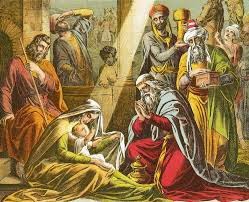
Today, as we celebrate the Epiphany, we celebrate God manifesting Himself (Epiphany means to show forth or manifest) to all the world, represented by the magi.  At Christmas God revealed Himself to the Chosen People, to Israel, represented by Mary, Joseph, and the shepherds.  Now at the Epiphany, God reveals Himself to those were not part of God’s people, the pagans, the Gentiles, the non-Jews.  God allowed the natural world (the star) to guide those who followed the movement of the stars, to lead them to Jesus, Mary, and Joseph.  And there they laid down their gifts at the feet of the newborn King.  Each gift has a meaning.
And that’s part of the beauty of the many verses of the hymn “We Three Kings”: the gifts are explained.  Gold is for a king (“Born a King on Bethlehem’s plain / Gold we bring to crown Him again;”); frankincense is for a God (“Frankincense to offer have I; / Incense owns a Deity nigh;”); myrrh is for burial (“Myrrh is mine; its bitter perfume / Breathes a life of gathering gloom;”).  Even though the magi were not part of the Chosen People, and did not have the revelation of God’s will through the Old Testament, they brought gifts for a King who was God, but who was also going to die.  They recognized Jesus as a King, as God, and as born to die, even when others later on would struggle with one or another of those identities.
But the gifts that we give Jesus tend to reveal more about ourselves than it does about Jesus.  We know who Jesus is.  We know that He was born a king, that He is truly God, and that He was born to die so that we can live.  But in the gifts that we give Jesus, we show Him what we really think about Him, and how much importance we give Him.
Time is definitely a gift that we can give Jesus, and to the extent that we give it to Him, it shows the extent to which we value His friendship.  Some have a habit of walking out after receiving Holy Communion.  While there can be legitimate reasons for this, for most people, waiting an extra 5 or 10 minutes won’t endanger anyone’s life or job.  And yet how many people leave early?  Or how many families, including sometime our Catholic school families, don’t even bother coming?  Yes, giving up an hour does mean that we are giving up doing something else that we might want to do.  But when we choose not to go to Mass (obviously not counting when we are sick, or more than 30 minutes away from a church, or when the weather makes it dangerous to drive), we withhold the gift of our time and attention from Jesus, and tell him that He is not as important as our plans and our will.
Love is also a gift that we can give Jesus.  I think sometimes we feel like an act of love of Jesus has to be profound and wordy.  But we can say it the same way we say it to others: “I love you, Jesus.”  What a beautiful prayer that is!  How many times have you said “I love you” to Jesus?  If you said it as infrequently to your spouse as you do to Jesus, would you still be married?  Even teenagers will throw that word around…a lot!  The girlfriend or boyfriend is loved, even if they have only been dating for a week.  But do we say it to Jesus?  
In a weird way, sin is also a gift that we can give Jesus.  No, this doesn’t mean that Jesus wants you to sin.  But if we do sin, He wants to take that from us, because He wants to take our death that comes from sin, and to give us life that comes from Him.  And the ordinary way of giving Jesus our sins is by going to confession.  Maybe it’s just a few small sins.  Maybe it’s a few big sins.  In either case, Jesus doesn’t want us to carry that burden.  And the ordinary way that He takes away that burden is by going to confession.  That’s the way Jesus established in the Scriptures; that’s the way a Catholic has his or her sins forgiven.  And by giving Jesus even our failings, we show Him that we want Him to have everything from us.  It’s not like Jesus doesn’t know the bad stuff we do, but we can sometimes pretend like all He needs to know about is the good stuff.  We cannot hide from God; we cannot pretend that we have not failed Him, that we have not fallen short of the glory of God.  Give even your sins to Jesus and let Him heal you.  He wants to.  He doesn’t just want your good; He also wants the bad and the ugly.  We shouldn’t try to sin, but when we do sin, give it to Jesus.

Because at the end of the day, Jesus wants all of us.  The gift He wants is of a heart given to Him.  That doesn’t mean we have to become a monk or a nun.  In every form of life, we can give Jesus our all.  And that is the perfect gift for Jesus, the gift that will give joy to His heart, the gift that He’s been waiting to receive.

02 January 2018

Entrusting our Family to God

Feast of the Holy Family of Jesus, Mary and Joseph
Last week my sister and brother-in-law celebrated their 9th wedding anniversary.  I remember the day of their wedding pretty clearly: I wasn’t a priest or even a deacon yet, so I was in charge of cantoring the Mass; there was lots of snow on the ground, but it was about 50 degrees, so it was very foggy; there were 5 priests concelebrating the wedding (including now-Bishop Raica, now-Msgr. Vincke, two priests from the Diocese of Lansing and one from the Archdiocese of Detroit; perks, I guess of having a seminarian for a brother, and a dad who works for a parish in DeWitt).
I also remember, a little more than 5 years ago, when they told us that they were pregnant with their first daughter, Evelyn.  I remember wondering how my mom would take being a grandmother, because, generally, grandma is a word that is associated with those who are a bit more mature (a kind way of saying older), and I wasn’t sure my mom was ready for the very real and public acknowledgment that she was, in fact, more mature.  But, I couldn’t have been more wrong!  My mom was very excited to be a grandmother, and she has loved spending her time with her two granddaughters, my niece Evelyn and my niece and goddaughter Adelaide.
We heard in our first reading and our second reading about Abraham becoming a father with his wife, Sarah, for the first time, at an age which would be described as really mature (that is, really old).  And God fulfills His promise to Abraham through Isaac, who is the beginning of the descendants of Abraham more numerous than the stars in the sky.  Abraham must have wondered if God was going to fulfill His promise, but Abraham trusted in God to be true to His word, and it happened.  And that trust was put to the test when God asked Abraham to sacrifice his son, Isaac.  Of course, God stayed Abraham’s hand before he could complete the sacrifice, but even then, Abraham trusted that God could raise from the dead an heir as we hear in the Letter to the Hebrews.  Of course, the author to the Letter to the Hebrews, traditionally St. Paul, sees in Isaac and Abraham a foreshadowing of Jesus, whose Father, God, did not stay the executioner’s hand, but let His Son be sacrificed so that we could go to heaven.

And that’s where our Gospel comes in.  Even as an infant, being offered to the Lord as the firstborn by the sacrifice of two doves, Jesus’ destiny is set.  Simeon, the just man, awaiting the Messiah, sees Jesus and knows that God has, again, been faithful, in not letting Simeon see death until he saw the Messiah.  But he also prophesies that Mary, Jesus’ mother, will have her heart pierced by sorrow, which is certainly the case when Mary had to watch her own Son die, naked on the cross.  
Children are, more often than not, the fruit of family life.  In fact, in order to be married, you have to be open to children (unless you’re past childbearing age).  It’s one of the goods of marriage, and even for those who are of childbearing age who cannot conceive, adoption is a great way of having children.  In either case, having or adopting a child should be the response to God’s will for a husband and wife.  Look what happened to Abraham when he tried to take God’s promise into his own hand: he and his slave, Hagar, conceived Ishmael (Sarah at first said it was ok, but then mysteriously changed her mind after Abraham started spending a lot of time with Ishmael).  When we try to replace God’s plan with our own plan, it tends to mess things up.  And we know, by what Jesus has said through His Church, that natural conception or adoption are the only good ways to bring a child into the world.  Sometimes, yes, that conception has to be helped by hormone treatments or vitamin supplements.  But when processes like in vitro fertilization are used, or when people decide they have a right to have a child on their terms, and not as part of God’s plan, our relationship with God is damaged by the sinful means or by selfish desires.  Children, no matter how they are conceived, are always blessings.  But we always want to be sure that the way we welcome a new life into a family is according to God’s plan, and not only according to our plan.

Instead, the Lord invites us to entrust our families to Him.  And that goes not only for how to welcome a new child in the family, but even before that.  The Church requires that Catholics get married in a Catholic Church, or get a dispensation from the local bishop from that requirement, because as a new family is formed, the Church wants to make sure that God is a part of that decision and is involved in the life of the new family.  And when that family, by natural conception or adoption, brings a new child into the picture, then the family is also invited to help that child with the life of faith by having the child baptized and living out that faith daily with the child.  This means going to Mass each Sunday (don’t worry if the baby or little child acts up or is noisy; it’s what kids do); praying at home before meals and sometime during the day or night (for me it was usually right before bed); showing unconditional love and forgiveness to the best of our ability; treating others as we want to be treated and as we would treat Jesus.  All of those things go into making a family holy, like the Holy Family of Jesus, Mary, and Joseph.  And that all starts by trusting God, by having faith in God and His plan, just like Abraham did.  We sin, and we mess up, when we take matters into our own hands, as Abraham himself did a few times.  But God invites us to trust in Him always, and so find salvation for ourselves and our families.