Showing posts with label Mark 14. Show all posts

07 June 2021

Charging our Spiritual Batteries

Solemnity of Corpus Christi

    One of the great thing about our technology like phones and Apple watches, is the ability to stay connected while one is on vacation, and eliminate the need for paper plane boarding passes.  However, those devices don’t operate on hopes and dreams.  So now, I don’t only have to pack clothes and toiletries.  Part of my packing protocol now is to make sure that I have both my phone charger and my watch charger.  If I forget the charger, then my phone and watch won’t work, and won’t be any good to me.
    As disciples of Jesus, we need to be charged.  The call to follow Christ in all areas of our life takes a lot of work to die to our fallen selves.  We need to recharge ourselves on a regular basis, or we’ll be spiritually dead.  And the way we do that is through the Eucharist.  The Eucharist is the food that strengthens us for our daily pilgrimage with Christ.  It gives us the spiritual nutrients we need to die to our fallen self and live for Christ.  It is, as we could say, plugging in to the source of our spiritual power.  How often do our young people (and perhaps ourselves) make sure that their iPhone has power so that they can text, chat, gram, and tweet?  But do we take care to make sure that our spiritual batteries are charged, and that we don’t run out of juice?  You cannot be the Catholic that Jesus wants you to be without the Eucharist.  Even with the Eucharist, we can reject Jesus, but without the Eucharist, we have no chance to have the fulness of Divine Life that God wants to communicate to us.
    But into what are we plugging ourselves?  Why is the Eucharist so powerful in helping us to be whom God wants us to be?  Our readings for today’s celebration of Corpus Christi remind us of the most important fact of the Eucharist: that it is the sacrifice.
    In our first reading, we hear about the sacrifice that foreshadowed the sacrifice of Jesus.  The people belong to God and show that they will be faithful to Him by being sprinkled by the blood that was sacrificed “as peace offerings to the Lord.”  Jesus’ perfect sacrifice was truly the peace offering that reconciled us to God as His People. 
    The author of the Letter to the Hebrews also takes up this theme that, while the sacrifices of the Old Covenant could bring some holiness, some sanctification, how much more does the Blood of Christ make us holy?  St. John Chrysostom also said that, if the blood of the Passover lamb could cause the angel of death to Passover the doors of the Chosen People, how much more will the Blood of Christ on our lips keep eternal death away from us?
    As we listened to the Gospel, perhaps we think that we moved away from sacrifice, and went to a meal only.  But the meal that Jesus held was a Passover celebration, a celebration of a sacrifice.  And it is in the context of a sacrifice that Jesus institutes the Eucharist.  Yes, it is in a meal, but in the sacrificial meal of Passover. 
    Jesus knew that we needed a connection to His once-for-all sacrifice, which only one apostle would attend.  And He wanted that connection to last through the centuries, not just for the lifetime of the first apostles.  So Jesus instituted this way that we could always connect to Him, connect to His sacrifice that saved us from sin and death, His sacrifice which reconciled us to God and brought the possibility of peace for all people. 

It is that sacrifice which recharges us, because it is that sacrifice that is the source of all of our power in Christ.  Baptism changes us because of the sacrifice of Christ; we are forgiven in the Sacrament of Penance by the sacrifice of Christ; we are able to receive the Holy Spirit in Confirmation because of the sacrifice of Christ, who said that if He did not leave, we could not receive the Holy Spirit; the anointing of the sick heals us by the sacrifice of Christ; marriage finds its fullest expression and model in the death of the bridegroom from His bride; and the Sacrament of Holy Order exists to connect us to the ministry of Jesus through the work of Jesus’ bishops and priests, as well as Jesus’ service through deacons.  All of our life in Christ goes back to the sacrifice of Jesus.  The meal of the Eucharist means nothing without it being connected to the sacrifice of Jesus. 
    And that is why we have the crucifix behind the altar: because through the Eucharist, the Body and Blood of Christ, we are connected to the sacrifice of Jesus that is before our eyes in the sacred image.  We look upon and remember what is made present for us and what we receive in our mouths as we consume the Eucharist.  And if we receive it in a state of grace, not aware of any mortal sins, then it recharges us; the Eucharist gives us power. 
    Don’t let your spiritual batter run out!  You will not be as effective, and you may even run out of any power to communicate Christ in your daily life.  Keep your soul like you keep your iPhone or Apple Watch: keep it fully charged by worthily receiving the Eucharist at least each week.  You will be charged by the saving sacrifice of Jesus!

29 March 2021

Take a Retreat

Palm Sunday of the Lord’s Passion


    Every year, priests are asked to take a spiritual retreat.  On a merely physical level, it’s an opportunity to “recharge the batteries,” that can be drained by spending himself for his people.  On a spiritual level, it’s an opportunity to deepen his relationship with the Lord, to grow in the Theological virtues of faith, hope, and love.  Jesus Himself invited the Twelve to take a brief retreat in Mark 6:31, when Jesus said, “‘Come away by yourselves to a deserted place and rest a while.’”  Mark notes that there were large numbers of people who had been coming to see Jesus, and the apostles and Jesus were often missing meal time, so they went off in a boat “to a deserted place.” 
    But retreats aren’t only for priests.  The lay faithful, too, are encouraged, to the extent possible, to take a yearly retreat.  Before COVID, our great retreat center in DeWitt offered different tailored retreats to men, women, married couples, and other groups.  As we get through this pandemic you can make sure and check their webpage for upcoming retreat opportunities. 
    But I get that retreats are especially hard for those who are still working and/or who are caring for dependents.  For many Catholics, a retreat is something that they hear about that other people do, but nothing they take advantage of for themselves. 
    So this year, for our upcoming Sacred Triduum–Holy Thursday, Good Friday, and Holy Saturday–I want to encourage you to think about the opportunities for prayer as a chance to retreat, to take some extra time with the Lord.  We’ve added times for prayer, but there’s also the times when the Church is simply open and quiet, when you can come and spend time with Jesus.
    Jesus Himself, as we heard in our Passion Narrative today, took time to pray in the Garden of Gethsemane as He was preparing for His Passion and Death.  He asked St. Peter, “‘Could you not keep watch for one hour?’”  Come to the Mass of the Lord’s Supper at 7 p.m. on Holy Thursday, and pray with Jesus in the Garden of Gethsemane after the Mass.  Pray for the openness to what the Lord wants to share with you during these holy days of the Lord’s Passion.  Sign-up for 30 minutes or and hour to spend with Jesus in our Community Room Gethsemane, which will start after Mass and go until 10 p.m.  Most of that time is simply silent, with the Blessed Sacrament.  But it’s a powerful time to pray and spend with Jesus.
    For Good Friday, we’ll have four opportunities for you to come and spend time with Jesus.  The church will be stripped, and we’ll start with Daytime Prayer, part of the Liturgy of the Hours, the official prayer of the Church, at noon.  Then at 12:30 we’ll continue with Stations of the Cross, the great devotion of walking with Jesus as He walked to Calvary to die for love of us.  It’s then that we can ponder our own crosses, our own falls on the path the God has allowed us to walk.  At 3 p.m., the hour that Jesus died, we’ll recall His Death on the Cross, and venerate the cross that saved us from sin and death.  And then at 8 p.m. Good Friday night, we’ll hear the powerful and sorrowful psalms and readings that point to the price that was paid for our salvation.  And, if any of those exact times don’t work, feel free to come to the church any time between 11:30 a.m. and 4 p.m. to spend time with Jesus.
    Holy Saturday is our day of watching and waiting.  We know the rest of the story, but we put ourselves into the place of the Apostles and faithful disciples who didn’t know what to do after Jesus had died.  We wait in the great silence of the day that Jesus’ Body remained in the Tomb, while His Soul descended to hell, the place of the dead, to rescue to the souls of the just and escort them into heaven.  We’ll have a powerful set of readings at 8:30 a.m., and then bless any Easter food you bring at 12:30 p.m.  On that day of silence, the expectation of what we know will happen that night pushes us to be patient with God’s will as it becomes known to us in our daily lives, especially in the sufferings that we endure, often not seeing the future risings that will come from them.  And then, at 8:30 p.m., we’ll begin our solemn Easter Vigil, the Night of Nights, when sorrow turned to joy, darkness turned to light, and death was conquered by Life Himself. 
    It’s only a three-day retreat, and it’s not the full three days, but you’ll have a great opportunity to take time away with the Lord, to give Him all that is on your heart right now, to rest with Him.  This is a beautiful way that we accompany Jesus during His Passion, doing for Jesus what He does for us in all our sufferings: stay with us, encourage us, pray with us.  Don’t miss out on this opportunity of our Triduum retreat.  Recharge your spiritual batteries; come to be with Jesus; rest with Him.

04 June 2018

How to Receive Jesus

Solemnity of Corpus Christi
Arguably the most popular topic for renaissance painters was the Madonna and Child.  There are more paintings of our Blessed Mother holding her child, Jesus than probably any other saint or person.  In almost all of those paintings, Mary is holding Jesus, and is looking down towards Him with love and wonder.  Probably the most famous statue of the Blessed Mother is the Pietà by
Michelangelo.  Currently housed in a chapel in the Papal Basilica of St. Peter in Vatican City, it shows the Blessed Mother holding the lifeless Body of her Son after He was taken down from the cross.  She is still looking down towards Him, but this time with sorrow on her face.
In both the paintings of Madonna and Child, and the Pietà, Mary’s gaze is towards Jesus.  She is focused on Him.  And as we come to Mass today to celebrate the Most Holy Body and Blood of our Lord, Mary invites us to do the same thing: to gaze towards Jesus.
For cradle Catholics, the Eucharist might seem very familiar, maybe even not a big deal.  But in the Eucharist, the Body and Blood, Soul and Divinity of Jesus Christ, we see the same Jesus that Mary held, and receive Him either on our tongue or in our hands.  It is the biggest deal on earth, and the greatest treasure the Church has.
Jesus, on the night of the Last Supper, that we heard about in the second half of our Gospel passage today, instituted both the ministerial priesthood and the Eucharist, as His way of perpetuating the new Passover, no longer the angel of death passing over the house of the Israelites, but Jesus, the true Passover or Paschal Lamb being sacrificed so that we, His adopted brothers and sisters in baptism, would not have to suffer eternal death.  Each time the Mass is celebrated, Jesus’ one, perfect sacrifice on the cross is made present to us again as we enter the ante-chamber, the narthex, as it were, of the perfect tabernacle in heaven.  That is why, instead of the risen Christ, the crucified Christ should occupy the central place above the Tabernacle in the sanctuary: placed before our eyes in a prominent way should be the mystery of what the Eucharist recalls: the crucifixion.  
But because this re-presentation of Calvary happens so frequently, as Catholics we can forget its power, and forget just how awesome it is to be able to come into the presence of Jesus Christ Himself.  Our posture hopefully helps us to remember.  We kneel during the Eucharistic Prayer, lowering our very bodies in adoration of the miracle of the bread and wine becoming the Body and Blood of Jesus.  Not simply a reminder of Jesus’ Body and Blood, but the same Body that hung on the Cross; the same Blood that was poured out for our salvation in Jesus’ Passion.  We even used to (and people are still allowed to) kneel to receive the Eucharist.  There was something good about this, as it reminded our bodies that we are not worthy, and therefore lowered, before the presence of Jesus.  
Our heavenly patron, Pope St. Pius X, encouraged frequent reception of the Body and Blood of Christ, and in his time, many people would only receive once per year, even though they attended Mass every Sunday.  There was, in his time, an over-exaggerated sense of sin and unworthiness to receive Jesus.  And so it was very important to encourage frequent, worthy reception of the Eucharist.  In our day, we have gone to the other extreme: the Eucharist is something that everyone who comes to Mass gets, even if they are truly unworthy and should not receive.  Only Catholics in a state of grace, that is, not aware of any grave sins, should receive the Eucharist.  Those who skip Mass out of laziness, who have taken the Lord’s Name in vain, who have misused the beautiful gift of human sexuality, or who have lied in a serious way need to go to confession before they receive the Eucharist, otherwise, as St. Paul says, they eat and drink damnation upon themselves for receiving the Eucharist unworthily.  Our venial sins are forgiven by the reception of the Eucharist, but our grave or mortal sins need to be healed before we can receive Holiness Himself in the Sacrament of Sacraments.  Too often the line for the procession for the Eucharist is like a line of a drive thru at a fast food restaurant.  But the line for the Eucharist does not lead us to a Whopper or a Big Mac, but to our Lord, Savior, and Creator, Jesus Christ.

We should take as our model as we approach the Eucharist Mary, the Mother of God.  Mary shows us how to love Jesus in the Eucharist.  Mary shows us how to hold Jesus carefully as a mother with her child, in the Eucharist.  Mary shows us that, to hold Jesus, we should be doing all that we can to say yes to Jesus, and being reconciled with Him in the Sacrament of Penance if we have, in some major way, said no to Him.  As we celebrate Corpus Christi, may we rediscover a profound spirit of wonder and awe in the presence of Jesus, who each day around the world humbles Himself by changing bread and wine into His Body and Blood, Soul and Divinity in the Most Blessed Sacrament of the Eucharist.

26 March 2018

Alone

Palm Sunday of the Lord’s Passion
Our Gospels today relate a circumstance we know all too well: when things are going well and you’re on top of the world, your friends are happy to be with you.  But as soon as things go south, you are all alone.  It’s like when you’re young and you have friends over to your house: they’re happy to be with you to have a good time, but as soon as you hear your parents say your first name followed by your middle name, all the sudden your friends scatter and it’s just you having to face what you know will be at least a stern talking to by your parent.
Jesus enters Jerusalem, as we heard in the Gospel proclaimed at the blessing of palms, with lots of people, cheering Him on.  But when Jesus is arrested, and eventually led away to be crucified, it is only a few friends (by varying accounts the Blessed Mother, St. John the Apostle, St. Mary Magdalen, and a few others) who stand by Jesus.
Death is something that is a part of life which makes us feel alone.  Generally, no one else experiences it with us, even if there are people standing around us at the time of death.  We can never experience death for another person.  As much as we might sympathize, and as much as there are common factors, death will be a unique experience for each one of us.
So it makes sense, as Jesus dies on the cross, that He says, as we heard in today’s psalm, “My God, my God, why have you abandoned me?” Jesus, in His human nature, feels alone, abandoned by God, as He dies.  He experiences everything we do, except without sin, including the individuality of dying.  Of course, for Jesus, death is not part and parcel of His existence.  Jesus is God, the source of life, Life Incarnate, so death is not merely something which makes so little sense, it is the antithesis of who Jesus is.  Of course, God the Father does not truly abandon Jesus at the hour of His death, as Jesus truly takes up His cross, any more than God abandons us when we are faced with the cross.  But Jesus feels like He is alone, as He empties Himself and dies on the cross.
The cross is the other place where we feel alone.  When I say cross here, I’m talking about our suffering, our challenges, especially the ones that touch us at the deepest levels of our human nature.  Whether it’s a big cross or a small cross to outsiders, each cross is heavy to the person carrying it, to the person dying on it.  Carrying the cross, on the cross, is where the person feels alone, abandoned, perhaps even by God.  The cross is the way that we, too, like Jesus, are invited to empty ourselves.  Our pride tells us to hold on to ourselves, to puff up ourselves, but the cross is the great deflator.  
Of course, we don’t have to carry or die on our crosses.  We always have the choice to say no to the cross.  But in saying no to the cross, we say no to the Resurrection.  The cross empties us, as St. Paul talks about in the second reading.  The cross humbles us.  But in emptying us and humbling us, we finally have room for God, who will not leave us empty and debased, but will raise us up, just as He did for Jesus.
Because we are human, our tendency is to run away from the cross.  We are afraid of its weight, and that God will abandon us as we carry it and die on it.  The cross, which is also to say dying to ourselves, is painful.  But it is the only way that we can allow God to raise us up, to conquer our sin and death and give us holiness and life.  And God will not abandon us, even if it feels that way, when we suffer.  

So I invite you not to abandon Jesus, just as He didn’t abandon you.  All this week we have an opportunity to be with Jesus as He suffers, to tell Jesus with our actions that He is not alone.  Come to the Mass of the Lord’s Supper on Thursday night at 7 p.m. as Jesus institutes the Eucharist and the ministerial priesthood, and is arrested in the Garden of Gethsemane.  Come to our Good Friday Liturgy at 2 p.m., as Jesus dies on the cross, and to Tenebrae at 8 p.m., as He is laid in the tomb.  Embrace Jesus’ Passion, Cross, and Death, so that you can share in His Resurrection.

02 April 2012

Hammering in the Nails

Palm Sunday of Passion of the Lord
            We began Holy Week by hearing how Jesus entered triumphantly into His city, Jerusalem.  Shortly afterwards, we recalled in the Gospel how Jesus was then mocked, stripped, and crucified for our salvation.  What a stark contrast in a short amount of time.  What a short time it must have seemed for Jesus between the original Palm Sunday and Good Friday.
            How fickle the crown of God’s creation can be.  How easily swayed we are by excitement…and fear.  With the celebration of the Passover in the background, with tens of thousands of pilgrims coming to Jerusalem, the Jews welcomed Jesus.  With the pressure of the Chief Priests, the Scribes, and the Sadducees, the Jews condemned Jesus for blasphemy.  The King of Glory who entered His capital with shouts of “Hosanna” was made to reign upon the Cross with shouts of “Hail the King of the Jews” in mockery. 
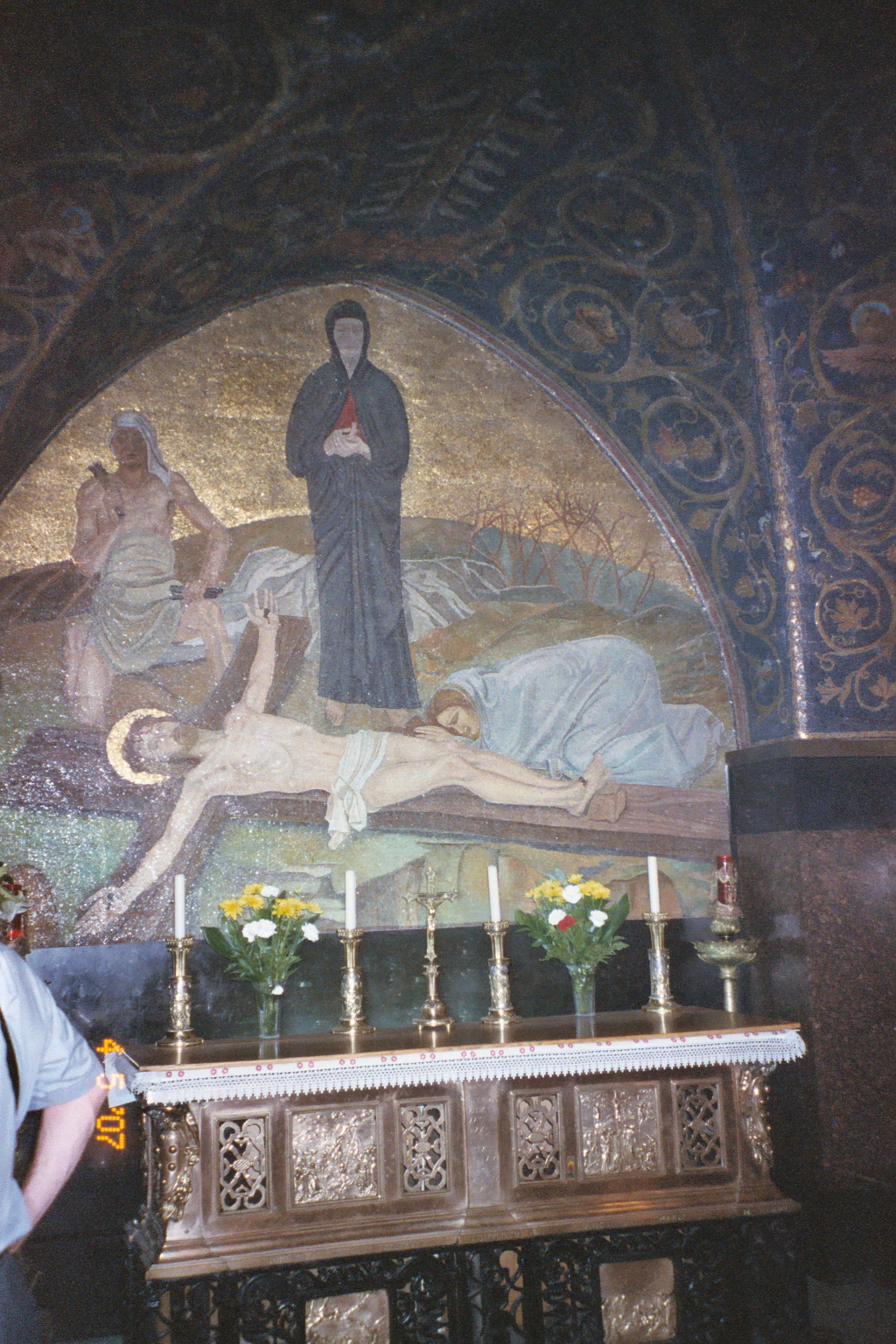
            Because we have become so used to seeing Jesus on the cross in artistic renditions of the crucifix, we can easily become numb to its reality.  Death by crucifixion was a death of suffocation, the lungs filling with fluid, making it harder and harder to breathe.  The only way to get a breath was to use the hands and feet to push oneself up, which only increased the pain where the nails were.  It was a horrible, painful death, filled with shame and derision.
            In the face of such suffering, we can all too easily think that we would never have been part of the crowd crucifying Jesus.  We would not be so easily swayed.  We might even say with St. Peter, “‘Even though all should have their faith shaken, mine will not be.’”  But we would be wrong.  All of us—from Pope Benedict XVI to me and you—have all helped to hammer in those nails into Jesus’ hands and feet.  All of us stand guilty.
            If we lie to another, the hammer falls.  If we swear and curse and take the Lord’s name in vain, the hammer falls.  If we totally ignore the poor standing on the corner; if we make decisions based on prejudice and racism; if we fail to see Christ in those around us, the hammer falls.  If we think first of ourselves and never of others; if we skip Mass because we don’t make time for the Lord; if we react to our parents, children, or family members with anger rather than responding with love, the hammer falls.  If we ignore the Church’s teaching on human sexuality, marriage, and contraception because we feel we’re more enlightened; if we support organizations or ideologies that allow for an innocent child in the womb or an elderly or ill person to be put to death because they are inconvenient to our way of life; if we support the objectification of men and women through pornography, the hammer falls.
            All of us who can make a moral choice have been in that fickle mob that first hailed Jesus on His entry into Jerusalem, and then mocked him by hailing Him on the cross.  All of us have helped hammer in the nails into Jesus’ hands and feet.  All of us have sinned, and fallen short of the glory of God.  We made Jesus cry out from that cross “My God, my God, why have you forsaken me?” as Jesus felt the weight of our sins. 
            Since we have forced Jesus to walk that dark pilgrimage to the crucifixion, let us not abandon Him this week.  Though we ran away with the apostles in the garden 2,000 years ago, let us accompany Jesus this year, this week, these days as the Church celebrates our salvation in Christ: to the upper room on Holy Thursday to celebrate the Last Supper; from the upper room to the Garden of Gethsemane to keep watch in prayer; from Gethsemane to Golgotha on Good Friday; and because death and sin do not have the final word, from Golgotha to the empty tomb for the Easter Vigil or the Easter Sunday Mass.  We began Holy Week today in joy.  Let us also end it in the joy of those who, having repented of their sins and confessed them to the Lord, have been washed clean in the blood of the Lamb.  “Come now, let us set things right, says the Lord: Though your sins be like scarlet, they may become white as snow; Though they be red like crimson, they may become white as wool.”