Showing posts with label Epiphany. Show all posts

05 January 2026

Drawn to Christ and Changed

Epiphany of the Lord

    [In the name of the Father, and of the Son, and of the Holy Spirit.  Amen].  I remember my first time I traveled to Rome, when I was a seminarian in the fall of 2004.  My classmates and I had flown from St. Paul, Minnesota, and arrived in Rome in the morning.  We took a train to Termini (the main train station), and then took the Metro to a stop near the convent we had to stay at because our rooms were not ready yet at the study abroad house.  The convent was just on the other side of Bernini’s colonnade at the Basilica of St. Peter.  I remember walking up the Via della Conciliazione and being amazed at the magnitude and beauty of St. Peter’s.  I thought the US Congress building was large; St. Peter’s is so much larger!  And then I walked inside, and though so exhausted from jet lag that I would soon start falling asleep while standing during the Gospel at Mass inside St. Peter, its beauty forever changed me in recognizing just what man could do to honor God and the saints.
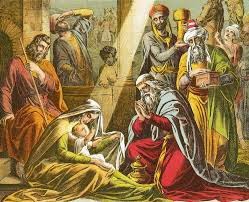
    In many ways the Solemnity of the Epiphany also follows a similar pattern, at least with the wise men.  They are drawn to a far-off land, perhaps a land they had never seen before.  But when they actually encounter the goal of their journey, the young King of the Jews, they are not the same.  The Gospel relates that an angel warned them not to return to their country by the same way because of King Herod, but encountering Christ also made them go back not just on a different road, but changed.  
    Hopefully this rings true for us as well.  Christ always draws us closer to Himself.  Whether we are baptized as an infant and grow up in the Catholic faith, or whether we joined the Church as an adult, Christ draws us to Himself.  He drew the Magi by a star, because that is how they would come.  When Christ calls us, He does it through means that, more often than not, appeal to our natural predispositions.  Maybe we’re hurting and we recognize in Christ a source of healing.  Maybe we’re looking for meaning and we recognize in Christ a way of life that will satisfy us.  Maybe we’re reaching out for something greater to whom we can pledge our life, and we recognize in Christ the God who is worthy of all our loyalty and dedication.  Whatever way it is, Christ calls us to Himself.  And He often does it through means that we can accept.
    But this draw also continues throughout our life.  Accepting Christ means a great deal, but it’s not a once-and-done encounter.  Each day, each week, each month, each year Christ wants to draw us closer.  Until we get to heaven, we can always grow closer to Christ.  And the closer we get, the easier and harder it is.  Easier, because we have a solid foundation and at least can intellectually know that God will truly satisfy every need in our life.  Harder, because we sometimes have to walk away from things that also delight us, however less, and sometimes it is hard to let go.  But no matter how much we accept, or how much we delay and hedge our bets, Christ always calls us closer to Himself.
    When we have encountered Christ, whether for the first time or for the myriad of times after that, the encounter should change us.  Change is easier to note when it comes to monumental moments in our life, like when we were baptized or confirmed.  Whether we felt it or not, the power of the sacrament changed us from a pagan to a Christian (baptism), or from a mere follower to a soldier of Christ and proclaimer of the Gospel (confirmation).  Ontologically, which means at the level our being, God changed us.
    But we don’t always experience that change in our day-to-day life.  Even when it comes to the Most Blessed Sacrament of the Eucharist, which we receive at Mass, we don’t always recognize the change it has in us.  That can either be because it’s hard to notice little changes day by day, or because of lack of fruitfulness, which means that, while the Eucharist wants to change us, we’re putting up some sort of block because of our sins or our will that does not allow the change that God wants to affect in us.  God never forces His grace on us, so if we don’t want to accept the change that He wants in us, it will not happen.  
    But we can also experience God through means other than the sacraments, like daily prayer, reading Scripture, serving the poor, etc.  And sometimes we notice the change, but sometimes we don’t.  Sometimes we notice the change after months of our sacramental or devotional practices, like a virtue exhibited when earlier we would have given in to vice.  Patience is not a virtue at which I always excel.  I have noticed some growth though, and can appreciate it when I notice that earlier I would have chewed someone’s head off for some stupid thing, but now I’m more understanding.  I’m still growing, and wouldn’t call myself a paragon of patience, but I have noticed growth that has happened since I started working on being more patient.  
    Like the Magi, God draws us closer to Himself, not just once, but each day.  Like the Magi, God doesn’t want us to return to the same sinful habits and patterns, or even simply the same way of life that we lived before drawing closer to Him.  God leads us down a different road, even when it’s within the same vocation.  Follow Christ, the Morning Star each day, and allow your encounter with Him to change you, so that the glory of the Lord can shine upon you[: the Father, and the Son, and the Holy Spirit.  Amen].

06 January 2025

The Light

Solemnity of the Epiphany of the Lord
    [In the name of the Father, and of the Son, and of the Holy Spirit.  Amen.]  Probably most of the time when we think of the Epiphany, we think about giving gifts, especially the gifts that the magi gave to Christ: gold, frankincense, and myrrh.  In some countries, Epiphany is the day that people exchange gifts more than Christmas.  And the Christmas carol, “The Twelve Days of Christmas” are actually about the twelve days after Christmas, and sing about giving gifts leading up the Epiphany.  

    And focusing on gifts at the Epiphany is well and good.  However, there is another aspect to the Epiphany that we probably miss: the theme of light.  The word epiphany finds its root in the Greek word πœ™π›Όπœ„πœˆπœ”, which means to reveal or to shine.  We hear it in John 1:5 [every Sunday]: “the light shines (πœ™π›Όπœ„πœˆπœ€πœ„) in the darkness.”  We hear it in Isaiah, chapter sixty, our (first) reading: “the glory of the Lord shines upon you.”  And the star that the magi follow shines upon the place where they could find the King of the Jews.  We hear it in the Collect, the opening prayer: “O God, who on this day revealed your Only Begotten Son to the nations by the guidance of a star.”  Light is as big a part of this day as giving gifts.
    And as we think of Christ as He reveals Himself as the Light of the World, we see the light growing.  Think of Christ like a candle: first it was simply one light.  As the Blessed Virgin Mary conceived Him in her virginal womb at the Annunciation, her candle was lit.  As Elizabeth and St. John the Baptist in her womb recognized the Lord at the Visitation, their candles were lit.  At the Nativity, the angels shared the light of Christ with the shepherds.  And now, as the magi come to visit, seeking by the light of a star the new born King of the Jews, they receive the light of Christ, and then take it back with them to the east, whence they came.  
    The light allows us to see well.  So light is connected with truth, which helps us understand the way the world works.  When we know the truth, we speak of being enlightened.  And besides the visit of the magi, the Epiphany also celebrates Christ shining during His baptism as well as at the wedding at Cana.  In these three events, others come to know the truth that Jesus is no mere mortal: the magi as they bring their gifts of gold for a king, frankincense for God, and myrrh for one who is to be buried; the people at the River Jordan as the Holy Spirit descends and the voice of the Father is heard; the disciples and servants as they realize that Christ has changed water into wine.  Pope St. John Paul II, wrote an Encyclical called Veritatis Splendor, the splendor (or illumination) of the truth, which is also a definition of beauty.  
    So for us today, Christ invites us to receive His light.  When we are baptized, the priest lights a candle from the Paschal Candle, the candle that represents Christ, and are invited to walk in the light.  Christ shares His light with us, as He did with the Blessed Mother, St. Elizabeth and St. John the Baptist, the shepherds, the magi, and the Apostles and disciples.  “The light shines in the darkness,” and with each person who chooses to live in the light, in the truth that God has revealed through His Church, more people see more clearly how true happiness can be found.  
    It is like at the Easter Vigil, at the beginning rites called the lucenarium, the ritual of light.  At first the Paschal Candle alone shines in the darkness of the church.  Then the priest lights his candle from the Christ Light.  Then the rest of the people begin to receive the light, until the entire church shines with the light of Christ that He has shared with others, one by one.
    Our Lord tells us that people don’t light candles to put them under a bushel basket.  So we should not hide the light that Christ has given to us.  Christ invites us to share that light with others.  He gives us grace, a form of His life and light, to allow us to live holy lives and follow Him.  But He also wants us to share that grace with others by the way we speak to them and the way we treat them.  King Herod remained in darkness because He feared the Lord as a threat to his earthly power.  Herod plunged himself deeper in darkness as he tried to snuff out the Light of Christ as young child and killed numerous innocent children, which we celebrated on 28 December.  When we don’t live as a disciple, especially when we commit mortal sins, we also go deeper and deeper into darkness.
    Instead, though, Christ invites us to love others in word and deed, and to share the Gospel with them in word and deed.  Maybe it’s a donation made to a food pantry, or, even better, time actually spent with the poor at a food pantry, serving them food and talking with them as we would talk to Christ.  Maybe it’s hugging a person who had a rough day.  Maybe it’s asking someone to pray with them after they tell us about a family member who has gone on the wrong path, or a scary medical procedure, or even just when they are tired of doing their job.  Maybe it’s inviting a person to come to Mass with you, or sharing an important Gospel passage that helps you to make sense of life.  In these ways and more, we take the light that Christ gave to us at our baptism, and we share it with others.  Sometimes the other person won’t be accepting of the light of Christ, or their light will blow out due to the winds of fear, pride, or error, but at least we did our best to share it with them, and maybe it will take a few times for the light to catch, like it sometimes takes a few strikes before a match begins to burn.  
    So as we celebrate Epiphany, may we remember and put into practice the words of our Lord from the Gospel: your light must shine before others, that they may see your good deeds and glorify your heavenly Father, who with the Son and the Holy Spirit is God, for ever and ever.  Amen.

15 January 2024

An Ordinary Epiphany

Second Sunday after Epiphany
    In the name of the Father, and of the Son, and of the Holy Spirit.  Amen.  If you were to ponder or ask which Gospels are the most radical, would this passage come to our mind?  I’m guessing not.  We might think of the cleansing of the temple; or maybe the denunciation of the Pharisees and scribes as a brood of vipers; or maybe even the miracle of the feeding of the five thousand, or the raising of Lazarus from the dead; certainly the crucifixion.  But the miracle at the wedding at Cana? 
    There is something radical, or rooted, in this Gospel passage that we probably most often fail to see.  And it’s connected to Christmas and the Epiphany (the Epiphany, remember, historically celebrates the visit of the Magi, the Baptism of the Lord, and the wedding at Cana: the three manifestations of Christ).  At Christmas, the God of all creation, whom the heavens and the earth cannot contain, we saw in a tiny baby.  The God who created time allowed Himself to be subject to time.  God manifested Himself in a very ordinary way.

Church at Cana in Galilee
   And at the wedding at Cana, our Lord manifested Himself in a very ordinary way.  He helped out a couple who had run out of wine by changing water into wine.  You can imagine someone who didn’t know Christ sitting down to talk to Him, listening to the Gospel, and the circling back to say something like, “So you have the power to make blind people see?”  “Yes.”  “And you can heal leprosy?”  “Yes.”  “And you can multiple five loaves of bread and two fish so that it’s enough to feed five thousand people and have leftovers?”  “Yes.”  “And you can raise people from the dead?”  “Yes.”  “And you chose, as your first miracle, as the first thing you would do to show your divinity, that you would change water into wine?”  “Yes.” 
    That is pretty incredible.  With all that Christ could do, His first revealing action was to take care of a basic party foul.  He created light from nothing; He separated day from night; He separated land from the seas; He created vegetation, fish, and animals; He created man from the earth and woman from the side of man; He created the universe out of nothing.  And He changes water into wine.  That is incredible! 
    But our God so often works in the ordinary, in the mundane, in the unexceptional.  Look at Abraham.  Yes, he was fairly wealthy with all his flocks, but he and Sarah had no children (at least at first).  Yet God chose Abraham to become the father of many nations.  The Israelites were literal slaves, and yet God chose them as His People, peculiarly His own, as Deuteronomy says.  David was a shepherd, yet he was chosen to be king of God’s People.  The Blessed Virgin Mary, a young, unknown girl, but became the Mother of God.  Bethlehem, least of the cities of Judah, became the birth place of the Messiah.  The twelve apostles were generally uneducated or unappreciated men, yet became the foundation of the Church.  So if we really understood God, the miracle at Cana wouldn’t actually be that shocking.
    And it also shouldn’t shock us that God continues to operate this way.  God so often operates in the everyday realities.  He still so often chooses the least powerful to demonstrate His glory.  Yes, there are times, like Mount Tabor and the Resurrection, where His glory and His power shine forth.  But those were two times in His three-year public ministry.  The rest were among the poor, the outcast, and the simple.
    Do we have eyes to see how God is working in our life?  Or are we looking for the wrong thing?  Are we looking for a Mount Tabor when we should be looking for a blind man on whose eyes our Lord puts mud made from his saliva?  Are we looking for glory on a mountain when our Lord is walking next to us through a field?  If we only seek God in the grandiose moments, then we’re missing the ways that He manifests Himself in everyday life.  In the embrace of a loved one; in the smile of a baby; in the unexpected good news; in the delight of a good glass of wine. 
    When we notice God in the ordinary, we tend to live more grateful lives, conscious of how God is working, rather than wondering why God never does anything for us.  Even something as simple as living becomes a moment to give thanks, because without God willing each of us, individually, to be alive, we would cease to exist.  He who keeps our solar system aligned just so, also feels that it’s important that you exist.  So often we can think of God setting things in motion and then letting them go their way.  But perhaps a more accurate view is that, at each nanosecond, God is willing each and every thing, animate and inanimate, into existence out of the joy of having something that He created continue in being.  That certainly would help us live that gift of the spirit of wonder and awe in the presence of God.  I can barely chew gum and walk at the same time.  God at each moment wills every thing in existence and ensures the functioning of its properties according to His divine will.  And He does so out of love and with joy, not begrudgingly, as we so often do when we have a task at work to which we don’t look forward. 
    The miracle at the wedding of Cana manifests God.  We have an epiphany of the divinity of Christ.  And yet, we also have an epiphany of how God so often works: not only in the big moments of power and grandeur, but even the daily humdrum needs and desires of life.  Perhaps recognizing all that God does for us at each fraction of a moment can help us be obedient to the command of Mary, “Do whatever he tells you”: the Father, and the Son, and the Holy Spirit.  Amen.

08 January 2024

Prayer over the Offerings

Solemnity of the Epiphany of the Lord
    When people talk about preparing for Mass, they often speak of getting dressed with better clothes than usual, brushing teeth, combing or brushing hair, maybe the ladies putting on make-up, maybe guys using that button-up shirt and maybe even a tie.  Or sometimes they mean looking at the readings ahead of time, which can be found at the Daily Readings tab of the usccb.org website.  Rarely do people look over the prayers that are said at Mass before they attend the Mass, but this is also a good way to prepare, as the prayers are usually based on saying from the Church Fathers, and often are poetic and filled with rich imagery.
    I want to focus today on the Prayer over the Offerings for the Solemnity of the Epiphany, which we celebrate tonight/today.  For this ancient feast, there are different prayers for the day before than for the day itself, and I want to focus on the Prayer over the Offerings for the actual day of Epiphany.  The prayer reads: “Look with favor, Lord, we pray, / on these gifts of your Church, / in which are offered now not gold or frankincense or myrrh, / but he who by them is proclaimed, / sacrificed and received, Jesus Christ. / Who lives and reigns for ever and ever.”  You will hear me chant that prayer after the altar is prepared for the celebration of the Eucharist.  It is the same prayer from the pre-Conciliar Mass, and I would guess the prayer likely is quite old, much older than even the 1570 Missal that Pope St. Pius V promulgated as a result of the Council of Trent.
    But what does the prayer say?  It is poetic, but what about the meaning?  It starts by talking about the gifts of God’s church, and asks God to receive them favorably.  Those gifts are the same gifts the Church has used since the Lord instituted the Eucharist on Holy Thursday at the Last Supper: bread and wine.  And it compares those gifts to the gifts we heard about in the Gospel: gold, frankincense, and myrrh.  But it talks about how these gifts are not the same gifts of the Magi, but rather, Jesus Christ Himself, who “is proclaimed, sacrificed and received.”  It looks forward to the purpose of the presentation of these gifts of bread and wine, their transformation or transubstantiation into the Body and Blood of Jesus Christ.  It reminds us that what we offer here is not only our gifts, like the gifts of the Magi, but the gift of Christ Himself to the Father, the very offering of His life on the Cross, which is made present for us in an unbloody manner through the Most Holy Sacrament of the Eucharist.  It’s as if we being catapulted through different scenes from the Gospel: first the adoration of the Magi when Jesus was little, to the Last Supper, to the Crucifixion. 
    But it goes even deeper than that.  Because our gifts of bread and wine are meant to represent something much more precious: the gift of our very selves.  Christ is our model, and He offered His entire self to the Father, even to the shedding of His Precious Blood.  He did not hold anything back.  So we, who claim to follow Him, are meant to offer all of who we are, not so much right now in the shedding of our blood, but if the pouring out of all that has happened in our life since the last time we went to Mass like a libation, a liquid offering.  We put on that bread the credit card bill that’s due with all the charges for a Christmas dinner with the family and Christmas presents; we place the joy of conceiving a new child; the concern for an infirm family member; the sorrow of a death at what is usually such a joyous time of year; the excitement of a new job or new opportunities; the extended time spent while on vacation with the kids; the relief of sending the kids back to school.  All of that and more, really our very selves, are supposed to be united to the bread and the wine spiritually.

    And this is the gift that Jesus wants.  Sure, the gold represents Christ’s kingly identity; the frankincense His divinity; the myrrh His Death.  But Christ still wants to receive gifts from us even if we don’t have those items to offer up.  He wants us to offer ourselves, united with Him, to the Father, and to receive, like Him, new life back from the Father who never lets us remain empty-handed.  The Father transforms whatever we give Him, and returns it back to us as a vehicle of grace, a chance to grow closer to Him, which is our ultimate happiness.
    All of that, and more, from a prayer that is six lines and forty-three words long.  How often do we miss those words, not just on the Epiphany, but each Sunday, because we haven’t truly prepared ourselves for Mass?  We miss the poetry, the connections, the deeper meaning of these very deep prayers that the Church has perfected over two millennia of encounters with God. 
    Perhaps this week you can give God a little more of your time and attention.  Perhaps this week, maybe on Saturday morning or even before that, you can look ahead and try to see what the prayers for the Mass are.  Or even if you can’t do it ahead of time, to accustom yourself to paying close attention to the prayers that are said during the Mass.  Offer to God that aspect of yourself, that time of preparation, and be prepared for God to enrich your life even more than you thought, because God will not be outdone in generosity.

04 January 2021

Follow the Light

 Solemnity of the Epiphany of the Lord


    One of the great images of the Epiphany is the star.  And sometime in the fall of last year, we heard that the conjunction of Jupiter and Saturn, which some postulate was the “star” of Bethlehem and led the magi to the Holy Family, was going to be visible on 21 December.  This was a seeming bright spot in a very dark year, and many people were excited to be able to see this celestial phenomenon, which one could even do while being social-distanced.  But, just to make 2020 feel even more 2020ish here in Flint, it was, of course, cloudy.  Lucky for them, the magi weren’t trying to find the newborn king in Michigan, because our usual cloudiness during this time of year would’ve made that nearly impossible!
    Because we’ve heard the story so often, we probably gloss over what the magi, the wise men, went through to find the Christ Child.  They were likely from modern-day Iran, a foreign land, which was not a friend of Israel or the west.  It was the Babylonians (in modern-day Iraq) who had conquered and exiled the Jews from the Chosen Land.  After the Persians took over the Babylonian Empire, they were not always friendly to others around them.  Recall that King Leonidas of Sparta at the Battle of Thermopylae fought against the Persians, some 500 or so years before Jesus was born.  The Persians (now referred to as Parthians) had kicked Rome out of Judea in 40 BC, but the Romans had regained control in 37 BC, and held it until centuries later.  All of this is to say, they were foreigners, and probably not necessarily welcome visitors.  In fact, it was a Herod who had helped the Romans to kick the Parthians out of Judea.
    Depending on where the magi came from, they may have traveled upwards of 700 or more miles, perhaps from Babylon, a great center of learning that the Persians took over from the Babylonians.  That’s 700 miles, and assuming the camel was carrying them and the supplies at about 3 mph, and traveling for maybe half a day (taking time to rest and eat), it would have been more than 20 days of travel, if everything went well.  It’s clear from the fact that they go to see Herod first that they were not exactly sure where this newborn king was supposed to be.  But Herod, after asking the chief priests and scribes, informs the magi that it will be in Bethlehem, which is about 5 miles away from Jerusalem by foot.  All that way, to see a little child, in the home of a carpenter and his wife, probably not much to speak of.  But they were guided by the light of the star, and they adapted their lives around that light because of the importance it had for them.
    Isaiah prophesies in our first reading that Jerusalem’s light has come, the glory of the Lord shines upon it.  While the world is in darkness and clouds, the Lord shines upon His people,  and even other nations shall be guided by that light from the Lord (a foreshadowing of the magi, those from other nations, coming to see the Lord Jesus).  The light of the Lord was to allow the Chosen People to see clearly, to not trip over obstacles, or lose their way.  
    That’s what the Lord wants to be for us, as well.  He wants to be the one who guides our way, who helps us to see clearly, who gives us the ability to avoid obstacles that will hurt us or wrong paths that will not take us to our destination.  Is He that light for us, or have we allowed clouds to cover up that light?
    The magi, for a king that they would see only for a short time, traveled some 700 miles.  They likely left behind family and friends to bring fine gifts to an unknown child.  They risked much for someone who wasn’t even part of their religion, but whom, they knew, they had to see.  How much effort do we put into seeing Jesus?  Which lights guide us, and where do they lead?
    God wants to be the light in our life.  Jesus will refer to Himself as the Light of the World.  Light allows us to see and interact with the world.  Are we guided by the light of Christ, or by other lights?  Jesus reveals to us how the world truly is, and where we want to go.  But how often do we find other paths, or prefer to stumble around in the dark?  
    I think that many people know what God wants them to do; they understand Jesus’ teaching; but their will is not in relationship with Jesus; they are not willing to follow that star.  Following the will of God is sometimes very difficult, because, like Herod, the world or even simply our fallen will would rather be in charge, and doesn’t want competition.  It seeks to snuff out the light, or to present us with other, dimmer lights that are pale reflections of the true light and do not lead us where we want to go.  We prefer our way to God’s way.  We bristle, especially now, at any institution which tells us how to live our life, as if guidance means that we lose control.  We prefer to stumble in darkness, and are then surprised when it hurts.  We follow lesser lights to places we are not meant to go, and then are shocked that we can’t find happiness.
    The life of a Catholic is meant to be a life that follows a star, the Morning Star, Jesus Christ, in everything.  God, through His Son Jesus, and the one Church that Jesus founded, the Catholic Church, reveals to us what we are to believe and how we are to live in order to be happy.  Sometimes that means that we have to give up things that we desire, or things that others, sometimes many others, say will make us happy.  Sometimes it means that, while the rest of the world goes one way, we go another.  It means when we come to significant or major decisions, we take them to prayer and evaluate them by Scripture and the teachings of the Church, not just think about them and decide what we want to do.  
    The magi followed a star to a foreign country to briefly see a king from a different religion.  For us who claim to follow Jesus, to belong to the religion He founded, are we willing to follow Him, our Star?  Are we willing to conform our life to Him in order to find the happiness we all desire?

06 January 2018

A Gift for Jesus

Solemnity of the Epiphany of the Lord
I am not the greatest gift giver.  I try; I really do.  I try to think what my parents, sisters, nieces, and friends would like to get, especially for Christmas.  But I never seem to have the knack of getting something that they really want, unless, of course, I’ve already asked them what they want.  I don’t beat myself up too much for needing to ask what my nieces want; I don’t see them too often, and I’m not quite in touch with what 2 and 5 year girls like.  
On Christmas, we celebrated the greatest gift ever: Jesus Christ, God-made-man, God-with-us.  At Christmas we usually give gifts, and it’s fitting that we try to imitate God’s generosity, though His generosity can never be outdone.  God gave us the possibility of eternal salvation when heaven and earth were joined in Jesus, the Word made flesh.  And throughout the Christmas season we have probably treasured our gifts, maybe used them, and maybe we think of the person who gave us those gifts when we do use them.
Today, as we celebrate the Epiphany, we celebrate God manifesting Himself (Epiphany means to show forth or manifest) to all the world, represented by the magi.  At Christmas God revealed Himself to the Chosen People, to Israel, represented by Mary, Joseph, and the shepherds.  Now at the Epiphany, God reveals Himself to those were not part of God’s people, the pagans, the Gentiles, the non-Jews.  God allowed the natural world (the star) to guide those who followed the movement of the stars, to lead them to Jesus, Mary, and Joseph.  And there they laid down their gifts at the feet of the newborn King.  Each gift has a meaning.
And that’s part of the beauty of the many verses of the hymn “We Three Kings”: the gifts are explained.  Gold is for a king (“Born a King on Bethlehem’s plain / Gold we bring to crown Him again;”); frankincense is for a God (“Frankincense to offer have I; / Incense owns a Deity nigh;”); myrrh is for burial (“Myrrh is mine; its bitter perfume / Breathes a life of gathering gloom;”).  Even though the magi were not part of the Chosen People, and did not have the revelation of God’s will through the Old Testament, they brought gifts for a King who was God, but who was also going to die.  They recognized Jesus as a King, as God, and as born to die, even when others later on would struggle with one or another of those identities.
But the gifts that we give Jesus tend to reveal more about ourselves than it does about Jesus.  We know who Jesus is.  We know that He was born a king, that He is truly God, and that He was born to die so that we can live.  But in the gifts that we give Jesus, we show Him what we really think about Him, and how much importance we give Him.
Time is definitely a gift that we can give Jesus, and to the extent that we give it to Him, it shows the extent to which we value His friendship.  Some have a habit of walking out after receiving Holy Communion.  While there can be legitimate reasons for this, for most people, waiting an extra 5 or 10 minutes won’t endanger anyone’s life or job.  And yet how many people leave early?  Or how many families, including sometime our Catholic school families, don’t even bother coming?  Yes, giving up an hour does mean that we are giving up doing something else that we might want to do.  But when we choose not to go to Mass (obviously not counting when we are sick, or more than 30 minutes away from a church, or when the weather makes it dangerous to drive), we withhold the gift of our time and attention from Jesus, and tell him that He is not as important as our plans and our will.
Love is also a gift that we can give Jesus.  I think sometimes we feel like an act of love of Jesus has to be profound and wordy.  But we can say it the same way we say it to others: “I love you, Jesus.”  What a beautiful prayer that is!  How many times have you said “I love you” to Jesus?  If you said it as infrequently to your spouse as you do to Jesus, would you still be married?  Even teenagers will throw that word around…a lot!  The girlfriend or boyfriend is loved, even if they have only been dating for a week.  But do we say it to Jesus?  
In a weird way, sin is also a gift that we can give Jesus.  No, this doesn’t mean that Jesus wants you to sin.  But if we do sin, He wants to take that from us, because He wants to take our death that comes from sin, and to give us life that comes from Him.  And the ordinary way of giving Jesus our sins is by going to confession.  Maybe it’s just a few small sins.  Maybe it’s a few big sins.  In either case, Jesus doesn’t want us to carry that burden.  And the ordinary way that He takes away that burden is by going to confession.  That’s the way Jesus established in the Scriptures; that’s the way a Catholic has his or her sins forgiven.  And by giving Jesus even our failings, we show Him that we want Him to have everything from us.  It’s not like Jesus doesn’t know the bad stuff we do, but we can sometimes pretend like all He needs to know about is the good stuff.  We cannot hide from God; we cannot pretend that we have not failed Him, that we have not fallen short of the glory of God.  Give even your sins to Jesus and let Him heal you.  He wants to.  He doesn’t just want your good; He also wants the bad and the ugly.  We shouldn’t try to sin, but when we do sin, give it to Jesus.

Because at the end of the day, Jesus wants all of us.  The gift He wants is of a heart given to Him.  That doesn’t mean we have to become a monk or a nun.  In every form of life, we can give Jesus our all.  And that is the perfect gift for Jesus, the gift that will give joy to His heart, the gift that He’s been waiting to receive.

07 January 2016

Two Sets of Kings

Solemnity of the Epiphany 
When we think about the Epiphany, which we celebrate today in this country, we probably think about the Three Magi, or Three Kings.  We hard about them in the Gospel today searching for Jesus, the “‘newborn king of the Jews’” and how they presented their gifts of gold, frankincense, and myrrh to Jesus: gold for a king, frankincense for God, and myrrh for burial.  The Scriptures don’t actually say there were three, but we presume that each magi brought one gift, and that there weren’t other kings who arrived empty-handed.
We’ve likely heard tons of homilies about how we should bring our gifts to Jesus, and how wise men (and women) still seek him, and the like.  So as I prepared my homily, I was trying to think of a different homily other than the usual one we hear on the Epiphany each year.  I even looked back at last year’s homily, where I preached about how the word Epiphany means to show off, and how God shows Himself off, but without bragging, and how we are also called to show off Jesus.  And as I was preparing, my heart was leading me to speak about the Magi.  But then it struck me: the Magi were not the only kings searching for Jesus.
I have never really focused on it before, though I have heard this Gospel at least 32 times, but there are two sets of kings looking for Jesus.  One is the Magi, following the star.  The other is King Herod, who wants to follow the Magi, but not to do Jesus homage, as he stated.  On the one hand we have people trying to find Jesus to honor Him.  On the other hand, we have people trying to find Jesus to kill Him.  The Magi bring their gifts to Jesus to honor who He is.  Herod brings the sword to kill Jesus because Herod is afraid of who Jesus is.  The Magi can see God’s design even in the stars, and are open to how God is communicating, though they are not Jews.  Herod has to ask the chief priests and the scribes where the king of the Jews would be born, and is not aware of God’s Holy Word which reveals that Jesus would be born in Bethlehem.  There are two very different searches going on
Th same is true today.  There are those who seek Jesus because they believe He is the King of Kings, and the answer to all their troubles.  There are those who seek Jesus in disdain because Jesus ruins all the “fun” they want to have and He threatens the way of life they prefer.  There are those who see with the eye of faith and notice how Jesus is the answer to the deepest longings of their hearts.  There are those who try to find ways to disprove Jesus’ teachings and find examples of how His disciples don’t live Jesus’ teachings out.  There are those who run to Jesus to obtain mercy.  There are those who run to Jesus and condemn Him for all the troubles in the world.
If Jesus is who He says He is, then gold, frankincense, and myrrh are the smallest gifts that we can give Jesus.  If Jesus truly is God and Man and rivals to humanity what it means to be human, then our response cannot be anything other than trying to change our life to follow Him.  Those who believe Jesus find in Him a new way to live, not just as a set of rules, but as a relationship with a person who prepares them for heaven.
But others, feeling that same tug at their hearts to change their lives, are more like King Herod, and fear what Jesus will take away from them.  They are worried that the change which Jesus requires for His disciples will diminish who they are, what they can do, and the joy that they will find.  They seek to put to death anything which threatens the reigns of their own ego, and will search for ways to discredit Jesus and His life as much as possible.

If we’re truly honest, we’re a mix of the two.  At times we are convinced by the Gospel and we want to be more like Jesus.  At other times we are afraid that Jesus will take away from us something that we need, and we do not trust Him.  May this celebration of the Epiphany, and our reception of the Body and Blood of Jesus in the Eucharist, make us less like King Herod who feared Jesus’ reign and sought to end it, and more like the Magi, who honored Jesus and brought Him gifts that represented so much more.  May we seek after Jesus, who wants to be found by us, so that we can give Him the gift of our very life.

13 January 2015

Show Off

Epiphany of the Lord
Being a show-off is not a good thing.  Doing something just to grab attention to yourself for some talent that you have is not something for which people usually praise you.  But today is the exception to the rule.  Today, the Lord is a show-off, or rather, is shown off, as we celebrate the Solemnity of the Epiphany of the Lord.  In fact, the very word epiphany comes from two Greek words (epi and phanos) which is most commonly translated as to reveal or to manifest, but could also be translated as to show off.  
The Epiphany celebrates three times that God showed Himself off.  We’re all familiar with the first one: when Jesus revealed Himself to the Magi, the three Wise Men, who came from the East and presented Jesus with gifts of gold, frankincense, and myrrh.  This is what we usually associate with this celebration.  But the Epiphany also celebrates when Jesus manifested Himself at the Wedding at Cana, where He turned water into wine, as well as the manifestation of Jesus in His Baptism in the Jordan River.  That last aspect our Western Church focuses on in a special way next Sunday on the Feast of the Baptism of the Lord, but in the Eastern Church, where this feast originated, all three were celebrated.
But notice that when Jesus shows off, it is not a matter of bragging, as is often the case when we show off.  When Jesus shows off, something else points to Him and makes His presence known.  When we talk about Jesus showing off to the Wise Men, it was really the star that pointed out the newborn King of the Jews.  Jesus, Mary, and Joseph didn’t go through the streets proclaiming Jesus as the new monarch of Israel.  The Magi had to follow the star, and when it finally came to rest, they recognized Jesus as the King of Kings, though He was in such a lowly circumstance.  When we talk about Jesus showing off at His Baptism, it is not Jesus who says, “I am the Beloved Son of God; listen to me!”  Instead, the Holy Spirit descends like a dove over Jesus, and the voice of God the Father is heard from the heavens declaring that Jesus is the Beloved Son of God and that we ought to listen to Him.  When we talk about Jesus showing off at the Wedding at Cana, it is not Jesus who says, “look what I can do!”  It is Mary, the Mother of God, who tells the servants, “Do whatever He tells you.”  When Jesus reveals who He is, He never does so on His own to draw attention to Himself.  Rather, He lets His heavenly Father and his Blessed Mother make Him known to others.  Jesus is not an attention junkie.
The question for us is whether or not we make Jesus known.  If Jesus doesn’t really bring attention to Himself, but lets others draw people into knowing who He is, then it is our responsibility to show off Jesus.  We are called to be like the star, or the voice of the Father, or the Blessed Mother, in helping others know who Jesus is.  We are called to be the evangelists, the ones who spread the Good News about who Jesus is.  We are called to help others to know that their mundane life, full of suffering and sorrow, is not all there is, but that God has so much more planned for them, even if none of their earthly circumstances change.  An unemployed person without Jesus can become bitter, despondent, and melancholic because nothing is going right for that person in helping him or her to provide for self or family.  An unemployed person with Jesus still may not have a job, but knows that God is in charge, and that, if the person continues to turn to God and offer those sufferings to Him, that something will happen for the betterment of that person.  A sick person without Jesus simply has a lack of good health that may or may not change based upon what medicine can offer.  A sick person with Jesus still does not have good health, but sees that sickness as a way to offer up suffering to God who can make it beneficial to eternal salvation.  Having Jesus makes all the difference in the world, and it is our call by our baptism to share Jesus with others so that they have hope in the midst of suffering.
One way that we show off Jesus is by talking about Him with other people.  That may seem odd for us Catholics.  It may seem very Protestant.  But the first disciples were not so driven to build a church building; they were driven to show off Jesus by talking about Him to others and sharing the wonderful things He had done in their lives.  When they showed Jesus off, others wanted that joy, that new outlook on life, and they joined the Church.  Whether it was Jews or Gentiles, slaves or free, when people heard about this Jesus who conquered sin and death and gave people freedom to live a truly happy life, they wanted it.
Pope Bl. Paul VI, Pope St. John Paul II, Pope Emeritus Benedict XVI, and Pope Francis have all encouraged us to participate in the New Evangelization.  One way that we, as a parish, are going to participate in this together is by participating in faith-sharing small groups this Lent.   Next week we are going to have a sheet to fill out which will give our contact information and in which interest group we would prefer to share our faith.  The groups will be for 6-10 people, so they won’t be too large for you introverts, but will be large enough for extraverts to be able to share.  It will focus us on the love of God and the difference that love makes.  After Lent is over, there will be more opportunities for different kinds of faith-sharing groups to meet.  And the whole point is that we get in the practice of showing off Jesus to those we know, so that when God calls us to, we can share that faith with others whom we may not know as well.  

When Jesus shows off it is not about vainglory or bragging.  Jesus allows others to point Him out so that they can find happiness and joy.  May we show off Jesus by what we do and what we say.

16 January 2013

What do you Fear?


Epiphany of the Lord
            On a most cloudy, 42-degree day, on Saturday, 4 March 1933, Franklin Delano Roosevelt was sworn in for his first term as president of the United States of America.  After taking the oath of office, President Roosevelt gave his first inaugural address, including one of the most famous phrases he ever uttered: “let me assert my firm belief that the only thing we have to fear is fear itself.” 
            Fear is a very powerful motivator and catalyst.  Think of the small child, lying in bed in the dark, not able to sleep, heart pounding almost out of his chest at the thought that the creaking of the house is actually a monster waiting to get him.  Think of the adolescent, willing to try any illicit activity because he is afraid of not being popular if he doesn’t do what the crowd wants.  Think of an adult, tossing and turning in bed, afraid that he will lose his job and afraid of what that will mean for his family.  Fear can really make us act.
            Fear is what overtook King Herod.  He was afraid that his kingdom was threatened by this newborn King of the Jews, as made known to him by the magi from the East.  His rule was already quite tenuous, as it was under the benevolence of the Romans, and amidst a people who did not accept him as their king.  He was afraid of losing all that he had built for himself.  And so he tries to use the Magi as his spies, to find the place of the newborn king so that Herod can kill the child and eliminate His reign.  And we all know the story: after the magi return by a different route, and Herod hears nothing, he orders the death of all male children ages 2 and younger, in the slaughter of the Holy Innocents, those first ones who died in place of Christ.
            And yet, as Jesus reveals Himself today in the Solemnity of the Epiphany; as He makes Himself known not just to the Chosen People but also to the Gentiles, to those outside of the Chosen People, represented by the magi, His message is not one of fear.  The magi come, and they see the Mighty God in the body of a little child.  This same child, after many years, proclaims to the apostles, the disciples, and to us today: “Do not be afraid!”  Herod had nothing to fear, if only he truly would have done Jesus homage as the King of Kings.
            And yet, even though Jesus tells us to be not afraid, as He reveals Himself to us, we still fear.  And the fear can lead us to do many things that we otherwise wouldn’t.  Think back 13 years ago to the fear that permeated society because the computers couldn’t handle the number 2000 for the year.  Or more recently, the perceived danger due to the end of the Mayan calendar on 21 December.  Or the recently averted so-called fiscal cliff.  Despite Jesus telling us year after year, “Be Not Afraid,” we still seem to act in fear, and it causes us to act in ways of which we would otherwise be ashamed.
            Of what are we afraid?  What personal kingdoms do we fear losing that we think Jesus is going to make us give up?  What things are we so afraid to lose if we lay them down at the feet of Jesus, the King of Kings?  Power?  Control?  Wealth?  Security?  Lifestyle?  A grudge?  How hard it can be to trust Jesus and not be afraid to put everything at His feet!
            I know it’s certainly hard for me.  I’m a type A personality (no shock for most of you, I’m sure!), and I love to have things under control.  I love to plan out events and how they’re going to go.  I like to have contingency plans in case something goes wrong.  It’s not wrong to want to keep things ordered, but they have to be ordered according to the will of God, not my will.  And it is hard to let Jesus have control, because, it means that I might have to change.  And nobody likes change.
            But the happiest people in life are those who laid their kingdom, whatever it was they were attached to, at the feet of Jesus and did not let their fear keep them from letting Jesus direct their lives.  Look at St. Ignatius of Loyola: he had everything figured out as a mercenary.  Then his leg was severely damaged in battle, and while recuperating he was eventually to not let his fear control him (though this took a great deal of battling with himself), and he became a knight for God.  Or American’s own St. Frances Xavier Cabrini, who gave up a life of great wealth in order to serve the Church in American, especially the African Americans and Native Americans who did not receive the same level of education because they were on the fringes of society.  It would have been so much easier for St. Ignatius to continue his soldiering; it would have been so much easier for St. Frances to live in the lap of luxury in Italy.  But they were able to conquer their fear with the help of God, and even though it meant that they had to abandon familiar people, places, and lives, they found life so much better in serving Jesus. 
            When King Herod feared a rival power, it led him away from God.  When we act out of fear, especially fear of having to make changes in our life because we are more devoted to Jesus, we move away from God.  When, instead, we choose to trust God in the face of fear and allow Him to truly be King of our hearts, we find that we lose nothing of who we are meant to be, and gain everything, because we have Jesus.  Do not be afraid to trust Jesus and give Him control of your life!  Will you have to change?  Jesus calls all of us to conversion.  But that relationship with Jesus, no matter what we have to abandon in order to follow Him, is the pearl of great price, which is worth more than anything the world could ever offer us.  “Do not be afraid!”

26 January 2012

"Little Baby Jesus" ~Ricky Bobby

Epiphany of the Lord
            Just a few weeks ago the trailer for “The Hobbit: An Unexpected Journey” was released.  As a big “Lord of the Rings” fan, both the books and the movies, I was pretty excited.  It looks to be a good movie telling the first half of the tale of Bilbo Baggins’ adventure.  Still, there’s always a little awkwardness that can come when, if you’ve read the books, you picture characters looking a certain way, and then on the screen the actors with all their makeup look different than you pictured.
            Today, as we celebrate the Epiphany of the Lord, we celebrate Jesus showing Himself forth to the nations, the Gentiles, the non-Jews, represented in the three magi who came from the east.  The very word epiphany could be translated as “showing forth.”  And, in fact, the Solemnity of the Epiphany has, historically, celebrated the three manifestations of Jesus: to the magi, at His baptism, and at the wedding of Cana, where Jesus, in three different ways at different times, made Himself known to others. 
            But, sticking with the Gospel passage we have today, I wonder if the magi saw what they expected.  They told King Herod that they were traveling to see the “newborn king of the Jews.”  So when they showed up at the home of Joseph and Mary, and saw a little boy, living in humble circumstances, I wonder if they were taken aback.  As they were offering their precious gifts: gold for a king, frankincense for a deity, and myrrh for a rich burial, I wonder what they thought of this little boy.
            We, of course, have ways that we like to think of Jesus.  Maybe we’re like Ricky Bobby from “Talladega Nights,” and we like to think of our Lord as “little baby Jesus.”  Or maybe when we picture Jesus we think of a king in royal robes and a crown.  Perhaps we think of Jesus as a poor, itinerant preacher, a radical of His own day.  Or maybe we see Jesus as a strong carpenter.  Or when we think of Jesus, maybe we always see Him on the cross.  In whatever way we like to think of Jesus, it is still the case that Jesus continues to surprise us by his presence.
            For some, Jesus surprises them by being present today in his brothers and sisters: in the poor begging on the corner; in our family members, especially the ones that we want to avoid; in the terminally ill; in the elderly; in those with a same-sex attraction, or in broken marriages.  And yet, Jesus still makes Himself present in these people, who have inherent goodness because they are human persons, created in the image and likeness of God, who, no matter what good or bad choices they have made, still deserve our love and can still manifest Christ, even if it’s harder to see at times.  In these manifestations, Jesus continues to make Himself known, and we still are called to care for Him who lays hidden beneath those human frailties. 
The life of St. Martin of Tours, whom the Church celebrates on November 11th, bares this out in a very clear way.  St. Martin was a soldier, and he was riding his horse in the cold winter.  Along the road was a poor man who barely had any clothes on and was freezing.  Martin cut his cloak in two with his sword, and gave half to that poor man so that he could warm, even if just a little.  That night, St. Martin had a vision of Jesus wearing that cloak, and realized what Jesus meant when, in Matthew 25, He said, “What you did for the least of my brothers and sisters you did for me.”
In our own times, there are a number of people, maybe right here in our own parish, who struggle to see Jesus manifest Himself through His Mystical Body, the Church.  And certainly, some members of the Church don’t always make it easy to see Christ in the Church.  We certainly are a corpus permixtum, as St. Augustine of Hippo calls us, a group made up of both sinners and saints.  And yet, in a mysterious way, the Church is the mystical and immaculate Body of Christ, without sin, and communicating the fruits of Christ’s own redeeming life to those who cling to it.  As Timothy Cardinal Dolan has said on many occasions, “Christ and his Church are one.”  You cannot have one without the other, period.  Or, to quote the Catechism, which quotes St. Cyprian of Carthage, “No one can have God as Father who does not have the Church as Mother.”
How often do we hear the phrase, again, sometimes from Catholics, “I’m spiritual, but not religious”?  Or, “I have a great relationship with Jesus, but I don’t want to mess it up by getting other people involved.”  When Jesus manifests Himself, even today, He does so always with His Mystical Body, the Church, and never apart from her.  To quote the great Vatican II theologian, Henri de Lubac, “For what would I ever know of him, without her?” 
Does this mean that everyone who represents the Church is always perfect and always right?  Certainly not.  Does this mean that we should never struggle with some of the teachings of the Church on matters of faith and morals?  Some people do struggle with what the Church teaches, seeking to understand what the Church has defined as belonging to the deposit of faith.  But, when it comes to matters of faith and morals, we can know that when the Church acts, it is Jesus acting through her, whether it’s on the Church’s teaching on abortion, contraception, the preferential option for the poor, marriage, who Christ is, who the Church is, and down the line.  We may not have been expecting to see Christ in that way, but just because we do not expect Christ to be shown forth in that way does not mean it is not Christ.  Maybe instead of wanting the Church to change to fit our desires, we need to change our desires to fit with the Church.
Jesus continues to manifest Himself to us, as He did to the magi 2,000 years ago.  As He likely shocked the magi then, sometimes He may shock us in His manifestation.  The question for us is whether, like the magi, we will choose to lay down what is precious for us: our time, our treasure, and our assent of the will in faith.  I would suggest that, for many of us, money and an independent will are the two things which are most precious to us.  Will we lay them down at the feet of Jesus Christ as He manifests Himself to us in the marginalized and in His Mystical Body, the Church?

04 January 2011

Gifts better than Gold, Frankincense, and Myrrh


Solemnity of the Epiphany

            I have often thought that having a birthday on or near Christmas is a mixed blessing.  On the one hand, you get the joy of knowing that everyone will remember your birthday and that, in many cases, the whole family is around to celebrate.  On the other hand, the celebration that usually takes precedence is the birthday of Jesus Christ, while the birth of the other person usually takes a back seat.  And, in terms of presents, I would think that many people have “present fatigue,” if you will, and aren’t really in the mood to shop for another gift.
            The solemnity we celebrate today, that of the Epiphany, is sort of like having a birthday around Christmas.  In our modern age, the celebration of the birth of Christ, when the Incarnation was made known to the shepherds, is the major celebration.  But, in the overall history of the Church, the Epiphany was always the greater celebration, because Christ was made known, not just to the few shepherds around Bethlehem, but also to the whole world, to the Gentiles, through the adoration of the Magi.  In fact, the very word epiphany comes from two Greek words meaning, “to show forth.”
            While Christ did make Himself known to the Gentiles through the three kings or wise men, traditionally named Melchior, Caspar, and Balthazar, He did not stop revealing Himself, and indeed, the entire Trinity, on that one day.  No, Jesus continues to make Himself known to us so that He and we might not be strangers, but might know each other well, like the best of friends, or like a spouse.
            Four ways that Jesus is made known or present are experienced in this very Mass!  Jesus is made truly present in the Word, since Jesus is the Word of God, as St. John tells us in the Prologue to the Gospel which bears his name.  Jesus is also truly present in the most august Sacrament of His Body and Blood.  He is made present through this community, gathering together, since He promised, “where two or three are gathered in my name, there am I in their midst,” as well as through me, your priest, who acts in persona Christi capitis, in the person of Christ the Head.  In this Mass, God, through Jesus, in the Holy Spirit, is making Himself known to all of us so that we might have union with Him in this privileged way.  What is important is, not so much that we show up to Mass (although it is important to come to Mass), but that God wills to communicate, to share, Himself with us, in the way He has given to us as a gift.
            This year the Epiphany, which was traditionally celebrated on January 6, also coincides with the New Year, the time when we look forward to more joys, and hopefully fewer sorrows, than the previous year.  We make new resolutions to better ourselves and the world.  This year, as a Church, we have a great opportunity to make some new resolutions that also go hand-in-hand with Christ making Himself known.
This New Year will bring with it a new translation of the way we celebrate Mass starting at the end of November: not in a new language, but in an English translation to which we are not yet accustomed.  FAITH Magazine has been preparing us, and will continue to do so even more, for these new words.  Our parish is preparing times when we can gather as a community to learn more about the Mass and to prepare for the new English words that we will say.  Change can hard.  Whatever our personal New Year’s resolution is, we have to work at it; it does not simply happen.  The same goes for our parish resolution  It will take a while to get used to the priest saying, “The Lord be with you” and the people responding, “And with your spirit.”  But frankly, the bulk of the changes will have to be made by the priests, rather than by the people.  So the burden is mostly on Fr. Mark, Fr. Joe, and I to work at being good leaders for you to guide you through the transition. 
            Our New Year’s resolution as a parish, as a Church, united in Christ, is to give God gifts that we know He wants to receive: not so much the “Caravans of camels…from Midian and Ephah,” or “from Sheba…gold and frankincense,” nor even the gifts of gold, frankincense, and myrrh that the three Wise Men brought.  But, as we prepare for these new ways of responding during Mass, it is our parish New Year’s resolution to give Jesus the gold of humility, the frankincense of patience, and the myrrh of obedience. 
Humility is like gold because it is precious in the eyes of the Lord when we realize that God is in charge, and we are not.  It helps us to value the fact that our God so loves us that He makes Himself present to us through the Mass in a four-fold way, rather than clinging to our own opinions of whether or not we like the way the new responses will sound.
Patience is like frankincense because when we are patient with the transition to the new responses, it is like the sweet smell of incense which rises before the Lord, and because, if you’re anything like me, the way that I grow in patience is to pray for it from the Lord as a gift.  Incense is a symbol of our prayers rising before God.
Obedience is like myrrh because myrrh is a perfume that was used to anoint dead bodies, and obedience means that we really have to die to our own wills, our own opinions, our own preferences, as good as we might think they are, and adapt to the great gift that the Church is giving us: to worship God in the way that He wants to be worshipped.  And, the more that we die to ourselves, the more we will rise to God, just as Christ, who was anointed at His death and burial, rose to new life in the resurrection.
Let us not pass over this great celebration of Jesus making Himself known to the Gentiles, but rather, let us offer God the great gift and New Year’s resolution of humility, patience, and obedience in thanksgiving for the four-fold way He makes himself known to us in this Mass: His Word, the Eucharist, the People gathered, and the priest; and in the manifold ways that He makes Himself known to us in our day-to-day life.