Showing posts with label Good Friday. Show all posts

22 April 2025

Getting the Bigger Picture

Easter Vigil
    I know someone well who is very smart.  His mind is a well-oiled machine.  When faced with different data points, he can put it together to make sense, and anticipate challenges and/or opportunities, and adjust expectations or actions as necessary.  Because of this, he is very gifted at administration.  When it comes to friendships: he struggles a bit more.  Because his mind tries to get to why a friend didn’t tell him something, or why did a friend use the words he did, and is that friend trying to communicate something subtly that he doesn’t want to say directly.  And then anxiety kicks in and his brain goes into overdrive trying to make sense of it all, and often reading into things that are much more innocent.
    I try to help him by reminding him to consider other facts that he knows to be true that will put his mind at ease.  I encourage him to expand the amount of data that his mind is analyzing to include more positive facts and input, and not just the negative ones to which his brain so easily goes.  While it takes work, seeing the bigger picture can help calm his fears of rejection and realize that he really does have good friends who aren’t looking to get rid of him.
    Maybe you don’t have an analytical mind, but with what has happened over the past few days, starting on Holy Thursday, there’s a lot to process.  In this one grand liturgy that began with the Mass of the Lord’s Supper, we entered into the model of service in the washing of feet; the institution of the priesthood and the Eucharist at the Last Supper; and the agony in the garden at the altar of repose.  On Good Friday we joined with Christ in the fruits of the betrayal by Judas and our God, Savior, and hope dying in the most horrible way possible.  Earlier today we just waited, joining with the apostles who had all likely lost hope and were wondering what they should do now that their Master was in a tomb.  And now, tonight, we celebrate that hope did not die, but that God raised His Son from the dead and conquered sin and death forever.  If we take these events seriously, they should make us wonder what God did and what it all means.  We may not get anxiety, but it calls for a deeper reflection on more facts, more data to understand God’s plan.
    And that’s why we had all these readings tonight.  We heard about how God created life to be good and an expression of His love.  We heard about Abraham almost sacrificing his beloved son, but God providing a ram to take Isaac’s place.  We heard about the Egyptians being put to death in water, which was also the way that God’s chosen people were saved: through water.  We heard the Prophet Isaiah talk about how God would take us back, though we had abandoned Him, and how God would give us the good things of life and renew His covenant with us.  The Prophet Baruch encouraged us to follow the ways of the Lord and so receive light and favor.  And we heard God tell the Prophet Ezekiel that God would give new life to His people, cleanse them from their sins, and lead them back to their promised inheritance.  
    These are all realities we all need to hear tonight, to better understand God’s plan.  But especially you, Dylan and Isaiah, need to hear these as you prepare to become Catholic through your baptism, confirmation, and reception of the Holy Eucharist.  You will go through water which will destroy all that is fallen in you, but will give you new life in Christ.  God will send His Spirit upon you to help you live the new law of grace.  And God will prepare for you the “rich fare” of the Eucharist, the food which is truly the Body and Blood of Christ, which will help join you to Christ in the closest union you can have with anyone while on earth.  Your stories–what brought you to this holy night, your path of conversion–now becomes a small part of the larger story of salvation, by which God gives us a greater gift even than the Garden of Eden, which He created for us, the people He has made in His image.  God made Eden for Adam and Eve, who lost it by their disobedience.  God opens heaven to you, greater than any earthly paradise, and you can receive it by your life of obedience to God.  

    The price of this great gift of heaven was costly indeed: the death of the Son of God.  But Christ accepted it lovingly as the will of the Father and because it meant you could go to heaven and be united with Him for all eternity, which is exactly why God created humanity in the first place: for union with Him.
    So do not only consider the drama of the past few days.  Do not fix your minds on what causes anxiety.  Consider all of salvation history, and how God, who created you in love, has redeemed you in love, and now welcomes you into His family of love, the Catholic Church, and now shows you the straight and narrow way to enter into eternal love in heaven.  

19 April 2025

Being Carried to Mount Doom

Good Friday of the Lord’s Passion

    One of the many moving scenes in the third movie, “Return of the King,” of  the trilogy “The Lord of the Rings,” is when Frodo Baggins and Samwise Gamgee are on the slopes of Mount Doom, the mountain in which the One Ring has to be destroyed in order to end the growing strength and power of the evil Sauron.  Frodo has almost no strength left from the weight of the ring on a chain around his neck, as it grows heavier the closer it gets to destruction.  Sam, too, is tired, but is doing all he can to help his friend complete the quest, without which all of Middle Earth will fall into darkness and despair.
    Even though Sam has offered to carry the ring to help, Frodo has made very clear (to put it lightly) that the ring can only be borne by Frodo.  It is his burden to bear.  So, as Frodo is exhausted on Mount Doom, full of despair and darkness, and cannot take another step, Sam says, “‘I can’t carry it for you, but I can carry you.”  And Sam carries Frodo up the slopes towards a small door that grants passage to the fires that will destroy the One Ring.  You can watch the rest of the movie, or, better yet, read the book, to learn how it all turns out.
    J.R.R. Tolkien demonstrates his genius and masterful Catholic storytelling by not having any one character always correspond to one person in salvation and the Scriptures.  Many often compare Frodo to Christ, because he carries the ring like Christ carries the cross and our sin.  And in this sense, we are called to be like Sam, a friend who never leaves the side of the one he loves.  We are to be like the Blessed Mother, John the Apostle, St. Mary Magdalen and the other holy women, Joseph of Arimathea, and Nicodemus, who stayed with Christ through His entire Passion, His entire agony on the cross.  And we are here today to do precisely that.  Through this long, ancient liturgy, begun last night at the Mass of the Lord’s Supper, we show our love for Christ, who showed His love for us by dying on the cross.
    And it’s not much.  We’re not fighting against the soldiers who nailed Jesus to the cross.  We’re not arguing with the Pharisees and the Sadducees who convinced Pilate to crucify the Lord of Glory.  We’re just here, with Jesus, in the liturgical presentation of His last hours before He dies.  We remain here, mourning, recognizing that our sins led Jesus here and made this day necessary.  
    But, Samwise Gamgee also represents Christ.  We are like Frodo, with the weight of sin around us.  We know that sin has to be destroyed, and we have done all we can to destroy it, but without any success.  The weight is too heavy for us to bear.  Sin clouds our vision so that we can no longer remember our home of heaven, union with God.  Sin gives the devil clear sight of us, a gaze which burns our souls and causes us to lose hope.  But Christ does not abandon us, though we have no strength to carry on.  He lifts us up on His shoulders and carries us so that sin can be destroyed and hope can be restored.  
    So today, we stand at the foot of the cross, remaining here with our Lord so that He does not have to be alone.  We see the cost that our sins have created.  But, let us make our own the words of Samwise Gamgee, the words Christ encourages us with as He suffers for our salvation: “Then let us be rid of it, once and for all.”  As Christ destroys sin and death: come, let us worship.

03 April 2023

The Fickle Nature of Humanity

Palm Sunday of the Lord’s Passion
    [In the name of the Father, and of the Son, and of the Holy Spirit.  Amen].  Today’s Mass is an exhibit on the fickle nature of humanity.  It is an emotional roller coaster if ever there was one.  Even the usually pristine nature of the Mass takes on notes of higher and lower pitch. 

    We started today echoing the words of the people as Christ entered His city, Jerusalem, fulfilling the prophecy of Zechariah.  We, like the Jews at the time of Christ, waved our palm branches, signs of victory and jubilation.  Not long after, however, our cries of “Hosanna” changed to “Crucify him!”  We started with, “‘Blessed is he who comes in the name of the Lord.’” and we ended with, “‘His blood be upon us and upon our children.’”
    How did this happen?  Our Lord was cheered as a hero, as the fulfillment of the messianic prophecies that filled the minds of the pilgrims in Jerusalem.  He was welcomed and embraced as an honored guest in the Holy City.  But in those few short days between Palm Sunday and Good Friday, the mood changed.  The Messiah was not the type of Messiah the people wanted.  They grew tired of His preaching.  The newness wore off.  Until, whipped into a frenzy by agitators, this honored guest was not only brushed away and forgotten, but snuffed out, even while the crowds called for the release of a notorious prisoner, Barabbas, whose name, ironically, means “son of the father.” 
    It would be easy to think of this simply as a past event.  It would certainly ease our conscience if we didn’t have to take any part in the great drama of salvation, and could stand as critics who know how the scene should play out, because we observe like omniscient spectators, convinced of our own wisdom.  But to do so is to miss the point.  We did not live 2,000 years ago, but we still cry out “Hosanna” and “Crucify him” because we are the crowd.  We are the mob.  We are fickle.
    We see Christ do amazing things for us.  Perhaps we ourselves witness miracles that Christ does to ease our suffering or heal our illness.  Something goes right and we say, “Thank you, Jesus!”  We embrace Him with love because of the mercy He shows us.  But then, as times get tough; as we do not receive all that we desire; as we have to say no to our fallen sinful selves; as our love is tested by sacrifice, we embrace Him again, but this time we say, “‘Hail, Rabbi,’” and kiss Him with the kiss of the betrayer.  We make the words of Psalm 41 (40) about us, as the Lord says, “Thus even my friend, in whom I trusted, / who ate my bread, has turned against me.”  We, who have eaten the bread of angels, the Eucharist, betray Christ and cast Him out of our midst. 
    To be welcomed and celebrated and then cast off so quickly.  How would we respond?  How does Christ?  He feels the agony of rejection, of betrayal, by those whom He loved so dearly: “‘My God, my God, why have you forsaken me?’” he cries out, quoting Psalm 22 (21).  And yet, He also says, “Father, forgive them.  They know not what they do.”  As Isaiah prophesied, “The Lord God is [His] help, therefore [he is] not disgraced.”  He is not ashamed to be called our Brother, even though we are ashamed, at times, to be called His. 
    We are fickle.  Our love fades so quickly.  Perhaps, though, today we silent our tongues, not cheering out in joy, nor howling in impious mockery.  But we simply watch, silently, as our Lord does what must be done for the salvation of the world [In the name of the Father, and of the Son, and of the Holy Spirit.  Amen].

11 April 2022

Because of Love

 Good Friday of the Passion of the Lord

    About a month ago a Trooper I know well and his wife had their first child, a baby boy.  In the first few weeks I would check in with him about how things were going and how much sleep he and they were getting.  Those of you who have had babies know that, especially in the first few weeks, sleep is a bit of a luxury.  Their child was very used to sleeping during the day, but being awake at night.  Still, even with this lack of sleep, it was really touching to see how much this Trooper and his wife loves their son.
    The Trooper was talking to me one day about how he even loves changing his son’s diaper, because it’s his son.  This Trooper has nieces and nephews already, and he doesn’t really change their diapers, and has no desire to do so.  But, he said (and I’ve made this rated G since we’re at Mass), he is happy to wipe his son’s poop away because of how much he loves his son.  
    When we think about Good Friday, and what Jesus did for us, we often immediately go to the suffering, and how necessary it was that Christ should suffer and die.  Our first reading today from Isaiah lays out how the suffering servant of the Lord, Jesus, would take our sins upon himself and suffer chastisements for us to make us whole.  
    We often immediately focus on Jesus paying the price for our sins.  The wages of sin is death, St. Paul says, and so we recognize how Jesus took upon Himself that penalty that He did not earn (because He had never sinned) so that all of us sinners could have eternal life.  Sometimes this can make us have an image of God that is not accurate, as if God is some masochist who enjoys making others, especially His own Son, suffer.  We heard the agony of Jesus in the Garden of Gethsemane, asking for another way, if it is possible, to save us, and it might make us wonder why God didn’t choose another means of salvation.
    But, I would like to suggest to you that we look upon Good Friday through the eyes of this Trooper and his (so far) only son.  Cleaning the feces from a baby’s butt is not an enjoyable task.  It stinks, it’s messy, and it often doesn’t happen easily because the baby is squirming around, or sometimes is not even done relieving himself when you remove the diaper.  But because it is his son, this Trooper finds delight in doing what he normally shuns and avoids.  
    So with us, God the Father, because of the Incarnation and by virtue of our baptism in which we were united to Christ, looks on us and sees His Son.  And what would otherwise be unbearable (as horrific as crucifixion is) becomes bearable because He is our Father.  And because Jesus and the Father are one, what the Father loves so does the Son (as well as the Holy Spirit).  So the Lord looks upon us with so great a love that nothing will stop Him from securing our salvation, and the possibility that we can be united with Him forever in Heaven, rather than being forever separated from Him in Hell.  
    There is no length that our God would not go to in order to save us.  He even descended to the gates of hell to rescue the just who were imprisoned there under Satan’s cruel guard.  His love for us cannot be imagined, and even the love of our earthly parents or even the love of our spouse falls short when compared to God’s love for us.  
    That love is what makes today happen.  Not some bloodlust.  Not some warped desire to make one person suffer for another person’s ease.  Simply love.  The love that created the universe; the love that holds everything in being; the love that knit us together in our mother’s womb.  That love will go to the greatest extreme possible to ensure the we, God’s beloved, are safe and wiped clean from the filth of sin with which we soiled ourselves.
    And it is to that love that we are invited to respond.  Yes, we are commanded to be obedient to God, just as we are commanded to be obedient to our parents, especially as young children.  Sometimes the delight that we should have in God is not present in our hearts because of sin or because of our lack of gratitude.  But that obedience is meant to stir back up in us the reciprocation of love for God that He first showered on us.  That is part of how the Lord wants us to be like children.  Children, especially babies, delight in their parents.  There is nothing quite like the smile of a baby being held in the arms of his mother and/or father.  The child, even before it can verbalize its love, senses the love from its parents and wants to return it.  So we, the children of God, should want to return, to the best of our ability, that love that God has for us, the love that even made going to the Cross worth it so that we could be reunited with God.
    Today, as you come forward to venerate the Cross, look upon it as the expression of how much God loves you and values your union with Him.  See the pain and the suffering, yes, but see the love of our Heavenly Father and Jesus our Brother which took that suffering and death as simply another way that He could show much how much we are worth to Him, and how much He loves us. 


29 March 2021

Take a Retreat

Palm Sunday of the Lord’s Passion


    Every year, priests are asked to take a spiritual retreat.  On a merely physical level, it’s an opportunity to “recharge the batteries,” that can be drained by spending himself for his people.  On a spiritual level, it’s an opportunity to deepen his relationship with the Lord, to grow in the Theological virtues of faith, hope, and love.  Jesus Himself invited the Twelve to take a brief retreat in Mark 6:31, when Jesus said, “‘Come away by yourselves to a deserted place and rest a while.’”  Mark notes that there were large numbers of people who had been coming to see Jesus, and the apostles and Jesus were often missing meal time, so they went off in a boat “to a deserted place.” 
    But retreats aren’t only for priests.  The lay faithful, too, are encouraged, to the extent possible, to take a yearly retreat.  Before COVID, our great retreat center in DeWitt offered different tailored retreats to men, women, married couples, and other groups.  As we get through this pandemic you can make sure and check their webpage for upcoming retreat opportunities. 
    But I get that retreats are especially hard for those who are still working and/or who are caring for dependents.  For many Catholics, a retreat is something that they hear about that other people do, but nothing they take advantage of for themselves. 
    So this year, for our upcoming Sacred Triduum–Holy Thursday, Good Friday, and Holy Saturday–I want to encourage you to think about the opportunities for prayer as a chance to retreat, to take some extra time with the Lord.  We’ve added times for prayer, but there’s also the times when the Church is simply open and quiet, when you can come and spend time with Jesus.
    Jesus Himself, as we heard in our Passion Narrative today, took time to pray in the Garden of Gethsemane as He was preparing for His Passion and Death.  He asked St. Peter, “‘Could you not keep watch for one hour?’”  Come to the Mass of the Lord’s Supper at 7 p.m. on Holy Thursday, and pray with Jesus in the Garden of Gethsemane after the Mass.  Pray for the openness to what the Lord wants to share with you during these holy days of the Lord’s Passion.  Sign-up for 30 minutes or and hour to spend with Jesus in our Community Room Gethsemane, which will start after Mass and go until 10 p.m.  Most of that time is simply silent, with the Blessed Sacrament.  But it’s a powerful time to pray and spend with Jesus.
    For Good Friday, we’ll have four opportunities for you to come and spend time with Jesus.  The church will be stripped, and we’ll start with Daytime Prayer, part of the Liturgy of the Hours, the official prayer of the Church, at noon.  Then at 12:30 we’ll continue with Stations of the Cross, the great devotion of walking with Jesus as He walked to Calvary to die for love of us.  It’s then that we can ponder our own crosses, our own falls on the path the God has allowed us to walk.  At 3 p.m., the hour that Jesus died, we’ll recall His Death on the Cross, and venerate the cross that saved us from sin and death.  And then at 8 p.m. Good Friday night, we’ll hear the powerful and sorrowful psalms and readings that point to the price that was paid for our salvation.  And, if any of those exact times don’t work, feel free to come to the church any time between 11:30 a.m. and 4 p.m. to spend time with Jesus.
    Holy Saturday is our day of watching and waiting.  We know the rest of the story, but we put ourselves into the place of the Apostles and faithful disciples who didn’t know what to do after Jesus had died.  We wait in the great silence of the day that Jesus’ Body remained in the Tomb, while His Soul descended to hell, the place of the dead, to rescue to the souls of the just and escort them into heaven.  We’ll have a powerful set of readings at 8:30 a.m., and then bless any Easter food you bring at 12:30 p.m.  On that day of silence, the expectation of what we know will happen that night pushes us to be patient with God’s will as it becomes known to us in our daily lives, especially in the sufferings that we endure, often not seeing the future risings that will come from them.  And then, at 8:30 p.m., we’ll begin our solemn Easter Vigil, the Night of Nights, when sorrow turned to joy, darkness turned to light, and death was conquered by Life Himself. 
    It’s only a three-day retreat, and it’s not the full three days, but you’ll have a great opportunity to take time away with the Lord, to give Him all that is on your heart right now, to rest with Him.  This is a beautiful way that we accompany Jesus during His Passion, doing for Jesus what He does for us in all our sufferings: stay with us, encourage us, pray with us.  Don’t miss out on this opportunity of our Triduum retreat.  Recharge your spiritual batteries; come to be with Jesus; rest with Him.

10 April 2020

The Hour

Good Friday of the Lord’s Passion
    When I was in elementary school, we would sometimes play a game called “What Time Is It, Mr. Fox?”  It’s not a complicated game.  One person is Mr. Fox, who stands at the far side of a gym or field, facing away from the other players.  Everyone else is, well, honestly, I forget what they are, but they all ask together, “What time is it, Mr. Fox?” and Mr. Fox calls out an hour of the day (say, 3:00).  The others then have to take 3 steps towards Mr. Fox.  If they get past Mr. Fox, they’re safe, but if Mr. Fox yells “Midnight,” then it’s a game of tag, and if you get tagged, you’re out.  The last person left becomes the next Mr. Fox.
    What on earth does this have to do with Good Friday?  Well, throughout John’s Gospel (we heard the Passion according to St. John today), Jesus talks about His hour.  At the wedding at Cana in chapter 2, Jesus says to the Blessed Mother, “‘Woman, how does your concern affect me?  My hour has not yet come.’”  With the Samaritan Woman at the well in chapter 4, Jesus says to the woman, “‘Believe me, woman, the hour is coming when you will worship the Father neither on this mountain nor in Jerusalem….the hour is coming, and is now here, when true worshipers will worship the Father in Spirit and truth.”  In John chapter six, after healing a man who had been ill for 38 years, Jesus says, “‘Amen, amen, I say to you, the hour is coming and is now here when the dead will hear the voice of the Son of God….the hour is coming in which all who are in the tombs will hear his voice and will come out, those who have done good deeds to the resurrection of life…’”  As the hatred of the scribes and Pharisees grow, St. John himself notes in chapter seven, “no one laid a hand upon him, because [Jesus’] hour had not yet come.” and in chapter eight, “But no one arrested him, because his hour had not yet come.”  In chapter 12, after the entry into Jerusalem, Jesus says, “‘The hour has come for the Son of Man to be glorified’” and “‘Yet what should I say? “Father, save me from this hour”?  But it was for this purpose that I came to this hour.’”  And finally, in chapters 13 through 17, which covers the Last Supper, Jesus talks about His hour 3 separate times, concluding with “‘Father, the hour has come.  Give glory to your son, so that your son may glorify you.’”
    Jesus’ hour has come.  The hour for the Son of Man to be glorified is precisely the hour at which the Son of Man, the Lamb of God, is sacrificed for the salvation of the world.  That’s what we’re celebrating here: the hour of the immolation, and yet the glorification, of Jesus.  All eternity points to this moment, to the death of the Incarnate God on the Cross.  All the past points to it, and all the future references back to it. 
    Why then?  Why at that hour?  Because it was God’s will.  That answer may not feel satisfactory.  But it’s the only answer we have, and before God’s will, we can only kneel down in wonder and awe and say, “Thy will be done.”  According to Divine Providence, God the Father chose that day at that time in that gruesome manner for His Son to save us from sin and death.  And so it was the most fitting day (the day that the Jews were slaughtering the Passover lambs), the most fitting time (at the time that the daily evening sacrifice was offered and the Passover lambs were usually slain), in a way that demonstrated just how far God would go in order to save the creation He had made in His own image and likeness. 
    So why are we going through this pestilence now?  Why can’t we come to church to celebrate the mysteries of our Lord’s redemption as the People of God?  All I can say is that this is part of God’s plan in Divine Providence, not to send us this virus, but to allow this virus to draw us closer to Him.  St. Paul reminds us that all things work for the good of those who love God.  Somehow, even our current suffering can work towards good.  If the death of the Son of God can bring us new life, then certainly our suffering, united to Jesus on the cross, can also bring us new life, new appreciation, new love of God. 
    Honestly, we don’t know why this hour.  But just as the crucifixion was the hour for the Son of Man to be glorified through His suffering, so this hour can be for the children of God to be glorified through our suffering.  That is our faith.  That is our hope.  That is our confidence.  We were chosen for this hour, to be a part of God’s plan for the glorification of God, and for our salvation.  Come, let us worship!
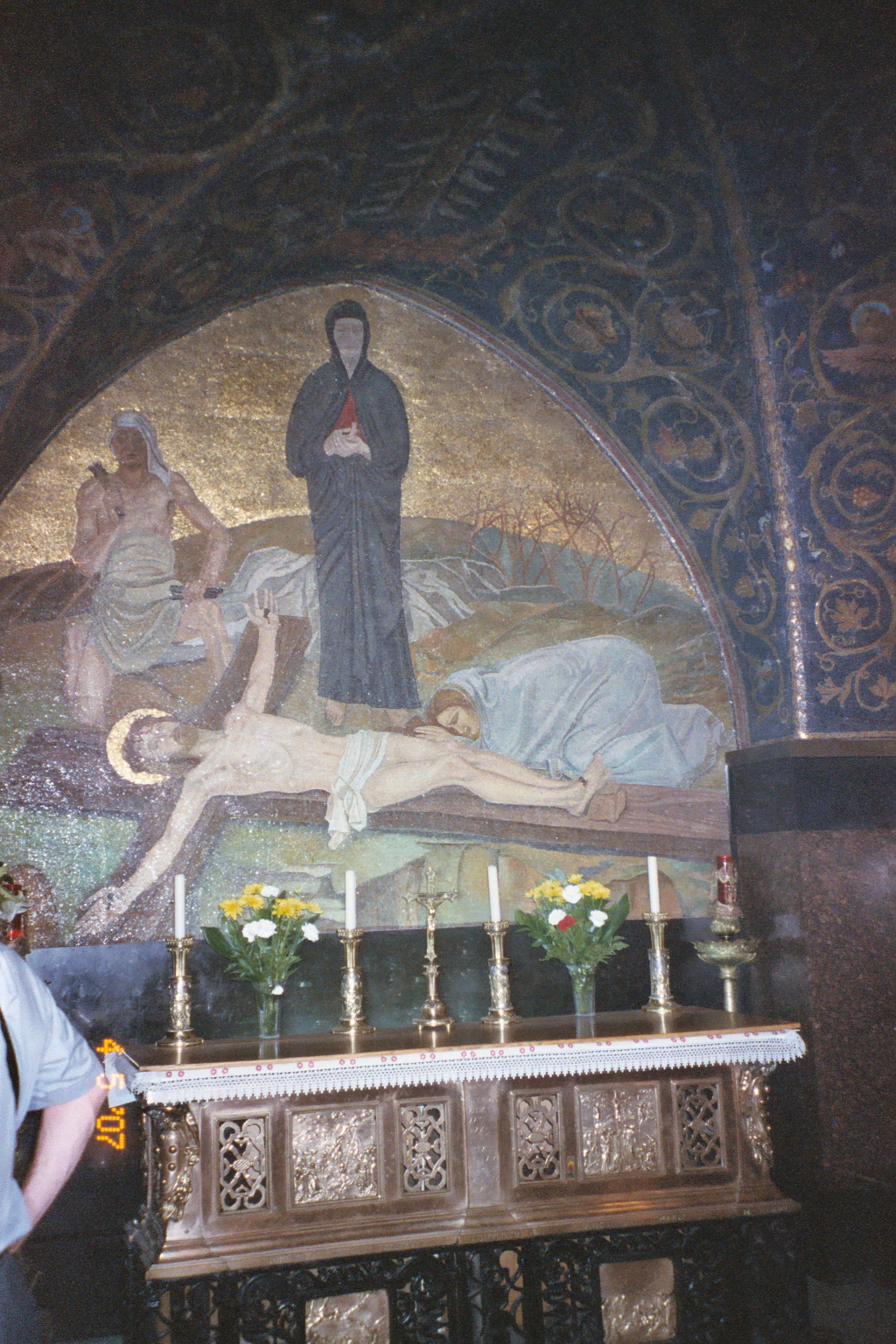
Calvary, presently inside the Church of the Holy Sepulchre in Jerusalem

29 March 2016

Putting Sin to Death

Good Friday of the Lord’s Passion
It might seem cruel of Jesus to say, as He did: “Whoever wishes to come after my must deny himself, take up his cross, and follow me.”  Why does the path to Jesus have to go through pain and suffering?  Why does the path to Jesus have to go through death?  Is God sadistic?  Does He love seeing His children in pain?  What is it about following Jesus that the cruelest torture the Romans could imagine would be the image of being a disciple of Jesus?
God does not rejoice in the death of His children.  He is not a sadist.  Pain and suffering were not part of the plan.  But we chose to reject God, and through our sin, death entered the world.  While we have had original sin washed away from us in baptism, we still feel its lingering effects, like the cold winds of winter that try to keep spring from coming.  We still have the tendency to say no to God and yes to our disordered desires: eating or drinking too much; using our gift of sexuality not in accord with God’s Word; tearing others down by what we say; unforgiveness and vengeance in our hearts; power, greed, control.  
God had to put all of that, and more, to death, because as long as it lives, it could take over.  It had to die.  And so Jesus took all of our disordered desires upon Himself, and let them be killed in Him, on the cross, as He gasped for breath, desire for air competing with the excruciating pain of the nails in his body.  The death of sin became the opportunity for life in Christ.
God does not see sin as we do.  It is not simply a mistake, a bad choice, a wrong road that one goes down.  It is antithetical to who He is; a perversion; a warped way of living.  Sin is darkness to the light of holiness, and in the presence of the light, the darkness has no choice but to be destroyed.  There is no other way to deal with darkness.
Today as we venerate the cross, we have the opportunity to nail to the cross all the sins that we have committed.  As we come and genuflect or bow, and maybe kiss the cross, we bring with us the sins that led Jesus to a cross, to have to put to death every sin that was ever committed and will ever be committed.  As we come to venerate the cross we bring our darkness so that it can be put to death.  

This plain cross reminds us that there is no path to life except through it.  The only way to deal with sin is by killing it.  Bring all of your disordered desires, as I will bring mine, and let them die with Jesus.  Let darkness have its time today.  Let us keep watch, though, for tomorrow night, as darkness falls, light will have its eternity.

03 April 2015

The Pilgrimage of Holy Week

Palm Sunday of the Lord’s Passion
Cathedral of
Santiago de Compostela
When I was a junior in college, I had the great opportunity to study in Rome for 5 months starting in October.  It was a beautiful experience in and of itself.  But before we settled into Rome, most of the seminarians who were also studying in Rome for those five months and I began a pilgrimage in Spain called the Camino de Santiago de Compostela.  It’s one of the oldest pilgrimages in Christianity, and the goal is the Cathedral of Santiago de Compostela, where the mortal remains of St. James the Greater are kept (for non-Spanish speakers, Santiago is James or St. James in Spanish).  We walked 111 km., the minimum to receive the plenary indulgence, but you can take a pilgrim route beginning in most major cities in Europe, and even as far away as the Holy Land.  But even in just those 111 km., I was able to experience a beautiful country, hills, valleys, injuries, friendship, distrust of other travelers, and the final joy of reaching the Cathedral and attending Mass there.  
Pilgrimages are meant to give Christians a microcosm of the life of a disciple: a long distance, beauty, hard times, easy times, injuries, friendship, distrust, and the final joy of reaching the heavenly destination with the eternal worship of God.  While we’re not going anywhere physically today, we do get to go on a spiritual pilgrimage this week, this Holy Week.  We walk with Jesus on His pilgrimage to his suffering and death, and then we will be able to rejoice in the destination of that pilgrimage: the Resurrection.  
We start that pilgrimage today in joy and triumph as the Messiah enters His city, fulfilling the prophecy of Zechariah that the Messiah would enter upon an ass’s colt.  The beginning of the pilgrimage is filled with the excitement of the crowd that all of God’s promises were about to be fulfilled, though they knew not the horrible way in which that would happen.  We just had a taste of the hills, the tough part of the pilgrimage, as we heard St. Mark’s account of the Passion.  We get a foretaste of what lies ahead of us in the days that will follow.
There is no substitution for walking a pilgrimage.  Of course, to arrive at the starting point, pilgrims these days often have to fly and/or drive.  But then there is walking–walking with Jesus.  We are not a walking people as much anymore.  We have planes, trains, and automobiles to take us wherever we want to go, and trams and subways to take us the shorter distances.  But on this pilgrimage there is no shortcut, no easy way to get there.  To truly experience Jesus’ pilgrimage, we need to walk with Him, day by day, and take in His experience.  To skip immediately past the Last Supper on Holy Thursday, past the crucifixion on Good Friday, to Easter means losing some of the power of the Resurrection, because the sweetness of new life is only accessible to those who have also known suffering and death.  
So I want to invite you this week to as many Masses and liturgies as you can attend.  We will have our usual Mass and adoration on Tuesday beginning at 5:15 p.m.; Mass Wednesday morning at 8 a.m.; the Mass of the Lord’s Supper on Holy Thursday at 7 p.m.; the celebration of the Passion on Good Friday at 3 p.m.; the sorrowful prayer of Tenebrae Good Friday at 9 p.m.; and the joy of the Resurrection at the Easter Vigil on Holy Saturday at 8:30 p.m., or the Easter Sunday Masses at 8 or 10 a.m.  Very few things are more important than the Masses this week.  Very few other things will help you prepare for Easter quite like the Masses will.  Of course, some of you can’t make it to Mass because of work, health, or other issues.  If you can’t attend Mass, at least read the daily readings either from our parish app or at usccb.org/readings.  I especially want to encourage you to attend the Easter Vigil Holy Saturday night.  The symbols of Easter speak quite loudly, and we will be there to support those becoming Catholic–the newest members of our parish.  

Walk with Jesus on His pilgrimage.  Walk the road that He walked for you.  Walk the pilgrimage from suffering, to death, to new life.

19 April 2014

What Love Looks Like


Friday of the Passion of the Lord (Good Friday)
            In a few moments we will have the opportunity to venerate the cross, a chance to come and give some sign of honor and respect—a genuflection, a bow, a kiss, a touch—to the instrument of our salvation.
            But right now, I want all of you to look at the crucifix hanging above our altar.  It’s been there since 1968 when the church was completed.  Perhaps many of us don’t even notice it any more, even with how large it is, because it has been there since the beginning.  But really take a good look at it.  What do you see?
            Of course, the easiest answer is Jesus.  We see Jesus crucified on the cross.  But go deeper.  Maybe we see a horrible way to die, cleaned up, though, for public piety.  Maybe we see the different types of wood.  Maybe we see the inscription INRI, which stands for “Iesus Nazarenus Rex Iudaeorum,” “Jesus the Nazarean, King of the Jews.” 
           
An Armenian mural from the
Basilica of the Holy Sepulchre in
Jerusalem
Those things are all there.  But when we look at the crucifix we should see love.  What we celebrate today on Good Friday is love: Love that was willing to be destroyed so that we could live.  Maybe when we think of love we think of a heart, or we think of an old couple holding hands together on a bench, or we think of a a young man, down on one knee, proposing to his girlfriend.  But love is the crucifixion.
            True love is when the Lover is willing to be beat up instead of or even for the Beloved.  True love is having the skin of your back ripped out by scourging so that the Beloved can remain whole.  True love is when the Lover’s head is pierced with thorns placed in a mocking way to represent a crown so that the Beloved can wear a true crown in paradise.  True love is when the Lover walks with a heavy burden so that the Beloved does not have to carry it or travel that awful road.  True love is when the Lover is willing to die so that the Beloved can live. 
            Whom do you love?  For whom are you willing to suffer?  For whom are you willing to die?  Love always means giving all of who you are, even your very life, for the good of the other, so that the other can go to heaven.  Love means horrible suffering, taken willingly so that the other does not have to suffer.  What we celebrate today is love, a love so pure, so true, that Lover was willing to die an agonizing death at the very hands of the Beloved.  That is love.  And if we come back just a day or so more, we will see that love, though it is death, is also new life.
            God loves you.  He shows us that love means being willing to die for the one we love.  How much do we love God?

14 April 2014

Be With Jesus


Palm Sunday of the Lord’s Passion
           
On the occasions when I am called to the hospital or to a house, to administer the sacraments to a person who is dying, there is, 99% of the time, at least one other person there to keep the dying person company.  There is, perhaps, nothing worse than going through a terminal illness and preparing for death alone, and we seem to instinctively know this, as people will do all they can (take time off work, travel far distances, spend large amounts of money) to be with someone in their last days.
            Brothers and sisters, during this Holy Week, we remember the days leading up to Jesus’ suffering and death.  He was not stricken by a terminal illness, but as He took the full weight of sin upon Himself, fewer and fewer stood by Him, and no one quite understood the pain He was undergoing as He freely offered His life, the full gift of Himself, to the Father.  You may not have to take time off work, or travel long distances, but will you be with Jesus this week?  Will you challenge yourself to stand with Jesus at Mass as He undergoes His passion?  Whether it’s the 6:30 a.m. Mass Monday through Wednesday at St. Thomas, or the 12:15 p.m. Mass Monday and Wednesday, or the 9:15 p.m. Mass Tuesday at St. John, will you accompany Jesus?  Will you stay with Jesus on Monday as Mary, the sister of Martha, takes the costly perfumed oil and anoints Jesus’ feet?  Will you stay with Jesus on Tuesday in the Upper Room as the Betrayer is announced and Judas leaves the twelve?  Will you stay with Jesus on Spy Wednesday, as Judas goes to the Chief Priests and offers to betray Jesus for thirty pieces of silver?
            Will you walk with Jesus through the Sacred Triduum?  The Mass of the Lord’s Supper begins this commemoration at 7 p.m. at St. John, and at 7:30 p.m. at St. Thomas.  Will you walk with Jesus to the Upper Room as He institutes the Priesthood and the Eucharist on Holy Thursday?  Will you walk with Jesus through the Kidron Valley to the Garden of Gethsemane as we process with Jesus’ true presence in the Eucharist from St. John to St. Thomas, and then we all walk around St. Thomas to the Chapel of Repose?  Will you walk with Jesus on the way of the cross as we celebrate Good Friday of the Passion of the Lord?  Will you stand at the foot of the cross with Mary, the Mother of God, Mary, the wife of Clopas, Mary of Magdala, and St. John, the Beloved Disciple?   Will you wait on Holy Saturday, and then go to the tomb on Saturday night or Sunday morning?  Will you be there for Jesus?
            As He died on the cross, Jesus prayed the words of Psalm 22—“‘Eli, Eli, lema sabachtani?’” “‘My God, my God, why have you abandoned me?’”—as He felt the full weight of sin and its punishment fall upon Him.  Let us not give Jesus reason to ask why we have abandoned Him in the hour He desires us to be with Him the most.

31 March 2014

A Precious Treasure


Fourth Sunday of Lent
            Every once in a while when I’m having lunch at the rectory, I flip to the History Channel and watch the show “Pawnstars” about a pawn shop in Las Vegas.  Most of the times people think they have something of extraordinary value, when what they have is not worth quite as much as they hope or want.  Occasionally, though, people come in and think they have something that might be worth a few hundred dollars, only to find that it’s worth tens of thousands of dollars.  That must be a crazy feeling when you realize that something you never valued that much turns out to be a precious treasure!
            This evening the question I believe the Lord is posing to us, especially through our Gospel, is how much we value suffering.  Now, suffering is not a good thing.  It was never part of God’s original plan.  And yet, as we said no to God, we brought suffering in: suffering that comes from saying no to loving God and each other, and suffering that comes from illness and disease that entered into the world through original sin.  But I don’t think I need to convince anyone that suffering is not good.  It’s more of a task to say that it’s a precious treasure.
            In our Gospel today, Jesus’ disciples ask Him why the man was born blind.  They want to know why he suffers.  And they have some idea that suffering is due to sin.  But they equate it to the man’s personal sins, or his parents’ personal sins.  Instead, Jesus tells them, “‘Neither he nor his parents sinned; it is so that the works of God might be made visible through him.’”  The disciples fall into the trap that so many of us do all the time: if something’s going wrong, God must be punishing me.  But Jesus says the blind man’s suffering is not because he or his parents did anything wrong.  He suffers so that God’s works might become known, and people might believe in Jesus, the Son of God.  As we follow the story, it’s easy to see that reasoning, as the blind man is led to faith and worships Jesus.  But do we see that reasoning in our own life?
            When there’s a tough exam that we have to take; when a loved one passes away; when a friendship or romantic relationship we want never gets off the ground, or when a friendship or a romantic relationship that we’re in falls apart; when we’re sick; whenever something negative happens to us, like MSU losing in the Elite Eight, it’s easy to get down in the dumps and say, “Why me?”  It’s easy to wish away the suffering and try to avoid it as much as possible.  We see it as simply a negative.  But when we do that, we are blind.
           
As we approach Good Friday, I bet that all of us here have thought or said that we would be there with Jesus through it all.  We would stand with Him and accompany Him as He went through His passion.  I think that’s why so many people show up for the Good Friday liturgy.  But then, when we find ourselves at the foot of the cross of school; at the foot of the cross of the death of a loved one; at the foot of the cross of relationships that never were or that failed, we, like most of the apostles, want to get as far away as possible.  We want the resurrection, but we don’t want the pain and suffering that lead to it.
            Suffering is a treasure, something beyond the price of gold, because Jesus has made it precious.  By His innocent suffering, He has made all the pain and suffering of life mean something because it can be united to His redemptive suffering.  No longer does suffering have to be meaningless.  It can be directed toward salvation, just as Good Friday was directed toward Easter Sunday.  God loved us so much that He took on our suffering, so that we would know that we do not suffer alone, but that we suffer with God.  And when we do suffer with God, we also know that we will later rejoice with God.
            The exams, family deaths, relationship issues, and sickness all become a treasure.  When we embrace them and offer up to Jesus the very real pain that comes with them, we have new ways to show forth the work of God.  We have new ways to show forth the power of the resurrection that comes after the passion.  When we unite our sufferings with Jesus on the cross, then we find ourselves on Calvary, but instead of running away, we stay there with the Blessed Mother, St. John the Evangelist, and the few other disciples, not enjoying the suffering (God doesn’t ask us to be masochists), but finding peace and joy because we know we are becoming more like Jesus and our sorrow will be turned into laughter, and our pain into peace. 
            Today we ask God to heal our blindness, and let us see the true value of suffering.  We ask God to help us to unite our suffering to the suffering of Jesus on the cross and show forth the work of God, which changes suffering to joy.  We don’t look for suffering, but as it comes our way, and we all know that it does every day, we ask God to help us treasure our suffering, so that we can stand with Jesus at the foot of the cross as He suffered, and so share the joy of the resurrection that comes after suffering is complete.

02 April 2012

Hammering in the Nails

Palm Sunday of Passion of the Lord
            We began Holy Week by hearing how Jesus entered triumphantly into His city, Jerusalem.  Shortly afterwards, we recalled in the Gospel how Jesus was then mocked, stripped, and crucified for our salvation.  What a stark contrast in a short amount of time.  What a short time it must have seemed for Jesus between the original Palm Sunday and Good Friday.
            How fickle the crown of God’s creation can be.  How easily swayed we are by excitement…and fear.  With the celebration of the Passover in the background, with tens of thousands of pilgrims coming to Jerusalem, the Jews welcomed Jesus.  With the pressure of the Chief Priests, the Scribes, and the Sadducees, the Jews condemned Jesus for blasphemy.  The King of Glory who entered His capital with shouts of “Hosanna” was made to reign upon the Cross with shouts of “Hail the King of the Jews” in mockery. 
            Because we have become so used to seeing Jesus on the cross in artistic renditions of the crucifix, we can easily become numb to its reality.  Death by crucifixion was a death of suffocation, the lungs filling with fluid, making it harder and harder to breathe.  The only way to get a breath was to use the hands and feet to push oneself up, which only increased the pain where the nails were.  It was a horrible, painful death, filled with shame and derision.
            In the face of such suffering, we can all too easily think that we would never have been part of the crowd crucifying Jesus.  We would not be so easily swayed.  We might even say with St. Peter, “‘Even though all should have their faith shaken, mine will not be.’”  But we would be wrong.  All of us—from Pope Benedict XVI to me and you—have all helped to hammer in those nails into Jesus’ hands and feet.  All of us stand guilty.
            If we lie to another, the hammer falls.  If we swear and curse and take the Lord’s name in vain, the hammer falls.  If we totally ignore the poor standing on the corner; if we make decisions based on prejudice and racism; if we fail to see Christ in those around us, the hammer falls.  If we think first of ourselves and never of others; if we skip Mass because we don’t make time for the Lord; if we react to our parents, children, or family members with anger rather than responding with love, the hammer falls.  If we ignore the Church’s teaching on human sexuality, marriage, and contraception because we feel we’re more enlightened; if we support organizations or ideologies that allow for an innocent child in the womb or an elderly or ill person to be put to death because they are inconvenient to our way of life; if we support the objectification of men and women through pornography, the hammer falls.
            All of us who can make a moral choice have been in that fickle mob that first hailed Jesus on His entry into Jerusalem, and then mocked him by hailing Him on the cross.  All of us have helped hammer in the nails into Jesus’ hands and feet.  All of us have sinned, and fallen short of the glory of God.  We made Jesus cry out from that cross “My God, my God, why have you forsaken me?” as Jesus felt the weight of our sins. 
            Since we have forced Jesus to walk that dark pilgrimage to the crucifixion, let us not abandon Him this week.  Though we ran away with the apostles in the garden 2,000 years ago, let us accompany Jesus this year, this week, these days as the Church celebrates our salvation in Christ: to the upper room on Holy Thursday to celebrate the Last Supper; from the upper room to the Garden of Gethsemane to keep watch in prayer; from Gethsemane to Golgotha on Good Friday; and because death and sin do not have the final word, from Golgotha to the empty tomb for the Easter Vigil or the Easter Sunday Mass.  We began Holy Week today in joy.  Let us also end it in the joy of those who, having repented of their sins and confessed them to the Lord, have been washed clean in the blood of the Lamb.  “Come now, let us set things right, says the Lord: Though your sins be like scarlet, they may become white as snow; Though they be red like crimson, they may become white as wool.”