Showing posts with label pornography. Show all posts

13 May 2024

Receiving the Holy Spirit

Sunday after the Ascension
    In the name of the Father, and of the Son, and of the Holy Spirit.  Amen.  St. Peter lays out some challenging admonitions for us in our epistle today: “be serious and sober for prayers…let your love for one another be intense…be hospitable without complaining…[use your gifts] to serve one another.”  Those are all things to which I hope we aspire.  But maybe we feel like we simply have to muscle through to get these things done.  And perhaps, as we try to lift ourselves up by our bootstraps, we get frustrated because in day to day life exhibiting these behaviors doesn’t always come easily, and maybe we even fail on a regular basis. 
    But God does not want us to muscle through or to try to lift ourselves up by our bootstraps.  God gives us a gift that will give us what we need to live as St. Peter exhorted.  That gift is the Holy Spirit.  He is the one who makes living as a disciple of Christ possible as the Holy Spirit leads us into all truth, and gives us the power to live that truth daily.
    I know that sometimes as Catholics who love the traditional Latin Mass we can get nervous about the Holy Spirit.  Maybe we see charismatic Catholics whose outward appearance seems more like Pentecostals than Catholics in their devotions and even in their liturgies.  Or people equate the way Vatican II was implemented (which was often a hot mess) with the Holy Spirit who called Pope St. John XXIII to convoke the Second Vatican Ecumenical Council.  So perhaps we are a bit skittish when it comes to this Third Person of the Blessed Trinity.
    But we do not believe in a Binity, only two Divine Persons of the Godhead.  We profess our faith each week in the Trinity, which includes the Holy Spirit, the Lord and Giver of Life.  And without Him, we miss something of the full expression of our life in Christ.  Christ promised us the Advocate, the Holy Spirit, to help us to know the truth who is Christ, and to live that truth, even in the face of persecution and suffering.  And these nine days between the Ascension and Pentecost are precisely the days when our Lord asked the Apostles and the Blessed Mother to pray for that gift of the Holy Spirit, who would give them a new power from on high to evangelize and transform the world.

    So how often do we call upon the Holy Spirit?  When, if ever, do we ask the Holy Spirit to fill us?  Is it only in these nine days as we pray our Holy Spirit novena?  Or is it more frequently?  A local priest is known to invoke the Holy Spirit every time he loses his train of thought or is having difficulty expressing himself as he says, “Come, Holy Spirit.”  Though I still need to grow in my comfort and relationship with the Holy Spirit, I will ask for His guidance in the hiring process, or when I need to make a big decision. 
    But the Holy Spirit is not just for new hires or major changes.  I need to, and I encourage you to, make the Holy Spirit more of a daily part of my life.  The Holy Spirit is not just the closer you bring in towards the end of the ninth inning to help you win the game.  The Holy Spirit should be the starter, the reliever, and the closer, all rolled up in one.  And the more we condition ourselves to be attentive to His voice in our daily lives, the more even our small choices will be guided by the Holy Spirit so that we cooperate with God in the big and the small matters.  This is the way the saints lived.
    One of the primary ways the Holy Spirit guides us is through the conscience.  Again, most people act as if the conscience is some subjective voice which tells me what do to without any connection to anything else.  Basically, we can use the word conscience to justify simply following our feelings.  But the Holy Spirit, as our conscience, tells us how the moral law applies in various situations.  He does not make us a moral law unto ourselves, determining right from wrong, though many would like that to be the case, which is exactly what Adam and Eve wanted.  They wanted to determine right from wrong, rather than let God guide them.
    As a parent, and especially today as we honor mothers, the Holy Spirit helps you to know how to raise your children.  I do not envy you parents in trying to raise your children today.  On the one hand, kids are so often over-exposed to social media, to extreme violence, to lust, and to unkindness from others.  Yes, I got teased when I was a young boy, but I could get away from it when I went home.  Today, kids will mercilessly make fun of each other on social media, and you never seem to be able to find a place that is not connected to it.  I was first exposed to pornography in a magazine when I was in high school.  Today, due to phones and the internet readily available in most places, many kids see images they should never see in fifth or sixth grade and devices their parents give them (because every other kid has one), and it can affect their future relationships and their interactions with the opposite sex.  When I was growing up, we knew that boys and girls were different, even if some girls liked rough sports and GI Joes, and some boys didn’t appreciate those things as much.  Now, our national leaders can’t even say what makes a woman and woman, and kids are told that gender dysphoria is not only not an illness that needs therapy, but should be celebrated and protected. 
    On the other hand, you can’t just live in a bubble (at least most can’t).  Eventually, children will go out into a rough and morally dangerous world, and parents are tasked with preparing them to choose virtue even when vice seems more attractive and readily available.  Part of the vocation of a mother or father is to help their children be attentive to the voice of the Holy Spirit to know what behaviors will lead them away from God the Father, and which behaviors will lead them toward God the Father.  A mother or a father’s vocation is to help their children be able to interact with people who are different from them and love others who do not live as God invites us, but to be able to reject the behaviors of those who reject God’s laws and teachings.  That is only possible if parents are calling upon the Holy Spirit daily to help them know when to push towards freedom and when to pull back to safety.  The Holy Spirit can guide you to know how best to discipline with charity, and not simply out of anger or a lack of patience. 
    So not just in these nine days between the Ascension and Pentecost, but each day, may we all call upon the Holy Spirit to help us hear the voice of God in our hearts, which is really His voice, and to follow it, so that we can go where Christ has led and has brought our human nature with Him, the right hand of God the Father, who with Christ His Son and the Holy Spirit who proceeds from them both, lives and reigns for ever and ever.  Amen.  

11 July 2022

Stopping the Anger and Violence

 Fifth Sunday after Pentecost
    In the name of the Father, and of the Son, and of the Holy Spirit.  Amen.  How providential is it that, a week after another horrible shooting, this time in the Chicago suburb of Highland Park, our Gospel wants us to focus on anger.
    Our Lord begins with the commonly-known prescription that we are not to kill.  It is important to note that, while in English we say kill, the meaning behind the original word is closer to “commit homicide,” or kill and innocent person.  We might also use the word murder.  But Christ says that the prohibition against murder is not sufficient for being in right relationship with God.  Indeed, I imagine all of us here can say, without equivocation, that we have not murdered anyone.  But beyond murder, and really, leading to it, is anger, hatred, and de-humanizing the other.  
    Again, the word anger, like kill, needs a little unpacking.  Anger, St. Thomas Aquinas says, is the reaction to a perceived injustice.  When we talk about the emotion of anger, we have very little control over that feeling.  Whenever we feel that someone acts unjustly toward us, that emotion appears.  That, in itself, does not merit blame.  But when we take that emotion and use it to attack, demean, or belittle the other, that is when anger can be thought of as a sin.  So, as one calls another a name, or puts another down, whether in thought, word, or deed, we start to walk down the path to murder, to killing the innocent.  
    We may think of putting others down as a far cry from murder (and it certainly is), but demeaning another is the first step on the path that leads to the destination of murder, if those actions of anger are not quenched.  Indeed, in the Catechism of the Catholic Church promulgated by Pope St. John Paul II, the fifth commandment not only includes treatment of intentional homicide, abortion, euthanasia, and suicide, but also treats respect for others (and the sin of scandal), respect for bodily integrity, and working towards peace.  Gossip, in its own way, is also connected to this, as a way that we speak ill of others, killing, as it were, their good name.
    But how do we stop what are becoming regular acts of violence, often mass violence, in our society?  How do we work to thwart other people not only demeaning others, saying cruel and harmful things about others, but even the taking of innocent life?
    Like so many things, it will start in small ways, especially in the family.  The change from a culture of death to a culture of life will not often gain wide notice in the press.  Like the mustard seed that starts as the smallest of seeds but becomes a large bush, the transition from death to life will fly under the radar until it breaks forth in a way that cannot be ignored.
    Starting in the family, then, is the respect for human life.  Two grave offenses against human life have run rampant in our country for decades, and are even widely promoted by some.  Those two offenses are abortion and pornography.  Is it any surprise that there is a disregard for some lives by members of a society that often trumpets the killing of an innocent and defenseless baby in the womb?  Is it any wonder that human life can be snuffed out so easily by some when another human being is used merely as an object of pleasure to satisfy personal lust?  
    Society cannot fix these problems, the recent Supreme Court ruling that abortion is not a constitutionally protected action notwithstanding.  While governmental action can help, at the end of the day respect for each human life begins, is sustained, and finds its greatest success in family life.  The family knows best how to show respect for life, even from a young age.  
    I think of a family I know rather well, and one of the adult children recently had a baby.  The toddler sees the baby, and often wants to hold that baby, like the adults do.  The adults, for their part, allow the toddler to hold the child (while supervised and supporting the baby’s head and neck), and in doing so are teaching the sacredness of human life in a way a toddler can understand.  As toddlers grow, they can become a bit more aggressive, especially with siblings, when they don’t get their way.  Teaching children that they can’t simply hit or kick a sibling (let alone an adult) when that other person gets in the way is teaching the sacredness of life.  
    As children grow into teens who have more freedom and make more decisions on their own, even as they face more temptations, the lessons become even more important: not to tease others because they are awkward (as every teen is at some point); not to drive in a way that puts others at risk, especially under the influence or even simply with a phone; not treating another person, whether a classmate or as communicated through social media or the internet, as a way to satisfy the desire for sexual union.  All those ways and more promote the dignity and sanctity of life.  

Fr. Anthony as an 8th grade graduate (left)
    I remember when I was a teen, and made a transition from one Catholic school to another.  Despite the stud you see before you today, I was very weak and awkward as a teen.  I was a bit of a nerd, and didn’t have great social skills.  I remember being asked by one of the boys in my class if there were any girls that I thought were cute.  Not knowing that this guy was just out to make fun of me, I gave him an answer of a girl I thought was quite breath-taking, only to find out that the girl I named was his girlfriend.  He teased me quite often about it.  But I had a home where I could escape teasing and could know acceptance and love, which helped me navigate through the tumultuous waters of teenage social interactions.  Many teens now, with Facebook, Twitter, and Instagram, don’t have a refuge where they can regroup and have their dignity reaffirmed.
    For us adults, we can work on watching how we talk about others, what we say to others, and how we communicate when we don’t get in our own way.  It seems like many more adults are living like toddlers: when I don’t get my way, I yell or destroy stuff, whether it’s at a customer service representative for a company, or in riots when a government decision isn’t what I wanted it to be.  
    If we want to end these mass shootings, there may be political action that could help.  I’m not a political science expert, so I’m not going to weigh in on what can be done in this forum.  But I do have knowledge about the human person, as revealed to us through Jesus Christ, and how the practice of religion helps society.  And so I can say, without hesitation, that if we want, not only to stop the symptoms, but stop the disease of the lack of respect for human life, it will start in our homes, in our families.  Have dinner together as a family, without phones.  Show love for your spouse and for your children in concrete ways.  Monitor video game, internet, and phone usage.  Support each other in the family.   The perpetrators in these mass shootings often do not have a strong family life, do not have a support system to reaffirm their dignity when others do put them down, and often turn to violent video games as the first place they vent their anger.  I’m not here to blame this or that factor, but only to say that we can do better, and it starts in the family.  
    Christ teaches us today that murder does not begin at that drastic action.  There are many smaller actions of anger that precede the more notorious tragedies.  One tried and true way to stop these mass shootings is to teach the dignity of every human being, from natural birth to natural death, which happens best when a family communicates by what they do and by what they say, the love of the Father, and the Son, and the Holy Spirit.  Amen. 

30 January 2017

A Strong Eighth Grader

Fourth Sunday in Ordinary Time
This past Wednesday at our school Mass, we celebrated the Feast of Conversion of St. Paul.  And in my homily I was talking about how God chose St. Paul, even though he had started out persecuting Christians, and trying to arrest them.  And in part of the homily I referenced both what we heard in our second reading today, as well as when St. Paul says that he was given a thorn in his flesh, but God assured St. Paul that God’s power is made manifest in weakness.  To illustrate the point between being strong and weak, I asked one of our eighth grade students to come forward (he didn’t know he was going to be called forward, either).  This was one of our students who plays football and basketball, and is pretty athletic.  Once he was forward, I asked him to flex.  He looked at me for a second, turned a little red with embarrassment, but then flexed and showed off his guns (that’s how some young men talk about their muscles).  And I’ll be honest, I didn’t realize how strong he was!  After Mass he told me that he benches 200 lbs.  I can barely add any weights to the bar, so I was the demonstration of one who is weak.

St. Paul reminds us today that we don’t have to be the wisest, we don’t have to be the most powerful, we don’t have to be nobly born in order to follow Jesus.  God so often chooses those who are not considered strong or powerful or wise to be the vessels of His power.  That’s the way our God works.  More often than not, God’s choices don’t make sense in our modern understanding, whether modern is in the time of Jesus, the first millennium, the second millennium, or even now in the third millennium since the birth of Christ.  
As strange as Jesus’ teaching sounds to us, it probably sounded as weird for the people listening to Jesus.  Now, as then, we don’t tend to think of the poor in spirit, those who mourn, the meek, those who desire righteousness, the merciful, the clean of heart, the peacemakers, and those who are persecuted for righteousness as people who are blessed.  Those people, in fact, seem like the ones who are the victims of society, and those who get run over by everybody.  But Jesus calls them blessed.  
How are they blessed?  They are attentive to God and His will, rather than the will of the world.  They are the ones who spend their attention and energy on serving God and bringing about His reign, rather than trying to hoard money, grab after power, cheat people, seek after vengeance, or look for and act on the desires of lust.  
And though Jesus taught on the mount in Galilee some 2,000 years ago, those words still apply to us today.  If we want to be blessed we have to rely on God, work for justice and peace, be meek and merciful, and be clean of heart.  Clean of heart may be one of the hardest in today’s world.  There are so many groups that make purity difficult: every second over $3,000 is being spent on lewd web pages.  Lack of purity can lead to addictions, can rewire the brains of our youth not to appreciate what is truly good and truly beautiful, can destroy marriages and families, and promote human trafficking.  It is an enslaving force in general.  But Jesus desires us to be free.  He wants to unshackle us from this uncleanness, so that we can live in true blessedness.  If you or someone you know struggles with lack of purity, like pornography, the Diocese of Lansing website has resources on its Marriage and Family Life webpage.  

No matter what beatitude strikes you as the most difficult, being weak is not a problem.  God chooses “the weak to shame the strong,” as St. Paul reminds us in our second reading.  All of us have weaknesses.  And so all of us can be chosen by God to show that God does great things, not by human accomplishment, but by His grace.

11 March 2013

My Favorite Sacrament


Fourth Sunday of Lent
            When people ask me what my favorite sacrament is, I don’t think they’re generally surprised to hear me say the Eucharist.  Vatican II teaches us that the Eucharist is meant to be the source and summit of Christian life, the beginning of our life in Christ, whence we get the strength to live as disciples, and the goal of the Christian life, that we have intimate communion with God.  For priests even more so, the Eucharist is the key to the priesthood, as the priest acts in the person of Christ the Head, offering himself to the Father represented by the bread and the wine which become the Body and Blood of Jesus Christ.
            I think they are more surprised when I say that there is another sacrament that is tied for first with the Eucharist, and that sacrament is Reconciliation.  But it’s true.  While I was, in some ways, prepared for the joy of celebrating the Mass and bringing about, in an unbloody manner, the sacrifice of Christ on the cross through the Eucharist, I have to say I was not prepared for what a gift celebrating the Sacrament of Reconciliation would be.
            At this point I have to make a disclaimer: I don’t love to celebrate Reconciliation as a confessor because I get to hear all your dirty little secrets of the things you’ve done wrong.  What I love is the fact that I get to take part in an intimate moment between the penitent and God and get to grant that penitent the forgiveness of their sins in the name of Christ, and bring them back to the road to heaven.  It is an experience of humility (because it takes true humility to tell God, not that we have made a mistake, but that we freely chose to go against His will) and an experience of love.  I treasure the “ministry of reconciliation” as St. Paul says in our second reading, that God has entrusted to me.  I am in awe of the fact that, though I continue to need to confess my sins (being a priest doesn’t mean that I suddenly stop sinning), God has chosen me to grant that forgiveness to His beloved sons and daughters so that they can, once more, be prepared for heaven.
            Our Gospel passage is all too familiar to us today.  We likely hear it every year, at least once.  But it is so powerful, if we let it speak to us!  We can put ourselves in the place of the prodigal son, the son who wastes his inheritance on dissipate living, and then who goes broke, and has to work as a swineherd (one of the worst jobs that a Jew could have), and would love just to eat the pigs’ food.  We can put ourselves in the place of the son who recognizes that he needs to return to the Father, if for no other reason than just to work as a slave so that he can eat.  And we can put ourselves in the place of the son who is embraced by the Father who has run out to meet him.  We can put ourselves in the place of the son, because that is what happens in reconciliation.
            “All men have sinned,” says St. Paul in his letter to the Romans, “and are deprived of the glory of God.”  We all tell God that we know better, that we’d rather control our own lives and do our own thing.  It’s the ancient sin of pride, which leads to so many other sins.  We squander the inheritance of grace that we received in baptism, when we were made sons and daughters in the Son of God.  And when we do that, we squander it quickly, and we find that we are living a trashy life, amidst slops that are meant for the pigs.  But God does not abandon us.  He gives us grace, we use the term prevenient grace, to lead us back to Him, to consider that the “threshold of the house of God” is better than the “tents of the wicked,” as Psalm 84 says.  Even just being close to union is God is better than living with evil.  And so we start on our way back.  But before we can even get out the words of our apology, to try to argue our case for being a slave rather than the heir that we were, the Father embraces us and says to us
“Quickly bring the finest robe and put it on him; put a ring on his finger and sandals on his feet.  Take the fattened calf and slaughter it.  Then let us celebrate with a feast, because this son of mine was dead, and has come to life again; he was lost, and has been found.”

God doesn’t rub in our face the wrong we have done, but celebrates that we have returned to our Father’s house, and that we are back to life in grace.
            There is nothing quite like the experience of welcoming someone back to the love of God in reconciliation.  Often, those who have been away from the Church for some time or those who feel the heavy weight of sin are brought to tears.  I am not ashamed to say that from time to time I am brought to tears as the love of God flows through me and I rejoice in the fact that the penitent was lost and now is found, was dead and is now alive by the grace of God.
            I want to invite each of you today, whether it’s been a week or a lifetime, to come experience this great sacrament of God’s mercy, and to start a habit of making regular confessions.  There’s no sin that can permanently keep you from the love of God, unless you give that sin that power.  God will forgive all sins, if we come to Him in sorrow, sincerely at least wanting to stop.  Whether it’s lying; impatience; stealing; adultery; viewing pornography and the sin that often accompanies it; sex outside of marriage; contracepting; murder; abortion; missing Mass; pride; or whatever other sins we may struggle with, God wants to put a robe of love around you and put the ring that signifies your place in God’s household on your finger.  Maybe it’s only been a few days since you last went to confession.  Maybe it’s been forty years since you last went to confession.  In either case, we priests are glad to give you the assurance of God’s mercy.  We have a great confession schedule between St. Thomas and St. John, and we even have a communal penance service with individual confession & absolution next Sunday, 17 March at 2 p.m. at St. Thomas in case you want to go to a priest from out of town (though recall that we can’t tell anyone else your sins, nor can we treat you any differently based upon your confession).  Don’t stay stuck in the pigs’ slop.  Come back to the Father’s house.  Let God love you and forgive you.  “Taste and see the goodness of the Lord.”

31 December 2012

How to Be a Holy Family


Feast of the Holy Family
            If there’s one time of year that we associate with family, it certainly would be Christmas time.  Whether our family is far or near, almost everyone I know tries to make it home to be with family for at least part of Christmas.  Sometimes the weather gets in the way.  Others cannot be with family due to service in the military.  But the goal is always to be home for Christmas time.
            It makes great sense, then, that in this Octave of Christmas, the eight days that the Church celebrates Christmas Day itself, that we celebrate the Holy Family of Jesus, Mary, and Joseph.  We take time to focus on that First Family of our Faith.  We try to emulate their example, and be a holy family ourselves.
            The Church takes great care in protecting families.  She teaches that the family is the domestic church, the home church, because is it not the family where the faith is passed on from one generation to the next?  Is it not in the family where daily sacrifices can be offered to God as fitting worship?  Is it not from the family that we are sent out to pass on what we have received?
            In our own times, family life can be strained and difficult.  It is no longer the case that most extended families live fairly close to each other.  Whether due to the economy, or even simply due to the fact that people are more mobile now than ever before, extended families are often separated by great distances.  And time seems so much more precious now, with more opportunities for parents and children alike.  Working with the children of our parish school, in one sense I cannot imagine what it takes to make sure that Bobby is at basketball, and Denise is at dance, and Jimmy is at hockey, and Julie is practice for the clarinet, all at the same time, of course.  On the other hand, as a spiritual father of this community, I can understand as I try to make it to the sports games, the band concerts, the plays and musicals, and all the different activities of adults and children alike to show how important each person is not just to me, but to Jesus, whom I represent.
            Besides the strain within family life, there are also external pressures on the family.  While the Internet has allowed people to keep in touch and to share valuable information with each other, it has also plagued many families, especially, but not limited to, fathers or sons, with the evils of pornography, Internet and gambling addictions, and double lives.  These evils tear away at the trust that is necessary in families, and they can often lead to extra-marital affairs and the objectification of others, especially women, as means to the end of gratification.  No wonder, then, the divorce rate is up and more and more families are broken.
            In the midst of this, the Church does not merely stand as a nay-sayer, just pointing out what is wrong and the dangers.  The Church, based upon God’s Word of life and truth, offers us guides to help us be the holy family that God has created us to be.
            Our first reading mentions a first and key ingredient to a holy family: going to the temple.  Hannah had pleaded with God for a child, and the Lord had blessed her with a son, Samuel.  After Samuel was weaned, Hannah brought him to the temple of the Lord, and gave him back to God.  Now, don’t leave all your children here after today’s Mass; that’s not what I’m suggesting.  But, bringing your children to Mass with you is so important!!  To show your children that a relationship with God is key to your life is to pass on the faith and be a missionary to those who do not fully know Jesus: your children.  Children know that what you make time for is important, and if you make time for God in attending Mass on Sundays and Holydays, they will know how important that is.  If, instead, you drop them off at religious ed and then return home, or even if you let them go to class while you go to Mass, and then just let them join you half-way through, you are not helping yourself to be a holy family.  Or, if you send your child to our parish school or Lansing Catholic, but then don’t go to Mass on Sunday because they have already gone once this week, then it will be much harder to be a holy family.
            But our relationship with God has to go beyond the walls of this Church.  Prayer life as a family is also a key ingredient in order to be a holy family.  Remember that old saying, “the family that prays together stays together”?  It was a wise saying!  Prayer as a family in the home is a great way to be like the Holy Family of Jesus, Mary, and Joseph.  And it has to go beyond Grace Before Meals.  Many parents pray with their children before bedtime, so that the child’s last activity before falling asleep is not TV, or video games, but is time spent talking and listening to God, often remembering those who need prayers in the family because of sickness or struggles.  At whatever time of day you choose, make it a habit to pray together as a family and/or read the Bible together with favorite stories, at least from the Gospel.
            There are other pieces of advice that the Church gives, based upon the Word of God and 2,000 years of being a Mother, like not making other things (including sports) a god; gathering around the table for dinner on a regular basis; guarding children from adult-themed TV shows, movies, and websites; and certainly having families support one another.  But the two I mentioned today are a good start.  Does it mean that there won’t be any difficulties?  Certainly not!  The Holy Family, as we heard in our Gospel today, wasn’t always on the same page.  Or think about the long journeys that they took, first to Egypt to escape King Herod, then to Nazareth, and St. Joseph died before Jesus began His earthly ministry.  Holy does not mean easy.  But it does mean united to God, who can help us to carry our crosses.  And what truly makes a family holy is that, each day, while juggling all the activities of family life, the family is trying to do the will of God as best as it can, and offering everything that happens to the Father as an acceptable sacrifice through Jesus the Son in the power of the Holy Spirit.          If we truly want to make society, which is just a conglomeration of families, a better, safer place, then we have to start in our own homes by making Sunday Mass a priority, by making prayer a priority, and by supporting each other in good times and in bad, so that we can strive to do the will of God, and be a holy family here in Michigan.  

02 April 2012

Hammering in the Nails

Palm Sunday of Passion of the Lord
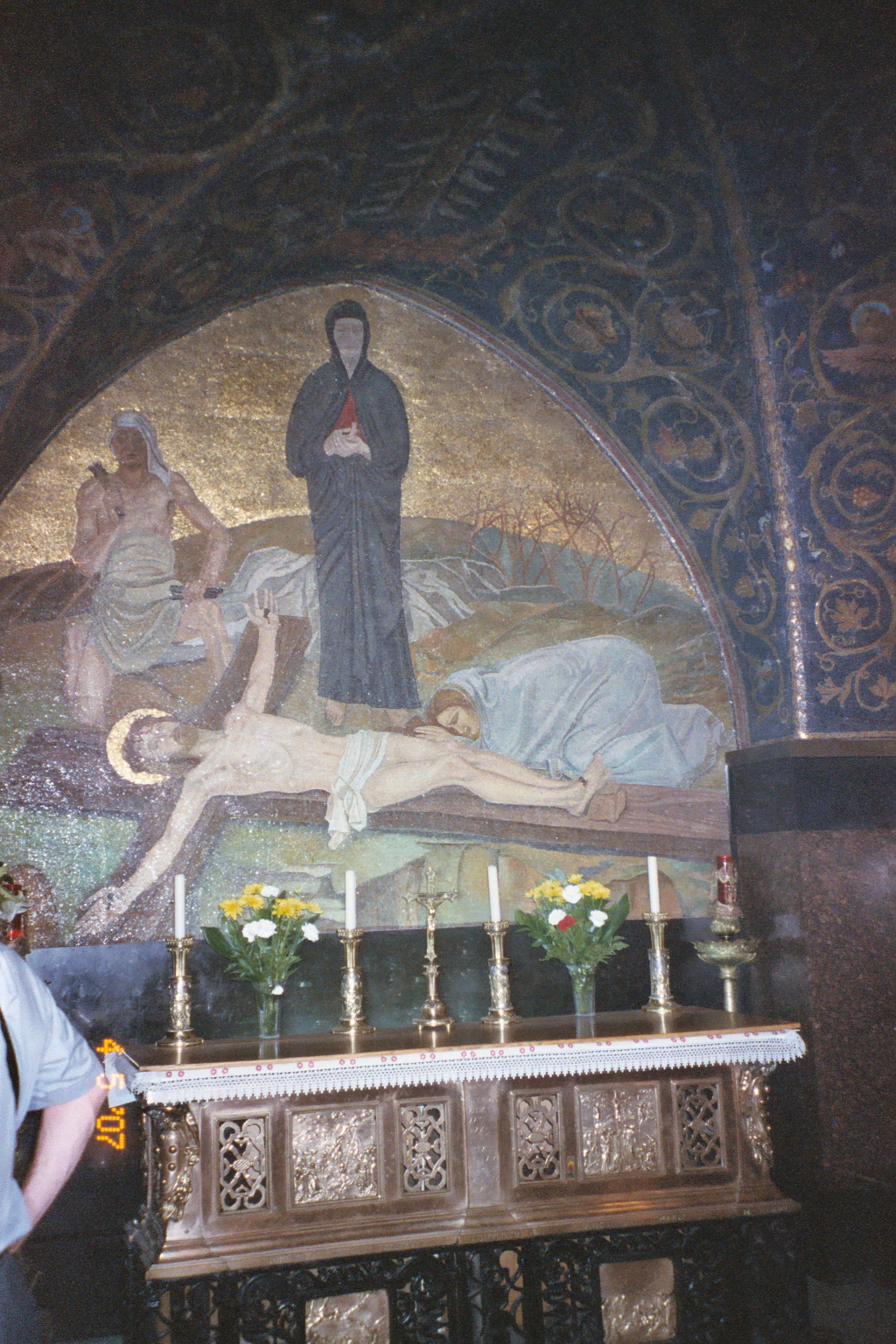
            We began Holy Week by hearing how Jesus entered triumphantly into His city, Jerusalem.  Shortly afterwards, we recalled in the Gospel how Jesus was then mocked, stripped, and crucified for our salvation.  What a stark contrast in a short amount of time.  What a short time it must have seemed for Jesus between the original Palm Sunday and Good Friday.
            How fickle the crown of God’s creation can be.  How easily swayed we are by excitement…and fear.  With the celebration of the Passover in the background, with tens of thousands of pilgrims coming to Jerusalem, the Jews welcomed Jesus.  With the pressure of the Chief Priests, the Scribes, and the Sadducees, the Jews condemned Jesus for blasphemy.  The King of Glory who entered His capital with shouts of “Hosanna” was made to reign upon the Cross with shouts of “Hail the King of the Jews” in mockery. 
            Because we have become so used to seeing Jesus on the cross in artistic renditions of the crucifix, we can easily become numb to its reality.  Death by crucifixion was a death of suffocation, the lungs filling with fluid, making it harder and harder to breathe.  The only way to get a breath was to use the hands and feet to push oneself up, which only increased the pain where the nails were.  It was a horrible, painful death, filled with shame and derision.
            In the face of such suffering, we can all too easily think that we would never have been part of the crowd crucifying Jesus.  We would not be so easily swayed.  We might even say with St. Peter, “‘Even though all should have their faith shaken, mine will not be.’”  But we would be wrong.  All of us—from Pope Benedict XVI to me and you—have all helped to hammer in those nails into Jesus’ hands and feet.  All of us stand guilty.
            If we lie to another, the hammer falls.  If we swear and curse and take the Lord’s name in vain, the hammer falls.  If we totally ignore the poor standing on the corner; if we make decisions based on prejudice and racism; if we fail to see Christ in those around us, the hammer falls.  If we think first of ourselves and never of others; if we skip Mass because we don’t make time for the Lord; if we react to our parents, children, or family members with anger rather than responding with love, the hammer falls.  If we ignore the Church’s teaching on human sexuality, marriage, and contraception because we feel we’re more enlightened; if we support organizations or ideologies that allow for an innocent child in the womb or an elderly or ill person to be put to death because they are inconvenient to our way of life; if we support the objectification of men and women through pornography, the hammer falls.
            All of us who can make a moral choice have been in that fickle mob that first hailed Jesus on His entry into Jerusalem, and then mocked him by hailing Him on the cross.  All of us have helped hammer in the nails into Jesus’ hands and feet.  All of us have sinned, and fallen short of the glory of God.  We made Jesus cry out from that cross “My God, my God, why have you forsaken me?” as Jesus felt the weight of our sins. 
            Since we have forced Jesus to walk that dark pilgrimage to the crucifixion, let us not abandon Him this week.  Though we ran away with the apostles in the garden 2,000 years ago, let us accompany Jesus this year, this week, these days as the Church celebrates our salvation in Christ: to the upper room on Holy Thursday to celebrate the Last Supper; from the upper room to the Garden of Gethsemane to keep watch in prayer; from Gethsemane to Golgotha on Good Friday; and because death and sin do not have the final word, from Golgotha to the empty tomb for the Easter Vigil or the Easter Sunday Mass.  We began Holy Week today in joy.  Let us also end it in the joy of those who, having repented of their sins and confessed them to the Lord, have been washed clean in the blood of the Lamb.  “Come now, let us set things right, says the Lord: Though your sins be like scarlet, they may become white as snow; Though they be red like crimson, they may become white as wool.”  

06 December 2011

The Comfort of the Truth


Second Sunday of Advent
            “Comfort, give comfort to my people, says your God.”  When I heard the word comfort, and try to think of what comforts me, I think of a cold, snowy evening, sitting by the fireplace, the living room lit only by a few flickering flames from candles, drinking my family recipe of hot spiced cider, and watching a favorite television show or movie.  For others it might be a hot tub, or a warm beach, or even just a pint of Häagen Dazs.  Or maybe you’ve got your own sense of what comforts you that is radically different from the examples I just listed. 
            It’s beautiful to hear the words of Isaiah the prophet, telling us that God wants to bring us comfort.  “Speak tenderly,” he says, “and proclaim to her that her service is at an end; her guilt is expiated…Go up on a high mountain…cry out at the top of your voice…Here is your God!  […] Like a shepherd he feeds his flock; in his arms he gathers the lambs, carrying them in his bosom, and leading the ewes with care.”  Who doesn’t want to know that the Lord is going to speak tenderly to us, to proclaim that our service is at an end, and that our guilt is no more?  Who doesn’t want the Lord to come as a shepherd, feeding his flock, gathering us in his arms and carrying us close to his chest?
            So what do we do with the middle part of the first reading and our Gospel?  We heard twice, “A voice cries out: In the desert prepare the way of the LORD!  Make straight in the wasteland a highway for our God!”  We have traditionally associated that proclamation with St. John the Baptist who, as St. Mark wrote in today’s Gospel passage, “appeared in the desert proclaiming a baptism of repentance for the forgiveness of sins.”  If any of you have seen the movie “Jesus of Nazareth” by Franco Zeffirelli, you can picture how enthused John the Baptist was about his message.  In the movie, John the Baptist is screaming at the top of his lungs: Repent!  And he’s only wearing a camel’s hair tunic and a leather belt around his waist, eating locusts and honey.  In fact, he screams so much that Herod has him arrested for preaching against his so-called marriage to his brother’s wife.  This is not the warm, pastoral scene that Isaiah has at the end of our first reading.  And it certainly doesn’t seem like the comfort that Isaiah prophesies at the beginning of our first reading.  So why is the figure of John the Baptist, the one crying out in the wilderness: Prepare the Way of the Lord, sandwiched between those two soft images?
            What John preaches is the truth.  As St. Augustine says in one of His sermons, Jesus is the word, and John is the voice.  Jesus is what is being proclaimed, and John is the one proclaiming it.  John is preaching repentance, which is the beginning of the comfort that God wants to give.  “But change is hard!  Change isn’t comfortable!”  Change can be difficult.  We’re seeing that as we slowly get used to our new translations, saying “And with your spirit” instead of “And also with you.”  But what is most comfortable is the truth.  The truth is precisely what gives comfort.  It may not always seem like it does, but if Jesus is the Truth, as he says (I am the Way, the Truth, and the Life), then when we receive the truth, we receive Jesus, who is the shepherd, drawing us close to his bosom, and leading us with care, from lies to truth, from darkness to light, from slavery to sin to freedom in God’s commandments. 
            It is true, sometimes the truth hurts, and we don’t usually associate that hurt with comfort.  But that painful truth is like knowing the reality that our infected wound has to be drained.  It is going to be painful at first, probably very painful, but it will actually be comforting to know that the infection is being treated, and the wound will heal properly. 
            So when John is preaching repentance, turning away from sins and being faithful to God, he is bringing the comfort of God.  Because it is only when we recognize that we need to turn back to the Lord, when we recognize the truth, that we can actually start going in the right direction with the help of God, rather than wandering off by ourselves away from the kingdom God has prepared for us, where the fullness of comfort is present. 
            We all need that message that John the Baptist preaches.  We need to hear, time and time again, “Repent!  For the Kingdom of God is at hand!”  We need the truth.  Otherwise we get stuck with the mentality: my sins aren’t that bad!  It’s not like I murdered someone!  It was just a little gossip; I just cheated a little bit; it’s just a little pornography every now and then; I’ll give back the money I took at my next paycheck.  If our mentality, no matter what sins we struggle with, is, “I’m really ok; I’m not that bad,” then we will not receive the comfort that God wants to give us, the comfort of living how God has created us: for Him in love, and with Him eternally in heaven.  If we do not repent, through the sacrament of Reconciliation, then God won’t be able to say to us, “your service is at an end, your guilt is expiated,” because we will have closed ourselves off to the mercy and love that God wants to communicate to us.  Next Sunday, on 11 December, we’ll once again host a Communal Celebration of the Sacrament of Reconciliation with Individual Confessions, with priests from around the Eastern part of Lansing offering you the sacramental grace and peace that comes from hearing the words and knowing the reality: your sins are forgiven; go in peace.  That’s the comfort the Lord wants to give you.  That’s the tenderness that waits for our response.  How will you answer?  Where will you find comfort?