22 January 2018

Drafted for the Gospel

Third Sunday in Ordinary Time
There are things for which we want to be chosen.  As adults it’s often the job that we applied for, or maybe it’s the significant other that we’ve been dating, whom we hope will ask us to marry.  As children we may want to be chosen to be on the team with our friends on the playground, or for the school play.  I think we all know that the reality is that we often don’t get chosen for the things we want.  Maybe we don’t get the job; maybe we get dumped; maybe we don’t get the role we want or are not on the team we want.
A young man I know from when I was a priest in East Lansing, Cooper Rush, was chosen again and again for football teams, despite ever-increasing odds not to be chosen.  He was the quarterback for Lansing Catholic, holds records for an MHSAA playoff game, led Lansing Catholic one year to the State Championship (where, ironically, Lansing Catholic lost to Flint Powers).  He then was chosen to play quarterback at Central Michigan University, and was very successful at Central, going to bowl games and even holding a FBS Bowl Game record for most touchdowns passes in a Bowl Game.  Currently, he is a back-up quarterback for the Dallas Cowboys.  And besides being a good athlete, he is also an upstanding man.
The odds of him making it to the NFL weren’t that good.  One stat from 2015 says that there were 1.087 million high school football players.  Of those, 310,000 high school football players were seniors.  Of those, only 70,000 were chosen to be on an NCAA football team.  Of those, on 20,000 played on an NCAA team.  Of those 20,000, about 15,500 were college seniors.  Of those 15,500 seniors, 6,500 were scouted by the NFL, and only 350 were invited to a combine to show their football skills.  Of those, 256 players were drafted by the NFL.  The odds of being chosen for high school, college, and professional football are about 1.6 out of 100.
The odds of being chosen to preach the Gospel, however, are much better.  Every baptized person has been chosen, drafted, we might say, to preach the Gospel both by deeds and words.  And while we might not think of ourselves as a draft pick, we heard in our first reading and Gospel about some unlikely characters who are chosen.
In the first reading, we hear about Jonah being asked by God to preach to the citizens of Nineveh.  God asks Jonah to tell them to repent, to turn away from their sinful, pagan ways.  Jonah didn’t want to go; he hated Nineveh, the capital of the Assyrian Empire which had exiled the members of the northern kingdom of Israel.  Jonah even tried to run away, but God did not abandon Jonah or let him off the hook.  And even when Jonah preached repentance, he hoped that the Assyrians would not listen, so that God could destroy the pagan empire.  Probably not a first round evangelist.
And in the Gospel we hear about Jesus calling the first apostles: Simon, Andrew, James, and John.  They were not rabbis.  There were not the educated elite of Judaism.  They were fishermen.  But Jesus saw something in them that He knew would be important for having as disciple.  It wasn’t always obvious to others, though.  Peter always seemed to speak before thinking, denied Jesus during His Passion, and even almost ran away from his martyrdom in Rome.  James and John were the ones who asked for a privileged spot in the kingdom of God, in front of the line of the other apostles, and asked Jesus to call down fire upon the Samaritan towns when they wouldn’t receive Jesus on His journey to Jerusalem.  And even the other apostles were not seemingly the best catch: Matthew was a tax collector; Thomas doubted; Simon wanted to violently overthrow the Roman government; and they were all uneducated, simple people.  And yet Jesus called each of them to preach the Gospel.

You may not think it, but Jesus has also called you to preach the Gospel.  When you were baptized you were committed or you committed yourself to being a disciple of Jesus, to conforming your life to His, to sharing with others the good news of what Jesus has done for us (freeing us from sin and death).  You may not think you have what it takes, but Jesus does.  And even if you feel like you need to know more, that’s why we have Bible studies, and faith sharing groups, and formational events both here, in the greater-Flint area, and across the Diocese, events like the Men’s and Women’s Conferences.  If you don’t feel like you have what it takes, then work towards that goal of having what it takes.  Make your faith life more than simply coming to Mass on Sundays and holydays.  Get involved in deepening your faith and maybe volunteering in our parish ministries.  You might just be the one to bring another person to Jesus.

06 January 2018

A Gift for Jesus

Solemnity of the Epiphany of the Lord
I am not the greatest gift giver.  I try; I really do.  I try to think what my parents, sisters, nieces, and friends would like to get, especially for Christmas.  But I never seem to have the knack of getting something that they really want, unless, of course, I’ve already asked them what they want.  I don’t beat myself up too much for needing to ask what my nieces want; I don’t see them too often, and I’m not quite in touch with what 2 and 5 year girls like.  
On Christmas, we celebrated the greatest gift ever: Jesus Christ, God-made-man, God-with-us.  At Christmas we usually give gifts, and it’s fitting that we try to imitate God’s generosity, though His generosity can never be outdone.  God gave us the possibility of eternal salvation when heaven and earth were joined in Jesus, the Word made flesh.  And throughout the Christmas season we have probably treasured our gifts, maybe used them, and maybe we think of the person who gave us those gifts when we do use them.
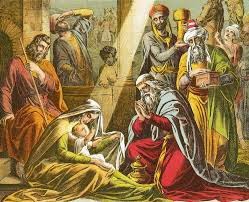
Today, as we celebrate the Epiphany, we celebrate God manifesting Himself (Epiphany means to show forth or manifest) to all the world, represented by the magi.  At Christmas God revealed Himself to the Chosen People, to Israel, represented by Mary, Joseph, and the shepherds.  Now at the Epiphany, God reveals Himself to those were not part of God’s people, the pagans, the Gentiles, the non-Jews.  God allowed the natural world (the star) to guide those who followed the movement of the stars, to lead them to Jesus, Mary, and Joseph.  And there they laid down their gifts at the feet of the newborn King.  Each gift has a meaning.
And that’s part of the beauty of the many verses of the hymn “We Three Kings”: the gifts are explained.  Gold is for a king (“Born a King on Bethlehem’s plain / Gold we bring to crown Him again;”); frankincense is for a God (“Frankincense to offer have I; / Incense owns a Deity nigh;”); myrrh is for burial (“Myrrh is mine; its bitter perfume / Breathes a life of gathering gloom;”).  Even though the magi were not part of the Chosen People, and did not have the revelation of God’s will through the Old Testament, they brought gifts for a King who was God, but who was also going to die.  They recognized Jesus as a King, as God, and as born to die, even when others later on would struggle with one or another of those identities.
But the gifts that we give Jesus tend to reveal more about ourselves than it does about Jesus.  We know who Jesus is.  We know that He was born a king, that He is truly God, and that He was born to die so that we can live.  But in the gifts that we give Jesus, we show Him what we really think about Him, and how much importance we give Him.
Time is definitely a gift that we can give Jesus, and to the extent that we give it to Him, it shows the extent to which we value His friendship.  Some have a habit of walking out after receiving Holy Communion.  While there can be legitimate reasons for this, for most people, waiting an extra 5 or 10 minutes won’t endanger anyone’s life or job.  And yet how many people leave early?  Or how many families, including sometime our Catholic school families, don’t even bother coming?  Yes, giving up an hour does mean that we are giving up doing something else that we might want to do.  But when we choose not to go to Mass (obviously not counting when we are sick, or more than 30 minutes away from a church, or when the weather makes it dangerous to drive), we withhold the gift of our time and attention from Jesus, and tell him that He is not as important as our plans and our will.
Love is also a gift that we can give Jesus.  I think sometimes we feel like an act of love of Jesus has to be profound and wordy.  But we can say it the same way we say it to others: “I love you, Jesus.”  What a beautiful prayer that is!  How many times have you said “I love you” to Jesus?  If you said it as infrequently to your spouse as you do to Jesus, would you still be married?  Even teenagers will throw that word around…a lot!  The girlfriend or boyfriend is loved, even if they have only been dating for a week.  But do we say it to Jesus?  
In a weird way, sin is also a gift that we can give Jesus.  No, this doesn’t mean that Jesus wants you to sin.  But if we do sin, He wants to take that from us, because He wants to take our death that comes from sin, and to give us life that comes from Him.  And the ordinary way of giving Jesus our sins is by going to confession.  Maybe it’s just a few small sins.  Maybe it’s a few big sins.  In either case, Jesus doesn’t want us to carry that burden.  And the ordinary way that He takes away that burden is by going to confession.  That’s the way Jesus established in the Scriptures; that’s the way a Catholic has his or her sins forgiven.  And by giving Jesus even our failings, we show Him that we want Him to have everything from us.  It’s not like Jesus doesn’t know the bad stuff we do, but we can sometimes pretend like all He needs to know about is the good stuff.  We cannot hide from God; we cannot pretend that we have not failed Him, that we have not fallen short of the glory of God.  Give even your sins to Jesus and let Him heal you.  He wants to.  He doesn’t just want your good; He also wants the bad and the ugly.  We shouldn’t try to sin, but when we do sin, give it to Jesus.

Because at the end of the day, Jesus wants all of us.  The gift He wants is of a heart given to Him.  That doesn’t mean we have to become a monk or a nun.  In every form of life, we can give Jesus our all.  And that is the perfect gift for Jesus, the gift that will give joy to His heart, the gift that He’s been waiting to receive.

02 January 2018

Entrusting our Family to God

Feast of the Holy Family of Jesus, Mary and Joseph
Last week my sister and brother-in-law celebrated their 9th wedding anniversary.  I remember the day of their wedding pretty clearly: I wasn’t a priest or even a deacon yet, so I was in charge of cantoring the Mass; there was lots of snow on the ground, but it was about 50 degrees, so it was very foggy; there were 5 priests concelebrating the wedding (including now-Bishop Raica, now-Msgr. Vincke, two priests from the Diocese of Lansing and one from the Archdiocese of Detroit; perks, I guess of having a seminarian for a brother, and a dad who works for a parish in DeWitt).
I also remember, a little more than 5 years ago, when they told us that they were pregnant with their first daughter, Evelyn.  I remember wondering how my mom would take being a grandmother, because, generally, grandma is a word that is associated with those who are a bit more mature (a kind way of saying older), and I wasn’t sure my mom was ready for the very real and public acknowledgment that she was, in fact, more mature.  But, I couldn’t have been more wrong!  My mom was very excited to be a grandmother, and she has loved spending her time with her two granddaughters, my niece Evelyn and my niece and goddaughter Adelaide.
We heard in our first reading and our second reading about Abraham becoming a father with his wife, Sarah, for the first time, at an age which would be described as really mature (that is, really old).  And God fulfills His promise to Abraham through Isaac, who is the beginning of the descendants of Abraham more numerous than the stars in the sky.  Abraham must have wondered if God was going to fulfill His promise, but Abraham trusted in God to be true to His word, and it happened.  And that trust was put to the test when God asked Abraham to sacrifice his son, Isaac.  Of course, God stayed Abraham’s hand before he could complete the sacrifice, but even then, Abraham trusted that God could raise from the dead an heir as we hear in the Letter to the Hebrews.  Of course, the author to the Letter to the Hebrews, traditionally St. Paul, sees in Isaac and Abraham a foreshadowing of Jesus, whose Father, God, did not stay the executioner’s hand, but let His Son be sacrificed so that we could go to heaven.

And that’s where our Gospel comes in.  Even as an infant, being offered to the Lord as the firstborn by the sacrifice of two doves, Jesus’ destiny is set.  Simeon, the just man, awaiting the Messiah, sees Jesus and knows that God has, again, been faithful, in not letting Simeon see death until he saw the Messiah.  But he also prophesies that Mary, Jesus’ mother, will have her heart pierced by sorrow, which is certainly the case when Mary had to watch her own Son die, naked on the cross.  
Children are, more often than not, the fruit of family life.  In fact, in order to be married, you have to be open to children (unless you’re past childbearing age).  It’s one of the goods of marriage, and even for those who are of childbearing age who cannot conceive, adoption is a great way of having children.  In either case, having or adopting a child should be the response to God’s will for a husband and wife.  Look what happened to Abraham when he tried to take God’s promise into his own hand: he and his slave, Hagar, conceived Ishmael (Sarah at first said it was ok, but then mysteriously changed her mind after Abraham started spending a lot of time with Ishmael).  When we try to replace God’s plan with our own plan, it tends to mess things up.  And we know, by what Jesus has said through His Church, that natural conception or adoption are the only good ways to bring a child into the world.  Sometimes, yes, that conception has to be helped by hormone treatments or vitamin supplements.  But when processes like in vitro fertilization are used, or when people decide they have a right to have a child on their terms, and not as part of God’s plan, our relationship with God is damaged by the sinful means or by selfish desires.  Children, no matter how they are conceived, are always blessings.  But we always want to be sure that the way we welcome a new life into a family is according to God’s plan, and not only according to our plan.

Instead, the Lord invites us to entrust our families to Him.  And that goes not only for how to welcome a new child in the family, but even before that.  The Church requires that Catholics get married in a Catholic Church, or get a dispensation from the local bishop from that requirement, because as a new family is formed, the Church wants to make sure that God is a part of that decision and is involved in the life of the new family.  And when that family, by natural conception or adoption, brings a new child into the picture, then the family is also invited to help that child with the life of faith by having the child baptized and living out that faith daily with the child.  This means going to Mass each Sunday (don’t worry if the baby or little child acts up or is noisy; it’s what kids do); praying at home before meals and sometime during the day or night (for me it was usually right before bed); showing unconditional love and forgiveness to the best of our ability; treating others as we want to be treated and as we would treat Jesus.  All of those things go into making a family holy, like the Holy Family of Jesus, Mary, and Joseph.  And that all starts by trusting God, by having faith in God and His plan, just like Abraham did.  We sin, and we mess up, when we take matters into our own hands, as Abraham himself did a few times.  But God invites us to trust in Him always, and so find salvation for ourselves and our families.

26 December 2017

A Great Deal

Solemnity of the Nativity of the Lord
Shel Silverstein
One of my favorite poems from Shel Silverstein is called “Smart.”  It reads:
My dad gave me one dollar bill
‘Cause I’m his smartest son,
And I swapped it for two shiny quarters
‘Cause two is more than one!

And then I took the quarters
And traded them to Lou
For three dimes — I guess he don’t know
That three is more than two!

Just then, along came old blind Bates
And just ‘cause he can’t see
He gave me four nickels for my three dimes,
And four is more than three!

And I took the nickels to Hiram Coombs
Down at the seed-feed store,
And the fool gave me five pennies for them,
And five is more than four!

And then I went and showed my dad,
And he got red in the cheeks
And closed his eyes and shook his head—
Too proud of me to speak!

Obviously the kid in this poem thinks he’s making a good deal, because he trades one for two, two for three, three for four, and four for five, when in fact he’s making a bad deal, because everything he trades for has less value than what he had before.  
What we celebrate today in Christmas is a great deal for humanity, and maybe makes God seem like the boy in Shel Silverstein’s poem, but is really God showing His love for us.  It is what St. Augustine, the saint depicted in the icon to the far right, described as admirabile commercium, or the admirable or great exchange.  And the exchange is that God take flesh in Jesus so that we can become one with God in Jesus.  St. Athanasius, the saint depicted in the icon to the left of the tabernacle, said it this way in his work on the Incarnation: “For the Son of God became man so that we might become God.”

This theme is taken up in the Prayer over the Offerings at the Christmas Mass at Night: “May the oblation of this day’s feast be pleasing to you, O Lord, we pray, that through this most holy exchange we may be found in the likeness of Christ, in whom our nature is united to you.  Who lives and reigns for ever and ever.”  And that same theme is re-echoed in our preface, the prayer that begins our Eucharistic Prayer: “For through him the holy exchange that restores our life has shone forth today in splendor: when our frailty is assumed by your Word not only does human mortality receive unending honor but by this wondrous union we, too, are made eternal.”  And, as the Collect, or Opening Prayer of the Christmas Mass during the Day says, “we may share in the divinity of Christ, who humbled himself to share in our humanity.”
This is kind of a bum deal for God.  He’s definitely trading down.  God who is not limited in any way, in the Person of Jesus can be located in one place at one time, and is limited in His human nature by external forces, like gravity and the material world.  God, who cannot suffer, can, in the Person of Jesus, get a splinter and stub His toe, and be nailed to a cross, bleed, and die.  God, who knows all things and sees all things, must learn how to talk and has eyes that cannot see everything at once.  This is not to say that Jesus is not God, or that Jesus loses His divinity, but that Jesus, who is infinite, assumes our humanity, which is finite.  He humbles Himself, and, as St. Paul says, takes the form of a slave.  
We, on the other hand, are joined to God in Christ.  By the power of the Holy Spirit we are united to divinity and are placed on a trajectory towards eternal happiness even though we start in this world as in a vale of tears.  We gain the opportunity of becoming, in heaven, impassable, that is to say, we cannot suffer, and not being limited by time and space, and being enveloped by perfect love, joy, and light.  That’s a great deal for us.
But God does not begrudgingly enter into this admirable exchange.  He is not forced into in by any way by any person.  God sees us in our weakness and fallen state, and rushes down to strengthen and save us, raising us up to realms of light and glory in heaven.
The deal is not automatic.  We don’t automatically get the deal just by being born.  We don’t even automatically get the deal just by being baptized.  We have to say yes to the deal, to give God our lives, and to accept His life as our own.  Each day, each hour, each minute we have to make that conscious choice of whether or not we are going to participate in the best deal ever offered.  

Every time I celebrate Mass, I mix a drop of water into the wine, and say the prayer, “By the mystery of this water and wine, may we come to share in the divinity of Christ who humbled himself to share in our humanity.”  Our challenge, this Christmas season and always, is to live out what happens under those signs of water and wine, to unite ourselves to Christ by what we do and what we say.  That is how we show God how grateful we are for the great exchange.  Today we recall that the Son of God became man for us.  May we respond to the great deal of salvation, so that we might become God.

Not Yet

Fourth Sunday of Advent
I’m not quite ready.  This is the shortest Advent possible, and this year, it feels like it.  I don’t know about you, but it feels like we just started Advent, and tomorrow night/tonight we are at Christmas.  That’s not to say that the time has had good things.  On the contrary, I have had some great celebrations over the past week.  But I just feel like I’m not ready yet.  Now does not seem like the right time for Christmas.
God in our first reading tells King David through the prophet Nathan that it wasn’t, in fact, quite time yet for the temple.  David wanted to build a temple out of his love for God.  David lived in a pretty plush house for the times, and wanted God’s house to be even greater.  And at first, Nathan agrees.  But then, after God speaks to Nathan at night, Nathan tells David that it’s not time yet.  God has blessed David in many ways, and God will even make a dynasty for David that will last forever.  But God will have David’s son, Solomon, build the temple, not David.
A model of Solomon's Temple
in Jerusalem
We can’t really say that God wasn’t ready for David to build a temple.  But the promise God made to David, and even the building of the temple, was not just in the short term, with David’s immediate descendants and a temple building, but looked forward to the Gospel passage we heard today.
God fulfilled His promise to David through Jesus, who has a kingdom that will never end.  Whereas David died and rested with his ancestors, Jesus was raised from the dead after three days, and lives forever.  And since Mary is of the house of David, Jesus is the fulfillment of that Davidic prophecy.  Jesus rules over the house of Jacob for ever from His throne in heaven.  Perhaps that is why Handel’s Messiah is so popular even at Christmas.  The words from the Hallelujah chorus, at which people traditionally stand, is from the Book of Revelation, and says, “For the Lord God omnipotent reigneth” and “The Kingdom of this world/ Is become the kingdom of our Lord/ And of His Christ, and He shall reign for ever and ever” and “King of Kings, and Lord of Lords.”  That promise that we associate with Jesus being born, is still fulfilled as Christ reigns in heaven for ever and ever as King of Kings and Lord of Lords.  
But God also fulfills in our Gospel the promise to have a temple.  No, there is no building really spoken of in our Gospel.  It speaks about the Annunciation, when Jesus becomes flesh in the womb of the Virgin Mary.  But the temple is the house of God, the place where God dwells, and the womb of the Blessed Virgin Mary becomes the new temple, not made with hands, that houses God, the second Person of the Blessed Trinity.  And because the temple was the house of God, it had to be pure, immaculate, so God preserved, from the moment of her conception, the Blessed Virgin Mary from the stain of original sin, which we celebrate each year on 8 December.  When King Solomon built the temple and consecrated it, God overshadowed it and dwelt in it.  So, when Mary said “yes” to becoming the Mother of Jesus, and therefore the Mother of God, the Theotokos, God overshadowed her and Jesus began to dwell in her.  

But besides Mary being the temple, because she was the house of God, Jesus is also the eternal temple, which was destroyed in His crucifixion, but rebuilt in three days.  Jesus’ Body is the physical house of His Divinity, and so is the new temple forever, because Jesus’ humanity is never divorced from His Divinity; they are forever one flesh, the marriage of God and man.  
But we, too, are called to be the temple of God.  God consecrates us and begins to dwell within us in baptism.  Our bodies become the temple of the Holy Spirit, which the Church holds to even in our death, which is why the Church recommends a funeral and burial with a body whenever possible (even if the Church does allow cremation as long as one does not act in a way that rejects the resurrection of the body).  All throughout our lives we strive to make sure that the temple is clean, and a place where God feels at home.  We don’t do as well as the Blessed Virgin Mary, who was the perfect disciple, but when our temple needs cleaning and purifying, we ask God’s mercy in confession, so that it can be a place where the Holy Spirit feels at home again.  God always gives us the necessary grace to live as His temple, but we have to respond to that grace.

As we prepare tonight to celebrate the Nativity of our Lord, when the temple of the Lord in Jesus became visible in Bethlehem, may we also prepare our temples, even in this last day, to be the pure and holy temple of God.

12 December 2017

Pointing

Second Sunday of Advent
Last week I mentioned that we began a new liturgical year with our beginning of the season of Advent.  New years are both times to look forward, as well as times to look back.  And looking back at our last liturgical year, it had its ups and downs for me.  Now, I’m not usually a guy to share struggles; I don’t want my burdens to become the burdens of others.  But, as the father of this parish community, I have to be vulnerable at times, as all parents do.  It’s important for me to be a pillar of strength for you and with you, but sometimes even parents communicate the struggles.
As I said, last year had its ups and downs.  There were some very good things that happened in my life (in no particular order): I continued to develop a good relationship with Powers Catholic High School, and boys and girls soccer both won State Championships; we had my first 8th grade graduation as pastor of St. Pius X Catholic School; I became a Michigan State Police Chaplain; I had my first Christmas and Easter here at St. Pius X, which is always a special time in the life of a priest; I have developed friendships here and strengthened others from elsewhere; I enjoyed a nice trip to Nashville and heard some great country music; I have welcomed new parishioners to St. Pius X, both by baptism and by transfers in.  
But there were also challenges, both personally and professionally: I buried my first grandparent; I had the sad duty of attending the Line of Duty Death of a State Trooper and an Oakland County Deputy; I had five parishioner funerals in 15 days (last year was apparently a year for funerals); our parish Mass attendance continued to shrink, mirroring trends across our diocese; we currently have a number of parishioners who have very serious illnesses and who are in hospice care; collections continue to be lower, which stifles the amount of ministry we can do as a parish; some parishioners, for a variety of reasons, continue to move to other parishes, and even with a majority of the ones that come to mind being because of changing residence or changing health, I still feel the pain, as I know you do.  The challenges seem to pile up faster than the joys.
Now, I don’t bring these up to make you feel bad for me, or for yourselves.  I persevere by the grace of God, who increases my joys and lessens my sorrows.  And certainly all those challenges are precisely challenges because of my love: for my biological family, my blue family (law enforcement, not Smurfs), and especially for my parish family.  If I didn’t love you, and all the others, I wouldn’t feel the pain that comes from those challenges.
But I bring these up because it is easy to get discouraged with those challenges, but God does not want us to despair.  Advent is precisely the season of hope, and the main character of our first reading and Gospel, St. John the Baptist, is precisely a prophet of hope.  Isaiah tells us that God wants to give us comfort, and St. John the Baptist shows us how.
St. John the Baptist is almost always depicted as pointing.  Whether it’s a painting or a statue, St. John the Baptist usually has his pointer finger pointing somewhere.  But not to somewhere, to someone.  And not just any someone, the Lamb of God, the one who baptizes with the Holy Spirit: Jesus.
Things weren’t great in the time of St. John the Baptist.  Israel was under foreign occupation by the Romans.  Herod, not the one who tried to kill baby Jesus, but another Herod, was a puppet king who was no winner, either.  There were religious sects that didn’t associate with each other for various reasons.  And few seemed to have much hope that things were going to get better.  And the ones who did think things were going to get better, were convinced it had to happen by a violent, military uprising.  Now those are some challenges.
In the midst of all this, St. John the Baptist points out Jesus.  We don’t quite hear that today in the Gospel, but we do hear about John preparing a way for Jesus, so that when Jesus did appear, John could point Him out.  And that is the key for us today: we need to point to Jesus.  In the midst of all our challenges, for me, for the parish, for you as individuals and families, we need to point out Jesus.
Is Jesus going to take all our troubles away?  Not on this side of eternity.  Ask John: he was beheaded because of the dance of a pretty girl.  But the challenge with challenges is that they can demand our attention, demand our focus, and can become all-consuming.  Before long, the darkness surrounds us, and it seems like life is nothing but a challenge, and we can despair, we can lose hope.  But when we point to Jesus, we point to the light, and we direct our attention to the greatest thing we have: God who loves us, God-with-us, Emmanuel.  Instead of darkness, the light increases, and while the challenges still remain, they are not overwhelming.  
No matter what my challenges; no matter what our parish challenges; no matter what your personal and family challenges are, allow me to point you to Jesus.  Allow me to lead you in focusing on the Lamb of God, who fills us with the Holy Spirit, the Comforter.  And if you feel like Jesus has helped you to escape the darkness of despair and brought you into the light of hope, then be a John the Baptist with me.  Point out Jesus to those you live with, work with, and play with, so that they, too, can see the light.  

There is only one Person who knows what this new liturgical year holds for me and for us: and that Person is Jesus.  He is the Lord of all, and everything is in His care, and nothing happens that He does not allow for our holiness.  Focus on Him; focus on Jesus, the one who brings comfort to His People.  Be like St. John the Baptist: point out the Lamb of God.

04 December 2017

Late to the Party?

First Sunday of Advent
It may seem like the Church is a little late to the party.  Here we are, beginning the new liturgical year with the beginning of Advent.  There are no Christmas trees up (except our giving tree in the narthex); we have no poinsettias around; there are no manger scenes.  Yet in malls, at businesses, and it seems everywhere else, Christmas has already come.  And not only has it already come, it has been here for four weeks already!  Many places decorated for Christmas the day after Halloween.  So why doesn’t our Church get with it?!?
Because our Church knows the human condition better than the secular world, and, as a loving Mother, is helping Her children to grow in virtue, especially the virtue of patience and watchfulness.  She gives us this season of Advent to prepare.  And we only prepare, if we are not ready right now.  And we aren’t ready right now to celebrate the Nativity of Jesus.  We need time to wait and to watch.
Because, after all, we are still waiting and watching for Jesus to return.  The word “Advent” comes from the Latin word adveniens, which means coming, or coming to.  Ever since Jesus ascended into heaven, we are waiting for Jesus to come back, to come to us again.  These four weeks of Advent are a microcosm of the state of life for all Christians for their lives: waiting for Jesus, waiting to celebrate His coming.
And we wait and we watch because we “do not know when the Lord of the house is coming.”  Waiting and watching for this long is hard.  Perhaps we have become drowsy and fallen asleep, in the sense that we don’t really think that Christ is ever going to return.  It has been 1,984 years since Jesus ascended, with angels promising to return in the same way that He left us.  But it is not the right time yet, and so we can forget that Jesus will return.  We can live in such a way that shows that we think we have months, or years, or decades, or maybe even centuries before Jesus returns.  But in honest, we do not know the day, nor the hour.  
And so in this season of Advent, we do in an intense way for four weeks what we should be doing in our lives always: waiting for Jesus.  As a Church we don’t put up Christmas decorations until the last possible moment because we need to prepare our hearts.  Our first reading from the Prophet Isaiah gives us a clue on how to do that: we need to acknowledge our sinfulness, and ask God to return.  When we recognize that we have not lived like Jesus calls us to, we prepare a way for Jesus to come to us, because a heart that is repentant, that is contrite, is a heart that recognizes its need for Jesus.  And Jesus will not force Himself upon us.  If we do not feel we need Jesus (even though we, of course, always do), then He will not come to us.  And when we call out to Jesus to “return for the sake of your servants,” He hears our prayer and comes to us in love and mercy.  For what sibling would not come to the aid of His brother or sister, if that brother or sister pleaded for the presence of the brother.  Our Divine Brother, Jesus, is waiting to hear us cry out to Him in our need so that He can come and save us, but He will wait for us to ask.

Certainly in our homes and maybe our places of work, we are starting to decorate and we are beginning to celebrate Christmas in a secular way.  We have parties, we put up trees, we may even get together with family because of different schedules on Christmas day and after.  But let’s not forget that we’re not there yet.  There is virtue in waiting to celebrate because it helps us truly keep watch for Jesus’ second coming in glory.  In this time Jesus comes to us in mercy.  At the end of time Jesus will come to us in judgment.  In this time, we wait to celebrate the Nativity of Jesus as a tiny, helpless baby in Bethlehem.  At the end of time Jesus will come as a conquering King who will finally vanquish all the effects of sin and death.  May we truly be watchful in our daily lives, especially during this Advent season, so that Jesus may not come suddenly and find us sleeping.  “‘Be watchful!  Be alert!’”

27 November 2017

Matthew 25: Setting the Bar

Solemnity of Our Lord Jesus Christ, King of the Universe
There can easily be a disconnect between our modern culture and the first reading and Gospel passage today.  They both focus on sheep and shepherding, which would have been a very common thing in Palestine around AD 33.  As we look forward toward Christmas, we know that the shepherds were one of the first to see the infant Jesus with Mary and Joseph.  But today, I can probably think of only person that I know that owns sheep.  Sheep aren’t quite as common today as people who have chickens or cattle or horses, though goats are starting to make a comeback in some areas (there are more and more videos on Facebook with goats doing funny things).  

So the idea of a sheep and shepherd might be a bit out there for us.  But we probably understand the metaphor well enough to get what Ezekiel and Jesus are saying to the people: God is going to shepherd His people, gather them together, and judge between the sheep (which are good) and the goats (which are bad).  In fact, one of the oldest depictions of Jesus is as the Good Shepherd in the catacombs of Pope St. Callixtus I in Rome.  
As we celebrate this weekend Our Lord Jesus Christ, King of the Universe, we celebrate a Shepherd-King.  Yes, Jesus is our King, not an elected official.  We can’t vote Jesus out of office if we don’t like Him.  By virtue of the fact that we were conceived, we became subjects of a king.  However, at the end our of life, we will be judged and will be in the Kingdom of Jesus, “a kingdom of truth and life, a kingdom of holiness and grace, a kingdom of justice, love and peace,” or in the kingdom of Satan, a kingdom of lies and death, of sin and vice, a kingdom of injustice, hatred, and war.  And as it turns out, it is not so much that we are sent to one of those kingdoms, but our actions on this earth determine of which kingdom we want to be a part.  
Over the past few weeks we have heard how we will be judged: two weeks ago we heard that we need to be ready for the Bridegroom to return, and to focus our lives on that one goal above all others, and be like the wise virgins; last week we heard that we need to use the talents God gave us to help us enter the kingdom of heaven; and this week we hear that it is how we treat Jesus in this life, especially in the least of His brothers, that will determine in which kingdom we will live eternally.  
The kingdom of heaven has been described over the past few weeks as a wedding party, and, on the flip side, hell has been described as outer darkness, a place of “wailing and grinding of teeth.”  And today Jesus describes hell as an eternal punishment of fire, but heaven as the place of the blessings of God and eternal life.  
It is easy to think of hell as the place for the most degenerate of persons: Hitler, Stalin, bin Laden, and Charles Manson.  It is easy to think of heaven as the default where everybody goes as long as they don’t commit genocide or murder.  But Jesus doesn’t talk today about murderers going to hell.  The people who go to hell are those who didn’t feed others, give others a drink of water, welcome the stranger, give clothing to the naked, and visit the ill and in prison.  Those are the people who will go to eternal punishment.  That might sound harsh if it were me saying it, but Jesus, Mercy Incarnate, is the one who sets the bar, and it’s certainly a gut-check for me, as it likely is for you.  God wants everyone to go to heaven; we are also told that in Scripture in St. Paul’s first letter to St. Timothy.  But if we put together all of chapter 25 of the Gospel according to Matthew, the Gospel passages for the last two weeks and this week, heaven is for those who have kept themselves focused on waiting for the Bridegroom, using their talents that God has given them, and serving Christ in others.  To the extent that we do that, we are being prepared for heaven.  To the extent that we ignore chapter 25, we are being prepared for hell.  In our life each day, we are either going one way or another; there’s no standing still in our spiritual lives.  We are either moving closer to God, or farther away from Him.  

The good news is that we have today to move towards God, impelled by His grace.  We don’t have yesterday; all we can do is ask forgiveness for our past sins in confession, a sacrament that moves us closer to God.  We don’t have tomorrow; all we can do is hope that we will accept God’s grace to continue moving toward Him.  But we do have today, and we do have opportunities to move closer to God through prayer, worship, and service.  If we follow God and where He tells us to go in our daily lives, we know He only leads us to heaven because He is the Good Shepherd.  And if we follow the Good Shepherd, we will end up in the verdant pastures, near restful waters, where “only goodness and kindness follow me” as we “dwell in the house of the Lord.”

13 November 2017

Preparation

Thirty-second Sunday in Ordinary Time
Most of you probably know that I spent a lot of time with the Powers Catholic Boys Soccer team, including being at the State Championship game, which they won, on Saturday, 4 November.  During the summer I was going to attend their conditioning workouts, both to be involved with the team (which is part of my outreach to the youth), as well as to get back in shape.  I only made one conditioning workout, which proved how out of shape I am!  But it was amazing to me to see all the hard work they put in during the summer, and then, once practices could begin, knowing all the drills they would to prepare for the games.  That preparation paid off, as they won the vast majority of their games, won all of the games in the post season, and only allowed two goals in the post season.  Their goal from the beginning of the season was to win a State Championship, and their preparation helped them to achieve that goal. 

In the Gospel today, and in the next few weeks, even in Advent, Jesus will talk about being prepared for the end of time, when Jesus, the Bridegroom, will return.  And in today’s parable, He talks about those who are wise virgins, prepared for the Bridegroom at any time, and those who are foolish virgins, those who are only ready if the Bridegroom returns quickly.  What may astound us in this parable is that Jesus does not talk about the wise virgins sharing their oil.  In fact, the wise virgins worry that there won’t be enough oil for both, so they keep their provisions to themselves.  Shouldn’t the wise virgins have shared what little they had?
But the point of this parable is that when it comes to Jesus’ return, we have to be prepared, and nothing should distract us from that goal.  If we take our eye off the prize, if we let our preparation slip, then there’s a chance that we will be left outside, and will hear the very sad words, “‘Amen, I say to you, I do not know you.’”  
Think of all the things you prepare for.  I’m a planner, so I love preparing; I hate having things left to the last minute.  I prepare for homilies (as much as I can), I prepare for vacations, I prepare for retirement, I’m even prepared for my funeral (the Diocese of Lansing encourages us to have plans made, since we never know when an angry parishioner might do us in!).  But can I honestly say that I’m ready for Jesus to return?  Some days are better than others.
We can put so much energy into things that will fade away.  Right now, probably the thing that so many people put time and energy into is sports.  Sports are great; they teach valuable lessons and help develop the body and mind.  But in these days, sports is like a God.  Everything else goes to the wayside, including many times people’s relationship with God, especially in Mass, because of sports.  And to miss a game or a practice can have a detrimental on the athlete him or herself or even on the entire team.  But when the Bridegroom returns, when Jesus comes back, would we be more ashamed that we let our team down, or that we didn’t make time for Jesus?  
The Dodgers just lost the World Series to the Houston Astros.  In 1965 the Dodgers were also in the World Series.  And one of their best pitchers, Sandy Koufax, refused to pitch in Game One because it fell on Yom Kippur, the Day of Atonement, one of the Jewish holydays.  The Dodgers lost that game, 8-2, but won the World Series, 4 games to 3.  Koufax was probably seen as letting his team down in that first game.  But I would guess he felt that his relationship with God was more important even than the World Series.
There are other things that we can put ahead of our relationship with God than sports.  But as Catholics, we are called to put God and our practice of the faith, including going to Mass and attending CCD, at the first place in our lives.
It can be hard to live always waiting for Jesus’ return.  That’s why in this month of November, we especially remember the four last things: death, judgement, Heaven, and Hell.  We put those things at the front of our mind as a way of saying, “Life is short; I need to have my priorities straight.”  It’s not morbid, and it’s not scrupulous.  Living as if we could die any day is both realistic (we never know what could happen), as well as a good way of making sure that we are ready for the Bridegroom’s return.  It doesn’t mean we can’t plan for retirement or plan for the future in general, but it does mean that even those plans are put in their proper order, and that we’re not making decisions that make us set for this life, but in danger in the life to come.  Not everybody goes to heaven.  Jesus Himself refers to the path to heaven as a narrow way.  But by living with the mindset that the Bridegroom could return any day, we are more likely to stay on that path.  

The prize of heaven is even more important than a State Championship or a World Series or a Super Bowl.  State Championships and World Series and Super Bowls will eventually end.  Heaven and hell are forever.  “‘Therefore, stay awake, for you know neither the day nor the hour.’”

06 November 2017

Glorifying God and Lifting Burdens

Thirty-first Sunday in Ordinary Time
This week is the week the Church in the United States focuses on promoting vocations to the priesthood, diaconate, and consecrated life, and it’s called National Vocation Awareness Week.  That may seem odd, because our first reading from Malachi and our Gospel passage sound pretty rough on priests.  God the Father, speaking through Malachi, has some harsh words for priests: “If you do not listen, if you do not lay it to bear, to give glory to my name, says the LORD of hosts, I will send a curse upon you.”  God the Son, Jesus, also is critical of the scribes and Pharisees, who were not necessarily priests, but who were leaders of the Jewish communities in their day: “‘The scribes and Pharisees have taken their seat on the chair of Moses.  Therefore, do and observe all things whatsoever they tell you, but do not follow their example.  For they preach but they do not practice.  They tie up heavy burdens hard to carry and lay them on people’s shoulders, but they will not lift a finger to move them.’”  It doesn’t sound like God the Father or Jesus has much love for priests and religious leaders!
  But, on the contrary, God the Father and Jesus both love priests, but they both also hold priests to a very high standard, because they are acting in God’s Name and are called to reflect who God is.  As Jesus says elsewhere, “To whom much has been given, much will be expected.”  God through Malachi chastises the priests because they are not leading the people in giving glory to God’s Name.  And Jesus does not condemn the priests for what they are teaching, but for what they fail to do in terms of helping God’s people.  Sadly, in our own country, a few priests have not led the people in glorifying God, and they have not helped God’s people, but have hurt them, sometimes in horrific ways.  
So what is the solution?  Should we get rid of priests?  Should we close down the seminaries and become Christian communities who do not have priests because a small group of priests have not lived up to their vocation?  To do so would be not put ourselves as masters of the Church, and as I preached a few months ago, it is not our Church; the Church belongs to Jesus; She is His Bride.  Instead, we need better priests.
People often ask me what I do each day (usually right before someone else chimes in that priests only work for an hour or two on Sundays).  And I can say that no two days are exactly the same.  There are some common things, but you never know what will happen on any given day.  The most important part of my job is to do what Malachi said: to lead you in giving glory to God, and that happens most perfectly, most eminently, in the Mass.  The Mass is the high point of my day, as I offer to God the Father through Christ the Son in the power of the Holy Spirit, the one, acceptable sacrifice of Jesus on the Cross for the salvation of the world.  And in that, I hopefully draw you in, not to glorify ourselves, not to focus inward on how great we are, because we are not great, but rather, to glorify God and so focus on serving God first in the Mass and then after the Mass in our daily lives.  That is the key to a priest’s life: the Mass; the Eucharist.
Outside of that, I try to do what Jesus condemned the scribes and Pharisees for not doing: practicing what I preach, and lifting burdens from people’s shoulders.  Practicing what I preach means treating ever parishioner the way I would want to be treated, and treating them according to what the Church, sitting on the Chair of St. Peter, has taught, never giving special consideration because a person is famous, gives a lot, or is a friend.  Each day I also try to lift the burdens of the people in my parish, as I talk to them about their marriages, as I hear their confessions and offer them God’s mercy, as I try to help our school students see how much God loves them and help them to mature as Catholic young men and women.  Does it take a lot out of me?  Certainly.  Being a priest is about giving of oneself, in a similar way to how marriage is about giving of oneself (without the sex part).  But that is why the Eucharist is so important, because it is the source of the strength and wisdom, without which a priest would quickly burn out and become useless.

The reality is that we need more priests.  We need courageous, adventurous men who are trying to live according to God’s law to become priests.  We don’t need sissies; they won’t make it.  The priesthood calls for a man’s man; not a man with machismo, who is all about his own strength, but for a man who seeks to glorify God and care for the people entrusted to his care, even when the people don’t want the care that he knows God wants for them.  You don’t have to be perfect to become a priest; I’m living proof of that!  But you do have to want to follow God as perfectly as you can, so that God can be glorified, and His people can be cared for in love and truth.