Showing posts with label truth. Show all posts

21 September 2026

One Faith and One God

Seventeenth Sunday after Pentecost

G.K. Chesterton
    In the name of the Father, and of the Son, and of the Holy Spirit.  Amen.  Gilbert Keith Chesterton wrote in his great work, Orthodoxy: 
 

I am the man who with the utmost daring discovered what had been discovered before….I freely confess all the idiotic ambitions of the end of the nineteenth century. I did, like all other solemn little boys, try to be in advance of the age. Like them I tried to be some ten minutes in advance of the truth. And I found that I was eighteen hundred years behind it….I have kept my truths: but I have discovered, not that they were not truths, but simply that they were not mine. When I fancied that I stood alone I was really in the ridiculous position of being backed up by all Christendom. It may be, Heaven forgive me, that I did try to be original; but I only succeeded in inventing all by myself an inferior copy of the existing traditions of civilized religion. The man from the yacht thought he was the first to find England; I thought I was the first to find Europe. I did try to found a heresy of my own; and when I had put the last touches to it, I discovered that it was orthodoxy.

Here Chesterton was, trying to be on the cutting edge of criticizing his own time, and found out that the new thing he was advocating was quite old, as old as the Church, because it was the Church.
    St. Paul talks about one faith, one God, one baptism.  And they are all connected.  We live in a cosmopolitan world.  Not only can you find those who practice monotheism almost everywhere, you can also find polytheists, those who believe in many gods, and even atheists, those who believe in no God.  And yet, all of them claim that their system is true, as they should, or else they should leave whatever system they have for believing.  However, there is one true faith because there is one true God.
    The key for us is discovering what this one faith is.  And no, I don’t mean to question Catholicism.  If I didn’t think Catholicism was true I could do a lot of other things than give up a family, good money, and my independence.  But do we believe that Catholicism is the truth?  Not exhaustive of it, because we are finite and our Lord, who calls Himself the Truth (along with the Way and the Life), is infinite, but at least as much truth as God has revealed exists in Christ and the one Church that He founded, which subsists in the Catholic Church.
    It would seem easier just to pretend like every form of Christianity is as true as the other, or that every religion is as true as the other.  It would seem to lead to less fighting.  But if there is truth, than it’s important to know it.  To put this outside the realm of theology, we really want to know if gravity exists, and if the natural world operates by cause and effect.  We don’t let off so easily those who deny gravity, or who deny that the natural world seems to operate by cause and effect.  Imagine the physical harm that could come from thinking that the Illuminati invented gravity to scare us from using our innate ability to fly.  And yet, we can write off someone who does not know the truth, a truth that does not only allow us to interact in this world, but a truth that could affect how we spend eternity!
    Now, a few important considerations.  First, just because someone gets part of the truth wrong does not mean they have the entire truth wrong.  I can know that cause and effect govern the natural order, but decide that the cause of an illness is bad humors that I have to release from the body through bloodletting.  I’m right about cause and effect; not so much about the bloodletting.  When it comes to our fellow man, just because they lack some of the truth does not mean they lack all of the truth.  Yes, God only founded 2 religions, Judaism and Catholicism (though we could rightly speak of Catholicism as the divinely-ordered fulfillment of Judaism).  But it doesn’t mean that other religions don’t have any truth.  Islam teaches that there is only one God; they’re right.  Buddhists talk about the importance of not letting our physical desires control us; that’s wise.  Still, our goal is to fill in the blanks for them, and help them see what they don’t have quite right.
    The same is true for our fellow Christians: they have a fair amount of things right; especially the Orthodox.  But if they’re not subject to the one leader Christ appointed for His Church; or they cut out books of the Bible; or they don’t recognize the sacramental system that Christ established, they are missing out.  And we should help them come to see the fullness of the truth.  If you think gravity exists, but only if you jump off a tall building, you have a strong start, but need to understand gravity better to know it exists everywhere, not just at tall buildings.
    Second, while it is imperative that we share the truth, it is equally imperative that we share it with love.  Yelling at Muslims in Dearborn that Mohammed is a false prophet probably won’t win them over.  But engaging in loving, respectful dialogue about how God could not contradict Himself might be a step in the right direction.  Or showing a Buddhist that God created the world good and does not want us to totally disassociate ourselves from it.  Or helping a non-Catholic Christian to see that the teachings of the Catholic Church are most faithful to what God has revealed in the Scriptures by talking about how you read the Scripture over a cup of coffee or bourbon can go a long way.
    There is only one true faith, because God is one.  Other religions and other Christian denominations have parts of the truth, and we should recognize those as finding their source in God, as all truth finds its source in God who is Truth Himself.  But if we commit ourselves to the truth, and commit to sharing with others in love, then we, like G.K. Chesterton, will find that the truth is not a political party or a vogue critique of the modern age, but a Person, who desires to love us and be loved by us, and help us to grow into the people He made us to be.  And that Person is Jesus Christ, who with the Father and the Holy Spirit is God, for ever and ever.  Amen.  

30 March 2026

Sacramentum Unitatis

Mass of the Lord’s Supper

    In 1971, the Hillside Singers released their version of a British popular song by Roger Cook and Roger Greenaway.  In the “Hilltop” version, as it was called, the producers of a Coca-Cola commercial used the song to promote their own pop, and suggested that if everyone would sing this song and buy each other a Coke the world could live in perfect harmony.  This commercial stood in the context of the on-going cold war with Communist Russia and the Vietnam War.
    Some 55 years later, wars still rage and the world and our country desire unity.  It seems like every election comes down to a slim majority determining the track of the country for the following years.  We equate compromise with cowardice.  Citizens in our country operate on very different philosophies about the human person and how society should operate, even including how to define men and women (if a person even admits that such a definition is possible).  We are a divided nation, perhaps not this divided since the Civil War.
    Our church, too, seems ever divided.  Some, even those who hold sacred office, seem to want to change unchangeable Church teaching.  Bishops and Cardinals sling verbal attacks at each other.  It seems we fight our own ecclesial war between progressivism and traditionalism, even if most of the soldiers are keyboard warriors.
    But singing a jingle and buying Coke (the drink, not the drug) will not bring unity.  The unity that we seek cannot come from our own making, though we do have to cooperate with it.  The unity we seek finds its source in Christ, not in us.  And as God assembles us tonight to celebrate the Mass of the Lord’s Supper, we celebrate the Sacramentum unitatis, the Sacrament of unity, and the one priesthood that our Lord established.
    The Eucharist is the sacrament of unity because it unites us with the one head of the Church, Jesus Christ.  When we receive worthily Holy Communion, unlike other food that becomes part of us, we become part of the Body of Christ, which we have just received.  Through the Eucharist, Christ brings together all those who believe in Him to be one with Him and one with each other.  The Didache, a second-century Greek ecclesial text talks about how many grains are gathered together to make the bread that becomes the Eucharist.  The many grains, ground into one batch of flour, join to each other through the water of baptism, and then bake in the fire of the Holy Spirit to become bread, which becomes the Body of Christ.  Likewise, many individual grapes are pressed through suffering to become juice which ferments over time to become wine, used to become the Blood of Christ.  Unity comes from diverse individuals, but all united through Holy Baptism, the Holy Spirit, and suffering, which joins us to Christ.  
    But unity with Christ can only come when we submit ourselves to Christ.  The reason why the non-baptized, and even the baptized who are not in full communion with the Catholic Church, cannot receive Holy Communion is because Christ is the ruler for unity, not us.  And Christ is the Way, the Truth, and the Life.  We cannot reject parts of the truth that Christ has revealed, and then claim unity with Truth Incarnate.  That would be a lie.  Unity does not come from rejecting what we know to be true until we get to a lowest common denominator of truth, but from embracing the truth has Christ Himself has revealed it through His teachings in the Scriptures and in the Church.  
    Both the Eucharist and the priesthood bring about unity because they find their source and power in the one Jesus Christ.  When we conform our lives to Him, we find the true unity because we can join ourselves, diverse as we are, to Him.  He brings us together as different parts of His Mystical Body to cooperate with each other and do what we cannot do on our own.  I do some things well, but other things not as well, or even poorly.  You do other things well, but not maybe the same things I do well.  When we bring our gifts to Christ, He allows them to work together so that we support each other, rather than combatting each other or each trying to do everything on his or her own.  
    Coca-Cola won’t bring us unity, catchy jingle or not.  Politics will not bring us unity, no matter who has the executive and legislative branches and how many laws they pass.  True unity, the unity that we desire, can only come from Christ, who both instituted the priesthood and the Eucharist tonight.  May our worthy reception of Holy Communion, made possible by my consecrated hands, but through no worthiness of my own, unify us so that we can find the peace and harmony we all desire.

02 February 2026

Clogging the Drain

Fourth Sunday in Ordinary Time
    Growing up, my dad and I were outnumbered, three females to two males.  One of the practical realities of having three women in the house was that hair could be found everywhere.  In most places it was just an inconvenience (like on couches, countertops, etc.).  But, when it came to bathroom sinks and tubs, it had a more significant impact.  Yes, men also shed hair a little, but when long hair starts going down drains, it has the tendency to clump up and block the drain, creating a blockage that can slow or even stop water flowing down the drain, requiring Drano or snaking the drain, if it gets bad enough.
    Pride is like the clumps of hair that blocks the drain of God’s grace.  Pride puts up an barrier (the Latin word is obex) to the flow of God’s life that He gives through the sacraments and the sacramentals (like the Rosary, daily devotions, reading of Scripture, etc.).  The opposite of pride is humility, which comes up in all our readings today, if not explicitly, implicitly.  
    What is it about humility that makes it such a great virtue?  Our own times don’t seem to value humility, and probably would see humility as a denigration of our self-esteem.  We live in a world where, if I think it, it must be true.  That’s the logical reasoning behind the phrase, “live your truth.”  It makes the individual the judge of reality, rather than starting with reality and adjusting to what reality gives us.  Imagine for a second that your truth is that gravity doesn’t exist.  You will quickly learn that “your truth” doesn’t really matter as you try to walk off a cliff.
    Humility does not primarily consist, however, in self-deprecation.  Humility is, according to such saints as St. Thomas Aquinas, whose feast day we celebrated last Wednesday, and St. Teresa of Avila, the acknowledgment of the truth.  Pride goes above who we are; self-deprecation does not give ourselves enough credit.  The truth stands in the middle, where we recognize who we truly are and who we are not.
    So how does humility mean a clean pipe, not filled with clogs of the hair of pride?  Humility allows our hearts to be open to God’s grace because it recognizes that we stand in need of God’s grace.  And then, when God’s grace flows, it allows us to accomplish what God wants and what will truly make us happy.  If I don’t think I need God because of my pride, or if I don’t think God would ever want to work with me (self-deprecation), I close myself off to God’s grace, and therefore close myself off to the power that allows me to do truly great things, which are only possible by God’s grace.  If I act as if I am God, why would I open myself up to God’s help?  If I don’t think I have anything good or worthy in me, I wouldn’t think that God would send His grace to me anyway, and would miss out on those opportunities.  
    God chooses the humble because He knows He can work with them.  The people “humble and lowly” from the first reading receive refuge and safety from God because they know they need Him, rather than trusting in political power, whether of themselves or of neighboring kingdoms.  The ones the world considers fools, “the lowly and despised of the world” from our second reading, God elevates because His power can work through them.  If we could have saved ourselves we would have done it.  But we couldn’t.  Even the best couldn’t open up heaven, because pride is exactly what closed it off.  Adam and Eve wanted to be gods on their own terms, even though, when they didn’t try to be gods God walked with them and provided everything they needed.  They had a healthy love of God and each other, as well as the creation entrusted to their care.  Only when they strove to be gods on their own terms did they begin to hide from God and hide their bodies from each other, and eventually even the animals started to avoid them.  

Church of the Beatitudes in the Holy Land
   The Beatitudes of the Gospel show us ways to be humble.  The poor in spirit are those who know that they need God; those who mourn know that all true comfort comes from God; the meek do not strive after things beyond them; those who hunger and thirst for righteousness know that it cannot come merely from their own efforts; the merciful recognize they are not perfect and need to receive and show forgiveness; the clean of heart understand that not all their desires should be followed; the peacemakers aim for the peace that comes when people receive what is their due; those who are persecuted for the sake of righteousness know that they do not always have to restore right order on their own, but that true righteousness comes from God; those who are injured for the sake of Jesus understand that vengeance belongs to God, and He will repay, either through allowing repentance or in the justice which only God can perfectly give.  Those are tall orders, but when we live opposite the beatitudes, we clog our souls with blockages to God’s grace and we live in the misery that is the opposite of beatitude.  
    As we get closer to Lent, perhaps now is a good time to think of how your Lenten practices can help you grow in humility.  I know I still have a long ways to grow in this virtue that allows me to be a conduit of God’s grace.  May God, especially through the Sacrament of Penance, snake our souls with His mercy so that we can live a humble life, and allow God to do powerful things through us by His grace. 

19 May 2025

Truth: Proposition and Person

Fourth Sunday after Easter
    In the name of the Father, and of the Son, and of the Holy Spirit.  Amen.  Math is not my thing.  Math is good, but it’s not something I focus on or am drawn to in my life.  There were many days in high school that I wondered whether I would ever use what I learned in Algebra I, Geometry, or Algebra II later in life.  But today, at even if just in this homily, it seems like math is once again useful.
    The math that came to mind when reading over the Gospel was the Transitive Property of Equality.  This law states that if A is equal to B, and B is equal to C, then A is equal to C.  What does that have to do with the Gospel?  Well, our Lord states that when the Spirit of truth comes, He will teach us all truth.  But the Christ Himself also says, “‘I am the way, and the truth, and the life.’”  So the Spirit of truth will lead us to truth, but Christ is truth, so the Spirit will lead us to Christ.
    Pope Francis, may he rest in peace, emphasized this point in his weekly audience in May 2013, when he said:


Jesus himself told his disciples: the Holy Spirit “will guide you into all the truth”, since he himself is “the Spirit of Truth”.  We are living in an age in which people are rather sceptical [sic] of truth.  Benedict xvi [sic] has frequently spoken of relativism, that is, of the tendency to consider nothing definitive….And yet Jesus is exactly this: the Truth that, in the fullness of time, “became flesh”, and came to dwell among us so that we might know it.  The truth is not grasped as a thing, the truth is encountered.  It is not a possession, it is an encounter with a Person.

We often think of truths like we think of mathematical laws: propositions that explain reality.  But truth cannot be limited to propositions, but desires to be encountered in the Divine Person of our Lord.
    We can try to limit truth to mere propositions.  We might say: you must believe this fact; or you must live in that way.  But for Catholics, these propositions do not exist simply as Platonic ideas in a far away heaven.  For Catholics, our beliefs and our morality reveal to us who Christ is, which is important because Christ reveals who we can be to us.  Gaudium et spes, the Pastoral Constitution of the Church in the Modern World from the Second Vatican Council puts it this way: “The truth is that only in the mystery of the incarnate Word does the mystery of man take on light….Christ, the final Adam, by the revelation of the mystery of the Father and His love, fully reveals man to man himself and makes his supreme calling clear.”
    And the Church Fathers from the earliest times recognized this revelation of who God desires us to be so clearly.  At the end of this month, we will celebrate in this church, with our Orthodox brothers and sisters in Genesee County, the 1700th anniversary of the First Ecumenical Council of Nicaea.  At this first ecumenical council in the life of the Church, the 318 bishops affirmed that Christ is consubstantial with the Father (‘𝜊𝜇𝜊𝜊𝜐𝜎𝜄𝜊𝜍 is the Greek term; we say consubstantialem in Latin), rather than what the heretic Arius taught, which was that Christ was an exalted part of God’s creation, but merely a created being.  But the fathers recognized that if Christ was not co-equal God, then He could not save us.  As St. Athanasius said, “God became man so that man might become God.”     So Christ reveals to us, in this proposition of truth, that we are those saved by God Incarnate.  We encounter the mystery of God-made-man, which allows us to understand that we are worth saving, that God would come to us and take on our human nature so that our human nature could be united to God.  While there are propositions that are true, we can more easily reject cold axioms.  But if Truth is a Person, then our connection to that axiom becomes a relationship with a brother, an opportunity to love and be loved and become the fullest version of ourselves, revealed by the one who created us.
    And Truth in flesh calls us to go deeper than merely the recitation of facts or axioms.  This becomes clearer when you think about your spouse or your best friend.  I could tell you that my best friend has brown hair, is six-foot-something tall, is muscular, works for the State Police, is married with children, likes to joke around and poke fun at me for mediocre homilies.  You might know those facts, but if you haven’t met Anthony, you wouldn’t fully appreciate who he is and how he is.  I could list all the facts in the world, but the encounter with him gives a reality that stating facts never could.  The same is truth for our faith: we could give all the facts about our Lord, but until you encounter Him, you cannot truly love Him, and only in encountering Him can that love blossom so that it gives us the fullness of joy that God desires for us.
    Yes, the Holy Spirit, the gift of the Father and the Son to the Church, leads us to understand propositions and axioms of how God made the world and how we are to live in it to find happiness.  But the Holy Spirit leads us to so much more than that!  The Holy Spirit leads us to encounter the Truth that surpasses propositions, because the Truth is not an “it” but a “He,” a Person that loves us, has shown us how to be truly happy, and that desires our love in return, Jesus Christ, who with the Father and the Holy Spirit is God for ever and ever.  

24 March 2025

A Relationship with the Truth

Third Sunday of Lent-First Scrutiny

    In high school I was on our own Quiz Bowl team (yes, I was a nerd).  And Lansing Catholic High School participated in the PBS TV station televised games called “Quiz Busters.”  I remember being in the championship game one year, with a one-year tuition scholarship to MSU on the line.  We were in the final Lightning Round, with either team in a position to win, and the question was asked, “In the Sistine Chapel, what color smoke…” to which I buzzed in and yelled “White!”, anticipating the rest of the question, which answer was right, and helped us win the “Quiz Busters” Championship against another school which was much larger than Lansing Catholic.
    I like to have the right answers, and there is something good about knowing the truth.  But having the right answers isn’t all there is, as we see in the Gospel today, this long Gospel that we use each year that we have an elect, a catechumen chosen by the Bishop for baptism at Easter.  The Samaritan woman has the right answers, at least most of them.  She knows that Jews do not drink from the same containers as Samaritan women, because the samaritans were pagans and it could render the Jew unclean.  She knows that to have water, you have to have a bucket to draw it out.  She gives a technically right answer when she says that she doesn’t have a husband.  And she says that Jews and Samaritans don’t agree on how and where to worship.
    But the Lord isn’t only looking for right answers.  He is looking for a relationship with her.  Now, Jesus also identifies Himself as the Truth.  So I’m not trying to say that the truth doesn’t matter.  It does.  But the truth comes in the context of a relationship with Truth Incarnate.  Jesus is trying to give the Samaritan woman eternal life, and all she can focus on is trying to give correct answers and trip Jesus up in theological debates.
    The Samaritan woman, upon entering into relationship with Jesus, recognizes that He knows her.  She says, “‘Come see a man who told me everything I have done.’”  Jesus knows her, more deeply than anyone else, though He just met her at the well.  The Samaritan woman heard Him say that He is the Christ, the Messiah, who will let everyone know what they are to believe and how they are to worship.  
    Dylan, as an elect, God already knows you.  But over these past months He has drawn you in to know Him better.  He knows everything you have done: the good, the bad, and the ugly.    But He wants to be in a relationship with you.  You have learned many important things over the past months about what it means to be Catholic and how we Catholics are called to follow Christ in our daily lives.  Being a friend of Jesus, and even more than a friend, a sibling with Jesus, means doing things that will strengthen your relationship with Him and avoiding anything that would harm that relationship with Him.  
    Through Holy Baptism, Confirmation, and reception of the Eucharist, the love of God will be poured into your heart, as St. Paul said in our second reading, “through the Holy Spirit who has been given to us.”  You will become an adopted son of God the Father, and God will dwell within you as in a temple.  
    As God prepares you for this, He draws you closer and closer to Himself.  The Samaritan woman changes the way she addresses Jesus as the conversation develops: she starts by calling Him “a Jew”; then, “Sir”; then “the Messiah.”  You, too, have come to know Jesus more deeply in the passing weeks and months, to be at a place where you are almost ready to profess Him as God and Savior.  
    And sometimes, like with the Samaritan woman, some of what Jesus the Savior has revealed has been painful.  I’m sure the Samaritan woman wasn’t too pleased when Christ said, “‘You are right in saying, “I do not have a husband.”  For you have had five husbands, and the one you have now is not your husband.’”  But Christ reveals our brokenness because He can heal us, and wants to heal us.  
    But this process of growing in relationship with Christ won’t end with your reception of the Sacraments of Initiation.  All of us here hopefully try to grow in our relationship with Christ each day.  Yes, we try to know the right answers, but we also try to be a good brother or sister of Christ and son or daughter of the Father.  Sometimes we miss the point, like the Samaritan woman.  Sometimes the Lord needs to convict us of sin, or sinful habits.  But everything the Lord does gives us the opportunity to grow closer to Him.  May we not squander the opportunities the Lord gives us to deepen our relationship with Him, especially this Lent, but drink from the living water which flows from the wounded side of Christ. 

03 March 2025

Ordo Amoris

Quinquagesima
    In the name of the Father, and of the Son, and of the Holy Spirit.  Amen.  I try to communicate accurately as much as I can, though I do sometimes err.  As a third order Dominican, the truth occupies a special place in my life and in my interactions with others.  When I make decisions, I try to have all relevant information that I can, to help me arrive at the right decision for a particular circumstance.  The more accurate information I have, the better decisions I can make, whether for the immediate present moment or even for the future.
    But truth, while greatly important, should not occupy the highest priority in our life.  St. Paul tells us that love, or charity (that type of love that reflects the love of God) is what is most important.  God could have given you special charisms, like speaking in tongues or prophecy.  You could know everything.  Your faith could be so strong that you, as our Lord said, move mountains or trees.  You could be the most generous person alive, giving away all that you have to the poor.  You could even offer up your body.  But if you do not love, all of that counts for nothing.
    What a good gut check!  How easy we can find it to do the right things.  We check off the lists of the precepts the Church asks us to follow: we go to Mass; we give money to support the parish; we pray daily; we abstain from meat on Fridays or do some other penance.  But even if we do all those things, if we do them without love, there is no merit for us.  All our daily deeds are like dehydrated food.  They have what they need to sustain us, but we need the water of love to rehydrate the food and make it edible once more.
    What many Catholics struggle with today is understanding what love is.  So many people, Catholics and non-Catholics alike, do not understand love.  They reduce love to an emotion or a desire.  They make non-sensical statements like “love is love.”  Or they react like children who want candy from the check-out line and say that if we really loved them, we would let them do whatever they wanted.  But that’s not how St. Paul describes love.  Love doesn’t seek after itself.  If I do not display patience with another, I’m not loving that person.  If I’m only looking out for myself, I’m not loving.  If my desires are perverse and contrary to nature, I do not desire love.

    Recently, our Vice President mentioned a teaching of St. Thomas Aquinas: the ordo amoris or order of love.  He referenced it in regards to the ongoing immigration debate.  I’m going to side-step the immigration debate, and simply focus on the ordo amoris, which will hopefully help you decide how best to implement what is most loving.  If you want the actual and full treatment from St. Thomas Aquinas, you can go to the Summa Theologiae, the Second Part of the Second Part, Question 26.
    The general order of love is: God, self, neighbor.  We then further delineate neighbor into family, city, country, and world.  We should love God above all else.  We owe everything to God as our Creator, and the first commandment our Lord gives us is to love God with all of who we are (and He cites the Book of Deuteronomy).  The second law is that we should love our neighbor as ourself.  But to love our neighbor as ourself, we have to love ourself first.  Love of self can be sacrificed for a higher good, the love of God, as we see in martyrs, or in parents for their children, but we need to have a proper love of self.  Lastly, we love others after God and self, based upon how close they are to us.  Generally speaking, the closest to us are family members, then members of our community, then other people.
    If we follow this to its natural conclusion, it makes perfect sense.  If I didn’t believe that there are priorities in love, then I might skip Mass on Sundays to spend time with a friend playing basketball or drinking bourbon.  Or if I don’t have a hierarchy of loves, then when I give money to charitable contributions, I should give the same amount of money I spend on groceries each week to each of the following: my parish; my Diocese; my local food pantry; the homeless shelter; each religious order that exists; each food pantry that exists in the US; each homeless shelter that exists in the US; every orphanage around the world; every charity around the world; etc.  Of course, that would lead to poverty, and the family would lack necessary goods, to which they have a right, while others, who are not even known to us, would receive the same financial support.  
    The Holy Father rightly brings up the parable of the Good Samaritan as our Lord reminds us to care for our neighbors who are not like us.  The Samaritan had no family or even national connection to the man left for dead.  But the man on the brink of death was close to him, and the Samaritan could do something at that moment to help the man, without neglecting any of his other legitimate responsibilities.  The man was in immediate need of assistance, and so, even in the ordo amoris, the Samaritan, like the priest and the levite before him who failed, had a duty to assist as a way of expressing love.
    The Scriptures also challenge us to remember that love of God cannot fully be divorced from love of neighbor.  St. John writes in his first epistle: “whoever does not love a brother whom he has seen cannot love God whom he has not seen.”  Love of God, strictly speaking, does outweigh love of neighbor.  I should be more concerned with what God thinks of me than what my friends or family think of me.  However, more often than not, we show God we love Him by loving the people He loves, that is, our neighbor.
    The argument of modern society is that we should love everyone equally.  To the extent that we generally will good for all people, that is true.  But we cannot, strictly speaking, actually love every single person on this planet equally, because we have closer ties with some than with others, and the resources by which we show our love are limited, even while love is not limited.  So we should order our loves, putting God above all else, then myself next, then my neighbor, and my neighbor starting with my family, then my friends, then my other communities both locally and internationally.  I also have to order my love so that I deal with what is in front of my face: the rich man had a duty to care for poor Lazarus because Lazarus was at his doorstep and needed the rich man’s help.  
    But we also have to understand what love is and what love is not.  Love is not just a feeling, or license to do whatever we or another want to do.  Love means willing the good, for ourselves and for others.  If we allow a person to do that which is harmful, or if we want to do something which is harmful, we are not loving.  
    We could do so many good things, or have so many spiritual gifts.  But love, willing the good of the other, has to undergird all of what we do.  Otherwise all of our good deeds and actions are worth nothing.  If we ever have a question about how love looks, then gaze at the crucifix.  Because that is the greatest example of love: to lay down one’s life for God and for neighbor.  If our actions connect us to the cross of Christ, then there is good chance that they are truly loving actions, and therefore join us to the God who is Love: Father, Son, and Holy Spirit.  Amen.  

29 April 2024

"What is truth?"

Fourth Sunday after Easter

    In the name of the Father, and of the Son, and of the Holy Spirit.  Amen.  We might say that we live in the age of Pontius Pilate.  What do I mean by that?  Pontius Pilate, while trying our Lord in the Praetorium, skeptically asked Christ, “What is truth?”  Pope Benedict XVI warned us of the effects of relativism, of the assertion that there is no such thing as objective truth.  But our times have continued down the path of relativism, despite its inherent contradictions.
    We use phrases like, “live your truth.”  We have media outlets of all kinds, conservative and liberal, who twist the truth to promote their agendas.  We have fact checkers, which would seem to be a good thing, except they, too, consider facts from a particular perspective, and their results do not always ring true.  Those who have great power or great prestige often say one thing, but then do not live up to what they say, or live in a way contradictory to it.  We even have leaders of the Church who openly posit teachings which the Church has taught is wrong and contrary to what our Lord revealed.  In the midst of all this, is it any wonder that people doubt if there is truth, or find themselves asking the same question as the governor of Judea: what is truth?
    Our Lord today tells us that He will send us the Spirit of truth, who will lead us into all truth.  The Savior doesn’t modify the truth, or say that He will help us to know our truth.  The Holy Spirit will teach us the truth.  Truth, by definition, is one, like God.  It does not admit of variations, even though people may have different perceptions of it.  There was a picture floating around Facebook a while back, and I suppose, in the best light, it was trying to help us look at things from another perspective.  It showed a number on the sidewalk in chalk, and two people arguing about whether it was the number 6 or the number 9.  But, as one commenter pointed out, someone put the number on the sidewalk, and intended it to be a 6 or a 9.  So even with perspective, there is still an objective truth, a reality to which the image refers. 
    And truth cannot change based upon the time in which one lives.  Our understanding can certainly grow and develop, but the truth is eternal, again, like God.  It’s not as if the world was flat at one time, until we started to learn more about the earth and the solar system, and then it became spherical.  It was always spherical; we just thought, from our base of knowledge, that it was flat.  Or, to use an item of faith, it’s not as if God was a monad until the New Testament, and then He became a Trinity.  God was always a Trinity of Persons, but we didn’t fully understand that until our Lord revealed it to us. 
    To live a successful life, we have to acknowledge the truth.  Otherwise, truth will exert itself in painful ways, no matter how much we try to ignore it.  I do not have to believe in gravity, but if I try to ignore it while walking off the roof of a building, gravity will impress upon me that it exists whether I want it to or not.  And, depending on the size of the building, my desire that gravity not exist may prove fatal.  I may want to walk through walls, but if I try, I will end up getting a serious headache and body ache. 
    The same is true with the truth about how God made the world when it comes to religion.  Just because we do not want something to be true, does not make it less true.  A person who does not believe in God will come face to face with that false opinion when he or she stands before God in judgement.  A person may convince him or herself that saying God’s name in vain doesn’t really matter, but at some point he or she will recognize the truth of the pain that the violation of that commandment brings.  Yes, our ability to know that truth, whether our ignorance was vincible or invincible, conquerable or unconquerable, will affect God’s judgement of us.  But the reality will impress itself upon us, and perhaps cause us a longer time in Purgatory, or perhaps even mean our eternal damnation.
    On a much happier note, we have children today who are making their first Holy Communion.  They are receiving our Lord in the Eucharist for the first time.  They have come to recognize that what looks like bread and wine is not bread and wine, but has become, through the power of the Holy Spirit and the ministry of the priest, the Body and Blood of Christ.  You, my dear children, fulfill today the words of Psalm 8: “on the lips of children and of babes / you have found praise to foil your enemy, / to silence the foe and the rebel.”  Though there is still a lot of truth you need to learn, you have come to understand the truth that our Eucharistic Lord gives Himself to us at each Mass so that we can eat His flesh and have life within us, even though it looks like ordinary bread. 
    And the way that you receive, kneeling and on your tongue, helps to demonstrate the truth that you have come to learn.  If it were only a matter of eating regular food, we would pull up a table and chairs and have you eat like normal.  But because Christ gives Himself to us, we kneel down in adoration, and allow Him to nourish us, like a baby bird receives its nourishment from its parent in its mouth.  In some ways, children, you are wiser than some adults, and know a truth that they have rejected.  Hold on to that truth.  Never doubt what Christ has taught us through the Scriptures and through the Church, that if we wish to have eternal life within us, we need to eat His flesh, which is the Eucharist.
    And for all of us, pray that the Holy Spirit will guide us all into the fullness of truth.  Not just the opinions that we like or that seem easy for us; not just the soundbites that support our pre-conceived notions; but the truth, the reality of how God has made the world.  There is real truth, because God exists who can ground the truth in Himself.  Our goal, aided by the light of the Holy Spirit, is to acknowledge the truth and live according to it, the truth that grounds itself in our Triune God: Father, Son, and Holy Spirit.  Amen.  

31 October 2022

Already and Not Yet

Feast of Christ the King
    In the name of the Father, and of the Son, and of the Holy Spirit.  Amen.  As we celebrate Christ the King, we celebrate what is, but also long for what is to come.  We see this even in our Lord’s description of His kingdom.  In the Gospel according to St. Mark, in the very first chapter, Christ says, “‘This is the time of fulfillment.  The kingdom of God is at hand.”  In the Gospel according to St. Luke, in chapter 21, the same Christ says, “‘behold, the kingdom of God is among you.’”  And yet, as we heard today, Christ also says in the Gospel according to St. John, “‘My kingdom does not belong to this world.  If my kingdom did belong to this world, my attendants [would] be fighting to keep me from being handed over….  But as it is, my kingdom is not here.’”  So, which is it?  Is the kingdom at hand and even among us, or is it not here?

    Yes.  Yes it is at hand; yes it is among us; yes it is not here.  As with so many aspects of our faith, we need to unpack the idea of Christ’s kingdom.  The Incarnation is the presence of the Kingdom of God, where all is right.  Christ holds all things together in himself, and in Christ we have the perfect union of God and man, which is part of the kingdom.  In Christ, the human soul is subject to the will of God perfectly, and the body is subject to the human soul.  In Christ, love and truth have met, justice and peace have kissed (to cite Psalm 84).  
    But, and you don’t have to look hard to realize this next point, we’re not living in the fullness of the kingdom.  Our bodies do not always obey our souls, which do not always obey the will of God.  Love is distorted to mean delight or even license; justice is often available to the highest bidder and is applied differently if you have money and/or power than if you don’t; civil unrest, battles, and wars still plague our cities, State, nation, and world.  Sorry, Belinda Carlisle, but heaven is not a place on earth.      And yet, as followers of Christ live the Gospel, heaven does break into earth more and more, and the kingdom establishes itself more perfectly.  When we love to the best of our ability with the love of God, the kingdom grows.  When we proclaim the truth of the Gospel, the truth that the Church continues to unpack throughout the centuries, the kingdom grows.  When we not only give each other his or her due, but also help others to thrive, the kingdom grows.  When we are able to pray for our enemies and do good to those who persecute us, the kingdom grows.  This is not to say that we are the ones who bring about the kingdom; that work is always primarily the work of God, with which we participate.  The approach that we have to usher in the kingdom tends to go wrong pretty quickly, due to our own sinfulness.  Just look at the approach taken in Central America which sought to bring about the kingdom, but which ended up being Marxist regimes that oppressed the people and led to class warfare and societal instability.
    It is Christ who brings about His own kingdom, and He will fully establish His reign at the end of time, when His angels will separate the sheep from the goats, the wheat from the chaff, and will cast down the beast and its followers for eternity in Hell.  That will be a dies irae for those who work against God, and the battle will be swift and decisively victorious for Christ.
    It will be decisive because Christ already decisively conquered on a tree.  His sacrifice, re-presented for us in an unbloody manner on this altar, was the defining battle of all time, when Satan was conquered once-for-all, and sin and death were trod underfoot.  So Christ already achieved victory, but that victory has not been extended in totality yet.  And that is why we wait.
    And as we wait, we show if we want to be victorious in Christ, or conquered with the ancient foe.  We demonstrate whether we prefer to serve in heaven or reign in hell.  Our actions are our response to the invitation of eternal salvation in the kingdom of God.  Are we going to the wedding feast of the kingdom, or do we find excuses why we cannot attend?
    If we wish that kingdom to spread, if we wish to cooperate in spreading that kingdom, then it begins here.  If Christ is the kingdom of God in its fullness, then when we receive Holy Communion worthily, the kingdom of God is among us and even within us.  Coming to Mass, offering ourselves with the host and the wine, and then receiving in a state of grace the Eucharist allows the kingdom of God to be planted inside of us at least each week, or even every day.  The more that we receive the Eucharist in a state of grace, the more likely it is that we will respond to spreading that kingdom in our lives at work, at home, on vacation, at sporting events, etc.  
    That kingdom also spreads most easily through the domestic church, the family.  When parents demonstrate love, the children learn to do the same.  When children and parents tell the truth, God’s kingdom is strengthened among them.  When parents make sure that every member of the family has the ability, not only to survive but to thrive, the justice of the Kingdom of God grows.  When children learn how to say “I’m sorry” when they have done wrong, and when children see their parents apologize for their sins in confession and in the home, Christ’s kingship is established more and more.  And then those children are more likely to do the same in the homes and families that they make for themselves.  And the kingdom spreads even more.  
    If you wish to help the kingdom God, then love, not only your neighbors, but also your enemies.  If you wish to help the kingdom of God, tell the truth, be honest in contracts.  If you wish to help the kingdom of God, stand up for what is right, no matter how unpopular it may be, correct with charity, when appropriate, and administer discipline as your state calls you.  If you wish to help the kingdom of God, admit when you’re wrong, and forgive when others have wronged you.  It will help show the “already” of the kingdom, and will allow us to persevere in the “not yet,” until Christ reigns fully, with the Father and the Holy Spirit, for ever and ever.  Amen. 
23 May 2022

What is Truth?

 Sixth Sunday of Easter
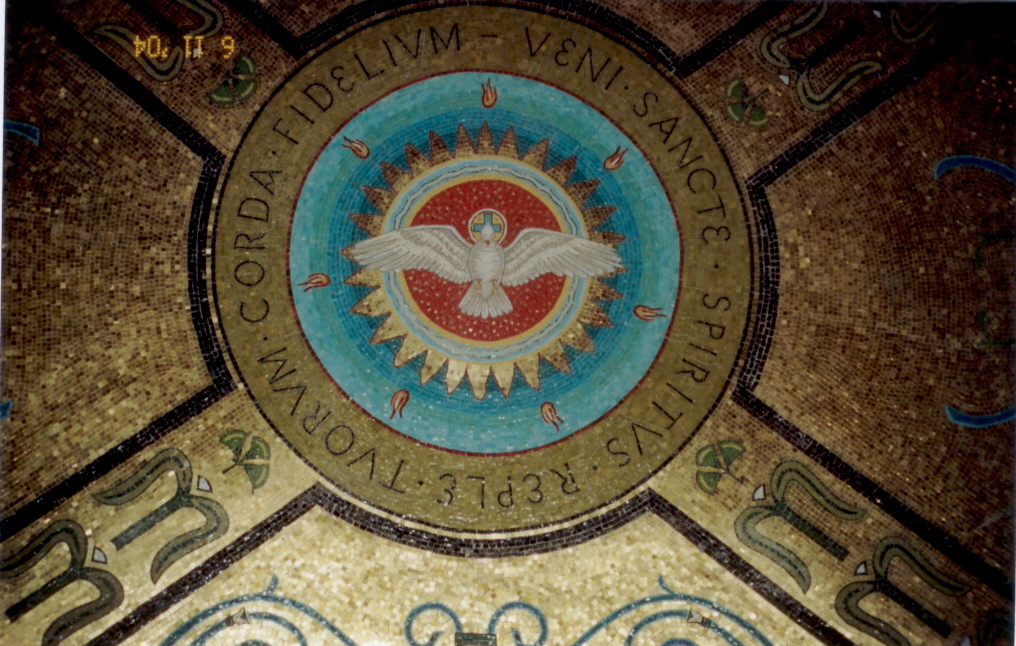
    “What is truth?”  It may not be the best thing to quote Pontius Pilate at the beginning of a homily, but as we hear about the Holy Spirit today in the Gospel, and how He will “‘teach you everything and remind you of all that [Jesus] told you,’” it seems an appropriate question.  The Holy Spirit is the Spirit of Truth, the Advocate who pleads our cause against Satan, the father of lies.  
    While we may have a general internal understanding of what truth is, it may be harder to define.  Truth is what is real, what is actual.  Truth allows us to interact with the world in a way which allows us to succeed.  Truth exerts itself and demands obedience, even if we don’t want to give it.  For example, the truth about gravity may be inconvenient, and we may want to ignore it, but if we jump off a cliff, hoping to go up, we will be sorely disappointed (and probably dead!).
    But truth isn’t only about physical realities.  Truth concerns both what is available to our senses, and what is beyond our senses, we might say both the physical and the metaphysical.  Pope St. John Paul II wrote an entire Encyclical about truth called Veritatis splendor, the Splendor of Truth, and writes that truth “enlightens man’s intelligence and shapes his freedom, leading him to know and love the Lord.”

    Truth is not up for debate.  Truth, like God, simply is, which is why it makes perfect sense for Christ to say in the Gospel, “‘I am the way, and the truth, and the life.’”  Because of the Incarnation, we can say that truth is not merely a set of propositions; truth has a face.  
    Truth does not change over the centuries, even if our understanding of it does.  Truth does not change depending on the type of government, or the political party in charge.  Truth is a light in the darkness that helps us walk on safe paths, without which we can often stumble and fall.
    But society for the past decades has struggled with truth.  Society has questioned if there even is such a thing as truth, has denied that there is truth altogether, and now can often only speak of voicing “your truth,” as if it changes not only for every time, but even for every person.  But if truth is different for every person, then communication is altogether impossible, as words presume a set meaning, an expression of a real idea, not simply our own invention of ideas based upon what we want something to be.  And this trend of questioning truth has found its way even into the people who profess, week after week, belief in God who is Truth Itself, and who reveals the truth about Himself to us out of love.
    It is vogue now, as it often has been in every century of the Church, to question this or that Church teaching, not for the purpose of understanding it more, but for the purpose of rejecting it.  Because some truths are hard for a given culture and time.  In the fourth and fifth centuries, as we came to understand Jesus Christ more, we discovered that explaining who Christ is could be difficult, but the easier answer didn’t account for who Christ had to be to save us.  He is fully God and fully man, unbegotten, consubstantial with the Father.  It would have been easier to say, like the heretic Arius, that Jesus was simply a special creature of God, above us, but not God.  That would have seemed to have been better to preserve the oneness of God.  But then, if He was not God, He could not save us.  But then, if He were not one of us, He would not be under the cost of disobedience that we acquired through sin.  And so we held to the hard truth, that Jesus Christ is one hundred percent God, but one hundred percent human, and that God, while one, is a Trinity of Three Divine Persons, while still one in substance.
    Lies are often easier, and less complicated, at least at first.  It’s easier to say, “Yes, I love this food!” that looks more like the charcoal you use in a grill.  And yet, even those “white lies” as we call them can lead to hurt and pain when, as most often happens, the truth is discovered (in this case when it’s discovered by your spouse that swallowing has suddenly become quite difficult).  And that’s just with small issues.  Imagine being told, “I love you,” by a person who is just using you.  You think that he or she really cares for you as a person, and you give yourself to him or her, trusting that you will not be betrayed, only to have that hope dashed against the rocks and your heart broken by someone who was not concerned about you, but only about him or herself.  
    Many times we know what the Church teaches, but we don’t want to accept it, because it was hard.  It was likely hard for those first Christians, especially those who were Jewish, who saw their faith as simply the right way to be a good Jew, to accept the truth revealed by the Holy Spirit to the Apostles that being a follower of Jesus didn’t require circumcision or the following of dietary laws that had been given by Moses.  It was hard, but it was the truth.  And the truth was revealed and preserved by the Holy Spirit, using the cooperation of the Apostles.  It wasn’t simply that old men wearing pointy hats decided to go one way, as is so often parroted when the Church holds fast to an unpopular teaching.  
    But just as gravity forces itself upon the individual, whether he or she likes it or not, the truths of our faith are also as stubborn; they cannot be wished away.  So if we wish to have a happy life, which comes from following the truth, not only here on earth but especially if we hope to go to heaven, we are called to subject ourselves to the truth, even when that’s hard.  If we wish to call ourselves follows of Christ who is the Truth, then we are called to follow the truth as revealed through the Mystical Body of Christ, the Church, no matter how hard it may be.  Ask the Holy Spirit today to help you know the truth, for the truth will set you free to be the person you are made to be, in the world as God made it.

16 May 2022

The Spirit of Truth

Fourth Sunday after Easter In the name of the Father, and of the Son, and of the Holy Spirit. As we are getting closer to Pentecost, our Gospels start to focus more and more on Christ leaving this world and the sending of the Holy Spirit. We hear our Lord today promise to send the Advocate to the apostles, who will lead them into all truth.
To be honest, the Holy Spirit is probably the least acknowledged Person of the Blessed Trinity. Christ is often the first, only because of the Incarnation and His taking on our human nature. Because of this, we naturally are drawn to Him. And the Father easily comes next, as a Son needs a Father. Most of our prayers are addressed to the Father, through Christ our Lord (Per Dominum nostrum Iesum Christum, Fillium tuum…). The Apostles’ Creed, the earliest baptismal creed that we have, professes faith in the Father, and in the Incarnate Son and the major events of His saving life, Death, Resurrection, and Ascension, but then just continues, “And in the Holy Spirit.” It wasn’t until the Council of Constantinople in 381 that we get the expansion of our understanding of the Holy Spirit. He is professed as, “the Lord and giver of life, who proceeds from the Father and the Son (that last part, in Latin, Filioque, being added some centuries later), who, with the Father and the Son is adored and glorified, who has spoken through the prophets.” St. Paul describes, especially in his first Epistle to the Corinthians. the gifts of the Holy Spirit and some of the charisms that can accompany the work of the Holy Spirit. St. John in his first Epistle describes the Spirit as one of the three witnesses to our Lord (along with water and blood). With the Catholic Charismatic Renewal, there was an explosion of interest in the Person of the Holy Spirit, but some (including many of those who love the Usus antiquior) were a bit skeptical of this focus on the Holy Spirit, if, for no other reason, than some of the liturgical innovations that accompanied it. What’s interesting is that, as far as theology, charismatics tend to be in step with traditional Catholics as far as being obedient to the teachings of the faith through Scripture and the Magisterium. But the Holy Spirit is given to us all, not only in Baptism, but especially in Confirmation, and works through all the seven sacraments. It is by the power of the Holy Spirit that the work of Christ continues to this day. Sometimes the Holy Spirit is demonstrated by extraordinary gifts like speaking in tongues, or words of prophecy (we hear about these charisms in the New Testament, but they didn’t stop after that). Other times the Holy Spirit is demonstrated by an attentiveness to doing God’s will in the present moment, those nudges that we get to assist this poor person with money or food, or a different way of expressing the faith to a person who is struggling, which seems to immediately help that person understand what we are saying. We need not be afraid of the Holy Spirit, any more than we need be afraid of the Father or the Son. Every good gift, as St. James says today in the Epistle, comes from above, from the Father, through the Son, in the power of the Holy Spirit. But I want to focus today on another way the Holy Spirit is revealed, which is mentioned directly in both the Gospel and the Epistle: and that is the revelation of the truth. We live in a world which both demands obedience to certain truths, all the while denying that there is any objective truth. We are told that science is to be believed by all (usually only science that favors certain policies or agendas). But then we are told that there is no truth outside of scientific facts (which is a self-defeating statement, because if there is no truth, then the statement that there is no truth is not true). One of the reasons why the Catholic Church is so often under attack is because we claim that there is truth, and that it has been revealed by our Lord through His Church. Any group that opposes the Church has to call into question the Catholic Church’s authority to proclaim the truth. I remember reading an article about how the New York Times works very hard to undermine the Catholic Church because the Grey Lady wants to be the bearer of truth (through its own ideological lenses), and does not want any competition. But we know that truth is not simply a set of propositions. Truth is a Person, a Person with a human nature and a human face, Jesus Christ. That is why we insist so much on truth, because it is an expression of faith in the Incarnate Lord. Our lies, no matter how small, are denials of Christ, who refers to Himself as the Way, the Truth, and the Life. But even Christ says that the Holy Spirit will reveal to us more truth, truth that the Apostles couldn’t bear during our Lord’s public ministry. And we know that this promise of Christ, this gift of the Holy Spirit to help us know the truth, has been preserved unbroken through 2,000 years of the Church. Doctrines do, indeed, develop, but truth does not; only our understanding of the truth expands. St. John Henry Newman likens the development of dogma as the growth of a human: the person has to remain the same, it cannot change, even while the limbs and features grow.
The Holy Spirit is the great Easter gift. When it comes to faith and morals, we don’t have to make it up, and rely on merely human wisdom (which is so subject to error). God Himself promises to reveal what we need to know about the truth, and that, when the Mystical Body of Christ teaches, it is without error. What a great assurance that is for us, especially in these days when everything seems to be changing and re-examined on an almost monthly basis! The promise of the Advocate who reveals the truth to us is the stabilizing factor as the barque of Peter is tossed about by the waves. May we hold fast to the truth always, given to us by the Father of lights, through His Incarnate Son, Jesus Christ, in the power and protection of the Holy Spirit, God for ever and ever. Amen.

20 May 2019

Easier Said Than Done

Fifth Sunday of Easter
“Easier said than done.”  We’ve probably heard and/or used that phrase countless times.  But it sure applies to today’s Gospel.  Jesus says, “‘I give you a new commandment: love one another.  As I have loved you, so you also should love one another.’”  It’s certainly easy to say that we should love others as God loves us.  But when it comes to actually doing it, that’s a different story.

Loving others can be difficult in two ways: knowing what love is, and then actually following through on loving others.  One of the greatest errors of modern society is with the definition of love.  Some say love is never having to say you’re sorry.  For others love is a feeling of delight in another person.  We use the word so often for different situations: love of food, love of a significant other, love of family, love of country, love of God.  We use the same word love for things that are very different from each other, or, at least, should be.  
For Catholics, love, true love, is willing the good of the other.  To love another person we have to want what is good for them and work for it.  Sometimes love means having to apologize for when we have done wrong, or forgiving someone else when they have wronged us.  Sometimes love doesn’t come with any good feelings.  Graduates, your teachers loved you when they gave you homework, and made you take exams.  In at least some cases, I bet that didn’t feel so good (or at least it would have felt better if you didn’t have homework or exams).  Graduates, your parents loved you when they kept you away from danger, when they gave you a spanking to help you know right from wrong, and when they dragged you to church every Sunday (maybe when they dragged you to church today).  You may not have appreciated that love, but they truly were acting for your good.  They wanted what is good for you and did their best to share it with you.
We often, as a society, divorce the truth from love.  We act as if they have nothing to do with each other.  But when love is separated from truth, it becomes mere infatuation or sentimentality, a feeling for something.  Think of a friend whom you know was being cheated on by a boyfriend or girlfriend.  What was the most loving thing to do?  Let them live in ignorant bliss for a while, oblivious to the infidelity?  Or tell your friend that the person with whom they were infatuated did not really love them?  Knowing the truth, which is intimately connected with goodness, helps us to love one another.
But besides knowing what love truly is, loving is hard because we actually have to follow through on willing the good of the other.  It is much easier to ignore other people, or to pretend that we don’t have any responsibility towards them than to love them.  In some ways our society also has made the act of loving more difficult.  People are now glued to their smart phones, their faces in a glaze at the screen even as they walk and drive.  We constantly see pictures of people who end up in danger because they’re trying to help someone who looks like they need a helping hand.  And if something goes wrong when trying to help someone, the person who tried to follow Jesus’ command to love might get sued.  All of those things and more can reinforce the mentality to mind our own business.  Plus, sometimes the people who need love do not run in our social circles, and we don’t want to be embarrassed by friends when we help them.  Throughout your schooling, dear graduates, I’m sure there were times where you felt the Holy Spirit in your conscience, encouraging you to help a classmate who was being teased or ostracized, or maybe even to stop antagonizing them yourselves.  How hard it was at those times to actually love that person because of peer pressure.  Here’s also a sad fact: peer pressure does not stop with middle or high school; it will continue for the rest of your life in different forms.
But in the midst of those difficulties, all of us, but especially you, dear graduates, need to be witnesses of true love, of willing the good of the other.  I remember well the excitement of graduating from high school, the anticipation of college, the joy of being away from my parents (though I did love them).  I had so much energy to change the world for the better, to learn the things that would help me transform the world.  And that energy is a blessing that will help you to love.  But in order to keep up that enthusiasm, you need the Holy Spirit to keep that love of others going.  You will need the Holy Spirit, Whom you received in a new, fresh outpouring when you were confirmed, to help you to know the truth more and more, and to love others in that truth.  

The world can be transformed by your witness.  The world needs to be transformed by your love.  As St. John says in his first letter, “let us love one another, not in word or speech, but in deed and truth.”

26 November 2018

Truth and Beauty

Solemnity of our Lord Jesus Christ, King of the Universe
When is a king most a king?  That might seem like a very academic question, but it impacts how we understand and celebrate this Solemnity of our Lord Jesus Christ, King of the Universe.  A king, I would suggest, is most a king when he has defeated his enemies, and his kingdom is secure.  The ideal of Jewish kings is King David, who conquered all of his enemies.  King Solomon, his son, is least kingly when he is conquered by his wives’ attachment to their foreign gods.  
So for we who celebrate this great festival, when is Jesus most a king?  When He has defeated His enemies, that is to say, Satan, sin, and death.  And when did Jesus do exactly that?  On the cross.  And so, Jesus is most kingly when He is on the cross, dying for our salvation, and, at the same time, destroying the reign of Satan over this world.  That helps us understand today’s Gospel, which is Christ being interrogated by Pontius Pilate.  Of course, this was right before Jesus was led away to His crucifixion.  Pilate asks about Jesus’ kingship, alleged by the chief priests, and Jesus answers that His kingdom is a kingdom of truth.  That truth was released upon the world in the most powerful way when Jesus was nailed to the cross, the truth that St. John the Evangelist also tells us, that, “God so loved the world that he gave His only Son, so that everyone who believes in him might not perish but might have eternal life.”
Truth is related to something else: beauty.  We so often hear the false, yet ubiquitous statement, “beauty is in the eye of the beholder.”  Beauty, though, is not subjective, because it is the splendor of the truth, and truth is utterly objective.  Something is beautiful as much as it is true, or reflects the truth.  Lies are ugly.  Tonight we enjoy beautiful music.  It’s beautiful not simply because of the number of people, not simply because of the instrumentation, nor even the notes themselves, but because it reflects the truth of heaven.  Now, maybe Mozart isn’t played 24/7 in heaven, but the genius of Mozart, why it has stood the test of time, is that he tapped into something otherworldly, something heavenly, which helps us recognize the grandeur, the immensity, the order of heaven.  And this particular piece was made for the Mass, where heaven and earth are joined in harmony with each other in this sacred space.  Mozart maybe isn’t played in heaven 24/7, but it helps us to recognize that in this church we straddle both heaven and earth as we worship Christ our King, which is true of every Mass.  

Today we worship Christ, the King, who reigned most perfectly from the cross, and who still reigns perfectly in heaven as He continues to pour Himself out fully to God the Father for Christ’s Bride, the Church.  May our adherence to the truth prepare us for what God destines for us, a place in the Kingdom of Christ the King, where we will experience the fullness of the Beauty of God, in which we participate today.

08 June 2012

"Babeling"


Pentecost
            In the story of the Tower of Babel, the sacred author of Genesis tries to explain how all the people of the earth at that time were speaking different languages.  The people try to build a tower to be able to go up to God.  Instead, God makes them speak different languages, so that they cannot complete the tower.  The Solemnity of Pentecost is the undoing of the confusion of Babel.  St. Luke records for us in the Acts of the Apostles that Jews from all over the world, who were in Jerusalem, heard the apostles speaking to them in their native languages, languages that the apostles did not know or speak minutes before the Spirit was given to them. 
While it is a work of God the Holy Spirit to allow the apostles to be able to speak to the Jews from all across the world in their own varied native languages, the story of the Tower of Babel, and the undoing of Babel at Pentecost, is about something much greater than being able to speak many languages.
            In the story of the Tower of Babel, humanity tries to make itself equal with God, to decide for itself what is right and wrong.  And the result of this pride is that everyone starts speaking differently so that no one is understood.  Our society is still a culture of Babel.
            We are a culture that values having our own opinions on just about everything and we often feel that our opinions are necessarily right, just as our neighbor feels that his opinion is necessarily right.  The result is that we often talk past each other without any understanding.  Take, for example, cable news stations like MSNBC, Fox News, or CNN.  Each presents the same facts, more or less.  But then those facts are pushed through a particular filter by which that station views the world, their opinion about how things should be, and we end up getting 3 different stories even though the facts are the same. 
            This is true also in the faith.  More and more people are deciding that their opinions about God, faith, and morality are necessarily the right ones, and no one should be able to contradict what they say, unless, of course, they want someone else’s opinion.  Whether it’s on who Jesus is, how marriage should be defined, women’s ordination, or contraception, or any other major issue, we have become the judges of right and wrong.  We are trying to build our own towers to God to tell Him how He should be.  And the result is confusion as each person speaks past each other as they share their opinions.
            Pentecost stands in stark contrast to this.  Rather than us trying to be on equal footing with God, Jesus sends the Holy Spirit to the apostles, the Blessed Mother, and the disciples to lead them into all truth, as Jesus says in the Gospel according to John, because the Holy Spirit is the Spirit of Truth.  He is not the Spirit of Opinion.  And while the many languages that were explained by Babel are still present, each person hears the truth, that Jesus is Lord and all that flows from who Jesus is, from the lips of the disciples in his or her own language.  No longer are opinions just being tossed about, but the truth is delivered, and the truth is convincing. 
            This gift of the Spirit of Truth did not end on Pentecost, as if it were a one-time event.  The Holy Spirit continues to pour Himself out to the apostles and disciples in the Church.  Through the successors of the apostles, the bishops, in union with the successor of St. Peter, the Pope, the Spirit fulfills Jesus’ promise to St. Peter that the gates of hell would never prevail against the Church and that what the apostles would be inspired to hold bound or loosed on earth would be held bound or loosed in heaven.  This gift is called the Magisterium: the bishops in union with the Pope, who teach, without error, on matters of faith and morals, like on who Jesus is, marriage, ordination, and contraception.
            But the disciples, too, are gifted with the Holy Spirit, to be persevered in the Truth.  Vatican II, in the document Lumen gentium, put it this way: “The entire body of the faithful, anointed as they are by the Holy One, cannot err in matters of belief…when ‘from the Bishops down to the last of the lay faithful’ they show universal agreement in matters of faith and morals.  It is exercised under the guidance of the sacred teaching authority, in faithful and respectful obedience…”  The lay faithful are guided by the Spirit, and, under obedience to the Magisterium, are kept in the truth so that what is believed about God, faith, and morals is not simply a matter of opinion, but is protected by the Holy Spirit as true and right. 
            Does this mean that the Church has every detail figured out?  Certainly not.  There are still prudential decisions to apply the truth to everyday situations.  But these decisions should not simply be based upon opinions, as if we decide what is right and wrong, but should be based upon the principles of faith and morality which are united to the Spirit of Truth.
            The gift of the Holy Spirit, the Spirit of Truth, is a great gift of Jesus to His Body, the Church, because it saves us from the endless babbling of opinions on what should be believed and how one should live.  There are so many voices that tell us that we should believe this or do that because they know better.  Even some Christian ecclesial communities have started to reject the parts of Scripture that do not fit modern “sensibilities.”  In the midst of this babbling, we have a sure guide in the Pope and the Bishops united with him who are protected from preaching error in matters of faith and morals because of the gift of the Holy Spirit.  And the you, lay faithful are also given the Spirit to lead you to believe and to hold on to what is taught by the successors to the apostles.  Rather than being divided among our own opinions of what we think we should believe and how we think we should live, let us be united in the Spirit of Truth in the Church so that the Gospel may be proclaimed to every language under heaven.