Showing posts with label John 13. Show all posts

19 May 2025

Two-fold Evangelization Approach

Fifth Sunday of Easter
    How do we help others recognize the important of joining the Catholic Church and living as a disciple?  Does a secret recipe or formula exist?  What program do we need to buy?  Our readings give us a hint of how we can evangelize effectively.
    Really, it comes down to two phrases from our first reading and Gospel, with the second reading an affirmation of what we heard in the first reading.  The two approaches that God gives us through His Sacred Word today are: report what God has done; and love one another.

Statue of St. Paul from St. Peter's Basilica
    The entire Bible lays out what God has done for us, which is why we read it week after week in the Church.  We’re following the pattern set down for us in the Acts of the Apostles where Paul and Barnabas, “called the church together and reported what God had done with them.”  The story of our Church, the one founded by Jesus Christ, stretches back to Judaism and the Book of Genesis, and goes all the way through the Book of Revelation.  This inerrant, privileged communication of God demonstrates what God has done.  He rescued us from the sin and death of the fall of our first parents through the Resurrection of Jesus, and then accompanied that proclamation of new life by signs and wonders.  Whether it’s the first patriarchs from the Book of Genesis, Moses and Joshua, the Judges, the good and bad kings, or the prophets, we hear how God interacts with us and calls us to the life that brings us happiness.  We then hear the life of Christ and how God worked through the second Divine Person of the Blessed Trinity.  And then we hear how the Holy Spirit continued the work of Christ through the early Church and the activity of the Apostles Paul, Peter, James, Jude, and John.  And we close Divine Revelation in the Scriptures with the culmination of how God will make everything right through the Book of Revelation, or the Apocalypse of St. John.  
    The Bible tells a very objective side of how God has worked, but we also make up the larger story of salvation history, that did not end after the death of the last apostle.  And so, part of effective evangelization also entails communicating what God has done in our own life.  No matter who we are, God works in our day-to-day life.  He’s not the God that many of the founding fathers of our country posited, who created the world, but then stands afar off, like a distant clockmaker who put together the clock and watches it wind down.  No, He’s intimately involved in every part of our life, or wants to be, and wants to guide us to live in a way that prepares us for heaven.  
    As the Book of Revelation tells us, God dwells with us as our God, and we are His people.  He works to help us stay on the narrow path to get to the place where tears are wiped away, where death, mourning, wailing, and pain no longer exist, because He has cast away the old life of sin and death, and made all things new.
    But, being a disciple goes beyond simply telling others about God.  To live as a disciple means loving others as God has loved us.  Jesus gave us this command in the Gospel today, and connected the living of this commandment to the glorification of God.  When we love others as God loves us, we glorify God, and God is glorified in us.  
    But love is not some amorphous idea.  Love means willing the good of the other in individual circumstances.  Whether we work in the home, raising children, or work outside the home; whether we are in school or on vacation; whether we try to find the right job or enjoy retirement from our job; God calls us to will the good of the other.  This can seem vague, but think about individual choices we make: if I hit my sibling because he or she annoys me, can I really say that I am willing my sibling’s good?  If I look at another person, whether live or online, with lust and use them for my own gratification, am I really willing that person’s good?  If I drive in a way that endangers my own or another’s life, am I willing the good of my fellow drivers?  If I treat people based on what they can do for me, or how productive they are for society, am I truly willing the good of those people?  The vague becomes pretty concrete when we think about it that way.
    The early Church seemed pretty good at sharing what God had done for His People (generally) and them (individually).  They were convinced that others needed to hear the hope and joy that God does not dwell in some far-off heaven, removed from our everyday experiences, but loves us and wants us to involve Him in our day-to-day life, to increase our joys and bear our sorrows with us.  They did not treat people based upon their social status or economic bracket, but loved even those whom society had cast away or who seemed dispensable.  And in this way, whether in Judea, or Egypt, or Persia, or India, or Rome, or wherever, the Gospel spread.  
    So while there are best practices in evangelization, there is no secret recipe or formula.  There is no program that we can buy that can replace these two essential factors: sharing what God has done for us, and loving others.  Not just to grow our parish, but to help people get on the road to heaven, God calls us to these two aspects of evangelization.  Will we share the Gospel and help others get to heaven?  Will we share what God has done for us, and love them as God has loved us?

19 April 2025

Bracing for Impact

Holy Thursday–Mass of the Lord’s Supper
    When I served as the Administrator of St. Joseph parish in Adrian, before Bishop Boyea assigned me as pastor, I still kept the same dentist in Williamston I had had growing up.  On 24 November 2014, I had morning Mass, and then started the drive up M-52 to get to Williamston for my appointment.  It had snowed recently, and there was maybe an inch on the ground, the roads were clear, except in the middle of the two-lane road and on the shoulders.  The sun was out and it was mostly clear skies.

My car after the accident
    Just after I left the village of Stockbridge, heading north on a straight stretch of road at around 55 mph, there was a Chevy Tahoe traveling south.  All of the sudden, the Tahoe started to slide into my lane, and I knew what would happen next.  I closed my eyes out of reflex as the moment of impact came, and tensed up, bracing for impact (which is, ironically, one of the worst things you can do if you know you’re going to be hit).  When I opened my eyes I was facing west, between 10 and 20 feet into a field on the east side of M-52.  All my airbags had deployed, and I could not feel any major injuries.  While I was taken to the hospital for evaluation, I had no major injuries, though my car was totaled.
    I knew something bad was going to happen, and I braced myself.  Tonight, as we begin this Sacred Triduum, these three holiest of days, I invite us this year to look to our Lord to see what He did as something not just bad, but awful, prepared to happen.
    In the Gospel tonight we simply hear about the washing of feet.  But, between Palm Sunday and Good Friday’s Passion Narratives, we know what else happened.  The Lord instituted the priesthood (which we celebrated liturgically this morning at the Chrism Mass) and the Eucharist.  He then went to the Garden of Gethsemane, not too long of a walk from the Upper Room, and there prayed so intensely that blood dripped from his body.  As the night progressed, Judas, one of His hand-picked Apostles, His closest friends, betrayed Him, and the Jewish soldiers took Jesus to the house of the High Priest for questioning.
    What a dramatic shift!  It’s like the weather in Michigan: going from 70 degrees one day to 30 degrees that night.  Christ had the joy of being with His closest friends and telling them that they would share in His power to change bread and wine into His Sacred Body and His Precious Blood.  But none of them quite understand.  And then, as He goes off to pray, the three closest of the closest–Peter, James, and John–all fall asleep, perhaps emotionally overwhelmed themselves in confusion of having their feet washed and eating what looked like bread, but that Christ had assured them was His Body.  
    The mental anguish was so much that Christ lost blood while praying to His Father, hoping that there could be another way to save humanity, but entrusting Himself in obedience to the will of the Father.  And then that moment, a moment He saw coming, when Judas came to betray Him with a kiss, and He was arrested and taken away, while His closest friends mostly scattered and fled.
    Throughout it all, Christ leans into His relationship with the Father.  St. John the Apostle and Evangelist records the beautiful, poetic, and cryptic monologue that we call the Last Supper Discourse, where Jesus talks about His connection to the Father.  We struggle when we try to explain the love we have for a spouse or a best friend.  Even more so do words fail to properly communicate the love between the Eternal Father and Co-Eternal Son.  
The church built over the place in the Garden of Gethsemane where Jesus prayed
    And in the agony in the garden, the first sorrowful mystery of the Rosary, Christ leans in on His relationship with the Father to ask that the chalice of suffering might pass, but that God’s will would be accomplished, and that Christ would be obedient to it, no matter the cost.  How fully the words of Psalm 116 were fulfilled on Good Friday as Christ took up the chalice of salvation and called on the name of the Lord.
    So, when we struggle with difficulties, as members of the Mystical Body of Christ, we should lean in to our relationship with the Father.  We are His beloved children, adopted in Christ.  When any difficulty comes our way, do we go to God immediately?  Do we ask for His help?  And, like Christ, do we humbly submit to the will of the Father, even when the chalice of suffering cannot pass by?  
    As we enter these three most holy days, may we cling to our love of the Father and His love for us, the love that saved us from sin and death, and opened heaven to all believers.

27 March 2024

The Eucharistic Plan

Mass of the Lord’s Supper
    When I was a young kid, one of my favorite pastimes was building stuff with my Legos.  Sometimes I would just put blocks together, but I’m Type A enough that I would always return to the plans that I came with the Lego set.

The Upper Room in Jerusalem
  Christ today sets out for us a plan, a plan centered around the Eucharist, whose institution we celebrate tonight. We don’t hear the entire plan tonight, as we hear just one snippet from John’s Gospel, but we are all (hopefully) familiar enough with what happened on Holy Thursday that we can extrapolate from other Gospel accounts the plan that Jesus gives us for how to follow Him.
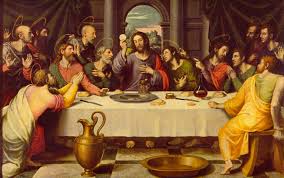
    Jesus demonstrates the first part in the Gospel we heard tonight.  John is the only evangelist to recount this beautiful encounter between Christ and His Apostles, His first priests (tonight also celebrates the institution of the priesthood).  Christ takes off his outer garments, and washes the feet of His disciples as a demonstration of love and humility from God.  And this is the first part of our Lord’s plan for following Him: allow Him to come to us and show His love and care.  
    We can often think that we have to make the first move when it comes to our relationship with God.  But that’s not how it works.  God always comes to us first.  Even the desire to know God is itself a gift from God.  God has loved us from all eternity, and He makes His love known to us in real ways.  Maybe that love is the love we receive from our parents.  Or maybe it’s a moment that we acknowledge the presence of God because we sense it deep within ourselves.  But God comes to us to invite us to enter into a relationship with Him.  
    Sometimes that invitation comes to us in ways that unsettle us.  Peter did not want the Lord to wash his feet.  He felt that was beneath the Messiah.  But, let’s be honest: taking on our human flesh is beneath God, inasmuch as the God who created heaven and earth and all that is in them humbles Himself to be bound in time and space, to feel the pressing heat of the day, to get chilled in the cool of the night; to hear a stomach growl because the food didn’t fully satisfy the desires of the body; to lick chaffed lips which had dried out.  God did not need to experience any of that, and yet He did, because of His great love for us.  So, in our desire to be good disciples, good followers of Jesus, we need to be attentive to God revealing Himself to us and sharing His love for us, sometimes in unexpected and uncomfortable ways.
    Secondly, we knew what happened after that.  Matthew, our patron, Mark, and Luke, record it well, and St. Paul speaks of it as well in our second reading: our Eucharistic Lord takes bread and changes it into His Sacred Body; He takes wine and changes it into his Precious Blood.  The second part of God’s plan is to allow Christ to offer Himself for us.  Of course, the offering on Holy Thursday night was a prefigurement of the total offering of self on Good Friday on Calvary.  The Eucharist always points to the sacrifice of the Lamb of God on the altar of the Cross.  But Christ desired that all generations would not only remember, but also share in, the once-for-all sacrifice, and so He gave us His Body and Blood, without which, Jesus says in the Gospel according to St. John, we do not have life within us.  
    That is the great joy of what we celebrate tonight, and at every Mass.  Christ, mindful of our need for Him, offers Himself for us, so that we can have His life flowing within our veins.  If Christ is the Vine and we are the branches, the Eucharist is the sap flowing through the branches, keeping us alive on the vine.  This is one of the greatest sadness of those who walk away from the Catholic Church: no matter how good the preaching is; no matter how much the music moves them; no matter what other programs are offered; they lack the spiritual sustenance which keeps us alive in Christ.  Tonight should not only stir up in us the sense of how much we need Christ feeding us, but also encourage us to reach out to those who have fallen away, and bring them back, first to the mercy of God in confession, so that they can fruitfully receive the Body of Christ and restore them to life.
    Third, and all the Gospel writers communicate this action, Christ goes out with His Apostles.  In the case of our Lord, He goes to the Garden of Gethsemane to pray to His Father for the strength to endure the Passion which awaited Him.  But the Eucharist does not mean we hunker down and stay hidden from the world.  It means we go out, to take that life and share it with others by the increased joy and love that we have because of Christ.  The going out, as Christ shows us, is not always easy, and sometimes involves great pain and sacrifice.  But the Upper Room is not an end in itself.  Our worthy reception of Holy Communion should push us out, like an infant who wants to leave the comfort of the womb in order to begin to realize a fuller potential.
An olive tree in Gethsemane which existed at the time of Jesus
    So, this pattern for us is: to allow Christ to come to us, even in unexpected ways; to receive spiritual nourishment from Christ Himself; and to then allow that spiritual nourishment to push us out and follow God’s will.  All of our Catholic life can be broken down into one of those three parts of the plan for us following Christ.  And they all happen, or are meant to happen, time and time again throughout our lives, in this continuing cycle on our pilgrimage to heaven.  
    Build with the plans God has given us.  Allow God to come to you tonight, in whatever way He wants to.  Receive worthily the Eucharist and be fed by God to have strength for God’s mission for you.  Joyfully share the love and truth of God which you have received in Holy Communion.  The plan may include heartbreak and suffering; it may take us out of our comfort zones.  But the plan will help us to be the disciples and the saints that God wants us to be, and so transform the world according to the plan of God.

03 April 2023

Anamnesis: A Special Kind of Remembrance

Mass of the Lord’s Supper

    In the name of the Father, and of the Son, and of the Holy Spirit.  Amen.  Usually at least once per lifetime, there is an event that looms larger than life, often times a tragedy.  Sometimes the event affects mostly local folk.  Other times it impacts an entire country or world.  No doubt those who attended MSU this year will talk about where they were when the shooting happened on campus.  For me, the major event was the terrorist attack on 9/11.  For those slightly older than me, maybe it was the explosion of the Challenger space shuttle.  For those in my parents’ generation and older, it was the JFK assassination. 
    These events weigh differently than other memories.  It almost always yields the question, “Where were you…?”  My mom talks about watching her mother, my grandmother, cry as the television reports of JFK’s death started to roll in.  I can remember walking down the hall of Lansing Catholic High School, and hearing our principal come over the PA and tell teachers that they may want to turn on the TV (we only had local channels) in their classrooms, and watching replays of the airplanes hitting the World Trade Center, and the buildings collapse before our eyes.  These events are not just memories in the sense that I remember my graduation; they etch themselves in a unique way into our very sub-conscience which seems to make the past present once more.
    The Greek word anamnesis is the word used for this kind of remembering, and which applied to the Passover celebration that Moses commanded the people to observe.  That night, the night that the angel of death passed over the houses of the Israelites marked with the blood of the lamb, was certainly one of those great events that etched itself in the memory.  But Moses commanded that it be celebrated each year in much the same way (though without the blood on the doorposts).  They were not only to remember the event, but, as it were, enter once more into that saving act which initiated their freedom from slavery in Egypt. 
    Since Christ celebrated the Passover (albeit a day early, due to His impending death), His celebration of the Last Supper dripped with that same significance and bearing.  The Apostles knew that they were entering into a sacred moment which brought to the present they ancient liberation from the Egyptians.  But our Lord changed some of the celebrations, which would have been noticeable.  First, He began with what we heard in the Gospel today, where He washed the feet of His Apostles.  Certainly the Apostles would have been shocked at this happening, but perhaps more so because it proceeded the ancient ritual.  Peter, never one to simply go with the flow, objects, but then wholeheartedly embraces such a new ritual.
    But even at the Passover meal, Christ changes the ritual.  No longer so much about a liberation from slavery, but now the giving over of His own Body and Blood, as He creates a new ritual for His Chosen Band, and for the Church which will embrace, not only Israel, but the entire world.  Again, the Apostles would have noticed this stark difference, and would have understood the words “Do this is memory of me” as a command for this new ritual to be repeated into the future, just as the Passover had been commanded by Moses. 
    As we enter into this new ritual, as we obey the command of the Lord to celebrate this sacrifice in His memory, we are not simply thinking back some 2,000 years to what happened in an upper room.  At this Eucharistic celebration, and at every Mass, we do not only recall what Christ did for us.  We enter into His offering of His Body and Blood under the sacramental signs of bread and wine.  We participate in that to which the Last Supper points, the death on the cross on Calvary. 
    No longer is it the blood of a dumb animal that covers the lintels of our doors, but the Precious Blood of the truly unblemished Lamb of God that paints the lintels of our lips as we receive the Body and Blood of Christ.  No longer does that blood tell the Angel of Death to pass over the house so that the children of Israel can be freedom from bondage in Egypt after they passed through the Red Sea, but the Precious Blood tells Satan not to enter the holy temple of God that we have become by baptism, and we are freed from any venial sins and oppression by the devil. 
    Remembering is good, and provides some benefits.  But entering in allows us to share in the benefits of what happened.  Our participation at Mass is not meant to be like watching an old Super Bowl on TV.  We are meant, using that analogy, to be on the field in that old Super Bowl game.  Yes, it happens sacramentally, but it still happens, nonetheless. 
    And so, at this Mass, as at every Mass, may we not simply act like spectators at an ancient event, but truly give our hearts and minds to being in that Upper Room with our Lord.  As we walk in procession tonight, may we see ourselves walking with our Lord from that Upper Room, across the valley, to Garden of Gethsemane, where Christ will ask us to watch and pray with Him.  As the ancient hymn from the Divine Liturgy of St. James sings, “Let all mortal flesh keep silence, / and with fear and trembling stand. / Ponder nothing earthly minded / For with blessing in His hand. / Christ our God to earth descending, / Our full homage to demand”, who, with the Father and Holy Spirit reigns for ever and ever.  

11 April 2022

The Ones the Lord Chooses

Mass of the Lord’s Supper
    In the name of the Father, and of the Son, and of the Holy Spirit.  Amen.  This is one of the weightier days for me as a priest.  I started this morning at the Chrism Mass, concelebrating with Bishop Boyea and my brother priests serving across the Diocese of Lansing.  Not only were the holy oils and Sacred Chrism blessed and consecrated, but we renewed the promises we made at our ordination.  It is a time of great joy, as we see each other again and catch up, and then celebrate the Mass together.  It’s a great way to celebrate the Institution of the ministerial priesthood, which took place on that first Holy Thursday.

    Then, as tonight starts, it is a very moving celebration, as I will wash the feet of twelve parishioners, this year from both St. Pius X and St. Matthew parishes.  What seems like a simple ritual has great import for me as a priest.  It is a reminder to me that my role as your pastor is to serve not to be served, and to give my life as a ransom for you.  Washing feet was awkward then because of the nature of how dirty feet were (given only sandals being worn, and likely some dung being mixed in with the dirt).  Now it’s the awkwardness of taking off shoes and socks.  But it is a treasured moment in my life. 
    Then, at the end of tonight, we will walk in solemn procession to the altar of repose and keep watch with our Lord, putting ourselves in Gethsemane.  The Lord was preparing for His Passion in Gethsemane.  At our altar of repose, I often think of the crosses I have borne in my ministry as pastor, some carried better than others.  I offer through Christ to the Eternal Father in the power of the Holy Spirit all that weighs upon me and all that weighs upon you as we seek to know and follow the will of God in our lives, no matter how joyful or painful it may be from day to day. 
    Returning to the washing of the feet, I couldn’t help but think of the Apostles, and what our Lord was doing for them, mixed bag as they were.  I think we have a tendency to think of them more like statues than anything else, religious icons of peace and serenity.  But the Gospels paint them as anything but.  Matthew, the tax collector and our patron here, was probably not easily accepted into the apostolic college, and perhaps treated with a bit of contempt among his fellow Apostles.  James and John were full of zeal, and John seems to have had a special bond with the Lord, perhaps because he was the only Apostle who was unmarried, like Jesus.  Andrew in the Gospels is a helper, as he is the one who brings the boy with the five loaves and the two fish to Christ.  Philip and Nathanael are pretty pragmatic, as Nathanael wonders if anything good can come from Nazareth and doesn’t believe until the Lord knows that Nathanael had been sitting under a tree, and Philip wonders how Christ could feed five thousand, given how many days’ wages it would have cost to secure food.  In the Last Supper discourse, Philip will also ask Christ to show them the Father, and that will be enough for them, to which the Lord responds that He who sees Him sees the Father.  We know little about the Simon, other than Simon belonged to the party of the Zealots, and James the Lesser was a cousin of the Lord.  Jude asks at the Last Supper why the Lord will reveal Himself to them only and not to the world, so perhaps he was hoping for a conquering king as a Messiah.  
    And then we come to Peter.  Peter was likely an extrovert, as he had to say something before he understood what he was thinking.  He has moments of greatness (think of his two great lines: “You are the Christ, the Son of the Living God” and “To whom shall we go?  You have the words of everlasting life”); he has moments where you want to face palm (probably not a good thing if Christ says to you, “Get behind me, Satan”).  He at first refuses to have the Lord wash his feet, but then asks for an entire bath instead.  He swears he will not deny Christ, only to do so some hours later. 
    And, of course, Judas.  Christ washes his feet, but then Judas leaves in order to betray Christ.  Dante puts Judas in the lowest level of Hell because of his betrayal of God, even going so far as to betray the Prince of Peace with a kiss of peace.  He later regrets his betrayal, but despairs and takes his own life in shame.
    These were the ones Christ came to serve.  They were as different, unique, and diverse as we are.  They were not perfect; some far from it.  And yet Christ chose them.  He chose them to be His first priests, to hand on the mysteries of the kingdom of heaven, which are not mind-teasers to be solved, but realities expressed in symbol that run far deeper than their physical representation.  He did so knowing that one would betray Him, and one would deny Him.  He did so knowing that all would scatter from the garden at His arrest, and only one would be at the foot of the cross with Him at His moment of greatest need.
    And that should give us hope.  Because Christ chose us, too.  He chose us knowing that we would sometimes fail, that we would sometimes deny that we know the Lord, and that we would sometimes abandon Him when the going got tough.  He knew that at times we, like Judas, would betray Him.  He chose us with our differences, our idiosyncrasies, our unique ways of seeing the world. 
    And, as long as we have repented for those times of betrayal, denial, and abandonment through the Sacrament of Penance, He invites us to eat of His Body, to be strengthened so that next time we might not betray, deny, and abandon.  Just as He instituted the Eucharist at the Last Supper, the mystery of His Passion and Death presented for us under the appearance of bread and wine, but truly His Body and Blood, so He gives us Himself tonight so that we can stand with Him through His Passion, made present for us in these sacred liturgies of the Triduum. 
    The great sign of Christ’s service for us is how He gives Himself to us each time the Holy Mass is celebrated.  He serves us by nourishing us, strengthening us, sacrificing Himself for us so that we can have life within us.  As the hymn sings, “What wondrous love is this!” 
    So tonight, as you approach the altar to receive the Lord on your tongue, think not on your differences from each other; think not on the great things you have said of our Lord, or the horrible ways you have denied even knowing Him; think not on how you have helped the Lord to be known, or hidden His truth out of fear.  Think only of His love for you, a love that was obedient even to the point of death, death on the cross.  In the name of the Father, and of the Son, and of the Holy Spirit.  Amen.  

31 March 2021

Food for the Journey

 Holy Thursday–Mass of the Lord’s Supper


    When many Catholics today talk about Last Rites, they think of the Sacrament of Anointing of the Sick.  But when the Church talks Last Rites, she talks about the Sacrament of Penance, the Apostolic Pardon, the Sacrament of Anointing of the Sick, and Viaticum, or Holy Communion for a person on the way to death (Viaticum is a smash-up of the words meaning “on the way with you).  We were taught in seminary that when a person is seriously ill, they are to be anointed.  When a person is certainly (barring a miracle) not getting better, the priest may anoint again, but certainly offers Viaticum (and Viaticum can also be offered by a deacon).  In the Church’s mind, the last sacrament a person should receive on earth is the Body of the Lord, Holy Communion with the Lord, because that is what we pray the person will experience after death, communion with the Lord in heaven.  
    We probably don’t often think about it this way, but the Eucharist is meant to be spiritual food for a people ready to move on somewhere.  We see that even in the prefigurement of the Eucharist in the Passover sacrifice.  The Jews were to sacrifice an unblemished lamb, spread its blood over the doorposts and lintel, and eat it.  They were to eat it “‘with your loins girt, sandals on your feet and your staff in hand, you shall eat like those who are in flight.’”  The eating of the Passover lamb was to prepare the Chosen People for their pilgrimage from slavery in Egypt to freedom in the Promised Land.  
    So for us, the Church, the Eucharist is our food for the journey, not only the journey from this life to the next, but even our daily journey from the safety of the church into the war zone of the world, where we fight against spiritual powers inside of us and outside of us.  It is meant to strengthen us for our witness to the Gospel in our daily life.  And yet, how often do we see it as boring, as just another obligation.  Dorothy Day, the great, saintly woman of the Catholic Worker movement, related a scenario when she encountered one such person:
I was saddened last week when a former nun told me she was tired of going to Mass daily.  She had been doing that for fourteen years, and no longer felt it necessary.  So much routine.  One could only point out that breathing was routine, and eating was routine…We go to eat of this fruit of the tree of life because Jesus told us to….He took upon himself our humanity that we might share in his divinity.  We are nourished by his flesh that we may grow to be other Christs.

Indeed, as Jesus prepare to celebrate the Last Supper, the first thing He does is serve.  He washes the feet of His apostles.  So for us, after we receive the Eucharist, we are called to serve.  Jesus says, “‘I have given you a model to follow, so that as I have done for you, you should also do.’”
    This is not to say that the Eucharist is merely a means to an end, the means by which we move on to the really important stuff, the activity of daily life.  In fact, it’s the other way around.  The Eucharist is the really important “stuff,” and the activity of daily life is the overflowing of the cup that is filled only with the Body and Blood of our Lord.  
    Jesus gave us the Eucharist because He knew we needed to be fed by God as part of our worship.  He knew that so few would be with Him on Golgotha, as He did what the Last Supper pointed to: give up His Body and Blood for the salvation of the world.  And from that most important act of the crucifixion, the transformation of the world became possible.  So it is only after we are worthily nourished by Eucharist that we are able to be the disciples that we are called to be, relating to others by word and deed how our connection to Jesus changes us.
    And then, there is a double movement that, after our daily activity of living as disciples, brings us back here, back to the Mass.  Having utilized the spiritual energy which we received the last time we went to Mass, we are drawn back for more, because we hunger more for God.  And yet, we also are drawn back to thank God for the power that we have seen exercised through us as we shared the fruits of the Eucharist we received in talking about Jesus, in loving like Jesus, in serving like Jesus.  “How shall I make a return to the Lord / for all the good he has done for me? / The cup of salvation I will take up, / and I will call upon the name of the Lord.”  We return because we hunger more; we return because we thank God for what the Eucharist made possible in our lives.
    As we begin these three holiest of days–Holy Thursday tonight, Good Friday tomorrow, Holy Saturday culminating in the Easter Vigil–there’s a lot going on.  If we are truly, fully entering into it, we’ll be physically, emotionally, and spiritually tired.  We will need sustenance.  Even though we won’t celebrate Mass again until Holy Saturday night, the Church will feed us with the Eucharist tomorrow from what was consecrated tonight.  And then we’ll have the chance to be fed once more on Holy Saturday evening as we will rejoice in the news the surpasses every joy.  Only those who are in need of Viaticum can receive the Eucharist at another time on Holy Saturday, because the Church knows they need Holy Communion to prepare them for the ultimate communion with God.  
    Tonight we are fed by the Lord, Who knows that we need Him to be His disciples.  May we never find the reception of Holy Communion routine, but find in it our strength to be the saints God has called us to be.

10 April 2020

It's Not Supposed to Be This Way

Mass of the Lord’s Supper
The Upper Room in Jerusalem (now a mosque)

    Many people presume that the Passover meal that Jesus celebrated was a Seder Meal.  I myself remember being in Catholic elementary school during Holy Week and having small Seder Meals in a classroom.  I wasn’t a fan of the egg, but I did enjoy the matzoh, parsley and the charoseth (which was a mixture of apples, walnuts, cinnamon, and honey).  Instead of real lamb, we had a paper lamb cut out for us (when I first tasted lamb many years later, I learned how truly disappointing it was to only have paper).  But scholars, even Jewish scholars, that I have read, state that the Seder Meal originated sometime after the destruction of the Temple in Jerusalem around the year of our Lord 70.  So Jesus, at the Last Supper, most likely was not celebrating a Seder Meal.  But, that’s not to say that the Passover didn’t have rituals.  Indeed, our first reading starts to outline some of the rituals of the Passover meal.
    Rituals are repeated actions, sometimes associated with religion.  The beauty of ritual is that, for the most part, it’s not supposed to change.  So the Apostles, gathered in the Upper Room with Jesus, had some idea of what was going to happen, even if it started out oddly, as it was a day earlier than the first Passover celebration was supposed to begin. 
    But those ideas were quickly shattered.  Before the celebration begins, Jesus takes off his outer garments and serves the Apostles in the task usually reserved for the lowest slave.  You can imagine the Apostles thinking, “It’s not supposed to be this way!”  Peter is the only one who has the courage to actually say what’s on his mind: “‘Master, are you going to wash my feet?’”  Jesus is the Master, the Messiah, the Anointed One of God who is supposed to lead Israel into a new kingdom of prosperity!  What is Jesus doing?  It’s not supposed to be this way!
    And then, as they celebrate the Passover (in whatever way that happened), Jesus changes things.  When it comes to the unleavened bread, Jesus changes the ritual and says, “Take this, all of you, and eat of it, for this is my Body.”  And then when it comes to the wine, Jesus again changes the ritual, and says, “Take this, all of you, and drink from it, for this is the chalice of my Blood, the Blood of the new and eternal covenant, which will be poured out for you and for many for the forgiveness of sins.  Do this is memory of me.”  As they ate the Body of the Lord, and drank His Blood in the celebration of the first Eucharist, I can imagine them thinking, ‘It’s not supposed to be this way!’
    After the first Eucharist, Jesus then has a beautiful prayer and conversation where He goes back and forth between a conversation with the Apostles and a conversation with His heavenly Father.  We call this the Last Supper Discourse, and if you’re looking for a beautiful read tonight and tomorrow and Saturday, you can read the Gospel of John chapters 14-17.  This was certainly not part of the Passover meal (you’ll get why if you read the chapters), and so probably the Apostles were thinking, ‘It’s not supposed to be this way!’
    As I celebrate Mass tonight, the same thought is on my mind: it’s not supposed to be this way.  The church is not supposed to be empty; there’s supposed to be the optional ritual of washing feet; there’s supposed to be a Eucharistic procession.  None of that will happen.  In fact, Cardinal Sarah, speaking for the Pope, had to give special permission for priests to celebrate this Mass with only one minister, as that has, from time immemorial, never been allowed.  Don’t get me wrong: Jesus is still here, the bread and wine will still become His Body and Blood, but I think that we realize that it’s not supposed to be this way.  The Mass of the Lord’s Supper is meant to be our special entering into the Lord’s Passion for all parishioners, not simply for the few who are necessary to pull off a beautiful, but minimal, celebration.
    But what followed from that first Eucharist, administered by the hands of Jesus Himself?  Salvation followed.  Dark days, yes, but light, too.  Suffering, intense suffering, but later, peace and joy.  Death, a death unlike any before or any after, but also resurrection.  All those came through a celebration that wasn’t supposed to be the way it happened.
    So, what will follow from this year’s, “it’s not supposed to be this way”?  Jesus is offering the same gifts, but our response will dictate whether or not we receive those gifts.  Will we treasure our reception of the Eucharist, rather than simply see it as the weekly routine we go through?  Will we prepare better for the celebration of the Eucharist, perhaps by confession, but always by quieting our hearts and minds to hear what the Lord wants to say to us?  We will allow the Eucharist to transform us and change the way that we interact with each other after we leave Mass? 
    There are many tragedies during this time of pandemic.  But the biggest tragedy of this time of fasting from public Mass in our churches will not be those who are infected or who have died, tragic as that truly is.  The biggest tragedy of this time of fasting from public Mass will not be the economic changes that churches have to make to adapt.  The biggest tragedy of this time when we cannot pray together in person in our parish church will be if, after all of this is over, we return to the same life we had before and not appreciate the sacrifice that Jesus allows us to share in every time we get to come to Mass by either not even coming when we don’t feel like it, or receiving the Eucharist in an unworthy state.  Tonight Jesus teaches us: it’s not supposed to be that way.

20 May 2019

Easier Said Than Done

Fifth Sunday of Easter
Easier said than done.”  We’ve probably heard and/or used that phrase countless times.  But it sure applies to today’s Gospel.  Jesus says, “‘I give you a new commandment: love one another.  As I have loved you, so you also should love one another.’”  It’s certainly easy to say that we should love others as God loves us.  But when it comes to actually doing it, that’s a different story.

Loving others can be difficult in two ways: knowing what love is, and then actually following through on loving others.  One of the greatest errors of modern society is with the definition of love.  Some say love is never having to say you’re sorry.  For others love is a feeling of delight in another person.  We use the word so often for different situations: love of food, love of a significant other, love of family, love of country, love of God.  We use the same word love for things that are very different from each other, or, at least, should be.  
For Catholics, love, true love, is willing the good of the other.  To love another person we have to want what is good for them and work for it.  Sometimes love means having to apologize for when we have done wrong, or forgiving someone else when they have wronged us.  Sometimes love doesn’t come with any good feelings.  Graduates, your teachers loved you when they gave you homework, and made you take exams.  In at least some cases, I bet that didn’t feel so good (or at least it would have felt better if you didn’t have homework or exams).  Graduates, your parents loved you when they kept you away from danger, when they gave you a spanking to help you know right from wrong, and when they dragged you to church every Sunday (maybe when they dragged you to church today).  You may not have appreciated that love, but they truly were acting for your good.  They wanted what is good for you and did their best to share it with you.
We often, as a society, divorce the truth from love.  We act as if they have nothing to do with each other.  But when love is separated from truth, it becomes mere infatuation or sentimentality, a feeling for something.  Think of a friend whom you know was being cheated on by a boyfriend or girlfriend.  What was the most loving thing to do?  Let them live in ignorant bliss for a while, oblivious to the infidelity?  Or tell your friend that the person with whom they were infatuated did not really love them?  Knowing the truth, which is intimately connected with goodness, helps us to love one another.
But besides knowing what love truly is, loving is hard because we actually have to follow through on willing the good of the other.  It is much easier to ignore other people, or to pretend that we don’t have any responsibility towards them than to love them.  In some ways our society also has made the act of loving more difficult.  People are now glued to their smart phones, their faces in a glaze at the screen even as they walk and drive.  We constantly see pictures of people who end up in danger because they’re trying to help someone who looks like they need a helping hand.  And if something goes wrong when trying to help someone, the person who tried to follow Jesus’ command to love might get sued.  All of those things and more can reinforce the mentality to mind our own business.  Plus, sometimes the people who need love do not run in our social circles, and we don’t want to be embarrassed by friends when we help them.  Throughout your schooling, dear graduates, I’m sure there were times where you felt the Holy Spirit in your conscience, encouraging you to help a classmate who was being teased or ostracized, or maybe even to stop antagonizing them yourselves.  How hard it was at those times to actually love that person because of peer pressure.  Here’s also a sad fact: peer pressure does not stop with middle or high school; it will continue for the rest of your life in different forms.
But in the midst of those difficulties, all of us, but especially you, dear graduates, need to be witnesses of true love, of willing the good of the other.  I remember well the excitement of graduating from high school, the anticipation of college, the joy of being away from my parents (though I did love them).  I had so much energy to change the world for the better, to learn the things that would help me transform the world.  And that energy is a blessing that will help you to love.  But in order to keep up that enthusiasm, you need the Holy Spirit to keep that love of others going.  You will need the Holy Spirit, Whom you received in a new, fresh outpouring when you were confirmed, to help you to know the truth more and more, and to love others in that truth.  

The world can be transformed by your witness.  The world needs to be transformed by your love.  As St. John says in his first letter, “let us love one another, not in word or speech, but in deed and truth.”

10 April 2017

24

Mass of the Lord’s Supper
What would you do if you knew you had 24 hours to live?  What person or persons would you want to see?  Where would you want to go?  What unfinished tasks would you try to complete?  Most people never have that foreknowledge.  Even when a person is older, and knows that death is soon coming, we never quite know when.  But what if you did?  What if you knew, right now, that at this time tomorrow you’d no longer be a part of this world?
Jesus was in that very boat; He knew that less than 24 hours from that first Holy Thursday, He would be buried in the tomb.  St. John reminds us of this fact: “Before the feast of Passover, Jesus knew that his hour had come to pass from this world to the Father.”  With whom does Jesus spend His time?  Where does He go?  Does He try to finish any incomplete tasks?
Jesus spends His time with His Apostles.  He celebrates His Last Supper with those whom He had chosen to govern His Church, and to act in His Name.  And He begins, as we heard in tonight’s Gospel, by washing their feet.  He teaches them that, though they are called to act with Jesus’ own power and authority, that power and authority is given to them to serve the entire Church.  Jesus washed the feet of all twelve of His apostles, even Judas.  In one of the last acts of His earthly ministry, Jesus serves the one who will, that same night, betray Him with a kiss.
After washing their feet, and after Judas leaves to set in motion his betray, Jesus begins to celebrate the Passover with His apostles.  But He changes it radically.  He says those words that had been passed down to St. Paul, which he, in turn, passed down to us: “‘This is my body that is for you.  Do this in remembrance of me.’”  And “‘This cup is the new covenant in my blood.  Do this, as often as you drink it, in remembrance of me.’”  Already startled by Jesus announcing the betrayal of Judas, who leaves shortly thereafter; and by Jesus announcing that Peter, the leader of this small band, would deny Jesus, their senses are heightened, and they realize Jesus is doing something new.  And in the act of breaking the bread and saying the new words of this new rite, and in the act of passing the chalice and saying the new words of this new rite, both the sacramental priesthood and the most holy Sacrament of the Eucharist are instituted.  
Then begins a long, beautiful, poetic prayer of Jesus to the Father, even as He also speaks to His apostles.  We call those words the Last Supper Discourse, and they are an expression of Jesus’ love for His Apostles, His first priests, but more importantly, Jesus’ love and unity with the Father, which will sustain Him even as it seems to escape Him in His Passion.  Nothing seems forced in these words; nothing rushed.  Jesus knows what He wants to say, and how He wants to say it.  At this point in the night, there is no anxiety, no troubled soul, but only the intimacy of a Master and His chosen friends who will continue His work in His Name.  

In His last 24 hours on earth, Jesus does what He did for all the hours of His earthly ministry: He gave Himself, according to the will of the Father, for His people.  While we know how much His human nature shuddered at the thought of the price He would have to pay to redeem His people from sin, He gave of Himself nevertheless.  

Psalm 116 tonight asks, “How shall I make a return to the Lord for all the good he has done for me?”  How can we repay God, who has given us everything that we need, and even more beyond that.  No matter what we give God it would never be enough to repay our debt.  But there is one acceptable gift that God desires: all of who we are.  We are invited to do the same thing Jesus did: to give of ourselves out of love of God and love of neighbor.  Jesus gave us His all.  Can we give Him ours?

25 March 2016

Union in the Face of Separation

Holy Thursday–Mass of the Lord’s Supper
One of the hardest things that we learn as humans is the pain of separation.  Sometimes that separation is between friends who have grown up together who are now leaving for different colleges; sometimes the separation is a break-up between and man and a woman who thought they were in love, but who are now going their separate ways; sometimes it is the separation by death of a husband from a wife who have lived together for most of their life; sometimes it is the separation of a priest from his parish.  Separation is a hard lesson to learn, a lesson that brings with it pain and tears.
Probably all of us have experienced some form of separation, whether the ones I listed or different ones.  We all know that pain, that pit in our stomach, the tears that flow from our eyes at the separation either already experienced or coming in the future.  Jesus, as fully human, also knew this pain, and it is in that context of separation that He celebrates the Last Supper with His apostles, anticipating the celebration of the Passover by one day.
Jesus “knew that his hour had come to pass from this world to the Father.  He loved his own in the world and he loved them to the end.”  He knew that He would not be able to celebrate the Passover, the great feast of redemption from slavery in Egypt, with his apostles because He would be on the cross, dying to truly redeem the world from its greatest enemy: sin.  We get some sense from the Gospel tonight and the Gospel passage we heard last Sunday of the trouble the Last Supper caused the apostles.  There is much confusion, concern, and anxiety.  No one knows what will happen next.  
So what does Jesus do?  St. Paul tells us that

the Lord Jesus, on the night he was handed over, took bread, and, after he had given thanks, broke it and said, “This is my body that is for you.  Do this in remembrance of me.”  In the same way also the cup, after supper, saying, “This cup is the new covenant in my blood.  Do this, as often as you drink it, in remembrance of me.”

Jesus, at the same time, institutes the priesthood and the Eucharist, so that all of Jesus disciples not in the upper room, that is, every disciple beyond the Eleven, could have something to hold on to in the midst of their separation.
We call the Eucharist Holy Communion, and it truly is Holy Union With Christ.  It is not simply a memory of what Jesus did.  It is a way, in the present, that the anxiety of separation can be lifted.  Because when we receive the Eucharist worthily, we are not separated from Jesus, but are united to Him.  When we eat His Body and drink His Blood, Jesus is one with us, and we are one with Him.  And, for those who are baptized into His Body and remain in it after Baptism, because we are members of the Church, the Body of Christ, we also have union with each other.  Only those members of the Body who have cut themselves off from it by mortal sin are truly separated from Jesus, even if they receive Holy Communion, until they are reconciled with God and rejoined to the Mystical Body of Christ.  Otherwise we are connected by Jesus by sharing in His Body and Blood.  
Jesus knows the pain of separation.  In fact, on the cross, feeling the full weight of sin, the full weight of enmity and rejection of God, Jesus will cry out, “Eli, Eli, lema sabachtani?” which means “My God, my God, why have you abandoned me?”  Jesus, in His human nature, feels the worst separation that any human can have: separation from God.  But that is not His plan for His followers.  Jesus institutes the priesthood so that His presence and His power will continue in the world through the sacramental life of the Church, especially the Most Blessed Sacrament of the Eucharist.  He gives all of His disciples a way to be united with Him, not separated from Him, until He returns in glory.  And not only Him, but also with each other, even when we are separated by long distances, or even by death.  In the Eucharist, the Sacrament of Love, death is overcome and we have union with Christ and with each other, whether our life continues on earth, or if it continues in Purgatory or Heaven.  

How do we show appreciation for such a great gift as continuing communion with Jesus?  We try to live as He did, in total obedience to the Father, in holiness of life.  If we fall and separate ourselves from God by mortal sin, we seek reconciliation with God through His Sacrament of Reconciliation, and change our life to be more like His.  How do we show appreciation for such a great gift?  We offer the “sacrifice of thanksgiving, and…call upon the name of the Lord.  [Our] vows to the Lord [we] pay in the presence of all his people.”

28 March 2013

"Poder es servir, porque Dios es Amor"


Mass of the Lord’s Supper
Poder es servir, porque Dios es amor.”  “Power is serving, because God is love.”  These are the words of the hymn, “Pan de Vida,” a hymn that many of us have likely sung at some point in our lives because of its popularity.  Power is serving, because God is love.
Often times we have a backwards view of power.  We consider power to be the ability to rule over others, to make others do things, to make changes.  But this is not the reality of power.  Like so many things in our lives, Jesus reminds us that the reality is backwards from the way we see it.  It is the poor in spirit who are blessed, the meek who inherit the earth, the pure of heart who see God, the peacemakers who are the children of God.  The last is the first.  The Master is the Servant.  This is not just another view from a wise sage.  It is the way the world really works.  Granted, on this side of eternity it doesn’t seem to go that way.  The blessed ones seem to be the rich, the greedy inherit the earth, those who have darkness and filth in their hearts seem to have “divine” moments of ecstasy, the warmongers who are favored.  The last is the loser.  The Master rules.  But what is more real?  Heaven, which is eternal, or earth, which even now is passing away?  Who is more real?  The Creator, who brought all things into existence out of nothing, or the creature, who without the Creator doesn’t even exist?
Power is serving, because God is love.  One of the major events that we celebrate tonight is the institution of the priesthood.  Jesus, unfettered by social construct (as we see so many times in the Gospels), utterly free in the choices He made, chose twelve uneducated men to follow Him more closely than all others, even than His Immaculate Mother.  He chose one of them, Peter, to lead the others, to speak for the others.  Jesus gave to Peter, and then, after His resurrection, to the others, power to bind things on earth that would be bound in heaven, and to loose things on earth that would be loosed in heaven.  Jesus gave them the authority to teach in His Name, such that, as Jesus said, “He who hears you, hears me.”  Jesus gave them power.  But this power was not to rule over, but to serve under.
At the heart of priestly service is the ministry of the Sacraments, especially another Sacrament that was instituted tonight, the Sacrament of Sacraments, the Eucharist.  At the heart of the power that priests receive is the ability to act in Jesus’ Name and to feed His sheep with the “bread from heaven, having all sweetness within it.”  Along with the other Sacraments, priests are to convey God’s grace, His presence, His love, to the People that God has made His own by the new and eternal covenant, the shedding of the blood of the truly unblemished Lamb. 
Jesus also gave His apostles, his first priests, the power to continue His teaching.  This, too, is a power which is serving, as Jesus knew that questions would remain about what Jesus would actually do and say given new circumstances and situations.  Did Jesus really mean “eat my flesh and drink my blood” literally?  Was Jesus serious when he said that sins don’t begin with our actions, but with the desires of our hearts?  Jesus knew that people would struggle with this, and would even disagree, and that there would need to be a way of sorting out the true from the false, the divine wisdom from the wisdom of the world, and so He gave His apostles authority to teach authoritatively, from the Author, what He Himself would teach.
Jesus called his apostles, his first priests, to wash each other’s feet, to serve them, by communicating God’s grace, God’s word, and God’s love.  But there has been, throughout the millennia, a confusion about the power.  Some have neglected the words of the Letter to the Hebrews which says that no one takes the honor of the priesthood upon himself, and have instead demanded that, as a matter of equality, they be given the right to be priests so that they can have more power.  But the Church does not have that power, but can only do what Jesus did.  Some priests have forgotten throughout the history of the Church that the power of the priesthood is not a power to rule over and control, but a power to serve.
In my own priesthood, I have tried to use the power the Christ has entrusted to me to serve you by being available to celebrate the Sacraments, especially the Eucharist and Reconciliation, as well as by preaching the truth.  But I also admit that there have been times when I have fallen into the view of power which simply seeks to rule, and when I have not been truly a servant to you because my own sinfulness has gotten in the way.  For these times when I forgot that “power is serving because God is love,” I sincerely apologize and ask your forgiveness. 
Tonight, as we walk to St. Thomas in Eucharistic procession, we will be a powerful group.  Our numbers will not be simply a band of twelve moving to the Garden of Gethsemane, but will be much larger, moving with our Lord to the Garden of Adoration.  May our procession witness to the power of Christ over our own lives, and provide the power of service to others to know the God who is Love, and draw them in to a deeper relationship with Him.  “Power is serving because God is love.”

22 April 2011

This Shocking Story


Holy Thursday Mass of the Lord’s Supper

            One of the things I find very difficult to do is to read a book more than once.  Especially if it’s a fictional book like the Grisham novel I’m in now, it’s hard for me to go over the same story a second or third time because, after I have read the book, I know where it’s going.  I know what the rising action will be, I know what the climax of the story will be, and I know how it ends.
            The difficulty with Holy Week, in particular our celebration with the Triduum, is that we hear the same readings each year.  I’m not suggesting we change that practice, because these readings are so powerful and so fitting, that we need to hear them each year.  But I think that each of us is faced with the temptation of becoming emotionally and/or spiritually numb to what is happening in these days, because, for most of us, from our earliest memories, we have heard these same readings.  Using tonight’s readings as examples, we are used to hearing about the institution of the Passover in Exodus, the institution of the Eucharist in Paul’s first letter to the Corinthians, and Christ’s humble service of His apostles in the Gospel according to St. John.
            Allow me to try and shake you from this numbness, and allow the blood to start flowing again, giving us that tingling sensation as we regain our emotional and spiritual feelings.
            Tonight we celebrate a three-fold humiliation of Jesus that should shock us to our core.  Jesus, the Divine, the Omnipotent, the Omniscient, the Son of God, the one worthy of all worship and adoration, the Master, becomes a slave as He washes the feet of His apostles.  Now for most of us, our feet aren’t that bad.  Sure, they may smell a bit, but they’re generally clean because we are a society that bathes our feet regularly, that has solid coverings for our feet twice over, if you include socks and shoes.  But the apostles did not bathe as regularly as we do, and many of them probably only had sandals covering the bottom of their feet.  Even so, the dust, the mud, the bacteria, the infections from open blisters surely would have been the covering for their feet.  And Jesus, the Lord of all creation, takes off his outer garments, took a towel, and began to wash the apostles’ feet.  This was the work of a slave, not a Master; the work of a servant, not a Lord.  And so Jesus says, “‘What I am doing you do not understand now, but you will understand later.’”  Peter has the guts to speak up and say how disgusted He is that Jesus would debase Himself to do this kind of menial service.  If Jesus was really God, as the apostles were coming to learn, and as Jesus had claimed throughout His entire public ministry, then this was not the God the Jews were used to worshipping.  How could God who was usually accompanied by trumpet blasts, thunder and lightning; whom Ezekiel and Isaiah depicted as a king on a throne with angels ministering to Him constantly in a jeweled paradise quietly wash the feet of His chosen band of men? 
            And it is even more shocking that, rather than just wash our feet, Jesus wants to come down to the messiest parts of our souls and cleanse them in His blood.  He wants to bend down as we recline like honored guests and wash from our souls the dust of all the venial sins we have committed and will commit.  He wants to wash off the caked-mud of any of the grave sins we have committed and may commit.  He wants to cleanse the putrid, puss-filled wounds of those sins that have been festering on our hearts and souls for many months, or even many years.  And we, like Peter, tell Jesus, “Don’t go there!  Don’t do that!  That part of my life is not worthy of you.  It’s not right for you, my Lord, to lower yourself and see.  ‘You will never wash my feet.’”  But Jesus assures us, “‘Unless I wash you, you will have no inheritance with me.’”
            Secondly, Jesus humbles Himself by instituting the ministerial priesthood that will act in His name, starting with those Apostles.  He chooses, freely and without any force or pressure, to so identify with the men who will be called from his disciples that they are able to act in His name and in His Person.  These are not always stellar men.  They have argued with each other since they were gathered together about who was the greatest.  They come from sinful backgrounds, one of them even being a tax collector, a Roman collaborator.  One of His first priests, in fact, the priest who will act as His Vicar, the first Pope, will first deny that he even knows Jesus. 
            And the shock continues through the centuries and even today as Jesus so debases Himself that he continues to act in a special way through the priests and bishops, allowing them to use His words to change bread and wine into His Body and Blood.  Allowing men who have sinned, sometimes grievously, to forgive sins in His name: men who sometimes fight amongst themselves; some who still jostle for power and prestige; some who even deny or betray Him even to this day.  Jesus humbles Himself by allowing men who are sinners to be ordained, and entrusting His power to them, drawing them closer to Himself and drawing them to the holiness that is required to execute such a pure office.
The Upper Room where Jesus washed the feet of His Apostles,
and Instituted the Sacraments of the Eucharist
and Holy Orders
            Thirdly, Jesus humbles Himself by allowing bread and wine to become His Body and Blood, Soul and Divinity.  He becomes defenseless once more in the hands of humanity, not able to defend Himself, not opening His mouth, like an unblemished lamb led to the slaughter.  He allows the appearances of bread and wine to house His very substance, so that when we hold what looks like bread and drink what tastes like wine, we are holding and drinking none other than the Lord of Life, the Creator of all things, the true Passover Lamb.  He makes Himself so vulnerable, that, if someone wanted, they could do horrible, sacrilegious things to His Body and Blood, and He remains defenseless, protected only by our reverence and respect for Jesus in the Most Holy Sacrament of the Altar.  And still we break our 1-hour before Communion Eucharistic fasts with gum, coffee, or even regular food and drink; still we receive Jesus in a state of grave sin, knowing that we should first be cleansed by God’s loving forgiveness if we are conscious a grave sin which greatly ruptures our relationship with God; still we consider the great gift that it is to be able to receive the Eucharist as boring and commonplace, rather than the great joy it truly is to be made one with our Lord as He enters into our very body.
            Why?  Why would Jesus humble Himself in these extreme ways?  Why would He allow Himself to do such menial work; to allow chosen men, still in need of redemption themselves, to act in His person; to allow Himself to become defenseless in our hands and our mouths?  Because, “He loved his own in the world and he loved them to the end.”  Even though we know the ending of this true story, let us be shocked this evening, this beginning of the Sacred Triduum, that God would lower Himself so much, because He loves us; because He wants us that much; because “he loved [us] to the end.”