Showing posts with label healing. Show all posts

23 September 2024

Better than Having $1,000,000

Eighteenth Sunday after Pentecost
    In the name of the Father, and of the Son, and of the Holy Spirit.  Amen.  In the mid 90s there was a song by the group Barenaked Ladies (ironically a band entirely made of up males) called “If I Had $1000000.”  It’s a catchy tune, and it talks about all the things that the writer would do if he had a million dollars.  He’d buy a house, furniture, a “reliant automobile,” a tree fort with a tiny fridge, a fur coat (“but not a real fur coat, that’s cruel”), an exotic pet like a llama or emu or monkey.  We’ve probably all thought of what we could do with an unlimited or nearly unlimited amount of money at one time or another, and maybe our dreams have even included some of the things of which the Barenaked Ladies sang.
    St. Paul, on the other hand, talks about becoming rich in Christ, so that no one wants for any grace while we wait for the return of our Lord.  Probably not a catchy enough phrase for a song, but a chance to reflect on how we can truly be rich.  Our world so often associates riches with material things and possessions.  But St. Paul talks about the richness of a relationship with Christ and the openness to His grace.
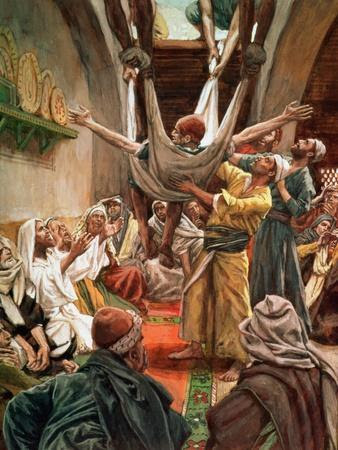
    Even as we look at the Gospel, the sick man’s friends brought him so that the Lord would heal him.  But what is the first thing the Savior does?  He forgives the sick man’s sins, which drives the scribes up a wall.  It is only to prove that He has the power to forgive sins that a physical healing follows.  What would the man have thought if all he received was the forgiveness of sins?  What would we think if we approached the Lord for physical healing, but only received spiritual healing?
    Physical healings are amazing.  They reveal God’s power over the human body, His ability to remake it as it should be.  And physical miracles can help to bolster our faith in spiritual realities, like the communion of saints.  But eventually whatever is healed will break down again.  Skin, muscle, organs, and bones will decompose, and then what will we have left?  But with spiritual healing, the effects can last into eternity, possibly snatching us from the teeth of the devil in Hell to the loving embrace of God in heaven.
    And even on earth, we can have opportunities to realize that material things, while nice, do not have as much value as intangible things.  For my birthday I received gifts from my family and from parishioners, for which I am very grateful.  I received a gift card to a brand of hotels in which I often stay to help lower my cost of future travel.  I received some cash and other gift cards with helped me purchase some items on my personal wish list.  And I received some very kind birthday cards.  But honestly, and with no ingratitude intended to anyone who gave me a gift, my best present was the chance for my very busy best friend to set aside time to spend with me, and let me know that, for that evening, he didn’t have anywhere else to be and didn’t have to cut out early to do anything else.  As MasterCard used to remind us, while you can buy many things with a credit card, the best things in life are priceless.
    So do we see God’s grace that way?  Do we view our relationship with God as our most treasured gift?  This is not to say that we can’t have material things that are precious to us, but do we treasure God above even our most expensive goods?  Do we treasure Him even above the intangible things on earth?  Or does God take second, or third, or fourth place when we consider what we value most?
    Do we appreciate the treasure that confession is?  God gave us a sensible way to receive His forgiveness through the Sacrament of Penance.  We hear the priest, acting in the person of Christ the head, in persona Christi capitis, telling us that our sins are forgiven.  Especially with my analytical mind, I can’t imagine simply asking God for forgiveness from my heart, but then wondering if I was truly sorry, which is the requisite for forgiveness.  Instead, if I have at least imperfect contrition, a firm amendment not to sin in the future, and a willingness to do penance, and if I confess my grave sins in number and kind to the priest, I know, I have certainty, that God has forgiven me; no ifs, ands, or buts.  What a treasure that is!  Can God forgive me without the sacrament?  Certainly.  But we will only know if that happened at the end of our life when we meet God for our final judgment.  Through the Church that Christ Himself founded, I can have confidence that those sins won’t be brought up at my final judgement, because Christ has washed them away in His Precious Blood.
    One million dollars is an impressive amount of money.  It can buy a lot of things that can help us live a comfortable life while on earth.  But the comfort that God wants for us doesn’t always come on earth, but lasts for eternity in heaven.  Each day we have the opportunity to decide how we want to be rich.  Do we want to strive primarily for the riches that can buy us a house, a car, or an emu?  Or do we want to strive primarily for the riches of knowing Jesus Christ and receiving the graces He sends us?  The two don’t always conflict, but one is always more important than the other.  Even if, at the end of our life, the world does not recognize us as rich, may God see how we have worked for and received the riches that He showers upon us each day: His grace, and knowledge, and love.  In the name of the Father, and of the Son, and of the Holy Spirit.  Amen. 

24 October 2022

Measuring Faith and Virtue

 Twentieth Sunday after Pentecost

    In the name of the Father, and of the Son, and of the Holy Spirit.  Amen.  At the house of former parishioners in East Lansing who have become like an extended family to me, there are marks at one of the closet doors with names and dates.  Maybe your family has a similar tradition, where the grandchildren’s heights are measured from time to time, and noted on the frame of a door.  It’s been fun to see the grandkids come back and see their heights at different stages of their life.
    Of course, as a kid, you’re always making sure you’re standing up nice and strait, trying to get every extra centimeter that you can.  And, if you measure yourself too closely in time, you’re not going to see much, if any difference in your height. It may appear that you’re not growing at all!
    In our Gospel today we hear about a man who didn’t have to see to believe.  He first approaches the Lord for the healing of his son, and our Lord somewhat rebuffs his request: unless you see signs, you will not believe.  Already, the Savior is noting that the people won’t believe unless He does something spectacular.  Still, the man has faith, and begs our Lord to do something, otherwise his son will die.  Christ assures him that his son will live, though the man cannot see the proof of his faith until he returns home, and his son is fine.  In fact, the son is healed at the moment that our Lord had said to the man that his son would be healed.  That sign (the term the Evangelist John uses for miracles) then leads others to believe.
    Still, think about the man walking back to his home.  We don’t know how far it was, but the walk must have taken at least a day, as the man inquires when the healing happened, and at which hour it took place.  The answer was that it took place a day earlier.  From what we can tell in the Gospel, the man never doubted that what our Lord said would happen would, in fact, happen.  Walking home, perhaps we would wonder if our faith would really be rewarded, if this Jesus was truly able to do something, especially so far away.  Would we doubt?  Would we lower our expectations so that we wouldn’t be disappointed?  None of these things the man seems to do.
    When it comes to our faith and our trust in the Lord, are we like the man who has faith?  Or are we like the crowds that need to see signs before we believe?  Do we have confidence when God says something will happen, even if we do not immediately see the results?  
    In some ways, we can be like kids who want to measure faith every day like we measure our height.  And, like our height, we may not see very noticeable results.  We pray for trust in God, we pray to be open to His will, but each day we don’t seem to make much progress.  Or maybe it’s working on a particular virtue, or eliminating a particular vice.  We ask God to strengthen us to choose the good, or support us in times of temptation so that we don’t fall, but we see no real movement.  Are we willing to be patient, not only with God, but also with ourselves, in growth in holiness?
    I do not consider myself a millennial; nor do I see myself as part of generation X.  I’m the micro-, in-between generation that some call xenials (with an x).  I know life before everyone had a cell-phone; I’m comfortable with cassette tapes and VHS.  We couldn’t simply pause TV if we had to go the bathroom; you had to rush to the bathroom and hope you finished your business by the time the commercials were ending.  But I have, like many millennials and later generations, gotten used to getting what I want immediately, thanks to the Internet and having a phone with me almost all the time.  And so patience is not always my strong suit.  I do work at patience, and I ask God to help me, but day-by-day, I didn’t seem to make any progress.  
    One day, a few years ago, I flew to Australia, to visit a priest friend of mine in Sydney.  My flight left in early November.  The day my flight left was the day in 2019 when we got pounded with 8 or so inches of snow.  I arrived at Bishop airport in Flint, and my flight was delayed.  I waited all day in the airport, only to find out that the flight was cancelled, and I would lose a day of my vacation, as United tried to rebook a whole plane of customers who had to go to Chicago, and then continue their travels.  Normally I would have been upset and frustrated.  I would not have normally been calm and collected when talking to the gate agents.  But, for whatever reason, I was patient.  And that virtue that I had been working on, I noticed that I was better, after all those years of praying for more patience.  God had answered my prayers, but I had to trust in His timing, and the work that had to be done in my soul before I would be open to that virtue.  
    Can we trust God, even when we don’t see miracles, even when we don’t see the work that He is doing?  God’s work is so often invisible, and so our cooperation in that work is also an act of faith.  We do have to go out on a limb to have confidence that God will change us, He will perfect us, as and if we allow Him to do so.  We may not see much progress day-by-day, but after a year or more, I’m willing to bet that we will notice that we are different, that we have grown in virtue.  Be like the man in today’s Gospel: no matter how long the walk takes to see the fruit of your faith, do not doubt God, but have confidence that, if we but trust in God to transform our lives, He will not disappoint us.  He will, in fact, outdo our expectations: the Father, and the Son, and the Holy Spirit.  Amen. 

10 October 2022

Healing and Thanksgiving

 Twenty-eighth Sunday in Ordinary Time
    While it’s not November yet, based upon our first reading and Gospel, it could be fitting to set the roasted turkey, mashed potatoes, stuffing (or dressing; however you call it), cranberry sauce, and corn out on the table, because the evident theme to these readings is thanksgiving.  Naaman gives thanks to God for his healing, and the Samaritan leper gives thanks to Christ for his healing.  So thanksgiving is certainly part of the readings and part of the message that God is communicating through His Word.
    But besides thanksgiving, there is another theme that is prevalent in both the first reading and the Gospel: healing.  Healing is what led to giving thanks to God in both readings that I mentioned.  Naaman had leprosy, and so did, obviously the ten lepers.  What else is common?  In both cases, the healing comes from God through a very ordinary means.  Naaman is told to wash in the Jordan River; the ten lepers are told to go show themselves to the priests (which is how the community could be sure, according to the law of Moses, that the leprosy had been healed).  There was no special drink or salve.  They didn’t have to find some rare flower with healing properties, or do extraordinary feats of strength to be healed: they were all healed in ordinary ways.
    We say “thank you” when someone has done something for us or given us something.  This very Mass is an act of thanksgiving, united to the thanksgiving sacrifice of Christ on the cross.  And this Mass not only thanks God, but also has the opportunity to heal us in very ordinary ways.
    But do we seek God’s healing?  If a doctor were to give us a prescription that alleviated our suffering or took care of our symptoms, we would say thank you, since we no longer have to go through pain or illness.  God offers us, not only healing of body (which still sometimes miraculously happens), but especially healing of soul: healing of the wounds that afflict us from injuries we have taken from family and/or friends over the years.

    We are now engaged in a spiritual battle to protect all life, including that in the womb.  Bishop Boyea has asked us to pray a daily Rosary through election day for the defeat of Proposal 3.  We should vote no on Proposal 3, because it would make abortion on demand available, even up to right before the delivery; because it would allow the butchering of a baby inside the womb (what we antiseptically call “partial-birth abortion”); and because minors could obtain abortions without their parents knowledge, among other evils of the proposal.  
    But I have heard stories, and I’m sure they have happened, of people walking out of homilies, or walking out of talks that remind people how horrible abortion is.  Most of the accounts I have heard have the people walking out being women.  And as I thought about healing, I thought about the almost 630,000 women in the US who had abortion in 2019 (the latest US stats I could find).  
    I have no doubt that women who have had an abortion feel deep spiritual, emotional, and psychological pain.  I have no doubt that listening to someone speak about how wrong an abortion is can be a struggle, because that person is having to relive the pain and is being confronted with truth, a truth that no one can escape: that the direct, intentional killing of a human being, no matter how developed, is a grave sin.  That sin causes pain; it causes one to be wounded.  And sometimes it seems easier to ignore the pain, ignore the wound, than to get treatment for it.  
    The good news is that Jesus came to save, He did not come to condemn.  Yes, Jesus calls for conversion, for changing our lives so that we say no to evil and yes to good.  But if we have evil in our past (and everyone does), Christ can heal us of that evil, and the wounds that the evil caused.  We don’t have to carry those wounds with us any longer.  Healing is possible, the healing that leads to thanksgiving, just like it did in the first reading and Gospel.
    One woman was relating to me her story that she had procured an abortion.  She felt like she had no other choice, even though she knew, in her heart, that it was wrong.  But she went through with it because she felt trapped.  Eventually she had a conversion, and asked God’s forgiveness for what she had done.  That night, she had a dream of her unborn child, who was rejoicing in heaven, and the child told the mother that she forgave her.  That mother felt such relief; her wound was healed.  
    To any woman here who has had an abortion: God loves you and wants you to be whole and healed.  He doesn’t want you to carry around the burden of what you did.  God wants to set you free from that pain and guilt.  To any person here who knows someone who has gotten an abortion: remind them of God’s love for them, and that God doesn’t want them to be in pain, but to be healed and to be made whole by God’s forgiveness, available to us through the Sacrament of Penance.  Do not say it with judgment, but only with the love of Christ, who calls all sinners to Himself, no matter what the sin.  
    Healing leads to giving thanks to God.  Whatever your wounds, whatever your pain.  Bring it to God and let Him heal you.  Sometimes it happens in the most ordinary ways.

24 January 2022

If You Want Something Done Right, Ask for God's Help

Third Sunday after Epiphany
    In the name of the Father, and of the Son, and of the Holy Spirit.  Amen.  If you want something done right, you have to do it yourself.  I can’t tell you how many times I have operated under that saying.  In the long run it may help to explain things to others and have them assist you with your task, but in a crunch, it’s so much easier to do what you know needs to be done, and to make sure it’s done in a correct way.
    While this approach can be helpful in daily tasks at home or at work, it is poison to our faith.  St. Paul tells us, “do not be wise in your own estimation.”  The apostle talks not only about head knowledge, but also about thinking that we can take care of ourselves when it comes to our needs.  When something goes wrong, we figure out a way to fix it.  When we need something done, we do it.  We maybe even think that the phrase, “God helps those who help themselves” is a phrase from the Scriptures or at least uttered by a saint, when, in fact, it likely originated in pagan Greece. 

    Our Gospel tells us the approach that we should take, and does so twice over.  We heard about the leper and about the centurion.  Both demonstrated how to live the spiritual life: go to Jesus.  The leper certainly wanted health.  He wanted to be reunited with the rest of the community of Israel, and to be able to worship God in the temple.  But he couldn’t give himself what he wanted most.  He couldn’t do it himself.  So he went to our Lord and said, “‘Lord, if you wish, you can make me clean.’”  He relied on the Lord and on the Lord’s good will, and did not presume that the Lord would even grant his request.  But he had faith that Christ could heal him, and heal him Christ did.
    The centurion wanted health for his slave.  He wanted the paralysis to end.  But he did not consider himself worthy to have our Lord even come to his house to do the miracle.  He simply had faith that Christ could heal, even from afar.  Maybe the centurion had tried doctors to cure the paralysis.  Maybe he had tried to take of the matter himself.  But to no avail. 
    It is also important to note that slaves were property.  Yet the centurion did not treat his slave as property.  If you have a horse that is lame, you euthanize it and put it out of its misery, because it is no longer good for anything, just using up supplies.  If a tree is no longer producing fruit, you cut it down so that something else can be planted that will produce food.  Countless Romans had likely dispatched their slaves because they were no longer able to help with the work that the estate required.  Yet the centurion had not killed his slave, but asked for healing.  And he trusted that the Lord could heal.
    When we trust only ourselves to advance spiritually, we are doomed to failure.  When we figure that we have gotten ourselves into a mess, and so we have to get ourselves out, we will not succeed.  Only with God’s help can we find the healing that we need.  Only with God’s help will we find progress in the spiritual life.  Only with God’s help can we find freedom from the messes in which we so often find ourselves.
    It is so easy to become Pelagians.  Pelagius was a British layman who taught that we have to reach out to God first, to do some good first, which God will then approve.  Pelagius denied original sin, and said that we could be holy without the assistance of grace.  This was declared heretical by the local Council of Carthage in 411, and was vehemently opposed by St. Augustine of Hippo.
      If anyone could understand that merely willing the good was not enough, St. Augustine certainly did.  He had tried almost every philosophy, every seductive way of living, including fathering a child out of wedlock.  Even after his mind began to believe in the truth of Catholicism, his will could not seem to follow.  Then, one day, at his wits end from the frustration of not being able to do what he wanted, he heard a voice call out, “Tolle, lege,” "Take, read," opened up St. Paul’s epistle to the Romans, and was “knocked over” by God’s grace, which allowed him to live as he desired, according to the law of Christ and His Church. 
    But how often do we think that we are somehow more privileged than St. Augustine, that we can do it by ourselves?  We have a virtue in our life, and so we decide to achieve it, not asking for God’s help, or only doing so as a second thought.  God has to be the beginning, the middle, and the end of achieving any virtue.  We cannot start a virtue on our own, continue a virtue on our own, or achieve a virtue on our own.  The only thing we can do on our own is sin.  The rest is made possible by God’s grace.
    Or, perhaps there is a sin that we are fighting.  Perhaps we have been fighting it for some time, and we do not find any progress.  I try to give some helpful advice in the confessional, especially if I am not pressed for time, for ways that we can respond to God’s grace and cooperate with it.  But so often we forget that those practical pointers are meant to accompany prayer and asking for divine help, rather than pulling ourselves up by our bootstraps. 
    Do we need to cooperate with God’s grace?  Certainly.  Can we be passive in our own conversion?  Certainly not.  But how often do we try to be wise in our own estimation and create plans which are not based in the will of God, and then find ourselves shocked that it didn’t work on our own?
    When it comes to the spiritual life, a better adage would be: if you want something done right, let God start the work.  Or: God helps those who ask for it.  Or, to quote the Psalms, “Unless the Lord build the house, in vain do its builders labor.”  In the name of the Father, and of the Son, and of the Holy Spirit.  Amen.

11 October 2021

Seeing or Believing

 Twentieth Sunday after Pentecost

    In the name of the Father, and of the Son, and of the Holy Spirit.  Amen.  I remember what a big deal it was when I was finally old enough to ride the Space Mountain roller coaster at Disney World.  I was nervous and excited, all at once.  I didn’t realize it was in the dark, and while I survived, that whole experience freaked me out!!  I like to see where I’m going, because I’ll know what to expect and how to adjust appropriate.
    The man in the Gospel whose son our Lord heals at first also wanted to see.  He asked Christ to come and heal his son, who was at the point of death.  Jesus bemoans that it must be seen in order to believe.  But that observation leads to the man having faith that the Savior could heal the man’s son, whether he was present or not.  And this faith led to the healing of the son.  Not only that, but the entire household believed in our Lord.  
    Do we have to see?  My desire to see everything that is coming up is sometimes virtuous, because it helps me to adjust for upcoming realities and plan.  But in other ways, it is pride, because I feel like I have to be in control.  Maybe some of you know that feeling, too.  If we see what is happening, we feel like we are in control of the situation.  When we feel like we cannot see, we don’t feel like we have control over what is going on, and when something else comes to us, we may not be as prepared for it.
    But over how much are we really in control?  During the pandemic, we have seen so many things change in a moment’s notice.  I remember 13 March, Thursday, hearing reports about schools closing down due to COVID, and then Friday, 14 March, the principal at St. Pius X school let me know that we were closed, and we didn’t reopen for the rest of that school year.  As a parish school, we laid off a number of employees eventually, because they were aids and there were no kids to watch over in the building.  I had plans to celebrate my tenth anniversary as a priest in June 2020, and even in March I was sure that it would still happen.  But by May I made the decision to cancel, and celebrated only with my immediate family who could attend a small dinner I held in my house.
    In our life, we control very little.  But God is control of all things.  He directs or allows things to happen for our good, but they don’t always seem that way.  But, through it all, God is in control, and we are not.  And because we are not in control, we are invited to have faith, to put our trust in God.  God invites us to loosen our grip on things we think we control, but we don’t.  He wants us to have confidence in Him as He cares for us.  
    Again, this can be hard for us, because our timing is not always God’s timing.  There are families who go through extreme illnesses; friends or family who are killed in an unforeseen accident; an unexpected child is conceived, or a couple wants to conceive and cannot; an employee loses a job.  In all these circumstances we so often presume that we know better.  We think that if God had simply left the decision up to us, then everything would be ok.  
    But how much really goes ok if we are left in charge?  We may be the best or one of the best in our particular field, but how many small examples of Divine Providence, which we had not organized or even considered, had to happen in our for our success to come about?  How many people had to get up at just the right time and leave the house in order for us to avoid a traffic crash?  If we think about all that happens for a single second to go right, it should make us fall on our knees in thanksgiving for that one second and all that had to occur just for that one second to go the way we want it to.  
    But even when we life doesn’t go as we want it to, St. Paul still reminds us to give thanks “for all things.”  We could write Paul off if his life had been easy.  Instead, the man who tells us to give thanks for all things was himself beaten, whipped, stoned, left for dead, abandoned by co-workers, and was held suspect by some believers.  St. Paul talks about being comfortable in having nothing, in going hungry.  And still, he says, give thanks.  
    It is easy to put our confidence in God when things are going the way we want it to, when we can see the healing taking place.  But the virtue of faith is truly exercised when we can’t see things going right, when nothing seems to be going right, and yet we trust in God anyway.  Faith is witnessed when we cannot see what God is doing, but we trust that He’s doing the best thing for our salvation, just as Jesus healed the man’s son even without the man being able to see that healing take place.
    Our days are evil.  Around us swirls hatred, confusion, division, immorality, idolatry, and a host of other evils too many to number here.  But God called us to live in this time, to be a witness of His love and truth in this time, when so many don’t want true love, don’t want truth.  We may sometimes say, with Frodo, that we wish that “none of this had ever happened.”  But God wanted us to be alive in this time, and He is accomplishing some good.  Further, we know it must be some great good, because it is opposed so much by the enemy.  We cannot decide the times in which we live, but we can decide “what to do with the time that is given to us.”  We cannot always see what God is doing, and the miracles He is accomplishing, but today, and everyday, the Lord invites us: have faith!

09 August 2021

How God Heals Us

 Eleventh Sunday after Pentecost
    In the name of the Father, and of the Son, and of the Holy Spirit.  Amen.  Catholicism is a sense-experience religion.  When you come to Mass you can see beauty, especially in this church.  You hear different prayers throughout the Mass.  You smell the incense burning in the thurible.  You taste the Eucharist on your tongue.  You sit, stand, and kneel at different parts of the Mass.  Ours is not a quietist religion where you simply sit and think of God.  Worship of God and the practice of the faith in our day-to-day life involves the entire person, body and soul.

    We involve the body and soul because that’s what our Savior did.  We heard it in the Gospel today: there was a man who was deaf and mute.  Jesus takes him aside, and rather than simply willing the healing, He puts His fingers into his ears, spits, and touches the man’s tongue.  He then groans, looks up to heaven, and says, “Ephphatha!  Be opened!”  I don’t know what exactly the deaf and mute man was expecting, but I’m not sure that I would have expected that!
    It’s important to see that our Lord comes to heal.  One of the early Greek titles of our Lord was 𝛴𝜔𝜏𝜂𝜌, which means “savior,” but also has a context of healing.  We tend to think of salvation in merely spiritual terms, saving our souls, but Christ knows that we are a union of soul and body, and so healing one has an impact on the other.  How many people in the Gospels came to Christ with a physical malady, but ended up healed in body and soul, with their sins forgiven as well as their illness healed?
    That ministry of healing did not end when our Lord ascended into heaven.  He continues to heal us.  Again, we tend to think of the healing that our souls need, but sometimes our bodies need healing, and the Lord does that as well.  One of my classmates, Fr. Mathias Thelen, has a charism of healing, which, as he always says, is God healing through him.  There are a great number of people whom God has cured, healed of infirmities, or eased the pain.  We also require these types of miracles through the intercession of one who has a cause of sainthood.  And those stories not only involve healing the body of that person, but also bolster our faith in how God works in our everyday world.
    But it’s good not to put God in a box, and put limits on how He can heal us.  At least from time to time, God heals us in an unexpected way, or maybe even a way with which we’re not that comfortable.  Again, think about the man in the Gospel.  Imagine yourself being taken aside by our Lord, and you have a confidence that He is going to heal you.  You’re looking forward to being able to hear and speak.  You will not longer be stuck mostly in your head.  And then you see Jesus take his fingers, and put them into your ears.  Okay…a little awkward, but maybe some touching of the ears was expected to cure the deafness.  But then, He spits and touches your tongue!  Now we’ve gone into the realm of the unexpected.  I can’t remember a time where I let someone touch my tongue, though, granted, I’m not mute.  Still, I think it’s at least plausible that this healing was not in the manner that the man expected.  But the man was healed, and was so grateful that he couldn’t keep his mouth shut (it had been, after all, shut for so long before that!).  
    How is the Lord trying to heal you?  Sometimes it can come in unexpected ways.  Maybe we’re not having people put fingers in ears, spitting, and touching our tongues.  But are we open to how God wants to heal and save us?  Our eternal salvation was won in a very unexpected way: by the death of our Lord on the cross.  It was so unexpected, almost none of His followers bothered to be with Him in His last hours.  And the disciples are doubly astounded when He shows up alive, after they knew He had been crucified.  
    But our healing that comes to us in our everyday life from God can also be unexpected.  Some couples take a little while to find their spouse, and it can often come after serious heartbreak.  But that heartbreak with the wrong person sometimes leads to the right person, the spouse God wants for you.  To use sports as an analogy, sometimes you have to go through serious pain to become a better athlete.  Sometimes a parent needs to discipline a child, perhaps even with a spanking, to help the child understand what not to do (which will help the child be a better person and disciple).  Sometimes a friend needs to speak a harsh word, or take drastic actions, in order to truly help the friend move on from a bad habit.  
    Those are all negative, but healing can happen in positive unexpected ways, too.  No matter how we experience the unexpected, it can often be in those ways that our Lord heals us and helps us to grow.  God continued to help His Church grow through St. Paul, who had previously persecuted the Church of God, hence St. Paul’s acknowledgement that he is the least of the Apostles.  But God’s grace, which took a persecutor and turned him into a martyr, did the work; it was not in vain.  
    Do not be afraid to ask for healing from God.  Have faith that God can heal whatever ails you, whether it’s physical or spiritual malady.  Healing may not come how you expect it, or maybe not even when you expect it, but it will come, as a gift of God: the Father, and the Son, and the Holy Spirit.  Amen. 

05 June 2017

Finish Strong!

Solemnity of Pentecost
In high school track I was a short distance runner.  I usually ran the 100m dash, 200m dash, 100m relay, and/or 200m relay.  I always said that as far as running went, if I wasn’t done in 26 seconds or less, something had gone horribly wrong.  But at one meet, perhaps because my track coach was a sadist, he asked me to run a 400m dash.  I had never run it before, never trained for it before, and had no desire to run it.  But, coach was telling me to run the event.  And how bad could it be?  It was only once around the track.
As the gun fired to start us, I tried to set a pace that I felt would make me competitive in the second heat.  Even though I wasn’t prepared for it, I didn’t want to lose and embarrass myself or my team.  So I pushed it.  After about 200m, I realized just how long 400m was as my legs started to ache.  The two things which were competing to win at that point were the fatigue in my muscles and my pride not to lose.  As I crossed the finish line, I think I got third.  What I remember more vividly was that my legs felt like jello, and I was sure I was going to fall down.  But, I had given it everything I had, and had finished strong.
Today, as we come to the end of our Easter Season and celebrate the Solemnity of Pentecost, we should want to finish strong.  Of course, we’re not totally done with life, but we are done with the Easter Season.  And we finish our Easter Season the way that the Apostles began their public ministry: with the gift of the Holy Spirit.

We hear about that gift in the second chapter of the Acts of the Apostles, a story with which we are likely pretty familiar.  There is a great wind, and then the Holy Spirit appears over the heads of the apostles and disciples like tongues of fire.  Immediately the disciples are compelled to speak about Jesus and how He was raised from the dead and offers us new life in Him.
As Catholics we may be a little uncomfortable with the Holy Spirit.  God the Father is someone we’re familiar with, but we can often keep Him at arm’s length, since He seems so mysterious.  Jesus is someone with whom we’re much more familiar, we know the stories from His life, but even He can seem a little distant, since He is seated at the right hand of the Father.  But He tends to be the focus of most of our prayers.  But the Holy Spirit–that’s the one who seems to make things go out of control.  Maybe we’ve even seen people who claim to have the Holy Spirit and they do what we consider “weird” things like speaking in tongues or having the gift of prophecy.  Perhaps we’re not that comfortable with the Holy Spirit.
But we need not be afraid of the gift of the Holy Spirit.  The Holy Spirit is the one who continues the ministry of Jesus in the Church.  He does give some people special gifts like speaking in tongues, prophecy, healing, etc., but He also showers His gifts upon all believers.  And we hear about some of those gifts that we can experience in the Scriptures.
At the Vigil Mass the first reading was from Genesis, and was the Tower of Babel.  The people all want to get to God on their own terms, but God makes them speak all different languages.  The unity of the people is not based on God, but on becoming the masters of their destinies, and so they are scattered.  But in the story of Pentecost, the Holy Spirit helps the people to have access to God by hearing the Good News of the Gospel of Jesus spoken to them in their languages.  And we experience that in our own way today: our Gospel was proclaimed in Latin, the mother-tongue of our Latin Rite church, and some of our petitions this weekend will be proclaimed in the languages of our parishioners, including Malayalam (from India), Tagalog (from the Philippines), Spanish, German, Arabic, and Italian.  And while perhaps we don’t all understand all these languages, they reflect the diversity of our cultures, and yet the unity of the faith, because what we believe is the same, no matter in what language it is proclaimed.
The Holy Spirit also gives us each gifts to build up the Mystical Body of Christ, the Church.  We all have certain gifts to build up our parish, our diocese, and the universal Church that the Holy Spirit encourages us to use.  Some of us garden and do yard work, some teach, some cook, some comfort the sorrowing, some serve as Extraordinary Ministers of Holy Communion or Lectors.  I am sure that some of our parishioners, besides being called to these ministries, are also called in the future to a vocation to the priesthood or diaconate, or to consecrated life as a sister or nun.  

The question for us is whether or not we are willing to respond to the Holy Spirit.  The Holy Spirit may lead us to new circumstances that are unfamiliar for us, just as the foreign lands to which the apostles went were unfamiliar to them.  But if it is the Holy Spirit calling us to them, then we know it is for the building of the Church and the spreading of the Gospel.  Do not be afraid of the Holy Spirit, but be open to His gifts, and then, with the courage the Holy Spirit gives us, use all that we have to continue to ministry of Jesus in the world!

10 September 2012

The Divine Physician


Twenty-Third Sunday in Ordinary Time
            The Word of God is often challenging.  It calls us to deeper conversion as we turn our lives away from sin and towards Jesus, trying to live our life in conformity with the love that Jesus showed us by what we say and do.  As a spiritual father, it is not uncommon for me to have to deliver a tough message, a message which calls us to rethink the way we’re living, to re-examine our priorities, and to change our habits of sin to habits of grace and virtue.  Just like a biological father or mother who must, from time to time, correct children to ensure that they will succeed in the world, not only as citizens of earth but also as citizens of the New Jerusalem in heaven, sometimes I have to correct the sheep of the Lord’s flock.  But today is not one of those days. 
            Today, the message the Lord speaks to us is one of His healing love.  Both in our Gospel and in our first reading, we hear about the tender love of our God which wants to heal us.  The Lord says to us today, as He spoke through Isaiah then, “Be strong, fear not!  Here is your God…he comes to save you.”  We hear that he will open the eyes of the blind, and clear the ears of the deaf.  He will make the lame leap like stags, and loose the tongues of the mute.  He will turn the desert into a watered garden.  And in our Gospel, Jesus fulfills that prophecy by healing the man who was deaf and had a speech impediment.  Jesus, as the very revelation of God the Father, makes present for us the healing love that God has for His people.
So, the question is, will we accept that healing touch of God?  Will we welcome the Divine Physician into our hearts to cure us from what ails us?  To those of you who have frightened hearts: of what are you afraid?  What causes you anxiety?  Whatever it is, open your hearts up to the Lord, and hear Him say to you as He said to the frightened disciples in the boat as the waves were crashing about it, and as He said to St. Peter as He bade Peter walk across the water, “Be not afraid!”  Those were the words that opened the pontificate of Bl. John Paul II in 1978, and we still need to hear those words: “Be not afraid!”  Because, as St. Paul says, “If God is for who, who can be against us?”  The waves of the world may crash all around us, but Jesus is in our boat, and He who separated the dry land from the water at the creation of the world will not let us capsize in the waters of chaos. 
Where do we not see the Lord?  Where do we think that He is absent from our lives?  Cry out like the blind man in Jericho, “‘Lord, that I may see!’”  Feel the warm, callused, but tender hand of our Lord over your eyes so that you may recognize Him: in the poor, the downtrodden, the infant in the womb, the elderly, the homebound, even in your enemy.  Let the Lord bring the light of the Gospel truth to the darkness of sin which blinds us to the presence of God in the world.
Where do we not hear the Lord?  Are we familiar with how the Lord speaks to us?  Sometimes it is in great moments when the Lord appeared to Moses on Mt. Sinai.  Other times, like with Elijah, it is in the whisper of a soft voice inside our hearts.  Ask the Lord to touch your ears and say, “‘Ephaphtha!’—that is, ‘Be opened!’” so that when you sit in silence, you will hear the clear Word of God in your heart and recognize the voice of the Good Shepherd speaking to you, leading you to green pastures. 
How are our mouths bound so that we do not speak?  How do we mumble the Word of God in our words and our deeds?  Ask the Lord to open you lips so that you proclaim His wonderful works in all that you say and do.  Ask Him to cleanse your speech so that when people hear you speaking, they are truly listening to the voice of God.  Ask Him to allow you to proclaim from the mountaintops that our God has come to save us, and the day of our vindication is at hand! 
But know this, if we do not ask; if we leave this building and act as if nothing has changed, then we will not be healed.  Not because the Lord does not love us, but because God, who did not ask to create us, will not heal and save us without our permission.  God loves us and respects our free will so much, that He will not force us to take His medicine, even if we will die without it.  We must recognize that we need the Lord’s help (which is itself a gift from God) and then ask Him to heal our infirmities, whatever they are, whether of body and/or soul, and He will come to us quicker than any ambulance ever could. 
Brothers and sisters, the Lord’s love for us will renew our youth and irrigate those parts of us that are as dry as deserts so that they are a luscious garden, full of life.  Our Lord comes to heal us so that we may not labor under the sickness of sin, but may have the fullness of life through the power of the Holy Spirit.  “Be strong, fear not!  Here is your God, he comes with vindication; with divine recompense he comes to save you.”  “He has done all things well.”