Showing posts with label riches. Show all posts

01 June 2026

Finding Love in God

Solemnity of the Most Holy Trinity

    [In the name of the Father, and of the Son, and of the Holy Spirit.  Amen].  A few years ago, after visiting Boston and the bar that served as the model for its self-named series, I had a hankering to re-watch “Cheers,” the 80s sitcom about a bar owned by a washed-up, Boston Red Sox pitcher who is not a paragon of moral virtue.  It turns out the series wasn’t as good as I remember it being when I watched the show (probably because I was young enough that most of the topics the show dealt with flew over my head).  But one part that many people know, even those who haven’t watched a full episode, is the theme song, or at least the lines, “Sometimes you want to go / Where everybody knows your name / and they’re always glad you came…”. There’s a couple more lines, but for the purposes of this homily, that’s enough.
    What made me think of “Cheers” is the Most Holy Trinity, whom we celebrate today.  When it comes to our God, He always knows our name.  And He’s always glad we come to spend time with Him.  Our Trinitarian God, St. John the Apostle and Evangelist tells us in his first epistle, is love.  And love affirms, to paraphrase Bishop Barron and quote a country music title from Dan and Shay, “I’m Glad You Exist.”  There is something especially good about having another person affirm your existence and affirm that they treasure you.  
    There’s nothing “soft” about wanting to be wanted.  God, who is Himself a Trinitarian Communion of Divine Persons, made us in His image, which means that He made us for union with others, whether that be the union of friendship or even, for many the union of Holy Matrimony.  But likewise, God made us for union with Him, which can happen in any and all states of life.  So many people try to mask over that desire with goods which will never truly satisfy.  Maybe, as Luke Combs sings, beer never broke your heart, but it also doesn’t support a healthy self-esteem and a feeling of desirability.  You can buy a lot of things, but as Paul McCartney sings, you can’t buy me love.  
    So many young people, and I’ll admit that I got a little caught up in this too, think that social media affirms them.  And maybe, in some small way, it does.  But a like, or a share, or a snap-streak cannot compete with true love.  The trouble is that social media seems to be set up to give some good feelings, feelings of acceptance and desirability, but ones which quickly fade.  So you post more to get more attention.  But that still fades.  So you post more and more, until you find yourself addicted to social media reactions.  Or, on the flip side, as much as you post, people don’t like or favorite or share your status or pics or posts, which only reminds you more of the lack of true love in your life, sometimes leading to depression or even suicide.  
    God made us for love.  God made us with the desire to be in a communion of human persons and divine Persons.  We need love, just like we need God.  And nothing else will fill that hole in our heart.  Nothing else–not riches, power, fame, or sex–will ever fill up the tanks in our hearts that love can.  
    “God showed His love for us,” St. Paul says, “in that while we were still sinners Christ died for us.”  Or, to quote John 3:16: “God so loved the world that he gave his only Son, so that everyone who believes in him might not perish but might have eternal life.”  Love does not equate simply to an emotion, but requires action.  And Christ demonstrated in a way we could understand just how far the love of God would go to reclaim us for Himself, to remind us that nothing earthly thing could ever truly fill our need for love.  God the Father showed His love for us by creating us in His image and likeness.  God the Son showed His love for us by dying on the cross for our salvation.  God the Holy Spirit shows His love for us as we get those God moments, of various types, that remind us just how much God loves us.  The action of love, from the beginning of all time until the consummation (very much a love word) of all time at the return of Christ, is a work of the entire Trinity, who is Himself a Communion of Love.  
    Our role is to accept the invitation into that love that truly makes us whole, and to invite others into that love, too.  The command of Christ at the end of Matthew’s Gospel to baptize all nations is a command to invite the entire world into the love which truly fulfills us.  Baptism, by uniting us to Christ, gives us entry into Trinitarian love.  And everyone needs that, even if they don’t recognize it.  Otherwise, they’ll try to find it in a bottle, in a paycheck, in notoriety, or in power.  And while those will satisfy for a little while, they will leave people feeling even more empty than before, because the thing they thought would fill their need for love abandoned them and lied to them and did not give them what they wanted.  
    We have a God who knows our name.  We have a God who is always glad when we come to Him.  We have a God who is love and who wants to embrace us with His love.  So many other things cry out and pretend to love us.  But in the end, only God’s love, and any true loves connected to God’s love, will last and sustain us.  Through Holy Baptism God joins us to His love.  Through the Mass, we see that love in action as God allows us to join in to the sacrifice of Christ, the Second Person of the Trinity, made once for all on Calvary.  Through our daily lives the Holy Spirit helps us to respond to that love that God first offered us.  Don’t search for love in a bar, not even a famous one in Boston.  God’s love is here, ready to be shared.  And God wants us to share that love out there, outside of this church, so that all people can experience the fullness of love, from the Father, and the Son, and the Holy Spirit.  Amen.  

23 September 2024

Better than Having $1,000,000

Eighteenth Sunday after Pentecost
    In the name of the Father, and of the Son, and of the Holy Spirit.  Amen.  In the mid 90s there was a song by the group Barenaked Ladies (ironically a band entirely made of up males) called “If I Had $1000000.”  It’s a catchy tune, and it talks about all the things that the writer would do if he had a million dollars.  He’d buy a house, furniture, a “reliant automobile,” a tree fort with a tiny fridge, a fur coat (“but not a real fur coat, that’s cruel”), an exotic pet like a llama or emu or monkey.  We’ve probably all thought of what we could do with an unlimited or nearly unlimited amount of money at one time or another, and maybe our dreams have even included some of the things of which the Barenaked Ladies sang.
    St. Paul, on the other hand, talks about becoming rich in Christ, so that no one wants for any grace while we wait for the return of our Lord.  Probably not a catchy enough phrase for a song, but a chance to reflect on how we can truly be rich.  Our world so often associates riches with material things and possessions.  But St. Paul talks about the richness of a relationship with Christ and the openness to His grace.

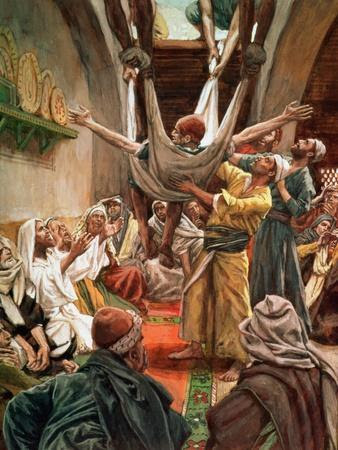
    Even as we look at the Gospel, the sick man’s friends brought him so that the Lord would heal him.  But what is the first thing the Savior does?  He forgives the sick man’s sins, which drives the scribes up a wall.  It is only to prove that He has the power to forgive sins that a physical healing follows.  What would the man have thought if all he received was the forgiveness of sins?  What would we think if we approached the Lord for physical healing, but only received spiritual healing?
    Physical healings are amazing.  They reveal God’s power over the human body, His ability to remake it as it should be.  And physical miracles can help to bolster our faith in spiritual realities, like the communion of saints.  But eventually whatever is healed will break down again.  Skin, muscle, organs, and bones will decompose, and then what will we have left?  But with spiritual healing, the effects can last into eternity, possibly snatching us from the teeth of the devil in Hell to the loving embrace of God in heaven.
    And even on earth, we can have opportunities to realize that material things, while nice, do not have as much value as intangible things.  For my birthday I received gifts from my family and from parishioners, for which I am very grateful.  I received a gift card to a brand of hotels in which I often stay to help lower my cost of future travel.  I received some cash and other gift cards with helped me purchase some items on my personal wish list.  And I received some very kind birthday cards.  But honestly, and with no ingratitude intended to anyone who gave me a gift, my best present was the chance for my very busy best friend to set aside time to spend with me, and let me know that, for that evening, he didn’t have anywhere else to be and didn’t have to cut out early to do anything else.  As MasterCard used to remind us, while you can buy many things with a credit card, the best things in life are priceless.
    So do we see God’s grace that way?  Do we view our relationship with God as our most treasured gift?  This is not to say that we can’t have material things that are precious to us, but do we treasure God above even our most expensive goods?  Do we treasure Him even above the intangible things on earth?  Or does God take second, or third, or fourth place when we consider what we value most?
    Do we appreciate the treasure that confession is?  God gave us a sensible way to receive His forgiveness through the Sacrament of Penance.  We hear the priest, acting in the person of Christ the head, in persona Christi capitis, telling us that our sins are forgiven.  Especially with my analytical mind, I can’t imagine simply asking God for forgiveness from my heart, but then wondering if I was truly sorry, which is the requisite for forgiveness.  Instead, if I have at least imperfect contrition, a firm amendment not to sin in the future, and a willingness to do penance, and if I confess my grave sins in number and kind to the priest, I know, I have certainty, that God has forgiven me; no ifs, ands, or buts.  What a treasure that is!  Can God forgive me without the sacrament?  Certainly.  But we will only know if that happened at the end of our life when we meet God for our final judgment.  Through the Church that Christ Himself founded, I can have confidence that those sins won’t be brought up at my final judgement, because Christ has washed them away in His Precious Blood.
    One million dollars is an impressive amount of money.  It can buy a lot of things that can help us live a comfortable life while on earth.  But the comfort that God wants for us doesn’t always come on earth, but lasts for eternity in heaven.  Each day we have the opportunity to decide how we want to be rich.  Do we want to strive primarily for the riches that can buy us a house, a car, or an emu?  Or do we want to strive primarily for the riches of knowing Jesus Christ and receiving the graces He sends us?  The two don’t always conflict, but one is always more important than the other.  Even if, at the end of our life, the world does not recognize us as rich, may God see how we have worked for and received the riches that He showers upon us each day: His grace, and knowledge, and love.  In the name of the Father, and of the Son, and of the Holy Spirit.  Amen.