Showing posts with label spiritual. Show all posts

23 September 2024

Better than Having $1,000,000

Eighteenth Sunday after Pentecost
    In the name of the Father, and of the Son, and of the Holy Spirit.  Amen.  In the mid 90s there was a song by the group Barenaked Ladies (ironically a band entirely made of up males) called “If I Had $1000000.”  It’s a catchy tune, and it talks about all the things that the writer would do if he had a million dollars.  He’d buy a house, furniture, a “reliant automobile,” a tree fort with a tiny fridge, a fur coat (“but not a real fur coat, that’s cruel”), an exotic pet like a llama or emu or monkey.  We’ve probably all thought of what we could do with an unlimited or nearly unlimited amount of money at one time or another, and maybe our dreams have even included some of the things of which the Barenaked Ladies sang.
    St. Paul, on the other hand, talks about becoming rich in Christ, so that no one wants for any grace while we wait for the return of our Lord.  Probably not a catchy enough phrase for a song, but a chance to reflect on how we can truly be rich.  Our world so often associates riches with material things and possessions.  But St. Paul talks about the richness of a relationship with Christ and the openness to His grace.
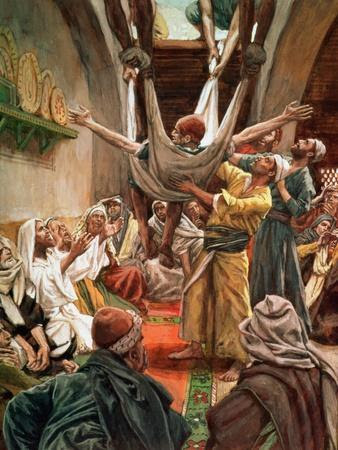
    Even as we look at the Gospel, the sick man’s friends brought him so that the Lord would heal him.  But what is the first thing the Savior does?  He forgives the sick man’s sins, which drives the scribes up a wall.  It is only to prove that He has the power to forgive sins that a physical healing follows.  What would the man have thought if all he received was the forgiveness of sins?  What would we think if we approached the Lord for physical healing, but only received spiritual healing?
    Physical healings are amazing.  They reveal God’s power over the human body, His ability to remake it as it should be.  And physical miracles can help to bolster our faith in spiritual realities, like the communion of saints.  But eventually whatever is healed will break down again.  Skin, muscle, organs, and bones will decompose, and then what will we have left?  But with spiritual healing, the effects can last into eternity, possibly snatching us from the teeth of the devil in Hell to the loving embrace of God in heaven.
    And even on earth, we can have opportunities to realize that material things, while nice, do not have as much value as intangible things.  For my birthday I received gifts from my family and from parishioners, for which I am very grateful.  I received a gift card to a brand of hotels in which I often stay to help lower my cost of future travel.  I received some cash and other gift cards with helped me purchase some items on my personal wish list.  And I received some very kind birthday cards.  But honestly, and with no ingratitude intended to anyone who gave me a gift, my best present was the chance for my very busy best friend to set aside time to spend with me, and let me know that, for that evening, he didn’t have anywhere else to be and didn’t have to cut out early to do anything else.  As MasterCard used to remind us, while you can buy many things with a credit card, the best things in life are priceless.
    So do we see God’s grace that way?  Do we view our relationship with God as our most treasured gift?  This is not to say that we can’t have material things that are precious to us, but do we treasure God above even our most expensive goods?  Do we treasure Him even above the intangible things on earth?  Or does God take second, or third, or fourth place when we consider what we value most?
    Do we appreciate the treasure that confession is?  God gave us a sensible way to receive His forgiveness through the Sacrament of Penance.  We hear the priest, acting in the person of Christ the head, in persona Christi capitis, telling us that our sins are forgiven.  Especially with my analytical mind, I can’t imagine simply asking God for forgiveness from my heart, but then wondering if I was truly sorry, which is the requisite for forgiveness.  Instead, if I have at least imperfect contrition, a firm amendment not to sin in the future, and a willingness to do penance, and if I confess my grave sins in number and kind to the priest, I know, I have certainty, that God has forgiven me; no ifs, ands, or buts.  What a treasure that is!  Can God forgive me without the sacrament?  Certainly.  But we will only know if that happened at the end of our life when we meet God for our final judgment.  Through the Church that Christ Himself founded, I can have confidence that those sins won’t be brought up at my final judgement, because Christ has washed them away in His Precious Blood.
    One million dollars is an impressive amount of money.  It can buy a lot of things that can help us live a comfortable life while on earth.  But the comfort that God wants for us doesn’t always come on earth, but lasts for eternity in heaven.  Each day we have the opportunity to decide how we want to be rich.  Do we want to strive primarily for the riches that can buy us a house, a car, or an emu?  Or do we want to strive primarily for the riches of knowing Jesus Christ and receiving the graces He sends us?  The two don’t always conflict, but one is always more important than the other.  Even if, at the end of our life, the world does not recognize us as rich, may God see how we have worked for and received the riches that He showers upon us each day: His grace, and knowledge, and love.  In the name of the Father, and of the Son, and of the Holy Spirit.  Amen. 

01 July 2024

Body and Soul

Sixth Sunday after Pentecost
    In the name of the Father, and of the Son, and of the Holy Spirit.  Amen.  One of the common errors of people today is a false dichotomy, or a presupposition that there are only two choices.  And this can also affect our faith life.  Because we sometimes act as if we forget that a person is a unity of soul and body, and deal with the one we find more enjoyable or the one that comes more easily to us.  But both soul and body are important, as we see in today's readings.
    The epistle focuses us mainly on the spiritual.  And we have to understand this spiritually, otherwise we would start some pretty strange practices.  St. Paul says that we are baptized into the death of Christ, and that the body has to be destroyed so that sin will no longer have power over us.  St. Paul intends, of course, that we read this spiritually.  We believe that by the pouring of water over our heads and the invocation of the Persons of the Blessed Trinity, we symbolically die.  Now, I say symbolically because our soul is not separated from the body, as happens in natural death.  But the death is real inasmuch as our fallen self dies with Christ on the cross, and then rises to new life with Christ in the resurrection.  So it’s not as if this is all made up or in our minds.  We die to sin when we die with the Lord in the waters of baptism, and that is very real.  But it is not that our physical life is ended, otherwise we would be a cult of mass homicide.
    But then in the Gospel, our Lord focuses on the physical needs of those who were following him.  Christ had been teaching the people about who He was, and backing up what He said by healings and exorcisms.  But then, it is three days later, and the people are getting hungry and running out of food.  At this point, while the Savior had taken care of their souls by His teaching, He also focuses on their bodies by performing a miracle of multiplying bread and fish, so that they could eat and be filled.
    In the Church, people easily separate into those who take care of the soul versus those who take care of the body.  As regards the latter, we can think of those who want to provide for people’s physical needs without consideration of the hunger of their souls for truth and beauty and love.  As regards the former, we can think of those who want to teach people about the Lord and instruct them in the faith, but then when they ask for something to eat, they say some form of, “we don’t do that.” 
    And this tension even exists in Scripture.  In Acts chapter 3, we hear about a crippled man who begs Sts. Peter and John for alms.  He wants money to take care of his physical needs.  But the first pontiff says, “‘I have neither silver nor gold, but what I do have I give you: in the name of Jesus Christ the Nazorean, walk.’”  There is a much deeper healing going on here.  Or look back to the Lord, who, when friends lower a paralyzed man down through the roof, immediately tells the man that his sins are forgiven, and only afterwards heals his body, as proof that the Son of Man can forgive sins.  But then in the epistle of James, chapter 2, we read, “If a brother or sister has nothing to wear and has no food for the day, and one of you says to them, ‘God in peace, keep warm, and eat well,’ but you do not give them the necessities of the body, what good is it?”
    So, we invoke the principle of both/and, so often operative in Catholicism.  Jesus is both God and man.  Mary is both virgin and mother.  The Church is composed of both saints and sinners.  We are both soul and body.  We are called to care for both the spiritual and the corporal works of mercy.  We cannot choose one and ignore the other, save at the possible expense of our souls. 

    This doesn’t mean that we can’t focus on one, even while we don’t exclude the other.  St. Theresa of Calcutta is a great example of doing both as she was able.  Her primary mission was to serve the poorest of the poor, and much of her work was caring for the physical needs of those whom society had abandoned.  She didn’t exclude service to people because they weren’t Catholic.  She fed them, cleaned them, and cared for them not because they were Catholic but because she was.  Still, and I know this from my own semester of working with the Missionaries of Charity in Rome, if you were living in their house and eating the food that they prepared, you would pray with the Missionaries of Charity, too.  And St. Theresa would even speak to spiritual poverty when she was given a platform on the national and international stage.
    Probably many of us feel more comfortable serving the spiritual needs of others rather than the physical needs of others.  Part of it may be because we readily have Church teachings accessible in our minds, but we don’t always know how to help someone who says they’re hungry, or thirsty, or need a bus ticket to somewhere.  And, sadly, some people try to scam others out of money, which makes it even more difficult to assist others.  But, I would encourage you to do what I do when someone asks me for help with basic needs of life: pray for guidance from the Holy Spirit to know how best to help that person.  And remember that we don’t have to do it all.  There are many groups in Flint that assist those who are hungry, thirsty, or homeless, like Catholic Charities, the St. Luke New Life Center, St. Francis Prayer Center, and others which are not Catholic but still do great work.  It is not wrong to refer someone to those agencies to do what we cannot do on our own.  But sometimes I know I feel that tug at my heart to give money, or I often carry Applebees gift cards in my car so that, if the Holy Spirit moves me to help someone, I can have a gift card to give them so that they can get food or drink. 
    So often we can try to create false dichotomy between the body and the spirit.  And certainly, one can be fully fed but spiritually starving; or one can be physically hungry but spiritually satisfied.  Christ invites us today through the Scriptures to consider both, and to do whatever we can to address both the spiritual and the physical needs of others, according to the gifts and talents we have received from God, the Father, Son, and Holy Spirit.  Amen.  

03 August 2020

Physical and Spiritual

Eighteenth Sunday in Ordinary Time
From the Church of the Multiplication

    Last Saturday night, I somehow managed to pop out a couple of ribs.  I was not doing any strenuous activity, so I joked Sunday morning at Mass that 36 is the new 80.  I can tell you that I was very aware that something was wrong (even before I knew exactly what it was).  At the same time, I was due for confession and arranged to meet Fr. Jim Rolph after Mass on Sunday.  We joked that, even though my soul had the more serious pain from my sins, the pain in my body was crying out for more attention.
    In our readings today, we see a distinction between the physical and the spiritual realms.  Isaiah in the first reading and Jesus in the Gospel are dealing with physical realities.  Isaiah says that if we are thirsty, we should come the water of the Lord.  If we have no money, we can still approach the Lord and eat.  And Jesus, after healing people’s illnesses, recognizes that they will need food, and He cannot simply send them away to their homes, but gives them bread and fish, multiplied in a miraculous manner from five loaves and two fish.
    Often times when it comes to religion, we focus on the spiritual only.  And the spiritual is important.  But Catholicism deals not only with the spiritual, but also with the bodily needs.  The Letter of James says, “If a brother or sister has nothing to wear and has no food for the day, and one of you says to them, ‘Go in peace, keep warm, and eat well,’ but you do not give them the necessities of the body, what good is it?”  We can’t simply ignore the needs of the poor and think that we’re living as a disciple of Jesus.  After all, in Matthew 25, Jesus condemns those who did not provide for the physical needs of the least of his brothers. 
    As followers of Jesus, we should look for opportunities to assist those who are in need.  We cannot simply say that it’s only the work of Catholic Charities or of the government to help the poor.  To the extent that we’re able, we are called to help those who need help.  I know that sometimes there are scams where people claim to be in need, but aren’t, and that makes it hard to know when to give to others.  One good piece of advice is, if a person asks for money, and you’re not sure if they truly need it, offer to go buy them a sandwich or a drink from a local restaurant and give it to them.  If they’re truly in need, they’ll take the help. 
    If you listen to the Holy Spirit, you can also tell whether God is nudging you to assist others.  Just a few weeks ago I was at McLaren getting some blood work.  As I was waiting, a woman probably in her 50s was talking about how the lab had given her the wrong test for her illness, and this was her second trip to the hospital that week.  She talked about how she had to use extra gas to get back to McLaren and get the new test, and I could tell that it was a hardship for her.  At that moment I felt that nudging in my conscience to offer to assist her.  I asked her if I could help her with gas money, and handed her a $5 bill.  I know it only got her a couple of gallons, but she said it would help her make sure that she could make it back home without getting stuck on the side of the road.  I don’t say that to brag, but just to illustrate how those circumstances can happen.
    But at the same time that we are required to assist others with bodily needs, we’re not simply fighting a physical battle.  St. Paul reminds us that, “neither death, nor life, nor angels, nor principalities, nor present things, nor future things, nor powers, nor height, nor depth, nor any other creature will be able to separate us from the love of God in Christ Jesus.”  Those are all spiritual things, at least for the most part.  St. Paul says elsewhere that we don’t battle so much against earthly powers, but against spiritual ones.  It’s not only the things that we notice with our senses, there are so many more things happening on a spiritual level of which we need to be aware.  When we abstain from meat on Fridays, or do some sort of physical penance, it’s not the steak or the drumstick that we’re fighting against.  We’re fighting against our fallen humanity which wants to give in to whatever desires the body has at any given moment.  And the fallen angels are trying to push us to give in. 
    The Church on earth is described as the Church Militant, because we’re in a fight.  And while we do sometimes face oppressive governments that want to hamper our faith life, more often than not we’re fighting spiritual battles that want to take us away from God.  We can’t pretend that we’re not at war, any more than a soldier could pretend in Normandy, or Korea, or Vietnam, or Iraq, or Afghanistan that he wasn’t in a battle that meant life or death.  Pretending the battle isn’t happening means losing the battle.  So each day we need to put on the helmet of salvation, the breastplate of righteousness, the shoes of peace, the shield of faith, and the sword of the Spirit which is the Word of God. 
    Humans are a union of body and spirit.  Both are important and need care.  Often times, we are more attentive to the needs, desires, and pains of the body.  But we can’t forget the spiritual realities, either.  Our call, as followers of Jesus, is, to the best of our ability, to address whatever bodily needs we can, as well as fighting those spiritual battles, equipped with all the spiritual defenses and weapons that God gives us.