Showing posts with label dying. Show all posts

24 June 2024

New Life Not Rules

Twelfth Sunday in Ordinary Time–Third Scrutiny Readings
    Go to Mass on Sundays and holydays; don’t eat meat on Fridays; serve the poor; love your enemies; save sex for marriage and don’t live together before you’re married; contribute to your parish; pray daily.  Catholicism is often broken down to these and many other rules.  And when Catholicism is presented as simply one set of rules (and fairly strict!) over others, it doesn’t sound that good.  But these rules are meant to be the response to a new life, rather than a reason for joining a new club.
    Yes, clubs have rules, but people make rules for themselves based upon their goals.  I remember a classmate of mine from high school whose goal was to become valedictorian.  She spent much of her time studying and making sure that she understood the concepts that the teachers taught.  She didn’t shy away from tougher honors classes, but I can only imagine the hours she spent going over lectures and assignments (and this, in addition to playing various sports).  But, her years of study, probably when others were doing things that seemed more enjoyable, paid off when she had the grades to be the valedictorian for the Lansing Catholic graduating class of 2002.
    Your goal, Mia, is not simply another tassel around your graduation gown.  Your goal is the new life that Christ offers.  And that is really what Catholicism is about.  If we’re honest with ourselves, we know that we are not always who we want to be.  We desire the eternal, even while going through life in very limited bodies.  There is a desire for God in our hearts, but we don’t always choose God.  We need help.  And God gave us that help in Christ, who not only teaches us, but can fill us with the power to accomplish what we want: union with God.  

    Catholicism isn’t about rules (though we have a lot of them).  Catholicism is about dying and rising; dying to our old, fallen self, and rising to our new glorified self.  That is most evident in baptism, where the Death and Resurrection of Christ are given to us so that we can be changed in a way we couldn’t on our own.  The death of Lazarus, which we heard today in the very long Gospel account, anticipated Christ’s own dying and rising, except that Lazarus would die again, but Christ would never die again, because it no longer had power over Him.  
    Catholicism is about being connected to the source of the power that allows us to reach beyond our limitedness, and begin to reach into infinity as we grow in our relationship with God who is infinite.  God desires us to have new life, not just be dried bones in graves.  And He makes it happen in us through the sacraments and through the grace that comes each day from them.
    And that new life comes from doing our best to live like Jesus.  When we live our merely human life, we care most importantly for ourselves.  We go throughout life seeking pleasure and avoiding pain wherever we think we can find delight and hide from discomfort.  The merely earthly life is very self-centered, very solipsistic.  And while it may lead to more money than one can imagine, or more things that one can count, or more power to exercise over others, it does not, as so many have shown us throughout history, lead to true and lasting happiness.  Ironically, the one who cares for others, who dies to his or her own desire to be most important, ends us rising to a happier form of life where doing God’s will is most important, others follow in importance, and only then are my desires considered.  The happiest people are those who live the new life where service to others comes before pampering the self.  
    And over the centuries, Mia, the Church has created rules and practices that help us die to self and rise for God.  Ever since Pentecost when the Church was born, we have come to know more and more deeply what actions are in accord with how Christ showed us to be happy, and what actions are antithetical to living a truly happy life in Christ.  And the more we live the life of Christ here on earth, the more it will seem like the place we want to be at the end of our life when our actions will shows whether or not we want to be in heaven, which is where God created us to be.  We do those practices and we follow those rules not because we can earn God’s love; we can’t.  We go to Mass, we serve the poor, we fast and abstain, we do all those things that I mentioned and more as our response to the love of God that has been poured into our hearts.  So happy are we that we have access to new life, that we can escape the bonds of death in Christ, that we don’t just tell Christ we love Him; we show Him by what we say and by what we do.
    Mia, you are not signing up to join a new club that your friends are in.  You are not simply applying new rules to your life as a form of self-control.  You are one week away from dying to everything that is old and fallen in you, and rising to all that is young and glorified in Christ.  God doesn’t just want to give you rules, He wants to give you new life.  Hear the voice of Jesus as He invites you out of the tombs of death of your old way of life.  Let Jesus unbind the sinful bands around you.  Come to the waters of baptism next week, not for a new set of rules, but for a new life that is only possible in Christ. 

07 June 2016

Frequent Dying and Rising

Tenth Sunday in Ordinary Time
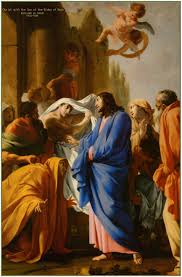
For as stupendous as raising someone from the dead is, it happens somewhat frequently in the Bible.  We heard about God raising the widow of Zarephath’s child through Elijah in our first reading, and Jesus raising the son of the widow from Nain in today’s Gospel.  Jesus also raises the daughter of Jairus, a synagogue official, and Lazarus.  After Jesus ascended into heaven, Peter raises a young girl named Dorkas (what an unfortunate name!), and Paul raises to life a person who falls out of a window after that person had fallen asleep because of how long Paul was preaching (there are dangers with preaching too long!).  I don’t know why, but I feel like that’s a lot of times.  About a month ago, I was given credit for raising someone from the dead by some of our firefighters, after I was riding with the firefighters and we responded to a call of someone having a heart attack, who seemed to miraculously wake up when we arrived (in reality, that person was an example of why you should never mix alcohol and a prescription narcotic).

But God truly does raise people from death on a regular basis, if we take time to think about it.  God raises from death those who are baptized.  In baptism, children, men and women are taken from being at enmity with God to being His children.  By baptism, people are buried with Christ–they die–so that they can rise with Him to new life.  By baptism, the old self has to die, like the grain of wheat, so that the new self, the person alive in Christ, can live.  
But that process of dying and rising does not stop on the day that we are baptized.  Each day we have the opportunity to die and rise.  It starts for some of us at the moment our eyes open.  At that moment we have the opportunity to die to our laziness and the comfort of our bed and rise to the new day that is before us.  There’s nothing wrong with hitting the snooze button if we have time, but at some point for many of us, we need to get up and get prepared for the day.  That’s why, at the beginning of my day, before my feet hit the floor of my bedroom, I say a short prayer: Mater mea, fiducia mea!–My Mother, my confidence!, and I entrust my entire day to Jesus through the intercession of the Blessed Virgin Mary.  You could say any prayer that you like, but prayer is a great way to rise to new life.
Throughout our day there will be people trying to kill us.  Sometimes we are the people trying to kill others.  Hopefully not literally, but certainly figuratively.  What I mean by that is that we are all sinful, and we all give in to temptations, to not be disciples of Jesus.  Whether it’s others or ourselves, there’s gossip, slander, sharing secrets we have no business sharing, treating others as objects or as means to advancement, and the list could go on and on.  If we are the culprit, then we need to die to all of those sins.  We need them to be put to death, and Jesus does that by His suffering on the cross.  When we bite our lip, or treat someone kindly, we are dying to our fallen nature and its sinful tendencies.  If we are on the receiving end, then we die when we patiently suffer through them (correcting when necessary and prudent) instead of giving back what we received.  And whether we are putting to death our own tendencies, or suffering with Jesus because of others’ tendencies, new life, resurrection, is available for us, not only after our earthly life ends, but even on this side of eternity.
Because those who can accept suffering and unite it with Jesus do live happier lives.  They may still have the same sorrows, but they do not let the sorrows control their lives.  They cling to their new life in Christ, given to them in baptism, and live in the joy of the Resurrection, even in this vale of tears.  Which is the happier life: the one tossed about by uncontrollable forces, or the one who entrusts his or her life to God and stays on a steady course toward Him?

Everything in our nature rebels against death.  We were not made to die, but experience death because of sin.  We see that rejection of death and its power in our first reading and Gospel today.  But there is another kind of death, a healing death, a death to our sinful selves, a death in Christ, which is not contrary to who we are, but helps us to be the fullest person we were created to be.  May we allow our sinful natures to die with Christ on the cross, so that we can also rise with Him to new life, both in our daily lives, and especially in the life to come.