23 July 2018

Wasting Time with Jesus

Sixteenth Sunday in Ordinary Time
Brad Paisley, one of the great country music singers of our time, has a song he released in 2005 called, “Time Well Wasted.”  He goes through all the things he could have been doing, things that were very practical, like raking leaves, washing the car, etc., but talks about how spending time with his love was “time well wasted.”
America, in particular, has a thing against “wasting” time.  We place work and productivity on a very high pedestal.  And there’s something good about that.  Work can be sanctifying if we unite it to Jesus, and producing new ideas and new products helps to better society.  But the temptation in our prodigiousness, the excess of that virtue of working hard, is working too hard, and missing out on the important things of life.  I remember when I was studying in Italy how things would close down for a few hours around lunch.  Now, I don’t mean to offend, and certainly I don’t want to stereotype too much, but in Europe, Italians are not known for being hard workers in the first place.  But they always make sure to take a break in the middle of the day for pranzo, lunch, and a nice riposo, a nice nap.  And while we might think that’s a waste of daylight, there’s something good about spending time with family and friends to enjoy a leisurely meal and rest.  The work will always be there, but as some people learn in tragic ways, friends and family are not always with us on earth.
Bishop Barron, in his new series on the Mass, talks about how the Mass is the ultimate form of play.  That might seem counterintuitive, given how serious we take the Mass.  But, think about children and how seriously they take playing.  Or think about sports and how seriously we take playing those games.  There are rules, there are expectations, there are uniforms.  So often, we think that the most important thing is work, and we play if we have time.  But play can be more important, especially when we talk about the Mass.
It’s no secret that people don’t go to Mass anymore.  We notice it as we look around, and as we prepare for the transition to two Masses per weekend.  So why are Masses so scarcely populated, and not just here in Flint, where people continue to leave the city, but around the United States and around the world?
Jesus, after His disciples had returned, invited the apostles to go off “to a deserted place and rest awhile.”  The ones whose very title, “apostle,” means one who is sent out, need time to rest with Jesus.  And what do we do at Mass, if not rest with Jesus?  We worship God, and that is most important, but just like the Jews on the Sabbath, we rest, and worshipping God allows us to rest from our labors, not because we are lazy, but because we imitate God in resting from His work of creation.  I think that part of the reason for people not coming to Mass is that they expect the Mass to provide something that it’s not meant to provide.  If you want to be entertained at Mass, then you will surely be disappointed, because the Mass is not a movie or a show.  If you want an emotional or spiritual high, then you may be disappointed, because the Mass is not meant to appeal to every personality style and temperament every week.  If you want music that speaks to you each and every time, then you’re putting way too much pressure on the Mass, because Catholic music, truly Catholic music, is meant to be adding dressing to Scripture.  Can we be entertained at Mass?  It happens; some priests are funny, and others, like me, are just funny-looking.  Can we get an emotional or spiritual high?  It can happen, and praise God when it does!  Can music touch our hearts in a way that mere words cannot?  Sometimes the words put together with a certain musical setting hits us right in the feels.  But Mass is meant to help us worship God and rest in Him.  
I know that’s a tough message.  I know it’s not the message we want to hear, because we want to be entertained, we want the high, we want the feels.  But too many sheep have wandered away from the fold because what they want from the Mass is not what the Mass is meant to give.  Sometimes even priests have mislead and scattered the flock by overly inserting themselves in the Mass, making the Mass a performance of their personality, instead of celebrating the Mass as the Church asks.  And I also know that sometimes, despite my own best efforts, my homilies are boring.  Our sound system could also use some updating. 

But I invite you to come to St. Pius X each weekend after your weekly work of spreading the Gospel to rest with Jesus and to worship Him, who brought us near by His blood, and who reconciled us to God through His Body through the Cross.  Sunday sports may sound more enticing.  The lawn may need mowing and the laundry may need cleaning.  The kids may be a handful and may be noisy.  But come to Mass anyway, to rest with Jesus.  And since you all already do come to Mass, tell your kids, tell your godchildren, tell your friends that Jesus knows you need a rest–not entertainment, not an emotional or spiritual roller coaster, but rest.  Receive the Body of Christ.  Taste the fountain of immortality.  Waste time with Jesus and worship Him who gives you the precious gift of rest in Him.

09 July 2018

Domesticated Prophets

Fourteenth Sunday in Ordinary Time
According to the most scholarly of sources, Wikipedia, dogs were domesticated sometime around 14,700 years ago, based on a dog being buried near a human grave.  Since then, we have many different varieties of domestic dogs that are called, because of their long association with humans, man’s best friend.
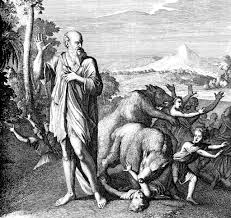
What our early ancestors did with dogs, we have done with Biblical prophets: we have domesticated them.  We have taken out, or chosen to ignore, many of the wild traits, in order to make it more comfortable to live with them.  But prophets have always been quite eccentric people that were not, at first blush, the best spokesmen for God.  Moses, the first great prophet, was slow of speech and tongue, according to his own words.  And he, by the power of God, changed a staff into a snake, caused the Nile to turn to blood, and brought a number of plagues upon Egypt.  Samuel, the great prophet who anointed the first kings of Israel, Saul and David, killed the Amalekite King Agag because Saul, was ordered by God to kill King Agag, but refused to do so.  Elisha was jeered at by some small
boys, who said, “‘Go up, baldhead!” and he cursed them, and two she-bears came out of the woods and tore them to pieces.  In chapter 20 of the Book of the Prophet Isaiah, God tells Isaiah, “Go and take off the sackcloth from your waist, and remove the sandals from your feet.  This he did, walking naked and barefoot.”  And it says in the next verse that this happened for 3 years.  Jeremiah told the king that Jerusalem, the place of the great Temple of the Lord, was going to be destroyed, and no one believed him.  And St. John the Baptist, the last and greatest of prophets, wore a camel-hair tunic and ate locusts and honey.  None of these seem to be people that civilized folk would want to be around.
And perhaps that is part of the reason they were never accepted in their home towns, as Jesus said in the Gospel today.  We tend to think of the prophets as nice guys who were able to tell the future.  We make them pretty well-dressed, white-bearded men.  But they railed against the injustices of their day and often became very unpopular in the process (walking around naked for 3 years can tend to make a person unpopular).  In many cases, they spoke out against the king, because he was the leader of the people.  But no matter whether they spoke out against a person or a situation, they always spoke the words that God gave them to say.
It’s cliché, but as prophets, God calls us to give comfort to the afflicted and affliction to the comfortable.  Jesus, as the source of prophecy and the Prophet about whom Moses spoke, to whom the Chosen People needed to listen, lived this out in a most perfect way.  To the Pharisees and scribes, those who were assured about their own righteousness, Jesus did not have great words to say, calling them “broods of vipers” and “white-washed sepulchers.”  But to the sinners, those who were often excluded from the daily life of Israel, Jesus preached love and acceptance, even while calling them, too, to conversion.  The woman caught in adultery is not stoned for her sin, but is told to go and sin no more.  The Samaritan woman at the well was convicted by Jesus about her many husbands, but she is also encouraged to drink the living water that comes from Jesus so that she can have eternal life.
There are parts of our life that God calls others to confront in us, and parts of our life that need the comfort of God.  When a person does not realize the conversion that needs to take place, God calls us to issue strong, dramatic words to help that person realize his or her need for God and a change in life.  When a person is beat up by the world, and despairing of any chance of redemption, God calls us to issue tender, loving words to help that person realize how much value he or she has.  We are not called to be nice, to say, “but that’s none of my business,” when we see sin and its effects in others.  But we are called to be prophets, by virtue of our baptism, who afflict the comfortable and comfort the afflicted.  
I’m not suggesting that we should walk around naked, not even for a day.  I’m not saying that we should curse people who make fun of us and send she-bears after them to tear them to pieces.  I’m not saying that we should threaten the destruction of a church.  But we also have to be careful about only saying things that people want to hear, things that do not make demands on life or call for conversion, things that do not challenge.  

God has called us to be prophets, and that in itself is a radical demand.  God calls us to speak His Word in our daily lives so that others can either turn from the evil they’re doing and live, and/or know just how much God loves them and wants the best for them.  Do not take the wild nature out of our prophetic call!  God save us from domesticated prophets!!

02 July 2018

Death and Resurrection

Thirteenth Sunday in Ordinary Time
Death.  It’s scary.  It seems so final.  What is beyond death is, generally, unknown.  It is the biggest change a person goes through in life, after being conceived and born.  We do everything we can to avoid death: we create new medicines; we buy creams to try to keep us looking young; we spend lots of money to fight death.  And yet, death comes to us all, some as young people, some as old.
Fighting death is, in one sense, natural for us because we were not made for death.  In the Garden of Eden, Adam and Eve cared for the Tree of Life, which would have allowed them to live forever.  But they were cast out of the garden, and banned from that tree.  And, as our first reading stated, “God did not make death.”  Death entered the world because when our first parents rejected God, they rejected life.  St. Paul says it this way in the Letter to the Romans: “Therefore, just as through one person sin entered the world, and through sin, death, and thus death came to all, inasmuch as all sinned…”  Everything in our being knows that we are made for eternal life, and yet we all have to experience death, and so we fight against it.
But, we need no longer fear death, because Jesus has conquered it by His Death and Resurrection.  Jesus gave a foretaste of that in today’s Gospel.  The woman with hemorrhages was getting worse; perhaps she was close to death.  But she went to Jesus because she had faith that He could make things better.  The little girl, the synagogue official’s daughter, was already dead by the time that Jesus got to her.  But her parents had faith, and she was returned to them.  Jesus unbound the power of death and gave new life.  Now, in both cases, the woman and the girl, they would later die.  But their faith changed the approach to death.  They followed Jesus’ command that we heard, “‘Do not be afraid; just have faith.’”
Death, for those who have faith in and follow Jesus should not be something that we fear so much.  Yes, we still may be anxious about the unknown, and we should not do anything to speed up our own death, but we need not be afraid if we have faith.  
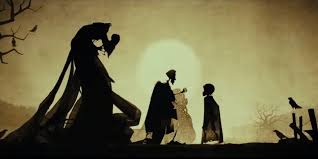
In “Harry Potter and the Deathly Hallows,” a story is told about the Deathly Hallows and three brothers.  Two of the three brothers try to cheat death.  But the third brother gained Death’s cloak of invisibility, and hid from death for many years.  After a long life, the third brother gave his cloak of invisibility to his son, and, as the story goes, “greeted death as an old friend.”  That’s not quite our view of death as Christians, but there is something that rings true in that story.  As believers in Jesus, death is not something we fear, but something that we can greet as a friend, because it is the necessary transition from this life to the life to come.  St. Augustine says that the only Christian who should fear death, is the one who has not truly followed Jesus, because eternal life will not be a life of joy, but a life of eternal torment.
If we are not afraid, if we have faith in Jesus, death is that which is the conclusion of our trials and testing on earth, and the beginning of our reward.  The student who has studied is not afraid of the final exam, but sees it as the necessary way to move towards graduation.  Our final judgment is not based on what we know, but, as St. John of the Cross states, whom we loved and how we loved.  But it still can allow us to graduate, to move on, to pass over, from this Valley of Tears to the eternal banquet of the Lamb of God in heaven.  
But death need not only be thought of in terms of our final breath.  We experience little deaths throughout our life, and our approach to those little deaths should be no less occasions of faith in what Jesus can do.  There’s the little deaths that happen in our family life: when we realize that our little baby is no longer a baby and is becoming more independent; when we lose a job; when, despite years of Catholic education and formation in the home, a child breaks our heart and stops practicing the faith.  There’s also little deaths that happen in our faith life: when we lose a pastor that we love; up 75 a bit and then down 475, St. Mary in Mt. Morris announced last Tuesday that, effective immediately, the school is closed; in our own parish as we make the transition to two weekend Masses from three.  All of those and more are little deaths in our lives.  We can fear it, we can fight it, we can kick and scream about it, or we can be not afraid and have faith in Jesus, trusting that He who brought us to all those situations and more will carry us through it.

Because our faith and our hope is in what is beyond the death, and that’s new life.  When Jesus rose from the dead He blazed a trail for us so that where He has gone, we hope to follow.  And although we have never seen what is on the other side of our own death, we have seen what is on the other side of Jesus’ death, and that is new life, transfigured life, glorified life.  To gain that new, transfigured, and glorified life, we need only follow Jesus and His way.  As we face death, in its many forms, Jesus invites us today: “‘Do not be afraid; just have faith.’”

25 June 2018

Celebrating Birthdays

Solemnity of the Nativity of St. John the Baptist
In our own times, birthdays are big deals.  Everybody I know celebrates birthdays, or avoids their celebration because they don’t want to be reminded that they’re going older.  Some people celebrate half birthdays (another excuse to party, I suppose), and some priests I know joke about celebrating an octave (8 consecutive days) of the day of their birth, just like we do for Jesus in the Octave of Christmas.
But for the Church, we generally celebrate the day a person died.  We don’t do this because we’re morbid, but because, especially as the Church first started celebrating holy men and women, we were celebrating martyrs, those who died for the faith.  So the date of their death was actually the date of their victory through Christ, the day they were born to eternal life; we might call it their heavenly birthday.  So today’s celebration, which supersedes a Sunday celebration, something not all that common, means something pretty big.  There are really only three birthdays that the Church celebrates: the Nativity of the Lord on 25 December, which is one of the holiest days of the year, after Easter; the Nativity of the Blessed Virgin Mary on 8 September, which, when it falls on a Sunday, is not celebrated; and the Nativity of St. John the Baptist, which is one of the handful of days in the Church’s calendar that has different readings for the vigil, the night before, than for the day.

Birthplace of St. John the Baptist
in En Kerem
And St. John the Baptist, the Precursor, as he is also called, is a pretty big deal.  He’s not as holy as the Blessed Virgin Mary, but he prepares the way for the Lord.  He plows the ground, as it were, so that the seed of faith that Jesus plants, can grow in the hearts of the men and women of his time.
John is known as being, what we would call a radical: he wears camel hair and eats locusts and honey.  He lives near the Jordan River, in a mainly uninhabited place, and tells everybody that they’re sinners, in need of repentance.  He calls out King Herod for his unlawful marriage to his brother’s wife, and St. John loses his head for it.  But the word radical does not really mean extreme.  Radical comes from the Latin word radix, which means root.  Our English word radish is simply a transliteration of the Latin word, which, in another form can be radice.  Not a very inventive word for not a very special root that we eat.  But John goes to the root of following Jesus: proclaiming repentance in preparation for Jesus.
In the Gospel on Saturday we hear about how John’s conception is achieved miraculously, but without faith from his father, Zechariah, believing it could happen, and so he is struck mute by the Archangel Gabriel.  And in the Gospel on Sunday, we hear about the naming of John, which frees Zechariah’s tongue and allows him to proclaim God’s wonders again.  But in both the first readings, we hear about being a prophet, speaking God’s Word to the people, which is exactly the mission of St. John the Baptist.
And that is exactly the mission of all of us: to proclaim God’s Word.  And that Word is not so much a particular teaching (though we can teach others about what God says), but a Person, the eternal Word of God that St. John the Apostle and Evangelist talks about, the Word that was in the beginning, the Word that was with God and is God.  We, like Jeremiah, like Isaiah, like St. John the Baptist, are called to prepare the way of the Lord, to make straight His paths.  
But, you might say, if you’re paying attention and not reading your bulletin, Jesus has already come!  We don’t need to prepare for Him, any more than we need to prepare for the Belgium vs. Panama World Cup Soccer game, because it’s already come.  But, in fact, Jesus’ coming happens daily to each person.  Each day Jesus wants to enter our hearts.  But in order to do that, we have to be prepared for him, and in order to be prepared, someone has to help us prepare, and that’s where we come in.  Each day we are called to help people see Jesus in what we say and in what we do: in the kind word to a person who is having a rough day; in the challenging word that we speak with love to a person who is not living as Jesus teaches us; in serving people in the food pantry.  But we have to be purposeful about it, about making it about Jesus.  When the person asks us why we are being kind to them, or why we are lovingly challenging them, or why we are serving them, we need to witness to Jesus and say it’s because Jesus loves them, and as followers of Jesus so do we.  It’s not enough to hope that they’ll catch on.
Imagine if John had been calling people to repentance, but then when Jesus came by, not said, “Behold the Lamb of God!”  He would not have completed his mission.  If, when John was baptizing and being asked why, John said, “I don’t really feel comfortable talking about it,” instead of, “One is coming after me who will baptize you with fire!”, maybe we wouldn’t be celebrating the Nativity of St. John the Baptist.  But we are.  And that in itself is a challenge to us to be like John, to prepare the way of the Lord, to help Jesus find a welcome home by our participation in the mission to proclaim the Word of God, the eternal Word of God, Jesus Christ in our daily words and actions.  

Be radical!  Embrace your mission!  Prepare the way for the Lord!

12 June 2018

These Aren't My Pants

Tenth Sunday in Ordinary Time
Probably the weirdest thing I’ve heard working with law enforcement, is when we had a driver out of a car and the Troopers were making sure he didn’t have any weapons or drugs on him.  As they looked in his pockets, they found some drugs.  We asked the person why he had drugs on him, and he said, I kid you not, “These aren’t my pants.”  Now, I know that I live a sheltered life, but I don’t have any particular memory in my 34 years of life, or at least since I was responsible for dressing myself, that I ever wore someone else’s pants, and certainly not with drugs in them.
“These aren’t my pants,” may sound crazy as an excuse, but we’re good at excusing ourselves and rationalizing our behavior.  We’ve been doing it almost since the beginning of humanity.  God called Adam on the carpet, Adam, who represented all of humanity, for eating the fruit that we were forbidden to eat, and what did he do?  “These aren’t my pants.”  Well, not so much, because he was wearing a fig leaf.  But he did the same thing: “It’s not my fault!  The woman made me do it!”  Then God goes to Eve, and, anticipating by some millennia the Flip Wilson Show, she basically said, “The devil made me do it!”  

We’re so good at dodging responsibility.  These aren’t my pants, someone else made me, it’s the Devil’s fault, and so many more excuses come to mind.  But sin is always our fault.  We have free will, and we only sin when we make choices that go against God’s law, natural law, and just human laws.  Temptations, however, are not sins.  Sin is only when we make a choice.  
If I desire to eat that quarter pounder on a Friday of Lent, my desires are not rightly ordered, but I haven’t sinned unless I pull through the drive-thru lane and take a bite into the burger.  If I’m laying in bed Sunday morning, the birds chirping, a cool 68 degree and sunny day, wanting to play nine holes instead of going to Mass, I’m not wanting to be where I should be, but I haven’t sinned.  If I’m cut off in my car by someone who needs remedial driving lessons and my desire is to lay on my horn and raise a certain finger to greet them, the emotion of anger is probably getting the better of me, but if I don’t act on that emotion, I haven’t sinned.  It’s only when we make that choice, in thought, word, or deed, when we exercise our free will in a negative way, that we talk about sin.
The Good News is that Jesus came to conquer sin.  The people in our Gospel today didn’t recognize that, and the scribes claim that Jesus is casting out demons by the power of demons.  But as Jesus points out, if Satan is fighting against himself, how does he expect to win?  Jesus comes to destroy the reign of Satan, and does so as God.
That’s why it’s so important to turn to Jesus when we are tempted, so that we don’t give in to that temptation and sin.  We shouldn’t wait and figure that we’re strong enough; let’s be honest, we’re weak.  Almost every time I have thought: I’m strong enough; I can handle this, I end up giving into temptation.  When I realize that I am weak and that without God I can do nothing, it is then that God conquers sin through me.  
Another thing that can be very common in our spiritual life and spiritual battle with sin is to “flirt” with the temptation.  We say no at first, but then we might return to the temptation a little later, and then maybe we say no again, but then we go back to it.  And eventually it conquers us.  But if we nip the temptation in the bud, and call on God to help us at the beginning, then God will preserve us from falling into temptation.  
There is only one sin that God cannot forgive, and that’s the sin against the Holy Spirit.  While there are different theories, what I was taught in seminary is that the only unforgivable sin is the sin that we don’t allow God to forgive, because God does not force His grace upon us; He respects our free will.  If we think that this sin or that sin is so bad that God cannot forgive it, then He won’t; not because it’s so heinous, but because we don’t allow Him to.  
The other key to fighting sin comes from our second reading.  St. Paul exhorts us not to be discouraged.  That can be easier said than done, especially when we’re struggling with the same sin over and over again, no matter how big or how small.  But God will give us victory eventually if we persevere in His grace and keep fighting.  It’s only when we give up, when we decide it’s useless, that Satan wins and gains mastery over us.  If we keep fighting, no matter how many battles we lose, God can still win the war.

When we sin, don’t blame others, don’t be discouraged, and do call on Jesus to help us.  Jesus came to free us from sin, and will do exactly that if we allow Him to and cooperate with the grace He gives us through the Sacrament of Penance and the Most Holy Sacrament of the Eucharist.  

04 June 2018

How to Receive Jesus

Solemnity of Corpus Christi
Arguably the most popular topic for renaissance painters was the Madonna and Child.  There are more paintings of our Blessed Mother holding her child, Jesus than probably any other saint or person.  In almost all of those paintings, Mary is holding Jesus, and is looking down towards Him with love and wonder.  Probably the most famous statue of the Blessed Mother is the Pietà by
Michelangelo.  Currently housed in a chapel in the Papal Basilica of St. Peter in Vatican City, it shows the Blessed Mother holding the lifeless Body of her Son after He was taken down from the cross.  She is still looking down towards Him, but this time with sorrow on her face.
In both the paintings of Madonna and Child, and the Pietà, Mary’s gaze is towards Jesus.  She is focused on Him.  And as we come to Mass today to celebrate the Most Holy Body and Blood of our Lord, Mary invites us to do the same thing: to gaze towards Jesus.
For cradle Catholics, the Eucharist might seem very familiar, maybe even not a big deal.  But in the Eucharist, the Body and Blood, Soul and Divinity of Jesus Christ, we see the same Jesus that Mary held, and receive Him either on our tongue or in our hands.  It is the biggest deal on earth, and the greatest treasure the Church has.
Jesus, on the night of the Last Supper, that we heard about in the second half of our Gospel passage today, instituted both the ministerial priesthood and the Eucharist, as His way of perpetuating the new Passover, no longer the angel of death passing over the house of the Israelites, but Jesus, the true Passover or Paschal Lamb being sacrificed so that we, His adopted brothers and sisters in baptism, would not have to suffer eternal death.  Each time the Mass is celebrated, Jesus’ one, perfect sacrifice on the cross is made present to us again as we enter the ante-chamber, the narthex, as it were, of the perfect tabernacle in heaven.  That is why, instead of the risen Christ, the crucified Christ should occupy the central place above the Tabernacle in the sanctuary: placed before our eyes in a prominent way should be the mystery of what the Eucharist recalls: the crucifixion.  
But because this re-presentation of Calvary happens so frequently, as Catholics we can forget its power, and forget just how awesome it is to be able to come into the presence of Jesus Christ Himself.  Our posture hopefully helps us to remember.  We kneel during the Eucharistic Prayer, lowering our very bodies in adoration of the miracle of the bread and wine becoming the Body and Blood of Jesus.  Not simply a reminder of Jesus’ Body and Blood, but the same Body that hung on the Cross; the same Blood that was poured out for our salvation in Jesus’ Passion.  We even used to (and people are still allowed to) kneel to receive the Eucharist.  There was something good about this, as it reminded our bodies that we are not worthy, and therefore lowered, before the presence of Jesus.  
Our heavenly patron, Pope St. Pius X, encouraged frequent reception of the Body and Blood of Christ, and in his time, many people would only receive once per year, even though they attended Mass every Sunday.  There was, in his time, an over-exaggerated sense of sin and unworthiness to receive Jesus.  And so it was very important to encourage frequent, worthy reception of the Eucharist.  In our day, we have gone to the other extreme: the Eucharist is something that everyone who comes to Mass gets, even if they are truly unworthy and should not receive.  Only Catholics in a state of grace, that is, not aware of any grave sins, should receive the Eucharist.  Those who skip Mass out of laziness, who have taken the Lord’s Name in vain, who have misused the beautiful gift of human sexuality, or who have lied in a serious way need to go to confession before they receive the Eucharist, otherwise, as St. Paul says, they eat and drink damnation upon themselves for receiving the Eucharist unworthily.  Our venial sins are forgiven by the reception of the Eucharist, but our grave or mortal sins need to be healed before we can receive Holiness Himself in the Sacrament of Sacraments.  Too often the line for the procession for the Eucharist is like a line of a drive thru at a fast food restaurant.  But the line for the Eucharist does not lead us to a Whopper or a Big Mac, but to our Lord, Savior, and Creator, Jesus Christ.

We should take as our model as we approach the Eucharist Mary, the Mother of God.  Mary shows us how to love Jesus in the Eucharist.  Mary shows us how to hold Jesus carefully as a mother with her child, in the Eucharist.  Mary shows us that, to hold Jesus, we should be doing all that we can to say yes to Jesus, and being reconciled with Him in the Sacrament of Penance if we have, in some major way, said no to Him.  As we celebrate Corpus Christi, may we rediscover a profound spirit of wonder and awe in the presence of Jesus, who each day around the world humbles Himself by changing bread and wine into His Body and Blood, Soul and Divinity in the Most Blessed Sacrament of the Eucharist.

14 May 2018

Our Hope in Christ, Assisted by Mary

Solemnity of the Ascension of the Lord
This past Thursday I buried a brother; not a biological brother, but a brother priest.  Fr. Tom Butler was a priest of the Diocese of Lansing, and well-loved for his sense of humor that he shared with his parishioners and with us priests.  And while many of his jokes could not be told in a church, probably not even in polite company, there is one story for which I will always remember him.
Fr. Tom told this story at a regional penance liturgy at St. Anthony in Hillsdale, where he was pastor for many years.  Fr. Tom and his family were originally baptist, but converted to Catholicism.  His mother embraced the faith, but always found a relationship with our Blessed Mother difficult.  Fr. Tom’s brother passed away some years ago in the Dallas, Texas area.  It was a cold day, and so, at the end of the funeral, he and his mother stayed just inside the doors of the church while the casket was carried to the hearse.  As it happened, his mother turned a little, and was noticeably startled.  Fr. Tom asked his mom if she was alright, and she said yes.
A few weeks later, his mom called Fr. Tom.  She said, “Tom, do you remember your brother’s funeral?”  “Yes, mother,” he replied.  “Do you remember when your brother’s casket was put into the hearse, and I was startled?”  “Mother, are you ok?” Fr. Tom asked.  “Yes,” she said.  “When I was standing there, I felt someone tap me on the shoulder.  I thought it was you, but then when I turned, I saw Mary, the Blessed Mother standing next to me.  She said to me, ‘I’ll watch over your son until you can join him.’  Then she disappeared.”
Perhaps it’s not fair to tug at the heart strings on this day the we honor mothers and celebrate the Ascension of the Lord.  But this story is perfect for these two celebrations.  We all know that the Ascension is when Jesus went, Body and Soul, into heaven.  But the Ascension is also our hope, because where Christ has gone, we are meant to follow.  Jesus took our human nature, which He had united to Himself at the Annunciation, and brought it into heaven at the Ascension.  He showed us the way to get there: by following Him with all our heart, mind, and soul.  Because Jesus has gone to heaven, we hope that we can go there, too.
Hope is not mere optimism, a wish that things will go well.  Hope is the grasping of things unseen.  It is, as we might say, the already, but not yet.  Hope is being at the edge of victory, and only having to finish.  Hope is what belongs to us as baptized Christians.  Our hope is that if we have died with Christ in baptism, then we shall rise with Him to new life.  When we are baptized, God does all the work, and we have only to cooperate with His grace throughout our life to claim the prize of victory.  
And how do we cooperate with God’s grace?  Mary shows us how.  Our Blessed Mother watches over all of us, her sons and daughters, and helps us grow closer to her Son.  Mary always said “yes” to God, and that’s how we take our hope and make it a reality.  It’s as simple and as complicated as that: say “yes” to God in all the decisions of our life.  And if we don’t say “yes” to God, Mary, as our loving Mother, picks us up, cleans off our wounds, and encourages us to try again.
Sometimes it may seem like we give Mary too much honor, and go to her too much.  That is often the complaint from our Protestant brothers and sisters.  Some accuse us of worshipping her, which we don’t; we worship God alone, but we honor Mary, the Mother of God.  But think about it this way: Jesus loved Mary, and Jesus’ love is infinite.  So there’s no amount of love that we can give to Mary that would ever even come close to rivaling the love that Jesus showed her.  
And Mary, free from all sin, does not let that honor stay with her.  Because she is the first and only perfect disciple, Mary always takes whatever honor we give her, and directs it toward her Son.  Mary has no selfishness, no pride, no ego that would cause her to take something away from God.  Her soul, as she herself said, proclaims the greatness of the Lord.

So today, as we celebrate the Ascension and Mother’s Day, we celebrate our hope of eternal life in Christ, and our Blessed Mother who helps us make our hope a reality.  Never be afraid to run to Mary to help you make Christ’s life your own in your daily experiences.  Never be afraid to run to your Blessed Mother when you fall down in sin; she will help pick you up and direct you to the forgiveness that God gives to His children.  Cling to that hope that belongs to us as children of God, that where Christ has gone, we are meant to go, too.  If we die with Christ, we will live with Christ, and if we live with Christ daily, then we will reign with Christ for eternity, in the kingdom of heaven, where our human nature is seated at the right hand of the Father in Christ.  

06 May 2018

"Love is in the Air"

Sixth Sunday of Easter
     So clearly, St. John is focusing on love this weekend.  Our second reading, from the first Letter of St. John, says "Beloved, let us love one another, because love is of God; everyone who loves is begotten by God and knows God."  And in the Gospel, also from St. John, we heard, "'As the Father loves me, so I also love you.  Remain in my love....This is my commandment; love one another as I love you.'"  As John Paul Young sang, "Love is in the air."
     And this weekend, as we have our second grade students receive their first Holy Communion, we celebrate what love is: love is the gift of self.  Jesus gives Himself in the Eucharist because He wants to remain with us, so that we can remain with Him.  And if we remain with Him, our joy will be complete.
   
 Love, as seen in the Eucharist, is a sacrifice.  We are so often told by basically every secular source, that love is about me.  Love is supposed to make me happy.  Love is a good feeling that I have with another.  Love completes me.  But that's not what Jesus shows us in the Eucharist.  What Jesus shows us in the Eucharist is that love is concerned with making the other person happy; love sometimes is not accompanied by any good feelings; love is about helping the other get to heaven.
   Because in the Eucharist, we receive Jesus' sacrifice of His own life on the cross.  In the Eucharist we receive Jesus' Body and Blood which was poured out for the one He loves, His Bride, the Church (that's us!).  If love was about the self, Jesus would not have died for us.  If love was about feeling good, Jesus would not have been crucified.  As St. John says, "In this is love: not that we have loved God, but that he loved us and sent his Son as expiation for our sins."
     Love is difficult; it's not easy.  Love is difficult even when the beloved loves you.  It's always a joy to celebrate anniversaries of couples at Mass.  When I see a couple that has been married for 25, 40, 50, or even 60 years, I see their joy and happiness with each other.  What I don't see on those days are the days that they maybe weren't so in love with each other, the days when maybe they didn't have good feelings towards each other, the days when the maybe they wanted to kill each other (metaphorically speaking, of course...I hope).  Because we are human we fail at love, because we have a tendency to be selfish, which is the opposite of love.  We are afraid to be selfless, because we are afraid that the love we express will not be returned.  That's part of what makes love so beautiful: it requires great vulnerability.
     But love is even more difficult when the beloved does not love you, even if it's just temporary.  Parents know this all too well: those moments when your own child says that they hate you, that you're a bad parent, that they never want to talk to you again, because you took away their iPhone, or grounded them for bad behavior.  Kinds don't usually mean it, they are generally just taking out their frustration.  But sometimes we do find people that generally have o love for us, who maybe even wish us ill.  But we are still called to love them.
     Love doesn't mean letting them engage in destructive behavior, or letting them do anything they want.  That's not love, that's apathy, not caring either way.  But loves means  we do what's best for the beloved, even if it's not appreciated or understood.
     Jesus tells us that love means laying down our life for our friends.  If anyone could say that, Jesus could, as the following day (this Gospel recounts what happened at the Last Supper), Jesus would lay down His life for His friends, the Apostles, for His Blessed Mother, and even for those who hated Him.  Whenever I hear this passage I think of our military personnel who lay down their life for our country, even if laying down their lives doesn't mean paying the ultimate sacrifice, but is led out by delaying their own plans for life, being away for their families, and daily doing jobs that many others never want to to.  I also think of our police officers, and specifically for me our State Troopers.  Law enforcement personnel daily also lay down their lives for the citizens that they serve.  Sometimes they, too, pay the ultimate price and sacrifice their lives.  Other times it's the nights or days that they're away from their families, interacting with people with whom most other people would rather not come into contact, and running towards danger while everyone else is running away.
     The reason why we especially honor veterans and first responders is because they show love in a way that many of us could not even fathom.  But mom and dads also sacrifice greatly; employees sacrifice for the good of their company; kids sometimes also know how to sacrifice for others in simple, yet profound ways, like sharing a favorite snack with a friend who doesn't have much food.  Love is not only a vocation for the great, it is a vocation for everyone.
     So as we who are prepared to receive the Eucharist today come forward, may we be inspired by love.  Not by a false sense of love which focuses on the self, but on true love that focuses on sacrificing for the good of the beloved.  May the sacrifice of love that we receive in the Body and Blood of Jesus help us to live out Jesus' message that we hear from St. John: love.

30 April 2018

It's About the Yes

Fifth Sunday of Easter
It’s a sad reality that talk is often cheap.  This is not universal, but is especially true in our Western culture.  We need a contract for everything.  When planning for my pilgrimage to the Holy Land, I wanted to go with a local group from Palestine.  However, they’re not big on contracts, and as an American that makes me leery.  Because I have been to the Holy Land before, I know that, in the Middle Eastern culture, a person’s word is everything, and if they do not live up to what was agreed, that person can lose everything, including his honor.  But I also know that, as Americans, we like to have things in writing.  So instead of going with a more local group, I went with an American tour company that has pilgrimages to the Holy Land.
St. John reminds us that we are called to love, not only “in word or speech but in deed and truth.”  It’s very easy to say that we follow Jesus, but do our actions back up what our mouths say?  In fact, St. John goes on to say that loving Jesus means keeping His commandments.  If we do this, then the Holy Spirit remains in us.  On the contrary, if we don’t keep Jesus’ commandments, then we lack a reality of the life of Christ.
John could say this because He heard Jesus say what was in our Gospel today, which is also from St. John.  Jesus told us that we need to stay connected to Him, as branches with the vine.  It’s not enough to say that we’re branches, we have to truly remain connected to Jesus.  If we are not connected, we’ll waste away and be good for nothing else then burning.  If, however, we stay connected to Jesus, then we’ll bear fruit that proves that we not only profess faith in Jesus, but also live in the way He shows us.
Words do mean, something, however.  They are cheap if they are not followed up by actions, but they can also be profound if they are connected to action.  For example, a relatively recent Pope wrote about the dangers facing society.  He warned against increased dangers of marital infidelity, and a lowering of moral standards.  He warned about how easy it is for young people to be tempted, and how they need to be taught how to live the moral law.  He also warned of a lack of respect for women, and how men could so easily make them objects of the satisfaction of their desires, rather than an equal partner “whom he should surround with care and affection.”  This pope wrote about these dangers 50 years ago, in 1968.  And in many ways, his prophecy, his words spoken from God, have come true.  It is more and more common for spouses to cheat on each other; I don’t think anyone would argue that morality has decreased over the past 50 years; young people more and more don’t know how to live the moral law, and are exposed to grave evils at younger and younger ages; and women are seen more and more not as people, equal in dignity and respect, but as tools to satisfy lust.  
These words were penned by Pope Bl. Paul VI.  And he wrote this in his very famous, and often derided, Encyclical, Humanae vitae.  This summer we celebrate 50 years since the promulgation of this prophetic document about human life.  I know it is a very contentious document, but Bishop Boyea has asked us to preach about it this weekend.  I think that one reason it is so often seen as negative is because it seems to simply say no to artificial contraception.  In fact, it actually talks about the great value of human life, something that needs to be reinforced, especially in light of the Alfie Evans’ recent.  Many people think that all the Church says is “no.”  But in fact, while the Church does say no, that no means an ability to say yes to other goods.
The Church teaches that all artificial contraception is gravely wrong, not because it can spread out childbirth, which can be a moral decision, but because the marital act between a woman and a man is meant to be a full gift of self, and artificial contraception of any kind means holding back one aspect of the gift of self, the ability to conceive, and makes that moment a lie, because one is not truly giving his or her entire self.  
But again, we can see it as no.  But in fact, sometimes, in order to say yes to a good, we have to say no to other lesser goods.  Think about when a man marries a woman.  That man, in marriage, is saying no to every other woman that has ever or will ever come along.  He is forsaking that special relationship of marriage with any other woman (and vis versa for a woman towards other men).  But I have never met a man who is so focused on the no to other women.  He is focused on the yes to that one woman.  He can’t say yes to that one woman without saying no to all others.  But it doesn’t meant it’s about the no.  It’s about the yes.
And look at what has happened with the ubiquitousness of contraception: we have a lower sense of morality, marriages break apart more and more, and we have recently seen the epidemic of men treating women in a way that is beneath the dignity and respect that they deserve.  Pope Bl. Paul VI’s words have been followed up by actions, a reality that is sad and has caused no small amount of pain in the lives of perhaps most families in America.

Today the Lord challenges us to not simply say that we will follow Him, but to actually do it, including in the ways that we regulate the size of our families.  May we not be focused on all the things we give up by following Jesus in word and deed, but in all the greater yeses that are made possible by following Jesus “in deed and truth.”

23 April 2018

Unexpected Pastures

Fourth Sunday of Easter
This Sunday of Easter is called Good Shepherd Sunday, and it’s not hard to understand why: our Gospel today comes from the Gospel according to John where Jesus refers to Himself as the Good Shepherd.  I think that we all see the necessity of Jesus leading us, like a shepherd, and, in fact, probably the most popular Psalm in the Bible is Psalm 23, which usually is remembered for it’s first line, “The Lord is my shepherd.”  
A shepherd is someone who leads us, and sometimes we don’t want to be led.  Often we want to lead ourselves, to determine our own direction and our own destinies.  But we proclaim this weekend that God is the one who is supposed to lead us.  Without God we would be lost and in danger, like sheep without a shepherd.  There are many other hirelings who tell us that they will lead us to good places, but Jesus reminds us today that they run away when danger comes, and they often do not lead us where we truly want to go.

I know in my own life Jesus, the Good Shepherd, has led me places I never imagined I would go.  If I simply think about my assignments as a priest, when I was meeting with Bishop Boyea to be approved for ordination to be a priest, I was wondering where he would send me.  The parishes I thought would be open for a newly-ordained priest would be Queen of the Miraculous Medal in Jackson (where I had interned as a seminarian), St. Gerard in Lansing (where I had lived for a summer in college), St. Thomas Aquinas/St. John Church & Student Center in East Lansing (where I went to middle school and where I had spent a couple of summers in college), and St. John the Evangelist in Fenton, where I was then serving as a deacon.  In my heart, I wanted to stay at St. John the Evangelist in Fenton, as I had grown to love that community, and knew how things operated with Fr. Harvey.  But Jesus, the Good Shepherd, through Bishop Boyea, sent me to St. Thomas Aquinas in East Lansing.  Even though it wasn’t my first choice, I had a great four years in East Lansing, made some lifelong friends, and learned a lot about parish ministry.
Then, when my first four years were coming to a close, I thought I might become an administrator in a new parish.  There were a number of parishes that were open, but none of them really jumped out at me as a place for which I should apply.  Jesus, the Good Shepherd, through Bishop Boyea, sent me to St. Joseph in Adrian, on the outskirts of the Diocese of Lansing.  I had never even really visited Adrian before.  And yet, the people of St. Joseph became near and dear to my heart and it was a good, two-year assignment which helped me learn how to be a pastor.
In my second year in Adrian, Jesus, the Good Shepherd, through Bishop Boyea, again led me somewhere I never imagined to go: Flint.  I was very happy in Adrian, but Bishop Boyea said that, because of other moves, he needed me to go to St. Pius X.  I told him that if that’s where God wanted me, then that’s where I would go.  We have certainly had our struggles here at St. Pius X since I arrived, but I love it here, and I love you, my parish family.
In each of my moves, the Good Shepherd has taken me to pastures I never expected.  And in each move, I have found blessings more than I ever would have expected at places that maybe I thought I would do well.  And that extends even beyond my parish assignments: Jesus, the Good Shepherd, continues to guide my formation as a priest.  That is greatly impacted by Bishop Boyea, my immediate shepherd, who, I know, loves me (as he does all his priests), but also challenges me (as he does with all his priests) to grow.
The People of God, the laity, are also called to grow in ways, sometimes that they never expected, and Jesus, the Good Shepherd, exercises his role as Shepherd through His priests.  This is also World Day of Prayer for Vocations.  Each vocation is a gift from God, and whether a person receives the Sacrament of Matrimony, makes vows in consecrated life, or receives the Sacrament of Holy Order, each is called to build up the Church, along with those perhaps not in one of those vocations temporarily or permanently.  But priests in a special way help make the Church.  Without priests, we do not have the ordinary way that God forgives our sins in the Sacrament of Penance, and without priests, we are not strengthened to live our universal vocation to be saints through the Most Blessed Sacrament of the Eucharist.  
And yet, some parents, or other family members, discourage their sons, grandsons, nephews, etc., to answer God’s call to become a priest.  As far as I know, no son of St. Pius X has ever been ordained a priest, or has even entered the seminary.  That is a very sad statistic.  Priesthood is not always easy; it is a sacrifice; and it requires a real man to step up and give his life away for the good of the People of God.  But it is also rewarding beyond any measure that I ever expected.  And I cannot imagine my life doing anything else (yes, that even includes being a police officer).  
So what can we do?  If you have a son or multiple sons, encourage them to think and pray about becoming a priest.  Always include it as an option for a future.  The same goes for if you have grandsons or nephews.  If you don’t, or can’t think of anyone who would be a good priest, then pray for the Holy Spirit to call one of the sons of St. Pius X to consider this vocation, maybe even if it’s simply trying out the seminary.  And pray for that man to be open to the Holy Spirit’s voice.  Another great way to promote the priesthood is to live married life faithful to the call in Holy Matrimony: a life of prayer, sacrifice for the other, and holiness.  Good priests come from good families.  

Jesus is our Good Shepherd, who sends us places sometimes we never expect.  He also sends us shepherds who care for us and help us to follow Him.  Pray for more men to respond to the call of priesthood: to a life of sacrifice, yes,  but also a life of great joy spent in imitation of the Good Shepherd, who calls us all to be saints, and leads us to green pastures.