Showing posts with label Mark 5. Show all posts

01 July 2024

New Catholics, New Life

Thirteenth Sunday in Ordinary Time
    Today we have the great joy of celebrating the baptism, confirmation, and first Holy Communion of Mia who has been preparing over these past months, growing in her desire to follow Jesus and make the pattern of His life her own.  We also have the great joy of welcoming Kelcie into full communion with the Catholic Church, and then celebrating her confirmation and first Holy Communion.  The prayer of St. Paul from our second reading we make our own for you both: may you excel in faith, knowledge, and love.
    Christ is doing for you both, each in your own way, what he did with the daughter of Jairus: raising you up to new life.  From today on, you begin a life that is meant to be a witness of the emptying of Christ (we use the church word kenosis) for our sake.  There are so many people at the point of death: not physical death so much, but spiritual death, but God does not want it to be that way, as He said through the sacred author of the Book of Wisdom.  God wants us to be with Him for eternity, and He has give us the Church to help us get there.  Really, the Church is a map to eternal life and happiness, helping us know which way we should go, and which ways lead to danger and move away from our final desired destination.  
    When I use the word Church, you may think of the official teaching office which promulgates and clarifies Church teachings.  And there is truth in that.  But you, as our soon-to-be newest members of the Church, also have that mission: to know which way we should go, and to know which ways lead away from salvation.  You might think that is a bit much for someone who is just joining the Church today, but guiding humanity to God is the mission of each baptized and confirmed person, no matter how long he or she has been Catholic.  We all help others to know what to do and what not to do.  Sometimes we know this because we have studied the faith and learned in our head the path to salvation.  Sometime we know this because we have wondered away from God and felt the negative consequences that come with opposition to God, and so we can let others know that we’ve been there, done that, and how it hasn’t worked out for us.  
    You also inspire us today by your choice to become Catholic.  Many here were born into the faith, so to speak.  As infants, our parents had us baptized, and so we take for granted sometimes the profundity of what it means to be Catholic.  But, as we see you, both adults, make a free and purposeful choice, we can be stronger in our convictions that our life in the Catholic Church makes sense, and is something others have chosen who didn’t grow up surrounded by Catholicism in their family.  So it’s not just others outside whom you will impact.  We feel the impact of your faith even now, inside the four walls of this church building.
    In confirmation, you will receive the Holy Spirit again, so that you can have the courage to proclaim the Gospel by word and by deed.  You will be filled with power from on high to live a life that reflects what you believe, and help people understand how the answer to the deepest questions of their hearts is connected to Christ and faith in Him.  

    But, let us now return to the daughter of Jairus.  We also see in this passage something that many pass over, but is also important: after Jairus’s daughter comes back to life through the prayer of Jesus, He tells them to give her something to eat.  New life has to be strengthened by food.  And so, the culmination of her new life on earth is strengthened by food to sustain her newly-animated body.  So your new life that you are given, either through baptism, Mia, or by your profession of faith, Kelcie, which joins you to us in fulness, will be strengthened by the heavenly food, the Bread of Angels, the Eucharist.  
    For children, the order has been changed, but the ancient order of the sacraments of initiation was baptism, confirmation, then the Eucharist, an order restored for the Order of Christian Initiation of Adults.  The Eucharist was the culmination of becoming Catholic and growing in the faith because it is the closest one can come to Christ.  Your entrance into the Catholic Church again confirms that all of our life as Catholics leads to the Eucharist, and then flows from the strength we receive from the Body and Blood of Christ.  
    So today we rejoice with you; we thank God for you; we thank you for your “yes” to Him.  May you remain in Christ’s Holy Church while on earth, and so enter the heavenly Jerusalem, the Church in triumph in heaven, which is the goal of your baptism, confirmation, and reception of the Eucharist today!
   

02 July 2018

Death and Resurrection

Thirteenth Sunday in Ordinary Time
Death.  It’s scary.  It seems so final.  What is beyond death is, generally, unknown.  It is the biggest change a person goes through in life, after being conceived and born.  We do everything we can to avoid death: we create new medicines; we buy creams to try to keep us looking young; we spend lots of money to fight death.  And yet, death comes to us all, some as young people, some as old.
Fighting death is, in one sense, natural for us because we were not made for death.  In the Garden of Eden, Adam and Eve cared for the Tree of Life, which would have allowed them to live forever.  But they were cast out of the garden, and banned from that tree.  And, as our first reading stated, “God did not make death.”  Death entered the world because when our first parents rejected God, they rejected life.  St. Paul says it this way in the Letter to the Romans: “Therefore, just as through one person sin entered the world, and through sin, death, and thus death came to all, inasmuch as all sinned…”  Everything in our being knows that we are made for eternal life, and yet we all have to experience death, and so we fight against it.
But, we need no longer fear death, because Jesus has conquered it by His Death and Resurrection.  Jesus gave a foretaste of that in today’s Gospel.  The woman with hemorrhages was getting worse; perhaps she was close to death.  But she went to Jesus because she had faith that He could make things better.  The little girl, the synagogue official’s daughter, was already dead by the time that Jesus got to her.  But her parents had faith, and she was returned to them.  Jesus unbound the power of death and gave new life.  Now, in both cases, the woman and the girl, they would later die.  But their faith changed the approach to death.  They followed Jesus’ command that we heard, “‘Do not be afraid; just have faith.’”
Death, for those who have faith in and follow Jesus should not be something that we fear so much.  Yes, we still may be anxious about the unknown, and we should not do anything to speed up our own death, but we need not be afraid if we have faith.  
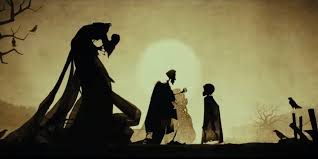
In “Harry Potter and the Deathly Hallows,” a story is told about the Deathly Hallows and three brothers.  Two of the three brothers try to cheat death.  But the third brother gained Death’s cloak of invisibility, and hid from death for many years.  After a long life, the third brother gave his cloak of invisibility to his son, and, as the story goes, “greeted death as an old friend.”  That’s not quite our view of death as Christians, but there is something that rings true in that story.  As believers in Jesus, death is not something we fear, but something that we can greet as a friend, because it is the necessary transition from this life to the life to come.  St. Augustine says that the only Christian who should fear death, is the one who has not truly followed Jesus, because eternal life will not be a life of joy, but a life of eternal torment.
If we are not afraid, if we have faith in Jesus, death is that which is the conclusion of our trials and testing on earth, and the beginning of our reward.  The student who has studied is not afraid of the final exam, but sees it as the necessary way to move towards graduation.  Our final judgment is not based on what we know, but, as St. John of the Cross states, whom we loved and how we loved.  But it still can allow us to graduate, to move on, to pass over, from this Valley of Tears to the eternal banquet of the Lamb of God in heaven.  
But death need not only be thought of in terms of our final breath.  We experience little deaths throughout our life, and our approach to those little deaths should be no less occasions of faith in what Jesus can do.  There’s the little deaths that happen in our family life: when we realize that our little baby is no longer a baby and is becoming more independent; when we lose a job; when, despite years of Catholic education and formation in the home, a child breaks our heart and stops practicing the faith.  There’s also little deaths that happen in our faith life: when we lose a pastor that we love; up 75 a bit and then down 475, St. Mary in Mt. Morris announced last Tuesday that, effective immediately, the school is closed; in our own parish as we make the transition to two weekend Masses from three.  All of those and more are little deaths in our lives.  We can fear it, we can fight it, we can kick and scream about it, or we can be not afraid and have faith in Jesus, trusting that He who brought us to all those situations and more will carry us through it.

Because our faith and our hope is in what is beyond the death, and that’s new life.  When Jesus rose from the dead He blazed a trail for us so that where He has gone, we hope to follow.  And although we have never seen what is on the other side of our own death, we have seen what is on the other side of Jesus’ death, and that is new life, transfigured life, glorified life.  To gain that new, transfigured, and glorified life, we need only follow Jesus and His way.  As we face death, in its many forms, Jesus invites us today: “‘Do not be afraid; just have faith.’”