Showing posts with label Isaiah. Show all posts

20 July 2026

Sons and Brides

Eighth Sunday after Pentecost
    In the name of the Father, and of the Son, and of the Holy Spirit.  Amen.  Today St. Paul reminds us that we are the sons of God and joint heirs with Christ.  While we often speak about the moral life and the requirements of following Christ as His disciples, there is something that comes before morality, and if we miss this, we often see the demands of a relationship with Christ as merely laws imposed on us from without.  What comes before morality is identity.  Or, to put it another way, being precedes doing.  You have to exist before you can act, and any action you take or can take flows from what and who you are.
    Now, we might think that St. Paul should have said that we are sons and daughters of God.  Certainly in the age we live in, we can demonstrate more inclusivity and not simply reference masculine identity.  But the Apostle to the Gentiles carefully chose his words, words that God Himself inspired.  So how can we disciples, both males and females, understand what St. Paul meant when he called us all sons?  

    Our identity, ever since baptism, connects to Christ.  At Holy Baptism, we receive a new identity, and that is of Christ.  In Holy Baptism, the Holy Spirit mystically joins us to the Body of Christ, so that we are members of Him.  And in that sense, all of us are sons.  Or, to put it another way, we can speak of ourselves as sons and daughters in the Son of God.  This identity cannot be overstated.  When God looks at us, He doesn’t ignore who we are.  He created us as males and females, different, and yet complimentary.  Even our bodies tell us something about ourselves that is not accidental (this is where those who promote gender dysphoria get it wrong; having a male body or a female body tells us something about ourselves, even if it doesn’t exhaust our identity).  And yet, as soon as we die with Christ in the waters of baptism, the Holy Spirit configures us to Christ so that, already and yet in potential, it is no longer I who live but Christ who lives in me, as St. Paul also says.  When God sees us He sees us as individuals, but also sees us as members of the Mystical Body of Christ, as His Beloved Son.
    And because God joins us to His Son, we can also call ourselves heirs of God “and joint heirs with Christ.”  All the riches that God has for His Son belong to us to, not by nature, but by adoption.  In human adoption, the child has no claim to anything from a parent not his own until that parent chooses the child, which opens up the claim to support from the parents to the adopted child.  So with us, as adopted sons and daughters in the Son of God, everything that God has for Christ, God offers to us as well.  As God Himself says in the second psalm: “‘You are my son; today I have begotten you.  Ask it of me, and I will give you the nations as your inheritance, and, as your possession, the ends of the earth.’”  God withholds nothings good from us, including eternal life and a seat at His right hand, provided we stay in God’s family and remain connected to Christ.  What good thing could God withhold from Christ?  He will not withhold it from us, either, because we are in His Son and part of Him through Holy Baptism.  Eternal life?  Ours.  Power?  Ours.  Grace to resist all temptations and never commit mortal sin?  Ours.  As St. Paul says in his first epistle to the Corinthians, chapter 3: “all belong to you, and you to Christ, and Christ to God.”
    So often we think only of what we have to do, but we ought to first think of to whom we belong and our identity.  When I know I belong to God, Catholicism no longer consists of rules to follow from without, but a means of fully living according to how God has made me and how He has configured me to Christ, so that I can be ready to receive my full inheritance as a son of God, rather than spending it elsewhere like the prodigal son.
My sister and brother-in-law at the their wedding reception
    But, lest you ladies feel like the struggle is only yours in thinking of yourselves as sons, we, all of us, are also brides.  This is where men have to struggle.  Throughout the Old and New Testament, God uses bridal imagery to describe His People.  In the Book of Hosea, Israel is compared to a wife, though an unfaithful one.  The Prophets Isaiah and Jeremiah speak about God as our husband.  And the Song of Songs allegorizes the Chosen People to a bride and God as the husband.  Likewise, in the New Testament, our Lord speaks of Himself as the Bridegroom for whom the virgins must keep watch.  In St. Paul’s epistle to the Ephesians, marriage is a mystery which refers back to Christ and the Church.  And in the Book of Revelation, the Apocalypse of St. John the Apostle, he describes heaven as a wedding feast of the Lamb of God, and the New Jerusalem is a bride adorned for her husband.
    Saints have long described the soul as a bride of Christ.  Not just the souls of women, but the souls of men.  Why?  Because there is meant to be a certain subordination of the wife to the husband, always out of love, and trusting in the husband laying down his life for the wife.  So we, the Church, Christ’s bride, should receive Christ’s law of love and obedience as a wife receives her husband.  That is why the Church has no authority to change the teachings of Christ, as so many of our Protestant brothers and sisters have tried to do, because we are not the masters of revelation, but simply the recipients and stewards of it.  The Church can develop those teachings and understand them more deeply through the centuries, but we cannot reject the ones we don’t like or find uncomfortable or inconvenient.  This is our challenge as men, who like to take charge and be in control: to give control over to the husband of our souls and submit to His rule, rather than to our own.
    Being precedes doing.  Before we do anything, we are sons of God and the Bride of Christ.  Starting with our identity makes actions much more intelligible.  The moral life no longer seems like barriers to our freedom, but ways to fully live out who and whose we are.  God wants to give us every good thing as our inheritance.  But to receive that great gift, we first must recognize that we are sons and daughters in the Son of God and our souls are the Bride of Christ, who with the Father and the Holy Spirit is God, for ever and ever.  

26 January 2026

Sundays after Epiphany

Third Sunday in Ordinary Time
    In the 1962 liturgical calendar, these Sundays after Epiphany are called, inventively enough, Sundays after Epiphany, rather than what we call them now after Vatican II, Sundays in Ordinary Time, or Sundays through the year.  And while the pre-Vatican II name didn’t require much imagination, it also didn’t require any serious study to know what the focus of these Sundays would be: the unpacking of the mystery of the Epiphany.
    I bring this up because the theme of the Epiphany is how Christ reveals Himself as well as how Christ is the Light to the Nations.  And even though we call these Sundays the Sundays in Ordinary Time, the theme or focus is also how Christ reveals Himself.  Last week we heard St. John the Baptist point to Jesus and reveal Him to John’s disciples.  This week we hear how Christ reveals Himself as a light to the land of Zebulun and Naphtali, the area that we commonly refer to as Galilee, as well as how Christ reveals Himself to His first apostles: the brothers Peter and Andrew and the brothers James and John.
    First, we heard Isaiah and the actual prophecy that, “The people who walked in darkness have seen a great light; upon those who dwelt in the land of gloom, a light has shone.”  God promises to bring his people to the light and bring them joy, rather than gloom.  When Isaiah wrote this, guided by the Holy Spirit, the immediate context was the return of the Jewish people from exile in Babylon.  But the Holy Spirit intended so much more than just a word of hope for a people who had lost their earthly homeland.  The Holy Spirit, the Divine Author of the Scriptures, intended to prepare the Jewish people for the day when the Messiah would come who would open up the possibility that those in exile from union with God in Eden, could return to an even better place than Eden, and could dwell with God in heaven.  At the Easter Vigil, which we will celebrate in about 10 weeks, we will hear in the Exultet how Christ is the light that dispels the darkness of sin and death, as the new Paschal Candle shines through the dark church and then we share its light to illuminate this temple.  
    How do we follow that light?  How do our lives go from exile from God to union with God?  Jesus proclaims the way in our Gospel: “‘Repent, for the kingdom of heaven is at hand.’”  God’s grace gives us the power to turn away from the darkness of sin, sin which causes death, and turn towards the light of grace and holiness, which gives us eternal life.  God offers a lit candle to us to give us light, but we have to choose to accept it.  When we choose our own will over God; when we choose whatever makes our bodies feel good, without reflection on God’s plan; when we seek to dominate others, we reject the light and continue to live in darkness and exile.  When we say with our actions, along with our words, “Thy will be done”; when we submit our earthly desires to what leads to heaven; when we see how we can serve others, even if we do exercise legitimate authority over them, we allow God to light our candle and move towards heaven, our true home.

    But Christ also revealed Himself to the apostles, Peter and Andrew, James and John.  And He called them to become fishers of men, rather than simple fishermen.  Having encountered Christ and accepted His light, God sends us on a mission.  That mission is to share the light and show others the way to heaven, rather than just keeping it for ourselves.  
    When we hear Apostles, we tend to think of bishops, and maybe even priests.  And that is a good instinct, as the bishops are the successors of the apostles, and the priests cooperate with the bishops in continuing the priestly ministry of Christ.  However, in the same way that we talk about St. Mary Magdalene as an apostle, we can also recognize our own call to be an apostle: to be someone who is sent out, as I mentioned last week, to proclaim the good news, the Gospel, to those who are still sitting in the shadow of death.  By Confirmation especially, we are called to share the light of Christ in our daily lives.  That might happen as a student in the way we treat fellow classmates; it might happen in the way that children obey their parents when told to do the dishes or clean their room; it might happen by parents who instruct their children in the faith and show them the love of God the Father; it might happen by sharing our faith at work to give guidance to a person searching for truth; it might happen by a small act of kindness for a person at a restaurant or on the street.  There are millions of ways that we can share the light of Christ, each tailored to the vocation to which God has called us.  
    In these first weeks of Ordinary Time, the first weeks after the Epiphany, I pray that we will continue to meditate on how Christ reveals Himself as the Light of the World.  I pray that we recommit ourselves both to receiving more light from Christ and sharing that light with others.  And through our reception and sharing of the Light of Christ, may we know abundant joy and great rejoicing, as the Prophet Isaiah prophesied!

24 March 2025

The Sacrifice God Desires

Third Sunday of Lent

    In the name of the Father, and of the Son, and of the Holy Spirit.  Amen.  So much of our communication connects to the culture in which we live.  For example, when I say the phrase “March Madness,” almost everyone knows that I am talking about the college basketball tournament.  But imagine, for a second, that you came from a place that had no knowledge of basketball, or even a diminished understanding of the cultural impact of college basketball.  The phrase “March Madness” would probably lead one to believe that there was a mental illness that could afflict people one month out of the year (and some may argue that the amount of attention some people pay to college basketball approaches a mental illness).   
    In the biblical word, sacrifice, as a word and an idea, was likely as ubiquitous as March Madness is in the US today.  Sacrifice was a daily, weekly, monthly, and yearly part of life.  Sacrifice usually entailed the destruction of something for the benefit of the gods, so very early on other animals or plants, or sometimes even humans, were used so that one did not have to kill off one’s own race and religion to appease the gods.  When we look at Judaism, animals, plants, and liquids (but not humans) are destroyed in order to thank the one, true God for the gift of life, to ask for forgiveness, and to ask God for some future good.  Sacrifices entail entering into a relationship with God, and agreeing to do or not do certain things in the future.  The English word sacrifice comes from the Latin words sacrum, a sacred thing, and facere, to make.  To sacrifice something was to make it holy, to set it apart for God.  
    St. Paul would have had all of this in mind when he wrote about Christ offering Himself as a sacrifice to God for an odor of sweetness.  Of course, Christ already belonged to God, but He offered His human nature to the Father through the sacrifice on the cross, an offering which had a sweet odor, as in precious incense, which represents prayers rising to God.  Christ did not need to become holy, set apart for God, but He offered our human nature so that all those who joined themselves to Christ through holy Baptism, could also be set apart for God.
    In times past, sacrifice often included animals.  Noah, after just rescuing animals from the great flood, immediately kills some of them once the flood recedes to thank God for saving him and his family.  Abraham sacrifices a ram, in place of his son Isaac, after the angel stays Abraham’s hand.  And the unblemished lamb is slaughtered and its blood is spread over the lintels of the door to prevent the angel of death from killing the first born of Israel.  Blood signified life, and so the pouring out of blood meant the offering of life of the animal.
    But God, though the prophets, instructs the people that the sacrifice He really wants is a life given, no longer through the shedding of blood, but through right living, following His ways, and loving others as God loves us.  In Psalm 39, the psalmist prays, “Sacrifice and offering you do not want; you opened my ears.  Holocaust and sin-offering you do not request; so I said, ‘See, I come…to do your will, my God.’”  The Prophet Isaiah speaks for God and says that God does not care so much for the sacrifices of the Temple, as for living according to the way of the Lord.  Isaiah says: “cease doing evil; learn to do good.  Make justice your aim: redress the wronged, hear the orphan’s plea, defend the widow.”  Through the Prophet Hosea God says, “it is mercy I desire, not sacrifice, and knowledge of God rather than burnt offerings,” a phrase that our Lord uses after He calls St. Matthew and goes to dine at his house.
    Through salvation history, God has led His people to think of sacrifice as something we do to an animal or grain or wine, to something we give of ourselves, which is the deeper meaning.  But we don’t have to destroy our physical life.  Rather, God wants to destroy in us by His grace all of the spiritual shortcomings that we have so that we can make more room in our souls for His grace.  God wants us to offer ourselves, not through the shedding of blood, or the burning of grains or incense, but by the shedding of all that is fallen in us, and the sending on high all the good that we desire to do.  God has received the blood that brings us into relationship with Him, the Precious Blood of our Lord, the true Passover Lamb.  He wants our joys and sorrows, our work and our leisure, our going and coming.  
    And God even wants our sins, the things that separate us from Him.  In the Sacrament of Penance, we sacrifice to God the ways that we have said no to God in contrition and with firm amendment to sin no more, and God grants us forgiveness and strengthens our soul to fight temptation in the future.  There is nothing that we have that God does not want to take from us, bless, and then return to us as an opportunity of grace.  May this Lenten season help us to offer the acceptable sacrifice of hearts humble and contrite to God the Father, through Christ the Son, in the power of the Holy Spirit.  Amen. 

10 February 2025

Angry Woman Meme

Fifth Sunday in Ordinary Time


    It’s a little old now, but there’s a famous meme where a woman is sitting at a table, yelling and pointing, while a white cat, sitting at the table, ostensibly across from her, has a snarky look on its face.  People put in all sorts of dialogues between the woman and the cat, some of which are pretty funny.  If I were to make a meme based on today’s readings, the woman would say, “God calls sinners!”, while the cat would respond, “He calls them to repent.”  
    After all, in all three readings, we hear about sinners whom God calls.  In the first reading, God calls Isaiah to be His prophet, to speak for Him.  But Isaiah knows that he is a sinner.  So he says, “‘Woe is me, I am doomed!  For I am a man of unclean lips, living among a people of unclean lips!’”  In the second reading, St. Paul acknowledges that he is not worthy to be called an apostle, because he persecuted the Church.  And finally, in the Gospel, Jesus calls St. Peter to follow Him, but Peter demurs, saying, “‘Depart from me, Lord, for I am a sinful man.’”  
    God knows that Isaiah, and St. Paul, and St. Peter, were all sinners.  God’s omniscience cannot be fooled.  But He does call each of them to do His will: Isaiah to speak for God as His prophet; St. Peter to be the first pope and head of the apostolic college; St. Paul to be the Apostle to the Gentiles.  And with each person–Isaiah and Peter and Paul–God offers them His mercy.  Isaiah receives an ember, touched to his lips, which takes away his sins.  Jesus asks St. Peter three times if he loves Him, and then gives Peter the mission of caring for Jesus’ flock.  St. Paul, who loses his sight when he encounters the Lord on the road to Damascus, regains his sight and is baptized through a follower of Jesus, Ananias.  
    So yes, God calls sinners.  And yes, He forgives their sins.  But He does so in order that they repent and change their ways, which is exactly what Isaiah and St. Peter and St. Paul did.  They left behind what the old man in them, the old Adam, to be exact, and they put on the new man, the new Adam, Jesus Christ, and lived according to His will, rather than their own.  God didn’t call them to Himself so that they could go back to their old ways.  God didn’t want Isaiah to use his speech for sinful matters.  God didn’t want St. Peter to go back to fishing.  God didn’t want St. Paul to return to persecuting His Church.  He met them where they were at, yes, but He led them to a new place, a new mission.
His Eminence, Francis Cardinal George
    In our laziness, our sloth, we can miss that second part.  We’re very happy that God meets us as we are.  It warms our heart that God would choose us, sinners though we are, to share in His life.  But when it comes to leaving the past behind, and going where God wants, no longer just where we want to go, we balk at the change and choose to remain in our past.  This is why so many people love the horrid hymn “All Are Welcome.”  It’s the first part of the call of Jesus to any person.  He welcomes sinners and tax collectors to dine with Him; that is true.  He does not condemn the woman caught in adultery, or the Samaritan woman at the well.  But the story doesn’t end there.  He tells them not to sin anymore, and gives them, by His presence, what they need to change their life to conform to His.  It is as His Eminence, Francis Cardinal George, used to say, “All are welcome, but on Christ’s terms, not their own.”  
    Today, as we admitted Jenna, Raegan, and Skyler to the Order of Catechumens, we saw the witness of one whom Christ called.  Ladies, you, like all of us before we were baptized, have original sin.  Original sin is an obstacle that following God as He desires.  But God has overcome that obstacle to invite you to follow Him by becoming a disciple of Jesus Christ.  God met you where you were, but now He calls you deeper into relationship with Him, to put out into the deep waters that might be scary, and which take you way from anything in your past which is not of God.  But He doesn’t leave you alone as you put out into the deep waters. He goes with you, and we also, now that you are a catechumen, promise to support you, pray for you, and help you as you prepare for baptism, confirmation, and the Eucharist.  
    We stand before you as those whom the Lord has also called, though we are sinners.  And we do not claim that we follow Christ perfectly.  But each time we fall, each time we sin, Christ reaches out for us again, and encourages us to put that behind us as He forgives us in the Sacrament of Penance, and strengthens us to say yes to Him and no to anything contrary to Him and His teachings.  He has called us, too, to deep waters, and sometimes we fear to go with Him, but He calls us, and we hope to follow as best as we can.
    Because the Lord doesn’t want us to wallow in our sins of the past.  He doesn’t want us going back there because our sins don’t give us life.  They don’t give us happiness.  They don’t allow us to be the people He has called us to be.  Only by following Christ, by making His life our own, by living according to what He has taught us through the Scriptures and the Church can we truly be happy and be fully ready for heaven at the end our life.
    So you, and we, are sinners.  And God has called you, and us, to leave that sinfulness behind.  He desires to burn away our sins like with the Prophet Isaiah; to open our eyes like St. Paul; to call us to leave behind our old way of life like St. Peter.  May you, and we, have the courage to answer that call, repent, and be faithful to the Gospel.

09 December 2024

Muppets and Making Ready

Second Sunday of Advent

    Growing up I was (and still am) a fan of the Muppets, the cloth puppets that Jim Henson created.  And so, during this Advent season, my mind turns to the Muppet adaptation of A Christmas Carol by Charles Dickens, called, “The Muppet Christmas Carol.”  Gonzo plays the part of Charles Dickens, with Rizzo the Rat assisting him.  Kermit the Frog is Bob Cratchit, with his wife, Miss Piggy, and their kids, including Robin playing Tiny Tim.  Michael Caine plays Ebenezer Scrooge.
    On the evening of Christmas Eve, Kermit and his fellow accountants (who are played by rats) close up the shop and start on their way home to get ready for Christmas, singing a song entitled, “One More Sleep ’til Christmas.”  They even ice skate in the street, and then Kermit makes his way home where Miss Piggy prepare the Christmas feast (meager as it was for the Cratchit family).
    As the Gospel introduces us to St. John the Baptist today, we continue to make our Christmas preparations, though we have more than one more sleep ’til Christmas.  St. John the Baptist is Jesus’ cousin, and fulfills the prophecy of the Prophet Isaiah as he cries out to prepare the way of the Lord and make straight his paths.  Isaiah also says that the valleys will be filled, and the mountains and hills will be leveled out, so that the road to God is flat and easily traversed.  
    So, do we listen to St. John and the Prophet Isaiah?  How do we prepare for the return of Christ and the celebration of His Nativity at Christmas?  What are the paths to God like in our lives?  
    First, how are we preparing for Christ, whether His return in glory, or the celebration of His Nativity?  Are we preparing?  It is so easy just to treat Advent like any other time of the year, but colder, darker, and with more parties.  There is so much to do, from decorating the house for Christmas, to buying presents, to attending work or personal Christmas parties, that the season can fly by.  In fact, as of today, there are only seventeen more days until Christmas, or slightly more than two weeks.  
    The best way to prepare for Christ is to prepare our hearts.  We do that by making a little more time for prayer each day.  Maybe it’s a daily Advent reflection, or simply an extra five minutes of prayer in the morning or before you go to bed.  But one of the best ways to prepare for Christ is to speak with Him about how life is going, and listen to what He says to you.  
    Another good way is to read Scripture.  In the Bible God reveals who He is and who we should be.  If do not familiarize ourselves with the Word of God in the Bible, then we’ll miss out on knowing God and knowing ourselves.  And while the Bible can be a bit overwhelming if you try to read it from cover to cover, during Advent, read the Book of the Prophet Isaiah in the Old Testament.  Isaiah prophesies a lot about the Messiah, prophecies that Christ fulfilled when He was conceived and born.  And while some of what Isaiah says needs some explanation, much of it is pretty accessible.
    As for valleys that Isaiah prophesied: what are the low points of our life?  I would suggest that the valleys in our lives are sins and sinful habits.  During this season of Advent, God wants to fill them in with His grace so that they no longer bring us low.  Advent is always a good time to go to confession.  But, in addition, look more deeply at your most common sins, or maybe the most serious sins, and try to understand why those sins are so tempting to you, and how you fall into them.  When it comes to our sins, the Devil always shows his hand in showing us where we like to fall.  Maybe it’s overeating; maybe it’s sexual sins by ourselves or with another; maybe it’s gossiping or detracting from someone.  Whatever our most common or most grievous sins, ask yourself when sin seems most appealing for you, and then ask for God’s grace during those times, and make a plan to distract yourself during those times from sins with something else that is good.
    As for mountains and hills: these are the times of pride in our life.  How does pride keep us from God?  Pride is a raising of ourselves in our own eyes or the eyes of another not in accord with God’s will.  When we have pride, we put ourselves in the place of God and unreasonably focus on our own good, rather than the good that God is, or the good that others need.  Humbling ourselves doesn’t mean pretending we’re no good, but it does mean not primarily going after honors or attention.  Humility means allowing God to be God and taking our cue from Him, rather than deciding that we know best and that the world should operate according to our wants and desires.  
    As we prepare for Christ’s return and the celebration of His Nativity at Christmas, St. John the Baptist invites us to make sure we are ready.  Are we praying daily, and maybe praying a bit more during Advent?  Do we read God’s word, especially maybe the Book of the Prophet Isaiah during Advent?  Are we seeking forgiveness of sins, and even trying to get rid of habits of sin?  Do we seek humility and not focus so much on ourselves?  All these ways, and more, are great ways to prepare for Christ so that God will bless us, everyone.

26 December 2023

Vigils

Vigil of the Nativity
    In the name of the Father, and of the Son, and of the Holy Spirit.  Amen.  When I was in college, it was just starting to become academically “enlightened” to stop labeling time with the abbreviations BC (for before Christ) and AD (for Anno Domini, meaning Year of the Lord), to BCE (for Before the Common Era) and CE (the Common Era).  I’m sure some person thought it quite “diverse” to remove religious terms like “Christ” and “the Lord” from the way that time was measured.  However, a few minutes of critical thinking would have helped them to realize that the reference point for the change in marking time was still religious.  What was common about the Common Era is that time was measured from the birth of Christ.  No matter what you call it (and as Catholics we should continue to use BC and AD), time is measured as happening before the Incarnation or after the Incarnation.  Our measurement of time points to that one, unique, universe-altering experience of God-made-man.

Statue of David from Jerusalem
    As St. Paul opens his epistle to the Romans, he references that the Good News, the Gospel that God became man and took our sins away was promised beforehand by the prophets.  All the Old Testament, in some way, shape, or form, pointed to the moment when God took flesh and was born of the Virgin Mary.  Even from the very beginning of humanity, after our first parents had rebelled against God, God promised to send a descendant of Eve who would strike at the head of the ancient serpent who led Adam and Eve astray.  Melchizedek, the King of Salem or Jerusalem; to whom Abraham gave a tenth of his spoils; who as priest of God Most High offered bread and wine, pointed to the true King of Jerusalem, the only true Priest who offers Himself to us under the appearance of bread and wine.  Moses prophesied a prophet to whom the Chosen People must listen, and which pointed to the Incarnation.  David, the King of Israel after God’s own heart, to whom God promised an heir that would reign for ever, pointed to the Incarnation.
    The prophets, too, also spoke God’s word that He would come among us.  Isaiah especially prophesied the virgin who would be with child, whose name would be Immanuel, God with us; and the flower from the root of Jesse (David’s father); and the gifts of gold and frankincense brought from the nations to worship the new king.  Micah prophesied that a ruler would come forth from Bethlehem. 
    Even the secular history was preparing for this moment.  After the disruptive civil war between Julius Caesar and Pompey in 49 BC, and then Caesar’s assassination by Brutus in 44 BC, Gaius Julius Caesar Augustus, also known as Octavian Augustus, would establish a certain peace throughout the Roman Empire which would help the spread of the Gospel.  It was Augustus who called for a census, which led Mary and Joseph to go to Bethlehem (though it also led to no vacancy at any of the places they wanted to stay).
    Today we celebrate the Vigil of the Nativity of the Lord.  Many Catholics use the word vigil to mean the night before.  But in the traditional calendar, it was the entire day before (the Saturday evening Mass is not technically a vigil, it’s an anticipatory Mass).  And the vigil day was a day of preparation.  Often, though not on Sundays, it was a day of fasting or abstinence.  But the idea was to get ready for the joyful celebration on the following day.  The prayers were different, the readings were different, and often extended.  We still retain these extended readings and prayers, for example, in the Vigil of Easter and the Vigil of Pentecost, though both are celebrated at Mass during the evening or night. 
    But it also recalls the waiting and anticipation that occurred before that actual day arrived.  As I said earlier, humanity had been waiting for the promised redeemer since it had broken away from God at the Fall of Adam and Eve.  And God had, though it wasn’t always understood until after the Incarnation, prepared for a redeemer and prophesied a redeemer throughout the preparation of the Chosen People for the millennia before Christ was born in Bethlehem. 
    I know that this sense of anticipation and waiting is hard today, as many (myself included) put up Christmas decorations much earlier than today.  Many stores started celebrating Christmas the day after Thanksgiving (or even after Halloween!).  I have enjoyed listening to Christmas music since Thanksgiving.  And in less than 4 hours, I’ll be celebrating the first of four Christmas Masses.  Some of my fondest Christmas memories are going to my maternal grandparents on Christmas Eve and celebrating with them, before going to the evening Mass. 
    But it helps us to remember that every generation had hoped that theirs would be the one where the Messiah came and revealed himself.  Their eyes were attentive, their ears open to the possibility that God had come to save them, even if they weren’t always looking for salvation from sin, but from their foreign oppressors. That’s why, when St. John the Baptist appears, the Pharisees ask if he is the Christ, or at least Elijah, who would come before the Christ, or the Prophet that Moses prophesied in Exodus.  They were waiting and watching.  And today, to the best of our ability, so should we.
    Because tomorrow, December 25, we remember the day that changed everything.  Not only the transition from BC to AD, but we came to be able to see our Savior, and know that God loved us so much that He took flesh to be able to be with us, walk with us, touch us, in a way He hadn’t before, not even in the Garden of Eden.  Waiting is hard, but may we be attentive these last eleven or so hours so that we may fully celebrate the Nativity of our Lord Jesus Christ in the flesh, who with the Father and the Holy Spirit live and reign for ever and ever.  Amen.

24 January 2022

Jesus' Mission–And Ours

Third Sunday in Ordinary Time
    The analogy that St. Paul uses of the Mystical Body of Christ, the Church, being like a human body is pretty accessible.  We think about the different parts of the body, and how they all work together.  And if a part is not working, it can pretty easily lead to problems.  Even something as simply as a foot falling asleep can be quite problematic.  The brain may want it to work, the lungs may be getting enough oxygen for the foot to work, but if there is no blood flow, the muscles can’t respond like they’re supposed to and walk.   
    But the Church isn’t about walking.  The Church’s mission is the exact same mission that Jesus outlined in today’s Gospel.  We have been anointed “to bring glad tidings to the poor…to proclaim liberty to captives and recovery of sight to the blind,…and to proclaim a year acceptable to the Lord.”  Maybe you’re thinking that you didn’t sign up for that, but you did, when you were baptized, or when your parents had you baptized.  By being configured to Christ through baptism, your mission became the same as the Lord’s, as Isaiah prophesied in the Old Testament. 
    Of course, we need to go beyond the literal meaning of the words, and go to the deeper, spiritual meaning.  What does it mean to bring glad tidings to the poor?  How do we proclaim liberty to captives?  Is there any way that we can give sight to the blind?  What is an acceptable year to the Lord, and how do we proclaim it?
    First, let’s look at bringing glad tidings to the poor.  Who are the poor?  We tend to think of them as those who do not have enough money or resources, for a variety of reasons.  But as we go beyond the economic definition of the poor, we can look to those who are spiritually poor.  Those who are spiritually poor are those who don’t have enough of what they need, but instead of focusing on money, they don’t have enough of the Lord.  We are each made for God, and, as St. Augustine says, “our hearts are restless until they rest in [God].”  So when a person doesn’t have that connection to God, they are spiritually

hungry and thirsty, and need that sustenance.  Bringing glad tidings to the poor means connecting people to God.  It may be a co-worker who is bemoaning a difficult decision in life, or a family member for whom nothing seems to go right.  If we are to continue the mission to bring glad tidings to the poor, we need to tell that co-worker about Jesus, and about how He can give us wisdom to make the right decision according to what will make us truly happy.  Or we can ask the family member if we can pray with them and for them about the bad situations they are experiencing.  That is how we bring glad tidings to the poor.
    When it comes to proclaiming liberty to captives, we’re not talking about letting people out of jail, which is generally a bad idea.  The captivity that binds us all is sin, as Jesus says in the Gospels, and St. Paul reaffirms in some of his epistles.  To proclaim liberty is to let people know that there is a way to unload their burden of sin, and find the freedom they want.  It may mean inviting someone to go to confession with us.  Or it may mean being an accountability partner for someone who is stuck in a cycle of addition.  But Jesus charges us with the task of letting people know that they do not have to continue in slavery to sin, but can find the freedom that they desire, the freedom of the children of God.
    In the Gospel according to John, Jesus calls the Pharisees blind because they are unaware of their sin, even while they are condemning the man who was born blind but whom Jesus healed.  The physically blind cannot see the physical world, which creates unique challenges to life.  The spiritually blind cannot see the spiritual world, which creates challenges both in the spiritual and the physical world.  If a person believes that this life is all there is, that there is no God, they will stumble through a world that God created according to His plan.  If a person does not acknowledge what God has revealed to make them happy, then they will be miserable.  So our duty as people on the mission is to help them see how the world truly works, not from an earthly point of view, but from a spiritual point of view.  We do this by encouraging those who can work to do so, to build up the society in which they live, rather than simply taking from a government program.  We encourage the virtue of chastity, especially, but not only, to the youth in our families, because the vice of lust leads people to trip and fall over many pitfalls that God does not want for their lives.  We invite people to come to Mass with us on Sunday, not because it’s easy or we always feel we get something out of it, but because God has made us to praise Him, and when we don’t, we’re lacking the ability to hear how God wants to most easily speak to us.
    Last, but not least, to proclaim a year acceptable to the Lord.  The acceptable year of the Lord was the jubilee, the celebration every 7 years, and especially in the 50th year, of a rest granted by the Lord.  Our words and our actions should point to heaven, which is the eternal rest to which the jubilee year pointed.  But we get there by the narrow path, not by the wide road.  So proclaiming that acceptable year means reminding people that this life is not all there is, and that heaven is what God wants for us, but we have to accept that gift of eternal life by the daily decisions that we make.  We tell others about Jesus’ Resurrection, and how that ensures for us the possibility of eternal life, where we will eternally worship God in the wedding feast of the Lamb. 
    When we were baptized, we were anointed with the Sacred Chrism which made us little christs, little anointed ones.  At that moment, the mission that Isaiah proclaimed, and that Jesus said was fulfilled in the hearing in the synagogue, became our mission, too.  Today, the Lord invites us to recommit ourselves to the mission: “to bring glad tidings to the poor,…to proclaim liberty to captives and recovery of sight to the blind,…and to proclaim a year acceptable to the Lord.”

27 December 2021

Illuminating the Night

 Solemnity of the Nativity of the Lord–Mass during the Night
    Talk about irony!  The first reading of the Mass that the Church calls “Mass during the Night” begins: “The people who walked in darkness have seen a great light; upon those who dwelt in the land of gloom, a light has shone.”  There is something beautifully still at Midnight Mass, a peace that exists as most people are asleep, but it’s also certainly dark.
    But Christ came precisely so that we can have light, as this church is illumined.  And the light that He came to bring is the light of holiness that casts away, not the darkness that comes from the earth spinning on its axis and certain parts of the globe facing away from the sun during times of the day, but the darkness of sin and death, which is really slavery.
    Isaiah continues with that theme of slavery when he talks about the “pole on their shoulder, and the rod of their taskmaster.”  Sin binds us up and takes us captive.  As Jesus is born, the one who ransomed us from slavery, who bought us at the price of His own Precious Blood, is made known to us, and for that reason we rejoice.  We rejoice even in the middle of the night because today is the today it happened; today the path to our freedom in Christ was begun in a backwards part of a nowhere failed kingdom, ignored by the powers of the world, but for the riots that would happen from time to time among the people.
    The shepherds were awake at night, looking out for wolves so that their sheep did not get eaten.  I remember my trip to Zion National Park.  I had a very early flight out of Vegas, so I had to leave at zero dark thirty.  Driving through Utah, where there were no towns, was something else.  The moon was out, so it wasn’t that dark, but without the moon, or on a cloudy night, it would have been pitch black.  On nights without clouds, the stars help to illumine the sky.  
 

   The shepherds saw the stars, and then saw other lights–angels–which not only shone but sang.  They tell the shepherds the good news, that the Messiah has been born, and not only the Messiah, but God Himself (Christ and Lord).  Then they sing the hymn that we sung earlier tonight: “Glory to God in the highest, and on earth peace to those on whom his favor rests.”  Both their presence and their hymn bring light to the world, not their own light, but reflections of the light of Christ.  Many of the Church Fathers, when considering when the angels were created (since there’s no mention of it in the Scriptures), attribute it to when God created the stars.  And so it was fitting that the angels should all appear at night, in the night sky, to proclaim the newborn Jesus to the shepherds.
    We know about darkness all too well in our lives.  Since March of 2020 we have lived in the darkness of a COVID world, and no matter how you look at the virus, it has made the world dark.  Our country and our world are torn by the darkness of division.  Horrible crimes perpetrated by powerful men and women have come to light, only to accentuate how dark things really are.  In our own City of Flint, homicides are up this year from last year, which was an increase from the year before.  And lest we simply try to focus on the spinner in our neighbor’s eye, without recognizing the beam in our own, I think we all recognize the sins that plague our life, small or great, which contribute to the darkness that surrounds our world.
    But in the midst of the darkness we dare to hold our baptismal candles, sometimes shining with more of the light of Christ than other times.  We do not simply curse the darkness, but we call on Christ to shine upon us and upon our world.  St. Paul talks about how the grace of God, which is the very life of God who is Light, “has appeared, saving all and training us to reject godless ways and world desires and to live temperately, justly, and devoutly in this age, as we await the blessed hope, the appearance of the glory of our great God and savior Jesus Christ.”  The Light of Christ is ready to shine upon us and upon our world, taking our baptismal candles which were lit from Him, which, by themselves do not illumine much, but united cast away all darkness.
    Just as the light of this church shines, even while surrounded by the darkness of the outside, so we, the living stones of the temple of God, are to shine, even when we are surrounded.  We do not have to be slaves to sin; we do not have to stumble our way through the darkness.  We have light, the very light of God that gives us true freedom and shows us the way to the day that never ends in heaven.  That is why we sing “Glory!”  That is why we venture out in the middle of the night in the bleak midwinter.  Not because we are perfect; not because we are the light and can solve every problem.  But because Christ is the Light, and is the answer to the question of every human heart, and the healing for every brokenness that exists in the world.  And today He is born for us.  
    Don’t blow out your candle because of how much darkness surrounds you.  Don’t even curse the darkness.  But, to quote the country singer Thomas Rhett, “Don’t hide in the dark, you were born to shine. In a world full of hate, be a light”  Or, even better, from the Prophet Isaiah: “The people who walked in darkness have seen a great light; upon those who dwelt in the land of gloom a light has shone.”  That light is Christ, born for us today.  “Glory to God in the highest, and on earth peace to people of goodwill.”

06 December 2021

What God Will Do For Us

 Second Sunday of Advent

    Last week I preached about how we prepare during Advent, both for Christmas and for the second coming of Christ.  We should still have that attitude of preparation in mind as we continue into this second week of Advent.  Our prayer, sacrifices, and almsgiving should be increased from usual so that we can be ready when Christ returns and when we celebrate His birth.  
    This week our readings remind us of what God is going to do.  God has begun a good work in us, and desires that, cooperating with Him, that work is brought to completion in Christ Jesus.  God desires that our love “increase ever more and more in knowledge and every kind of perception, to discern what is of value, so that [we] may be pure and blameless,” as St. Paul said in our second reading.
    We can often think that we are the ones who are doing most of the work.  And while our cooperation with God’s grace is necessary (we are not simply passive spectators in the process of our salvation), God does most of the work, and without God, holiness is impossible.  Without God we cannot be free from sin; without God we cannot hope to enter heaven; without God we cannot be the saints that He desires us to be.  God is always giving us what we need so that we can live as disciples of Jesus.
    First, God desires that we take off our robe of mourning and misery, and he puts on us the cloak of justice.  We heard this phrase in our first reading from the book of the prophet Baruch.  Baruch worked with the prophet Jeremiah.  He saw the destruction of Jerusalem, including the magnificent temple of Solomon, in 587 BC.  That would certainly be a reason to mourn and be miserable.  He also saw many of the Israelites be deported from Judea to Babylon, while others who were allowed to stay in Judea, despite God’s warning to the contrary, fled to Egypt.  Again, mourning and misery.  
    But God promises through Baruch to bring the people back, even carried like on a royal throne.  He promises to return them to the Promised Land, and to lower the mountains, and raise up the gorges.  This connects directly with our Gospel, where we heard about St. John the Baptist, “proclaiming a baptism of repentance for the forgiveness of sins,” the one about whom Isaiah prophesied who would prepare the way for the Lord, make straight his paths, lower every hill and mountain, and raise up the valleys.  And, importantly, Isaiah concludes, “all flesh shall see the salvation of God.”  
    While God did fulfill the promise through Baruch to bring the people back to their home after the Babylonian Exile beginning in 538 BC.  But this prophecy was meant for more than simply a literal reading.  God gives it a spiritual meaning which applies to us even today.
    First of all, what is the robe of mourning and misery?  It is sin.  We chose, in Adam and Eve, to disobey God and to cover ourselves in sin.  We usually think of Adam and Eve covering themselves up after they sinned, because of their shame of their own nakedness, and their lustful desire for the other.  So they sew fig leaves together for clothes, which were not that comfortable.  But Genesis also says that, after God explained the consequence of their sin, He also made them leather garments for clothes.  He gave them something much more comfortable and durable, even while it still hid their nakedness.  
    When we sin, we cover ourselves in uncomfortable clothes.  But God wants to give us a cloak of justice, clothes which take away our sins and restore us to right relationship with God, which the word justice connotes.   That is our baptismal garment, the white cloth which represents our purity before God.  It’s not simply hiding our sins, but God takes away our sins and gives us His holiness, which we are free to keep wearing, or to throw off when we sin.  Sin is uncomfortable clothes, and causes us grief, and yet, we still sometimes choose to abandon the cloak that God made for us for clothing that doesn’t protect us from the elements.
    The hills are the struggles that we have in the spiritual life, the trials and tribulations that are difficult in life.  It can be a bad break-up of a relationship or friendship; the death of a loved one, especially during this time between Thanksgiving and Christmas; the loss of a job, or an unexpected bill.  These events and realities make life seem like nothing but an uphill climb.  But in the place that God has prepared for us, our true home in heaven, all these challenges have been leveled off so that we don’t have to experience them anymore.  
    The valleys are all the easy ways that we slide into sin.  It can be talking about an annoying co-worker or boss; too much time spent on social media; the white lies we tell so that we don’t have to tell someone something unpleasant; lust in thought, word, and/or deed that looks so enjoyable but leaves one empty.  God promises to fill those in for us so that we don’t coast into a life that pushes Him away.  In heaven, there won’t be those easy temptations that can so quickly lead us astray.
    And lastly, in heaven, we see the full and complete salvation of our God, as Isaiah promised.  If we’re in heaven, we’re there for eternity, and we spend eternity basking in the love of God, who created us to be with Himself.  St. Paul says that right now we see dimly, as is a mirror (mirrors were not as clear then as we have them now), but later we shall see clearly.  Our goal of preparing with God’s grace is so that we can be with God forever.  Because for us, as Catholics, the Promised Land is not a place on earth, but our true home in heaven, where God wants to lead us after this exile through the valley of tears.  He gives us glimpses of heaven in this liturgy, where we gaze upon the same Christ who saved us by His Death and Resurrection, and who saves us each day whenever we cooperate with Him in living a holy life.  That helps us to stay on the narrow path that leads to salvation, and avoid the valleys of easy sins, and gives us strength to climb the mountains that inevitably arise in our lives.  
    But, as we continue to prepare for Christ’s return in glory and to celebrate the Nativity, God promises good for us.  He promises to clothe us in holiness, garments that do not merely cover our sins, but transform us from sinners into His adopted children.  He promises to assist us with grace to climb the difficult mountains and avoid the easy valleys of sin.  He promises to do everything He can to help us see the salvation that He desires for us, which is only possible with His help.  God has set forth for us the goal of our Advent preparations.  He has shown us what He desires for us.  Will we accept His offer?

13 January 2020

What We Are Called

Feast of the Baptism of the Lord
    There are numbers of things that we can be called during our life time, and some of them can even be said in church!  My grandparents and their generation called me Tony; among my elementary and middle school friends I was TJ; in high school I was AJ; Bishop Mengeling liked Anthony, which is what I started to be called in seminary.  In seminary I developed the nickname Strohs, after the cheap beer, since my last name was similar.  In the State Police I have developed the nicknames Padre and Chap (short for chaplain).  I’m sure there are others about which I don’t know because people don't say them to my face!
    Today we hear a few names or titles.  In the first reading: “my servant” and “my chosen one,” and in the Gospel, “‘my beloved Son.”  Each, too, comes with longer descriptions about the identity of the one about whom God is speaking.  Isaiah talks about the servant and chosen one as “upon whom I have put my spirit.”  He goes on to say about this person, “I…have called you for the victory of justice, I…set you as a…light for the nations.”  Isaiah probably didn’t know it, but God was speaking to Isaiah about Jesus.    In the Gospel, the name is without doubt about Jesus, and John and the people hear it clearly.  As Jesus is coming up from the water, God the Father, who had sent the Holy Spirit in the form of a dove, says that Jesus is the beloved Son, “‘with whom I am well pleased.’”  What an identity!  What an expression of love from the Father!
    And yet, in Baptism, both of those things now apply to us.  Let’s look at the Gospel first.  In Baptism, we become a child of God in the Son of God.  God does not simply cover us up with His grace, as snow covered dung (to paraphrase an alleged phrase of Martin Luther).  In  Baptism, He changes our soul and makes us like Himself, so that, when God looks at us, He truly sees His beloved Son.  We are configured to Christ, with an indelible mark, a seal, a character, that forever wants us to be like Christ in our daily choices.  Preface VII of the Sundays in Ordinary Time says it this way: “so that you might love in us what you loved in your Son.”  That’s no small thing!  God is not blind, so it’s not like He cannot see our sins, but at our soul, since we are baptized, He sees Jesus, His beloved Son.
    And then, turning to our first reading, because of our new identity in Baptism, our path is changed.  Before Baptism, we are not likely on the road to heaven.  The road to heaven is narrow, and the only way to it is through Christ.  In fact, the Church goes so far as to say that for those who do not know Christ or His Church through no fault of their own, if they are seeking God with all their heart and doing their best to follow their conscience, it is possible that they can be saved.  Possible.  It can happen, but the pre-requisites (not knowing Jesus through true ignorance, doing everything possible to try to know God, and following the conscience) are pretty tough. 
    But with Baptism, the road becomes a bit easier, because we have a well-spring of grace flowing up within us, urging us on towards the divine life of holiness.  Which is why Isaiah can say, “I, the Lord, have called you for the victory of justice.”  We are not baptized into failure.  We are baptized for victory, for greatness.  Ours is not meant to be the mediocre life.  Ours is meant to be a heroic life, even if not many people know about our heroism.  For January 12, listen to the saints that are honored on this day (even if not in the general calendar): St. Marguerite Bourgeoys; St. Aelred of Rievaulx; St. Anthony Mary Pucci; St. Arcadius; St. Bartholomew Alvarez; St. Benedict Biscop; St. Caesaria; The Ephesian Martyrs; St. John of Ravenna; St. Martina; St. Martin of Leon; St. Salvius; St. Satyrus; St. Tatiana of Rome; Sts. Tigrius and Eutropius; St. Victorian of Asan; and St. Zoticus.  Have any of you heard of any of them?  I haven’t!  But they’re all canonized saints.  And beyond them, think of the others who are in heaven who lived heroic lives but not well-known lives.  All of that was a response to baptism, to that call for the victory of justice. 
    What does that look like?  For parents of young children, it means doing all you can to pass on the faith to them and help them to develop their relationship with Jesus.  For young children it means obeying parents and being loving even when your young siblings maybe aren’t showing that love to you.  For older couples, it means putting up with your spouse’s idiosyncrasies (which you see much more as retired), and caring for each other in illness.  For widows and widowers it means turning to the Lord in times of loneliness and sorrow.  For all of us it means donating our time to the Lord, avoiding gossip and speaking ill of others, and making our relationship with Jesus the most important part of each day. 
    In Baptism, we were chosen by the Lord as His servant and chosen one.  In Baptism we became a son or daughter in the Son of God.  In Baptism we were made for the victory of justice.  Let’s not forget those names and titles, and, by the grace of God, work to make them even more true each day. 

21 December 2019

A Birthday and a Wedding

Solemnity of the Nativity of the Lord (Christmas)

    When we think of Christmas as a celebration, we often think of it as a birthday celebration.  And it certainly is.  We celebrate the birth of Jesus in the flesh in Bethlehem.  Some families have even gone so far as to have birthday cake on Christmas, or to sing “Happy Birthday” to Jesus at the family Christmas.
    But we can also think about Christmas as a wedding.  Our church takes on some of the appearance of a wedding.  At wedding, the church often is decorated with lots of flowers, like the poinsettias that we have here.  Often times you’ll have more candles lit at a wedding.  At wedding Masses we sing the Gloria, the song of the angels in heaven when Jesus was born.  And people dress up for weddings, like so many of you are dressed up today. 
    But the wedding that we celebrate is not between a man and wife, but between heaven and earth, between divinity and humanity, between God and man.  At Christmas heaven descends to earth as Jesus is born.  At Christmas we come to know of the union, never to be broken or divorced, between divinity and humanity in the Person of Jesus.  At Christmas, the angels make known the birth of the God-man, Jesus Christ, the Son of God and son of Mary. 
    The Prophet Isaiah himself uses the image of a wedding:

No more shall people call you “Forsaken,” or your land, “Desolate,” but you shall be called “My Delight,” and your land, “Espoused.”  For the Lord delights in you and makes your land his spouse.  As a young man marries a virgin, your Builder shall marry you; and as a bridegroom rejoices in his bride so shall your God rejoice in you.

God is our Builder and marries our humanity in Jesus.  God is our bridegroom and we, His people, are His bride.  No longer are we weighed down by our past sinfulness; no longer are we forsaken or desolate.  But we are the delight of the Lord, and espoused to Him. 
    We were not a bride that was desirable, because of our unfaithfulness.  We had been engaged or betrothed to God through Abraham, when God chose to make us His People.  But time and time again, we were unfaithful to God and wandered away from Him.  We were burdened by the yoke of slavery to sin, and Satan was our taskmaster.  But when Jesus Christ was born, He, the only one by whom we are saved, took us back to Himself and freed us from our bondage.  Jesus is truly “a savior…born for [us]” who heals us from our ancient wound of sin and gives us the freedom of the children of God.
    This is Good News!  This is the wedding announcement that should make all of us rejoice and be glad on this holy night/day.  For “The Lord has bared his holy arm in the sight of all the nations;” “All the ends of the earth have seen the saving power of God.”  “In times past, God spoke in partial and various ways to our ancestors through the prophets; in these last days, he has spoken to us through the Son.”  God has finally wedded us in Christ, and He will always stay faithful to His marriage vows, even when we stray and are unfaithful. 
    And this Good News is renewed for us each time we come to Mass.  In every Mass, it is as if Jesus is born again, as the bread and wine presented by you become the Body and Blood of Jesus.  Especially on Sunday Masses, we almost always sing the hymn of the angels, the Gloria, as Christ is born in our hearing of the Word of God, and in the confection of the Eucharist.  Heaven is joined to earth, with all the angels and saints, who worship God the Father through Christ the Son in the power of the Holy Spirit.
    But think about a wedding, and think about how you respond to that joyful news.  My sister, Allison, was married this past March, and my sister, Amanda, celebrates her 11th Anniversary on 27 December.  People were so happy and shared the news to those they met, in person and over social media.  Weddings are reasons for celebration and sharing that joy with others.  And so is the wedding of heaven and earth, divinity and humanity, God and man.  Isaiah encourages us: “How beautiful upon the mountains are the feet of him who brings glad tidings, announcing peace, bearing good news, announcing salvation.”  Will we keep this good news of this special wedding to ourselves?  Will we keep the lamp of joy under a bushel basket of fear?  Or will we join with the angels and shepherds in proclaiming to the ends of the earth the wedding which brings salvation to all those who have sat in the shadow of death?  The wedding is certainly good news.  And “Blessed are those called to the wedding feast of the Lamb.”
My brother-in-law, Tom, with my sister, Allison

11 February 2019

Duc In Altum

Fifth Sunday in Ordinary Time
One of my favorite saints has always been St. Peter.  No, I don’t want to be pope (being a pastor is enough responsibility for me!), but I like St. Peter.  He’s one of the great apostles of Jesus, who always has great things to say, unless he’s putting his foot in his mouth (as he also often does).  He is, we might say, very relatable.  I’d like to believe that I have had great moments of faith and trust in God (even if great is a sliding scale), but I also know that I have had my own outbreaks of foot-in-mouth disease.
And since I like St. Peter so much, today’s Gospel is one of my favorites.  It’s St. Luke talking about how St. Peter was called by Jesus.  St. Peter (still going by Simon at this point) is fishing all night and catching nothing (side note: have you ever noticed that St. Peter is never able to catch fish on his own?!?).  Then Jesus, who, from all outside views, knows nothing about fishing, tells him to go out again, and put into deep waters.  St. Peter begrudgingly does this, and then catches so many fish that he has to call his partners, James and John (who also became apostles), to help him drag it in.  St. Peter realizes that he is in the presence of someone special, someone great, and makes a confession of his own sinfulness.  Jesus tells him not to be afraid, because he will be catching men from now on.
When others hear this story, they sometimes ask me how I came to follow Jesus as a priest.  And certainly, all of our readings focus on calls: on the call of Isaiah to be a prophet; the call of St. Paul to preach the Gospel as the last apostle; and, as I mentioned, the call of St. Peter to follow Jesus as one, and the chief, of His apostles.  
Some priests I know have amazing stories like St. Peter of Jesus doing something great and spectacular in their lives.  But for me, that’s not the case.  As an eighth grader, I started thinking about what I wanted to do as an adult (so that I could concentrate on the right classes in high school, get into a good college in a field in which I wanted, and then get a good job).  If it were up to me, I wanted to be a lawyer, and then maybe go into politics.  I wanted to be married, have a few kids, a couple of dogs, and have lots of money.  But I knew that if I were going to be happy, I had to do what God wanted me to do.  So I started praying to God each night, asking Him to let me know.  And I heard nothing.  
So I started to go to daily Mass a few times at Lansing Catholic High School, and it was there that a stranger asked me if I were going to be a priest.  And other classmates and teachers started to do the same thing.  And before long, I started to realize that maybe God was asking me to consider a vocation to the priesthood.  I started to learn more about Catholicism, and fell in love with the Church, as one falls in love with his girlfriend.  And I decided that I wanted to give my life to serve her, just as a man decides (and hopefully the woman agrees) that he wants to give his life to serve the woman he wants to be his wife.  I applied to the seminary in my senior year through the Diocese of Lansing, and was accepted for my freshman year of college.  Each year I asked God to make it painfully clear if He didn’t want me to continue on.  And each year, I was asked to come back and continue studying to become a priest.  It wasn’t always easy; there were times where I thought (with the assistance of a rather attractive female lab partner) that maybe the priesthood wasn’t for me; but God did and has sustained me in my vocation.  God’s providential care for me has been more in the day-to-day events of life, not so much in the spectacular, like St. Peter.
But God knows what we need in responding to His call.  Some people don’t need the dramatic moments.  Some people do.  The key is that we are listening for the call of Jesus, and we respond with courage to the call of Jesus.  Because Jesus says to anyone who wants to follow Him, “Put out into deep water.”  In Latin that phrase is Duc in altum, and it was used by Pope St. John Paul II as he began his Apostolic Letter on the new millennium in 2001.  It was also a favorite of Bishop Mengeling, who told us seminarians not to dangle our toes in the water, but to put out into deep water.
Any vocational call–ordained ministry, marriage, consecrated life–and even while discerning God’s call, takes courage.  It takes faith in God, and confidence that He will show you the way.  As a priest it takes courage to serve when a very small percentage have tainted the good name of the priesthood, and it takes courage to say yes to never having a wife and a biological family of your own.  As a consecrated man or woman it takes courage to promise to not have any personal bank accounts and to be obedient to the religious congregation’s superiors.  As a married man or woman, it takes courage to commit to only being with one person in the special friendship of marriage for your entire life, to only be physically intimate with that person as long as that person lives.  Any vocation, and, again, even when trying to find out what God wants us to do, takes the courage to put out into deep waters and trust that God will not abandon us in those waters.

Many of you already have discerned your vocation here.  But some of you have not.  Be courageous in answering the Lord’s call, whatever it is, in your life.  Some of you may have spectacular calls like St. Peter.  Some of you will have more quotidian or ordinary calls like me.  But don’t be afraid to answer it.  Duc in altum!

28 January 2019

Not Them vs. Us

Third Sunday in Ordinary Time
If you’ve been watching the news recently (a depressing venture, to be sure), you’ve heard about students from Convington Catholic High School at the March for Life.  A first video was shared which seemed to show an elder Native American activist being shouted at by the students, some with “Make America Great Again” hats, with one student in particular with a smug, very condescending smile on his face.  Some also claimed that the students were chanting “Build the Wall.”  The students were excoriated in the media as being the problem with America, and by some, the problem with the pro-life movement.  The Diocese of Convington apologized for the students’ behavior and judged them as guilty based upon the popular narrative at the time.
Shortly after the first video was released, a second video was released with more context, showing that the students were being yelled at by an African-American group that was protesting.  That group of people were yelling hateful things towards the students, so, to drown out the hate, they started doing school chants.  At that point, the elder Native American and his group walked towards the students, and the Native American elder stood very close to the smiling student.  That student explained that he was smiling to try to diffuse a very tense situation, and did what he thought was best to keep other students from the school from becoming verbally or physically abusive in retaliation.  Some apologies and retractions were issued about those who pounced on the first video, and these students were put forward as good examples of our youth not being baited into a fight, while others were excoriated for jumping to conclusions and reporting those conclusions before all the facts were available.
I’m not here to dissect all the blame in this situation, and who is right and who is wrong.  I’m here to preach the Gospel, and our Gospel today bears upon this situation.  Jesus in the Gospel says, quoting the Prophet Isaiah, that he has come “‘to proclaim liberty to captives…[and] to let the oppressed go free.’”  When we hear those words, we probably associate them with those who are incarcerated or held by strong forces (captives) and those who are downtrodden (the oppressed).  Maybe we think about it in social terms or government terms, or maybe even military or law enforcement terms (probably, some of those hearing it understood Jesus to mean that He was going to free them from Roman rule).  
But we are today captivated, that is to say, held by, and oppressed by more things than just foreign powers or strong worldly forces.  We are, I would suggested, held captive and oppressed by a mentality, from which Jesus came to free us.  That mentality, which captivates and oppresses us is a mentality which divides the world into “them” and “us.”  Jesus does not see people as “others,” but rather, as “His,” because all things have been handed over to Him by His Father, by our heavenly Father.  
This is not to say that Jesus naïvely thought that everyone was working for him.  How many times did Jesus condemn the scribes and Pharisees for their wrong interpretation of the law, their oppression of people, and they hypocrisy.  And yet, when a Pharisee came asking Jesus about the greatest commandment, and when Jesus responded, that Pharisee gave his assent to the teaching of Jesus, then Jesus told the Pharisee that he was not far from salvation.  Jesus condemned the misreading and skepticism about the resurrection of the dead by the Sadducees, and yet Nicodemus, one of the Sadducees, engaged in dialogue with Jesus about baptism and being born again, and there was no condemnation from Jesus.  Jesus told the adulterous woman to go and sin no more, and called tax collectors to stop cheating others, and called everyone to stop hating their enemies, or looking lustfully at people, or swearing oaths blithely.  But Jesus also welcomed sinners into His company and invited them to a relationship with Him so that they could find the conversion to which Jesus called them.
We have become captives and oppressed by a worldview that divides the world.  We are all too happy to condemn them when they don’t agree with us.  This is hard to do as humans, because we’re social and want to belong.  So we demonize others, put them down, so that we can write them off.  Look at Congress and the President over the past month.  Nothing was getting done because each side had demonized the other.  There’s plenty of blame to go around for both sides; no one side is perfectly innocent.  The same goes for the coverage of the Convington Catholic students.  And yet, we willingly let ourselves be led like lemmings to a pre-determined conclusion because of a political or social affiliation that we value more than our affiliation with Jesus.  St. Paul says in his letter to the Ephesians: 
remember that at one time you, Gentiles in the flesh…were at that time without Christ, alienated from the community of Israel and strangers to the covenants of promise, without hope and without God in the world.  But now in Christ Jesus you who once were far off have become nearly by the blood of Christ.  For he is our peace, he who made both one and broke down the dividing wall of enmity, through his flesh…[creating] in himself one new person in place of the two, thus establishing peace.

St. Paul puts it in terms of Gentile and Jew, the Jewish division of the world.  But it applies to any division we make in our world.

There are people who do evil in the world.  There is legitimate blame for things that people do wrong, for which we can hold them accountable.  But if we see the world through the lens of “them” vs. “us,” then we are ignoring the Good News that Jesus came to bring, that He came to bring us freedom from being held captive and oppressed by division, and that God’s freedom, prophesied by Isaiah, has been fulfilled by Christ.

09 July 2018

Domesticated Prophets

Fourteenth Sunday in Ordinary Time
According to the most scholarly of sources, Wikipedia, dogs were domesticated sometime around 14,700 years ago, based on a dog being buried near a human grave.  Since then, we have many different varieties of domestic dogs that are called, because of their long association with humans, man’s best friend.
What our early ancestors did with dogs, we have done with Biblical prophets: we have domesticated them.  We have taken out, or chosen to ignore, many of the wild traits, in order to make it more comfortable to live with them.  But prophets have always been quite eccentric people that were not, at first blush, the best spokesmen for God.  Moses, the first great prophet, was slow of speech and tongue, according to his own words.  And he, by the power of God, changed a staff into a snake, caused the Nile to turn to blood, and brought a number of plagues upon Egypt.  Samuel, the great prophet who anointed the first kings of Israel, Saul and David, killed the Amalekite King Agag because Saul, was ordered by God to kill King Agag, but refused to do so.  Elisha was jeered at by some small
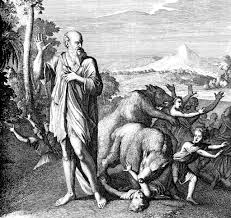
boys, who said, “‘Go up, baldhead!” and he cursed them, and two she-bears came out of the woods and tore them to pieces.  In chapter 20 of the Book of the Prophet Isaiah, God tells Isaiah, “Go and take off the sackcloth from your waist, and remove the sandals from your feet.  This he did, walking naked and barefoot.”  And it says in the next verse that this happened for 3 years.  Jeremiah told the king that Jerusalem, the place of the great Temple of the Lord, was going to be destroyed, and no one believed him.  And St. John the Baptist, the last and greatest of prophets, wore a camel-hair tunic and ate locusts and honey.  None of these seem to be people that civilized folk would want to be around.
And perhaps that is part of the reason they were never accepted in their home towns, as Jesus said in the Gospel today.  We tend to think of the prophets as nice guys who were able to tell the future.  We make them pretty well-dressed, white-bearded men.  But they railed against the injustices of their day and often became very unpopular in the process (walking around naked for 3 years can tend to make a person unpopular).  In many cases, they spoke out against the king, because he was the leader of the people.  But no matter whether they spoke out against a person or a situation, they always spoke the words that God gave them to say.
It’s cliché, but as prophets, God calls us to give comfort to the afflicted and affliction to the comfortable.  Jesus, as the source of prophecy and the Prophet about whom Moses spoke, to whom the Chosen People needed to listen, lived this out in a most perfect way.  To the Pharisees and scribes, those who were assured about their own righteousness, Jesus did not have great words to say, calling them “broods of vipers” and “white-washed sepulchers.”  But to the sinners, those who were often excluded from the daily life of Israel, Jesus preached love and acceptance, even while calling them, too, to conversion.  The woman caught in adultery is not stoned for her sin, but is told to go and sin no more.  The Samaritan woman at the well was convicted by Jesus about her many husbands, but she is also encouraged to drink the living water that comes from Jesus so that she can have eternal life.
There are parts of our life that God calls others to confront in us, and parts of our life that need the comfort of God.  When a person does not realize the conversion that needs to take place, God calls us to issue strong, dramatic words to help that person realize his or her need for God and a change in life.  When a person is beat up by the world, and despairing of any chance of redemption, God calls us to issue tender, loving words to help that person realize how much value he or she has.  We are not called to be nice, to say, “but that’s none of my business,” when we see sin and its effects in others.  But we are called to be prophets, by virtue of our baptism, who afflict the comfortable and comfort the afflicted.  
I’m not suggesting that we should walk around naked, not even for a day.  I’m not saying that we should curse people who make fun of us and send she-bears after them to tear them to pieces.  I’m not saying that we should threaten the destruction of a church.  But we also have to be careful about only saying things that people want to hear, things that do not make demands on life or call for conversion, things that do not challenge.  

God has called us to be prophets, and that in itself is a radical demand.  God calls us to speak His Word in our daily lives so that others can either turn from the evil they’re doing and live, and/or know just how much God loves them and wants the best for them.  Do not take the wild nature out of our prophetic call!  God save us from domesticated prophets!!