Showing posts with label Harry Potter. Show all posts

01 March 2021

Transformation through Trial

 Second Sunday of Lent
    In many a great story of literature, we find a hero who has to undergo a great trial, or many great trials.  After going through the trial(s), the hero is changed, for the better; transformed, we might even say.  This is true of ancient literature, like “The Odyssey,” where Odysseus, on his way home from war, has to conquer many trials on various islands as his ship is tossed about the seas.  This is true of classical literature like “A Christmas Carol” by Charles Dickens, where Ebenezer Scrooge has to grapple with his past, his present, and even a possible future in order to be changed from a miser to philanthropist.  This is true in the great Catholic trilogy, “The Lord of the Rings” by J. R. R. Tolkien where Frodo is put through many trials trying to destroy the Ring of Power in the fires of Mount Doom.  This is even true in J. K. Rowling’s novels about Harry Potter, who discovers who he is and how to stop the evil wizard Voldemort through many tribulations.  
  

 That is true also for Abraham in today’s first reading.  After being promised a son to inherit everything; after his wife, Sarah, getting impatient with God’s plan and telling Abraham to conceive a child with her slave, Hagar; after finally having that son through Sarah, God asks Abraham to sacrifice his son, his only son (at least of the promise), the son whom he loves.  Abraham’s willingness to abandon himself to God’s plan, however mysterious, is his great trial, for which God greatly rewards Abraham.
    As for the greatest story ever told, the story of Jesus, He doesn’t have to do anything to be great; He is great because He is God.  And yet, Jesus, too, in humility, undergoes a great trial in His Passion and Death, in order to be transformed, to be raised from the dead and receive a glorified body.  And in today’s Gospel, we hear about a foretaste of that glorified body as Jesus is transfigured before Peter, James, and John.  It is a rest before the great struggle begins, and the apostles will need that reminder as they go through an unexpected journey of their own with their Master.
    What about our story?  I dare say that everyone over the past year has had trials.  And many people had trials before COVID.  And we will all have trials after we’ve gotten a handle on this pandemic.  How do we view those struggles in the light of faith?  Do we view those struggles in the light of faith, or are we fatalists, just letting life happen to us?  
    God does not call us to be fatalists, as if suffering is beyond the control of God and so we have no one to turn to during our tribulations.  God calls us to be sons and daughters in His Son, who gives us everything that we need, including allowing us to undergo trials to help us to grow.  
    There is, I would also dare say, a part of us that cringes from the trials and tests.  We would rather have the Resurrection without the crucifixion.  We would rather have abs of steel without going to the gym and eating well.  We would rather have infused knowledge than going to school for so many years.  But that’s not the way the world works.  In God’s mysterious plan, somehow the struggle is good for us, and builds us in ways that cheap grace never could.  There is no such thing as cheap grace; it is never earned (because grace is a gift), but it’s also not encountered passively; it always requires some death to self, which is a struggle.  
    And the attitude to have through it all is the attitude of Abraham, of Isaac, of Jesus: God will provide.  We can imagine how much the thought of sacrificing his son tore up Abraham.  We can imagine how confused and perhaps even scared Isaac was.  And in a few weeks we’ll hear the reaction of Jesus to His known, impending suffering and Death as He asks His loving Father for another way, if it is possible.  But, and these words are key, Jesus says, “Not my will, but yours be done.”  
    The trials and tribulations of life, the sufferings we encounter, especially if they are not of our own making, are the ways that we pass through death to life.  Lent is a long time of truly entering in, as we are called to do year round, to the Paschal Mystery–to the Passion and Death of Jesus–so that we are share in the Resurrection and Ascension of Jesus.  And if we go through whatever struggles we have with God, they do strengthen us, they transform us, they even transfigure us to be more like Jesus in glory.  
    We have a choice: do we want to get to that glory that Jesus showed His apostles on Mt. Tabor?  If so, there’s only one way to get there: through the cross; through suffering and death to our own wills and to our own sinfulness.  St. Rose of Lima put it this way: “Apart from the cross there is no other ladder by which we may get to heaven.”  The ladder may be difficult to climb, but the reward at the top is joy beyond imagining!  In the story of your life, follow the path of so many literary heroes: go through trials so that you can be transformed!


02 July 2018

Death and Resurrection

Thirteenth Sunday in Ordinary Time
Death.  It’s scary.  It seems so final.  What is beyond death is, generally, unknown.  It is the biggest change a person goes through in life, after being conceived and born.  We do everything we can to avoid death: we create new medicines; we buy creams to try to keep us looking young; we spend lots of money to fight death.  And yet, death comes to us all, some as young people, some as old.
Fighting death is, in one sense, natural for us because we were not made for death.  In the Garden of Eden, Adam and Eve cared for the Tree of Life, which would have allowed them to live forever.  But they were cast out of the garden, and banned from that tree.  And, as our first reading stated, “God did not make death.”  Death entered the world because when our first parents rejected God, they rejected life.  St. Paul says it this way in the Letter to the Romans: “Therefore, just as through one person sin entered the world, and through sin, death, and thus death came to all, inasmuch as all sinned…”  Everything in our being knows that we are made for eternal life, and yet we all have to experience death, and so we fight against it.
But, we need no longer fear death, because Jesus has conquered it by His Death and Resurrection.  Jesus gave a foretaste of that in today’s Gospel.  The woman with hemorrhages was getting worse; perhaps she was close to death.  But she went to Jesus because she had faith that He could make things better.  The little girl, the synagogue official’s daughter, was already dead by the time that Jesus got to her.  But her parents had faith, and she was returned to them.  Jesus unbound the power of death and gave new life.  Now, in both cases, the woman and the girl, they would later die.  But their faith changed the approach to death.  They followed Jesus’ command that we heard, “‘Do not be afraid; just have faith.’”
Death, for those who have faith in and follow Jesus should not be something that we fear so much.  Yes, we still may be anxious about the unknown, and we should not do anything to speed up our own death, but we need not be afraid if we have faith.  
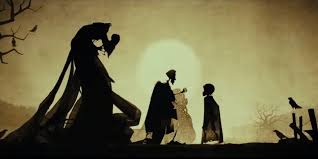
In “Harry Potter and the Deathly Hallows,” a story is told about the Deathly Hallows and three brothers.  Two of the three brothers try to cheat death.  But the third brother gained Death’s cloak of invisibility, and hid from death for many years.  After a long life, the third brother gave his cloak of invisibility to his son, and, as the story goes, “greeted death as an old friend.”  That’s not quite our view of death as Christians, but there is something that rings true in that story.  As believers in Jesus, death is not something we fear, but something that we can greet as a friend, because it is the necessary transition from this life to the life to come.  St. Augustine says that the only Christian who should fear death, is the one who has not truly followed Jesus, because eternal life will not be a life of joy, but a life of eternal torment.
If we are not afraid, if we have faith in Jesus, death is that which is the conclusion of our trials and testing on earth, and the beginning of our reward.  The student who has studied is not afraid of the final exam, but sees it as the necessary way to move towards graduation.  Our final judgment is not based on what we know, but, as St. John of the Cross states, whom we loved and how we loved.  But it still can allow us to graduate, to move on, to pass over, from this Valley of Tears to the eternal banquet of the Lamb of God in heaven.  
But death need not only be thought of in terms of our final breath.  We experience little deaths throughout our life, and our approach to those little deaths should be no less occasions of faith in what Jesus can do.  There’s the little deaths that happen in our family life: when we realize that our little baby is no longer a baby and is becoming more independent; when we lose a job; when, despite years of Catholic education and formation in the home, a child breaks our heart and stops practicing the faith.  There’s also little deaths that happen in our faith life: when we lose a pastor that we love; up 75 a bit and then down 475, St. Mary in Mt. Morris announced last Tuesday that, effective immediately, the school is closed; in our own parish as we make the transition to two weekend Masses from three.  All of those and more are little deaths in our lives.  We can fear it, we can fight it, we can kick and scream about it, or we can be not afraid and have faith in Jesus, trusting that He who brought us to all those situations and more will carry us through it.

Because our faith and our hope is in what is beyond the death, and that’s new life.  When Jesus rose from the dead He blazed a trail for us so that where He has gone, we hope to follow.  And although we have never seen what is on the other side of our own death, we have seen what is on the other side of Jesus’ death, and that is new life, transfigured life, glorified life.  To gain that new, transfigured, and glorified life, we need only follow Jesus and His way.  As we face death, in its many forms, Jesus invites us today: “‘Do not be afraid; just have faith.’”