Showing posts with label participation. Show all posts

06 January 2020

Our Gifts for God

Solemnity of the Epiphany

    When it comes to getting my nieces presents for birthdays and Christmas, I will admit that I’m always just making my best guess at what they want.  I can even ask my sister for ideas, but I’m never quite sure if the gifts I get are the ones that my nieces want, or what my sister and brother-in-law want for their kids.  But this year, I bucked the trend!  One of the gifts that I got my nieces was a mini-backpack (apparently those are very chic right now), one with a koala and koala baby and one with a kangaroo and a joey.  My nieces were so thrilled and wore the backpacks all throughout the rest of our Christmas celebration. 
    On this Solemnity of the Epiphany, we focus on the gifts that Jesus received, as we celebrate the magi bringing the gifts of gold, frankincense, and myrrh.  One of the great liturgical reforms after the Second Vatican Council was the restoration of an extended offertory procession, with the gifts being presented by the people.  There was nothing wrong with how it happened before, with the servers presenting the gifts from the credence table, as the servers represented the entire assembly.  But there is something nice with the gifts of bread and wine being presented by parishioners.
    Those gifts of bread and wine are not only used because they are necessary for the Mass.  But they are meant to also symbolize so much more.  So often during the Mass, we get caught up with the external things that are being done.  When people think of full, active, and conscious participation, which had been called for in the liturgy since the beginning of the twentieth century, people often immediately go to the external things, like bringing up the gifts, or maybe being a reader at Mass, or an Extraordinary Minister of Holy Communion, or an altar server.  And none of those things are bad.  But everyone is called to participate fully, actively, and consciously, even if a person does not have a “special role.”  Externally, this happens through singing the hymns, joining in the Ordinary of the Mass (the parts that never change, like the Gloria, the Sanctus, etc.), and responding to the prayers.  But even those externals are meant to be the outer reality of something that is happening interiorly.
    Interior participation in the Mass is the first step in fully, actively, and consciously participating.  Just because one is responding or doing something does not mean one’s heart is in it.  We can all say the Creed, but how often is that profession of faith an external sign of our internal belief in who God is: Father, Son, and Holy Spirit?  We are all called not simply to go through the motions of the prayers, but to work at making sure our inner reality is being conformed to the outer reality of the rites of the Mass.
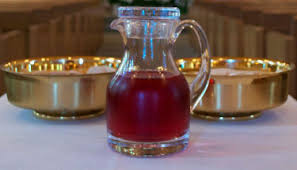
    And that brings us back to the gifts at the offertory.  Each time the bread and wine (and on Sundays and Holydays the collection) are brought forward, that external action is meant to be united to our internal action of bringing to God everything that has happened since the last time we came to Mass.  We are invited and called to unite in a mystical way our lives with the bread and the wine, which will be offered to God the Father by the power of the Holy Spirit, united to the perfect offering of Christ on the Cross. 
    Allow me to give you an example of what that could look like from my own life, extended a bit beyond what happened since the last time I went to Mass (yesterday) into the entire Christmas season thus far.  While the collection is happening, while we’re singing the offertory hymn, in my mind I would be recalling the different parts of my life, and offering them to God.  I would give God the blessing as well as the challenge and sorrow of seeing both my grandfathers, both widowers, as their own health declines, and their minds lose some of their  sharpness that I remember.  I would give God my own frustration at not being able to see a best friend who was in town for a couple of weeks, my fear that maybe our friendship isn’t as strong as I thought it was, but also my gratitude at the small ways that he confirmed for me that our friendship is a priority for him as well.  I would give God thanks for the generosity of you, my parish family, to me as an individual, and to the parish which helps us keep St. Pius X running, not only by financial donation but also the donation of time and talents.  I could go on, but you get the idea.  The offertory is our opportunity to give gifts to Jesus.
    When it comes to giving gifts to Jesus, I think it’s a little easier than my nieces.  Jesus is pleased with any gift that we give Him, as long as it’s our best gift that we can give him.  It doesn’t have to be perfect, but it does need to be honest and come from us.  It may not be gold, frankincense, or myrrh, but it’s meant to be the best that we offer to God from what we have experience since the last time we came to Mass.  Today, every Sunday, and every time we go to Mass, unite those experiences, good and bad, joyful and sorrowful, to the bread and wine presented from you to God the Father, transformed by the Holy Spirit into a gift of new life which God returns to you from His love: the Body and Blood of Jesus Christ. 
19 April 2019

Participation in the Mystery

Mass of the Lord’s Supper
Sometimes you just need to mix things up a bit.  Usually, I preach on the readings, because the Word of God should be preached; St. Paul says, “Woe to me if I do not preach the Gospel.”  However, tonight, to mix things up, I thought I’d preach on one of the prayers that will be said soon, what we call the Prayer over the Offerings.  This is the prayer that is said after I have prepared the bread and the wine on the altar, and have washed my hands in preparation.  
The prayer says, “Grant us, O Lord, we pray, that we may participate worthily in these mysteries, for whenever the memorial of this sacrifice is celebrated the work of our redemption is accomplished.  Through Christ our Lord.”  Maybe it sounds to you like any other prayer in the Mass, a little wordy, some unique words.  But this one in particular is very full of meaning that, if we are not paying attention, can gloss over us.  
We start out by asking God the Father to help us “participate worthily in these mysteries…”  Right now, we are participants in something.  We are not spectators (at least we are not supposed to be).  We are engaged in something.  So often the Church uses the phrase “active participation” when it comes to what we should be doing in the Mass, and because we are an active society, we tend to take it as doing something, like being a lector or an extraordinary minister or a choir member.  But active participation is always united to us giving ourselves, first and foremost interiorly, to the Father through the Son in the power of the Holy Spirit, in what is being celebrated.  Tonight, on Holy Thursday, we participate in the Lord’s Supper in a mystical way.  We do not simply remember it.  A lot of Protestant music will talk about remembering what our Lord did at the Last Supper, remembering His saving life, Death, and Resurrection.  But we don’t only remember.  We participate.  Simply remembering is for museums, which is what some churches have become.  If people understood that they participate in what we celebrate, churches would not be so empty.  
But it is not any participation.  It is a worthy participation.  And how do we worthily participate?  We respond to the prayers with the voice, we listen to the prayers with our ears, we focus our attention on what is being done, on the smoke of the incense, on the precious nature of the vessels.  And hopefully, we also come with pure souls, free from any grave sins that hinder us from being present with Jesus, just as Judas left the Upper Room.  He could not worthily participate because his heart did not belong to God.  Shortly after this prayer we are invited to lift up our hearts, to leave behind the worries and anxieties of the day, and to focus on what God is doing for us.  We say, “We lift them up to the Lord,” but do we?
The Upper Room, where Jesus celebrated the
Last Supper
In what do we participate?  Yes, I have said the Last Supper, but we participate in the mystery of the Last Supper.  This is not a Sherlock Holmes mystery.  This mystery is something which is infinite, but which breaks into our finite time and minds.  We often will mentally chide St. Peter for not understanding what was going on when Jesus tried to wash St. Peter’s feet, or the apostles who fell asleep in the Garden of Gethsemane.  But do we understand what is going on?  Do we understand that the mystery of Jesus’ Body and Blood in the Eucharist is a gift beyond description, beyond riches, beyond understanding.  St. John Vianney said that if we truly understood what happened in the Mass, then they would die of joy.  
This mystery is so great that angels themselves bow down in worship, and shield their faces from the miracle that takes place when ordinary bread and wine become the Body of Blood of Jesus.  The God whom the universe cannot contain humbles Himself and makes Himself present in the ciborium and in the chalice.  The saints, who worship with us tonight and at every Mass, join their prayers to the perfect prayer of the Mass, the perfect prayer of Jesus offering Himself to the Father.  
The place in Jerusalem where Jesus was
nailed to the cross
And the Eucharist, every Eucharist, is not simply the Last Supper, but is what the Last Supper points to, what only one of the Apostles would actually experience, the sacrifice of Jesus on the cross.  Tonight only makes sense–and every Mass only makes sense–in the light of the crucifixion of Jesus on Calvary.  Jesus gave His Church, His bride, a way that His once for all sacrifice on the cross could be accessible, not only in memory, but in reality, to every member of the Church throughout the ages.  And that is why the prayer continues, “for whenever the memorial of this sacrifice is celebrated the work of our redemption is accomplished.”  Every time Mass is celebrated, Christ’s saving work continues.  That’s why we offer Masses for people, that Christ’s saving work can be applied for this person or that person, living or deceased.  Each and every day that the Mass is celebrated, salvation is achieved by Christ.  And it’s achieved here, where we get to participate in it, not watch it as spectators.  

Of course tonight we use many of our signs and symbols to impress what the prayers say.  But it’s the same at a Papal Mass, and at Mass in the gym at Powers, and at Mass here at St. Pius X Church.  Tonight, as we enter into the three intense days of our Lord’s saving action of Holy Thursday, Good Friday, and Easter, let us set aside all earthly cares, lift up our hearts to the heavenly things, and focus our spirit, mind, and body on the great mystery of our salvation, accomplished by Christ, and made present for us in the Mass.  “Grant us, O Lord, we pray, that we may participate worthily in these mysteries, for whenever the memorial of this sacrifice is celebrated the work of our redemption is accomplished.  Through Christ our Lord.”