Showing posts with label crucifixion. Show all posts

19 April 2025

Being Carried to Mount Doom

Good Friday of the Lord’s Passion

    One of the many moving scenes in the third movie, “Return of the King,” of  the trilogy “The Lord of the Rings,” is when Frodo Baggins and Samwise Gamgee are on the slopes of Mount Doom, the mountain in which the One Ring has to be destroyed in order to end the growing strength and power of the evil Sauron.  Frodo has almost no strength left from the weight of the ring on a chain around his neck, as it grows heavier the closer it gets to destruction.  Sam, too, is tired, but is doing all he can to help his friend complete the quest, without which all of Middle Earth will fall into darkness and despair.
    Even though Sam has offered to carry the ring to help, Frodo has made very clear (to put it lightly) that the ring can only be borne by Frodo.  It is his burden to bear.  So, as Frodo is exhausted on Mount Doom, full of despair and darkness, and cannot take another step, Sam says, “‘I can’t carry it for you, but I can carry you.”  And Sam carries Frodo up the slopes towards a small door that grants passage to the fires that will destroy the One Ring.  You can watch the rest of the movie, or, better yet, read the book, to learn how it all turns out.
    J.R.R. Tolkien demonstrates his genius and masterful Catholic storytelling by not having any one character always correspond to one person in salvation and the Scriptures.  Many often compare Frodo to Christ, because he carries the ring like Christ carries the cross and our sin.  And in this sense, we are called to be like Sam, a friend who never leaves the side of the one he loves.  We are to be like the Blessed Mother, John the Apostle, St. Mary Magdalen and the other holy women, Joseph of Arimathea, and Nicodemus, who stayed with Christ through His entire Passion, His entire agony on the cross.  And we are here today to do precisely that.  Through this long, ancient liturgy, begun last night at the Mass of the Lord’s Supper, we show our love for Christ, who showed His love for us by dying on the cross.
    And it’s not much.  We’re not fighting against the soldiers who nailed Jesus to the cross.  We’re not arguing with the Pharisees and the Sadducees who convinced Pilate to crucify the Lord of Glory.  We’re just here, with Jesus, in the liturgical presentation of His last hours before He dies.  We remain here, mourning, recognizing that our sins led Jesus here and made this day necessary.  
    But, Samwise Gamgee also represents Christ.  We are like Frodo, with the weight of sin around us.  We know that sin has to be destroyed, and we have done all we can to destroy it, but without any success.  The weight is too heavy for us to bear.  Sin clouds our vision so that we can no longer remember our home of heaven, union with God.  Sin gives the devil clear sight of us, a gaze which burns our souls and causes us to lose hope.  But Christ does not abandon us, though we have no strength to carry on.  He lifts us up on His shoulders and carries us so that sin can be destroyed and hope can be restored.  
    So today, we stand at the foot of the cross, remaining here with our Lord so that He does not have to be alone.  We see the cost that our sins have created.  But, let us make our own the words of Samwise Gamgee, the words Christ encourages us with as He suffers for our salvation: “Then let us be rid of it, once and for all.”  As Christ destroys sin and death: come, let us worship.

31 March 2025

New Levels

Fourth Sunday of Lent

    In the name of the Father, and of the Son, and of the Holy Spirit.  Amen.  A few people in the parish know that I play the online game, Clash of Clans.  For those who know, I’m Town Hall 17.  For those who don’t, probably best not to wonder too much.  It’s a game on the phone or tablet where you collect resources, build and defend your village, and war with other plays to get more resources and collect special rewards.  It’s not a role-playing game, but just a fun, online pass time that gives me a distraction a few times a day when I can use a rest for my brain.
    Inevitably, as I get close to getting to the highest level for all my buildings and troops (maxing out, we call it), they release new levels and new things which moves the finish line farther away.  For example, just as I was about to complete most of my buildings for Town Hall 16, they added Town Hall 17 and new upgrades on most of the buildings, which means I had to start saving resources to get to the next level.
    All this “nerding out” does have a point.  In our Gospel today, and to a lesser extent in the epistle, we have different layers that lead somewhere else.  In the epistle it’s a bit simpler: we start with the story of Abraham and Sarah and their slave Hagar.  Now, Abraham and Sarah and Hagar were all real.  They lived life as the Bible describes, including Sarah “convincing” Abraham to have relations with Hagar because Sarah was barren, and Hagar giving birth to Ishmael.  But then God allows Sarah to give birth to a son Isaac after she has relations with Abraham.  And, like the good soap opera which it sounds like, the two women who bore sons to Abraham don’t get along.  But St. Paul notes that this true story was also a foreshadowing of the Law of Moses (represented by Hagar and Ishmael) and the Law of Christ (represented by Sarah and Isaac.). But it also points to the earthly Jerusalem (again, represented by Hagar and Ishmael) and the heavenly Jerusalem (again, represented by Sarah and Isaac).  Just when you think you understand one story, it’s taken to the next level.  And the epistle, as I mentioned, is the easier reading of the two.
    In the Gospel, we have all sorts of levels going on, some of which are directly mentioned, but some of which only make sense in the broader Biblical and theological context.  We start with Passover in the Book of Exodus (the anniversary of which is the time in which the Gospel takes place).  Hopefully we remember what happened: the Israelites put the blood of the unblemished lamb on the doorposts of their houses in Egypt, so that the Angel of Death would pass over their houses.  God established it as a liturgical feast to be celebrated every year as the making present of the past event of the thing that made Pharaoh free the Israelites from slavery.  That’s the first level.
    The second level is the Gospel today, which takes place around the feast of Passover.  In the Gospel, Jesus miraculously multiples five barley loaves and two fish into enough for 5,000 men, not counting women and children.  After this miracle, and after the Lord flees from the Jews who wanted to make Him King, because it was not yet His hour, Christ gives the famous Bread of Life discourse, teaching us that if we wish to have eternal life, we must eat His flesh and drink His blood.  Many of the Lord’s followers reject this hard teaching and walk away, but He doesn’t change what He says or even modify it.
    But, the multiplication of the loaves points to something which is coming up: the Last Supper.  Christ gives His Apostles, His first bishops, a new liturgy, connected to the Passover, but superseding it, in which ordinary unleavened bread and wine, which were used in the Passover, becomes His Sacred Body and His Precious Blood.  Christ uses language to assert that this is a new rite for His new Church, and asks that they repeat this ritual in His remembrance.  This is level three.
    But we’re not done yet.  Because the Last Supper points to and intimately connects to the offering of the truly unblemished lamb, the Lamb of God pointed out by John the Baptist, on the cross on Good Friday.  The Eucharist, the sacrament of the Flesh and Blood of our Savior, first preached in John, chapter 6, was instituted on Holy Thursday, but is the unbloody presentation of what happened on Good Friday.  The Precious Blood of the Lamb of God save, not only the first born in Egypt, but all of God’s people in all time and space whom God has chosen.  Death is conquered when Life Incarnate dies on the tree, and Christ gives us a way to access that conquest of death each time we receive the Eucharist in a state of grace.  Level four.
Ghent Altarpiece
    But wait; there’s more!  Because the Eucharist, the re-presentation of Calvary in an unbloody manner on the altar points to the heavenly Jerusalem (connecting us with the epistle) where Christ eternally offers Himself to the Father in the wedding banquet of the Lamb of God, the heavenly worship to which the Mass points.  This is the fifth level.  The beautiful bottom panel of the Ghent Altarpiece shows the Lamb, pierced with blood flowing into a chalice, on an altar, with a cross nearby, with angels and saints around the altar worshiping and singing, which brings together most of those levels in one artistic rendition.  
    In the Scriptures, so many things connect together, and so many Old Testament true stories point to New Testament fulfillment and realities, which themselves prepare us for heaven.  May our Lenten sacrifices keep taking us deeper and deeper into our understanding of what God has revealed, until we hopefully see the final fulfillment in the kingdom of heaven, where Christ lives and reigns with God the Father in the unity of the Holy Spirit, God for ever and ever.  Amen.  

01 September 2023

So You Had a Bad Day

Twenty-Second Sunday in Ordinary Time
    I think a lot of people have this idea that if we just do what God wants, then everything in life is going to go well.  If you believe in God and follow His teachings in your life, then you won’t worry about not having enough food or clothing, won’t lose your job, won’t experience suffering.  Maybe we have some innate sense in us that says that if we do right, God will reward us immediately. 
    I don’t know about you, but I have not experienced life that way.  Not always, but more than I would have hoped in my life, the song “Bad Day” by Daniel Powter has resonated: “You stand in the line just to hit a new low. / You’re faking a smile with the coffee to go. / You tell me your life’s been way off line, / You’re falling to pieces every time / and I don’t need no carrying on.”  And the thought very easily comes to my mind: ‘God, why are you allowing this to happen to me?  I’m one of the good guys!  Bad stuff shouldn’t happen to me!’
    If we would read this Gospel passage a bit more, we might not set such unrealistic expectations.  First, Jesus tells the disciples that he was going to suffer and be killed, but that He would rise on the third day.  If anyone was truly one of the good guys, to whom bad stuff shouldn’t happen, it would certainly be Jesus.  And yet, He foretells his own passion and Death. 
    But then he makes it even more real: “‘Whoever wishes to come after me must deny himself, take up his cross, and follow me.’”  If we wish to be His disciples, then get ready for suffering, in other words.  As Bishop Barron says, we have become so used to the cross, that we have sanitized this phrase.  But think of the worst thing that could happen in your life: the most humiliating, painful thing that could happen to you.  And then put that in where Jesus says, “take up his cross.”  That’s how shocking it would have sounded to the disciples listening to Him.  But He didn’t take it back, or say it was just mean to be taken metaphorically.  And some, like Peter would experience a literal crucifixion just for following Jesus.

    Again, to remind us how bad crucifixion was, let me paint a picture.  First, you were stripped naked.  Not down to your loin cloth; stark naked, with all that God gave you hanging out for everyone to see.  As much as nudity is ubiquitous in our society, it’s altogether different when it’s forced upon us, and we have no way to cover ourselves up.  Then, you were strapped to unfinished wood.  Think of the splinters you were getting, not just in a finger, but probably all over your body.  Of course, Jesus’ body at His crucifixion was already battered, as He had endured scourging where pieces of flesh had been torn out.  Then, to get you supported to hang on the cross, nails would have gone, likely, through the wrists and the feet.  And then you would be suspended as the cross was placed in the stand, and you hung there.  Medically speaking, the weight of your body would have pressed upon your lungs, which started to fill with fluid.  Breathing became more and more difficult.  You could push yourself up a little, to allow the lungs more space to take in oxygen, but that would reignite the sharp pains in your hands and feet.  Crucifixion was a death of asphyxiation.  You suffocated…slowly.  And that was the treatment a disciple could expect.
    Life on this earth is not meant to be easy for a follower of Christ.  It’s not easy because the world is generally against Christ.  And the only way we get a totally easy life on this side of eternity is do the opposite of what St. Paul taught: “Do not conform yourselves to this age but be transformed by the renewal of your mind, that you may discern what is the will of God, what is good and pleasing and perfect.”  When we give in to the things which are contrary to Christ, life probably will be a bit easier on this earth.  But that gamble only works if this life is all there is.
    If, on the other hand, there is more to life, where those who have followed Christ faithfully finally get eternal rest and happiness, then even suffering on this earth isn’t as bad.  Our happiness will come, just not here.  And that’s why Christ also says, “‘For the Son of Man will come with his angels in his Father’s glory, and then he will repay all according to his conduct.’”  When we view life from an eternal perspective, the present suffering, while not a walk in the park, can be endured for a future of glory.  It’s like the mother who’s pregnant (an image Jesus Himself uses).  The morning sickness, the skin stretching out, the back pain, the inability to see, let alone touch, your toes, and then the delivery of a baby through an area that starts out much smaller than the baby is not fun.  Especially the last part, especially without drugs, is very painful.  But then the mother gets to hold her baby for the first time, and the pain, while not forgotten, somehow seems worth it. 
    God does not promise us an easy life, even if we follow His will perfectly (which, of course, we don’t).  God does promise us that we will have pain, sometimes very sharp pain, because we follow Him and are working on conforming our lives to His.  But the Good News is that He has also experienced that pain for doing God’s will.  Our God didn’t shrink away from or avoid our pain.  He entered into it and saved even suffering so that we could use it for good when we unite it to Him.  We will have a bad day now and then, even when we’re the good guy.  But God will uphold our souls in the midst of our suffering if we stay faithful to Him and do our best to discern the will of God: “what is good and pleasing and perfect.”  

03 April 2023

The Fickle Nature of Humanity

Palm Sunday of the Lord’s Passion
    [In the name of the Father, and of the Son, and of the Holy Spirit.  Amen].  Today’s Mass is an exhibit on the fickle nature of humanity.  It is an emotional roller coaster if ever there was one.  Even the usually pristine nature of the Mass takes on notes of higher and lower pitch. 

    We started today echoing the words of the people as Christ entered His city, Jerusalem, fulfilling the prophecy of Zechariah.  We, like the Jews at the time of Christ, waved our palm branches, signs of victory and jubilation.  Not long after, however, our cries of “Hosanna” changed to “Crucify him!”  We started with, “‘Blessed is he who comes in the name of the Lord.’” and we ended with, “‘His blood be upon us and upon our children.’”
    How did this happen?  Our Lord was cheered as a hero, as the fulfillment of the messianic prophecies that filled the minds of the pilgrims in Jerusalem.  He was welcomed and embraced as an honored guest in the Holy City.  But in those few short days between Palm Sunday and Good Friday, the mood changed.  The Messiah was not the type of Messiah the people wanted.  They grew tired of His preaching.  The newness wore off.  Until, whipped into a frenzy by agitators, this honored guest was not only brushed away and forgotten, but snuffed out, even while the crowds called for the release of a notorious prisoner, Barabbas, whose name, ironically, means “son of the father.” 
    It would be easy to think of this simply as a past event.  It would certainly ease our conscience if we didn’t have to take any part in the great drama of salvation, and could stand as critics who know how the scene should play out, because we observe like omniscient spectators, convinced of our own wisdom.  But to do so is to miss the point.  We did not live 2,000 years ago, but we still cry out “Hosanna” and “Crucify him” because we are the crowd.  We are the mob.  We are fickle.
    We see Christ do amazing things for us.  Perhaps we ourselves witness miracles that Christ does to ease our suffering or heal our illness.  Something goes right and we say, “Thank you, Jesus!”  We embrace Him with love because of the mercy He shows us.  But then, as times get tough; as we do not receive all that we desire; as we have to say no to our fallen sinful selves; as our love is tested by sacrifice, we embrace Him again, but this time we say, “‘Hail, Rabbi,’” and kiss Him with the kiss of the betrayer.  We make the words of Psalm 41 (40) about us, as the Lord says, “Thus even my friend, in whom I trusted, / who ate my bread, has turned against me.”  We, who have eaten the bread of angels, the Eucharist, betray Christ and cast Him out of our midst. 
    To be welcomed and celebrated and then cast off so quickly.  How would we respond?  How does Christ?  He feels the agony of rejection, of betrayal, by those whom He loved so dearly: “‘My God, my God, why have you forsaken me?’” he cries out, quoting Psalm 22 (21).  And yet, He also says, “Father, forgive them.  They know not what they do.”  As Isaiah prophesied, “The Lord God is [His] help, therefore [he is] not disgraced.”  He is not ashamed to be called our Brother, even though we are ashamed, at times, to be called His. 
    We are fickle.  Our love fades so quickly.  Perhaps, though, today we silent our tongues, not cheering out in joy, nor howling in impious mockery.  But we simply watch, silently, as our Lord does what must be done for the salvation of the world [In the name of the Father, and of the Son, and of the Holy Spirit.  Amen].

11 April 2022

Because of Love

 Good Friday of the Passion of the Lord

    About a month ago a Trooper I know well and his wife had their first child, a baby boy.  In the first few weeks I would check in with him about how things were going and how much sleep he and they were getting.  Those of you who have had babies know that, especially in the first few weeks, sleep is a bit of a luxury.  Their child was very used to sleeping during the day, but being awake at night.  Still, even with this lack of sleep, it was really touching to see how much this Trooper and his wife loves their son.
    The Trooper was talking to me one day about how he even loves changing his son’s diaper, because it’s his son.  This Trooper has nieces and nephews already, and he doesn’t really change their diapers, and has no desire to do so.  But, he said (and I’ve made this rated G since we’re at Mass), he is happy to wipe his son’s poop away because of how much he loves his son.  
    When we think about Good Friday, and what Jesus did for us, we often immediately go to the suffering, and how necessary it was that Christ should suffer and die.  Our first reading today from Isaiah lays out how the suffering servant of the Lord, Jesus, would take our sins upon himself and suffer chastisements for us to make us whole.  
    We often immediately focus on Jesus paying the price for our sins.  The wages of sin is death, St. Paul says, and so we recognize how Jesus took upon Himself that penalty that He did not earn (because He had never sinned) so that all of us sinners could have eternal life.  Sometimes this can make us have an image of God that is not accurate, as if God is some masochist who enjoys making others, especially His own Son, suffer.  We heard the agony of Jesus in the Garden of Gethsemane, asking for another way, if it is possible, to save us, and it might make us wonder why God didn’t choose another means of salvation.
    But, I would like to suggest to you that we look upon Good Friday through the eyes of this Trooper and his (so far) only son.  Cleaning the feces from a baby’s butt is not an enjoyable task.  It stinks, it’s messy, and it often doesn’t happen easily because the baby is squirming around, or sometimes is not even done relieving himself when you remove the diaper.  But because it is his son, this Trooper finds delight in doing what he normally shuns and avoids.  
    So with us, God the Father, because of the Incarnation and by virtue of our baptism in which we were united to Christ, looks on us and sees His Son.  And what would otherwise be unbearable (as horrific as crucifixion is) becomes bearable because He is our Father.  And because Jesus and the Father are one, what the Father loves so does the Son (as well as the Holy Spirit).  So the Lord looks upon us with so great a love that nothing will stop Him from securing our salvation, and the possibility that we can be united with Him forever in Heaven, rather than being forever separated from Him in Hell.  
    There is no length that our God would not go to in order to save us.  He even descended to the gates of hell to rescue the just who were imprisoned there under Satan’s cruel guard.  His love for us cannot be imagined, and even the love of our earthly parents or even the love of our spouse falls short when compared to God’s love for us.  
    That love is what makes today happen.  Not some bloodlust.  Not some warped desire to make one person suffer for another person’s ease.  Simply love.  The love that created the universe; the love that holds everything in being; the love that knit us together in our mother’s womb.  That love will go to the greatest extreme possible to ensure the we, God’s beloved, are safe and wiped clean from the filth of sin with which we soiled ourselves.
    And it is to that love that we are invited to respond.  Yes, we are commanded to be obedient to God, just as we are commanded to be obedient to our parents, especially as young children.  Sometimes the delight that we should have in God is not present in our hearts because of sin or because of our lack of gratitude.  But that obedience is meant to stir back up in us the reciprocation of love for God that He first showered on us.  That is part of how the Lord wants us to be like children.  Children, especially babies, delight in their parents.  There is nothing quite like the smile of a baby being held in the arms of his mother and/or father.  The child, even before it can verbalize its love, senses the love from its parents and wants to return it.  So we, the children of God, should want to return, to the best of our ability, that love that God has for us, the love that even made going to the Cross worth it so that we could be reunited with God.
    Today, as you come forward to venerate the Cross, look upon it as the expression of how much God loves you and values your union with Him.  See the pain and the suffering, yes, but see the love of our Heavenly Father and Jesus our Brother which took that suffering and death as simply another way that He could show much how much we are worth to Him, and how much He loves us. 


10 April 2020

The Hour

Good Friday of the Lord’s Passion
    When I was in elementary school, we would sometimes play a game called “What Time Is It, Mr. Fox?”  It’s not a complicated game.  One person is Mr. Fox, who stands at the far side of a gym or field, facing away from the other players.  Everyone else is, well, honestly, I forget what they are, but they all ask together, “What time is it, Mr. Fox?” and Mr. Fox calls out an hour of the day (say, 3:00).  The others then have to take 3 steps towards Mr. Fox.  If they get past Mr. Fox, they’re safe, but if Mr. Fox yells “Midnight,” then it’s a game of tag, and if you get tagged, you’re out.  The last person left becomes the next Mr. Fox.
    What on earth does this have to do with Good Friday?  Well, throughout John’s Gospel (we heard the Passion according to St. John today), Jesus talks about His hour.  At the wedding at Cana in chapter 2, Jesus says to the Blessed Mother, “‘Woman, how does your concern affect me?  My hour has not yet come.’”  With the Samaritan Woman at the well in chapter 4, Jesus says to the woman, “‘Believe me, woman, the hour is coming when you will worship the Father neither on this mountain nor in Jerusalem….the hour is coming, and is now here, when true worshipers will worship the Father in Spirit and truth.”  In John chapter six, after healing a man who had been ill for 38 years, Jesus says, “‘Amen, amen, I say to you, the hour is coming and is now here when the dead will hear the voice of the Son of God….the hour is coming in which all who are in the tombs will hear his voice and will come out, those who have done good deeds to the resurrection of life…’”  As the hatred of the scribes and Pharisees grow, St. John himself notes in chapter seven, “no one laid a hand upon him, because [Jesus’] hour had not yet come.” and in chapter eight, “But no one arrested him, because his hour had not yet come.”  In chapter 12, after the entry into Jerusalem, Jesus says, “‘The hour has come for the Son of Man to be glorified’” and “‘Yet what should I say? “Father, save me from this hour”?  But it was for this purpose that I came to this hour.’”  And finally, in chapters 13 through 17, which covers the Last Supper, Jesus talks about His hour 3 separate times, concluding with “‘Father, the hour has come.  Give glory to your son, so that your son may glorify you.’”
    Jesus’ hour has come.  The hour for the Son of Man to be glorified is precisely the hour at which the Son of Man, the Lamb of God, is sacrificed for the salvation of the world.  That’s what we’re celebrating here: the hour of the immolation, and yet the glorification, of Jesus.  All eternity points to this moment, to the death of the Incarnate God on the Cross.  All the past points to it, and all the future references back to it. 
    Why then?  Why at that hour?  Because it was God’s will.  That answer may not feel satisfactory.  But it’s the only answer we have, and before God’s will, we can only kneel down in wonder and awe and say, “Thy will be done.”  According to Divine Providence, God the Father chose that day at that time in that gruesome manner for His Son to save us from sin and death.  And so it was the most fitting day (the day that the Jews were slaughtering the Passover lambs), the most fitting time (at the time that the daily evening sacrifice was offered and the Passover lambs were usually slain), in a way that demonstrated just how far God would go in order to save the creation He had made in His own image and likeness. 
    So why are we going through this pestilence now?  Why can’t we come to church to celebrate the mysteries of our Lord’s redemption as the People of God?  All I can say is that this is part of God’s plan in Divine Providence, not to send us this virus, but to allow this virus to draw us closer to Him.  St. Paul reminds us that all things work for the good of those who love God.  Somehow, even our current suffering can work towards good.  If the death of the Son of God can bring us new life, then certainly our suffering, united to Jesus on the cross, can also bring us new life, new appreciation, new love of God. 
    Honestly, we don’t know why this hour.  But just as the crucifixion was the hour for the Son of Man to be glorified through His suffering, so this hour can be for the children of God to be glorified through our suffering.  That is our faith.  That is our hope.  That is our confidence.  We were chosen for this hour, to be a part of God’s plan for the glorification of God, and for our salvation.  Come, let us worship!
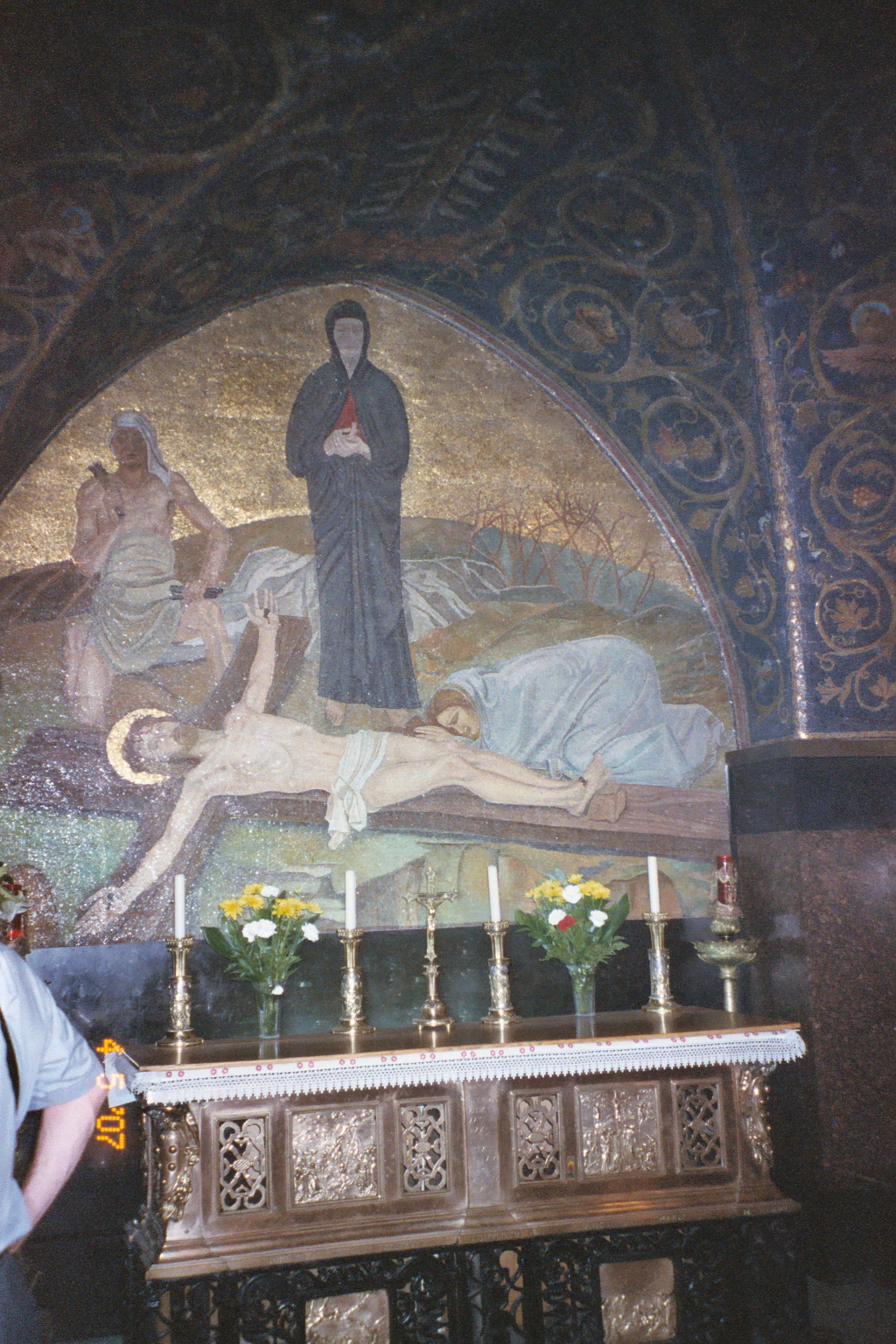
Calvary, presently inside the Church of the Holy Sepulchre in Jerusalem

19 April 2019

115 Days Since Christmas

Good Friday of the Lord’s Passion
It has been 115 days since Christmas.  115 days since we celebrated the birth of Jesus Christ from the Blessed Virgin Mary, God-with-us, Emmanuel.  115 days since that joy of knowing that God loved us so much that He sent His only Son to become like us in all things but sin.  And every day, since Christmas, has been pointing to this day.
Recall that there was a tree in the Garden of Eden besides the Tree of the Knowledge of Good and Evil, from which God had forbidden Adam and Eve to eat.  That other tree was the Tree of Life.  And when Adam and Eve had been expelled from the garden, God stationed a cherubim with a “fiery revolving sword…to guard the way to the tree of life.”  Humanity was created for life, but because of sin, they chose to seek after death.
Jesus, on the other hand, was, in a sense, born for death.  Now, to be clear, Jesus’ death should have never happened.  When God became flesh, we should have accepted Him and followed Him, and then God would have brought about salvation in some other way.  But, as we know that God knows the course of history, because all time belongs to Him as is as the present to Him, we also know that God the Father knew that Jesus, His Beloved Son, would be rejected.  God the Father knew that His Son would be “marred…beyond human semblance.”  He knew that Jesus would be “spurned and avoided by people, a man of suffering…pierced for our offenses, [and] crushed for our sins.”  And yet, God chose His Beloved Son to be born so that He could die.
Why?  Why would a loving Father–and we know God the Father is loving because Jesus revealed to us so many times how loving God is–send His Son to die?  God sent His Son to die that we could, once more, have access to the Tree of Life, closed off to us by sin.  And let’s be clear, it is not as if this was foisted upon Jesus.  Jesus willingly, lovingly, accepted His death out of that same love for us that God the Father has.  In the supernatural order, sin brought death, but, ironically, it was death that brought life.  And just as sin entered by a tree, so by a tree, the cross, sin and death were defeated by life itself.
We deserved death because of sin.  We had abandoned God, though He never abandoned us.  Jesus, on the other hand, did not deserve death, because He had no sin.  He was tested, as our second reading says, but He did not sin.  But He still took upon Himself our offenses, our sins, so that, by His chastisements, we might be made whole; by His stripes we might be healed; by His offering of His life, we no longer had to lose ours.  
The place of the Crucifixion in the
Church of the Holy Sepulchre
John’s Gospel makes very clear that, through it all, Jesus remained God and in control.  If He wanted to, Jesus could have called upon an army of cherubim with their fiery swords, and brought about divine vengeance upon all who wished to harm the Son of God.  But He didn’t.  He was killed in the most shameful way, the most painful way, and the Lamb of God who takes away the sins of the world, was “like a lamb led to the slaughter…he was silent and opened not his mouth.”  
In one sense it was our sin that led Jesus here today.  Even the smallest venial sin, the tiniest act of disobedience to God cries out for justice, and, as St. Paul says, the wages of sin is death.  We cannot simply blame the Jews of Jesus’ time for calling for His death; we cannot simply blame Pontius Pilate and his moral weakness for capitulating to the Chief Priests' and Pharisees’ demand for blood.  We also must blame ourselves because our sins, our personal sins, no matter how big or how small, closed off the tree of life from us.
But, in another sense, it was the love of God that led Jesus here today.  The love of God that is so strong that it leaves the 99 safe sheep behind for the 1 lost lamb; the love of God that is so strong that it runs out to meet the Prodigal Son even as he is far off; the love of God that is so strong that He would rather sacrifice Himself to death than see any of His ungrateful children suffer.  It was love that led Jesus here, to die for us on a tree, the tree to which He was nailed to become the Tree of Life for all who believe.  

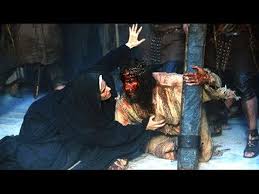
In one of the most powerful scenes, I think, from the movie “The Passion of the Christ,” we see Jesus on the Via Dolorosa, the Sorrowful Way, the Way of the Cross.  Mary, the Blessed Mother, is off in the distance with St. John, the Beloved Apostle, shocked at what they are doing to her Son.  Jesus falls, and says, “Mother,” and Mary thinks back to little Jesus falling on a road on Nazareth.  She notices, and, as any loving mother does, she rushes to comfort the little Child who has fallen.  As she runs to the Child Jesus, she cries out, “Jeshua, Jeshua,” “Jesus, Jesus,” and it then shows Mary, now as Jesus walks to His death, and she runs to him again, saying, as she did when He was a child, “I’m here.  I’m here.”  She embraces the suffering Jesus, just as she embraced the Child Jesus.  And Jesus, clinging to His Cross, says, “See, Mother, I make all things new.”  Jesus was born to make all things new.  He died to make all things new; to have the cherubim sheath his fiery sword, and give all access to the Tree of Life which gives immortality, the wood of the Cross.  Come, let us worship!

Participation in the Mystery

Mass of the Lord’s Supper
Sometimes you just need to mix things up a bit.  Usually, I preach on the readings, because the Word of God should be preached; St. Paul says, “Woe to me if I do not preach the Gospel.”  However, tonight, to mix things up, I thought I’d preach on one of the prayers that will be said soon, what we call the Prayer over the Offerings.  This is the prayer that is said after I have prepared the bread and the wine on the altar, and have washed my hands in preparation.  
The prayer says, “Grant us, O Lord, we pray, that we may participate worthily in these mysteries, for whenever the memorial of this sacrifice is celebrated the work of our redemption is accomplished.  Through Christ our Lord.”  Maybe it sounds to you like any other prayer in the Mass, a little wordy, some unique words.  But this one in particular is very full of meaning that, if we are not paying attention, can gloss over us.  
We start out by asking God the Father to help us “participate worthily in these mysteries…”  Right now, we are participants in something.  We are not spectators (at least we are not supposed to be).  We are engaged in something.  So often the Church uses the phrase “active participation” when it comes to what we should be doing in the Mass, and because we are an active society, we tend to take it as doing something, like being a lector or an extraordinary minister or a choir member.  But active participation is always united to us giving ourselves, first and foremost interiorly, to the Father through the Son in the power of the Holy Spirit, in what is being celebrated.  Tonight, on Holy Thursday, we participate in the Lord’s Supper in a mystical way.  We do not simply remember it.  A lot of Protestant music will talk about remembering what our Lord did at the Last Supper, remembering His saving life, Death, and Resurrection.  But we don’t only remember.  We participate.  Simply remembering is for museums, which is what some churches have become.  If people understood that they participate in what we celebrate, churches would not be so empty.  
But it is not any participation.  It is a worthy participation.  And how do we worthily participate?  We respond to the prayers with the voice, we listen to the prayers with our ears, we focus our attention on what is being done, on the smoke of the incense, on the precious nature of the vessels.  And hopefully, we also come with pure souls, free from any grave sins that hinder us from being present with Jesus, just as Judas left the Upper Room.  He could not worthily participate because his heart did not belong to God.  Shortly after this prayer we are invited to lift up our hearts, to leave behind the worries and anxieties of the day, and to focus on what God is doing for us.  We say, “We lift them up to the Lord,” but do we?
The Upper Room, where Jesus celebrated the
Last Supper
In what do we participate?  Yes, I have said the Last Supper, but we participate in the mystery of the Last Supper.  This is not a Sherlock Holmes mystery.  This mystery is something which is infinite, but which breaks into our finite time and minds.  We often will mentally chide St. Peter for not understanding what was going on when Jesus tried to wash St. Peter’s feet, or the apostles who fell asleep in the Garden of Gethsemane.  But do we understand what is going on?  Do we understand that the mystery of Jesus’ Body and Blood in the Eucharist is a gift beyond description, beyond riches, beyond understanding.  St. John Vianney said that if we truly understood what happened in the Mass, then they would die of joy.  
This mystery is so great that angels themselves bow down in worship, and shield their faces from the miracle that takes place when ordinary bread and wine become the Body of Blood of Jesus.  The God whom the universe cannot contain humbles Himself and makes Himself present in the ciborium and in the chalice.  The saints, who worship with us tonight and at every Mass, join their prayers to the perfect prayer of the Mass, the perfect prayer of Jesus offering Himself to the Father.  
The place in Jerusalem where Jesus was
nailed to the cross
And the Eucharist, every Eucharist, is not simply the Last Supper, but is what the Last Supper points to, what only one of the Apostles would actually experience, the sacrifice of Jesus on the cross.  Tonight only makes sense–and every Mass only makes sense–in the light of the crucifixion of Jesus on Calvary.  Jesus gave His Church, His bride, a way that His once for all sacrifice on the cross could be accessible, not only in memory, but in reality, to every member of the Church throughout the ages.  And that is why the prayer continues, “for whenever the memorial of this sacrifice is celebrated the work of our redemption is accomplished.”  Every time Mass is celebrated, Christ’s saving work continues.  That’s why we offer Masses for people, that Christ’s saving work can be applied for this person or that person, living or deceased.  Each and every day that the Mass is celebrated, salvation is achieved by Christ.  And it’s achieved here, where we get to participate in it, not watch it as spectators.  

Of course tonight we use many of our signs and symbols to impress what the prayers say.  But it’s the same at a Papal Mass, and at Mass in the gym at Powers, and at Mass here at St. Pius X Church.  Tonight, as we enter into the three intense days of our Lord’s saving action of Holy Thursday, Good Friday, and Easter, let us set aside all earthly cares, lift up our hearts to the heavenly things, and focus our spirit, mind, and body on the great mystery of our salvation, accomplished by Christ, and made present for us in the Mass.  “Grant us, O Lord, we pray, that we may participate worthily in these mysteries, for whenever the memorial of this sacrifice is celebrated the work of our redemption is accomplished.  Through Christ our Lord.”

26 November 2018

Truth and Beauty

Solemnity of our Lord Jesus Christ, King of the Universe
When is a king most a king?  That might seem like a very academic question, but it impacts how we understand and celebrate this Solemnity of our Lord Jesus Christ, King of the Universe.  A king, I would suggest, is most a king when he has defeated his enemies, and his kingdom is secure.  The ideal of Jewish kings is King David, who conquered all of his enemies.  King Solomon, his son, is least kingly when he is conquered by his wives’ attachment to their foreign gods.  
So for we who celebrate this great festival, when is Jesus most a king?  When He has defeated His enemies, that is to say, Satan, sin, and death.  And when did Jesus do exactly that?  On the cross.  And so, Jesus is most kingly when He is on the cross, dying for our salvation, and, at the same time, destroying the reign of Satan over this world.  That helps us understand today’s Gospel, which is Christ being interrogated by Pontius Pilate.  Of course, this was right before Jesus was led away to His crucifixion.  Pilate asks about Jesus’ kingship, alleged by the chief priests, and Jesus answers that His kingdom is a kingdom of truth.  That truth was released upon the world in the most powerful way when Jesus was nailed to the cross, the truth that St. John the Evangelist also tells us, that, “God so loved the world that he gave His only Son, so that everyone who believes in him might not perish but might have eternal life.”
Truth is related to something else: beauty.  We so often hear the false, yet ubiquitous statement, “beauty is in the eye of the beholder.”  Beauty, though, is not subjective, because it is the splendor of the truth, and truth is utterly objective.  Something is beautiful as much as it is true, or reflects the truth.  Lies are ugly.  Tonight we enjoy beautiful music.  It’s beautiful not simply because of the number of people, not simply because of the instrumentation, nor even the notes themselves, but because it reflects the truth of heaven.  Now, maybe Mozart isn’t played 24/7 in heaven, but the genius of Mozart, why it has stood the test of time, is that he tapped into something otherworldly, something heavenly, which helps us recognize the grandeur, the immensity, the order of heaven.  And this particular piece was made for the Mass, where heaven and earth are joined in harmony with each other in this sacred space.  Mozart maybe isn’t played in heaven 24/7, but it helps us to recognize that in this church we straddle both heaven and earth as we worship Christ our King, which is true of every Mass.  

Today we worship Christ, the King, who reigned most perfectly from the cross, and who still reigns perfectly in heaven as He continues to pour Himself out fully to God the Father for Christ’s Bride, the Church.  May our adherence to the truth prepare us for what God destines for us, a place in the Kingdom of Christ the King, where we will experience the fullness of the Beauty of God, in which we participate today.

10 April 2017

Running on Empty

Palm Sunday of the Lord’s Passion
While all generalities fall short in describing the reality of the world, we can say with decent accuracy, that there are two types of people in this world: those who fill up for gas when they’re around half a tank, and those who try to get that needle as close to E as possible before getting gas.  Being the cautious guy that I am, I usually try to fill up my Malibu when I have about half of a tank left.  But, when it comes to our life in Christ, we should mimic those who, more often than not, are running on empty.

There are so many messages that God wants to communicate to us as we enter Holy Week this year.  There are so many themes that I could preach on as we begin our pilgrimage from the triumphant entry, into which we entered at the beginning of Mass, to the Last Supper, which we enter into on Holy Thursday evening, to Calvary, in which we participate on Good Friday at the Celebration of the Lord’s Passion, to the empty tomb, proclaimed to the world at Easter.  But today, I want us to examine how God emptied Himself.
St. Paul uses that exact phrase, “emptied himself,” in our second reading today.  In this beautiful hymn which focuses on the divine kenosis, which is a Greek word which means “emptying,” St. Paul reminds us that, “Christ Jesus, though he was in the form of God, did not regard equality with God something to be grasped.  Rather, he emptied himself, taking the form of a slave,…[and] humbled himself, becoming obedient to the point of death, even death on a cross.”  Jesus, the full revelation of the God the Father, runs on empty as He saves the world.  He leaves nothing in the tank, but abandons Himself fully to the will of God.  And in this emptying, in this kenosis, God the Father exalts Jesus and glorifies Him.  
If we were to read the chapters of the Gospels that cover the time of the triumphant entry into Jerusalem through the crucifixion, we would not find Jesus holding anything back.  He accepts the praise of the people, who acclaim Him as the Messiah; He cleanses the temple; he fights back every verbal tussle with the scribes, Pharisees, and Sadducees; He washes His apostles’ feet as He calls them to serve; He gives His very Body and Blood for His Apostles at the Last Supper; He gives so much of His strength that He begins to sweat blood in the Garden of Gethsemane; He takes the mockery and cruelty of the trials before the chief priest and Pontius Pilate; He gives His last breath on the cross, and even the blood and water that filled His sacred Body are shed for our salvation.  And this is why God exalts Jesus: because He holds nothing back for the good of His people.  And this is why God will exalt us: if we hold nothing back from God.
This is one of the many paradoxes of Christianity.  It is only by giving ourselves away that we can gain what is most lasting.  It is only by emptying ourselves that we can truly be full.  Vatican II, in the Pastoral Constitution on the Church in the Modern World, entitled Gaudium et spes, says it this way: “…man, who is the only creature on earth which God willed for itself, cannot fully find himself except through a sincere gift of himself.”

In this life we can be scared of losing; we can be afraid of having nothing left, of running out of gas.  When we do it for God, however, we do not lose anything, but gain everything.  This week I invite you to participate in Jesus’ kenosis, His emptying.  After a long, hard day of work on Thursday, give God even the fatigue by participating in the Mass of the Last Supper; empty yourself, maybe even of some of your paid time off, by participating in the Celebration of the Lord’s Passion; empty yourself even of the time that you would normally sleep and participate in the new life of the Resurrection, the new life that will be given to the newly baptized at the Easter Vigil.  The Sacred Three Days, the Sacred Triduum, is our participation in Jesus’ kenosis, so that we can understand and live in our lives the paradoxical truth of Christianity that we learn from Christ: it is only by emptying ourselves that we can truly be full; it is only by giving ourselves away to God that we can find who we are truly meant to be.

04 March 2015

Where's the Animal?

Second Sunday of Lent
What is our reaction to the first reading today?  What thoughts cross our mind when we hear about God asking Abraham to sacrifice his beloved son, Isaac, on Mount Moriah?  Perhaps we weren’t really thinking about it too much because we’ve heard the story before.  We know that the angel will stay Abraham’s hand and the ram will take Isaac’s place.  But when we do that, we lose the force of this passage.  What if God asked you to sacrifice your child or one of your children?  What would your reaction be?  Would you start marching up the mountain?
This story should make us shudder.  Part of the story wasn’t so strange for the Jews and pagans hearing it, because the sacrifice of the son was part of a few pagan worship practices.  In fact, the Israelite and Judean kings will be blamed by God later for taking upon themselves the worship of Moloch; and the way Moloch was worshipped was by immolating, killing, the first son by throwing him into the fire.  But even while Abraham was probably not surprised that a god might ask for the sacrifice of the son, that didn’t make it any easier for Abraham.  He had sent away Ishamel, his son by the slave woman, Hagar.  He and Sarah were even more past the age for bearing children than when Isaac had been conceived probably around twelve years earlier.  And yet, God had promised that Abraham’s descendants would be more numerous than the stars in the sky or the grains of sand by the sea.  You can imagine the question Abraham has going through his mind: ‘How could this be?  How will I have all these descendants if God is asking me to kill my son?’  
Maybe some of the children could relate to Isaac, too.  Hopefully not because they think their parents would kill them!  But imagine what must have been going through Isaac’s head: ‘Dad says we’re going to offer sacrifice to God today.  And here I am carrying the wood, and the knife, and everything to make the sacrifice, but where’s the animal that we’re going to sacrifice?  It’s just me and dad walking up the mountain!!’  With each step, maybe Isaac got a little more nervous about what was going on.  And Isaac is even forced to set up the wood for the sacrificial fire.  And Isaac even lays down, no doubt asked by his father to do so, as Abraham was an old man, and there was no way he could have caught up to Isaac if he decided to run away, or fight off Isaac if he decided to resist being sacrificed.  Hopefully we’re starting to feel the tension, like in a movie where the hero is about to die, but you’re not quite sure the hero is going to be able to escape and wondering how the plot can continue without the hero.
Even though this account that we hear today is a true account, it also foreshadows a future event to which St. Paul refers: the crucifixion of Jesus.  Isaac becomes a prefigurement of Jesus: he carries the wood for his own sacrifice; he willingly lays down upon the wood to be sacrificed.  But, instead of an angel appearing at the last minute to stop Abraham from killing his own son, God the Father allows Jesus to die.  The scourges fall on Jesus’ back; the nails pierce through Jesus’ hands and feet; the spear punctures Jesus’ side.  There is no ram to take Jesus’ place.  Jesus Himself, the only Son of God, the Beloved, dies, the sacrifice of the Lamb of God to take away the sins of the world.  The hero of the disciples dies, as an unexpected twist in the plot of their lives and in salvation history (at least from our point of view).  
With such drastic suffering that the disciples were going to experience in watching their master be arrested, scourged, and put to death by evil men, God did not want the disciples to be without hope.  And that’s where the Gospel comes in today.  God gives the disciples a preview of the end of the movie: the Resurrection and Ascension as Jesus is transfigured before their eyes.  Peter, James, and John get a preview of the heavenly life and what a glorified body will look like to help carry them through the dark days of the Passion of our Lord.  Of course, they don’t understand that it’s meant to carry them through.  Especially in the Gospel of Mark (by tradition Mark’s source for Jesus’ life was St. Peter) the disciples never seem to understand what’s going on, with a few brief exceptions.  But afterwards, they see how God was preparing them for suffering by seeing a taste of glory.
That preparation is important for us, too.  For many of us, there is suffering in our lives: unemployment; loved ones with diseases; dysfunctional families; a lack of friends.  God doesn’t say to us: deal with it!  He does, sometimes just in fleeting moments, give us a foretaste of the joy that awaits us in heaven.  Mass is supposed to be something of that, as we come together to worship God with precious metals and vestments that remind us of heaven, where we will see God face to face and be embraced by His love and by all those who have been faithful in following Christ.  God gives us the Eucharist to give us strength to make it through suffering, as food for our pilgrimage.  And He shares glory with us in so many other small ways, that we often don’t recognize them until later.  

The same could be said for Lent.  During Lent we focus on suffering: on Jesus’ suffering; on uniting our own suffering and penances to Jesus on the cross.  But it’s not meant to be all suffering.  Even this early, in the second week of Lent, God gives us a foretaste of the glory that comes after suffering through Him, with Him, and in Him.  Lent is not the end of the story.  Jesus’ death is not the end of the story.  God has prepared glory for us, just as He prepared glory for Jesus and raised Him from the dead.  May we recognize the foretastes of glory that God gives to us, so that the joy of Easter carries us through the Good Fridays of our lives.

19 April 2014

What Love Looks Like


Friday of the Passion of the Lord (Good Friday)
            In a few moments we will have the opportunity to venerate the cross, a chance to come and give some sign of honor and respect—a genuflection, a bow, a kiss, a touch—to the instrument of our salvation.
            But right now, I want all of you to look at the crucifix hanging above our altar.  It’s been there since 1968 when the church was completed.  Perhaps many of us don’t even notice it any more, even with how large it is, because it has been there since the beginning.  But really take a good look at it.  What do you see?
            Of course, the easiest answer is Jesus.  We see Jesus crucified on the cross.  But go deeper.  Maybe we see a horrible way to die, cleaned up, though, for public piety.  Maybe we see the different types of wood.  Maybe we see the inscription INRI, which stands for “Iesus Nazarenus Rex Iudaeorum,” “Jesus the Nazarean, King of the Jews.” 
           
An Armenian mural from the
Basilica of the Holy Sepulchre in
Jerusalem
Those things are all there.  But when we look at the crucifix we should see love.  What we celebrate today on Good Friday is love: Love that was willing to be destroyed so that we could live.  Maybe when we think of love we think of a heart, or we think of an old couple holding hands together on a bench, or we think of a a young man, down on one knee, proposing to his girlfriend.  But love is the crucifixion.
            True love is when the Lover is willing to be beat up instead of or even for the Beloved.  True love is having the skin of your back ripped out by scourging so that the Beloved can remain whole.  True love is when the Lover’s head is pierced with thorns placed in a mocking way to represent a crown so that the Beloved can wear a true crown in paradise.  True love is when the Lover walks with a heavy burden so that the Beloved does not have to carry it or travel that awful road.  True love is when the Lover is willing to die so that the Beloved can live. 
            Whom do you love?  For whom are you willing to suffer?  For whom are you willing to die?  Love always means giving all of who you are, even your very life, for the good of the other, so that the other can go to heaven.  Love means horrible suffering, taken willingly so that the other does not have to suffer.  What we celebrate today is love, a love so pure, so true, that Lover was willing to die an agonizing death at the very hands of the Beloved.  That is love.  And if we come back just a day or so more, we will see that love, though it is death, is also new life.
            God loves you.  He shows us that love means being willing to die for the one we love.  How much do we love God?

02 April 2012

Hammering in the Nails

Palm Sunday of Passion of the Lord
            We began Holy Week by hearing how Jesus entered triumphantly into His city, Jerusalem.  Shortly afterwards, we recalled in the Gospel how Jesus was then mocked, stripped, and crucified for our salvation.  What a stark contrast in a short amount of time.  What a short time it must have seemed for Jesus between the original Palm Sunday and Good Friday.
            How fickle the crown of God’s creation can be.  How easily swayed we are by excitement…and fear.  With the celebration of the Passover in the background, with tens of thousands of pilgrims coming to Jerusalem, the Jews welcomed Jesus.  With the pressure of the Chief Priests, the Scribes, and the Sadducees, the Jews condemned Jesus for blasphemy.  The King of Glory who entered His capital with shouts of “Hosanna” was made to reign upon the Cross with shouts of “Hail the King of the Jews” in mockery. 
            Because we have become so used to seeing Jesus on the cross in artistic renditions of the crucifix, we can easily become numb to its reality.  Death by crucifixion was a death of suffocation, the lungs filling with fluid, making it harder and harder to breathe.  The only way to get a breath was to use the hands and feet to push oneself up, which only increased the pain where the nails were.  It was a horrible, painful death, filled with shame and derision.
            In the face of such suffering, we can all too easily think that we would never have been part of the crowd crucifying Jesus.  We would not be so easily swayed.  We might even say with St. Peter, “‘Even though all should have their faith shaken, mine will not be.’”  But we would be wrong.  All of us—from Pope Benedict XVI to me and you—have all helped to hammer in those nails into Jesus’ hands and feet.  All of us stand guilty.
            If we lie to another, the hammer falls.  If we swear and curse and take the Lord’s name in vain, the hammer falls.  If we totally ignore the poor standing on the corner; if we make decisions based on prejudice and racism; if we fail to see Christ in those around us, the hammer falls.  If we think first of ourselves and never of others; if we skip Mass because we don’t make time for the Lord; if we react to our parents, children, or family members with anger rather than responding with love, the hammer falls.  If we ignore the Church’s teaching on human sexuality, marriage, and contraception because we feel we’re more enlightened; if we support organizations or ideologies that allow for an innocent child in the womb or an elderly or ill person to be put to death because they are inconvenient to our way of life; if we support the objectification of men and women through pornography, the hammer falls.
            All of us who can make a moral choice have been in that fickle mob that first hailed Jesus on His entry into Jerusalem, and then mocked him by hailing Him on the cross.  All of us have helped hammer in the nails into Jesus’ hands and feet.  All of us have sinned, and fallen short of the glory of God.  We made Jesus cry out from that cross “My God, my God, why have you forsaken me?” as Jesus felt the weight of our sins. 
            Since we have forced Jesus to walk that dark pilgrimage to the crucifixion, let us not abandon Him this week.  Though we ran away with the apostles in the garden 2,000 years ago, let us accompany Jesus this year, this week, these days as the Church celebrates our salvation in Christ: to the upper room on Holy Thursday to celebrate the Last Supper; from the upper room to the Garden of Gethsemane to keep watch in prayer; from Gethsemane to Golgotha on Good Friday; and because death and sin do not have the final word, from Golgotha to the empty tomb for the Easter Vigil or the Easter Sunday Mass.  We began Holy Week today in joy.  Let us also end it in the joy of those who, having repented of their sins and confessed them to the Lord, have been washed clean in the blood of the Lamb.  “Come now, let us set things right, says the Lord: Though your sins be like scarlet, they may become white as snow; Though they be red like crimson, they may become white as wool.”