Showing posts with label Judas. Show all posts

17 July 2023

True Dichotomy

Seventh Sunday after Pentecost
    In the name of the Father, and of the Son, and of the Holy Spirit.  Amen.  So often we’re nudged in the direction of a false dichotomy.  That phrase, false dichotomy, might sound foreign, might even sound like an obscure body part, but it’s the wrong assertion that there are only two choices.  For example, a person might say, “You have to vote for a Republican or a Democrat,” when, in fact, there are other political parties for whom you can vote.  Or, less weighty, you have to decide whether or not you can put pineapple on pizza.  As I tend to be the pop culture reference guy, it’s like Anakin in “Star Wars: Revenge of the Sith” saying to Obi Wan, “‘If you’re not with me, then you’re my enemy.’” 

    But not all dichotomies are false.  Scripture, and especially our epistle today, talks about the dichotomy between sin and grace, death and life.  Sin brings death, grace brings life.  And St. Paul talks about the Romans had previously been slaves to sin and death, but now were raised to life through grace, “in Christ Jesus our Lord.” 
    But this is not just St. Paul.  It’s the overarching theme in the Scriptures, from Genesis to Revelation.  In Genesis, after God creates everything good, culminating in the creation of man and woman in His image, our first parents have life.  They are living in the grace of God.  But then, Eve, followed by Adam, disobey God; they sin.  And by sinning, they welcome death into the world.  They are expelled from the Garden of Eden, and separated from the Tree of Life, so that they experience death. 
    And so throughout Genesis, we see that when evil is allowed to fester, it leads to death.  Think of the Flood and the destruction of Sodom and Gomorrah.  But, when people follow God, they find life.  Think of Abram leaving Ur because God calls him to go to Canaan, and then becoming Abraham, the father of many nations.  The same could be said for Exodus, where God leads His people from slavery to sin in Egypt to freedom in following His law in the Promised Land.  Of course, throughout the journey, some disobey God, and they find death.  While others, like Joshua and Caleb, follow God, even when unpopular, and they enter the Promised Land.
    This same overarching theme repeats itself in the Books of Joshua and Judges, and then with the Kings of Israel.  The prophetic books are basically warnings from God through His prophets to live according to God’s will, because if they continue in their sin, they will die.  This culminates in the dispersion of the Northern Kingdom of Israel after they start worshiping false gods and oppressing those for whom God has a special love: widows and orphan; and the exile of the Southern Kingdom of Judah to Babylon after they, too, engage in idolatry and mistreatment of the poor and vulnerable.
    Of course, nowhere does this dichotomy appear clearer than with our Lord, who calls Himself, “‘the Way and the Truth and the Life.’”  To follow Him is to have life; to reject Him is to choose death.  The Savior even takes our rejection and the consequence of that rejection–death–upon Himself in His crucifixion, but because He was faithful to God He rises on the third day.  And the rest of the New Testament unpacks that choice between life and death, and helps those who follow the Lord to know what choosing life looks like to the nascent Church.  The Acts of the Apostles, St. Paul’s epistles, the epistles of St. Peter, St. Jude, and St. John all talk about how we can have eternal life and reject the death of sin.
    And at the end of the Bible in the Book of Revelation, we see the cosmic battle between good and evil, a battle that God wins convincingly.  But the Spirit also warns the churches that they have to continue to follow God to have that life.  It was not enough to choose life once or earlier; life must be chosen each day.  In the end, sin and death are defeated forever, and the fullness of the reign of God shines forth, with eternal life for those who remained faithful (and eternal punishment for those who rejected God).
    So which do we choose: life or death?  By our fruits, Christ tells us, you can tell what we choose.  Each time we sin, especially grave sins, we invite death into our lives.  Each time we follow God, we invite eternal life into our lives.  Indeed, though we often think of the judgment as Christ telling us where to go, either to Hell, or to Purgatory or Heaven, really we make that choice each day of our lives.  While the just are surprised that they served Christ through service to the poor, and the wicked are likewise surprised that they ignored Christ through ignoring the poor, they knew that they had served or ignored the poor.  In that way, their salvation or damnation was not a surprise, because they knew their choices, and whether or not they choose to do follow what God had instructed for eternal life.  Sometimes it was one act of following the Lord at the end of one’s life, like St. Dismas, the good thief, who received paradise for his defense of Christ crucified.  At other times it was more choices for the Lord, with some rejections sprinkled in, like St. Peter.  Or, in a negative sense, one great act of betrayal from Judas led him to despair of any chance of salvation.  But Dismas nor Peter nor Judas was ignorant of the choices they made and how each could affect eternal salvation.
    So where will we come out in this great drama and battle between life and death?  By baptism Christ claimed us for Himself and eternal life, and gives us the grace to stay faithful to the choices of life each day.  Each day the enemy works to enslave us once more to death.  Neither Christ nor the devil chooses for us.  We choose if we want death or life.  Praised be to God who gives us all the graces necessary so that we can accept the gift that salvation is, won for us by Jesus Christ, who with the Father and the Holy Spirit is God, for ever and ever. 
    

26 March 2018

The Greatest Story Ever Told

Mass of the Lord’s Supper
One of my major complaints about movies today is that Hollywood no longer knows how to tell a new story.  Many of the movies that have come out recently are either telling a story that’s already been told (like in a comic book), or continuing with a story that was told earlier (like the new Star Wars movies).  I was recently chastised by an older friend who was appalled both that I liked the new “True Grit,” and that I had never seen the original “True Grit” with John Wayne.  
But the great things about the movies that stick with us is that they tell a timeless tale.  In any movie that works, there is a decisive event, which leads to a challenge, and that challenge must be overcome to find success.  As I understand literature, the comedies are the stories where the success involves the life of the hero; tragedies are the stories where the success involves the death of the hero.
Human redemption is not simply a story, but it is the basis for all good stories.  Salvation history, writ large, is about the decisive event (the Fall of Adam and Eve), and God reconciling humanity (quite a big challenge because of our stubbornness and our attraction to sin), and God overcoming our challenge by the Death of His Son, Jesus.  Of course, in Jesus, we find both tragedy and comedy, as Jesus both dies, but then lives again.  
In salvation history, redemption is always tied up with death, either literal or metaphorical.  In our first reading, we hear about the redemption of Israel from the slavery of Egypt by the death of the lamb, which also saves them from the death of the first born, the tenth and most drastic plague.  And as Jesus institutes the Eucharist (which St. Paul talks about in the second reading), He gives His apostles a way to connect, not only simply to remember, but to connect to His death, which He anticipates in His early celebration of the Passover.  Perhaps that is why God inspired the Psalmist to say: “Precious in the eyes of the Lord is the death of his faithful ones.”  Psalm 116 seems to see the necessary connection between death and redemption.
The Eucharist is precisely redemption given to us as food and drink.  In the Eucharist, Calvary is given to us under the appearance of bread and wine as Jesus gives His Body and Blood for us.  That is why the Church asks that a crucifix occupy a most central place in the sanctuary: so that we can see and be drawn to the love that we receive on our tongues and in our hands.  
Redemption involves death, but God turns death on its head so that death actually becomes an opportunity for life.  We will see this on Saturday night and Sunday, but we also see it in Jesus washing His apostles’ feet.  Jesus does not literally die when He washes the apostles’ feet, but He dies to elevating oneself and what should be.  He is the Lord, they are they servants, and yet He makes Himself their servant.  He is the Rabbi, they are the disciples, but His teaching involves elevating them, rather than Himself, and then He says that just as He has done, so they should do.
Bishop Boyea washes Fr. Anthony's foot at his
presbyteral ordination
It is easy to pass over (if you’ll pardon the pun) the depth of this event.  Every Holy Thursday we hear about Jesus’ washing His apostles’ feet, about Simon Peter resisting because it’s unbecoming, but then overcompensating by saying he wants his hands and head as well.  But remember this: Jesus would wash the feet of Peter, who would, that same night, deny even knowing Jesus.  Peter would not die to his fear, to his pride, and so death, which is what sin is, would enter his soul.  Judas also had his feet washed, the same Judas who that same night would find the temple guards and lead them to Jesus to betray Him.  Everything in Jesus’ human will must have screamed against treating Judas, the betrayer apostle, the same as John, the beloved apostle.  But He died to that temptation so that He could live in obedience to the Father.
It would be to facile to simply say, “serve others.”  What Jesus did on Holy Thursday, in the washing of the feet and the institution of the Eucharist and the ministerial priesthood, is much stronger than “do good for others.”  Jesus invites us to be a part of the grand story, the grand reality, of our redemption.  But as we are reminded, redemption, our own redemption, involves death.  Perhaps the death of our bodies (there continue to be armies of martyrs crowned with the palm of victory), but more likely the death of our wills, where we let go of what we want, where we let go of what the world says is right, and we hold on to dear life to the will of God, which is often not what we want and not what the world says is right.  

Tonight we have the opportunity not only to remember what Jesus did, not only to recall our redemption in Christ, but also to actually participate in our redemption.  As we receive the Eucharist, we receive Jesus’ death for us.  And if we allow the Eucharist to do the work that it is meant to do, we can participate in the great story of human redemption.

10 April 2017

24

Mass of the Lord’s Supper
What would you do if you knew you had 24 hours to live?  What person or persons would you want to see?  Where would you want to go?  What unfinished tasks would you try to complete?  Most people never have that foreknowledge.  Even when a person is older, and knows that death is soon coming, we never quite know when.  But what if you did?  What if you knew, right now, that at this time tomorrow you’d no longer be a part of this world?
Jesus was in that very boat; He knew that less than 24 hours from that first Holy Thursday, He would be buried in the tomb.  St. John reminds us of this fact: “Before the feast of Passover, Jesus knew that his hour had come to pass from this world to the Father.”  With whom does Jesus spend His time?  Where does He go?  Does He try to finish any incomplete tasks?
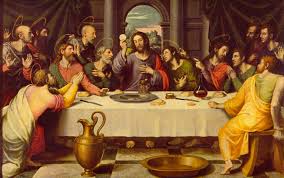
Jesus spends His time with His Apostles.  He celebrates His Last Supper with those whom He had chosen to govern His Church, and to act in His Name.  And He begins, as we heard in tonight’s Gospel, by washing their feet.  He teaches them that, though they are called to act with Jesus’ own power and authority, that power and authority is given to them to serve the entire Church.  Jesus washed the feet of all twelve of His apostles, even Judas.  In one of the last acts of His earthly ministry, Jesus serves the one who will, that same night, betray Him with a kiss.
After washing their feet, and after Judas leaves to set in motion his betray, Jesus begins to celebrate the Passover with His apostles.  But He changes it radically.  He says those words that had been passed down to St. Paul, which he, in turn, passed down to us: “‘This is my body that is for you.  Do this in remembrance of me.’”  And “‘This cup is the new covenant in my blood.  Do this, as often as you drink it, in remembrance of me.’”  Already startled by Jesus announcing the betrayal of Judas, who leaves shortly thereafter; and by Jesus announcing that Peter, the leader of this small band, would deny Jesus, their senses are heightened, and they realize Jesus is doing something new.  And in the act of breaking the bread and saying the new words of this new rite, and in the act of passing the chalice and saying the new words of this new rite, both the sacramental priesthood and the most holy Sacrament of the Eucharist are instituted.  
Then begins a long, beautiful, poetic prayer of Jesus to the Father, even as He also speaks to His apostles.  We call those words the Last Supper Discourse, and they are an expression of Jesus’ love for His Apostles, His first priests, but more importantly, Jesus’ love and unity with the Father, which will sustain Him even as it seems to escape Him in His Passion.  Nothing seems forced in these words; nothing rushed.  Jesus knows what He wants to say, and how He wants to say it.  At this point in the night, there is no anxiety, no troubled soul, but only the intimacy of a Master and His chosen friends who will continue His work in His Name.  

In His last 24 hours on earth, Jesus does what He did for all the hours of His earthly ministry: He gave Himself, according to the will of the Father, for His people.  While we know how much His human nature shuddered at the thought of the price He would have to pay to redeem His people from sin, He gave of Himself nevertheless.  

Psalm 116 tonight asks, “How shall I make a return to the Lord for all the good he has done for me?”  How can we repay God, who has given us everything that we need, and even more beyond that.  No matter what we give God it would never be enough to repay our debt.  But there is one acceptable gift that God desires: all of who we are.  We are invited to do the same thing Jesus did: to give of ourselves out of love of God and love of neighbor.  Jesus gave us His all.  Can we give Him ours?